Journal of Advanced Research in Ocean Engineering 4(4) (2018) 195-203
http://dx.doi.org/10.5574/JAROE.2018.4.4.195
Dynamic Response of Container Ship Subjected to
Bow flare Slamming Loads
†Tae-Soon Choi
1*, MD Shafiqul Islam
1, Dae-Won Seo
1, Joon-Gyu Kim
1,
and Kang-hyun Song
11Korean Register of Shipping, Busan, Korea
(Manuscript Received October 10 2018; Revised November 7, 2018; Accepted December 8, 2018)
Abstract
The wave impact on ships could cause local damage to the ship’s hull, which has been a concerning issue dur-ing the ship design process. In recent years, local structural damages of ships caused by slammdur-ing loads have been reported by accident; therefore, it is necessary to study the local slamming pressure loads and structural response assessment.
In the present study, slamming loads around the ship’s bow region in the presence of regular wave have been simulated by RANS equations discretized with a cell-centered finite volume method (FVM) in conjunction with the k- turbulence model. The dynamic structural response has been calculated using an explicit FE method. By adding the slamming pressure load of each time step to the finite element model, establishing the reasonable boundary conditions, and considering the material strain-rate effects, the dynamic response prediction of the bow flare structure has been achieved. The results and insights of this study will be helpful to design a container ship that is resistant enough to withstand bow flare slamming loads.
Keywords: Bow flare slamming; Container Ship; Finite Volume Method; Finite Element Method; Strain Rate Effects
1. Introduction
In recent decades, with the development of global trade and increasing shipping volume, container ships are getting larger. As a result, today’s large container ships have a more substantial bow flare and stern area, allowing it to carry more cargo without decreasing its sailing speed. However, this increases the probability of the slamming phenomenon, which results in a higher risk of slamming failure.
The slamming load caused by the movement of the ship and the relative motion of the incident waves may cause damage such as deformation and fracture of the outer shell, buckling of the reinforcement structure, etc. Therefore, this type of load must be considered during the initial design stage. This study was carried out to develop a procedure for nonlinear dynamic structural strength analysis and evaluation under slam-ming loads, which is required in the initial design stages of container ships.
Currently, the dynamic structural behavior under flare slamming impact load is obtained by linear static analysis, and the hull structural design is performed accordingly. However, damages caused by slamming loads have been recently reported, thus indicating that the linear static analysis method used for structural
†
*Corresponding author. E-mail address: [email protected]
using a nonlinear boundary element method. In a similar way, Veen (Veen, 2012) combined the nonlinear strip theory and the smoothed particle hydrodynamics (SPH) method to predict bow flare slamming pres-sure. Using a chain of seakeeping codes and a Reynolds averaged Navier–Stokes equations code, Schellin (2007) determined the slamming loads under the design condition. Wang (Wang, 2010) introduced a reduc-tion factor to transform the dynamic slamming pressure into static pressure and carried out an elastic wedge experiment to verify the equivalent static method.
In the current study, the design wave is determined through a long-term analysis of the relative vertical motion between the hull and the wave. The target wave height, which is expected to cause the maximum slamming load, and the target wave period are determined through motion analysis of the ship. The slam-ming pressure calculated from the computational fluid dynamics (CFD) analysis is mapped to the structural model for strength evaluation and the dynamic response of the hull structure due to slamming pressure is calculated using the nonlinear analysis program LS-DYNA (LS-DYNA, 2016). Based on the analysis re-sults, a basis for structural strength evaluation criteria has been proposed.
The purpose of this study is to generalize the procedure for performing nonlinear structural dynamic anal-ysis under bow flare slamming loads generated in a large container ship.
2. Slamming Analysis Procedure
The current structural design criteria for vessels and container ships treat slamming as static uniformly distributed pressures. The design slamming pressure for direct strength assessment is represented as an equivalent static pressure that would cause the same maximum structural response as the dynamic slam-ming pressure. In addition, the effect of the time-varying slamslam-ming pressure is represented using a dynamic load factor combined with the static pressures. However, as the slamming produces time-varying impact loads, a transient dynamic finite element analysis is more appropriate to predict the actual structural behav-ior.
Different methods for slamming loads and strength assessment are illustrated in Figure 1.
Method 1 is widely used in the shipbuilding industry to design the vessel against slamming pressures. Slamming pressures are calculated using standards or class rules and the structural strength or scantling of the member is obtained following the calculated design static slamming pressure. Method 2 is the calcula-tion of slamming pressures and structural strength using two way coupling. This method requires high computational effort and cost.
The current study follows method 3 to calculate the dynamic response of container ships under slamming pressures. This method is based on one-way coupling. Dynamic slamming pressures are calculated using the CFD program STAR-CCM+ and the structural non-linear dynamic analysis is performed using the LS-DYNA program. The detailed procedure is presented in Figure 2.
Fig.1 Methods for slamming loads and structural strength assessment
Fig.2 Procedure for nonlinear dynamic structural analysis under slamming loads
The structural model is either developed in LS-DYNA format or converted from Nastran format. The model contains geometry and material information. The time-varying slamming pressures calculated by the STAR-CCM+ program are exported to Nastran format. These time variant pressures, which are mapped on each outer shell element, are further converted to LS-DYNA format. Finally, each one of the outer shell elements in LS-DYNA is loaded with the time-varying slamming pressures. Boundary and other analysis control parameters are defined to set up the analysis. Nonlinear dynamic analysis provides time variant outputs such as stress, strain, deflections, etc. These results are used for structural strength evaluation.
3. Assessment of Slamming Loads
Prior to calculating the slamming load, it is necessary to define the sea state condition at which the slam-ming phenomenon is most probable to occur. In order to select the critical wave domain, ship motion anal-ysis is required. Resulting from this analanal-ysis, as well as from the relative motion of the incident wave, the length and height of the regular wave can be selected.
Secondly, CFD analysis is performed to calculate the slamming loads on the hull surface. To perform CFD analysis, it is necessary to construct the grids on the numerical model, define the incident wave, and select the turbulence model. In particular, a superposition grid or a dynamic fluid body interaction (DFBI) method must be used in order to make the motion of the ship unrestricted.
motion of the ship, the response amplitude operators (RAO) were derived for the relative motion of the FP and the incident wave. The wave that had the greatest impact on the slamming at the bow flare was limited to an incident wave (180°), and the target wave length was set as that with the greatest relative motion. To determine the wave height of the incident wave, the North Atlantic Standard Wave Data (IACS, 2014) and
PM Spectrum were used to calculate the long term wave height, with a probability level of 10-8, and then
divide it by the maximum value of the relative motion. As a result of the ship motion analysis, the design wave length was calculated as 21.4 m, corresponding to a 25 return period at a wave length of 14.3 seconds. 3.2 Slamming Load Calculation
Based on the selected design wave, slamming load calculations were performed through CFD slamming analysis. In consideration of the accuracy and simulation time of the CFD analysis, a model scale was used for the CFD analysis. The CFD analysis conditions are presented in Figure 3.
Using the Froude law, the calculated pressure of the model vessel was converted to the actual vessel size. The trimmer mesh technique was used because it has the advantage of reducing the total number of grids by varying the grid density according to the flow characteristics, as shown in Figure 4.
Fig.3 Slamming load calculation conditions
Fig. 5 The contour of surface pressure and wave elevation
Second order accuracy was implemented by using the least square method as the spatial gradient of the physical quantity included in the polyhedral grids, which were defined according to the trimmer mesh tech-nique. In addition, a boundary layer grid (Prism Layer) technique was used to accurately simulate the boundary layer flow on the hull surface.
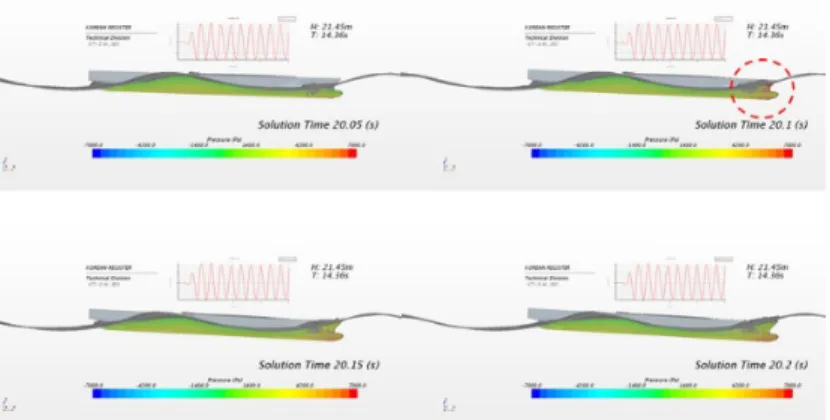
Figure 5 shows the free surface and the pressure changes graph, as well as the pitch motions observed from the side of the ship. A wave with a wave length similar to the length of the hull will cause the move-ment of the ship and change the pressure acting on the hull. As the ship descends below the free surface following the pitch motion, the impact pressure on the bow region begins to increase at about 20.05 s and gradually disappears, thus leaving only the static pressure, as can be seen from Figure 5.
3.3 Slamming Loads Mapping
Since the slamming pressure changes with time, the calculated hull surface pressure at every time step must be mapped to the structural elements for performing the structural analysis. Therefore, in addition to the mapping procedure, the time, which must be mapped and stored in the structural element, is also very important. In the current study, the mapping time step of the slamming pressures from the CFD to the struc-tural element was 0.015 s. For the mapping on the strucstruc-tural elements, the least squares method was used for interpolation. Figure 6 illustrates the mapped pressure from the CFD to the structural model, which confirms that the mapping procedure is accurate and thus acceptable.
4. Structural Strength Assessment under Slamming Loads
This section describes the procedure for dynamic structural strength assessment under slamming pressure loads using LS-DYNA.
Fig.7 FE model for bow flare slamming analysis 4.1 Structural Model Development
In this study, the target structural model of the container ship was created using the SeaTrust-HullScan program developed by KR. SeaTrust-HullScan is a program developed to perform global and local struc-tural analysis of ships. It is a convenient finite element analysis program for creating strucstruc-tural analysis models, loads, and boundary conditions. SeaTrust-HullScan can export the structural model in Nastran format, which was further converted to LS-DYNA format in order to perform the nonlinear dynamic struc-tural analysis. In addition, the time variant slamming pressures calculated by the CFD analysis were created in the Nastran file format (PLOAD4); therefore, these pressures loads were converted to the LS-DYNA input file format as well.
The target model for bow flare slamming is shown in Figure 7 and the length of the model (0.25L from Forward Perpendicular) is determined following the ABS guideline (ABS, 2013).
4.2 Material property
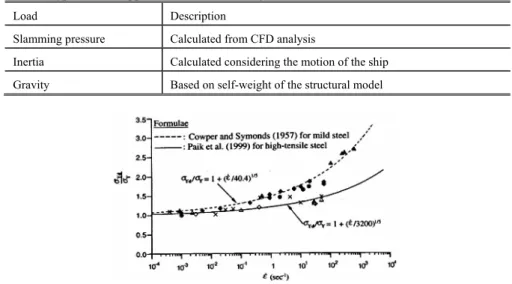
For the nonlinear dynamic structural analysis, Mild steel and high tensile steel (HT32 and H36) properties were defined according to the NORSOK Standard N-004 (Norsok, 2013). Table 1 presents the material properties used in the FE analysis. Slamming produces high impact loads and it is therefore necessary to consider material strain rate effects for the increased strength and the reduced ductility. The Cowper-Symonds (CS) model was used to simulate the strain rate effects.
= (1 + ̇ ) (1)
Where, σdynamicis the dynamic yield stress, σstaticis the static yield stress, ̇is strain rate, C and P are ma-terial constants.
Table 2. Types of loads applied in the structural analysis model
Load Description
Slamming pressure Calculated from CFD analysis
Inertia Calculated considering the motion of the ship Gravity Based on self-weight of the structural model
Fig.8 Strain rate dependent material strength properties 4.3 Loading and Boundary Condition
In addition to the slamming pressure loads, inertia and gravity forces were applied in the structural analy-sis. The inertia forces were calculated by ship motion analysis and gravity was applied by defining the self-weight of the model. The summary of the loads applied in the structural model is shown in Table 2.
The length of the FE model was 0.25L from the FP and the end of the model was considered as fixed for all six degrees of freedom.
4.4 Structural Analysis Results and Strength Evaluation
The stress distributions calculated by the nonlinear dynamic structural analysis along the length of the ship are shown in Figures 9 and 10. From the figures, it can be seen that the maximum stress is generated by the bow wave impact for a short time in the bow flare region.
Excessive stress was developed in the region close to the boundary areas due to the applied boundary condition and hull girder bending moments. As all the six degrees of freedom were set as fixed in the anal-ysis, high stresses could develop around that area. However, it is clear from the figures that high stresses occur around the bow flare area due to slamming impact loads. Therefore, the impact load is the dominant factor for the structural responses of the bow flare area. In order to exclude the boundary effects, a smaller strength evaluation area could be defined and it could be located closer to the bow flare area where the impact load is dominant.
Based on the results of the nonlinear dynamic structural analysis, plastic deformation did not occur on the outer shell as the yield strength of the material was not exceeded. However, some plastic deformation oc-curred in the inner support structural members, as shown in Figure 11.
caused by the strong impact force during a short time. In addition, stress concentration occurred locally around the web frame and the outer shell supporting the structural members. However, the mesh size of the current structural analysis model was excessive across the longitudinal space dimension, and therefore a finer mesh is required to obtain more accurate stress and strain values on the local region. In addition, the stress of the main members of the ship, such as the shell plating, is not allowed to exceed the yield stress; however, some plastic strain of secondary members may be allowed. Nevertheless, how much plastic strain of secondary members would be accepted is still an uncertain problem and, therefore, more research is re-quired to solve this issue.
5. Conclusions
In the current study, a procedure for performing nonlinear dynamic analysis under slamming loads was developed using CFD software STAR-CCM+ and the structural analysis program LS-DYNA. A typical large container ship of 13,000 TEU was used to accomplish the study. By combining the numerical predic-tion of slamming loads and the finite element analysis method, the dynamic response of the bow flare struc-ture was calculated. Based on the performed analysis, it can be observed that the hull outer shell strucstruc-ture satisfies the yielding criteria but the inner support structures experiences permanent deformations, thus failing to meet the yielding criteria. For the current FE model, high stress areas through coarse mesh screening were located and therefore further analysis with a finer mesh is required.
Due to high strain rate effects, the strength of the material must be increased. The dynamic yield strength of the material is greater than that of the static yield stress. Therefore, the evaluation of the nonlinear dy-namic structural analysis should meet the criteria with the plastic strain value, but since the allowable value of the plastic strain is not defined, it is necessary to establish a standard for an effective evaluation method in future studies.
Acknowledgements
The author would like to express his gratitude to the company (Korean Register) for giving the opportuni-ty and providing the necessary facilities for conducting the research.
References
Abdussamie, N., Amin, W., Ojeda, R., Thomas, G. & Drobyshevski, Y., “Vertical Wave-in-Deck Loading and Pressure Distribution on Fixed Horizontal Decks of Offshore Platforms,” Proceedings of the 24th
International Offshore and Polar Engineering, Busan, Korea, 2014.
Abdussamie, N., Ojeda, R., Amin, W., Thomas, G. & Drobyshevski, Y., “Prediction of Wave-in-Deck Loads on Offshore Structures Using CFD,” The 19th Australasian Fluid Mechanics Conference, Mel-bourne, Australia, 2014.
ABS Guideline, “Guideline for Slamming Loads and Strength Assessment for Vessels,” March 2011(Updated July 2013).
Bae, D., Hong, B., Moon, D., “Analysis on the Dynamic Response of the Hull Structure due to Slamming Impact – By Finite Element Method,” Journal of the Korean Society of Fisheries and Ocean Technology, 19(2), pp. 117-124, 1983.
Choi, M., Park, I., Koo, W., “Numerical Production of Slamming Impact Loads and Response on a Ship in Waves Considering Relative Vertical Velocity,” Journal of the Korean Society of Naval Architects of
Korea, 51(6), pp. 503-509, 2014.
Choi, M., Park, I., Koo, W., “A Comparison Study on the Simplified Formulae for Ship Motion and Global Loads in Waves,” Journal of the Korean Society of Naval Architects of Korea, 49(6) pp. 534-540, 2012. Hanbing, L., Jinjian, W., Shan, W., “Parallel Computing of Water Entry of a 2D Rigid Wedge Using an
Explicit Finite Element Method,” Journal of Ship Mechanics, 16(8), pp. 907-914, 2012.
Hermundstad, O. A., Moan, T., “Numerical and Experimental Analysis of Bow Flare Slamming on a Ro-Ro Vessel in Regular Waves,” Journal of Marine Science Technology, 10, pp. 105-122, 2005.
IACS, "Common Structural Rules for Bulk Carriers and Oil Tankers,” Part 1, Chapter 4, Section5, 2014. KR, “Rule for the Classification of Steel Ship,” Part3, Hull Structures, 2017.
Kwon, S., Yang, Y., & Lee, H., “Experimental and Numerical Study on Slamming Impact,” Journal of
Ocean Engineering and Technology, 27(1) pp. 1-8, 2013.
LS-DYNA, “User Manual,” Volume-I, R8.0, LSTC, 2016.
Nahm J., Kang, H., Chung, J., Kwon, S., & Choi, H., “An Experimental Study on Slamming Phenomenon by Forced Impact,” Journal of Ocean Engineering and Technology, 21(1) pp. 40-44, 2007.
N-004, “NORSOK Standard,” Rev 3. Feb. 2013.
Ock, Y.B., “Numerical Simulations of Added Resistance around Ships in Regular Head Waves using Over-set Grids,” Master’s thesis, Department of Naval Architecture and Ocean Engineering, Pusan National
University, 2014.
Park, J., Oh, S., Kwon, S., & Chung, J., “A Study on Slamming Impact Pressure,” Journal of Ocean
Engi-neering and Technology, 23(1) pp. 67-73, 2009.
Schellin, T. E., Moctar, E. O., “Numerical Prediction of Impact-Related Wave Loads on Ships”
Interna-tional Conference on Offshore Mechanics and Artic Engineering, OMAE, 129(1), pp. 39-47, 2007.
Veen, D. J., Gourlay, T. P., “A Combined Strip Theory and Smoothed Particle Hydrodynamics Approach for Estimating Slamming Loads on a Ship in Head Seas” Journal of Ocean Engineering, 43, pp. 64-71, 2012.
Wang, H., “Slamming Load Determination in Local Structure Design of Ships” Shipbuilding of China, 51(2), pp. 69-76, 2010.
Zhao, R., Faltinsen, OM., “Water Entry of Two-dimensional Bodies,” Journal of Fluid Mechanics, 222, pp. 215-230, 1991.
Zhao, R., Faltinsen, OM., Aarsnes, J., “Water Entry of Arbitrary Two-dimensional Sections with and without Flow Separation,” Proceedings of Twenty-first Symposium on Naval Hydrodynamics, pp. 408-423, 1996.