• 검색 결과가 없습니다.

Antioxidative Activity after Rosuvastatin Treatment in Patients with Stable Ischemic Heart Disease and Decreased High Density Lipoprotein Cholesterol

N/A
N/A
Protected

Academic year: 2022

Share "Antioxidative Activity after Rosuvastatin Treatment in Patients with Stable Ischemic Heart Disease and Decreased High Density Lipoprotein Cholesterol"

Copied!
6
0
0

로드 중.... (전체 텍스트 보기)

전체 글

(1)

Korean Circulation Journal

Introduction

The benefits of statin for the primary and secondary prevention of coronary artery disease are well established.

1-5)

These benefits

can be obtained through the reduction of low-density lipoprotein cholesterol (LDL-C) and an increase in high-density lipoprotein cholesterol (HDL-C). Usually, statin treatment is associated with modest elevation in HDL-C; however, the HDL-C response to any given statin has a wide variation from study to study.

High-density lipoprotein (HDL) particles exert various effects, depending on their properties.

6)

There are both functional and dysfunctional HDL particles, and it is important to promote the functional HDL activities, including reverse cholesterol transport, anti-oxidative and anti-inflammatory actions. Oxidative modification of low-density lipoprotein (LDL) particles was a key event in atherosclerotic lesion formation. In the past few decades, it has become evident that HDL particles have antioxidative properties that protect LDL particles from oxidation. During this process, the HDL- associated enzyme paraoxonase 1 (PON1) has been suggested as a possible mechanistic cause of this phenomenon.

7)

Epidemiological studies indicate that high PON1 activity is inversely associated with

Print ISSN 1738-5520 • On-line ISSN 1738-5555

Antioxidative Activity after Rosuvastatin Treatment in Patients with Stable Ischemic Heart Disease and Decreased High Density Lipoprotein Cholesterol

Do-Sim Park, MD 1 , Kyeong Ho Yun, MD 2,3 , Hyun Young Park, MD 3 , Sang Jae Rhee, MD 2 , Nam-Ho Kim, MD 2 , Seok Kyu Oh, MD 2 , and Jin-Won Jeong, MD 2

1
Department of Laboratory medicine, Wonkwang University Hospital and School of Medicine, Iksan,

2

Department of Cardiovascular Medicine, Regional

Cardiocerebrovascular Center, Wonkwang University Hospital, Iksan,

3

Institute of Wonkwang Medical Science, Wonkwang University School of Medicine, Iksan, Korea

Background and Objectives: The clinical significance of statin-induced high-density lipoprotein cholesterol (HDL-C) changes is not well known.

We investigated whether rosuvastatin-induced HDL-C changes can influence the anti-oxidative action of high-density lipoprotein particle.

Subjects and Methods: A total of 240 patients with stable ischemic heart disease were studied. Anti-oxidative property was assessed by paraoxonase 1 (PON1) activity. We compared the lipid profile and PON1 activity at baseline and at 8 weeks after rosuvastatin 10 mg treatment.

Results: Rosuvastatin treatment increased the mean HDL-C concentration by 1.9±9.2 mg/dL (6.4±21.4%). HDL-C increased in 138 patients (57.5%), but decreased in 102 patients (42.5%) after statin treatment. PON1 activity increased to 19.1% in all patients. In both, the patients with increased HDL-C and with decreased HDL-C, PON1 activity significantly increased after rosuvastatin treatment (+19.3% in increased HDL-C responder; p=0.018, +18.8% in decreased HDL-C responder; p=0.045 by paired t-test). Baseline PON1 activity modestly correlated with HDL-C levels (r=0.248, p=0.009); however, the PON1 activity evaluated during the course of the treatment did not correlate with HDL-C levels (r=0.153, p=0.075).

Conclusion: Rosuvastatin treatment improved the anti-oxidative properties as assessed by PON1 activity, regardless of on-treatment HDL-C levels, in patients with stable ischemic heart disease. (Korean Circ J 2016;46(3):309-314)

KEY WORDS: Hydroxymethylglutaryl-CoA; Reductase inhibitors; High-density lipoproteins; Paraoxonase.

Received: July 17, 2015

Revision Received: August 31, 2015 Accepted: October 6, 2015

Correspondence: Kyeong Ho Yun, MD, Department of Cardiovascular Medicine, Regional Cardiocerebrovascular Center, Wonkwang University Hospital, 895 Muwang-ro, Iksan 54538, Korea

Tel: 82-63-859-2524, Fax: 82-63-852-8480 E-mail: [email protected]

• The authors have no financial conflicts of interest.

This is an Open Access article distributed under the terms of the Creative Commons Attribution Non-Commercial License (http://creativecommons.

org/licenses/by-nc/3.0) which permits unrestricted non-commercial use,

distribution, and reproduction in any medium, provided the original work

is properly cited.

(2)

the progression of atherosclerosis, and reduction in the incidence of coronary artery disease.

8)

In our previous study, we have shown that many patients showed decreased HDL-C response after statin therapy, although the mean HDL-C of total patients was increased.

9)

In addition, statin-induced HDL-C changes did not predict long-term outcomes. Therefore, our hypothesis was that functional properties of HDL particle were not correlated with HDL-C levels. We compared anti-oxidative activity between the patients with increased HDL-C and those with decreased HDL-C response after statin therapy, to define functional response beyond HDL-C levels. In this study, we examined the on- treatment lipid levels and anti-oxidative properties using PON1 activity at baseline and at 8 weeks after rosuvastatin 10 mg treatment.

Subjects and Methods

Study population

This was a prospective study protocol. We enrolled and analyzed 240 statin-naive patients with stable ischemic heart disease.

Exclusion criteria were acute coronary syndrome, including myocardial infarction within 3 months; no significant coronary

lesions; allergy to statin; administration of drugs that can affect lipid levels including fibrate, fish oil, niacin, ezetimibe or probucol;

known inflammatory, neoplastic, or infectious diseases. The patients who underwent percutaneous coronary intervention were included; however, patients who developed periprocedural myonecrosis were excluded.

10)

All patients provided informed consent for processing their anonymous data according to a protocol approved by the Institutional Review Board of Wonkwang University Hospital (WKUHIRB-1459).

Rosuvastatin (10 mg; Crestor

®

, Zoetermeer, Zuid-Holland, Nertherlands) was administered after enrollment. During the 8-weeks treatment, no patients withdrew from the study due to adverse effects of statin. Angiotensin-converting enzyme inhibitors, beta blockers, and nitrates were prescribed according to the physician’s discretion.

Lipid analysis and paraoxonase 1 activity

Total cholesterol, triglycerides, and HDL-C were measured using an enzymatic colorimetric assay (Roche Diagnostics, Indianapolis, IN, USA), after 12 h overnight fasting. LDL-C was directly measured.

Lipid and lipoprotein levels were obtained at baseline and at 8 weeks treatment.

PON1 activity of the serum samples was measured using full

Table 1. Baseline clinical characteristics

  Increased HDL-C (n=138) Decreased HDL-C (n=102) p

Age (years) 64.9±10.7 63.0±12.6 0.200

Male 95 (68.8) 74 (72.5) 0.534

Hypertension 73 (52.9) 56 (54.9) 0.758

Diabetes 32 (23.2) 20 (19.6) 0.506

Current smoker 45 (32.6) 35 (34.3) 0.671

Body mass index (kg/m

2

) 24.1±3.2 24.4±2.8 0.494

Baseline laboratory findings

WBC (/μL) 6922.2±1836.4 6971.4±1685.6 0.832

Hemoglobin (g/dL) 14.0±1.9 14.5±2.0 0.064

ALT (IU/L) 34.8±17.4 32.0±12.3 0.753

Serum creatinine (mg/dL) 0.9±0.3 0.9±0.3 0.572

Creatine kinase (IU/L) 142.0±24.1 99.6±6.0 0.136

Medications

ARB 58 (42.0) 36 (35.3) 0.291

ACEI 49 (35.5) 46 (45.1) 0.133

Beta blocker 77 (55.8) 57 (55.9) 0.990

CCB 35 (25.4) 19 (18.6) 0.217

Diuretics 19 (13.8) 14 (13.7) 0.992

Data are expressed as mean±standard deviation or number (%). HDL-C: high-density lipoprotein cholesterol, WBC: white blood cell, ALT: alanine transami-

nase, ARB: angiotensin receptor blocker, ACEI: angiotensin converting enzyme inhibitor, CCB: calcium channel blocker

(3)

automated paraoxonase activity measurement kit (Mega Tip, Gaziantep, Turkey) on Hitachi 7600 automatic biochemical analyzer (Hitachi, Tokyo, Japan).

11)

Statistical analysis

All measurements were represented as mean±standard deviation or absolute number (percentage). The patients were divided into two groups according to the changes in HDL-C: increased HDL group [on-treatment HDL-C≥baseline HDL-C], and decreased HDL group [on-treatment HDL-C<baseline HDL-C]. Inter-group analysis was performed using independent t-test and χ

2

test, which were conducted using SPSS 19.0 for Window (SPSS Inc., Chicago, IL, USA). To compare the change of lipid profiles and PON1 activity before and after rosuvastatin treatment, we used paired t test.

Relationships between changes in HDL-C and PON1 activity were measured by Pearson correlation coefficients. Statistical significance was set at p<0.05.

Results

Baseline characteristics

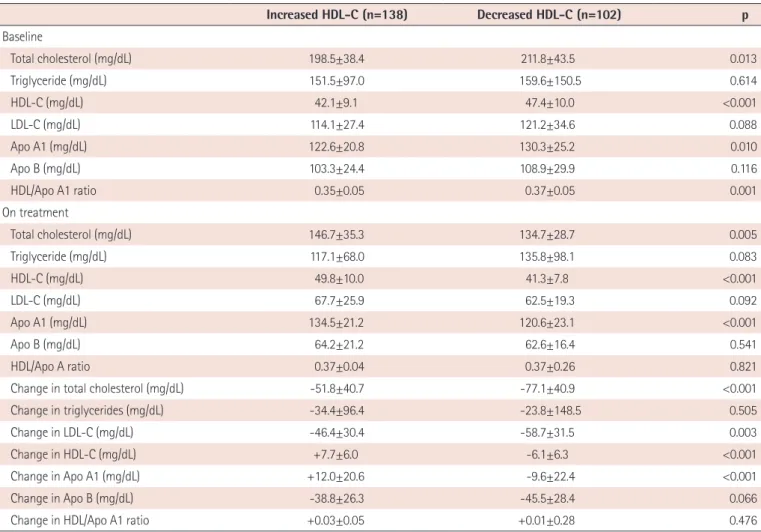
Mean on-treatment HDL-C levels were 46.2±10.1 mg/dL, and mean on-treatment LDL-C levels were 65.5±23.4 mg/dL. Rosuvastatin treatment increased the mean HDL-C concentration by 1.9±9.2 mg/

dL (6.4±21.4%). HDL-C levels increased in 138 patients (57.5%), but decreased in 102 patients (42.5%) after statin treatment.

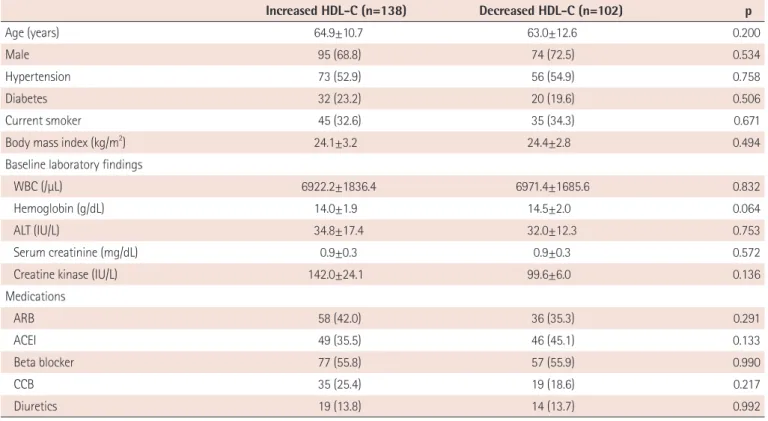
The baseline clinical characteristics according to HDL-C response are shown in Table 1. There was no significant difference in the most relevant clinical characteristics between the two groups.

Changes of lipid and lipoprotein

Total cholesterol, triglyceride and LDL-C levels decreased after statin treatment (Table 2). Baseline HDL-C levels were higher in patients with decreased HDL-C at 8 weeks (47.4±10.0 vs. 42.1±9.1 mg/dL, p<0.001). Baseline Apolipoprotein (Apo) A1 also higher in decreased HDL-C responder (130.2±25.2 vs. 122.6±20.8 mg/dL,

Table 2. Lipid findings after statin treatment

  Increased HDL-C (n=138) Decreased HDL-C (n=102) p

Baseline

Total cholesterol (mg/dL) 198.5±38.4 211.8±43.5 0.013

Triglyceride (mg/dL) 151.5±97.0 159.6±150.5 0.614

HDL-C (mg/dL) 42.1±9.1 47.4±10.0 <0.001

LDL-C (mg/dL) 114.1±27.4 121.2±34.6 0.088

Apo A1 (mg/dL) 122.6±20.8 130.3±25.2 0.010

Apo B (mg/dL) 103.3±24.4 108.9±29.9 0.116

HDL/Apo A1 ratio 0.35±0.05 0.37±0.05 0.001

On treatment

Total cholesterol (mg/dL) 146.7±35.3 134.7±28.7 0.005

Triglyceride (mg/dL) 117.1±68.0 135.8±98.1 0.083

HDL-C (mg/dL) 49.8±10.0 41.3±7.8 <0.001

LDL-C (mg/dL) 67.7±25.9 62.5±19.3 0.092

Apo A1 (mg/dL) 134.5±21.2 120.6±23.1 <0.001

Apo B (mg/dL) 64.2±21.2 62.6±16.4 0.541

HDL/Apo A ratio 0.37±0.04 0.37±0.26 0.821

Change in total cholesterol (mg/dL) -51.8±40.7 -77.1±40.9 <0.001

Change in triglycerides (mg/dL) -34.4±96.4 -23.8±148.5 0.505

Change in LDL-C (mg/dL) -46.4±30.4 -58.7±31.5 0.003

Change in HDL-C (mg/dL) +7.7±6.0 -6.1±6.3 <0.001

Change in Apo A1 (mg/dL) +12.0±20.6 -9.6±22.4 <0.001

Change in Apo B (mg/dL) -38.8±26.3 -45.5±28.4 0.066

Change in HDL/Apo A1 ratio +0.03±0.05 +0.01±0.28 0.476

HDL-C: high-density lipoprotein cholesterol, LDL-C: low-density lipoprotein cholesterol, Apo: apolipoprotein, HDL: high-density lipoprotein

(4)

p=0.010). HDL-C/Apo A1 ratio was different in both groups at baseline, but on-treatment HDL-C/Apo A1 ratio was similar: 0.01 to 0.03 increase was seen in both groups.

Changes of paraoxonase 1 activity

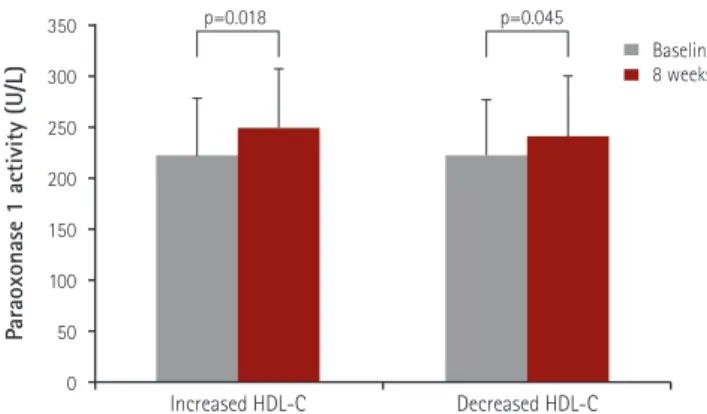
PON1 activity increased to 19.1% in all patients. In both, the patients with increased HDL-C and with decreased HDL-C, baseline PON1 activity was similar between the two groups (223.8±105.3 vs. 223.7±105.9 U/L, p=0.994), and PON1 activity significantly increased after rosuvastatin treatment (+19.3% in increased HDL-C responder; p=0.018, +18.8% in decreased HDL-C responder; p=0.045 by paired t-test) (Fig. 1). Therefore, on-treatment PON1 activity was similar between the two groups (247.8±102.3 vs. 242.6±106.9 U/L, p=0.751). Baseline PON1 activity modestly correlated with HDL-C levels (r=0.248, p=0.009); however, on-treatment PON1 activity did not correlate with HDL-C levels (r=0.153, p=0.075) (Fig. 2).

Discussion

The main findings of the present study were as follows: (1) some patients showed decreased HDL-C levels after rosuvastatin treatment, despite their overall HDL-C elevation; (2) antioxidative property assessed by PON1 activity improved after rosuvastatin treatment regardless of HDL-C levels. These observations might support that on-treatment HDL-C levels alone was not an important target in patients with ischemic heart disease.

HDL-C is a well-established risk factor for coronary heart disease (CHD). However, on-treatment values of HDL-C after statin treatment have been inconsistently correlated with the risk of cardiovascular events. High dose statin studies, such as Analyses of the Pravastatin or Atorvastatin Evaluation and Infection Therapy trial and Justification for the Use of Statins in Prevention: an Intervention Trial Evaluating Rosuvastatin (JUPITER) trial, reported that HDL-C concentrations were not predictive of residual CHD risk among patients treated with potent statin therapy who attained very low concentrations of LDL-C.

12)13)

The studies of HDL-C elevating drug also demonstrated that niacin or cholesterol ester transport protein inhibitors did not improve outcomes, in spite of marked HDL-C elevation in patients who underwent statin treatment.

14)15)

In addition, the authors previously reported that statin-induced HDL-C changes did not predict 12-months major adverse outcomes, despite more than 4%

of HDL-C elevation after rosuvastatin 10 mg treatment.

9)

The possible explanations about low predictive power of rosuvastatin-induced changes in HDL-C, or on-treatment HDL-C on cardiovascular outcomes, will be made by concept of HDL particle or HDL functionality. A sub-analysis of JUPITER study demonstrated that HDL particle number may be a better marker of Fig. 1. Changes of paraoxonase1 activity according to statin-induced

high-density lipoprotein cholesterol (HDL-C) response.

350 300 250 200 150 100 50

0 Increased HDL-C Decreased HDL-C

Baseline 8 weeks

p=0.018 p=0.045

Paraoxonase 1 activity (U/L)

500 400 300 200 100 0

r=0.248 p=0.009

20 30 40 50 60 70 80 Baseline HDL-C (mg/dL)

Baseline paraoxonase 1 activity (U/L)

500 400 300 200 100 0

r=0.153 p=0.075

20 30 40 50 60 70 80 On-treatment HDL-C (mg/dL)

On-treatment paraoxonase 1 activity (U/L)

Fig. 2. Correlation between paraoxonase1 activity and high-density lipoprotein cholesterol (HDL-C) levels. Baseline PON1 activity modestly correlated with HDL-C levels (A); however, on-treatment PON1 activity did not correlate with HDL-C levels (B).

A B

(5)

residual risk than chemically measured HDL-C or Apo A1.

16)

That is, among placebo-allocated patients, the on-treatment HDL particle measured by nuclear magnetic resonance spectroscopy and HDL-C had similar inverse association with cardiovascular outcomes.

However, among rosuvastatin-allocated patients, on-treatment HDL particle had stronger association with outcomes, rather than HDL-C. The number of HDL particle could be measured by HDL-C/

Apo A1 ratio, indirectly.

17)

As the particle size of HDL increased, the HDL particle contained more Apo A1 molecules; therefore, HDL-C/

Apo A1 ratio showed a linear correlation with HDL particle number.

In this study, as the HDL/Apo A1 ratio increased in both groups, it indicated that HDL particle number could be increased after rosuvastatin treatment regardless of on-treatment of HDL-C levels.

Ordinary HDL particle is “functional HDL” which exerts anti- atherosclerotic, anti-inflammatory and anti-oxidative effects. When various factors such as metabolic syndrome, smoking, or chronic inflammatory conditions influence the HDL particles, they are modified from “functional HDL” to “dysfunctional HDL”.

6)

Statin may improve the functionality of HDL particle, especially the cholesterol efflux and anti-inflammatory action. Statin may also improve the anti-oxidative action of HDL particle via PON1.

18-20)

PON1 is an enzyme hydrolyzing peroxidized lipids, which is synthesized in the liver and is present in blood bound to Apo A1 of HDL particles.

21)

PON1 exerts its anti-oxidative action by inhibiting the oxidation of LDL and even HDL itself, depending on the degree of its activity.

22)

Statin treatment increased the PON1 activity about 10-35%.

20)

However, changes of PON1 activity according to HDL-C levels during statin treatment have not been demonstrated. In this study, rosuvastatin treatment significantly increased the PON1 activity to 19%. Moreover, we demonstrated that increased PON1 activity was not associated with on-treatment HLD-C levels. Therefore, HDL-C levels are not correlated to HDL functionality, especially in rosuvastatin treated patients.

Our study has several limitations. We did not evaluate cardiovascular outcomes in the study population. Clinical significance of HDL/Apo A1 ratio or PON1 activity was still unknown in rosuvastatin treated patients with stable ischemic heart disease. It is unknown whether the HDL-C response to statin is similar to that of other types of statins or of other rosuvastatin doses. Further studies would be necessary.

In conclusion, rosuvastatin treatment improved the lipid profile and anti-oxidative property assessed by PON1 activity in patients with stable ischemic heart disease. Moreover, PON1 activity was not associated with on-treatment HDL-C levels.

Acknowledgment

This study was supported by grants from The Korean Society

of Cardiology (2012-08) and Basic Science Research Program through the NRF of Korea funded by the Ministry of education (2012R1A1A2041914).

References

1. Randomized trial of cholesterol lowering in 4444 patients with coronary heart disease: the Sacandinavian Simvastatin Survival Study (4S). Lancet 1994;344:1383-9.

2. Shepherd J, Cobbe SM, Ford I, et al. Prevention of coronary heart disease with pravastatin in men with hypercholesterolemia. West of Scotland coronary prevention study group. N Engl J Med 1995;333:1301-7.

3. Hong YJ, Jeong MH, Lim JH, et al. The prognostic significance of statin therapy according to the level of C-reactive protein in acute myocardial infarction patients who underwent percutaneous coronary intervention. Korean Circ J 2003;33:891-900.

4. Ridker PM, Danielson E, Fonseca FA, et al. Reduction in C-reactive protein and LDL cholesterol and cardiovascular event rates after initiation of rosuvastatin: a prospective study of the JUPITER trial.

Lancet 2009;373:1175-82.

5. Sim DS, Jeong MH, Cho KH, et al. Effect of early statin treatment in patients with cardiogenic shock complicating acute myocardial infarction. Korean Circ J 2013;43:100-9.

6. Yamashita S, Tsubakio-Yamamoto K, Ohama T, Nakagawa-Toyama Y, Nishida M. Molecular mechanisms of HDL-cholesterol elevation by statins and its effects on HDL functions. J Atheroscler Thromb 2010;17:436-51.

7. Aviram M, Rosenblat M, Bisgaier CL, Newton RS, Primo-Parmo SL, La Du BN. Paraoxonase inhibits high-density lipoprotein oxidation and preserves its functions. A possible peroxidative role for paraoxonase.

J Clin Invest 1998;101:1581-90.

8. McElveen J, Mackness MI, Colley CM, Peard T, Warner S, Walker CH.

Distribution of paraoxon hydrolytic activity in the serum of patients after myocardial infarction. Clin Chem 1986;32:671-3.

9. Yun KH, Shin SN, Ko JS, et al. Rosuvastatin-induced high-density lipoprotein changes in patients who underwent percutaneous coronary intervention for non-ST-segment elevation acute coronary syndrome. J Cardiol 2012;60:383-8.

10. Thygesen K, Alpert JS, Jaffe AS, et al. Third universal definition of myocardial infarction. J Am Coll Cardiol 2012;60:1581-98.

11. Cebeci E, Oner FA, Usta M, Yurdakul S, Erguney M. Evaluation of oxidative stress, the activities of paraoxonase and arylesterase in patients with subclinic hypothyroidism. Acta Biomed 2011;82:214-22.

12. Ray KK, Cannon CP, Cairns R, Morrow DA, Ridker PM, Braunwald E.

Prognostic utility of apoB/AI, total cholesterol/HDL, non-HDL

cholesterol, or hs-CRP as predictors of clinical risk in patients

(6)

receiving statin therapy after acute coronary syndromes: results from PROVE IT-TIMI 22. Arterioscler Thromb Vasc Biol 2009;29:424-30.

13. Ridker PM, Genest J, Boekholdt SM, et al. HDL cholesterol and residual risk of first cardiovascular events after treatment with potent statin therapy: an analysis from the JUPITER trial. Lancet 2010;376:333-9.

14. Barter PJ, Caufield M, Eriksson M, et al. Effects of torcetrapib in patients at high risk for coronary events. N Engl J Med 2007;357:2109-22.

15. AIM-HIGH Investigators, Boden WE, Probstfield JL, et al. Niacin in patients with low HDL cholesterol levels receiving intensive statin therapy. N Engl J Med 2011;365:2255-67.

16. Mora S, Glynn RJ, Ridker PM. High-density lipoprotein cholesterol, size, particle number, and residual vascular risk after potent statin therapy. Circulation 2013;128:1189-97.

17. Mazer NA, Giulianini F, Paynter NP, Jordan P, Mora S. A comparison of the theoretical relationship between HDL size and the ratio of HDL cholesterol to apolipoprotein A-I with experimental results from the Women’s Health Study. Clin Chem 2013;59:949-58.

18. Nagila A, Permpongpaiboon T, Tantrarongroj S, et al. Effect of atorvastatin on paraoxonase1 (PON1) and oxidative status. Pharmacol Rep 2009;61:892-8.

19. Miyamoto-Sasaki M, Yasuda T, Monguchi T, et al. Pitavastatin increases HDL particles functionally preserved with cholesterol efflux capacity and antioxidative actions in dyslipidemic patients. J Atheroscler Thromb 2013;20:708-16.

20. Harangi M, Seres I, Harangi J, Paragh G. Benefits and difficulties in measuring HDL subfractions and human paraoxonase-1 activity during statin treatment. Cardiovasc Drugs Ther 2009;23:501-10.

21. Blatter MC, James RW, Messmer S, Barja F, Pometta D. Identification of a distinct human high-density lipoprotein subspecies defined by a lipoprotein-associated protein, K-45. Identity of K-45 with paraoxonase.

Eur J Biochem 1993;211:871-9.

22. Mackness MI, Arrol S, Abbott C, Durrington PN. Protection of low-

density lipoprotein against oxidative modification by high-density

lipoprotein associated paraoxonase. Atherosclerosis 1993;104:129-35.

수치

Table 1. Baseline clinical characteristics
Table 2. Lipid findings after statin treatment
Fig. 2. Correlation between paraoxonase1 activity and high-density lipoprotein cholesterol (HDL-C) levels

참조

관련 문서

First, after the Group Art Therapy, the scale of hopelessness depression in the test group decreased significantly in comparison with that before the group

In addition, if the patients had a high MPV level (cut-off value of 7.95 fL) without low-dose aspirin therapy, they were at risk for ischemic stroke, especially in

This study was conducted under the hypothesis that a group art therapy program may increase emotional expression and decrease life event stress in patients with

With these results, we can suggest the hypothesis that increased cardiac output in the patients who administered ketamine increased muscle blood flow, and this is the

The change in active oxygen was decreased after exercise in the exercise group than in the control group, and there was a statistically significant

FBG: fasting blood glucose, TC: total cholesterol, TG: triglyceride, HDL-C: high density lipoprotein-cholesterol, LDL-C: low density lipoprotein-cholesterol,

Second, the total cholesterol, low density lipoprotein cholesterol, and triglyceride of the exercise group significantly decreased after 8 weeks of Ju-do

In the late nineteenth century, although the proportion of ether was increased and that of chloroform decreased due to the raised awareness of the high