Although contemporary cardiovascular treatment strategies including antiplatelet agents and statins have improved the clinical outcomes in high-risk patients with atherosclerotic cardiovascular disease (ASCVD), the mortality rate from ischemic heart disease remains unchanged and up to 5% of patients suffered from recurrent CV events each year.
1)Therefore, novel therapeutic strategies are required to prevent adverse clinical events.
2)3)The development of direct oral anticoagulants (DOACs) has stimulated interest in studying the important role of the coagulation cascade in atherosclerotic progression and occurrence of atherothrombotic events.
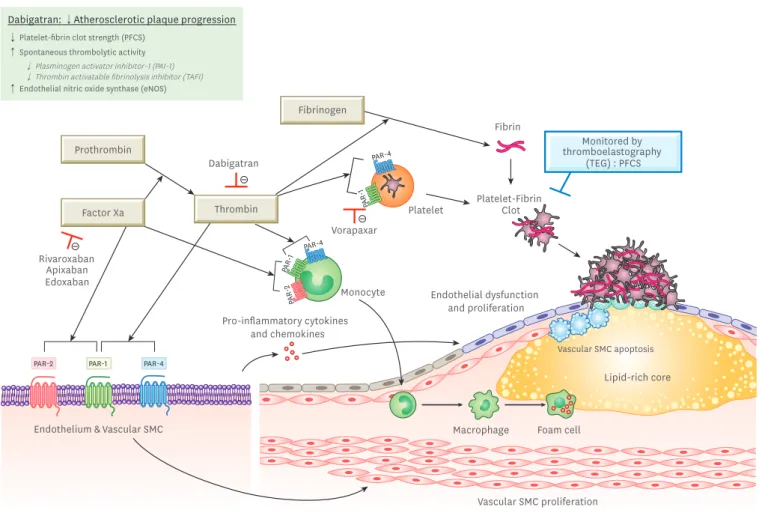
4-6)Factor Xa and thrombin play critical roles during platelet activation and fibrin formation. The latter properties are essential for stable platelet-fibrin clot generation at the site of vascular injury during ischemic event occurrences (Figure 1).
2)3)In addition, these components are also closely associated with all stages of development and progression of atherosclerosis. Cell signaling at the site of atherosclerotic plaque is mediated through the activation of protease-activated receptor (PAR).
2)3)PARs are expressed on diverse cell membranes including endothelial cells, leukocytes, platelets, and vascular smooth muscle cells (SMCs). PAR-mediated signaling is involved in endothelial cell activation and dysfunction, the inflammatory process by stimulating the generation of pro-inflammatory cytokines and chemokines, and proliferation and apoptosis of vascular SMCs. Factor Xa activates PAR-1 and PAR-2, whereas thrombin activates PAR-1, PAR-3, and PAR-4. Therefore, reducing factor Xa/thrombin levels with DOAC or inhibiting platelet activation through the PAR-1 antagonist may have a potential to attenuate the atherosclerosis progression and subsequent ischemic event occurrences.
4-6)Clinical trials using these antithrombotic agents already have shown clinical benefit in reducing the risk of ASCVD.
2)3)In this edition of the Korean Circulation Journal, Sanda et al.
7)reported the interesting evaluation regarding thrombin inhibitory effect and spontaneous thrombolytic activity by dabigatran in apolipoprotein E (ApoE)
−/−–low-density lipoprotein receptor (LDLR)
−/−double-knockout mice.
Editorial
Received: Jul 6, 2020 Accepted: Jul 21, 2020 Correspondence to Young-Hoon Jeong, MD, PhD
Department of Internal Medicine, Gyeongsang National University School of Medicine and Cardiovascular Center, Gyeongsang National University Changwon Hospital, 11, Samjeongja- ro, Seongsan-gu, Changwon 51472, Korea.
E-mail: [email protected] Copyright © 2020. The Korean Society of Cardiology
This is an Open Access article distributed under the terms of the Creative Commons Attribution Non-Commercial License (https://
creativecommons.org/licenses/by-nc/4.0) which permits unrestricted noncommercial use, distribution, and reproduction in any medium, provided the original work is properly cited.
ORCID iDs Hyun Kuk Kim
https://orcid.org/0000-0002-4554-041X Udaya S. Tantry
https://orcid.org/0000-0002-8542-8596 Paul A. Gurbel
https://orcid.org/0000-0002-5461-568X Young-Hoon Jeong
https://orcid.org/0000-0003-0403-3726 Funding
This editorial is supported by the Basic Science Research Program through the National Research Foundation (NRF) of Korea funded
Hyun Kuk Kim , MD, PhD 1 , Udaya S. Tantry , PhD 2 , Paul A. Gurbel , MD 2 , and Young-Hoon Jeong , MD, PhD 3
1
Department of Internal Medicine, Chosun University School of Medicine, Chosun University Hospital, Gwangju, Korea
2
Sinai Center for Thrombosis Research and Drug Development, Sinai Hospital of Baltimore, Baltimore, MD, USA
3
Department of Internal Medicine, Gyeongsang National University School of Medicine and Cardiovascular Center, Gyeongsang National University Changwon Hospital, Changwon, Korea
Another Unmet Need against Residual Risk of Atherosclerotic Cardiovascular Disease: Can “Thrombin Pathway” Be a New Target for Therapy?
►
See the article “Effects of Long-term Thrombin Inhibition (Dabigatran Etexilate) on Spontaneous
Thrombolytic Activity during the Progression of Atherosclerosis in ApoE
−/−–LDLR
−/−Double-Knockout
Mice” in volume 50 on page 804.
by the Ministry of Science, ICT and Future Planning (NRF-2015R1A5A2008833).
Conflict of Interest
Dr. Gurbel reports grants and personal fees from Bayer HealthCare LLC, and grants and personal fees from Otitopic Inc, during the conduct of the study. He is a consultant for Otitopic Inc., the company producing nanoparticle aspirin; grants from Instrumentation Laboratory, grants from Haemonetics, grants and personal fees from Amgen, grants from Medicure Inc., grants and personal fees from Janssen, grants and personal fees from US WorldMeds LLC, grants from Idorsia Pharmaceuticals, personal fees from Up-To-Date, and grants
Their study showed that thrombin inhibition by dabigatran reduced atherosclerotic plaque progression and increased thrombolytic activity.
7)Following thrombin inhibition, expressions of plasminogen activator inhibitor-1 (PAI-1) and thrombin-activatable fibrinolysis inhibitor (TAFI) were decreased, but endothelial nitric oxide synthase (eNOS) was increased. Results of the present study were similar with previous experimental studies using direct thrombin inhibitors,
2)3)which may suggest a close association between the activity of the coagulation system and atheroma progression.
Coronary artery disease (CAD) is a pathological process characterized by atherosclerotic plaque generation in the epicardial arteries.
8)The atherosclerotic disease can have long, stable periods but can become unstable at any time, infrequently resulting in an acute clinical event caused by plaque rupture or erosion. This dynamic nature of the coronary atherothrombotic process can be categorized as either acute coronary syndrome (ACS) or chronic coronary syndrome (CCS). To maintain stability of CCS, pharmacological therapies are essential. Platelet activation and aggregation is the main trigger for symptomatic arterial
PAR-2
Factor Xa
Rivaroxaban Apixaban Edoxaban
Endothelium & Vascular SMC
Dabigatran Thrombin
Lipid-rich core Vascular SMC apoptosis Endothelial dysfunction
and proliferation
Foam cell Macrophage
Prothrombin
Fibrinogen
Fibrin
Platelet-Fibrin Clot Platelet
Vorapaxar
Monocyte
Monitored by thromboelastography
(TEG) : PFCS
Vascular SMC proliferation Pro-inflammatory cytokines
and chemokines
PAR-2 PAR-1
PAR-1
PAR-1
PAR-4
PAR-4
PAR-4