263 https://e-kcj.org
Type 2 diabetes mellitus (T2DM) studies and its drug development aim to improve glycaemic control as well as mitigate the cardiovascular and renal risks and diseases associated with T2DM.
1)The introduction of sodium glucose co-transporter 2 (SGLT2) inhibitors provides new insight and avenues in T2DM patients' health management, but this also presents treatment modes for the fields of nephrology and, in our journal's interest, for the field of cardiology.
Over the years, cardiovascular disease related with T2DM has become a prevalent health issue worldwide. T2DM morbidity and mortality have largely been associated with cardiovascular disease that is followed by subsequent heart failure seen in patients.
2)In addition to this, T2DM has also been found to cause diabetic kidney disease. Patients afflicted with T2DM also experience renal disease that exacerbates the incidence of cardiovascular disease due to the ineffective action of the kidney in terms of glucose excretion.
3)The belief that cardiovascular benefits were indirectly related was due to SGLT2 transporters found largely in the kidney, at the proximal tubules. Due to the inhibition of SGLT2, glucose reabsorption is limited and glucose excretion is increased.
1)This then lowers the glycated hemoglobin plasma levels that further improve conditions in terms of the body weight, insulin and blood pressure. Prevention and reduction of heart failure hospitalization was an unexpected cardiovascular benefit from SGLT2 inhibitors.
1-3)Meta-analysis by Zelniker et al.
4)presented that efficiency of SGLT2 inhibitors in preventing heart failure was observed from patients with renal disease. This then established that the condition of the kidney may contribute in either promoting or preventing heart failure.
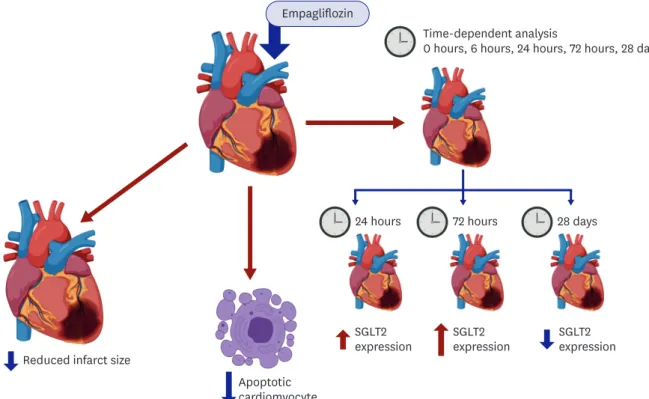
With this in mind, large-scale clinical studies were launched to determine the safety, benefits and effects of SGLT2 inhibitors to be used as cardioprotective drugs. These mandated clinical trials brought to the forefront how SGLT2 inhibitors rapidly reduced renal and, what was assumed indirectly, cardiovascular adverse events. The clinical trials of interest such as BI 10773 (Empagliflozin) Cardiovascular Outcome Event Trial in Type 2 Diabetes Mellitus Patients (EMPA-REG OUTCOME) trial, CANagliflozin cardioVascular Assessment Study program and Dapagliflozin Effect on Cardiovascular Events–Thrombolysis in Myocardial Infarction largely identified patients with heart failure in their medical histories.
5-7)There was a pronounced speed in the reduction and recovery of patients from cardiovascular diseases with hospitalisations due to stroke, heart failure, myocardial infarction (MI), and even cardiovascular-related mortality. It is noted by Cowie and Fisher, however, that Korean Circ J. 2021 Mar;51(3):263-266
https://doi.org/10.4070/kcj.2020.0512 pISSN 1738-5520·eISSN 1738-5555
Editorial
Received: Dec 15, 2020 Accepted: Dec 24, 2020 Correspondence to Jin Han, MD, PhD
Department of Physiology, College of Medicine, Smart Marine Therapeutics Center, Cardiovascular and Metabolic Disease Center, Inje University, 75, Bokji-ro, Busanjin-gu, Busan 47392, Korea.
E-mail: [email protected]
Copyright © 2021. The Korean Society of Cardiology
This is an Open Access article distributed under the terms of the Creative Commons Attribution Non-Commercial License (https://
creativecommons.org/licenses/by-nc/4.0) which permits unrestricted noncommercial use, distribution, and reproduction in any medium, provided the original work is properly cited.
ORCID iDs
Maria Victoria Faith Garcia
https://orcid.org/0000-0002-1541-0569 Jin Han
https://orcid.org/0000-0003-2847-0197 Funding
This research was supported by the Basic Research Lab Program (NRF2020R1A4A1018943) and the Basic Science Research Program (2018R1A2A3074998) through the National Research Foundation of Korea funded by the Ministry of Science and ICT, Korea Conflict of Interest
The authors have no financial conflicts of interest.
Maria Victoria Faith Garcia , MSc 1,2 , and Jin Han , MD, PhD 1,2
1
Department of Physiology, Smart Marine Therapeutics Center, Cardiovascular and Metabolic Disease Center, Inje University College of Medicine, Busan, Korea
2
Department of Health Sciences and Technology, Graduate School of Inje University, Busan, Korea
SGLT2 Inhibitors: the Gift that Keeps on Giving
►