• 검색 결과가 없습니다.

Estimation for the half triangle distribution based on Type-I hybrid censored samples

N/A
N/A
Protected

Academic year: 2021

Share "Estimation for the half triangle distribution based on Type-I hybrid censored samples"

Copied!
9
0
0

로드 중.... (전체 텍스트 보기)

전체 글

(1)

Estimation for the half triangle distribution based on Type-I hybrid censored samples

Suk-Bok Kang 1 · Young-Seuk Cho 2 · Jun-Tae Han 3

1 Department of Statistics, Yeungnam University

2 Department of Statistics, Pusan National University

3 National Health Insurance Policy Research Institute, National Health Insurance Corporation

Received 18 July 2009, revised 11 September 2009, accepted 15 September 2009

Abstract

A hybrid censoring is a mixture of Type-I and Type-II censoring schemes. This paper deals with estimation based on Type-I hybrid censored samples from the half triangle distribution. We derive some estimators of the scale parameter of the half tri- angle distribution based on Type-I hybrid censored samples. We compare the proposed estimators in the sense of the mean squared error for various censored samples.

Keywords: Approximate maximum likelihood estimator, half triangle distribution, Type-I hybrid censored sample.

1. Introduction

The half-triangle distribution has the following cumulative distribution function (cdf)

F (x) = 1 − 1 − x θ

! 2

, 0 < x < θ, (1.1)

and the probability density function (pdf)

f (x) = 2

θ 1 − x θ

!

, 0 < x < θ. (1.2)

A triangle distribution was applied to a kernel function in nonparametric density estima- tion. Johnson (1997) studied the possibility of using the more intuitively obvious triangular distribution as a proxy for the beta distribution. Some properties of the triangular distri- bution was studied by Balakrishnan and Nevzorov (2003). Lee et al . (2008) proposed the

1 Professor, Department of Statistics, Yeungnam University, Gyeongsan 712-749, Korea.

2 Assistant Professor, Department of Statistics, Pusan National University, Pusan 609-735, Korea.

3 Corresponding author: Researcher, National Health Insurance Policy Research Institute, National

Health Insurance Corporation, Seoul 121-749, Korea. E-mail: [email protected]

(2)

approximate maximum likelihood estimators (AMLEs) of the scale parameter in a triangu- lar distribution based on multiply Type-II censored samples by the approximate maximum likelihood estimation methods. Recently, Kang (2007) proposed some explicit estimators for the half triangle distribution based on multiply Type-II censored samples. Hybrid censoring scheme is a mixture of Type-I ad Type-II censoring schemes.

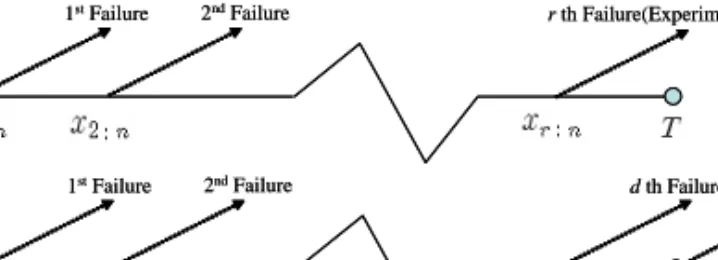
Let us assume that the ordered lifetimes be denoted by X 1:n , X 2:n , ..., X n:n . Epstein (1954) introduced Type-I hybrid censoring scheme, and considered lifetime experiments assuming that the lifetime of each unit follows an exponential distribution. Type-I hy- brid censoring scheme in which the life testing experiment is terminated at a random time T = min {X r:n , T }, where 1 ≤ r ≤ n and T ∈ (0, ∞) are fixed in advance. As with a con- ventional Type-I censoring scheme, the termination point here is at most T . A schematic illustration is depicted in Figure 1.1, when x 1:n < ... < x r:n denote the observed failure times if x r:n < T and x 1:n < ... < x d:n denoted the observed failure times if x d:n < T , d < r and the (d + 1) th failure does not take place before times point T .

r th Failure(Experiment stops) 1

st

Failure 2

nd

Failure

d th Failure

1

st

Failure 2

nd

Failure Experiment stops

CASE I :

CASE II :

r th Failure(Experiment stops) 1

st

Failure 2

nd

Failure

d th Failure

1

st

Failure 2

nd

Failure Experiment stops

CASE I :

CASE II :

Figure 1.1 The Type-I hybrid censoring scheme

Childs et al . (2003) proposed the Type-II hybrid censoring scheme, and it can be described as follows. Put n identical items on test, and then stop the experiment at the random time T = max {X r:n , T }, where r and T are prefixed numbers. Then, the Type-II hybrid censoring scheme ensures that at least r failures take place.

In this paper, we derive some estimators of the parameter θ in the half triangle distribution based on Type-I hybrid censored samples. We also compare the proposed estimators in the sense of the mean squared error (MSE) for various censored samples.

2. Estimation for the scale parameter

We will discuss the maximum likelihood estimation of the scale parameter based on Type-I hybrid censored samples. The log-likelihood function for two different cases follow. Based on the observed data, the log-likelihood function (without the constant term) for Case I is

ln L I = (n − r) ln [1 − F (x r:n )] +

r

X

i=1

ln f (x i:n ), (2.1) and for Case II, it is

ln L II = (n − d) ln [1 − F (T )] +

d

X

i=1

ln f (x i:n ). (2.2)

(3)

The random variable Z i:n = X i:n /θ then has a standard half triangle distribution with pdf and cdf;

f (z i:n ) = 2(1 − z i:n ) and F (z i:n ) = 1 − (1 − z i:n ) 2 .

On differentiating the log-likelihood function with respect to θ of (2.1) and (2.2) in turn and equation to zero, we obtain the estimating equations as

∂ ln L I

∂θ = − 1 θ

"

r − 2(n − r) 1

(1 − z r:n ) z r:n

r

X

i=1

1 (1 − z i:n ) z i:n

#

= 0, (2.3)

and

∂ ln L I

∂θ = − 1 θ

"

d − 2(n − d) 1

(1 − z T ) z T

d

X

i=1

1 (1 − z i:n ) z i:n

#

= 0, (2.4)

respectively, where z T = T /θ.

We can find the maximum likelihood estimator (MLE) of θ as values e θ that maximize the log-likelihood function in (2.1) and (2.2) by solving the equation ∂ ln L I /∂θ = 0 and

∂ ln L II /∂θ = 0. Since the equation (2.3) and (2.4) cannot be solved explicitly, some numer- ical method must be employed.

Since the log-likelihood equation do not admit explicit solutions, it will be desirable to consider an approximation to the likelihood equation which provide us with explicit estimator for the scale parameter.

We expand the functions z i:n /(1 − z i:n ) and 1/(1 − z i:n ) in Taylor series around the points ξ i , where ξ i = F −1 (p i ) = 1 − √

q i and q i = 1 − p i . First, we can approximate this function by

z i:n

1 − z i:n ≈ − ξ i 2 q i + 1

q i z i:n . (2.5)

By substituting equation (2.5) into equation (2.3), we may approximate the equation in (2.3) by

∂ ln L I

∂θ = − 1 θ

"

r + 2(n − r) ( ξ r 2

q r

− 1 q r

z r:n )

+

r

X

i=1

( ξ 2 i q i

− 1 q i

z i:n )#

= 0. (2.6)

We can derive an estimator of θ as follows;

θ b I,1 = B 1

A 1

, (2.7)

where

A 1 = r + 2(n − r) ξ r 2 q r

+

r

X

i=1

ξ i 2 q i

and B 1 = 2(n − r) 1 q r

X r:n +

r

X

i=1

1 q i

X i:n .

Since ξ 2 i /q i > 0 and 1/q i > 0, the estimator b θ 1 is always positive.

(4)

Second, we can approximate this function by equations 1

1 − z i:n ≈ (1 − 2ξ i ) q i + 1

q i z i:n . (2.8)

By substituting equation (2.8) into equation (2.3), we may approximate the likelihood equation in (2.3) by

∂ ln L II

∂θ = − 1 θ

"

r − 2(n − r)

( (1 − 2ξ r ) q r + z r:n

q r )

z r:n −

r

X

i=1

( (1 − 2ξ i ) q i + z i:n

q i )

z i:n

#

= 0.

(2.9) Equation (2.9) is a quadratic equation in θ, with its roots given by

b θ I,2 = − A 2 ± pA 2 2 − 4rB 2

2r , (2.10)

where

A 2 = −2(n − r) 1 − 2ξ r q r

X r:n −

r

X

i=1

1 − 2ξ i q i

X i:n

and

B 2 = −2(n − r) 1 q r

X r:n 2

r

X

i=1

1 q i

X i:n 2 .

Since B 2 < 0, only one root is admissible, and hence the AMLE of θ is given by

b θ I,2 = − A 2 + pA 2 2 − 4rB 2

2r . (2.11)

Similarly for Case II, the AMLE of θ can be obtained by solving

∂ ln L II

∂θ = − 1 θ

"

d + 2(n − d) ( ξ d 2

q d

− 1 q d

z T

) +

d

X

i=1

( ξ 2 i q i

− 1 q i

z i:n

)#

= 0, (2.12)

and

∂ ln L II

∂θ = − 1 θ

"

d − 2(n − d)

( (1 − 2ξ d

) q d

+ 1 q d

z T )

z T

d

X

i=1

( (1 − 2ξ i ) q i

+ 1 q i

z i:n )

z i:n

#

= 0, (2.13) respectively, where ξ d

= F −1 (p d

) = 1 − √

q d

, p d

= (p d + p d+1 )/2 and q d

= 1 − p d

. Therefore, in this case following the same steps as before, we obtain the AMLE of θ as follows;

θ b II,1 = D 1

C 1 and θ b II,2 = − C 2 + pC 2 2 − 4rD 2

2r , (2.14)

(5)

where

C 1 = d + 2(n − d) ξ d 2

q d

+

d

X

i=1

ξ i 2

q i , D 1 = 2(n − d) 1 q d

T +

d

X

i=1

1 q i X i:n ,

C 2 = −2(n − d) 1 − 2ξ d

q d

T −

d

X

i=1

1 − 2ξ i q i

X i:n , and D 2 = −2(n − d) 1 q d

T 2

d

X

i=1

1 q i

X i:n 2 .

Cheng and Amin (1983) proposed maximum product of spacings estimator (MPSE) method. The new suggested method can be applied in principle to the estimation of pa- rameters in any continuous univariate distribution. The MPSE of θ is the value of this parameter, which maximize the geometric mean of spacings and expressed below after taking logarithm;

G = 1

n + 1

n+1

X

i=1

ln(G i ), (2.15)

where G i = F (x i ) − F (x i−1 ), i = 1, 2, ..., n + 1, x 0 = 0 and x n+1 = ∞.

We can modify equation (2.15) based on Type-I hybrid censored samples as follows; For Case I, it is

G I = 1 r + 1

r

X

i=1

ln(G i ), (2.16)

and for Case II, it is

G II = 1 d + 1

d

X

i=1

ln(G i ). (2.17)

On differentiating the equations (2.16) and (2.17) with respect to θ in turn and equation to zero. The resulting equations are given below.

r

X

i=1

2X i:n − 2X i:n 2 − 2X i−1:n + 2X i−1:n 2

2X i:n θ − X i:n 2 − 2X i−1:n θ + X i−1:n 2 = 0, (2.18) and

d

X

i=1

2X i:n − 2X i:n 2 − 2X i−1:n + 2X i−1:n 2

2X i:n θ − X i:n 2 − 2X i−1:n θ + X i−1:n 2 = 0, (2.19) respectively.

Since the equation (2.18) and (2.19) cannot be solved explicitly, solution of (2.18) and (2.19) are obtain by using numerical method. We can find the MPSE of θ as values ¯ θ.

Woo (2007) considered the inference on the reliability, and derived the k th moment of the

ratio of two independent half triangle distributions with different supports. He also proposed

(6)

unbiased estimators of the parameter θ in the half triangle distribution based on complete samples as follows;

θ = X n:n

c , (2.20)

where

c =

n P n−1

i=0 (−1) i 2 n−i n − 1 i

!

(n + 1 + i)(n + i + 2) .

Finally, for Type-I hybrid censored samples, we can modify the estimator (2.20) as follows;

For Case I is

θ I = X r:n

c 1 , (2.21)

where

c 1 =

r P r−1

i=0 (−1) i 2 r−i r − 1 i

!

(r + 1 + i)(r + i + 2) , and for Case II, it is

θ II = T c 2

, (2.22)

where

c 2 =

d P d−1

i=0 (−1) i 2 d−i d − 1 i

!

(d + 1 + i)(d + i + 2) .

3. Simulated results

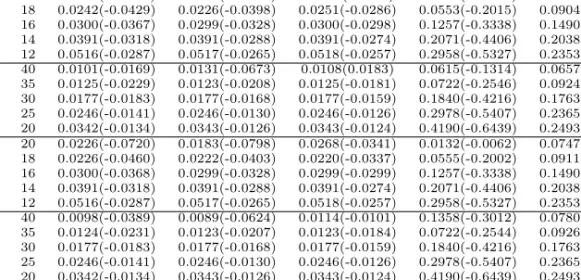
From the above formula, the mean squared errors of the estimators are simulated by Monte Carlo method (based on 10,000 Monte Carlo runs) for sample size n =20, 40, and different r and T values. We mainly compare the performances of the proposed estimators of the scale parameter θ, in terms of their biases and mean squared errors (MSEs) for different censoring scheme. The convergence of Newton-Raphson method depended on the choice of the initial values. For this reason, the AMLE b θ 1 (b θ I,1 and b θ II,1 ) was used as starting values for the iterations, the MLE e θ and MPSE ¯ θ are obtained using Newton-Raphson method.

From Table 3.1 the following general observations can be made. For all the method, for

fixed n and r the MSEs decrease as T increases, for fixed r and T the MSEs decrease as n

increases from 20 to 40, for fixed n and T the MSEs decrease as r increases.

(7)

The performances of the AMLEs and MLE are very similar in all aspects. The AMLE b θ 1 is a linear function of available order statistic and the performance is good. The AMLE b θ 2 is generally more efficient than b θ 2 in the sense of the MSE when n > r.

The MSEs of the estimator θ I and θ II ) and ¯ θ are larger than the AMLEs or MLE for all scheme. For T ≥ 0.7 and n = r =20, the estimator θ is more efficient than the others.

As note earlier, as T → ∞ the results for Type-I hybrid censoring reduce to results for conventional Type-II censoring. Therefore, when T is large, or equivalently when there is a high probability that X r:n < T , we would expect the results for Type-I hybrid censoring to agree closely with the results for conventional Type-II censoring. By taking θ = 1, r = 19, n = 20, T = 0.5, we get P (X 12:20 < 0.5) ≈ 95.91% (see, equation 3.1 and Table 3.2).

Since this probability is high, it is reasonable that the results agree quite closely with conventional Type-II censoring in this case. But when r = 18, P (X 18:20 < 0.5) ≈ 9.13%.

As expected, for fixed n and r the P (X r;n < T ) increases as T increases, for fixed n and T the P (X r;n < T ) increases as r decrease (see, Table 3.2).

P (X 12:20 < 0.5) =

20

X

i=12

20 i

! 

1 − 1 − 0.5 1

! 2 

i

1 − 0.5 1

! 2(20−i)

= 0.9591. (3.1)

Table 3.1 The relative mean squared errors and biases for the estimators of the scale parameter θ

T n r MSE(Bias)

θ b 1 θ b 2 e θ θ θ ¯

0.5 20 20 0.0435(0.0176) 0.0459(-0.0108) 0.0477(0.0590) 0.1262(-0.3551) 0.1958(-0.4396)

18 0.0448(0.0155) 0.0446(-0.0086) 0.0505(0.0539) 0.1306(-0.3603) 0.1964(-0.4403)

16 0.0492(0.0046) 0.0456(-0.0081) 0.0573(0.0320) 0.1552(-0.3885) 0.2027(-0.4474)

14 0.0527(-0.0133) 0.0498(-0.0155) 0.0591(-0.0005) 0.2136(-0.4522) 0.2197(-0.4665)

12 0.0573(-0.0240) 0.0564(-0.0226) 0.0598(-0.0191) 0.2965(-0.5341) 0.2380(-0.4869)

40 40 0.0202(0.0076) 0.0211(-0.0081) 0.0212(0.0280) 0.1633(-0.4041) 0.1844(-0.4276)

35 0.0205(0.0070) 0.0208(-0.0075) 0.0218(0.0267) 0.1646(-0.4055) 0.1847(-0.4280)

30 0.0234(-0.0038) 0.0219(-0.0082) 0.0258(0.0062) 0.1995(-0.4435) 0.2005(-0.4457)

25 0.0258(-0.0126) 0.0256(-0.0118) 0.0264(-0.0105) 0.2983(-0.5414) 0.2377(-0.4868)

20 0.0342(-0.0133) 0.0343(-0.0126) 0.0343(-0.0124) 0.4190(-0.6439) 0.2493(-0.4993)

0.6 20 20 0.0329(0.0043) 0.0364(-0.0373) 0.0360(0.0525) 0.0579(-0.2399) 0.1272(-0.3497)

18 0.0363(-0.0040) 0.0329(-0.0268) 0.0429(0.0309) 0.0760(-0.2682) 0.1327(-0.3570)

16 0.0394(-0.0210) 0.0360(-0.0243) 0.0447(-0.0056) 0.1295(-0.3450) 0.1618(-0.3944)

14 0.0425(-0.0285) 0.0417(-0.0265) 0.0442(-0.0226) 0.2074(-0.4416) 0.2058(-0.4487)

12 0.0523(-0.0283) 0.0523(-0.0261) 0.0527(-0.0251) 0.2958(-0.5328) 0.2355(-0.4837)

40 40 0.0150(0.0008) 0.0171(-0.0252) 0.0155(0.0249) 0.0832(-0.2872) 0.1099(-0.3279)

35 0.0167(-0.0049) 0.0152(-0.0181) 0.0188(0.0116) 0.0975(-0.3099) 0.1164(-0.3370)

30 0.0188(-0.0165) 0.0184(-0.0158) 0.0194(-0.0131) 0.1847(-0.4229) 0.1775(-0.4161)

25 0.0246(-0.0141) 0.0246(-0.0130) 0.0247(-0.0125) 0.2978(-0.5407) 0.2365(-0.4852)

20 0.0342(-0.0134) 0.0343(-0.0126) 0.0343(-0.0124) 0.4190(-0.6439) 0.2493(-0.4993)

0.7 20 20 0.0268(-0.0148) 0.0287(-0.0645) 0.0301(0.0393) 0.0192(-0.1324) 0.0823(-0.2712)

18 0.0295(-0.0283) 0.0250(-0.0373) 0.0342(-0.0050) 0.0573(-0.2163) 0.0991(-0.2996)

16 0.0317(-0.0347) 0.0308(-0.0318) 0.0328(-0.0266) 0.1258(-0.3348) 0.1500(-0.3751)

14 0.0394(-0.0316) 0.0393(-0.0287) 0.0396(-0.0270) 0.2071(-0.4407) 0.2039(-0.4458)

12 0.0516(-0.0287) 0.0517(-0.0265) 0.0518(-0.0257) 0.2958(-0.5327) 0.2353(-0.4834)

40 40 0.0118(-0.0052) 0.0157(-0.0468) 0.0121(0.0246) 0.0356(-0.1642) 0.0720(-0.2545)

35 0.0140(-0.0184) 0.0126(-0.0207) 0.0152(-0.0105) 0.0743(-0.2624) 0.0962(-0.2985)

30 0.0177(-0.0183) 0.0177(-0.0167) 0.0177(-0.0158) 0.1840(-0.4216) 0.1763(-0.4139)

25 0.0246(-0.0141) 0.0246(-0.0130) 0.0246(-0.0126) 0.2978(-0.5407) 0.2365(-0.4852)

20 0.0342(-0.0134) 0.0343(-0.0126) 0.0343(-0.0124) 0.4190(-0.6439) 0.2493(-0.4993)

(8)

Table 3.1 Continued

T n r MSE(Bias)

b θ

1

θ b

2

e θ θ

θ ¯

0.8 20 20 0.0245(-0.0405) 0.0219(-0.0795) 0.0293(0.0118) 0.0087(-0.0484) 0.0662(-0.2269) 18 0.0242(-0.0429) 0.0226(-0.0398) 0.0251(-0.0286) 0.0553(-0.2015) 0.0904(-0.2787) 16 0.0300(-0.0367) 0.0299(-0.0328) 0.0300(-0.0298) 0.1257(-0.3338) 0.1490(-0.3729) 14 0.0391(-0.0318) 0.0391(-0.0288) 0.0391(-0.0274) 0.2071(-0.4406) 0.2038(-0.4456) 12 0.0516(-0.0287) 0.0517(-0.0265) 0.0518(-0.0257) 0.2958(-0.5327) 0.2353(-0.4834) 40 40 0.0101(-0.0169) 0.0131(-0.0673) 0.0108(0.0183) 0.0615(-0.1314) 0.0657(-0.2248) 35 0.0125(-0.0229) 0.0123(-0.0208) 0.0125(-0.0181) 0.0722(-0.2546) 0.0924(-0.2898) 30 0.0177(-0.0183) 0.0177(-0.0168) 0.0177(-0.0159) 0.1840(-0.4216) 0.1763(-0.4139) 25 0.0246(-0.0141) 0.0246(-0.0130) 0.0246(-0.0126) 0.2978(-0.5407) 0.2365(-0.4852) 20 0.0342(-0.0134) 0.0343(-0.0126) 0.0343(-0.0124) 0.4190(-0.6439) 0.2493(-0.4993) 0.9 20 20 0.0226(-0.0720) 0.0183(-0.0798) 0.0268(-0.0341) 0.0132(-0.0062) 0.0747(-0.2212) 18 0.0226(-0.0460) 0.0222(-0.0403) 0.0220(-0.0337) 0.0555(-0.2002) 0.0911(-0.2783) 16 0.0300(-0.0368) 0.0299(-0.0328) 0.0299(-0.0299) 0.1257(-0.3338) 0.1490(-0.3730) 14 0.0391(-0.0318) 0.0391(-0.0288) 0.0391(-0.0274) 0.2071(-0.4406) 0.2038(-0.4456) 12 0.0516(-0.0287) 0.0517(-0.0265) 0.0518(-0.0257) 0.2958(-0.5327) 0.2353(-0.4834) 40 40 0.0098(-0.0389) 0.0089(-0.0624) 0.0114(-0.0101) 0.1358(-0.3012) 0.0780(-0.2236) 35 0.0124(-0.0231) 0.0123(-0.0207) 0.0123(-0.0184) 0.0722(-0.2544) 0.0926(-0.2900) 30 0.0177(-0.0183) 0.0177(-0.0168) 0.0177(-0.0159) 0.1840(-0.4216) 0.1763(-0.4139) 25 0.0246(-0.0141) 0.0246(-0.0130) 0.0246(-0.0126) 0.2978(-0.5407) 0.2365(-0.4852) 20 0.0342(-0.0134) 0.0343(-0.0126) 0.0343(-0.0124) 0.4190(-0.6439) 0.2493(-0.4993)

Table 3.2 P (X r;n < T )

T n r P (X r;n < T ) T n r P (X r;n < T ) T n r P (X r;n < T )

0.5 20 20 0.0032 0.6 20 20 0.0306 0.7 20 20 0.1516

18 0.0913 18 0.3580 18 0.7334

16 0.4148 16 0.7941 16 0.9710

14 0.7858 14 0.9696 14 0.9987

12 0.9591 12 0.9979 12 1.0000

40 40 0.0000 40 40 0.0009 40 40 0.0230

35 0.0433 35 0.3654 35 0.8535

30 0.5839 30 0.9547 30 0.9994

25 0.9738 25 0.9998 25 1.0000

20 0.9998 20 1.0000 20 1.0000

0.8 20 20 0.4420 0.9 20 20 0.8179

18 0.9561 18 0.9990

16 0.9990 16 1.0000

14 1.0000 14 1.0000

12 1.0000 12 1.0000

40 40 0.1954 40 40 0.6690

35 0.9951 35 1.0000

30 1.0000 30 1.0000

25 1.0000 25 1.0000

20 1.0000 20 1.0000

References

Balakrishnan, N. and Nevzovor, V. B. (2003). A primer on statistical distributions , John Wiley & Sons, New York.

Cheng, R. C. A. and Amin, N. A. K. (1983). Estimating parameters in continuous univariate distributions with a shifted origin. Journal of the Royal Statistical Society, Series B , 45, 394-403.

Childs, A., Chandrasekar, B., Balakrishnan, N. and Kundu, D. (2003). Exact likelihood inference based on Type-I and Type-II hybrid censored samples from the exponential distribution. Annals of the Institute of Statistical Mathematics, 55, 319-330.

Epstein, B. (1954). Truncated life tests in the exponential case. Annals of the Institute of Statistical

(9)

Mathematics, 25, 555-564.

Johnson, D. (1997). The triangular distribution as a proxy for the beta distribution in risk analysis. The Statistician, 46, 387-398.

Kang, S. B. (2007). Estimation in a half-triangle distribution based on multiply Type-II censored samples.

Journal of the Korean Data & Information Science Society, 18, 793-801.

Lee, H. J., Han, J. T. and Kang, S. B. (2008). Estimation for a triangular distribution based on multiply Type-II censored samples. Journal of the Korean Data & Information Science Society, 19, 319-330.

Woo, J. (2007). Reliability in a half-triangle distribution and skew-symmetric distribution. Journal of the

Korean Data & Information Science Society, 18, 543-552.

수치

Figure 1.1 The Type-I hybrid censoring scheme
Table 3.1 The relative mean squared errors and biases for the estimators of the scale parameter θ
Table 3.1 Continued T n r MSE(Bias) bθ 1 θ b 2 eθ θ ∗ θ ¯ 0.8 20 20 0.0245(-0.0405) 0.0219(-0.0795) 0.0293(0.0118) 0.0087(-0.0484) 0.0662(-0.2269) 18 0.0242(-0.0429) 0.0226(-0.0398) 0.0251(-0.0286) 0.0553(-0.2015) 0.0904(-0.2787) 16 0.0300(-0.0367) 0.0299(

참조

관련 문서

Third, based on the above results, this study concluded that the competitiveness of the agricultural product distribution industry in uncertain business

12 As such, using finite element modeling, the effect of stress distribution around the internal non-submerged type implants on marginal bone resorption

Based on the above results, the 12-week complex type correction program had a positive effect on the shoulder angle, trunk rotation angle, and body shape

Maximum heat generation, temperature distribution(case) considering various time, maximum von-mises stress and maximum deformation under discharge current(1.25 A discharge)

By analysing the dependences of the maximum increase in temperature and the maximum acceleration on the medium properties and the information of the damage

Phylogenetic analysis of Orientia tsutsugamushi strains based on the sequence homologies of 56-kDa type-specific antigen genes. FEMS

As examined above, based on the type changes this study confirmed that &lt;Seoyukyonmunrok&gt; has plenty of 'aaba' type structures and most lines are

Based on the introduction of industrial wastewater TOC effluent standard, the distribution characteristics of organic matter according to the type of business