• 검색 결과가 없습니다.

Percutaneous Transseptal Left Atrial Drainage for Decompression of the Left Heart in an Adult Patient During Percutaneous Cardiopulmonary Support

N/A
N/A
Protected

Academic year: 2022

Share "Percutaneous Transseptal Left Atrial Drainage for Decompression of the Left Heart in an Adult Patient During Percutaneous Cardiopulmonary Support"

Copied!
3
0
0

로드 중.... (전체 텍스트 보기)

전체 글

(1)

402

Print ISSN 1738-5520 / On-line ISSN 1738-5555 Copyright © 2011 The Korean Society of Cardiology CASE REPORT

DOI 10.4070/kcj.2011.41.7.402

Open Access

Percutaneous Transseptal Left Atrial Drainage for Decompression of the Left Heart in an Adult Patient During

Percutaneous Cardiopulmonary Support

Min-Ho Kang, MD, Joo-Yong Hahn, MD, Hyeon-Cheol Gwon, MD, Young Bin Song, MD, Jin Oh Choi, MD, Jin-Ho Choi, MD, Seung-Hyuk Choi, MD, Sang Hoon Lee, MD, and Eun Suk Jeon, MD

Division of Cardiology, Department of Medicine, Samsung Medical Center, Sungkyunkwan University School of Medicine, Seoul, Korea ABSTRACT

A 28-year-old male with hemophagocytic lymphohistiocytosis presented with left ventricular dysfunction and cardiac ar- rest. Percutaneous cardiopulmonary support (PCPS) was initiated, but left heart distension developed with associated ag- gravation of pulmonary edema. Percutaneous transseptal left atrial sheath (28-Fr) drainage was incorporated into the PCPS venous circuit under fluoroscopic guidance to enable left heart decompression 1 days after PCPS initiation. The patient’s pulmonary edema improved markedly, and distention of his left heart diminished. He was successfully weaned from PCPS 5 days later. Percutaneous transseptal left atrial drainage with large venous cannulae is feasible and effective in decompress- ing the left heart in adult patients during PCPS. (Korean Circ J 2011;41:402-404)

KEY WORDS: Heart arrest; Assisted circulation; Heart catheterization.

Received: September 12, 2010 Accepted: November 1, 2010

Correspondence: Joo-Yong Hahn, MD, Division of Cardiology, Depart- ment of Medicine, Samsung Medical Center, Sungkyunkwan University School of Medicine, 50 Irwon-dong, Gangnam-gu, Seoul 135-710, Korea Tel: 82-2-3410-6653, Fax: 82-2-3410-6278

E-mail: [email protected]

• The authors have no financial conflicts of interest.

cc
This is an Open Access article distributed under the terms of the Cre- ative Commons Attribution Non-Commercial License (http://creativecom- mons.org/licenses/by-nc/3.0) which permits unrestricted non-commer- cial use, distribution, and reproduction in any medium, provided the origi- nal work is properly cited.

Introduction

Percutaneous cardiopulmonary support (PCPS) is a mode of circulatory support provided to bridge patients with severe cardiac failure to recovery or heart transplantation.

1)2)

If ve- noarterial PCPS is applied, left heart distension and pressure overload may develop and lead to pulmonary edema, suben- docardial ischemia, and further deterioration of left ventricu- lar function. Therefore, left heart decompression is often ne- cessary following PCPS.

3-5)

Although the percutaneous trans- septal approach is considered to be more practical and leads to less complications than other techniques, it fails to effecti- vely achieve left heart decompression in adult patients.

6)7)

We report a case of successful left heart decompression in

an adult during PCPS by using percutaneous transseptal left atrium (LA) drainage with a large venous cannula.

Case

A 28-year-old male was referred to our unit with a 4-week history of high fever. He was 167 centimeters tall and weigh- ed 55 kilograms. He was initially admitted to the general ward for diagnostic work-up. Laboratory results confirmed anemia, thrombocytopenia, decreased fibrinogen level. Bone marrow biopsy confirmed hemophagocytosis in the bone marrow and reduced natural killer-T cell activity. The diagnosis was secon- dary hemophagocytic lymphohistiocytosis (HLH) due to vi- ral infection. Steroid and intravenous immunoglobulin were administered, but on the fifth hospital day the patient develop- ed hemodynamic failure despite increased medical support.

He was transferred to the intensive care unit, where echocar-

diography revealed severe left ventricular systolic dysfunc-

tion with an ejection fraction of 20%. On the next day, the pa-

tient experienced a seizure followed by pulseless cardiac ar-

rest. PCPS was rapidly applied using a 21-Fr venous cannula

in the right femoral vein and a 17-Fr arterial cannula in the

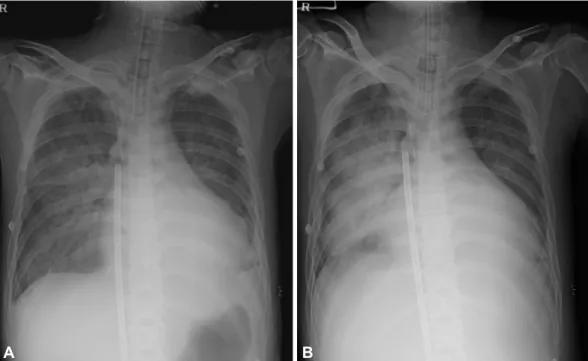
right femoral artery (Fig. 1A). With a flow rate of 4.0 L/min, st-

able blood pressure was maintained but pulmonary edema

and left heart distention rapidly deteriorated (Fig. 1B). Thir-

(2)

Min-Ho Kang, et al. 403

ty-four hours later, it was decided to perform percutaneous transseptal LA decompression under fluoroscopic guidance.

Transseptal puncture was performed via the left femoral vein using a Brockenbrough transseptal needle with a 8-Fr Mullin sheath. A 28-Fr cannula was positioned in the LA after dilat- ing the puncture site of the atrial septum with a percutaneous mitral valvuloplasty dilator. The LA drain was then incorpo- rated into the venous limb of the PCPS circuit. There were no complications related to this procedure. Within hours, the pa- tient’s pulmonary edema improved considerably, and his dis- tended left heart diminished (Fig. 2). Decompression continu- ed for 5 days, and the patient was weaned from PCPS after a total of 6 days following restoration of stable hemodynamics without neurologic sequelae. After immunosuppressive ther- apy, the patient was discharged. Echocardiography perform- ed 4 months after discharge revealed normal left ventricular function without left to right shunting through the transseptal puncture site.

Discussion

HLH is often a fatal disease caused by specific gene muta- tions, various infections, hematologic malignancies, autoim- mune disorders or drugs. HLH may manifest with multiple or- gan dysfunction, including cardiac involvement.

8)9)

According to the Extracorporeal Life Support Organization registry, there was an increase in the proportion of pediatric pa- tients undergoing LA decompression over the study period, from 4% between 1995 and 1998, to 30% between 2003 and 2006.

2)

However, the data regarding adult patients are limited,

and the frequency of left heart decompression and success rates have not been reported. As ischemic heart disease a very common underlying conditions in adult patients with PCPS, there may be greater need for left heart decompression in adult patients than in pediatric patients. Therefore, it is important to develop a useful left heart decompression method in adult patients during PCPS.

A B

Fig. 1. Chest radiographs showing interval change over time since percutaneous cardiopulmonary support initiation. A: anteroposterior chest radiograph illustrating percutaneous cardiopulmonary support initiation. B: chest radiograph showing severe pulmonary edema and left heart distension developed shortly after percutaneous cardiopulmonary support initiation.

Fig. 2. Anteroposterior chest radiograph following percutaneous

transseptal left atrial drainage while on percutaneous cardiopul-

monary support, with left heart decompression and subsequent im-

provement of pulmonary edema.

(3)

404 Left Heart Decompression on PCPS

Aiyagari et al.

6)

showed that adequate decompression of the left heart could be achieved by transseptal left atrial sheath pl- acement incorporated into an extracorporeal membrane ox- ygenation venous circuit in a study of 7 cases. However, there were no adult survivors. In that study, the size of the left atrial drain catheters used was 8- to 15-Fr. Larger LA cannulae dia- meters and higher maximum LA cannula flow rates indexed to body surface area were associated with more satisfactory left heart decompression.

6)

Poor outcomes in adult patients may be attributable to small cannula size. Therefore, we inserted a large cannula (28-Fr) into the LA under fluoroscopic guidance for our patient. Transsepal left heart catheterization using a large cannula has been widely applied to manage patients with various indications, such as ablation of atrial fibrillation and percutaneous mitral valvuloplasty, in which its safety and feasibility have been demonstrated.

10-12)

In addition, gradual dilation of the puncture site in the atrial septum may lower the risk of complications. To our knowledge, this is the first report describing effective left heart decompression and successful weaning of PCPS via percutaneous transseptal LA drainage in an adult patient.

In summary, percutaneous transseptal left atrial drainage with a large venous cannula appears to be feasible and effec- tive for the decompression of the left heart in adult patients dur- ing PCPS.

REFERENCES

1) Rhee I, Gwon HC, Choi JH, et al. Percutaneous cardiopulmonary support for emergency in-hospital cardiac arrest or cardiogenic shock.

Korean Circ J 2006;36:11-6.

2) Rajagopal SK, Almond CS, Laussen PC, Rycus PT, Wypij D, Thiaga- rajan RR. Extracorporeal membrane oxygenation for the support of

infants, children, and young adults with acute myocarditis: a review of the Extracorporeal Life Support Organization registry. Crit Care Med 2010;38:382-7.

3) Ward KE, Tuggle DW, Gessouroun MR, Overholt ED, Mantor PC.

Transseptal decompression of the left heart during ECMO for severe myocarditis. Ann Thorac Surg 1995;59:749-51.

4) Seib PM, Faulkner SC, Erickson CC, et al. Blade and balloon atrial septostomy for left heart decompression in patients with severe ventri- cular dysfunction on extracorporeal membrane oxygenation. Cathe- ter Cardiovasc Interv 1999;46:179-86.

5) Cheung MM, Goldman AP, Shekerdemian LS, Brown KL, Cohen GA, Redington AN. Percutaneous left ventricular “vent” insertion for left heart decompression during extracorporeal membrane oxygenation. Pe- diatr Crit Care Med 2003;4:447-9.

6) Aiyagari RM, Rocchini AP, Remenapp RT, Graziano JN. Decompres- sion of the left atrium during extracorporeal membrane oxygenation using a transseptal cannula incorporated into the circuit. Crit Care Med 2006;34:2603-6.

7) Guirgis M, Kumar K, Menkis AH, Freed DH. Minimally invasive left- heart decompression during venoarterial extracorporeal membrane oxygenation: an alternative to a percutaneous approach. Interact Car- diovasc Thorac Surg 2010;10:672-4.

8) Creput C, Galicier L, Buyse S, Azoulay E. Understanding organ dys- function in hemophagocytic lymphohistiocytosis. Intensive Care Med 2008;34:1177-87.

9) Karapinar B, Yilmaz D, Balkan C, Akin M, Ay Y, Kvakli K. An unus- ual cause of multiple organ dysfunction syndrome in the pediatric in- tensive care unit: hemophagocytic lymphohistiocytosis. Pediatr Crit Care Med 2009;10:285-90.

10) Hammerstingl C, Lickfett L. Safety of single transseptal puncture for ablation of atrial fibrillation: retrospective study from a large cohort of patients. J Cardiovasc Electrophysiol 2008;19:E36; author reply E37.

11) Babaliaros VC, Green JT, Lerakis S, Lloyd M, Block PC. Emerging applications for transseptal left heart catheterization old techniques for new procedures. J Am Coll Cardiol 2008;51:2116-22.

12) Liu TJ, Lai HC, Lee WL, et al. Immediate and late outcomes of pa- tients undergoing transseptal left-sided heart catheterization for symp- tomatic valvular and arrhythmic diseases. Am Heart J 2006;151:

235-41.

수치

Fig. 1. Chest radiographs showing interval change over time since percutaneous cardiopulmonary support initiation

참조

관련 문서

Fig. Security Threats in Cloud Environments.. completely removed when the user leaves the existing cloud environment [4-12]. A user who has left creates a problem if he /

core exercise program showed not only increasing peak torque of the right leg, left leg in Hip Extension of exercise group but also increasing peak torque of the right leg, left

Percutaneous endoscopic cervical discectomy (PECD) is an effective minimally invasivesurgery for soft cervical disc herniation in properly selected cases..

For Kummell’s disease with persistent pain and without neurological symptoms, percutaneous vertebroplasty (VP) or balloon kyphoplasty (KP) has been known to

 When a symmetry operation has a locus, that is a point, or a line, or a plane that is left unchanged by the operation, this locus is referred to as the symmetry

82 year-old female patient with traffic accident, (A,B,C) Initial x-rays show open fracture of left distal femur(AO 33-C3, Gustilo-Anderson II) with patella

* When a symmetry operation has a locus, that is a point, or a line, or a plane that is left unchanged by the operation, this locus is referred to as the symmetry element..

Pilot Confirm runway 09 left for landing. ATC gives you further instructions to turn right heading 310. On the radar display, there was an area to avoid which requires a