A Case of a Shiga Toxin Producing Escherichia Coli
Seung-Hak Cho,
1* Jung-Beom Kim,
2* Yong-Bae Park,
2Mi-Sun Park,
1Hiun Suk Chae,
3and Hae Kyung Lee
41Division of Enteric Bacterial Infections, Center for Infectious Diseases, Korea National Institute of Health, Osong;
2Division of Health Research and Planning, Gyeonggi-do Research Institute of Health and Environment, Suwon;
Departments of 3Internal Medicine and 4Laboratory Medicine, Uijeongbu St. Mary's Hospital, The Catholic University of Korea College of Medicine, Uijeongbu, Korea.
Received: June 10, 2011 Revised: August 10, 2011 Accepted: August 11, 2011
Corresponding author: Dr. Hae Kyung Lee, Department of Laboratory Medicine, The Catholic University of Korea College of Medicine,
65-1 Geumo-dong, Uijeongbu 480-717, Korea.
Tel: 82-31-820-3159, Fax: 82-31-847-6266 E-mail: [email protected]
*Seung-Hak Cho and Jung-Beom Kim contributed equally to this work.
∙ The authors have no financial conflicts of interest.
© Copyright:
Yonsei University College of Medicine 2011 This is an Open Access article distributed under the terms of the Creative Commons Attribution Non- Commercial License (http://creativecommons.org/
licenses/by-nc/3.0) which permits unrestricted non- commercial use, distribution, and reproduction in any medium, provided the original work is properly cited.
We encountered a patient with hemolytic uremic syndrome (HUS) with persistent isolation of shiga toxin-producing Escherichia coli (STEC) for 3 weeks despite of having no clinical symptoms. STEC has been recognized as an important food- borne pathogen that causes severe diseases such as HUS. We characterized this STEC strain via a polymerase chain reaction, reverse-passive latex agglutination and the slide agglutination method. In this STEC strain, stx2 (shiga toxin), eaeA, tir, iha (adherence genes), espADB (type III secretion genes), and hlyA, ehxA, clyA (hemolysin genes) were present. The O antigen of the strain was non-typable.
Key Words: Shiga toxin-producing Escherichia coli, hemolytic uremic syn- drome, non-typable serotype STEC strain
INTRODUCTION
Shiga toxin-producing Escherichia coli (STEC) O157:H7 has been recognized as an important food-borne pathogen that causes severe diseases such as a hemolytic uremic syndrome (HUS).1 The majority of cases of this disease are caused by strains of the serotype O157:H7, but infections by enterohemorrhagic Escherichia coli (EHEC) strains belonging to serogroups other than O157, such as O26, O103, O111and O145, have been reported with increasing frequency.1,2
Shiga toxins (stxs) are the virulence factor of EHEC. The two groups consist of stx1 and stx2.3 Apart from stxs, there are various virulence factors of EHEC, eae (Intimin), tir (translocated intimin receptor), hlyA (EHEC hemolysin), and espADB (type III secretion proteins).1,4 The locus for enterocyte effacement (LEE) is asso- ciated with intimate adherence to epithelial cells.5 Several protein were proposed to be adhesion factors in LEE-negative strains, including iha (an adherence-con- ferring protein),6 efa1 (an EHEC factor for adherence),7 Saa (an autoagglutinating adhesin)8 and toxB (a protein from 93-kbplasmid pO157), which are required for O157:H7 strain Sakai expression of adherence.9 E. coli hemolysin (hlyA), entero- hemorrhagic E. coli toxin (ehx) and cytolysin A (clyA) are well known as repeats in the toxin (RTX) family.10-12
In Korea, we encountered a patient who had been hospitalized for a long-time, due
genes, eaeA and tir genes and non-LEE adhesion genes such as the iha, saa, efa1 and toxB genes, were analyzed in the STEC strain. The eaeA, tir, and iha genes were present in the strain (Table 1). All the genes tested for type III se- cretion proteins, i.e., espADB were found in the strain in the PCR analysis. PCR analysis showed that the hlyA, ehxA, and clyA genes for hemolysin production were de- tected in the strain (Table 1).
The presence of O antigens was determined by slide ag- glutination with the available O (O1-O181) antisera (Uni- versidad de Santiago de Compostela, Lugo, Spain).13 We performed serotyping of the stain with the antisera. Howev- er, the serotype of the strain was non-typable with the tested antisera.
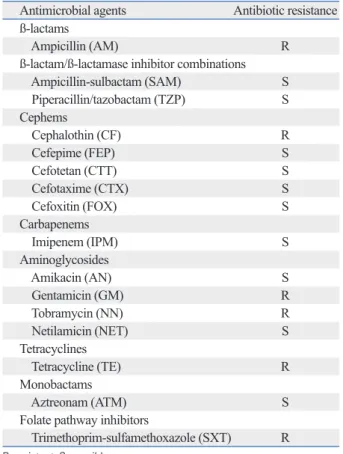
Antimicrobial susceptibility of the isolate to the following 16 antibiotics was determined by agar disk diffusion (Kirby- Bauer method) using Mueller-Hinton agar (Difco) : ampi- cillin/sulbactam (SAM), ampicillin (AM), tetracycline (TE), aztreonam (ATM), cefotetan (CTT), cefepime (FEP), cefoxitin (FOX), cefotaxime (CTX), tobramycin (NN), tri- methoprim/sulfamethoxazole (SXT/TM), cephalothin (CF), imipenem (IPM), gentamicin (GM), amikacin (AN), piper- acillin/tazobactam (TZP), netilamicin (NET). E. coli ATCC 25922 and E. coli ATCC 35218 were used as quality con- trols. As shown in Table 2, the isolate showed resistance to Ampicillin, Tetracycline and Trimethoprim-sulfamethoxa- zole, while it was sensible to two antibiotics of β-lactam/
β-lactamase inhibitor combinations and Imipenem. Among the Cephems, the isolate showed resistance only to Cepha- lothin. On hospital day (HD) 17, cefuroxime was started due to persistent STEC isolation. On HD38, cefepime was started for four days. On HD 49, she was discharged after having negative results for stool STEC isolation for a week.
DISCUSSION
In the present study, we characterized the virulence genes of the STEC strain. Our results showed that the strain in this study possessed many virulent factors for infection, for example, toxins, adhesins and hemolysins.
The Shiga-toxin genotype of the infecting strain may in- fluence the risk of developing microangiopathic sequelae and the outcome of infection. Patients infected with STEC 0157 possessing stx2 but not stx1 had significantly devel- oped systemic sequelae, including HUS, than patients in- fected with STEC 0157 harboring stx1 alone or both stx1 to long-term isolation of STEC. We conducted molecular and
serotype analyses on this patient.
CASE REPORT
A three-year-old child was admitted to Uijeongbu St. Mary’s Hospital with abdominal pain and watery/bloody diarrhea 3-4 days after eating boiled fish paste. Physical examination upon admission was unremarkable. The abdomen computer- ized tomography image showed prominent submucosal edema of the total colon. Hematological tests revealed-: he- moglobin 12.6 g/dL, leukocyte count 43.5×10⁹/L with neu- trophilia (90%), platelet count 33×109/L. The results of a blood chemistry study of the serum samples were blood urea nitrogen, 39.1 mg/dL, albumin 1.7 g/dL and CRP 5.03 mg/dL. The serum creatinine level was increased from 0.44 mg/dL to 2.33 mg/dL. Urinalysis showed four positive tests for hematuria and proteinuria. A diagnosis of HUS was made and the patient was transferred to another hospital, where she underwent hemodialysis.
She was admitted to our hospital a second time due to persistent STEC isolation, although her clinical symptoms were improved. We isolated the STEC strain from the pa- tient’s stool. However, no other pathogenic bacteria such as Salmonella spp., Shigella spp., and Vibrio spp. were detect- ed in the stool. The isolate was biochemically characterized using the API20E system (Biomerieux, Marcy l’Etoile, France). The isolate was directly inoculated into 3 mL of Luria-Bertani (LB) broth, and this was incubated overnight at 37ºC. After incubation, the enriched broth culture was centrifuged at 13,000 rpm (Sorvall® Biofuge Pico, Germa- ny) for 1 min and the pellet was heated at 100ºC for 10 min.
Following centrifugation, 5 µL of the supernatant was used in the PCR assays. The PCR assays were performed using the primers shown in Table 1. The PCR assays were carried out in a 50 µL volume with 2 U DNA Taq polymerase (Taka- ra Ex TaqTM, Otsu, Japan) in a thermal cycler (PTC-100; MJ Research, Watertown, MA, USA). Positive DNA and dis- tilled water were used as positive and negative controls.
Production of stx1 and stx2 was determined using a re- versed passive latex agglutination kit (VTEC-RPLA; Den- ka Seiken Co., Ltd., Tokyo, Japan). One mL of the overnight culture was centrifuged and the titer of the supernatant was determined using the VTEC-RPLA test, which was per- formed at dilutions up to 1 : 256. The PCR and RPLA test showed that the strain produced only stx2. The adherence
cytes, and renal tubularcells.12 The HlyA is frequently pro- duced by E. coli strains that cause urinary tract infections, while ehxA is found in the EHEC strains of serogrou- pO157.10 ClyA is the prototype of pore-forming cytotoxins.18
Although STEC O157:H7 is known to be the predomi- nant serotype associated with most STEC-related outbreaks worldwide, previous epidemiological studies have implied that non-O157 STEC infection is becoming problematic in public health.19 Among those non-O157 STEC associated with human disease are the serotypes O8:H-, O26:H11, O91:H21, O103:H2, O111:H-, O113:H21, and O128:H2.1 The O antigen of the strain was non-typable. From this re- sult, we suggest that a non-typable serotype might play an important role in causing a long-term carrier state.
There have been several reports of Stx producing E. coli and stx2.14 The strain in this study possessed only stx2 gene
among stx genes (Table 1).
The stx2 toxin has been described as being 1,000 times more cytotoxic than the stx1 toxin, and was related with high virulence in STEC strains from HUS patients.15 The adher- ence of bacteria is important for the infection. Enteropatho- genic E. coli (EPEC) and EHEC produce an adherence fac- tor, intimin encoded by the eae gene.16 This gene is detected in the locus of enterocyte effacement (LEE), which is re- quired for attachment-effacement lesions. Another study showed that the most widely distributed STEC adhesin gene was the iha gene.17 The LEE gene encodes the type III secre- tion system.4 The strain possessed all the tested genes related with the hemolysin. HlyA lyses cells via the creation of pores in the cell membrane and this affects erythrocytes, leuko-
Table 1. Detection of Virulence Genes in the Shiga Toxin Producing Escherichia Coli (STEC) Strain Isolated from a Long-Term Hospitalized Patient
Description Target genes Primer sequence (5’ to 3’) Size of PCR
product (bp) Presence of target gene Shiga toxin genes stx1 CGTACGGGGATGCAGATAAATCGC
CAGTCATTACATAAGAACGCCCAC 210 No
stx2 GTTCTGCGTTTTGTCACTGTCAC
GTCGCCAGTTATCTGACATTCTGG 326 Yes
LEE adhesion genes eaeA ATGCTGGCATTTGGTCAGGTCGG
TGACTCATGCCAGCCGCTCATGCG 233 Yes
tir GCTTGCAGTCCATTGATCCT
GGGCTTCCGTGATATCTGA 107 Yes
Non-LEE adhesion genes iha CAGTTCAGTTTCGCATTCACC
GTATGGCTCTGATGCGATG 1,305 Yes
saa CGTGATGAACAGGCTATTGC
ATGGACATGCCTGTGGCAAC 119 No
toxB ATACCTACCTGCTCTGGATTGA
TTCTTACCTGATCTGATGCAGC 602 No
efa1 GAGACTGCCAGAGAAAG
GGTATTGTTGCATGTTCAG 479 No
Type III secretion genes espA GTTTTTCAGGCTGCGATTCT
AGTTTGGCTTTCGCATTCTT 187 Yes
espD AAAAAGCAGCTCGAAGAACA
CCAATGGCAACAACAGCCCA 145 Yes
espB GCCGTTTTTGAGAGCCAGAA
AAAGAACCTAAGATCCCCA 106 Yes
Genes for hemolysin hlyA GCATCATCAAGCGTACGTTCC
AATGAGCCAAGCTGGTTAAGCT 519 Yes
ehxA GGTGCAGCAGAAAAAGTTGTAG
TCTCGCCTGATAGTGTTTGGTA 1,551 Yes
clyA GAGGCGAATGATTATGACTG
ACTTCAGGTACCTCAAAGAG 920 Yes
PCR, polymerase chain reaction; bp, base pair; LEE, locus for enterocyte effacement.
biol Rev 1998;11:142-201.
2. Tozzi AE, Caprioli A, Minelli F, Gianviti A, De Petris L, Edefonti A, et al. Shiga toxin-producing Escherichia coli infections associ- ated with hemolytic uremic syndrome, Italy, 1988-2000. Emerg Infect Dis 2003;9:106-8.
3. Melton-Celsa AR, O’Brien AD. Animal models for STEC-medi- ated disease. Methods Mol Med 2003;73:291-305.
4. Makino S, Tobe T, Asakura H, Watarai M, Ikeda T, Takeshi K, et al. Distribution of the secondary type III secretion system locus found in enterohemorrhagic Escherichia coli O157:H7 isolates among Shiga toxin-producing E. coli strains. J Clin Microbiol 2003;41:2341-7.
5. Clarke SC, Haigh RD, Freestone PP, Williams PH. Virulence of enteropathogenic Escherichia coli, a global pathogen. Clin Micro- biol Rev 2003;16:365-78.
6. Tarr PI, Bilge SS, Vary JC Jr, Jelacic S, Habeeb RL, Ward TR, et al. Iha: a novel Escherichia coli O157:H7 adherence-conferring molecule encoded on a recently acquired chromosomal island of conserved structure. Infect Immun 2000;68:1400-7.
7. Nicholls L, Grant TH, Robins-Browne RM. Identification of a novel genetic locus that is required for in vitro adhesion of a clini- cal isolate of enterohaemorrhagic Escherichia coli to epithelial cells. Mol Microbiol 2000;35:275-88.
8. Paton AW, Srimanote P, Woodrow MC, Paton JC. Characteriza- tion of Saa, a novel autoagglutinating adhesin produced by locus of enterocyte effacement-negative Shiga-toxigenic Escherichia coli strains that are virulent for humans. Infect Immun 2001;69:
6999-7009.
9. Tatsuno I, Horie M, Abe H, Miki T, Makino K, Shinagawa H, et al. toxB gene on pO157 of enterohemorrhagic Escherichia coli O157:H7 is required for full epithelial cell adherence phenotype.
Infect Immun 2001;69:6660-9.
10. Welch RA, Forestier C, Lobo A, Pellett S, Thomas W Jr, Rowe G.
The synthesis and function of the Escherichia coli hemolysin and related RTX exotoxins. FEMS Microbiol Immunol 1992;5:29-36.
11. Bauer ME, Welch RA. Characterization of an RTX toxin from en- terohemorrhagic Escherichia coli O157:H7. Infect Immun 1996;
64:167-75.
12. König B, Ludwig A, Goebel W, König W. Pore formation by the Escherichia coli alpha-hemolysin: role for mediator release from human inflammatory cells. Infect Immun 1994;62:4611-7.
13. Guinée PA, Agterberg CM, Jansen WH. Escherichia coli O anti- gen typing by means of a mechanized microtechnique. Appl Mi- crobiol 1972;24:127-31.
14. Ostroff SM, Tarr PI, Neill MA, Lewis JH, Hargrett-Bean N, Ko- bayashi JM. Toxin genotypes and plasmid profiles as determinants of systemic sequelae in Escherichia coli O157:H7 infections. J In- fect Dis 1989;160:994-8.
15. Tarr PI, Gordon CA, Chandler WL. Shiga-toxin-producing Esche- richia coli and haemolytic uraemic syndrome. Lancet 2005;365:
1073-86.
16. Jerse AE, Gicquelais KG, Kaper JB. Plasmid and chromosomal elements involved in the pathogenesis of attaching and effacing Escherichia coli. Infect Immun 1991;59:3869-75.
17. Toma C, Martínez Espinosa E, Song T, Miliwebsky E, Chinen I, Iyoda S, et al. Distribution of putative adhesins in different seropa- thotypes of Shiga toxin-producing Escherichia coli. J Clin Micro- biol 2004;42:4937-46.
18. Oscarsson J, Westermark M, Löfdahl S, Olsen B, Palmgren H, Mizunoe Y, et al. Characterization of a pore-forming cytotoxin ex-
from asymptomatic human carriers.20,21 The patient may have produced antibodies against the STEC strain during the long-term infection. However, further study of the mech- anisms of long-term isolation in the patient is needed.
In conclusion, we suggest that this result provides epide- miological information for a prototype of a molecular mech- anism showing how the STEC strain can remain in a pa- tient for a long time without causing symptoms.
ACKNOWLEDGEMENTS
This work was supported by a grant of the National Insti- tute of Health, Ministry of Health, and Welfare, Republic of Korea (NIH 4800-4845-300). We also acknowledge the fi- nancially supporting of Gyeonggi-do (Local Government), Republic of Korea and Catholic University, Republic of Korea.
REFERENCES
1. Nataro JP, Kaper JB. Diarrheagenic Escherichia coli. Clin Micro-
Table 2. Antibiotic Resistance Patterns of the Shiga Toxin Producing Escherichia Coli (STEC) Isolate
Antimicrobial agents Antibiotic resistance ß-lactams
Ampicillin (AM) R
ß-lactam/ß-lactamase inhibitor combinations Ampicillin-sulbactam (SAM) S Piperacillin/tazobactam (TZP) S Cephems
Cephalothin (CF) R
Cefepime (FEP) S
Cefotetan (CTT) S
Cefotaxime (CTX) S
Cefoxitin (FOX) S
Carbapenems
Imipenem (IPM) S
Aminoglycosides
Amikacin (AN) S
Gentamicin (GM) R
Tobramycin (NN) R
Netilamicin (NET) S
Tetracyclines
Tetracycline (TE) R
Monobactams
Aztreonam (ATM) S
Folate pathway inhibitors
Trimethoprim-sulfamethoxazole (SXT) R R, resistant; S, sensible.
SM, et al. Human Stx2-specific monoclonal antibodies prevent systemic complications of Escherichia coli O157:H7 infection. In- fect Immun 2002;70:612-9.
21. Stephan R, Untermann F. Virulence factors and phenotypical traits of verotoxin-producing Escherichia coli strains isolated from as- ymptomatic human carriers. J Clin Microbiol 1999;37:1570-2.
pressed by Salmonella enterica serovars typhi and paratyphi A. In- fect Immun 2002;70:5759-69.
19. Coombes BK, Wickham ME, Mascarenhas M, Gruenheid S, Fin- lay BB, Karmali MA. Molecular analysis as an aid to assess the public health risk of non-O157 Shiga toxin-producing Escherichia coli strains. Appl Environ Microbiol 2008;74:2153-60.
20. Mukherjee J, Chios K, Fishwild D, Hudson D, O’Donnell S, Rich