461
https://www.ejast.org
Journal of Animal Science and Technology
RESEARCH ARTICLE
J Anim Sci Technol 2021;63(2):461-464
https://doi.org/10.5187/jast.2021.e38 pISSN 2672-0191 eISSN 2055-0391
Complete genome sequence
of Escherichia coli K_EC180, a
bacterium producing shiga-like
toxin isolated from swine feces
Hyeri Kim
1#, Jae Hyoung Cho
1#, Jin Ho Cho
2#, Minho Song
3#, Hakdong Shin
4,
Sheena Kim
1, Eun Sol Kim
1, Hyeun Bum Kim
1* and Ju-Hoon Lee
5*
1Department of Animal Resources Science, Dankook University, Cheonan 31116, Korea 2Division of Food and Animal Science, Chungbuk National University, Cheongju 28644, Korea 3Division of Animal and Dairy Science, Chungnam National University, Daejeon 34134, Korea
4Department of Food Science and Biotechnology, College of Life Science, Sejong University, Seoul 05006, Korea
5Department of Food Animal Biotechnology, Department of Agricultural Biotechnology, Center for Food and Bioconvergence, Seoul National University, Seoul 08826, Korea
Abstract
Escherichia coli normally colonizes the lower intestine of animals and humans, but some serotypes are foodborne pathogens. The Escherichia coli K_EC180 was isolated from swine feces that were collected from a weaner pig. In this genome announcement, E. coli K_EC180 was sequenced using PacBio RS II and Illumina NextSeq 500 platforms. The complete chro-mosome of E. coli K_EC180 is composed of one circular chrochro-mosome (5,017,281 bp) with 50.4% of guanine + cytosine (G + C) content, 4,935 of coding sequence (CDS), 88 of tRNA, and 22 of rRNA genes. The complete genome of E. coli K_EC180 contains the toxin genes such as shiga-like toxins (stxA and stxB).
Keywords: Escherichia coli K_EC180, Swine feces, Whole genome sequencing, Shiga-like toxin
INTRODUCTION
Escherichia coli is a facultative anaerobic bacterium which is commonly spread on biosphere. E. coli
normally colonizes the lower intestine of animals and humans (1). However, Some of the serotypes such as Enterohemorrhagic E. coli (EHEC), Enterotoxigenic E. coli (ETEC), Enteropathogenic E. coli (EPEC) and Shiga toxin-producing E. coli (STEC) can cause foodborne illnesses in people.
E. coli K_EC180 was isolated from swine feces that were collected from a livestock farm in
Haenam-gun, Jeollanam-do, Korea. E. coli K_EC180 was streaked to Luria-Bertani (LB) agar and incubated at 37℃ for 24 h. The suspected colony in LB agar was inoculated into LB broth and incubated at 37℃ for 24 h. To analyze the complete genome, the E. coli K_EC180 genome was sequenced by PacBio RS II (Pacific Biosciences, Menlo Park, CA, USA) at Insilicogen (Yongin, Korea) and Illumina NextSeq 500 (Illumina, San Diego, CA, USA) platform at LabGenomics (Seongnam, Korea). The genomic DNA of E. coli K_EC180 for PacBio and Illumina sequencing was extracted using the MagAttract
Received: Oct 22, 2020 Revised: Jan 20, 2021 Accepted: Jan 21, 2021
# These authors contributed equally to this work.
*Corresponding author
Hyeun Bum Kim
Department of Animal Resources Science, Dankook University, Cheonan 31116, Korea.
Tel: +82-41-550-3653 E-mail: [email protected] Ju-Hoon Lee
Department of Food Animal Biotechnology, Department of Agricultural Biotechnology, Center for Food and Bioconvergence, Seoul National University, Seoul 08826, Korea.
Tel: +82-2-880-4854 E-mail: [email protected]
Copyright © 2021 Korean Society of Animal Sciences and Technology. This is an Open Access article distributed under the terms of the Creative Commons Attribution Non-Commercial License (http:// creativecommons.org/licenses/by-nc/4.0/) which permits unrestricted non-commercial use, distribution, and reproduction in any medium, provided the original work is properly cited.
Escherichia coli K_EC180 genome
462 | https://www.ejast.org https://doi.org/10.5187/jast.2021.e38
HMW DNA Kit (QIAGEN), and NucleoSpin® Microbial DNA kit (TAKARA) according to the manufacturer’s instructions. Library preparation was conducted using SMRTbell™ Template Prep Kit 1.0 for Pacbio (Pacific Biosciences) and TruSeq DNA Sample Preparation Kit for Illumina (Illumina) according to the manufacturer’s instructions. PacBio sequencing yielded 1,131,537,370 base pairs and 145,423 long reads after filtering, and 9,199,306 paired-end reads with 1,389,095,206 bp were obtained with Illumina sequencing. De novo assembly was conducted using the hierarchical genome assembly process (HGAP v2.3.0) workflow (Chin et al., 2013) and polished using Quiver. Subsequently, Illumina NextSeq reads were aligned to the PacBio RSII assembly using Burrows-Wheeler Aligner (BWA)-MEM v0.7.17-r1188, and the errors were corrected by using Pilon version 1.23 (2, 3). The quality of genome assembly and the validaty of the final genome were assessed using Quality Assessment Tool for Genome Assemblies (QUAST) v5.0.2 and Benchmarking Universal Single-Copy Orthologs (BUSCO) v3.0.2 (4, 5). Open reading
ORCID
Hyeri Kim
https://orcid.org/0000-0002-6560-2390 Jae Hyoung Cho
https://orcid.org/0000-0002-1128-3451 Jin Ho Cho https://orcid.org/0000-0001-7151-0778 Minho Song https://orcid.org/0000-0002-4515-5212 Hakdong Shin https://orcid.org/0000-0001-7615-9809 Sheena Kim https://orcid.org/0000-0002-5410-1347 Eun Sol Kim
https://orcid.org/0000-0001-8801-421X Hyeun Bum Kim
https://orcid.org/0000-0003-1366-6090 Ju-Hoon Lee
https://orcid.org/0000-0003-0405-7621
Competing interests
No potential conflict of interest relevant to this article was reported.
Funding sources
The present study was supported by the research fund (19162MFDS037) from the Ministry of Food and Drug Safety, Republic of Korea, and by the University Innovation Support Program through the National Research Foundation of Korea (NRF) funded by the Ministry of Education (Dankook University 2019).
Acknowledgements
We thank Mo Re Kim (Brandeis University, MA, USA) for the English grammar corrections.
Availability of data and material
Upon reasonable request, the datasets of this study can be available from the corresponding author.
Authors’ contributions
Conceptualization: Cho Jin Ho, Song MH, Kim HB, Lee JH.
Data curation: Kim H, Shin H, Kim S, Kim ES.
Formal analysis: Kim H, Shin H, Kim S, Kim ES.
Methodology: Kim H, Cho Jae Hyoung, Song MH.
Software: Kim H, Cho Jae Hyoung, Song MH.
Validation: Kim H, Shin H, Kim S, Kim ES. Investigation: Kim H, Cho Jin Ho, Song MH,
Kim HB, Lee JH.
Writing - original draft: Kim H, Cho Jae Hyoung, Song MH, Kim HB, Lee JH. Writing - review & editing: Kim H, Cho Jin
Ho, Song MH, Kim HB, Lee JH.
Ethics approval and consent to participate
This article does not require IRB/IACUC approval because there are no human and animal participants.
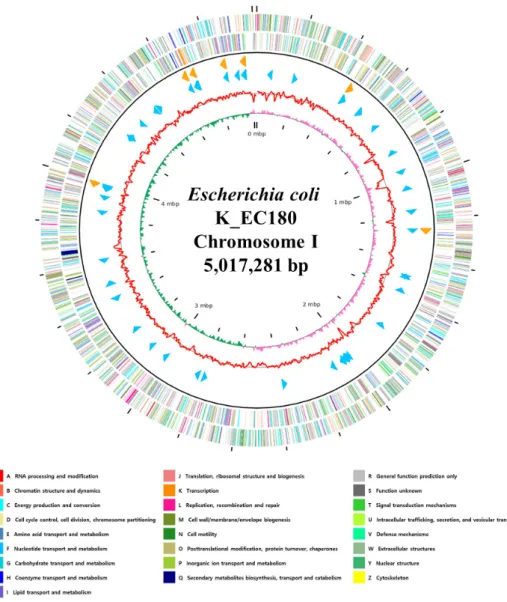
Fig. 1. Genome map of Escherichia coli K_EC180. The outer circle denotes the locations of all annotated ORFs, and the inner circle with the red denotes GC content. Pink, and green peaks denote GC skew. The orange arrows denote rRNAs, and the sky blue arrows denote the tRNA operons. All annotated ORFs are colored differently based on the COG assignments. ORFs, open reading frames; G, guanine; C, cytosine; COG, clusters of orthologous groups.
https://doi.org/10.5187/jast.2021.e38 https://www.ejast.org| 463
Kim et al.
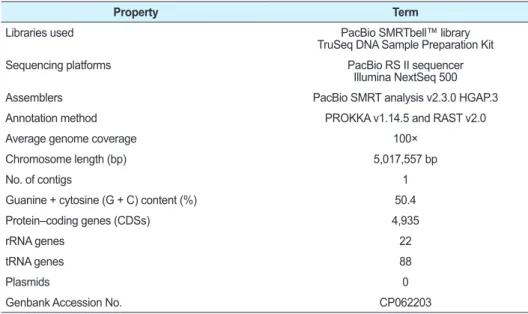
frames (ORFs) and RNA genes of E. coli K_EC180 were predicted and functionally annotated through rapid prokaryotic genome annotation (PROKKA) v1.14.5 (6) and Rapid Annotation using Subsystem Technology (RAST) v2.0 (7). The functional categorization and classification of all predicted ORFs were conducted using the RAST server-based SEED viewer and Clusters of Orthologous Groups (COG) – based EggNOG. The putative virulence factors and Antimicrobial resistance were described using BLAST according to the Virulence Factor Database (VFDB) (8). The whole genome of E. coli K_EC180 is composed of one circular chromosome (5,017,281 bp) with 50.4% of G+C content, 4,935 of coding sequence (CDS), 88 of tRNA, and 22 of rRNA genes. The complete genome of E. coli K_EC180 contains the toxin genes encoding shiga-like toxin (stx2e subunit A and stx2e subunit B), which may cause diseases in humans by damaging small blood vessels in places such as the digestive tract, kidneys and central nervous system (9, 10). E.
coli K-EC180 also possessed essC, escV, escR, escS, escV, and escJ genes which involved in a type
III secretion system. In addition, there were fim (A to H) genes encoding Type I fimbriae. We summarized the general properties of the E. coli K_EC180’s complete genome in the Fig. 1 and Table 1.
DATA AVAILABILITY
The complete genome sequences of E. coli K_EC180 were deposited in GeneBank under the accession numbers CP062203. The BioSample accession number is SAMN16277032, and BioProject accession number is PRJNA666028.
REFERENCES
1. Guevarra RB, Lee JH, Lee SH, Seok MJ, Kim DW, Kang BN, et al. Piglet gut microbial shifts early in life: causes and effects. J Anim Sci Biotechnol. 2019;10:1. https://doi.org/10.1186/ s40104-018-0308-3
2. Li H. Aligning sequence reads, clone sequences and assembly contigs with BWA-MEM. arXiv. https://arxiv.org/abs/1303.3997
Table 1. Genome features of Escherichia coli K_EC180
Property Term
Libraries used PacBio SMRTbell™ library
TruSeq DNA Sample Preparation Kit
Sequencing platforms PacBio RS II sequencer
Illumina NextSeq 500
Assemblers PacBio SMRT analysis v2.3.0 HGAP.3
Annotation method PROKKA v1.14.5 and RAST v2.0
Average genome coverage 100×
Chromosome length (bp) 5,017,557 bp
No. of contigs 1
Guanine + cytosine (G + C) content (%) 50.4
Protein–coding genes (CDSs) 4,935
rRNA genes 22
tRNA genes 88
Plasmids 0
Escherichia coli K_EC180 genome
464 | https://www.ejast.org https://doi.org/10.5187/jast.2021.e38
3. Walker BJ, Abeel T, Shea T, Priest M, Abouelliel A, Sakthikumar S, et al. Pilon: an integrated tool for comprehensive microbial variant detection and genome assembly improvement. PLOS ONE. 2014;9:e112963. https://doi.org/10.1371/journal.pone.0112963
4. Simão FA, Waterhouse RM, Ioannidis P, Kriventseva EV, Zdobnov EM. BUSCO: assessing genome assembly and annotation completeness with single-copy orthologs. Bioinformatics. 2015;31:3210-2. https://doi.org/10.1093/bioinformatics/btv351
5. Gurevich A, Saveliev V, Vyahhi N, Tesler G. QUAST: quality assessment tool for genome as-semblies. Bioinformatics. 2013;29:1072-5. https://doi.org/10.1093/bioinformatics/btt086 6. Seemann T. Prokka: rapid prokaryotic genome annotation. Bioinformatics. 2014;30:2068-9.
https://doi.org/10.1093/bioinformatics/btu153
7. Aziz RK, Bartels D, Best AA, DeJongh M, Disz T, Edwards RA, et al. The RAST server: rapid annotations using subsystems technology. BMC Genomics. 2008;9:75. https://doi. org/10.1186/1471-2164-9-75
8. Liu B, Zheng D, Jin Q, Chen L, Yang J. VFDB 2019: a comparative pathogenomic platform with an interactive web interface. Nucl Acids Res. 2019;47:D687-92.
9. Tesh VL, O’Brien AD. The pathogenic mechanisms of Shiga toxin and the Shiga-like toxins. Mol Microbiol. 1991;5:1817-22. https://doi.org/10.1111/j.1365-2958.1991.tb00805.x
10. O’Brien AD, Holmes RK. Shiga and Shiga-like toxins. Microbiol Rev. 1987;51:206-20. https://doi.org/10.1128/MR.51.2.206-220.1987