Gene-Environment Interactions in Asthma: Genetic and Epigenetic Effects
Jong-Uk Lee,
1Jeong Dong Kim,
1and Choon-Sik Park
21Department of Interdisciplinary Program in Biomedical Science Major, Soonchunhyang Graduate School, Bucheon;
2Genome Research Center and Division of Allergy and Respiratory Medicine, Soonchunhyang University Bucheon Hospital, Bucheon, Korea.
Received: March 31, 2015
Corresponding author: Dr. Choon-Sik Park, Genome Research Center and
Division of Allergy and Respiratory Medicine, Soonchunhyang University
Bucheon Hospital, 170 Jomaru-ro, Wonmi-gu, Bucheon 420-767, Korea.
Tel: 82-32-621-5105, Fax: 82-32-621-5023 E-mail: [email protected]
∙ The authors have no financial conflicts of interest.
© Copyright:
Yonsei University College of Medicine 2015 This is an Open Access article distributed under the terms of the Creative Commons Attribution Non- Commercial License (http://creativecommons.org/
licenses/by-nc/3.0) which permits unrestricted non- commercial use, distribution, and reproduction in any medium, provided the original work is properly cited.
Over the past three decades, a large number of genetic studies have been aimed at finding genetic variants associated with the risk of asthma, applying various genetic and genomic approaches including linkage analysis, candidate gene polymorphism studies, and genome-wide association studies (GWAS). However, contrary to gen- eral expectation, even single nucleotide polymorphisms (SNPs) discovered by GWAS failed to fully explain the heritability of asthma. Thus, application of rare al- lele polymorphisms in well defined phenotypes and clarification of environmental factors have been suggested to overcome the problem of ‘missing’ heritability. Such factors include allergens, cigarette smoke, air pollutants, and infectious agents dur- ing pre- and post-natal periods. The first and simplest interaction between a gene and the environment is a candidate interaction of both a well known gene and envi- ronmental factor in a direct physical or chemical interaction such as between CD14 and endotoxin or between HLA and allergens. Several GWAS have found environ- mental interactions with occupational asthma, aspirin exacerbated respiratory dis- ease, tobacco smoke-related airway dysfunction, and farm-related atopic diseases.
As one of the mechanisms behind gene-environment interaction is epigenetics, a few studies on DNA CpG methylation have been reported on subphenotypes of asthma, pitching the exciting idea that it may be possible to intervene at the junction between the genome and the environment. Epigenetic studies are starting to include data from clinical samples, which will make them another powerful tool for re- search on gene-environment interactions in asthma.
Key Words: Asthma, gene, environment, polymorphism, genome, epigenetics, variants
INTRODUCTION
Asthma is a genetically complex disease associated with familial segregation of at- opy and increased levels of total serum IgE.1 Asthma and atopy are closely correlat- ed with increased bronchial hyperresponsiveness2 and elevated blood eosinophil count.3 These intermediate phenotypes are highly heritable and subject to intensive genetic research. Asthmatics cluster in families, indicating that a genetic component is likely to be involved. Twin studies represent a useful first step to determine wheth-
than 300 genes containing asthma-associated SNPs record- ed in the NCBI databases (www.ncbi.nlm.nih.gov). As of March 2015, a keyword search for “asthma and polymor- phism” returned 2851 publications, including 226 papers published in Korea. Interestingly, almost all associated SNPs have odds ratios (ORs) below 2.0, indicating that the candi- date gene approach has provided information on genetic variants causing a significant risk of increase in asthma, but their contribution to the development of asthma may be smaller than expected.
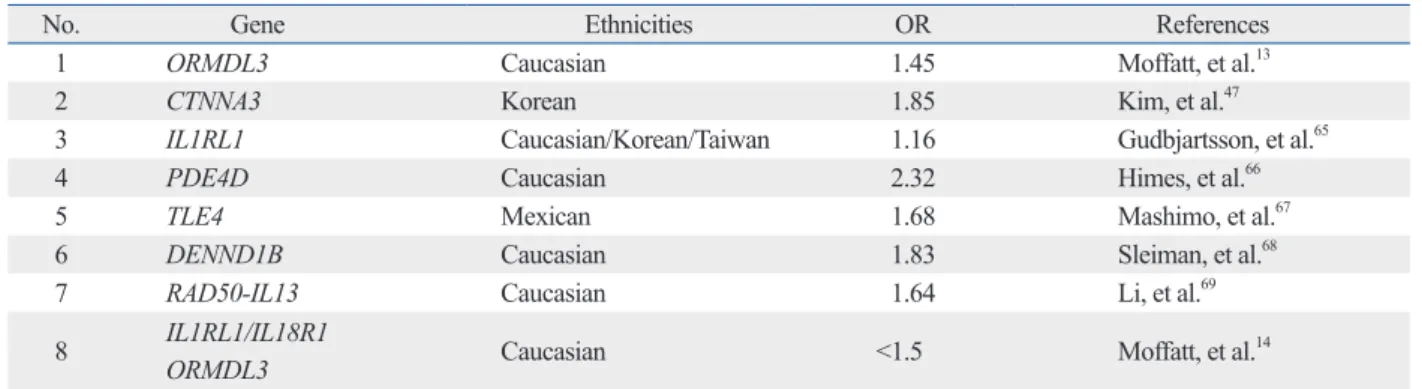
Since the development of GWAS, genotyping of 500000 SNPs enables nearly complete surveys of all common ge- netic variability.12 Based on this concept, whole genome SNP genotyping arrays have been developed and employed for investigating the genetic background of multifactorial complex diseases over the past 8 years. As of February 2012, 2111 GWAS had been published showing statistical signifi- cance for 17 traits of common allele complex diseases (NH- GRI catalogue at www.genome.gov/gwastudies). GWAS on asthma and its traits have been published from 2007 on- wards, producing 408 publication titles containing “GWAS and Asthma” in PubMed, including 23 with Korean asth- matics. Among the initial eight studies (Table 1), six per- tained to Caucasians, one to Mexicans, and Koreans were included in two studies. Seven studies focused on asthma risk, the remaining one on occupational asthma.
The first GWAS on asthma, published in England in 2007,13 found strong signals on chromosome 17q and on chromosome 2. SNPs associated with childhood asthma could be consistently linked to transcript levels of ORM- DL3, a member of a gene family that encodes transmem- brane proteins anchored in the endoplasmic reticulum.13 The second asthma GWAS analyzed sequence variants affecting blood eosinophil counts in Icelanders, and the ten most sig- nificant SNPs were further studied in 12118 Europeans and er a given trait or disease has a measurable genetic compo-
nent. In a large twin study with 7000 same-sex twins born between 1886 and 1925, the concordance rate for self-re- ported asthma in monozygotic (MZ) twin pairs was 19%, four times as high as the 4.8% in dizygotic (DZ) twins.4 Her- itability has been estimated as up to 60% and is thought to be determined by genetic factors such as nucleotide variants.
Identification of single nucleotide polymorphisms (SNPs) associated with asthma
To search for nucleotide variants as genetic factors, genome- wide linkage analyses, biologically plausible candidate-gene approaches, and genome-wide association studies (GWAS) have been used over the past 30 years. While monogenic disorders with simple Mendelian inheritance such as cystic fibrosis have been successfully identified using whole ge- nome linkage analysis, positional cloning, and case control studies,5 more than 100 loci on autosomal and sex chromo- somes have been found to be linked to asthma. Among them, at least 5 asthma genes, including a disintegrin and metalloprotease 33 (ADAM33) on 20p13,6 dipeptidyl pepti- dase 10 (DPP10) on 2q14.1,7 plant homeodomain zinc fin- ger protein 11 (PHF11) on 13q14.2,8 G protein-coupled re- ceptor (GPR) for asthma susceptibility on 7p15-p14,9 and prostaglandin D2 receptor (PTGDR) on 14q24,10 have been identified as strongly associated with asthma. However, rep- lication studies including a large cohort of 7703 adults re- vealed that only a minor risk of increase in asthma incidence was linked to DPP10 and ADAM33.6,7 These limitations of linkage analysis in complex human disease have caused a redirection of focus from linkage analysis and microsatellite markers toward single nucleotide polymorphisms (SNP) ge- notyping and different analytical strategies based on associa- tion and haplotype analysis.11
Consequently, the candidate gene approach led to more
Table 1. Genes Associated with Asthma by GWAS Studies between 2007–2010
No. Gene Ethnicities OR References
1 ORMDL3 Caucasian 1.45 Moffatt, et al.13
2 CTNNA3 Korean 1.85 Kim, et al.47
3 IL1RL1 Caucasian/Korean/Taiwan 1.16 Gudbjartsson, et al.65
4 PDE4D Caucasian 2.32 Himes, et al.66
5 TLE4 Mexican 1.68 Mashimo, et al.67
6 DENND1B Caucasian 1.83 Sleiman, et al.68
7 RAD50-IL13 Caucasian 1.64 Li, et al.69
8 IL1RL1/IL18R1
ORMDL3 Caucasian <1.5 Moffatt, et al.14 OR, odds ratio; GWAS, genome-wide association studies.
Considering the causative factors of GWAS’ limitations such as imprecise disease phenotypes, use of control groups of questionable comparability, and inconsideration of envi- ronmental contributors, Manolio, et al.18 proposed the fol- lowing three solutions to overcome the missing heritability:
discovery of SNPs of rare allele frequencies, stratification of subjects into well defined specific phenotypes, and clari- fication of environmental influences.
Discovery and application of rare variants
Until recently, much of the speculation about missing herita- bility from GWAS has focused on the possible contribution of rare variants (minor allele frequency MAF<0.5%), be- cause the previous GWAS had analyzed common variants of MAF>5%. To provide more information on these rare variants on human chromosomes, the 1000 Genomes Proj- ect (www.1000genomes.org/page.php) of sequencing 1000 individual genomes has already identified more than 15 mil- lion new SNPs, 1 million short insertions and deletions, and 20000 structural variants.19 The Project pilot data revealed that African populations show the highest density of rare variants followed by Asian and European populations.20 The newly discovered SNPs have started to be applied to recent genetic association studies on the traits of asthma.21
Improvement in attributable risk fraction of genetic variants by stratification of phenotypes
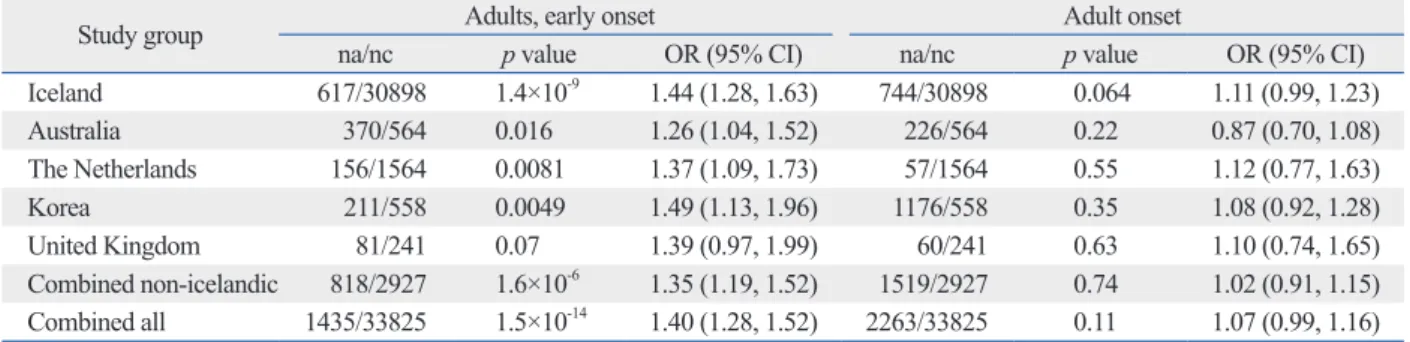
The definition of phenotype under study is of major impor- tance, as asthma is a heterogeneous disease. Well defined subphenotypes improve the genetic power of SNPs. The ORMDL3 SNP was reanalyzed in Caucasians and Koreans according to onset age of asthma development (Table 3).22 When subjects were stratified around age 16, the association of rs7216389 at 17q21 became more apparent in Caucasians and Koreans under that age, with ODs ranging from 1.26 to 5212 East Asians including Koreans. While SNP rs1420101
in the IL1RL1/IL18R1 gene cluster at 2q12 was strongly as- sociated with asthma (p=5.5×10⁻¹²), its OR was still below 1.5. In 2010, a large-scale, consortium-based GWAS of asthma with 10365 asthmatics and 16110 controls con- firmed the association of the previously defined SNPs in- cluding the ones in ORMDL3 and IL1RL1,14 yet their ORs were within the range of 0.5 to 1.5.
Subsequently, GWAS has been applied to determine wheth- er disease-related intermediate phenotypes are causal or secondary to the disease progress.15 A meta-analysis on to- tal IgE concentration showed strong association with HLA- DQ (rs9469220) in Caucasians16 and CRIM1 in Koreans (rs848512 and rs711254).17
Searching for the missing heritability of asthma
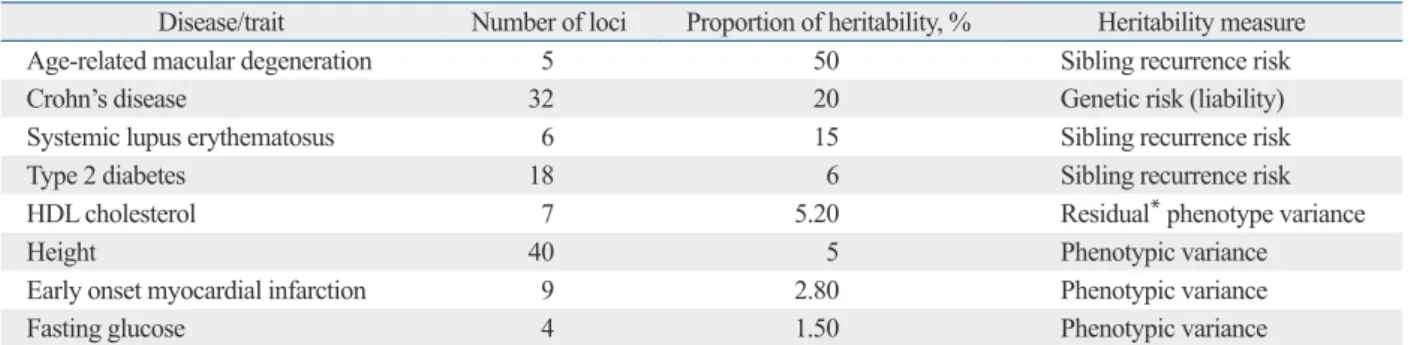
GWAS have identified hundreds of genetic variants associ- ated with complex human diseases and traits, providing deep insights into their genetic architecture. In case of age- related macular degeneration, proportions of heritability ex- plained by 5 SNPs were found to be responsible for 50% of the risk (Table 2), while for Crohn’s disease 32 loci can ex- plain 20% of the heritability. However, most variants identi- fied so far confer relatively small increments in risk, ex- plaining only a small proportion of heritability and leading to the question how the missing heritability can be ex- plained.18 In the GWAS presented in Table 1, the population attributable risk fractions (PAF) of SNPs in asthma and its’
traits ranged from 3.9% to 24%, indicating a relatively large impact of the genetic variants on asthma development. In the studies including asthmatics, rs7216389 in ORMDL3 returned a PAF of 21.8%, while the SNPs on the other gene had a PAF of less than 12%. This suggests that even the GWAS-discovered SNPs explain only limited genetic ef- fects on the development of asthma.
Table 2. Estimates of Heritability and Number of Loci for Several Complex Traits
Disease/trait Number of loci Proportion of heritability, % Heritability measure
Age-related macular degeneration 5 50 Sibling recurrence risk
Crohn’s disease 32 20 Genetic risk (liability)
Systemic lupus erythematosus 6 15 Sibling recurrence risk
Type 2 diabetes 18 6 Sibling recurrence risk
HDL cholesterol 7 5.20 Residual* phenotype variance
Height 40 5 Phenotypic variance
Early onset myocardial infarction 9 2.80 Phenotypic variance
Fasting glucose 4 1.50 Phenotypic variance
HDL, high density lipoprotein.
*Residual is after adjustment for age, gender, diabetes. Adapted from Manolio, et al.18
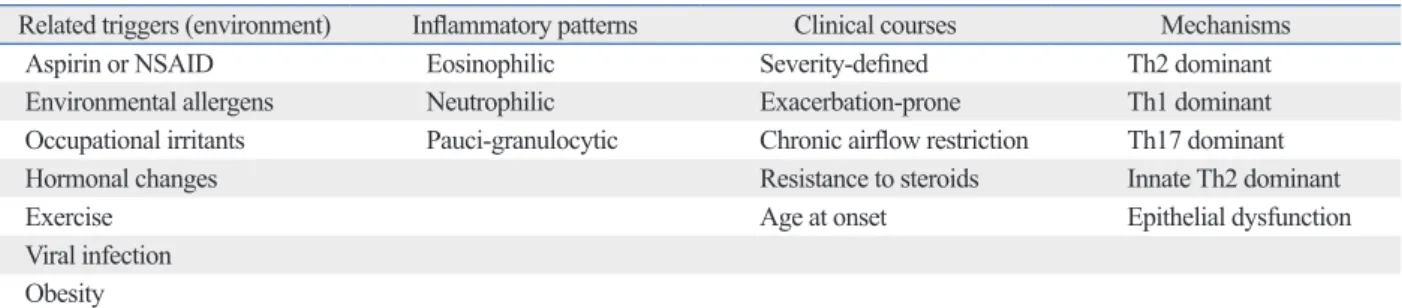
asthma, exercise-induced asthma, and menstruation- or obe- sity-associated asthma. Inflammatory patterns on sputum analysis have revealed eosinophilic, neutrophilic, and pauci- granulocytic types of asthma. Therefore, asthmatics can be stratified into several clinical and physiological subgroups.
Recently, biological phenotypes (endotypes) have been in- troduced to classify parts of the asthma process. Many bio- logical mediators such as immune and constitutional cells in allergy, inflammation, and airway remodeling are candidates for determining endotypes, e.g., Th2, Th17, innate Th2, epi- thelial and smooth muscle dysfunctions (Table 4). Thus, fu- ture genetic association studies should be applied to asth- matics stratified into well defined subphenotypes using cluster analysis and new endotypes.24,25
Gene-environment interactions
Whereas there are certainly genetic factors involved in the development of multifactorial diseases, the prevalence of childhood and adult-onset asthma has increased dramatical- ly in both developed and developing countries during the 1.49, while ODs of the older group ranged from 0.87 to 1.12
(Fig. 1). Attributable risk fractions were 0.269 in the early and 0.057 in the late onset group. These data indicate the ne- cessity of stratification of asthma phenotypes according to age, because the two types of asthma may have different pathogeneses.
Various ways have been tried to develop subphenotypes.
Schematically, the pathogenic mechanism of asthma can be divided into two major pathways23–the adaptive immune response pathway and the innate immunity pathway. In the former, Th2 cells, mast cells, and eosinophils participate in an antigen-specific IgE- and Th2 cytokine-dependent man- ner, a process usually starting at young age. In the latter, macrophages, dendritic cells, epithelial cells, and neutro- phils are involved, causing IgE-independent, adult onset asthma. Therefore, asthmatics should be stratified into sev- eral subphenotypes as shown in Table 4.
Regarding environmental and lifestyle factors as triggers, asthma can be subgrouped into IgE-dependent allergic asth- ma, aspirin-exacerbated respiratory disease, occupational
Table 3. Comparison of Odds Ratios of T Allele rs7216389 in ORMDL3 between Early Onset and Adult Onset of Asthma
Study group Adults, early onset Adult onset
na/nc p value OR (95% CI) na/nc p value OR (95% CI)
Iceland 617/30898 1.4×10⁻⁹ 1.44 (1.28, 1.63) 744/30898 0.064 1.11 (0.99, 1.23)
Australia 370/564 0.016 1.26 (1.04, 1.52) 226/564 0.22 0.87 (0.70, 1.08)
The Netherlands 156/1564 0.0081 1.37 (1.09, 1.73) 57/1564 0.55 1.12 (0.77, 1.63)
Korea 211/558 0.0049 1.49 (1.13, 1.96) 1176/558 0.35 1.08 (0.92, 1.28)
United Kingdom 81/241 0.07 1.39 (0.97, 1.99) 60/241 0.63 1.10 (0.74, 1.65)
Combined non-icelandic 818/2927 1.6×10⁻⁶ 1.35 (1.19, 1.52) 1519/2927 0.74 1.02 (0.91, 1.15) Combined all 1435/33825 1.5×10⁻¹⁴ 1.40 (1.28, 1.52) 2263/33825 0.11 1.07 (0.99, 1.16) na/nc, number of asthmatics and controls; OR, odds ratio; CI, confidence intervals.
Adapted from Halapi, et al.22
Fig. 1. Age-dependent changes of odds ratios of T allele rs7216389 in ORMDL3 in respect to the association with asthma. Permission license number:
3596250009660. Taken with permission from Halapi, et al. Eur J Hum Genet 2010;18:902-8.22 2.5
2
1.5
1
0.5
0
Odds ratios
0 4 8 12 16 20 24 28 32 36 40 44 48 52 56 60 64 68
Onset age of asthma (years)
diisocyanate (TDI)-induced asthma in Korean patients as analyzed by GWAS.47 Genetic polymorphisms of CTNNA3 (catenin alpha 3, alpha-T catenin) were significantly associ- ated (OR=5.84 for rs10762058) with the TDI-induced asth- ma phenotype, and PAF increased up to 24%, indicating that missing heritability of asthma can be compensated by intro- duction of environment factors into the genetic analysis.
Other examples of environmental effects on susceptible in- dividuals are drug-induced reactions such as aspirin exacer- bated respiratory disease (AERD). Association studies on AERD began with biologically plausible genes responsible for over- or under-production of critical modulators in the metabolism of arachidonic acids. LTC4S, ALOX5, NAT2, CysLTR1, and CYSLTR2 of the cysteinyl leukotriene path- way have AERD-associated SNPs with ORs ranging from 1.88 to 9.78 (Fig. 2).48 Mediators in the pathways of lipox- ins, thromboxanes, and prostaglandins also contribute to ad- verse aspirin reactions, with some genes of those pathways, and others discovered by GWAS,49 showing strong, yet slightly lower ORs than the genes of the cysteinyl leukotri- ene pathway. However, diagnosis of AERD is hampered by the low penetrance of these genotypes, i.e., if genetically susceptible subjects do not take aspirin or nonsteroidal anti- inflammatory drugs (NSAID) in their lifetime, they will not develop AERD or aspirin-induced urticaria. Thus, history of aspirin or NSAID intake should be assessed at diagnosis, al- though exact amounts and times of intake are hardly record- ed by patients or physicians.
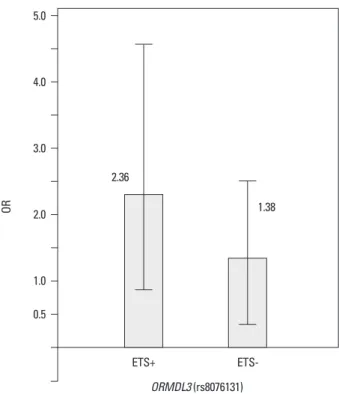
In the first asthma GWAS, identifying a strong association of asthma with the 17q21 locus (Fig. 3),48 a further interest- ing finding on 17q21 variants came out after the 1511 sub- jects from 372 families were grouped by passive exposure to environmental tobacco smoke early in life.50 ORMDL3 variants at rs8076131 showed significant association (OR=
2.5) with the risk of asthma in families with offspring ex- posed to cigarette smoke, in contrast to the unexposed (OR=
1.38). This result, which was later replicated,51,52 hinted at last two to three decades.26 Epidemiological studies have
demonstrated that the entirety of SNPs discovered so far is not able to explain all phenotypic differences. The twin co- hort study mentioned above, for example, showed a concor- dance rate for self-reported asthma in MZ twin pairs of 19%.27 Assuming that MZ twins have identical genetic vari- ants, they should develop asthma almost concurrently. How- ever, a concordance rate of less than 20% indicates that non- genetic factors may play a role in the development of asthma.
One possible explanation for this discordance is epigenetics, which is fundamentally affected by the environment. Al- though the concept of gene-environment (GxE) interactions emerged in the 19th century, investigation of GxE interac- tions has been mainly limited to candidate genes or candi- date environmental exposures. In 1938, Haldane28 suggest- ed that genetic differences might explain the variability of respiratory symptoms and survival of potters in response to industrial exposures.
While the effects of environmental factors certainly de- pend on genetic susceptibility, exposure to smoking and malnutrition during pre- and post-natal periods are well known risk factors for asthma. Moreover, asthma is trig- gered and exacerbated by allergens,29-32 indoor and outdoor air pollutants,33 occupational exposures,34,35 microbial and viral pathogens,36-38 nutrition,39,40 and lifestyle.41,42
The first and simplest situation is a candidate interaction:
both the gene and the environmental factor are known and assumed to be involved in a kind of direct physical or chem- ical reaction. Well known and extensively studied candidate interactions are the interactions between the CD14 gene and environmental exposure to endotoxin, an essential compo- nent of the gram-negative bacterial cell wall,43,44 between Toll-like receptor genes and infectious agents,45 and between HLA genes and allergens,46 which are presented to T lym- phocytes via HLA molecules on dendritic cells.
Occupational exposure to inducers or triggers is an impor- tant and easily accessible environmental factor, e.g., toluene
Table 4. Categories of Asthma According to Etiology, Clinical Patterns, and Underlying Mechanisms
Related triggers (environment) Inflammatory patterns Clinical courses Mechanisms
Aspirin or NSAID Eosinophilic Severity-defined Th2 dominant
Environmental allergens Neutrophilic Exacerbation-prone Th1 dominant
Occupational irritants Pauci-granulocytic Chronic airflow restriction Th17 dominant
Hormonal changes Resistance to steroids Innate Th2 dominant
Exercise Age at onset Epithelial dysfunction
Viral infection Obesity
NSAID, nonsteroidal anti-inflammatory drugs.
Fig. 2. Genetic impact of SNPs in candidate genes of the arachidonic acid pathway on aspirin exacerbated respiratory disease. Data are represented as odds ratios (OR). Taken with permission from Park, et al. Allergy Asthma Immunol Res 2013;5:258-76.48 SNPs, single nucleotide polymorphisms.
Gene rs number OR
LTC4S rs730012
2.62 1.88 - - CACNG6 rs192808
BL1_ht6 2.88
2.81
ALOX5 Sp1 binding motifs in tandem [G-C-G-A]
- 5.0 NAT2 -9246G>C
[T-C-A-C-G-G] 1.61 1.62
CysLTR1 -634C>T -475A>C -336A>G 927T>C 899G/A
2.89 - 9.78 6.28
CysLTR2 601G/A -1220A>C -819T>G +2078C>T +2534A>G
- - 2.04 2.28 2.02
Gene rs number OR
ADORA1 rs16851030 rs10920568 ht [A-C-G]
3.22 0.52 0.56 ADORA2A ht [A-T] 0.33 GPR44 -466T>C -
PTGER2
-12813G>A -10814T>A -6179A>G -616C>G -166G>A
3.21 - - 0.64 2.60
PTGER3 -1709T>A A>C A/G
3.02 1.31 1.36 PTGER4 -1254A>G 1.90 PTGIR +1915T>C 0.37 TBXAS1 +141931T>A 0.27
TBXA2R +795T>C +795T>C -4684C>T
- 2.57 0.42 RGS7BP BL3_ht2 0.47 COX-cyclooxygenase
LT-lcukotriene PG-prostaglandin TX-thromboxane LX-lipoxins
ASA: acetylsalycylic acid HPETE-15-
hydroxyeicosatetraenoic acid
Membrane phospholipids
Cyclooxygenase pathway Cyclooxygenase Lipooxygenase pathway
Arachidonic acid
LTA4
hydrolase LTC4 synthase 15-HPETE
LXA4 LTB4 LTC4, LTD4,
LTE4 LXA4
Increased
COX-1
PGE2, PGI2,
TXA2 PGD2, PGF2
COX pathway shunting towards the LOX
Alteration of COX-2 structure COX-2 ASA
LXB4 15-lipoxygenase
(15-L0) 5-lipoxygenase (5-L0)
Phospholipase A2
Gene rs number OR
HLA DQ w2 -
HLA
DPB1 401 301
- 0.48 5.3
IL4 rs2243250 1.89
IL13 rs1881457 rs1800925 - TBET -1993 T>C 2.15 IL-10 &
TGF-beta -1082 AG
-509 CT or TT 2.664
Gene rs number OR NLRP3 (1.08-2.24) 1.55 PPARG (1.08-14.53) 3.97 ACE (1.28-3.38)
rs4292 2.08 1.91
ADAM33 ST+7 G>A V-1 C>A V5 A>G - FSIP1 rs7179742 1.63 EMID2 BL2_ht2 0.64
SMOC2 rs2982510 rs2294752 rs446738
0.24 0.24 0.44
SLC6A12 rs499368 rs557881 -
1.49 1.47 1.45 SLC22A2 rs316021 0.6 KIF3A rs2237059 4.40
Gene rs number OR
MS4A2 (FcεR1β) rs 1441586 7.723
FCER1γ rs11587213 -
FCER1α rs2427827
Acquired
IL-10 TGF-β IL-4
FCER1α
Treg Naive
GATA3 T-bet
IL-2 IFN-γ TH1
TH2
FcRll TLR4/CD14
NFAT, API, GATA NFκB
Asthma
IκB IL-5 IL-8
FcRl Macrophage
Mast cells
Th2 CD4+
Lymphocyte
Epithelial cells
Macrophage
Eos Pmn
Dendritic cells Virus (RSV),
endotoxin NO2/ozone, particulates Innate
Immune response
Fig. 3. Genetic impact of SNPs in candidate genes of immune and inflammatory pathways on aspirin exacerbated respiratory disease. Data are represented as odds ratios (OR). Taken with permission from Park, et al. Allergy Asthma Immunol Res 2013;5:258-76.48 SNPs, single nucleotide polymorphisms.
persist through cell divisions for the remainder of a cell’s life, possibly lasting for multiple generations without any change in the intrinsic DNA sequence of an organism. Epi- genetic changes include histone deacetylation, DNA meth- ylation, and non-coding RNAs. Particularly regions of meth- ylated DNA, i.e., methyl groups covalently added to cytosine residues in CpG dinucleotides,61 have been correlated with tissue-specific expression of several genes and with active coding regions across the genome.62
In the human genome, about one fifth of CpG islands at 5’
UTRs are variably methylated, and one third of methyl- ations correlate with amounts of transcripts. As epigenetics plays a role in main immunological aspects of asthma such as T-cell differentiation and regulation, genome-wide studies of methylation status at various loci may identify new asth- ma initiating and modulating genes and pathways.
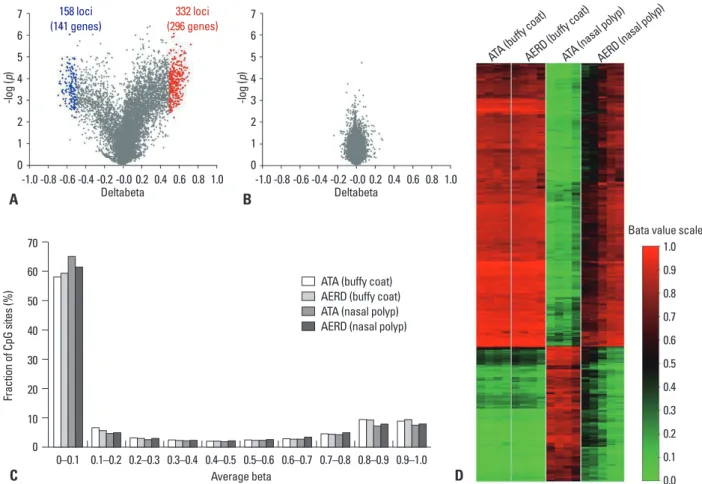
So far, genome-wide CpG methylation changes have been found in a few studies of asthmatics, e.g., methylation pat- terns of whole genome DNA were significantly different be- tween nasal polyps of subjects with AERD and aspirin toler- ant asthma (ATA) patients, whereas less differences were found in buffy coat.63 Differences between AERD and ATA comprised 332 CpG sites in 296 genes that were hypometh- ylated, and 158 sites in 141 genes that were hypermethyl- ated (Fig. 5). CpG site methylations of nasal polyps did not correlate with those of buffy coats, indicating that differenc- es in methylation patterns were a nasal tissue-specific find- ing. Among the genes of the arachidonic acid pathway, pros- taglandin E synthase was hypermethylated and prostaglandin D synthase, arachidonate 5-lipoxygenase-activating protein, leukotriene B4 receptor, and lipoxygenase homology do- mains 1 were hypomethylated, indicating that different meth- ylation patterns of these candidate genes may be responsible for the penetrance of specific phenotypes such as AERD in asthma. In the bronchial mucosa of atopic asthmatics, hy- permethylation was detected at 6 loci in 6 genes, while hy- pomethylation was found at 49 loci in 48 genes, compared to non-atopic asthmatics.64
CONCLUSIONS
The definition of phenotypes is of major importance to ge- netic studies. Ways of improving phenotype definition in- clude physiologic or biological phenotypes related to dis- ease processes (endotypes) and the use of unbiased and statistically based approaches such as cluster analysis, which the importance of environmental factors in genetic studies
on asthma (Fig. 4). The first published genome-wide GxE interaction study for asthma explored interactions between farm-related exposure and genome-wide SNPs in 1700 chil- dren from four rural areas in Central Europe.53 This well de- signed study did not reveal any significant interactions with common SNPs previously associated with asthma. Never- theless, interactions were detected with rare SNPs, e.g., in genes of the glutamate receptor pathway.54 For the most complex future scenario in which both genes and environ- ment are unknown, exposomes–large sets of environmental exposures55–and specific asthma phenotypes56 need to be defined. While agnostic approaches to GxE interactions are still in their infancy, methodological progress towards opti- mization of study design and analytical methods has been made.57,58 Recently, both gut and airway microbiomes were found to contribute to chronic asthma,59 introducing envi- ronmental microbiomes as further complicating factors of complex GxE interactions in asthma development.
Mechanisms behind gene-environment interactions in asthma
Epigenetics comprises changes in gene expression due to mechanisms other than variations of the underlying DNA sequence,60 which may induce phenotypic alterations and
Fig. 4. Example of candidate interaction between gene and environment. A variant (rs8076131) in ORMDL3 (gene) is associated with early asthma and exposure to environmental tobacco smoke (ETS, environment). OR increas- es two times in cases with positive ETS than in cases with negative ETS.
Modified from Bouzigon, et al.50 OR, odds ratio.
5.0
4.0
3.0
2.0
1.0
2.36
ETS+
ORMDL3 (rs8076131)
OR
ETS- 1.38
0.5
the identification of functional regulatory elements for hu- man gene expression is an active subject of research in the postgenomic era, longitudinal studies, including collection of biological samples over time, are a desirable way to vali- date the positive results obtained on GxE interactions.
ACKNOWLEDGEMENTS
The study was supported by Soonchunhyang University re- search fund and by the Ministry of Health and Welfare, Re- public of Korea (HI13C0319).
REFERENCES
1. Burrows B, Martinez FD, Halonen M, Barbee RA, Cline MG. As- sociation of asthma with serum IgE levels and skin-test reactivity
are promising because they may define new phenotypes from a number of features related to disease occurrence, evolution, therapy, and biological phenotypes. As time-de- pendent change plays a major role in clustering-based ap- proaches, more precise phenotyping should be obtainable from longitudinal studies. Taking into account time of asth- ma onset can characterize novel GxE interactions, extending the two-dimensional problem of GxE interactions to a three- dimensional problem. Although most genetic studies so far have examined single phenotypes, joint analysis of multiple phenotypes through multidimensional and multivariate meth- ods can improve statistical power for identifying genes with a pleiotropic effect. Although a number of multivariate meth- ods have been proposed, improvements are needed to inte- grate information from various data types, including ‘‘-omics’’
data. Moreover, as for GWAS, meta-analysis of gene-envi- ronment interaction studies can increase driving power fur- ther and provide robust estimates of GxE interactions. As
Fig. 5. CpG DNA methylation patterns of nasal polyps and peripheral blood mononuclear cells obtained from subjects with AERD and ATA. (A) Volcano plot of differential methylation levels between AERD and ATA in nasal polyp tissues (A) and buffy coat samples (B). Red dots, deltabeta≥0.5 and p value≤0.01; blue dots, deltabeta≤-0.5 and p value≤0.01; grey dots, -0.5≤deltabeta≤0.5 and p value>0.01. Deltabeta, difference of DNA methylation level (subtracting DNA meth- ylation level of ATA from AERD). -log (p), log-transformed t-test p values. (C) Distribution of DNA methylation levels of AERD and ATA in buffy coat and nasal polyps. Average Beta, DNA methylation level (0 to 1). (D) Heat map of 490 differentially methylated CpGs between AERD and ATA in buffy coat and nasal pol- yps. Taken with permission from Park, et al. Allergy Asthma Immunol Res 2013;5:258-76.48 AERD, aspirin exacerbated respiratory disease; ATA, aspirin toler- ant asthma.
60 50 40
Fraction of CpG sites (%)
30 20 10 0 70
Deltabeta Deltabeta
-1.0-0.8-0.6-0.4-0.2-0.00.20.4 0.6 0.8 1.0 -1.0-0.8-0.6-0.4-0.2-0.00.20.4 0.6 0.8 1.0
-log (p) -log (p)
7 6 5 4 3 2 1 0
7 6 5 4 3 2 1 0
0–0.1 0.1–0.2 0.2–0.3 0.3–0.4 0.4–0.5 Average beta
0.5–0.6 0.6–0.7 0.7–0.8 0.8–0.9 0.9–1.0 ATA (buffy coat) AERD (buffy coat) ATA (nasal polyp) AERD (nasal polyp)
A B
C D
1.0 0.9 0.8 0.7 0.6 0.5 0.4 0.3 0.2 0.1 0.0 ATA (buffy coat)AERD (buffy coat)ATA (nasal polyp)AERD (nasal polyp)
Bata value scale 158 loci
(141 genes) 332 loci
(296 genes)
nist treatment in a multiethnic asthma population: a genetic study.
Lancet Respir Med 2014;2:204-13.
22. Halapi E, Gudbjartsson DF, Jonsdottir GM, Bjornsdottir US, Thor- leifsson G, Helgadottir H, et al. A sequence variant on 17q21 is as- sociated with age at onset and severity of asthma. Eur J Hum Genet 2010;18:902-8.
23. Green RH, Brightling CE, Bradding P. The reclassification of asth- ma based on subphenotypes. Curr Opin Allergy Clin Immunol 2007;7:43-50.
24. Moore WC, Meyers DA, Wenzel SE, Teague WG, Li H, Li X, et al. Identification of asthma phenotypes using cluster analysis in the Severe Asthma Research Program. Am J Respir Crit Care Med 2010;181:315-23.
25. Jang AS, Kwon HS, Cho YS, Bae YJ, Kim TB, Park JS, et al.
Identification of subtypes of refractory asthma in Korean patients by cluster analysis. Lung 2013;191:87-93.
26. Ho SM. Environmental epigenetics of asthma: an update. J Allergy Clin Immunol 2010;126:453-65.
27. Thomsen SF, van der Sluis S, Kyvik KO, Skytthe A, Backer V. Es- timates of asthma heritability in a large twin sample. Clin Exp Al- lergy 2010;40:1054-61.
28. Haldane JBS. Heredity and politics. London: George Allen & Un- win Ltd Pblisher; 1938.
29. Huiyan W, Yuhe G, Juan W, Junyan Z, Shan W, Xiaojun Z, et al.
The Importance of Allergen Avoidance in High Risk Infants and Sensitized Patients: A Meta-analysis Study. Allergy Asthma Immu- nol Res 2014;6:525-34.
30. Peden D, Reed CE. Environmental and occupational allergies. J Allergy Clin Immunol 2010;125(2 Suppl 2):S150-60.
31. von Mutius E. Gene-environment interactions in asthma. J Allergy Clin Immunol 2009;123:3-11.
32. Park HJ, Lim HS, Park KH, Lee JH, Park JW, Hong CS. Changes in allergen sensitization over the last 30 years in Korea respiratory allergic patients: a single-center. Allergy Asthma Immunol Res 2014;6:434-43.
33. Lee JH, Lee HS, Park MR, Lee SW, Kim EH, Cho JB, et al. Rela- tionship between indoor air pollutant levels and residential environ- ment in children with atopic dermatitis. Allergy Asthma Immunol Res 2014;6:517-24.
34. Jeong I, Kim I, Park HJ, Roh J, Park JW, Lee JH. Allergic diseases and multiple chemical sensitivity in Korean adults. Allergy Asth- ma Immunol Res 2014;6:409-14.
35. Hur GY, Ye YM, Koh DH, Kim SH, Park HS. IL-4 Receptor α Polymorphisms May Be a Susceptible Factor for Work-Related Respiratory Symptoms in Bakery Workers. Allergy Asthma Immu- nol Res 2013;5:371-6.
36. Yang SN, Hsieh CC, Kuo HF, Lee MS, Huang MY, Kuo CH, et al.
The effects of environmental toxins on allergic inflammation. Al- lergy Asthma Immunol Res 2014;6:478-84.
37. Kim BJ, Lee SY, Kim HB, Lee E, Hong SJ. Environmental chang- es, microbiota, and allergic diseases. Allergy Asthma Immunol Res 2014;6:389-400.
38. Yang SI, Lee E, Jung YH, Kim HY, Seo JH, Kwon JW, et al. Effect of antibiotic use and mold exposure in infancy on allergic rhinitis in susceptible adolescents. Ann Allergy Asthma Immunol 2014;113:
160-5.e1.
39. Kim SH, Sutherland ER, Gelfand EW. Is there a link between obe- sity and asthma? Allergy Asthma Immunol Res 2014;6:189-95.
40. Lee SY, Kang MJ, Kwon JW, Park KS, Hong SJ. Breastfeeding Might Have Protective Effects on Atopy in Children With the to allergens. N Engl J Med 1989;320:271-7.
2. Burrows B, Sears MR, Flannery EM, Herbison GP, Holdaway MD, Silva PA. Relation of the course of bronchial responsiveness from age 9 to age 15 to allergy. Am J Respir Crit Care Med 1995;
152(4 Pt 1):1302-8.
3. Bousquet J, Chanez P, Vignola AM, Lacoste JY, Michel FB. Eosin- ophil inflammation in asthma. Am J Respir Crit Care Med 1994;
150(5 Pt 2):S33-8.
4. Edfors-Lubs ML. Allergy in 7000 twin pairs. Acta Allergol 1971;26:249-85.
5. Zielenski J, Tsui LC. Cystic fibrosis: genotypic and phenotypic variations. Annu Rev Genet 1995;29:777-807.
6. Van Eerdewegh P, Little RD, Dupuis J, Del Mastro RG, Falls K, Simon J, et al. Association of the ADAM33 gene with asthma and bronchial hyperresponsiveness. Nature 2002;418:426-30.
7. Allen M, Heinzmann A, Noguchi E, Abecasis G, Broxholme J, Ponting CP, et al. Positional cloning of a novel gene influencing asthma from chromosome 2q14. Nat Genet 2003;35:258-63.
8. Zhang Y, Leaves NI, Anderson GG, Ponting CP, Broxholme J, Holt R, et al. Positional cloning of a quantitative trait locus on chromosome 13q14 that influences immunoglobulin E levels and asthma. Nat Genet 2003;34:181-6.
9. Laitinen T, Polvi A, Rydman P, Vendelin J, Pulkkinen V, Salmikan- gas P, et al. Characterization of a common susceptibility locus for asthma-related traits. Science 2004;304:300-4.
10. Oguma T, Palmer LJ, Birben E, Sonna LA, Asano K, Lilly CM.
Role of prostanoid DP receptor variants in susceptibility to asthma.
N Engl J Med 2004;351:1752-63.
11. Risch NJ. Searching for genetic determinants in the new millenni- um. Nature 2000;405:847-56.
12. Hardy J, Singleton A. Genomewide association studies and human disease. N Engl J Med 2009;360:1759-68.
13. Moffatt MF, Kabesch M, Liang L, Dixon AL, Strachan D, Heath S, et al. Genetic variants regulating ORMDL3 expression contribute to the risk of childhood asthma. Nature 2007;448:470-3.
14. Moffatt MF, Gut IG, Demenais F, Strachan DP, Bouzigon E, Heath S, et al. A large-scale, consortium-based genomewide association study of asthma. N Engl J Med 2010;363:1211-21.
15. Sheehan NA, Didelez V, Burton PR, Tobin MD. Mendelian ran- domisation and causal inference in observational epidemiology.
PLoS Med 2008;5:e177.
16. Levin AM, Mathias RA, Huang L, Roth LA, Daley D, Myers RA, et al. A meta-analysis of genome-wide association studies for se- rum total IgE in diverse study populations. J Allergy Clin Immunol 2013;131:1176-84.
17. Kim JH, Cheong HS, Park JS, Jang AS, Uh ST, Kim YH, et al. A genome-wide association study of total serum and mite-specific IgEs in asthma patients. PLoS One 2013;8:e71958.
18. Manolio TA, Collins FS, Cox NJ, Goldstein DB, Hindorff LA, Hunter DJ, et al. Finding the missing heritability of complex dis- eases. Nature 2009;461:747-53.
19. 1000 Genomes Project Consortium, Abecasis GR, Altshuler D, Auton A, Brooks LD, Durbin RM, et al. A map of human genome variation from population-scale sequencing. Nature 2010;467:
1061-73.
20. Raska P, Zhu X. Rare variant density across the genome and across populations. BMC Proc 2011;5 Suppl 9:S39.
21. Ortega VE, Hawkins GA, Moore WC, Hastie AT, Ampleford EJ, Busse WW, et al. Effect of rare variants in ADRB2 on risk of se- vere exacerbations and symptom control during longacting β ago-
gene via interaction with coffee. PLoS Genet 2011;7:e1002237.
55. Wild CP. The exposome: from concept to utility. Int J Epidemiol 2012;41:24-32.
56. Wenzel SE. Asthma phenotypes: the evolution from clinical to mo- lecular approaches. Nat Med 2012;18:716-25.
57. Bookman EB, McAllister K, Gillanders E, Wanke K, Balshaw D, Rutter J, et al. Gene-environment interplay in common complex diseases: forging an integrative model–recommendations from an NIH workshop. Genet Epidemiol 2011;35:217-25.
58. Thomas D. Gene--environment-wide association studies: emerging approaches. Nat Rev Genet 2010;11:259-72.
59. Han MK, Huang YJ, Lipuma JJ, Boushey HA, Boucher RC, Cookson WO, et al. Significance of the microbiome in obstructive lung disease. Thorax 2012;67:456-63.
60. Goldberg AD, Allis CD, Bernstein E. Epigenetics: a landscape takes shape. Cell 2007;128:635-8.
61. Klose RJ, Bird AP. Genomic DNA methylation: the mark and its mediators. Trends Biochem Sci 2006;31:89-97.
62. Sato S, Yagi S, Arai Y, Hirabayashi K, Hattori N, Iwatani M, et al.
Genome-wide DNA methylation profile of tissue-dependent and differentially methylated regions (T-DMRs) residing in mouse plu- ripotent stem cells. Genes Cells 2010;15:607-18.
63. Cheong HS, Park SM, Kim MO, Park JS, Lee JY, Byun JY, et al.
Genome-wide methylation profile of nasal polyps: relation to aspi- rin hypersensitivity in asthmatics. Allergy 2011;66:637-44.
64. Kim YJ, Park SW, Kim TH, Park JS, Cheong HS, Shin HD, et al.
Genome-wide methylation profiling of the bronchial mucosa of asthmatics: relationship to atopy. BMC Med Genet 2013;14:39.
65. Gudbjartsson DF, Bjornsdottir US, Halapi E, Helgadottir A, Sulem P, Jonsdottir GM, et al. Sequence variants affecting eosinophil num- bers associate with asthma and myocardial infarction. Nat Genet 2009;41:342-7.
66. Himes BE, Hunninghake GM, Baurley JW, Rafaels NM, Sleiman P, Strachan DP, et al. Genome-wide association analysis identifies PDE4D as an asthma-susceptibility gene. Am J Hum Genet 2009;
84:581-93.
67. Mashimo T, Hadjebi O, Amair-Pinedo F, Tsurumi T, Langa F, Seri- kawa T, et al. Progressive Purkinje cell degeneration in tambaleante mutant mice is a consequence of a missense mutation in HERC1 E3 ubiquitin ligase. PLoS Genet 2009;5:e1000784.
68. Sleiman PM, Flory J, Imielinski M, Bradfield JP, Annaiah K, Wil- lis-Owen SA, et al. Variants of DENND1B associated with asthma in children. N Engl J Med 2010;362:36-44.
69. Li X, Howard TD, Zheng SL, Haselkorn T, Peters SP, Meyers DA, et al. Genome-wide association study of asthma identifies RAD50- IL13 and HLA-DR/DQ regions. J Allergy Clin Immunol 2010;125:
328-35.e11.
CD14C-159T CT/CC Genotype. Allergy Asthma Immunol Res 2013;5:239-41.
41. Seo S, Kim D, Paul C, Yoo Y, Choung JT. Exploring Household- level Risk Factors for Self-reported Prevalence of Allergic Diseases Among Low-income Households in Seoul, Korea. Allergy Asthma Immunol Res 2014;6:421-7.
42. Zhang G, Khoo SK, Mäkelä MJ, Candelaria P, Hayden CM, von Hertzen L, et al. Maternal Genetic Variants of IL4/IL13 Pathway Genes on IgE With “Western or Eastern Environments/Lifestyles”.
Allergy Asthma Immunol Res 2014;6:350-6.
43. Vercelli D. Learning from discrepancies: CD14 polymorphisms, atopy and the endotoxin switch. Clin Exp Allergy 2003;33:153-5.
44. Martinez FD. CD14, endotoxin, and asthma risk: actions and inter- actions. Proc Am Thorac Soc 2007;4:221-5.
45. Aderem A, Ulevitch RJ. Toll-like receptors in the induction of the innate immune response. Nature 2000;406:782-7.
46. Howell WM, Holgate ST. HLA genetics and allergic disease. Tho- rax 1995;50:815-8.
47. Kim SH, Cho BY, Park CS, Shin ES, Cho EY, Yang EM, et al. Al- pha-T-catenin (CTNNA3) gene was identified as a risk variant for toluene diisocyanate-induced asthma by genome-wide association analysis. Clin Exp Allergy 2009;39:203-12.
48. Park SM, Park JS, Park HS, Park CS. Unraveling the genetic basis of aspirin hypersensitivity in asthma beyond arachidonate path- ways. Allergy Asthma Immunol Res 2013;5:258-76.
49. Park BL, Kim TH, Kim JH, Bae JS, Pasaje CF, Cheong HS, et al.
Genome-wide association study of aspirin-exacerbated respiratory disease in a Korean population. Hum Genet 2013;132:313-21.
50. Bouzigon E, Corda E, Aschard H, Dizier MH, Boland A, Bousquet J, et al. Effect of 17q21 variants and smoking exposure in early-on- set asthma. N Engl J Med 2008;359:1985-94.
51. Flory JH, Sleiman PM, Christie JD, Annaiah K, Bradfield J, Kim CE, et al. 17q12-21 variants interact with smoke exposure as a risk factor for pediatric asthma but are equally associated with early- onset versus late-onset asthma in North Americans of European ancestry. J Allergy Clin Immunol 2009;124:605-7.
52. van der Valk RJ, Duijts L, Kerkhof M, Willemsen SP, Hofman A, Moll HA, et al. Interaction of a 17q12 variant with both fetal and infant smoke exposure in the development of childhood asthma- like symptoms. Allergy 2012;67:767-74.
53. Ege MJ, Strachan DP, Cookson WO, Moffatt MF, Gut I, Lathrop M, et al. Gene-environment interaction for childhood asthma and exposure to farming in Central Europe. J Allergy Clin Immunol 2011;127:138-44, 144.e1-4.
54. Hamza TH, Chen H, Hill-Burns EM, Rhodes SL, Montimurro J, Kay DM, et al. Genome-wide gene-environment study identifies glutamate receptor gene GRIN2A as a Parkinson’s disease modifier