R E S E A R C H A R T I C L E
Open Access
Deleterious genetic variants in ciliopathy
genes increase risk of ritodrine-induced
cardiac and pulmonary side effects
Heewon Seo
1†, Eun Jin Kwon
2†, Young-Ah You
2, Yoomi Park
1, Byung Joo Min
1, Kyunghun Yoo
1,
Han-Sung Hwang
3, Ju Han Kim
1*and Young Ju Kim
4*Abstract
Background: Ritodrine is a commonly used tocolytic to prevent preterm labour. However, it can cause unexpected serious adverse reactions, such as pulmonary oedema, pulmonary congestion, and tachycardia. It is unknown whether such adverse reactions are associated with pharmacogenomic variants in patients.
Methods: Whole-exome sequencing of 13 subjects with serious ritodrine-induced cardiac and pulmonary side-effects was performed to identify causal genes and variants. The deleterious impact of nonsynonymous substitutions for all genes was computed and compared between cases (n = 13) and controls (n = 30). The significant genes were annotated with Gene Ontology (GO), and the associated disease terms were categorised into four functional classes for functional enrichment tests. To assess the impact of distributed rare variants in cases with side effects, we carried out rare variant association tests with a minor allele frequency≤ 1% using the burden test, the sequence Kernel association test (SKAT), and optimised SKAT.
Results: We identified 28 genes that showed significantly lower gene-wise deleteriousness scores in cases than in controls. Three of the identified genes—CYP1A1, CYP8B1, and SERPINA7—are pharmacokinetic genes. The significantly identified genes were categorized into four functional classes: ion binding, ATP binding, Ca2+-related, and ciliopathies-related. These four classes were significantly enriched with ciliary genes according to SYSCILIA Gold Standard genes (P < 0.01), thus representing ciliary genes. Furthermore, SKAT showed a marginal trend toward significance after Bonferroni correction with Joubert Syndrome ciliopathy genes (P = 0.05). With respect to the pharmacokinetic genes, rs1048943 (CYP1A1) and rs1804495 (SERPINA7) showed a significantly higher frequency in cases than controls, as determined by Fisher’s exact test (P < 0.05 and P < 0.01, respectively).
Conclusions: Ritodrine-induced cardiac and pulmonary side effects may be associated with deleterious genetic variants in ciliary and pharmacokinetic genes.
Keywords: Ritodrine, Pulmonary oedema, Whole-exome sequencing, Ciliopathy, Joubert syndrome
* Correspondence:[email protected];[email protected] †Equal contributors
1Seoul National University Biomedical Informatics (SNUBI), Div. of Biomedical Informatics, Seoul National University College of Medicine, Seoul 03080, Korea
4Department of Obstetrics and Gynecology, College of Medicine, Ewha Womans University Mok Dong Hospital, Seoul 07985, Korea
Full list of author information is available at the end of the article
© The Author(s). 2018 Open Access This article is distributed under the terms of the Creative Commons Attribution 4.0 International License (http://creativecommons.org/licenses/by/4.0/), which permits unrestricted use, distribution, and reproduction in any medium, provided you give appropriate credit to the original author(s) and the source, provide a link to the Creative Commons license, and indicate if changes were made. The Creative Commons Public Domain Dedication waiver (http://creativecommons.org/publicdomain/zero/1.0/) applies to the data made available in this article, unless otherwise stated.
Background
Preterm birth (PTB: before 37 weeks gestation) is a major cause of neonatal mortality and morbidity, and can cause long-term health problems [1, 2]. Babies born prematurely are at an increased risk of cerebral palsy, re-spiratory illnesses, and intellectual disabilities [3]. The incidence of PTB has been reported to range from ap-proximately 4% in Eastern Asia to 17% in the United States [4, 5]. Despite extensive research, advances in ob-stetrics care, and the development of pharmacological agents designed to reduce PTB, few effective PTB ther-apies are available.
Tocolytic agents are medications used to delay PTB and suppress uterine contractions. Beta2-adrenergic re-ceptor agonists, such as ritodrine, are widely used toco-lytic drugs that are effective for uterine relaxation [6]. However, ritodrine can cause serious adverse effects, such as pulmonary congestion, pulmonary oedema, dys-pnoea, and tachycardia for the mother and the foetus
[7–9]. In Korea, 13.1% of patients receiving ritodrine
ex-perienced side effects [2]. Ritodrine was withdrawn from use in the United States, and is used on a limited basis in Europe and Asia [7, 9]. To our knowledge, few studies have aimed to identify genetic polymorphisms associated with side effects related to ritodrine treatment as a toco-lytic therapy to prevent PTB. The relationship between a mutation in calcium voltage-gated channel subunit alpha 1 C (CACNA1C) and ritodrine-induced side effects was recently reported [10].
Whole-exome sequencing (WES) is currently used to identify novel genetic variants that affect protein func-tion [11]. WES is being applied to identify candidate genes in Mendelian disorders, common diseases, and cancer [12]. In addition, rare variants associated with complex diseases have been found by WES [13]. For
example, rare variants of identified genes have been found to affect low-density lipoprotein cholesterol levels [14]. However, genetic polymorphisms that lead to ritodrine-induced cardiac and pulmonary side effects have not yet been identified, and the molecular mecha-nisms underlying the adverse effects of ritodrine remain unclear.
Thus, we investigated genes associated with the side effects of ritodrine using WES from 13 ritodrine-treated subjects with serious side effects in PTB.
Methods
Ethics statement
This research involving human subjects and their genomic data was approved by the Institutional Review Boards of Ewha Womans University Medical Center and Konkuk University Medical Center (IRB Nos. ECT 06– 127-7 and KUH1040034). Written Informed consent
was obtained from each subject prior to their
participation.
Patient and control samples for WES
Thirteen Korean pregnant women were analyzed using next-generation sequencing technology. Four subjects had pulmonary embolism, and nine subjects had a com-bination of tachycardia, palpitation, and/or dyspnoea. Two subjects were treated at Konkuk University Medical Center and the others were treated at Ewha Womans University Medical Center (Case, Table 1). For the con-trol group, we selected exomes of 30 healthy Korean subjects (Control, 11 females and 19 males) from in-house data, which were provided by volunteers at the Division of Biomedical Informatics at Seoul National University (http://www.snubi.org/). Although the sub-jects had never been exposed to ritodrine, the exomes
Table 1 Clinical characteristics of 13 pregnant women
Sample Maternal age (years) Gestational age at administration (weeks) Side effect(s)
S1 30–39 31.4 Dyspnea
S2 30–39 30.2 Pulmonary edema, Pulmonary congestion
S3 30–39 34.0 Tachycardia, Dyspnea
S4 30–39 35.1 Dyspnea
S5 20–29 35.4 Pulmonary edema, Dyspnea
S6 30–39 36.5 Tachycardia, Dyspnea
S7 30–39 15.2 Tachycardia, Dyspnea
S8 20–29 33.5 Dyspnea
S9 40–49 27.6 Tachycardia, Dyspnea, Palpitation
S10 20–29 20.3 Tachycardia, Dyspnea, Headache, Sweating
S11 20–29 30.6 Dyspnea, Palpitation
S12 20–29 30.5 Pulmonary edema
were sequenced using the same platform as the cases to minimize platform-specific biases. A total of 43 Koreans were recruited for WES analysis.
WES and variant calls
Genomic DNA extracted from peripheral blood cells was amplified to generate 175–250-base pair (bp) DNA fragments spanning the protein-coding regions of hu-man genome DNA using the Ion AmpliSeq Exome Panel (Thermo Fisher Scientific, Waltham, MA, USA). Library construction was performed to load the DNA samples into the semiconductor chip using the Ion AmpliSeq Ex-ome Library Kit Plus, covering 57,742,646 bp (1.85% of human genomic regions) as described in the manufac-turer’s instructions (Thermo Fisher Scientific). The exon-enriched DNA libraries were sequenced using the Ion Proton platform following the manufacturer’s in-structions (Thermo Fisher Scientific). All subjects were sequenced with the PI chip, which generated a mean depth of 70× (a sufficient depth to interrogate the exons for mutations). Sequence alignment and MAP files were generated with Torrent Suite (v4.4) software (Thermo Fisher Scientific), and variants were identified using the Genome Analysis Toolkit (GATK; v2.8) software using ‘HaplotypeCaller’ against the GRCh37 version of the hu-man reference genome [15].
Validation with genotyping assay
We validated 11 cases with side effects (out of the 13 cases with sufficient DNA) using an array-based high throughput method for 32 variants in 20 genes. In the single nucleotide polymorphism (SNP) type assay, 40 ng of genomic DNA flanking the SNP of interest was amplified by polymerase chain reaction (PCR) with a specific target amplification primer set. PCR was per-formed as described in the manufacturer’s instructions (Fluidigm, San Francisco, CA, USA). After amplification, the SNP type assay reaction was carried out according to the manufacturer’s instructions. SNP analysis was per-formed using Fluidigm SNP Genotyping Analysis soft-ware (ver. 4.0.1).
Predicting the deleterious impact of variants
The Sorting Intolerant from Tolerant (SIFT) [16, 17] al-gorithm predicts the effect of a coding variant on pro-tein function, which is displayed as a single measure based on the conservation and scores precomputed and distributed by the J. Craig Venter Institute (http://sift.jc-vi.org/). The SIFT Human database that supports GRCh37 Ensembl release 63 (the latest version) was downloaded. In total, 33,248,232 coding DNA sequence variants with a SIFT score, ranging from 0 to 1, and
19,729 protein-coding genes listed in the SIFT
Human database were analyzed. Combined Annotation
Dependent Depletion v1.3 (CADD; http://cadd.gs.wa-shington.edu/) [18] and Polymorphism Phenotyping
v2.2.2 (PolyPhen2; http://genetics.bwh.harvard.edu/
pph2/) [19] were also downloaded to predict the delete-riousness of the annotated variants on protein function.
Aggregation of the impact of variants within genes
The gene deleteriousness score (G), defined as the geometric mean of the SIFT scores for the multitude of deleterious variants in a gene [20], was applied to estimate the aggregate impact of all deleterious variants
in the genes. G aggregates the impact of deleterious
variants by combining the probabilities of estimation of the likelihood that protein function was altered for each gene. Multiple deleterious variants of the same gene may synergistically impact protein function. We included only variants with a SIFT score < 0.7 as an input of the
geometric mean and replaced 0 to 10− 8for the G score
calculation. We assigned aG score of 1 when no variants
were reported in a given gene. A lowerG score indicates
a more damaged function of the gene at the protein level.
Identification of significantly altered genes
Among the 13 cases, a total of 558,091 variants were de-tected from 117,633 loci (Fig. 1). Initially, we included
86,927 loci with allele frequencies (AFs)≥ 1/5008, as
re-ported in the 1000 Genomes Project (T1GP; n = 2504),
phase 3, with the assumption that variants in a highly curated public database would be less likely to contain
errors [21, 22]. Next, we calculated a G score vector for
all genes in each sample to assess the impact of deleteri-ous variants on protein function. Student’s t-test was ap-plied to identify altered function genes with deleterious
variants by comparing theG score distribution between
the case and control groups. We selected genes with at least one variant with SIFT < 0.3, which contributed to
the lower G score. Lastly, to exclude likely
false-positives, we reviewed each variant of the selected genes by manually inspecting all reads at all candidate loci in BAM files.
Gene functional annotation and categorization
To interpret the biological relevance of the significant genes, we used DAVID v6.7 software to annotate Gene Ontology (GO) terms [23, 24]. In addition, we manually reviewed every gene to annotate known gene functions and associated diseases. We categorized the selected genes based on the annotations into four functional
cat-egories: ion binding, ATP binding, Ca2+-related, and
ciliopathies. We obtained gene sets for the four categor-ies; ion binding (GO: 0043167) and ATP binding (GO: 0005524) had corresponding GO terms that were exactly matched. Thus, we downloaded the gene sets annotated
with the GO terms, which were comprised of 4386 and 1495 genes, respectively. However, the GO terms for the remaining two categories did not show an exact match.
We searched for ‘calcium’ or ‘cilia’ as keywords to find
the GO terms containing either of the keywords. As a result, we collected 1548 and 370 genes annotated to
312 and 42 GO terms for ‘Ca2 + −related’ and
‘ciliopa-thies’, respectively. We performed hypergeometric distri-bution tests with the four gene-sets to investigate the statistical significance of the selected genes.
Ciliary genes and Joubert syndrome-related genes
Ciliary genes were extracted from The SYSCILIA Gold Standard Version 1, a high-confidence dataset that pro-vides gene lists associated with ciliopathies (n = 303) [25]. In addition, we downloaded genes known to be in-volved in ciliopathy (n = 102) and Joubert and
Meckel-Gruber syndromes (JBTMKS, n = 30) [26]. As the genes
for Joubert syndrome (JBTS,n = 11) and Meckel-Gruber
syndrome (MKS, n = 8) were grouped together in the
JBTMKS category, we obtained genes for each syndrome from the Genetics Home Reference (GHR) [27, 28]. For each gene list, we carried out three rare-variant associ-ation tests: (1) the burden test, (2) sequence Kernel asso-ciation test (SKAT), and (3) the optimised (SKAT-O) test using the SKAT package in R [13]. Only variants
with a minor allele frequency (MAF) < 1% were selected for rare-variant association tests.
Results
Primary WES data analysis and genotyping assays
The Torrent Mapping and Alignment Program aligner in Torrent Suite generated, on average, 20 GB of BAM files per sample. Based on the GATK Best Practices guidelines, we modified a variant-calling pipeline to function with Ion Proton data and obtained an average of 41,819 ± 1976 [mean ± standard deviation (SD)] and 41,661 ± 1848 variants from the case and control groups (P = 0.81), respectively. Additionally, we confirmed that there was no significant difference in the number of var-iants between males and females in controls (P = 0.89). Next, we filtered out 30,706 variants that were not re-ported in the T1GP. We merged all variants that were called from individuals and annotated the SIFT score for
each variant. Then, we calculated the G score for the
genomic profile. TheG score distributions were uniform
across the different groups, showing a high and sharp peak near the highest score, which indicates a gene with normal function, a small peak near the lowest score, which indicates altered function, and a long plateau be-tween the peaks, which indicates moderate function.
Using the G score, we carried out Student’s t-test and
found that the distributions of gene scores of 58 genes Fig. 1 Workflow of data analysis for whole-exome sequencing. Workflow shows the steps used to select the significantly altered genes associated with ritodrine-induced side effects from 13 exomes. AF, allele frequency; FDR, false discovery rate; SIFT, sorting intolerant from tolerant
differed significantly at the significance level (false dis-covery rate, FDR < 0.1). We selected 43 genes that
har-boured deleterious and likely deleterious variants
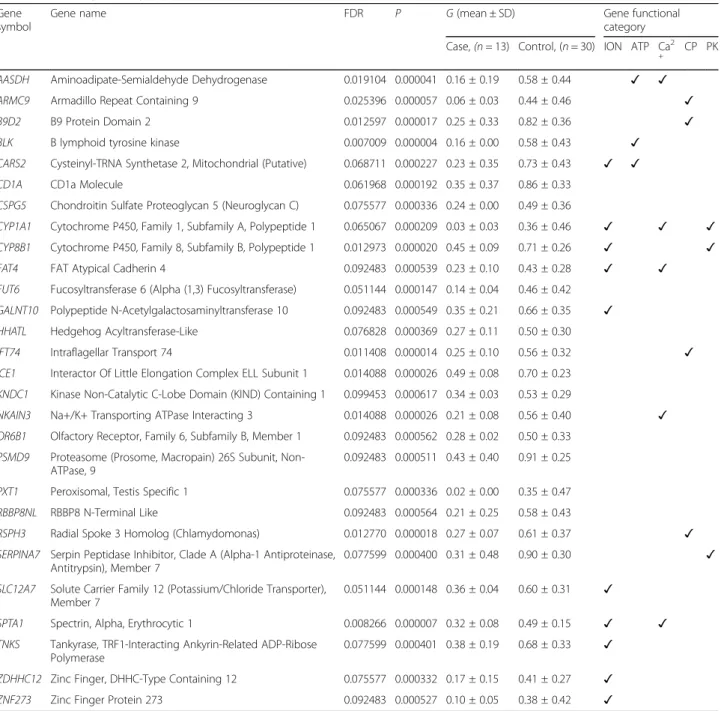
predicted by SIFT. For those selected genes, we con-cluded that the calls in 15 genes were false positive find-ings due to misalignment and/or off-target regions and that the remaining 28 genes were true positives. In sum-mary, we identified 28 genes SIFT-predicted deleterious variants that were statistically significantly associated with ritodrine-induced cardiac and pulmonary side ef-fects (Table 2). Additionally, all 32 variants that were
predicted to be deleterious by either SIFT or CADD, among the 82 variants in the 28 significant genes, were successfully replicated using Fluidigm™ genotyping as-says in 11 cases with sufficient DNA.
Genes associated with ritodrine-induced side effects
The hypergeometric test failed to identify a significantly enriched GO term, perhaps due to the small number of significant genes obtained. However, the hypergeometric distribution test revealed that the 28 genes showed sig-nificant enrichment with the SYSCILIA Gold Standard
Table 2 Genes significantly associated with ritodrine-induced side effects
Gene symbol
Gene name FDR P G (mean ± SD) Gene functional
category Case,(n = 13) Control, (n = 30) ION ATP Ca2
+ CP PK
AASDH Aminoadipate-Semialdehyde Dehydrogenase 0.019104 0.000041 0.16 ± 0.19 0.58 ± 0.44 ✓ ✓
ARMC9 Armadillo Repeat Containing 9 0.025396 0.000057 0.06 ± 0.03 0.44 ± 0.46 ✓
B9D2 B9 Protein Domain 2 0.012597 0.000017 0.25 ± 0.33 0.82 ± 0.36 ✓
BLK B lymphoid tyrosine kinase 0.007009 0.000004 0.16 ± 0.00 0.58 ± 0.43 ✓
CARS2 Cysteinyl-TRNA Synthetase 2, Mitochondrial (Putative) 0.068711 0.000227 0.23 ± 0.35 0.73 ± 0.43 ✓ ✓
CD1A CD1a Molecule 0.061968 0.000192 0.35 ± 0.37 0.86 ± 0.33
CSPG5 Chondroitin Sulfate Proteoglycan 5 (Neuroglycan C) 0.075577 0.000336 0.24 ± 0.00 0.49 ± 0.36
CYP1A1 Cytochrome P450, Family 1, Subfamily A, Polypeptide 1 0.065067 0.000209 0.03 ± 0.03 0.36 ± 0.46 ✓ ✓ ✓
CYP8B1 Cytochrome P450, Family 8, Subfamily B, Polypeptide 1 0.012973 0.000020 0.45 ± 0.09 0.71 ± 0.26 ✓ ✓
FAT4 FAT Atypical Cadherin 4 0.092483 0.000539 0.23 ± 0.10 0.43 ± 0.28 ✓ ✓
FUT6 Fucosyltransferase 6 (Alpha (1,3) Fucosyltransferase) 0.051144 0.000147 0.14 ± 0.04 0.46 ± 0.42 GALNT10 Polypeptide N-Acetylgalactosaminyltransferase 10 0.092483 0.000549 0.35 ± 0.21 0.66 ± 0.35 ✓
HHATL Hedgehog Acyltransferase-Like 0.076828 0.000369 0.27 ± 0.11 0.50 ± 0.30
IFT74 Intraflagellar Transport 74 0.011408 0.000014 0.25 ± 0.10 0.56 ± 0.32 ✓
ICE1 Interactor Of Little Elongation Complex ELL Subunit 1 0.014088 0.000026 0.49 ± 0.08 0.70 ± 0.23 KNDC1 Kinase Non-Catalytic C-Lobe Domain (KIND) Containing 1 0.099453 0.000617 0.34 ± 0.03 0.53 ± 0.29
NKAIN3 Na+/K+ Transporting ATPase Interacting 3 0.014088 0.000026 0.21 ± 0.08 0.56 ± 0.40 ✓
OR6B1 Olfactory Receptor, Family 6, Subfamily B, Member 1 0.092483 0.000562 0.28 ± 0.02 0.50 ± 0.33 PSMD9 Proteasome (Prosome, Macropain) 26S Subunit,
Non-ATPase, 9
0.092483 0.000511 0.43 ± 0.40 0.91 ± 0.25
PXT1 Peroxisomal, Testis Specific 1 0.075577 0.000336 0.02 ± 0.00 0.35 ± 0.47
RBBP8NL RBBP8 N-Terminal Like 0.092483 0.000564 0.21 ± 0.25 0.58 ± 0.43
RSPH3 Radial Spoke 3 Homolog (Chlamydomonas) 0.012770 0.000018 0.27 ± 0.07 0.61 ± 0.37 ✓
SERPINA7 Serpin Peptidase Inhibitor, Clade A (Alpha-1 Antiproteinase, Antitrypsin), Member 7
0.077599 0.000400 0.31 ± 0.48 0.90 ± 0.30 ✓
SLC12A7 Solute Carrier Family 12 (Potassium/Chloride Transporter), Member 7
0.051144 0.000148 0.36 ± 0.04 0.60 ± 0.31 ✓
SPTA1 Spectrin, Alpha, Erythrocytic 1 0.008266 0.000007 0.32 ± 0.08 0.49 ± 0.15 ✓ ✓
TNKS Tankyrase, TRF1-Interacting Ankyrin-Related ADP-Ribose Polymerase
0.077599 0.000401 0.38 ± 0.19 0.68 ± 0.33 ✓
ZDHHC12 Zinc Finger, DHHC-Type Containing 12 0.075577 0.000332 0.17 ± 0.15 0.41 ± 0.27 ✓
ZNF273 Zinc Finger Protein 273 0.092483 0.000527 0.10 ± 0.05 0.38 ± 0.42 ✓
FDR false discovery rate, G gene deleteriousness score, ION ion binding, ATP adenosine triphosphate binding, Ca2+calcium-related, CP ciliopathy,
genes (P = 0.009). SYSCILIA is a multi-national consor-tium for a biology systems approach to dissect cilia func-tion and its disrupfunc-tion in human genetic disease, and the SYSCILIA Gold Standard contains highly curated ciliary and ciliopathy genes. Even after lowering the definition stringency of deleterious genes between cases and
con-trols from FDR < 0.01 toP < 0.01 and P < 0.05, the
statis-tical significance of the SYSCILIA Gold Standard gene
enrichment remained robust and sustained (P0.01= 0.047
and P0.05= 0.001, respectively). As shown in Table 2, the
28 significant genes (FDR < 0.1) were categorized into
four functional classes: ion binding, ATP binding, Ca2
+
-related, and ciliopathies.
Analysis of ciliopathy genes and their subsets
The SKAT rare variant association test between the case (n = 13) and control (n = 30) groups showed marginal significance for JBTMKS after Bonferroni correction (P = 0.1054, Table 3) from the Invitae. Since JBTMKS harbour both JBTS- and MKS-related genes, we further evaluated the association signals for JBTS and MKS sep-arately using GHR. Only JBTS genes showed a marginal trend toward significance, whereas MKS genes did not. This result suggests that genetic variations identified in patients with serious ritodrine-induced cardiac and pul-monary side effects may be associated with JBTS. Table 4 presents the rare (MAF < 0.01) and deleterious (pre-dicted to be deleterious by at least one Bioinformatics tools: SIFT, CADD, or PolyPhen2) variants in JBTS genes (n = 11) in patients with serious ritodrine-induced side effects. Of these, four genes (AHI1, ARL13B, KIF7,
and RPGRIP1L) exhibited five heterozygous mutations,
but no homozygous mutations. Pulmonary embolism, considered to be the most serious side effect induced by ritodrine, was observed in four patients (SN1923, SN3230, SN8592 and SN9899). Rs193219215 on ADP ribosylation factor-like GTPase 13B (ARL13B), which
in-teracts with Intraflagellar transport 74 (IFT74) [29], was
found in two cases with pulmonary embolism (SN3230 and SN8592). This nonsynonymous variant, predicted to be deleterious by CADD, is a rare variant (MAF < 0.001) that has been found only in East Asian (EAS) popula-tions according to T1GP. Rs146925098 on RPGRIP1 like
(RPGRIP1L) was found in one case with pulmonary
embolism (SN3230). SN1923 and SN9899 cases with pulmonary embolism exhibited none of the above variants.
Drug metabolism-related genes
Two cytochrome P450 genes [family 1, subfamily A, polypeptide 1 (CYP1A1) and family 8, subfamily B, poly-peptide 1 (CYP8B1)] and serpin family A member 7 (SERPINA7), which are involved in drug metabolism phases I and II, respectively, exhibited significantly lower G scores in the case group compared to those in the
control group. Rs1048943 onCYP1A1 was found in nine
patients including two patients with pulmonary embol-ism (SN1932 and SN9899), and the carrier frequency in cases was significantly higher than in controls using Fisher’s exact test (P = 0.046, Table 5). The carrier
fre-quency of rs143070677 on CYP1A1 was significantly
higher in cases than in the EAS population (P = 0.050), whereas it was not significant compared to the control group (P = 0.518). This allele was found in one patient with pulmonary embolism (SN3230) and is a singleton
in T1GP (MAF < 0.0002). Rs4646422 on CYP1A1 was
found in four patients including one patient with pul-monary embolism (SN8592). In summary, either one of
the two functional variants of CYP1A1 was found in all
patients with pulmonary embolism. These alleles are East Asian-specific, in that their frequencies are rela-tively higher in EAS than in other populations. Although
a patient with rs202192572 on CYP8B1 did not have
pulmonary embolism, this is also a rare East Asian-specific variant that was found in only five EAS subjects
in T1GP. The carrier frequency of rs1804495 on
SER-PINA7 was significantly higher in cases than in control
groups (PControl< 0.001,PEAS= 0.018, andPT1GP= 0.001),
and nine patients carried this allele including two with
pulmonary embolism. Rs1804495 was also
over-represented in the EAS population.
Discussion
Little is known about the physiological mechanism of
rito-drine;ADRB2 is the only known target. Here, we analyzed
the whole-exomes of 13 cases with serious side effects and identified 28 genes that increase the risk of ritodrine-induced cardiac and pulmonary side effects. To the best of
Table 3 Rare-variant association tests for genes associated with ciliopathies and subsets
Database Gene list (No. of genes) Bonferroni correctedP Reference
Burden SKAT SKAT-O
Invitae Ciliopathies (102) 1.00000 1.00000 1.00000 [26]
Joubert and Meckel-Gruber Syndromes (JBTMKS; 30) 0.39528 0.10536 0.19548 [26]
GHR Joubert Syndrome (JBTS; 11) 0.09908 0.05076 0.08020 [27]
Meckel Syndrome (MKS; 8) 1.00000 1.00000 1.00000 [28]
Table 4 Distribution of rare and de leterious variants on four Joubert Syndrome genes from GHR in 13 cases with ritodrine-induced serious cardiac and pulmona ry side effects Gene Sym bol rsI D Variant deleteriou sne ss score MA F SN127 5 SN19 23 SN29 31 SN 2956 S N3230 SN 3828 SN418 1 SN421 1 SN440 7 SN502 1 SN520 9 SN859 2 SN989 9 SIFT CADD PolyP hen2 AHI1 rs1 48000 791 0.25 23.6 NA 0.0077 HET WT HET HET WT WT WT WT WT WT WT HET WT ARL13 B rs1 93219 215 0.12 20.9 0.41 0.0008 WT WT WT WT H ET WT WT WT WT WT WT HET WT KIF7 rs5 46772 749 0.01 9.2 0.01 0.0002 HET WT HET HET H ET WT WT WT HET HET WT WT WT rs5 36773 143 0.16 15.4 0.89 0.0002 WT WT WT WT WT WT WT WT WT WT WT HET WT RPG RIP1L rs1 46925 098 0 19.7 0.99 0.0002 WT WT WT WT H ET WT WT WT WT WT WT WT WT SIFT Sorting Intolerant from Tolerant, CADD Combined Annotation Dependent Depletion, PolyPhen2 Polymorphism Phenotyping v2.2.2, AF allele frequency, HET heterozygous, WT wild type, AHI1 Abelson Helper Integration Site 1, ARL13B ADP Ribosylation Factor Like GTPase 13B, KIF7 Kinesin Family Member 7, RPGRIP1L RPGRIP1 Like
our knowledge, this study was the first analysis using next-generation sequencing data to identify associations between ritodrine side effects and genomic variants. Using
theG scoring method, ion binding, ATP binding, Ca2+
-re-lated, and ciliopathy genes were found to be significantly altered in protein function. In particular, ion binding, ATP
binding, and Ca2+-related genes are important and
well-known for their roles in tocolysis. In addition, rare vari-ants in cases were associated with JBTS genes using RVATs. Two out of four pulmonary embolism cases car-ried at least one rare and deleterious variant on JBTS genes. Consequently, we speculate that rare variants on JBTS genes may contribute to the ritodrine-induced side effects related to muscle flexibility.
In addition to identifying ciliopathy genes, we detected ion- and ATP-binding, and calcium-related, genes that were significantly associated with ritodrine-induced side effects. These genes have not been reported as being disease-related genes and are not members of a pathway, implying that they may not play a key role in pathogen-icity. The results suggest that, the significant genes may be important in drug responses; however, further investi-gations are required. The molecular functions of these genes have been well-studied. Calcium, ATP and inor-ganic phosphate play key roles in the physiological func-tions of proteins, including muscle contraction [30]. In particular, myometrium contraction is affected by in-creased calcium levels and activation of the myosin light chain kinase via phosphorylation [31]. Ritodrine causes relaxation of smooth muscles in the uterus while stimu-lating cardiac muscles [31, 32]. In addition, mutations in sulfotransferase 1A3 were determined to affect the meta-bolic activity of ritodrine [33]. Collectively, we speculate that genetic predisposition related to ion- and ATP-binding and calcium plays an important role in the side effects of ritodrine treatment of PTB. An association
be-tween rs10774053 in CACNA1C and ritodrine side
ef-fects was reported recently [10]; however, this genetic association was not replicated in this study as no
signifi-cant difference (P = 0.1962) was detected in CACNA1C;
G score (mean ± SD) between the case and the control
groups (0.28 ± 0.2 and 0.35 ± 0.3, respectively). However,
they selected five SNPs in CACNA1C, including three
and two variants in intron and exon regions, respect-ively. The two exonic variants are predicted to be benign according to SIFT, and a recessive model was applied for statistical tests.
The distribution of deleterious variants of pharmacoki-netic genes differs markedly across ethnic groups. Two rare
Asian-specific functional alleles (rs143070677 and
rs202192572) were reported only in an EAS population with MAF < 0.001. Rs1048943, rs4646422, and rs1804495 are common alleles (MAF > 0.05), and MAFs in EAS are relatively higher than those in other ethnic groups. CYP1A1 and CYP8B1, which are xenobiotic enzymes, are involved in the metabolism of drug and toxicants [34].
Ele-vated CYP1A1 activity causes the formation of DNA
ad-ducts in pulmonary tissue and cellular damage [35, 36]. A particularly interesting finding was that at least one of the
functional variants ofCYP1A1 was identified in pulmonary
embolism cases in this study. An association of CYP1A1
polymorphisms with an increase in CYP1A1 activity has
been confirmed by functional studies [37, 38]. In particular, the catalytic activity in oestrogen metabolism was signifi-cantly higher in those with rs1048943 than wild-type [39]. The tocolytic effect of ritodrine was enhanced by adding natural progesterone in pregnant women [40]. A more re-cent study revealed the loss of a transcription factor
bind-ing site at Sp7 due to rs1048943 at exon 7 ofCYP1A1; this
variant was predicted to be deleterious by SIFT and CADD [41]. We also identified rare variants in drug metabolism-related genes with a relatively higher frequency in Asian subjects, despite the small sample size. Therefore, overrep-resented and/or significantly higher deleterious variants in drug metabolism genes may also increase the risk of ritodrine-induced side effects, such as pulmonary embol-ism, in the Korean population.
Conclusions
Using WES, this study identified rare deleterious variants associated with ritodrine-induced serious cardiac and pul-monary side effects in Korean preterm labour subjects.
Table 5 Carrier frequencies and Fisher’s exact test results of variants on the drug metabolism-related genes
Gene Symbol
rsID Variant deleteriousness score Case,
n = 13 Control,n = 30 EAS,n = 504 T1GP,n = 2504
SIFT CADD PolyPhen2 Freq P Freq P Freq P
CYP1A1 rs1048943 0.01 21.9 0.49 9 (69%) 10 (33%) 0.0457 221 (44%) 0.0902 568 (23%) 0.0005
rs143070677 0.03 24.4 0.51 1 (8%) 1 (3%) 0.5183 1 (0.2%) 0.0497 1 (0.04%) 0.0103
rs4646422 0.08 24.0 0.19 4 (31%) 12 (40%) 0.7349 111 (22%) 0.4986 116 (5%) 0.0025
CYP8B1 rs202192572 0.04 23.9 0.05 1 (8%) 0 (0%) 0.3023 5 (1%) 0.1423 5 (0.2%) 0.0306
SERPINA7 rs1804495 0.01 23.8 0.46 9 (69%) 3 (10%) 0.0002 179 (36%) 0.0180 623 (25%) 0.0010
Freq carrier frequency, SIFT Sorting Intolerant from Tolerant, CADD Combined Annotation Dependent Depletion, PolyPhen2 Polymorphism Phenotyping v2.2.2, EAS East Asian in the 1000 Genomes Project, T1GP The 1000 Genomes Project, CYP1A1 cytochrome P450, family 1, subfamily A, polypeptide 1, CYP8B1 cytochrome P450, family 8, subfamily B, polypeptide 1, SERPINA7 serpin peptidase inhibitor, clade A (alpha-1 antiproteinase, antitrypsin), member 7
Most importantly, rare variants on ciliopathy genes were demonstrated to be significantly associated with JBTS. Asian-specific rare and common variants related to the pharmacokinetics of ritodrine may elicit serious cardiac and pulmonary side effects. Further studies are needed to validate the rare variants in a larger cohort for replication, and to elucidate the role of these variants in the molecular mechanisms of the side effects.
Acknowledgements
JHK would like to gratefully acknowledge the Education and Research Encouragement Fund of Seoul National University Hospital. Funding
This study was supported by the Ministry of Health & Welfare of the Republic of Korea (HI14C0306 and HI15C2059) through the Korea Health Industry Development Institute, and grants from the Korean Health Technology R&D Project, Ministry of Health and Welfare (HI16C11280000).
Availability of data and materials
The SRA (Sequence Read Archive) accession number for the exome sequences reported in this paper is SRP127651.
Authors’ contributions
HS, EJK, YAY, YP, and KY performed the research, wrote the manuscript and contributed to revision of the paper. BJM performed the sequencing experiments, assisted in data analysis, and wrote the manuscript. HSH and YJK conducted the clinical design and sample acquisition. JHK conceived of the research idea and designed the study. HSH, JHK and YJK managed and supervised the study. All authors reviewed, edited and approved the final manuscript.
Ethics approval and consent to participate
This study was approved by the Institutional Review Boards of Ewha Womans University Medical Center and Konkuk University Medical Center
(IRB Nos. ECT 06–127-7 and KUH1040034). All participants provided written
informed consent prior to participation in the study. Consent for publication
Not applicable Competing interests
The authors declare that they have no competing interests.
Publisher’s Note
Springer Nature remains neutral with regard to jurisdictional claims in published maps and institutional affiliations.
Author details
1Seoul National University Biomedical Informatics (SNUBI), Div. of Biomedical Informatics, Seoul National University College of Medicine, Seoul 03080, Korea.2Medical Research Institute, College of Medicine, Ewha Womans University, Seoul 07985, Korea.3Department of Obstetrics and Gynecology, Konkuk University Medical Center, Konkuk University School of Medicine, Seoul 05030, Korea.4Department of Obstetrics and Gynecology, College of Medicine, Ewha Womans University Mok Dong Hospital, Seoul 07985, Korea. Received: 9 August 2017 Accepted: 8 January 2018
References
1. Beck S, Wojdyla D, Say L, Betran AP, Merialdi M, Requejo JH, et al. The
worldwide incidence of preterm birth: a systematic review of maternal
mortality and morbidity. Bull World Health Organ. 2010;88:31–8.
2. Hwang HS, Na SH, Hur SE, Lee SA, Lee KA, Cho GJ, et al. Practice patterns in
the management of threatened preterm labor in Korea: a multicenter
retrospective study. Obstet Gynecol Sci. 2015;58:203–9.
3. Goldenberg RL, Culhane JF, Iams JD, Romero R. Epidemiology and causes of
preterm birth. Lancet. 2008;371:75–84.
4. Merritt TA, Deming DD, Boynton BR. The‘new’ bronchopulmonary
dysplasia: challenges and commentary. Semin Fetal Neonatal Med. 2009;14:
345–57.
5. Horbar JD, Carpenter JH, Badger GJ, Kenny MJ, Soll RF, Morrow KA, et al.
Mortality and neonatal morbidity among infants 501 to 1500 grams from
2000 to 2009. Pediatrics. 2012;129:1019–26.
6. Li X, Zhang Y, Shi Z. Ritodrine in the treatment of preterm labour: a
meta-analysis. Indian J Med Res. 2005;121:120–7.
7. Canadian Preterm Labor Investigators Group. Treatment of preterm labor
with the beta-adrenergic agonist ritodrine. N Engl J Med. 1992;327:308–12.
8. Kagabu M, Murai S, Ogasawara T. Acute coronary syndrome associated with
oral administration of ritodrine hydrochloride during pregnancy: a case
report. J Obstet Gynaecol Res. 2001;27:337–40.
9. Park JY, Lee NR, Lee KE, Park S, Kim YJ, Gwak HS. Effects ofβ2-adrenergic
receptor gene polymorphisms on ritodrine therapy in pregnant women
with preterm labor: prospective follow-up study. IJMS. 2014;15:12885–94.
10. Baek MY, Hwang HS, Park JY, Chung JE, Lee KE, Lee GY, et al. Association
between CACNA1C gene polymorphisms and ritodrine-induced adverse
events in preterm labor patients. Eur J Clin Pharmacol. 2017;73:837–42.
11. Koboldt DC, Steinberg KM, Larson DE, Wilson RK, Mardis ER. The
next-generation sequencing revolution and its impact on genomics. Cell. 2013;
155:27–38.
12. Kaname T, Yanagi K, Naritomi K. A commentary on the promise of
whole-exome sequencing in medical genetics. J Hum Genet. 2014;59:117–8.
13. Lee S, Abecasis GR, Boehnke M, Lin X. Rare-variant association analysis:
study designs and statistical tests. Am J Hum Genet. 2014;95:5–23.
14. Lange LA, Hu Y, Zhang H, Xue C, Schmidt EM, Tang ZZ, et al. Whole-exome
sequencing identifies rare and low-frequency coding variants associated
with LDL cholesterol. Am J Hum Genet. 2014;94:233–45.
15. McKenna A, Hanna M, Banks E, Sivachenko A, Cibulskis K, Kernytsky A, et al.
The genome analysis toolkit: a MapReduce framework for analyzing
next-generation DNA sequencing data. Genome Res. 2010;20:1297–303.
16. Ng PC, Henikoff S. SIFT: predicting amino acid changes that affect protein
function. Nucleic Acids Res. 2003;31:3812–4.
17. Kumar P, Henikoff S, Ng PC. Predicting the effects of coding
non-synonymous variants on protein function using the SIFT algorithm. Nat
Protoc. 2009;4:1073–81.
18. Kircher M, Witten DM, Jain P, O'Roak BJ, Cooper GM, Shendure J. A general
framework for estimating the relative pathogenicity of human genetic
variants. Nat Genet. 2014;46:310–5.
19. Adzhubei IA, Schmidt S, Peshkin L, Ramensky VE, Gerasimova A, Bork P, et
al. A method and server for predicting damaging missense mutations. Nat
Methods. 2010;7:248–9.
20. Lee KH, Baik SY, Lee SY, Park CH, Park PJ, Kim JH. Genome sequence
variability predicts drug precautions and withdrawals from the market. PLoS One. 2016;11:e0162135.
21. 1000 Genomes Project Consortium, Abecasis GR, Auton A, Brooks LD, MA
DP, Durbin RM, et al. An integrated map of genetic variation from 1,092
human genomes. Nature. 2012;491:56–65.
22. 1000 Genomes Project Consortium, Auton A, Brooks LD, Durbin RM,
Garrison EP, Kang HM, et al. A global reference for human genetic variation.
Nature. 2015;526:68–74.
23. Huang DW, Sherman BT, Lempicki RA. Bioinformatics enrichment tools:
paths toward the comprehensive functional analysis of large gene lists.
Nucleic Acids Res. 2009;37:1–13.
24. Huang DW, Sherman BT, Lempicki RA. Systematic and integrative analysis of
large gene lists using DAVID bioinformatics resources. Nat Protoc. 2009;4:
44–57.
25. van Dam TJ, Wheway G, Slaats GG, SYSCILIA Study Group, Huynen MA, Giles
RH. The SYSCILIA gold standard (SCGSv1) of known ciliary components and its applications within a systems biology consortium. Cilia. 2013;2:7.
26. Invitae,“Ciliopathies”, Invitae Corporation, https://www.invitae.com/en/
physician/ny-category/CAT000016/ (Accessed 20 June 2017).
27. Genetics Home Reference,“Joubert syndrome”, Lister Hill National Center
for Biomedical Communications, U.S. National Library of Medicine, National Institutes of Health, Department of Health & Human Services, https://ghr. nlm.nih.gov/condition/joubert-syndrome#genes (Accessed 28 June 2017).
28. Genetics Home Reference,“Meckel syndrome”, Lister Hill National Center for
Institutes of Health, Department of Health & Human Services, https://ghr. nlm.nih.gov/condition/meckel-syndrome#genes (Accessed 28 June 2017).
29. Cevik S, Sanders AA, Van Wijk E, Boldt K, Clarke L, van Reeuwijk J, et al.
Active transport and diffusion barriers restrict Joubert syndrome-associated ARL13B/ARL-13 to an inv-like ciliary membrane subdomain. PLoS Genet. 2013;9:e1003977.
30. Wray S. Uterine contraction and physiological mechanisms of modulation.
Am J Phys. 1993;264:C1–18.
31. Word RA, Stull JT, Casey ML, Kamm KE. Contractile elements and myosin
light chain phosphorylation in myometrial tissue from nonpregnant and
pregnant women. J Clin Invest. 1993;92:29–37.
32. Wray S, Jones K, Kupittayanant S, Li Y, Matthew A, Monir-Bishty E, et al.
Calcium signaling and uterine contractility. J Soc Gynecol Investig. 2003;10:
252–64.
33. Hui Y, Liu MC. Sulfation of ritodrine by the human cytosolic
sulfotransferases (SULTs): effects of SULT1A3 genetic polymorphism. Eur J
Pharmacol. 2015;761:125–9.
34. Zanger UM, Schwab M. Cytochrome P450 enzymes in drug metabolism:
regulation of gene expression, enzyme activities, and impact of genetic
variation. Pharmacol Ther. 2013;138:103–41.
35. Nebert DW. Role of genetics and drug metabolism in human cancer risk.
Mutat Res. 1991;247:267–81.
36. Bartsch H, Petruzzelli S, De Flora S, Hietanen E, Camus AM, Castegnaro M,
et al. Carcinogen metabolism in human lung tissues and the effect of
tobacco smoking: results from a case–control multicenter study on lung
cancer patients. Environ Health Perspect. 1992;98:119–24.
37. Crofts F, Taioli E, Trachman J, Cosma GN, Currie D, Toniolo P, et al.
Functional significance of different human CYP1A1 genotypes.
Carcinogenesis. 1994;15:2961–3.
38. Nerurkar PV, Okinaka L, Aoki C, Seifried A, Lum-Jones A, Wilkens LR,
et al. CYP1A1, GSTM1, and GSTP1 genetic polymorphisms and urinary 1-hydroxypyrene excretion in non-occupationally exposed individuals.
Cancer Epidemiol. 2000;9:1119–22.
39. Kisselev P, Schunck W-H, Roots I, Schwarz D. Association of CYP1A1
polymorphisms with differential metabolic activation of 17beta-estradiol
and estrone. Cancer Res. 2005;65:2972–8.
40. Chanrachakul B, Broughton Pipkin F, Warren AY, Arulkumaran S, Khan RN.
Progesterone enhances the tocolytic effect of ritodrine in isolated pregnant
human myometrium. Am J Obstet Gynecol. 2005;192:458–63.
41. Zou J-G, Ma Y-T, Xie X, Yang Y-N, Pan S, Adi D, et al. The association
between CYP1A1 genetic polymorphisms and coronary artery disease in the Uygur and Han of China. Lipids Health Dis. 2014;13:145.
• We accept pre-submission inquiries
• Our selector tool helps you to find the most relevant journal • We provide round the clock customer support
• Convenient online submission • Thorough peer review
• Inclusion in PubMed and all major indexing services • Maximum visibility for your research
Submit your manuscript at www.biomedcentral.com/submit