• 검색 결과가 없습니다.

INTRODUCTION EfficacyandLong-TermFollowUpofCombinationTherapywithInterferonAlphaandRibavirinforChronicHepatitisCinKorea

N/A
N/A
Protected

Academic year: 2022

Share "INTRODUCTION EfficacyandLong-TermFollowUpofCombinationTherapywithInterferonAlphaandRibavirinforChronicHepatitisCinKorea"

Copied!
6
0
0

로드 중.... (전체 텍스트 보기)

전체 글

(1)

Vol. 47, No. 6, pp. 793 - 798, 2006

Combination therapy with interferon alpha (IFN- ) and α ribavirin for 24 or 48 weeks according to HCV genotype has improved the overall sustained virological response (SVR) rates to approximately 40%. The aim of this study was to investigate the long-term efficacy of combination therapy with IFN- and ribavirin for chronic hepatitis C in Koreans. α One hundred thirty-eight patients with chronic hepatitis C who received this combination therapy between 1995 and 2003 were analyzed retrospectively. All patients were treated with IFN- 3-6 million units three times weekly in com α - bination with 900-1200 mg/day of ribavirin for 24 weeks.

The overall SVR rate was 41.3%. Patients were followed up for a median of 41 months (range, 12-105 months) after completion of therapy. In all of the SVR patients (57 patients), SVR was conserved during the follow-up period.

None of the patients progressed to decompensated liver disease or hepatocellular carcinoma (HCC). However, 5 of the 81 non-SVR patients (6.2%) progressed to decom- pensated liver disease or HCC. In conclusion, combination therapy with IFN- α and ribavirin shows good long-term efficacy in patients with chronic hepatitis C in Korea, one of the highest endemic areas of hepatitis B virus (HBV) infec- tion.

Key Words: Chronic hepatitis C, interferons, ribavirin, long- term effects

INTRODUCTION

Chronic hepatitis C infection affects nearly 170 million people worldwide, and it is the most com- mon indication for liver transplantation.

1-3

Between 20 and 30% of infected individuals will eventually go on to develop cirrhosis and its sequelae.

1-3

Un- fortunately, even in developed countries, deaths due to hepatitis C are increasing because of in- adequate detection and treatment.

4-6

In a high endemic area of HBV infection, chronic hepatitis C may be overlooked until the disease has progressed significantly. In Korea, which is a high endemic area of HBV infection, about 50-90 thou- sand people are chronically infected with HCV, and at least 10-17% of hepatocellular carcinoma (HCC) cases are probably attributable to HCV in- fection.

7

The previous standard treatment for patients infected with HCV before introduction of pegy- lated IFN consisted of a combination of interferon (IFN) and ribavirin, which lead to the elimination of HCV-RNA and a long-term remission of the liver disease in approximately 40% of patients.

8

There have been some studies which suggested that treatment with the standard interferon-based therapy resulted in a long-term moderate decrease in HCC risk.

9-11

However, there have been few reports on the long-term follow-up and rates of HCC in patients who received the combination therapy of interferon with ribavirin, especially in high endemic areas of HBV infection. Our study sought to address this question in Korean patients.

Efficacy and Long-Term Follow Up of Combination Therapy with Interferon Alpha and Ribavirin for Chronic Hepatitis C in Korea

Jie-Hyun Kim,

1

Kwang-Hyub Han,

1

Kwan Sik Lee,

1

Young Nyun Park,

2

Sang Hoon Ahn,

1

Chae Yoon Chon,

1

and Young Myoung Moon

1

Departments of

1

Internal Medicine, Institute of Gastroenterology,

2

Pathology, Yonsei University College of Medicine, Seoul, Korea.

Received February 13, 2006 Accepted June 13, 2006

This work was supported by the Brain Korea 21 Project, and in part by a grant (no. 2005-8-1371) from the Ministry of Com- merce Industry and Energy, Republic of Korea.

Reprint address: requests to Dr. Kwang-Hyub Han, Department of Internal Medicine, Yonsei University College of Medicine, 134 Shinchon-dong, Seodaemun-gu, Seoul 120-752, Korea. Tel: 82-2- 2228-1949, Fax: 82-2-393-6884, E-mail: [email protected].

ac.kr

(2)

MATERIALS AND METHODS Patients

We retrospectively reviewed the clinical data of 138 chronic hepatitis C patients who were serum anti-HCV positive according to a third-generation immunoenzyme assay, and HCV RNA positive by a reverse transcriptase-polymerase chain reaction (RT-PCR) using HCV specific primers. We ex- cluded patients who had evidence of liver disease due to any cause other than chronic hepatitis C, decompensated liver disease-hypoalbuminemia (albumin < 3.0 g/dL), jaundice (total bilirubin >

2.0 mg/dL), prothrombin time (PT) prolongation (PT > 3 seconds), hepatic encephalopathy or ascites-, other severe systemic disease, and preg- nancy.

The patients were treated in the outpatient clinic of Severance Hospital from January 1995 to December 2003. We divided the 138 patients into two groups, the initial treatment group and the retreatment group. The initial treatment group consisted of 94 patients, and the retreatment group consisted of 44 patients who had pre- viously received IFN monotherapy or IFN plus ribavirin combination therapy.

All patients were treated for 24 weeks with recombinant interferon alpha (Intermax- ; LG α chemical Ltd, Korea: Intron- A; Schering-Plough, Kenilworth, NJ, USA) plus ribavirin (Rebetol;

Schering-Plough, Kenilworth, NJ, USA). IFN-α was administered subcutaneously three times weekly (3-6 million units (MU)) and the ribavirin was orally given 900 - 1200 mg/day. The safety, tolerance and efficacy of the treatment were assessed by interview and by biochemical and hematological testing including serum -feto α pro- tein and abdominal ultrasonography for screening of HCC. Serum HCV-RNA concentrations were measured before initiating treatment, 12 weeks into the program, at the completion of therapy, and every 24 weeks in the follow-up period.

Serum HCV RNA concentrations were measured by PCR using a commercial assay with a lower limit of detection of 50 IU/ml (Cobas Amplicor HCV Monitor; Roche Diagnostics, Hoffman- Laroche, Basel, Switzerland).

The IFN or ribavirin doses were modified if an

important adverse event occurred such as serious alterations of renal function or hematological toxicity.

Assessment of efficacy

In accordance with the NIH consensus state- ment, the end of treatment response (ETR) was defined as when a patient achieved undetectable serum HCV RNA levels at the end of therapy. A sustained virological response (SVR) was defined as a persistent serum HCV RNA clearance for 24 weeks after the completion of therapy. A patient was considered to have relapsed when the HCV RNA was detected again after discontinuation of treatment after it was reduced to undetectable levels over the course of treatment. Patients for whom HCV RNA levels remained detectable at the end of treatment were considered nonre- sponders (NR). Progression to decompensated liver disease or development of HCC during the follow-up period were included as possible long- term outcomes of patients who received combina- tion therapy.

Statistical analysis

The Chi square and the Fisher's exact test were employed when necessary for comparison of categorical variables, and the Student's t-test was used for comparison of continuous variables.

Univariate and multivariate logistic regression analyses were carried out to study the influence of different variables on achievement of a SVR.

Differences were considered as significant when the p-value was < 0.05. All calculations were per- formed using the SPSS statistical package (SPSS Inc., Chicago, IL, USA).

RESULTS

Ninety-four of the 138 patients (initial treatment

group) underwent IFN- plus ribavirin combina α -

tion therapy as their initial therapy and forty-four

patients (retreatment group) received retreatment

therapy. The patient characteristics of the two

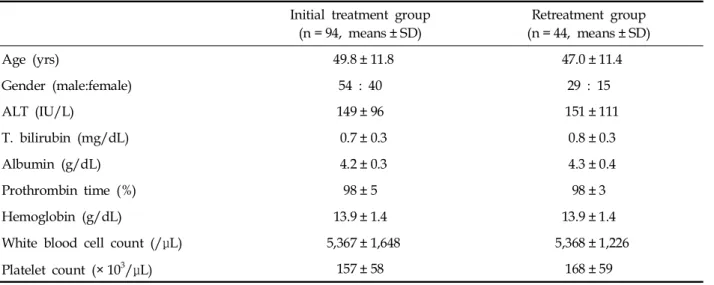
groups are shown in Table 1. There were no sig-

nificant differences in age, gender, or baseline

(3)

laboratory findings between the two groups.

Virological response in initial and retreatment patients

The proportions of patients grouped according to the efficacies of both treatments are reported in Table 2. For all the enrolled patients, a SVR was observed in 57 of 138 patients (41.3%). There were no significant differences in SVR (42.5% vs. 39%

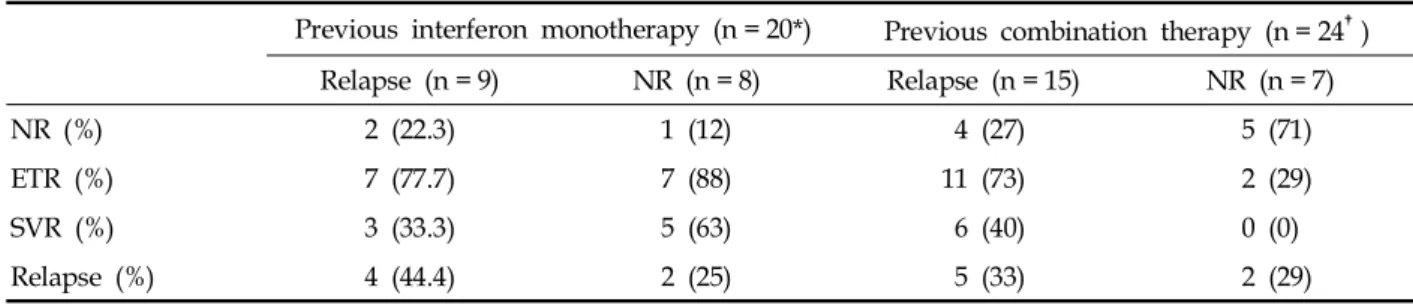
respectively) between the initial and retreatment groups. In the retreatment group, 20 patients had been treated by previous IFN monotherapy and 24 patients had been treated by previous IFN plus ribavirin combination therapy. The proportion of patients grouped according to the efficacies of the retreatment groups as categorized by previous treatment responses is reported in Table 3. None

of nonresponders to previous combination therapy had SVR on retreatment, whereas the SVR of the other patients was comparable to the initial treatment group.

Variables associated with SVR; pre-treatment and on-treatment predictors

The SVR was unrelated to gender, age, baseline ALT or biopsy stage before treatment

In this study, the on-treatment predictors for response rates were analyzed as follows: out of the 88 patients with ALT normalization at 4 weeks after the initiation of therapy, 44 (32%) achieved a SVR. Of the 50 patients with abnormal ALT levels at 4 weeks, only 13 (9%) achieved a SVR (Table 5). In a multivariate logistic model, ALT normalization at 4 weeks after initiation of Table 1. Base-line Characteristics of Patients

Initial treatment group (n = 94, means ± SD)

Retreatment group (n = 44, means ± SD)

Age (yrs) 49.8 ± 11.8 47.0 ± 11.4

Gender (male:female) 54 : 40 29 : 15

ALT (IU/L) 149 ± 96 151 ± 111

T. bilirubin (mg/dL) 0.7 ± 0.3 0.8 ± 0.3

Albumin (g/dL) 4.2 ± 0.3 4.3 ± 0.4

Prothrombin time (%) 98 ± 5 98 ± 3

Hemoglobin (g/dL) 13.9 ± 1.4 13.9 ± 1.4

White blood cell count (/ L) μ 5,367 ± 1,648 5,368 ± 1,226

Platelet count (× 10

3

/ L) μ 157 ± 58 168 ± 59

p > 0.05 between initial treatment and retreatment groups.

ALT, alanine aminotransferase.

Table 2. Response Rates after Treatment According to ETR, SVR, and Relapse or NR

Total (n = 138) Initial treatment (n = 94) Retreatment (n = 44)

NR (%) 43 (31.2) 30 (32) 13 (30)

ETR (%) 95 (68.8) 64 (68) 31 (70)

SVR (%) 57 (41.3) 40 (42.5) 17 (39)

Relapse (%) 38 (27.5) 24 (25.5) 14 (31)

p, NS between two groups.

ETR, end of treatment response; SVR, sustained virological response; NR, no response.

(4)

therapy was significantly associated with a SVR (p

= 0.018) (Table 5).

Among the 83 patients who underwent testing for HCV-RNA by PCR, 37 patients (45%) who were negative for HCV-RNA at 12 weeks after initiation of therapy achieved SVR. Thirty-seven (63.8%) of the 58 patients who were negative for HCV-RNA at 12 weeks after initiation of therapy achieved a SVR (Table 5). Therefore, the predicta-

bility of the SVR based on the early virologic response (EVR) was confirmed.

Tolerability and adverse events

No patients left the combination therapy trial because of side effects. There were no differences between the initial and retreatment groups in their rates of dose modification. However, the side effect profiles were higher in the initial treatment Table 3. Treatment Responses in the Retreatment Group According to the ETR, SVR, and Relapse or NR

Previous interferon monotherapy (n = 20*) Previous combination therapy (n = 24 ) Relapse (n = 9) NR (n = 8) Relapse (n = 15) NR (n = 7)

NR (%) 2 (22.3) 1 (12) 4 (27) 5 (71)

ETR (%) 7 (77.7) 7 (88) 11 (73) 2 (29)

SVR (%) 3 (33.3) 5 (63) 6 (40) 0 (0)

Relapse (%) 4 (44.4) 2 (25) 5 (33) 2 (29)

*Previous response unknown in 3 patients (SVR = 2/3).

Previous response unknown in 2 patients (SVR = 1/2).

ETR, end of treatment response; SVR, sustained virological response; NR, no response.

Table 4. Long-term Follow-up Outcomes of SVR and Non-SVR Patients

SVR (n = 57) Non-SVR (n = 81)

Follow-up duration (median months) 34 (17 - 91) 44 (12 - 105)

Follow-up outcomes

SVR conservation without complication 57 (100%) 0

Relapse or no response without complication 0 76 (93.8%)

Decompensated liver disease 0 2 (2.5%)

Hepatocellular carcinoma 0 3 (3.7%)

SVR, sustained virological response.

Table 5. Multivariate Analysis of On-treatment Factors Associated with SVR

N (%) SVR rate (%) Odds ratio (95% CI) p

ALT at 4 weeks 138 4.17 (3.57 - 4.78) 0.018

Normal 88 (64) 44 (32)

Abnormal* 50 (36) 13 (9)

HCV RNA at 12 weeks 83 20.38 (19.58 - 21.18) < 0.001

Negative 58 (70) 37 (45)

Positive 25 (30) 2 (2)

*ALT > 46 IU/L.

SVR, sustained virological response; CI, confidence interval; ALT, alanine aminotransferase.

(5)

group than in the retreatment group (Table 6). For hematologic side effects, which can be fatal, there were no significant differences between the two groups. The most common non-hematologic side effect was general weakness.

Long-term clinical outcomes of combination therapy In this study, patients were treated in our outpatient clinics from January 1995 to December 2003, and followed up for mean period of 39 months after completion of therapy.

In all of the SVR patients (57 patients), SVR was persistently conserved during the follow-up period (median 34 months, 17-91 months). None of the patients progressed to decompensated liver disease or HCC during the follow-up period.

However, in the 81 non-SVR patients, 2 (2.5%) patients progressed to decompensated liver dis- ease and 3 (3.7%) progressed to HCC during the median of 44 months (12-105 months) of follow- up.

DISCUSSION

Combination therapy with IFN- and ribavirin α for 24 or 48 weeks has improved the overall SVR rates, which had been reported in previous major trials as 31% to 47%.

1,9,12

In some studies, late virological relapse, defined as the appearance of detectable HCV RNA more than 24 weeks after treatment with combination therapy,

13

occurred in less than 1% of SVR patients.

13-15

In this study, SVR was persistently conserved during an aver- age follow-up period of 34 months.

The ultimate goal of anti-viral therapy for chronic hepatitis C is to prevent HCC and im- prove long-term prognosis. Some studies that have addressed the long-term clinical outcomes of

interferon-based treatments.

9-11

Although the re- sults were limited by the lack of randomized con- trolled trials and substantial heterogeneity among the retrospective and prospective group studies, the evidence was generally consistent in sug- gesting that treatment with standard interferon- based therapy produced a moderate decrease of the risk for HCC in the complete responders and relapsed groups.

9-11

The potential benefits of interferon therapy in preventing HCC may be due to prevention of cirrhosis by interruption of the inflammation and necrosis that accompanies chronic hepatitis C, which generally resolves itself in sustained virological responders.

14

Interferon may exert a direct effect on cancer risk due to its antiproliferative activity. Finally, interferon may blunt the carcinogenic effects of viral replication or intracellular viral proteins responsible for pro- moting cell growth, proliferation, and malignant transformation by suppressing viral replication.

16

To address the lack of long-term follow-up data for combination therapy with interferon and riba- virin, our study sought to investigate the long- term clinical outcomes of responders and non- responders to combination therapy with interferon and ribavirin. However, the follow-up period of all subjects was not consistent or well-matched, as this was a retrospective study. The follow-up period was longer in the non-responders. Therefore, more follow-up data in responders is necessary for an exact comparison with non-responders.

According to this study, none of 57 SVR patients progressed to decompensated liver disease or HCC. However, only 2 patients (5.3 %) among the 38 relapsers progressed to HCC and 3 patients (7.0

%) among 43 nonresponders progressed to de- compensated liver disease or HCC. This fact raised the possibility that standard interferon- based combination therapy decreased the risk of Table 6. Rates of Adverse Events or Dose Reduction

Initial treatment group n = 94 (%)

Retreatment group

n = 44 (%) p

Side effects 49 (52) 12 (27) 0.006

Hematologic 16 (17) 2 (5)

Others 33 (35) 10 (22)

Dose reduction 26 (28) 5 (11) 0.343

(6)

decompensated liver disease or HCC in the SVR group. However, it is uncertain whether inter- feron-based therapy that does not result in a SVR has an effect in slowing the progression of disease and the risk of HCC.

14

Some studies reported that interferon had beneficial long term effects that reduced the occurrence of HCC, even in patients who did not have complete response to inter- feron.

17

In one such study, retreament with IFN to incomplete responders to previous IFN therapy appeared to have the additional effect of sup- pressing the development of HCC.

15

That study suggested that IFN treatment had a suppressive effect on disease progression even in patients whose HCV was not eradicated with IFN. However, more studies should be conducted regarding the impact of interferon-based combination therapy on the long-term outcomes of HCV non-eradi- cated patients.

The recent treatment of choice for chronic hepatitis C has been pegylated interferon (PEG- IFN) plus ribavirin. In randomized-multinational phase III clinical trials, PEG-IFN plus ribavirin produced overall SVR rates of 56%

16

and 63%

17

in initial treatment patients with chronic hepatitis C, superior to the standard IFN plus ribavirin regi- men. Therefore, further studies are warranted to determine whether better results for long-term clinical outcomes of HCV-infected patients can be achieved with a combination therapy consisting of PEG-IFN and ribavirin.

In conclusion, combination therapy with IFN-α and ribavirin has a good long-term efficacy in patients with chronic hepatitis C in Koreans, and this treatment could decrease the risk of decom- pensated liver disease or HCC in treatment responders.

REFERENCES

1. Poynard T, Marcellin P, Lee SS, Niederau C, Minuk GS, Ideo G, et al. Randomised trial of interferon 2b plus α ribavirin for 48 weeks or for 24 weeks versus interferon 2b plus placebo for 48 weeks for treatment of chronic α

infection with hepatitis C virus. Lancet 1998;352:1426-32.

2. Seeff LB, Buskell-Bales Z, Wright EC, Durako SJ, Alter HJ, Iber FL, et al. Long-term mortality after transfusion- associated non-A, non-B hepatitis. The National Heart, Lung, and Blood Institute Study Group. N Engl J Med 1992;327:1906-11.

3. Poynard T, Bedossa P, Opolon P. Natural history of liver fibrosis progression in patients with chronic hepatitis C. The OBSVIRC, METAVIR, CLINIVIR, and DOSVIRC groups. Lancet 1997;349:825-32.

4. Poynard T, Yuen MF, Ratziu V, Lai CL. Viral hepatitis C. Lancet 2003;362:2095-100.

5. Deuffic S, Buffat L, Poynard T, Valleron AJ. Modeling the hepatitis C virus epidemic in France. Hepatology 1999;29:1596-601.

6. Deuffic S, Poynard T, Valleron AJ. Correlation between hepatitis C virus prevalence and hepatocellular carci- noma mortality in Europe. J Viral Hepat 1999;6:411-3.

7. Huh K, Choi SY, Whang YS, Lee DS. Prevalence of viral hepatitis markers in Korean patients with hepatocel- lular carcinoma. J Korean Med Sci 1998;13:306-10.

8. Perez R, Jimenez M, Crespo J, Diago M, Enriquez J, Vaquero P, et al. Comparative study of the efficacy of an induction dose of interferon- 2b with ribavirin com α - pared with standard combined treatment in naive patients with chronic hepatitis C. J Viral Hepat 2003;10:

437-45.

9. Nishiguchi S, Shiomi S, Nakatani S, Takeda T, Fukuda K, Tamori A, et al. Prevention of hepatocellular carci- noma in patients with chronic active hepatitis C and cirrhosis. Lancet 2001;357:196-7.

10. Bernardinello E, Cavalletto L, Chemello L, Mezzocolli I, Donada C, Benvegnu L, et al. Long-term clinical outcome after beta-interferon therapy in cirrhotic patients with chronic hepatitis C. TVVH Study Group.

Hepatogastroenterology 1999;46:3216-22.

11. Horiike N, Fujisawa T, Michitaka K, Tada K, Masumoto T, Iuchi H, et al. The effectiveness of interferon therapy on occurrence of hepatocellular carcinoma in chronic hepatitis C. Oncol Rep 1998;5:1171-4.

12. McHutchison JG, Gordon SC, Schiff ER, Shiffman ML, Lee WM, Rustgi VK, et al. Interferon alfa-2b alone or in combination with ribavirin as initial treatment for chronic hepatitis C. Hepatitis Interventional Therapy Group. N Engl J Med 1998;339:1485-92.

13. Lindsay KL. Introduction to therapy of hepatitis C.

Hepatology 2002;36(5 Suppl 1):S114-20.

14. Heathcote EJ. Prevention of hepatitis C virus-related hepatocellular carcinoma. Gastroenterology 2004;127(5 Suppl 1): S294-302.

15. Toyoda H, Kumada T, Nakano S, Takeda I, Sugiyama K, Kiriyama S, et al. The effect of retreatment with interferon- on the incidence of hepatocellular carci α - noma in patients with chronic hepatitis C. Cancer 2000;

88:58-65.

16. Fried MW, Shiffman ML, Reddy KR, Smith C, Marinos G, Goncales FL Jr, et al. Peginterferon alfa-2a plus ribarivin for chronic hepatitis C virus infection. N Engl J Med 2002;347:975-82.

17. Hadziyannis SJ, Sette H Jr, Morgan TR, Balan V, Diago

M, Marcellin P, et al. Peginterferon- 2a and ribavirin α

combination therapy in chronic hepatitis C: a ran-

domized study of treatment duration and ribavirin

dose. Ann Intern Med 2004;140:346-55.

수치

Table 2. Response Rates after Treatment According to ETR, SVR, and Relapse or NR
Table 4. Long-term Follow-up Outcomes of SVR and Non-SVR Patients

참조

관련 문서

Adefovir and lamivudine combination therapy is superior to adefovir mono- therapy for lamivudine-resistant patients with HBeAg-negative chronic hepatitis B.. Adefovir

Efficacy of 24 weeks treatment with peginterferon alfa-2b plus ribavirin in patients with chronic hepatitis C infected with genotype 1 and low pretreatment

Efficacy of 24 weeks treatment with peginterferon alfa-2b plus ribavirin in patients with chronic hepatitis C infected with genotype 1 and low pretreatment

Efficacy and tolerability of pe- ginterferon alpha plus ribavirin in the routine daily treatment of chronic hepatitis C patients in Korea: a multi-center, retro- spective

This study aimed to compare the efficacy of TDF monotherapy with that of TDF-nucleoside analogue combination therapy in patients with drug-resistant chronic hepatitis B.. Methods:

Vitamin D supplementation did not increase sustained virologic response in pegylated inter- feron-α and ribavirin treatment of naïve pa- tients with chronic viral hepatitis C regardless

CS, Lu SN, Wang PW: Thyroid dysfunction in patients with chronic hepatitis C receiving a combined therapy of interferon and ribavirin: incidence, associated

Efficacy of combination therapy for pa- tients with chronic prostatitis/chronic pelvic pain syndrome: a prospective study. Terazosin therapy for chronic prostatitis/chronic pelvic