INTRODUCTION
About 400 million people in the world are infected with hepa- titis B virus (HBV), which can greatly affect the health of these population. Chronic hepatitis B (CHB) is linked to liver cir- rhosis and hepatocellular carcinoma.1 Several nucleoside and
nucleotide analogs are used in CHB treatment. Currently, en- tecavir (ETV) and tenofovir are generally considered first-line treatments for treatment-naïve patients, since these drugs have relatively strong antiviral effects and low incidences of resistance.2 However, identification of other treatment options for patients with CHB infection is important, because many CHB hepatitis patients cannot afford antiviral therapy due to the high cost of these drugs.
A cost-effective3,4 possible alternative treatment involves initial treatment with a potent antiviral agent with a low inci- dence of resistance, then changing to a more economical agent for maintenance therapy once HBV DNA negativity is achieved.
Fung, et al.5 investigated the virological outcomes of patients with HBV DNA negativity induced by ETV who switched to lamivudine: the study examined if HBV DNA loss was main- tained during a 2-year treatment period, and they showed that
Entecavir to Telbivudine Switch Therapy
in Entecavir-Treated Patients with Undetectable Hepatitis B Viral DNA
Dong Hyun Kim, Jong Won Choi, Jeong Hun Seo, Yong Suk Cho, Sun Young Won, Byung Kyu Park, Han Ho Jeon, Sang Yun Shin, and Chun Kyon Lee
Department of Internal Medicine, National Health Insurance Service Ilsan Hospital, Goyang, Korea.
Purpose: This study examined 2-year outcome of consecutive therapy using entecavir (ETV) followed by telbivudine (LdT) in subjects with undetectable hepatitis B virus (HBV) DNA level and normal alanine aminotransferase level after the initial 6 months of ETV treatment.
Materials and Methods: Sixty subjects were randomized to continue with ETV or switch to LdT. Significant difference in baseline characteristics was not found between the two groups. Persistent HBV DNA level of 20–60 IU/mL in three consecutive samples collected three months apart or singly measured HBV DNA level of >60 IU/mL was defined as virological rebound.
Results: During 96 weeks of follow-up, all subjects of the ETV-only group (n=30) resulted in undetectable HBV DNA level. On the other hand, 83.3% (n=25) of the LdT-switched group showed treatment success. Virological rebound time varied from week 24 to 84 after switching to LdT. HBV DNA level was 180 to 2940 IU/mL at rebound time. All subjects with virological rebound (n=5) showed drug-resistant mutation: three had mutation rtM204I, and two had mutation rtM204V. Consecutive treatment using ETV followed by LdT showed virological rebound in 16.7% of subjects during 96 weeks of follow-up. HBV DNA negativity during initial ETV therapy could not be achieved in patients who switched to LdT.
Conclusion: Consecutive treatment using ETV followed by lamivudine was ineffective for treating chronic hepatitis B. LdT was found as a more potent antiviral agent than lamivudine. However, this conclusion requires larger-scale, long-term prospective re- views of the treatment effects of ETV-LdT switch therapy.
Key Words: Hepatitis B virus, entecavir, telbivudine
pISSN: 0513-5796 · eISSN: 1976-2437
Received: October 12, 2016 Revised: January 17, 2017 Accepted: January 18, 2017
Corresponding author: Dr. Chun Kyon Lee, Department of Internal Medicine, National Health Insurance Service Ilsan Hospital, 100 Ilsan-ro, Ilsandong-gu, Goyang 10444, Korea.
Tel: 82-31-900-0275, Fax: 82-31-900-0049, E-mail: [email protected]
•The authors have no financial conflicts of interest.
© Copyright: Yonsei University College of Medicine 2017
This is an Open Access article distributed under the terms of the Creative Com- mons Attribution Non-Commercial License (http://creativecommons.org/licenses/
by-nc/4.0) which permits unrestricted non-commercial use, distribution, and repro- duction in any medium, provided the original work is properly cited.
Yonsei Med J 2017 May;58(3):552-556 https://doi.org/10.3349/ymj.2017.58.3.552
switching therapy from ETV to lamivudine resulted in virolog- ical rebound in 24% of patients. Thus, lamivudine switch showed a high possibility of antiviral resistance even when HBV DNA loss was achieved. Rebound due to mutations is also a possi- bility when the drug is taken for a long time.6,7 We observed mutations in approximately 30% of HBV DNA-negative pa- tients (unpublished data), who had maintained this negative status for more than 3 years. Therefore, despite its cost-effec- tiveness, long-term treatment of lamivudine appears to be in- sufficient for maintaining HBV DNA negativity.
Telbivudine (LdT) is less potent than ETV or tenofovir but is more economical. Some studies showed that LdT is superior to long-term lamivudine after achieving the loss of HBV DNA because of its stronger antiviral potency and lower incidence of resistance.8,9 We, therefore, evaluated the effectiveness of ETV-LdT switch therapy in CHB patients who achieved the loss of HBV DNA and normal liver function through initial ETV therapy.
MATERIALS AND METHODS
Patients
We prospectively recruited 60 patients from National Health Insurance Service Ilsan Hospital, in Goyang, Korea, between July 2011 to December 2012. Patients eligible for entry to this study were age ≥18 years and treated with ETV 0.5 mg for at least 6 months, with a normal alanine aminotransferase (ALT;
≤40 IU/L) and undetectable HBV DNA [<20 IU/mL with a poly- merase chain reaction (PCR) assay]. Then, the patients were assigned randomly to two groups by the primary investigator in a 1:1 ratio to two arms using computer-generated numbers pre- assigned to either arm. The first group (ETV-ETV) continued on ETV 0.5 mg daily, whereas patients in the second group (ETV- LdT) were switched from ETV to LdT 600 mg daily. Exclusion criteria included evidence of hepatocelluar carcinoma (HCC), a history of decompensated liver cirrhosis, co-infection with hepatitis C, hepatitis D, or HIV. The study protocol conformed to the guidelines of the 1975 Declaration of Helsinki and was approved by our Institutional Review Board.
Laboratory tests
Serum HBV DNA level, hepatitis B serology, ALT level, liver function test results, and hematology results such as complete blood count with differential analysis were evaluated every 3 months after randomization. Serum HBV DNA level was mea- sured using the COBAS Amplicor Monitor 2.0 HBV assay (Roche Molecular Systems, Branchburg, NJ, USA; low detec- tion limit <20 IU/mL). Analysis for drug-resistant mutations was performed at the time of virological breakthrough. Break- through was determined by line-probe assays using INNO-Li- PA HBV DR v2 and v3 (Innogenetics, Ghent, Belgium), allow- ing simultaneous detection of wild-type HBV polymerase and
drug-induced mutations associated with lamivudine (LAM) and ETV resistance at codons rt169, 173, 180, 184, 202, 204, and 250 of the HBV polymerase region. HBeAg was measured using standard enzyme-linked immunosorbent assays (Ab- bott Diagnostics, Abbott Park, IL, USA). The upper normal limit of ALT was 40 IU/L.
Definitions and endpoints
Virological rebound was defined as a single HBV DNA level of
>60 IU/mL or persistent HBV DNA level of 20–60 IU/mL for 3 consecutive samples collected 3 months apart. Additional mu- tational analyses were performed on patient samples at the time of virological rebound.
Cirrhosis was defined as either platelet count <100000/L with ultrasonographic findings suggestive of cirrhosis includ- ing a blunted, nodular liver edge accompanied by splenomeg- aly (>12 cm), esophageal or gastric varices; or overt complica- tions of liver cirrhosis including ascites, variceal bleeding, and hepatic encephalopathy.
Switchback criteria
Patients who developed virological rebound were switched back to and continued on ETV for the remainder of the follow- up period. Patients with LdT resistance were treated with te- nofovir.
Statistical analysis
Statistical analyses were performed with SPSS ver. 19.0 (SPSS Inc., Chicago, IL, USA). Data are expressed as median (range) or number (%). Chi-square test was used for categorical vari- ables and Fisher’s exact test when necessary. For continuous variables, differences were evaluated with a t-test. p values less than 0.05 were considered statistically significant.
RESULTS
Baseline characteristics
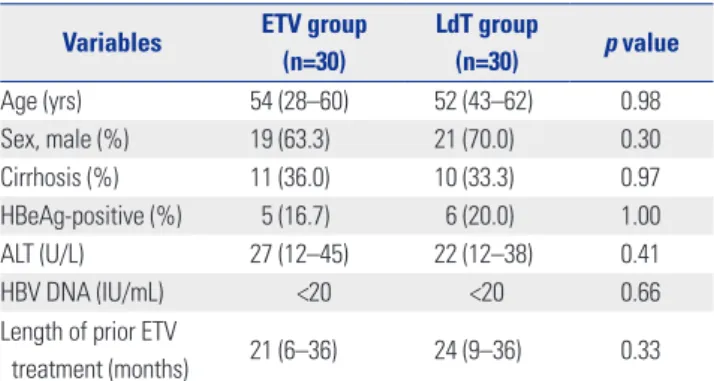
A total of 60 patients were enrolled and were evenly allocated
Table 1. Baseline Clinical Characteristics of Patients Variables ETV group
(n=30)
LdT group
(n=30) p value
Age (yrs) 54 (28–60) 52 (43–62) 0.98
Sex, male (%) 19 (63.3) 21 (70.0) 0.30
Cirrhosis (%) 11 (36.0) 10 (33.3) 0.97
HBeAg-positive (%) 5 (16.7) 6 (20.0) 1.00
ALT (U/L) 27 (12–45) 22 (12–38) 0.41
HBV DNA (IU/mL) <20 <20 0.66
Length of prior ETV
treatment (months) 21 (6–36) 24 (9–36) 0.33 ALT, alanine aminotransferase; HBV, hepatitis B virus; ETV, entecavir; LdT, tel- bivudine.
into two groups: ETV maintenance (ETV-ETV, n=30) or LdT switch (ETV-LdT, n=30). The baseline characteristics of the two groups are shown in Table 1. The median age was 54.0 years for ETV-ETV and 52.0 years for ETV-LdT, and the median duration of prior ETV therapy was 21.0 months (ETV-ETV group) and 24.0 months (ETV-LdT group). Cirrhosis was present in 11 pa- tients (36.7%) in the ETV-ETV group and 10 (33.3%) in the ETV-LdT group. No statistical differences were observed between the two groups for age, gender, HBeAg status, or liver biochemistry.
Virological response and biochemical durability All patients had normal ALT level at the beginning of the study.
During scheduled visits at weeks 12, 24, 48, 72, 84, and 96, no patients showed ALT level above the upper normal range.
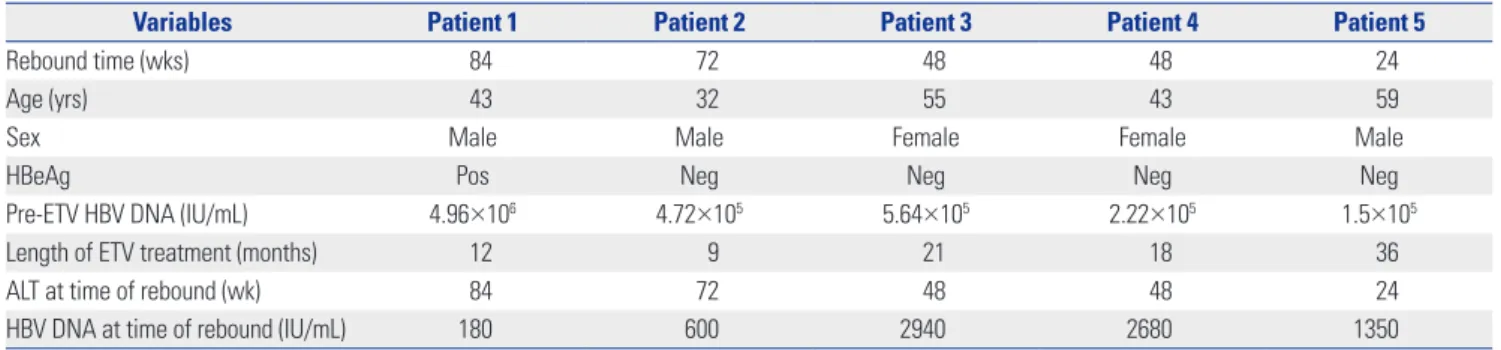
In the ETV-ETV group, no evidence of virological rebound was observed during the 96-week follow-up. In ETV-LdT group, five patients developed virological rebound (Fig. 1); charac- teristics of these patients are shown in Table 2. Virological re- bound time was variable at weeks 24 to 84 after switching to LdT. The HBV DNA level at virological rebound varied from 180 to 2940 IU/mL. All five patients with virological rebound had evidence of drug-resistant mutations, with three patients
with the rtM204I mutation and two with the rtM204V muta- tion. Patient 1 showed HBV DNA level of 35 IU/mL at week 60 and 34 IU/mL at week 72 after switching to LdT; however, this level reached 180 IU/mL at week 84 (Fig. 2). Patient 2 main- tained HBV DNA loss up to 60 weeks after switching to LdT, but serum HBV DNA level increased to 600 IU/mL at week 72.
Patient 3 showed HBV DNA of 30 IU/mL and 39 IU/mL at weeks 24 and 36 after switching to LdT, respectively. However, at week 48, serum HBV DNA level increased to 2940 IU/mL.
In patients 4 and 5, serum HBV DNA level increased to 2680 IU/mL at week 48 and 1350 IU/mL at week 24, respectively, without prior HBV DNA increase. These 5 patients were sub- sequently changed to tenoforvir and had undetectable HBV DNA 12 weeks later.
The other 25 patients in the ETV-LdT group maintained un- detectable HBV DNA level and normal liver function during 96 weeks of treatment. Age, gender, HBeAg, serum ALT level, serum HBV DNA level before switching, and initial ETV treat- ment period were not significantly related to virological re- bound (Table 3).
DISCUSSION
Most studies of antiviral agent change have focused on antiviral Table 2. Characteristics of Patients with Virological Rebound
Variables Patient 1 Patient 2 Patient 3 Patient 4 Patient 5
Rebound time (wks) 84 72 48 48 24
Age (yrs) 43 32 55 43 59
Sex Male Male Female Female Male
HBeAg Pos Neg Neg Neg Neg
Pre-ETV HBV DNA (IU/mL) 4.96×10⁶ 4.72×10⁵ 5.64×10⁵ 2.22×10⁵ 1.5×10⁵
Length of ETV treatment (months) 12 9 21 18 36
ALT at time of rebound (wk) 84 72 48 48 24
HBV DNA at time of rebound (IU/mL) 180 600 2940 2680 1350
ETV, entecavir; HBV, hepatitis B virus; ALT, alanine aminotransferase.
Fig. 1. Study design and patient flow for both arms. A total of 60 patients with CHB were enrolled. Study population has been treated with 0.5 mg ETV for at least six months. A total of 60 patients were assigned randomly to ETV monotherapy continued group and LdT monotherapy switch group in 1:1 ratio. ETV, entecavir; HBV, hepatitis B virus; LdT, telbivudine; CHB, chronic hepatitis B; ALT, alanine aminotransferase; TDF, tenofovir.
Treated with ETV 0.5 mg >6 months Normal ALT
Undetectable HBV DNA
Continued on ETV 0.5 mg (n=30)
No rebound (n=30)
Continued on ETV (n=30)
No rebound (n=25)
Continued on LdT (n=25)
Rebound (n=5)
Switched to TDF (n=5) Switched to LdT (n=30)
Fig. 2. Detail of five patients in entecavir-telbivudine switching group with vi- rological breakthrough. HBV, hepatitis B virus; TDF, tenofovir.
2000
200
20 0 12 24 36 48 60 72 84 96 rtM204V>TDF
Patient 1 Patient 2 Patient 3 Patient 4 Patient 5
rtM204I>TDF
Five patients in the entecavir-telbivudine switching group with virological breakthrough
rtM204I>TDF
rtM204I>TDF
HBV DNA (IU/mL)
rtM204V>TDF
Week
resistance and insufficient effects of the chosen antiviral agent.
Furthermore, these studies were conducted on monoexclu- sive or combination therapy of antiviral agents applicable for controlling resistance.10-15 However, little research has ad- dressed switching antiviral agents to nucleoside or nucleotide analogs in circumstances without resistance, except for stud- ies on the sequential therapy of oral antiviral agents and inter- feron.16,17 In particular, few reports have studied the effects of switching to a more cost-effective agent after complete virogi- cal response was achieved with a potent but more expensive antiviral agent.5
Lack of evidence on this topic may be due to the notion that long-term treatment with a low-cost, low-potency agent with a high incidence of resistance may result in treatment failure.
However, resistance to lamivudine develops in approximately 15–20% of patients per year, with 5.0% resistance rates to LdT in the first year and 25.1% in the second year of treatment in HBeAg-positive patients. Although the incidence of resistance to LdT therapy in CHB patients is lower than resistance to la- mivudine, these levels are still too high to be overlooked when compared to ETV or tenofovir.18
Fung, et al.5 started treating patients with HBV DNA loss with ETV and then switched to lamivudine and continued the treatment for 2 years. The study was based on an earlier study that reported a low incidence of resistance in the first 2 years of lamivudine treatment in patients with serum HBV DNA that was undetectable with PCR (<300 copies/mL) at week 24 of lamivudine treatment.7 Viral reemergence was observed in 6 of 25 patients (24%), and resistance was found in 3. Therefore, Fung, et al.5 expressed negative views toward lamivudine- switching therapy in patients with a favorable response to ETV therapy. However, they also reported that, after rebound, 3 patients were again treated with ETV to induce HBV DNA loss.
Of the 3 patients who developed lamivudine resistance, 1 did not properly take the drug, while another had a history of la- mivudine that could have affected resistance development. If patients with appropriate medical history are chosen and se- rum HBV DNA level is monitored after return to ETV immedi- ately after HBV DNA rebound, a switch to lamivudine therapy might be acceptable.
Reports on LdT indicate that serum HBV DNA and ALT lev- els before treatment and degree of viral suppression at week 24 can be used as markers to predict treatment response through week 96.3 In HBeAg-positive patients whose initial serum HBV DNA was less than 109 copies/mL, initial serum ALT was twice the upper normal limit, and serum HBV DNA at week 24 was undetectable (less than 300 copies/mL), the rate of se- rum HBV DNA loss was 89% after 2 years, with a resistance in- cidence of 1.8%. In HBeAg-negative patients, when initial se- rum HBV DNA was less than 107 copies/mL, initial ALT was twice the upper normal limit, and serum HBV DNA at week 24 was undetectable, serum HBV DNA level was consistently not detected in 91% after 2 years, with a resistance incidence of 2.3%.3 This incidence is noticeably lower than the overall resis- tance incidence for LdT.
Therefore, our study evaluated the effect of ETV-LdT switch therapy. We used LdT because its cost is similar to that of lami- vudine, but it is considered more effective than lamivudine.8,9,19 However, our results showed virological breakthrough in 5 of 30 patients (16.6%) who were switched from ETV to LdT, and resistant mutations were found in all of these patients.
In contrast to ETV-lamivudine switch therapy, where resis- tance mutations were observed in only 50% of patients with vi- rological rebound, genotypic resistance in this study was found in all patients. Therefore, a switch back to ETV 0.5 mg was not considered. The incidence of resistance in this study was higher than the rate for LdT treatment of naïve patients3 and was similar to the incidence of resistance seen with ETV-lamivu- dine switch therapy.5 In the present study, none of the patients who developed resistance after switching therapy had a medi- cal history of treatment with antiviral agents or poor compli- ance, as had been found in a previous study of ETV-lamivudine switch therapy, and we identified no significant risk factors.
The only difference between patients with and without viro- logical breakthrough was a lower ALT level before initial ETV treatment in those with breakthrough compared to those who maintained HBV DNA negativity after switching to LdT. This result suggests that the patient’s degree of immune activity before beginning ETV might affect virological response after switching from ETV to LdT. Also, it is possible that the ETV that Table 3. Comparison of Patients in the ETV-Telbivudine Switching Group with and without Virological Breakthrough
Valuables No virological rebound (n=25) Virological rebound (n=5) p value
Age (yrs) 54 (43–62) 49 (44–59) 0.436
Sex (male, %) 18 (72) 3 (60) 0.727
Cirrhosis (%) 8 (32) 2 (40) 0.648
Pre-ETV ALT (IU/L) 103 (72–144) 55 (63–139) 0.254
Pre-ETV HBV DNA (IU/mL) 8.9×10⁵ (3.7–9.8) 3.9×10⁵ (1.5–2.5) 0.514
Length of prior ETV treatment (months) 24 (12–36) 21 (9–36) 0.555
At the time of randomization
HBeAg-positive (%) 20 20 1.00
ALT (U/L) 23 (14–38) 31 (12–33) 0.74
ETV, entecavir; HBV, hepatitis B virus; ALT, alanine aminotransferase.
was used before affected the development of resistance, al- though we didn’t evaluate the presence of resistance mutations before the study begun. Mutations had already developed in 204 areas of HBV DNA polymerase during ETV treatment, but the high antiviral potency and resistance barrier of ETV pre- vented virological rebound and maintained HBV DNA nega- tivity. Switching to LdT, which has a lower potency and toler- ance barrier, may have allowed the mutation to have an effect.
Compared to ETV-lamivudine switch therapy, ETV-LdT switch therapy did not show the superiority of maintaining HBV DNA negativity. Therefore, it is not recommended to switch from ETV to LdT for cost-effectiveness in patients with HBV DNA negativity resulted from initial ETV therapy.
The use of tenofovir, which is effective in treating patients who are resistant to nucleoside analogs including LdT, is clini- cally approved. Even if resistant mutations develop after sw- itching to LdT, appropriate control of resistance will be possi- ble if virological breakthrough is identified early and treated with tenofovir. Although our results were not significant due to small number of patients, investigating factors that affect the maintenance of complete virological response in ETV-LdT switch therapy is needed to support patient treatment selec- tions. Long-term treatment should be considered in patients with chronic HBV, which is an economic burden. This conclu- sion should be consolidated with larger-scale, long-term pro- spective reviews of the treatment effects of ETV-LdT switch therapy.
ACKNOWLEDGEMENTS
This study was supported by a grant from the National Health Insurance Service Ilsan Hospital, Republic of Korea.
REFERENCES
1. Lee WM. Hepatitis B virus infection. N Engl J Med 1997;337:1733- 45.
2. Pol S, Lampertico P. First-line treatment of chronic hepatitis B with entecavir or tenofovir in ‘real-life’ settings: from clinical trials to clinical practice. J Viral Hepat 2012;19:377-86.
3. Zeuzem S, Gane E, Liaw YF, Lim SG, DiBisceglie A, Buti M, et al.
Baseline characteristics and early on-treatment response predict the outcomes of 2 years of telbivudine treatment of chronic hepati- tis B. J Hepatol 2009;51:11-20.
4. Yuen MF, Fong DY, Wong DK, Yuen JC, Fung J, Lai CL. Hepatitis B virus DNA levels at week 4 of lamivudine treatment predict the 5-year ideal response. Hepatology 2007;46:1695-703.
5. Fung J, Lai CL, Yuen J, Cheng C, Wu R, Wong DK, et al. Random- ized trial of lamivudine versus entecavir in entecavir-treated pa-
tients with undetectable hepatitis B virus DNA: outcome at 2 Years. Hepatology 2011;53:1148-53.
6. Lee HW, Lee HJ, Hwang JS, Sohn JH, Jang JY, Han KJ, et al. Lami- vudine maintenance beyond one year after HBeAg seroconver- sion is a major factor for sustained virologic response in HBeAg- positive chronic hepatitis B. Hepatology 2010;51:415-21.
7. Yuen MF, Sablon E, Hui CK, Yuan HJ, Decraemer H, Lai CL. Fac- tors associated with hepatitis B virus DNA breakthrough in patients receiving prolonged lamivudine therapy. Hepatology 2001;34(4 Pt 1):785-91.
8. Lai CL, Leung N, Teo EK, Tong M, Wong F, Hann HW, et al. A 1-year trial of telbivudine, lamivudine, and the combination in patients with hepatitis B e antigen-positive chronic hepatitis B. Gastroen- terology 2005;129:528-36.
9. Lui YY, Tsoi KK, Wong VW, Kao JH, Hou JL, Teo EK, et al. Cost-ef- fectiveness analysis of roadmap models in chronic hepatitis B us- ing tenofovir as the rescue therapy. Antivir Ther 2010;15:145-55.
10. Lee JM, Kim HJ, Park JY, Lee CK, Kim DY, Kim JK, et al. Rescue monotherapy in lamivudine-resistant hepatitis B e antigen-posi- tive chronic hepatitis B: adefovir versus entecavir. Antivir Ther 2009;
14:705-12.
11. Leemans WF, Janssen HL, Niesters HG, de Man RA. Switching pa- tients with lamivudine resistant chronic hepatitis B virus from te- nofovir to adefovir results in less potent HBV-DNA suppression. J Viral Hepat 2008;15:108-14.
12. Seo YS, Kim JH, Yeon JE, Park JJ, Kim JS, Byun KS, et al. Antiviral efficacy of adefovir dipivoxil versus lamivudine in patients with chronic hepatitis B sequentially treated with lamivudine and ade- fovir due to lamivudine resistance. World J Gastroenterol 2007;
13:4072-9.
13. Fung J, Lai CL, Yuen JC, Wong DK, Tanaka Y, Mizokami M, et al.
Adefovir dipivoxil monotherapy and combination therapy with lamivudine for the treatment of chronic hepatitis B in an Asian population. Antivir Ther 2007;12:41-6.
14. Lampertico P, Viganò M, Manenti E, Iavarone M, Sablon E, Colom- bo M. Low resistance to adefovir combined with lamivudine: a 3-year study of 145 lamivudine-resistant hepatitis B patients. Gas- troenterology 2007;133:1445-51.
15. Sherman M, Yurdaydin C, Sollano J, Silva M, Liaw YF, Cianciara J, et al. Entecavir for treatment of lamivudine-refractory, HBeAg- positive chronic hepatitis B. Gastroenterology 2006;130:2039-49.
16. Niro GA, Fontana R, Gioffreda D, Fiorella S, Accadia L, Iacobellis A, et al. Sequential treatment with lamivudine and alpha-interfer- on in anti-HBe-positive chronic hepatitis B patients: a pilot study.
Dig Liver Dis 2007;39:857-63.
17. Shi M, Wang RS, Zhang H, Zhu YF, Han B, Zhang Y, et al. Sequen- tial treatment with lamivudine and interferon-alpha monothera- pies in hepatitis B e antigen-negative Chinese patients and its sup- pression of lamivudine-resistant mutations. J Antimicrob Chemother 2006;58:1031-5.
18. Liaw YF, Gane E, Leung N, Zeuzem S, Wang Y, Lai CL, et al. 2-year GLOBE trial results: telbivudine is superior to lamivudine in pa- tients with chronic hepatitis B. Gastroenterology 2009;136:486-95.
19. Lai CL, Gane E, Liaw YF, Hsu CW, Thongsawat S, Wang Y, et al. Tel- bivudine versus lamivudine in patients with chronic hepatitis B.
N Engl J Med 2007;357:2576-88.