INTRODUCTION
Vasospastic angina (VA) is characterized by acute
Coronary Computed Tomography Angiography for the Diagnosis of Vasospastic Angina: Comparison with Invasive Coronary Angiography and Ergonovine Provocation Test
Jiesuck Park, MD 1 , Hyung-Kwan Kim, MD, PhD 1 *, Eun-Ah Park, MD, PhD 2 *, Jun-Bean Park, MD, PhD 1 , Seung-Pyo Lee, MD, PhD 1 , Whal Lee, MD, PhD 2 , Yong-Jin Kim, MD, PhD 1 , Dae-Won Sohn, MD, PhD 1
1
Department of Internal Medicine and Cardiovascular Center, Seoul National University Hospital, Seoul, Korea;
2Department of Radiology, Seoul National University Hospital, Seoul, Korea
Objective: To investigate the diagnostic validity of coronary computed tomography angiography (cCTA) in vasospastic angina (VA) and factors associated with discrepant results between invasive coronary angiography with the ergonovine provocation test (iCAG-EPT) and cCTA.
Materials and Methods: Of the 1397 patients diagnosed with VA from 2006 to 2016, 33 patients (75 lesions) with available cCTA data from within 6 months before iCAG-EPT were included. The severity of spasm (% diameter stenosis [%DS]) on iCAG- EPT and cCTA was assessed, and the difference in %DS (Δ%DS) was calculated. Δ%DS was compared after classifying the lesions according to pre-cCTA-administered sublingual nitroglycerin (SL-NG) or beta-blockers. The lesions were further categorized with %DS ≥ 50% on iCAG-EPT or cCTA defined as a significant spasm, and the diagnostic performance of cCTA on identifying significant spasm relative to iCAG-EPT was assessed.
Results: Compared to lesions without SL-NG treatment, those with SL-NG treatment showed a higher Δ%DS (39.2% vs. 22.1%, p = 0.002). However, there was no difference in Δ%DS with or without beta-blocker treatment (35.1% vs. 32.6%, p = 0.643).
The significant difference in Δ%DS associated with SL-NG was more prominent in patients who were aged < 60 years, were male, had body mass index < 25 kg/m
2, and had no history of hypertension, diabetes, or dyslipidemia. Based on iCAG-EPT as the reference, the per-lesion-based sensitivity, specificity, positive predictive value, negative predictive value, and accuracy of cCTA for VA diagnosis were 7.5%, 94.0%, 60.0%, 47.1%, and 48.0%, respectively.
Conclusion: For patients with clinically suspected VA, confirmation with iCAG-EPT needs to be considered without completely excluding the diagnosis of VA simply based on cCTA results, although further prospective studies are required for confirmation.
Keywords: Variant angina pectoris; Coronary computed tomography angiography; Coronary angiography; Provocation test;
Nitroglycerin
chest pain at rest that is caused by contraction of the vascular smooth muscle tissue in large coronary arteries leading to coronary spasm (1, 2). According to the current Korean J Radiol 2019;20(5):719-728
https://doi.org/10.3348/kjr.2018.0847
Received December 3, 2018; accepted after revision January 11, 2019.
*These authors contributed equally to this work.
Corresponding author: Hyung-Kwan Kim, MD, PhD, Department of Internal Medicine and Cardiovascular Center, Seoul National University Hospital, 101 Daehak-ro, Jongno-gu, Seoul 03080, Korea.
• Tel: (822) 2072-0243 • Fax: (822) 762-9662 • E-mail: [email protected]; and
Eun-Ah Park, MD, PhD, Department of Radiology, Seoul National University Hospital, 101 Daehak-ro, Jongno-gu, Seoul 03080, Korea.
• Tel: (822) 2072-0187 • Fax: (822) 747-7418 • E-mail: [email protected]
This is an Open Access article distributed under the terms of the Creative Commons Attribution Non-Commercial License (https://
creativecommons.org/licenses/by-nc/4.0) which permits unrestricted non-commercial use, distribution, and reproduction in any medium,
provided the original work is properly cited.
guidelines, invasive coronary angiography (iCAG) with either an acetylcholine or ergonovine provocation test (EPT) is required for a conclusive diagnosis in patients with clinically suspected VA (1). However, the iCAG with provocation test is invasive and, thus, inherently poses some risks to the patient, such as myocardial ischemia or infarction, serious arrhythmia, and puncture-site related complications (3). The introduction of coronary computed tomography angiography (cCTA) has had a significant effect on clinical practice, especially in the diagnosis of coronary artery disease. Owing to its high sensitivity and negative predictive value (NPV), cCTA is now accepted as a powerful noninvasive tool not only for identifying anatomic features of coronary arteries (i.e., luminal stenosis or the presence of plaques), but also for predicting long-term outcomes (4- 6). To accomplish this purpose, the acquisition of high- quality images is critical, which can be realized by pre-cCTA administration of beta-blockers and sublingual nitroglycerin (SL-NG) for coronary artery dilation and heart rate
reduction (7). Although cCTA has been widely used in the evaluation of patients with chest pain, there is a paucity
of data regarding the impact of the use of beta-blocker and SL-NG on the diagnostic accuracy of cCTA in patients with suspected VA. Thus, the purpose of this study was to investigate the ability of cCTA to diagnose VA relative to the gold-standard iCAG-EPT. We also attempted to reveal the potential influence of pre-cCTA-administered beta-blockers and SL-NG on any discrepancy between iCAG-EPT and cCTA when assessing coronary vasospasm.
MATERIALS AND METHODS
Study Population
The selection process for the study population is presented in Figure 1. In brief, from January 2006 to December 2016, a total of 1397 patients who had a newly recorded diagnostic code of VA (I201) based on the International Classification of Disease, Tenth Revision, Clinical Modification were identified. Of them, 356 patients had undergone iCAG-EPT. Forty-nine of the 356 patients had undergone cCTA within 6 months before iCAG. Of them, patients with no anginal symptoms (n = 2) were
Total 1397 patients with newly recorded diagnostic code for VA (I201) from January, 1, 2006–December, 31, 2016
Total 49 patients who underwent cCTA within 6 months before iCAG-EPT
Total 33 patients with VA (confirmed on iCAG-EPT) (75 lesions included)
Total 356 patients who underwent both iCAG and EPT
Quantitative analysis for severity of spasm of target lesions by provocation test and cCTA
2 excluded due to no anginal symptom
12 excluded due to negative EPT 2 excluded due to organic stenosis over 50%
Fig. 1. Flow diagram showing study design and patient selection. cCTA = coronary computed tomography angiography, EPT = ergonovine
provocation test, iCAG = invasive coronary angiography, VA = vasospastic angina
excluded. After iCAG-EPT, those with no spasm in any coronary trees upon the provocation test (n = 12) and with coronary spasm on lesions with significant stenosis (% diameter stenosis [%DS] ≥ 50%) (n = 2) were further excluded. Finally, a total of 33 patients were included in the final analysis. Information regarding age; sex; body mass index (BMI); comorbidities including diabetes mellitus (DM), hypertension (HTN), dyslipidemia, and smoking;
and administration of pre-cCTA medication including beta- blockers and SL-NG was collected by careful review of the electronic medical records. This study protocol was approved by the Institutional Review Board of Seoul National
University Hospital and was conducted in accordance with the Declaration of Helsinki. The requirement for written informed consent was waived owing to the retrospective nature of the study.
iCAG-EPT
Experienced cardiologists performed iCAG via a transradial or transfemoral approach based on the current guidelines (8). Patients were instructed to stop using vasodilators, such as calcium channel blockers, nitrates, and potassium channel openers (i.e., nicorandil), 48 hours prior to the provocation test with the only exception of SL- NG administration, if needed. First, diagnostic coronary angiograms for the left and right coronary arteries were obtained. Coronary lesions with an organic stenosis of
%DS ≥ 50% were excluded from the provocation test. The provocation test was then subsequently performed for the left and right coronary arteries using intracoronary ergonovine administration. Incremental doses of 30 (E1), 60 (E2), and 90 µg (E3) were injected into the left coronary artery and incremental doses of 20 (E10), 40 (E2), and 60 µg (E3) were injected into the right coronary artery (9). Care was taken to investigate both coronary arteries after the provocation test. After the provocation test was completed, intracoronary nitrate was injected to reverse coronary vasospasm.
Multi-Detector cCTA Image Acquisition
All CT examinations were performed using a dual-source CT scanner (SOMATOM Definition; Siemens Healthineers, Forchheim, Germany). Patients with a pre-scan heart rate of 65 beats per minute (bpm) or higher were given 50–100 mg of oral metoprolol (Betaloc; AstraZeneca, Sweden) 45–60 minutes prior to the CT examination, unless the subject had a contraindication to beta-blockers. Additional beta-
blockers were not administered to subjects who underwent CT scanning 45–60 minutes after administration of beta- blockers, even if the heart rate did not fall to below 65 bpm. SL-NG (0.6 mg; Nitroquick; Ethex, St. Louis, Mo, USA) was administered if the patient had no contraindications to nitroglycerin for coronary vasodilation immediately before scanning. Sixty mL of a nonionic contrast medium (iopromide, Ultravist® 370; Bayer Healthcare, Berlin, Germany) was injected into the antecubital vein at 5 mL/
sec, followed by an additional 20 mL of a nonionic contrast medium, and 50 mL of 8:2 mixture of normal saline and contrast medium, at a flow rate of 4 mL/sec using a dual power injector (Stellant; Medrad, Indianola, PA, USA). The bolus triggering method was used to determine the starting point of CT acquisition by monitoring the signal density of contrast medium in the mid-ascending aorta. CT scans were initiated 8 seconds after a threshold trigger of 150 HU above baseline was achieved. Details of the CT scan protocol have been described in previous studies (10, 11).
Image Interpretation of iCAG-EPT and cCTA
All iCAG-EPT and cCTA images were carefully reviewed by two independent investigators who were blinded to patients’
clinical information. All conflicting results were resolved by consensus (κ = 0.781). For target lesions on iCAG images, the degree of stenosis was evaluated using quantitative coronary analysis (QCA) (CAAS QCA; Esaote, Genova, Italy) at baseline and after the provocation test to calculate the
%DS in the iCAG-EPT. QCA analysis was conducted with blinding to the clinical information and cCTA results.
The degree of stenosis on cCTA was assessed semi- automatically using a dedicated cardiac workstation (Syngo.
via; Siemens Healthineers). Corresponding sites to each spastic lesion identified on iCAG-EPT were evaluated for severity of stenosis, presence of atherosclerotic plaques, and vascular remodeling. Because negative vascular remodeling was reported as a main finding of spasm on cCTA (12), its presence at the spasm sites was investigated. Negative remodeling was considered present when the vessel area at the site of plaque was smaller than the distal reference (12).
Analysis of cCTA images was also performed blinded to the baseline clinical characteristics and results of iCAG-EPT.
Statistical Analysis
To evaluate the influence of pre-medication on
discrepancies between the two modalities, the lesions were
categorized into groups based on pre-test administration of
beta-blockers and SL-NG, and the difference in %DS (Δ%DS) of each lesion as measured iCAG-EPT and cCTA was compared between the groups. Subgroup analysis was performed to evaluate the impact of pre-medication on discrepancies in relation to accompanying cardiovascular risk factors such as old age (age ≥ 60 years), obesity (BMI ≥ 25 kg/m
2), DM, HTN, dyslipidemia, and smoking. To determine whether temporal variance exists in diagnostic discrepancies, the lesions were further divided into groups according to when the cCTA was performed (from midnight to 10 AM or 10 AM to midnight) and compared for %DS assessed by iCAG-EPT and cCTA.
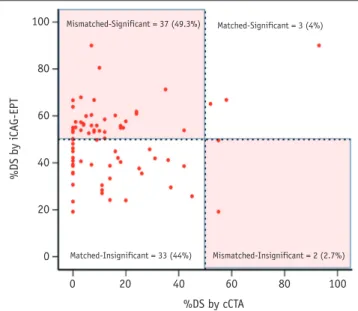
To assess the diagnostic performance of cCTA compared to iCAG-EPT, lesions with %DS more than 50% after the provocation test or on cCTA were defined as a significant spasm (13). The lesions were then subsequently classified into four groups according to the spasm seen on iCAG-EPT and cCTA: 1) Matched-Insignificant: concordant insignificant spasm, 2) Matched-Significant: concordant significant spasm, 3) Mismatched-Significant: significant spasm only on iCAG-EPT, and 4) Mismatched-Insignificant: significant spasm only on cCTA without spasm on iCAG-EPT. To ensure matching of spasm sites on cCTA images with those on iCAG-EPT, great care was taken to identify the adjacent side branches and lumen ostia that were used as landmarks (12).
The diagnostic performance of cCTA was determined using the sensitivity, specificity, positive predictive value (PPV), NPV, and accuracy compared with iCAG-EPT on both a per- patient and per-lesion basis.
All probability values were two-sided, and a p value of <
0.05 was considered statistically significant. The statistical package SPSS, version 22.0 (IBM Corp., Armonk, NY, USA) and R version 3.3.3 (R Development Core Team, Vienna, Austria) were used for statistical analyses.
RESULTS
Study Population
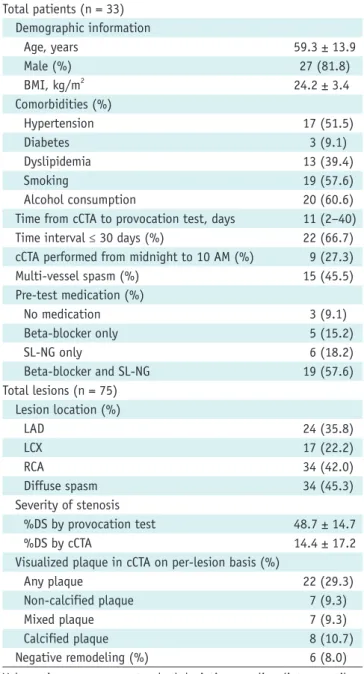
Baseline characteristics of the study population are presented in Table 1. There were 27 men with a mean age of 59.3 years. The median time difference between cCTA and iCAG-EPT was 11 days. Of the 33 patients, nine underwent cCTA between midnight and 10 AM (21 lesions). Prior to cCTA, both beta-blocker and SL-NG were administered to 19 patients (57.6%), beta-blocker alone to 5 (15.2%), SL-NG alone to 6 (18.2%), and neither beta-blocker nor SL-NG to 3 patients (9.1%). Fifteen patients (45.5%) had multi-vessel
coronary spasm. Of the 75 lesions identified using iCAG- EPT, most were located in the right coronary artery (42.0%) and 45.3% showed diffuse spasm. The mean %DS recorded using iCAG-EPT and cCTA were 48.7 ± 14.7 and 14.4 ± 17.2, respectively. Plaque was visible in 22 lesions (29.3%), and only 6 (8.0%) lesions showed negative remodeling.
Table 1. Baseline Characteristics of Study Population and Related Coronary Lesions
Total patients (n = 33) Demographic information
Age, years 59.3 ± 13.9
Male (%) 27 (81.8)
BMI, kg/m
224.2 ± 3.4
Comorbidities (%)
Hypertension 17 (51.5)
Diabetes 3 (9.1)
Dyslipidemia 13 (39.4)
Smoking 19 (57.6)
Alcohol consumption 20 (60.6)
Time from cCTA to provocation test, days 11 (2–40)
Time interval ≤ 30 days (%) 22 (66.7)
cCTA performed from midnight to 10 AM (%) 9 (27.3)
Multi-vessel spasm (%) 15 (45.5)
Pre-test medication (%)
No medication 3 (9.1)
Beta-blocker only 5 (15.2)
SL-NG only 6 (18.2)
Beta-blocker and SL-NG 19 (57.6)
Total lesions (n = 75) Lesion location (%)
LAD 24 (35.8)
LCX 17 (22.2)
RCA 34 (42.0)
Diffuse spasm 34 (45.3)
Severity of stenosis
%DS by provocation test 48.7 ± 14.7
%DS by cCTA 14.4 ± 17.2
Visualized plaque in cCTA on per-lesion basis (%)
Any plaque 22 (29.3)
Non-calcified plaque 7 (9.3)
Mixed plaque 7 (9.3)
Calcified plaque 8 (10.7)
Negative remodeling (%) 6 (8.0)
Values given as mean ± standard deviation, median (interquartile range, 25th and 75th percentile), or number (percentage). BMI
= body mass index, cCTA = coronary computed tomography angiography, LAD = left anterior descending coronary artery, LCX
= left circumflex artery, RCA = right coronary artery, SL-NG =
sublingual nitroglycerin, %DS = % diameter stenosis
Effect of cCTA Pre-Medication on the Discrepancies of Spasm Severity Assessed by iCAG-EPT and cCTA
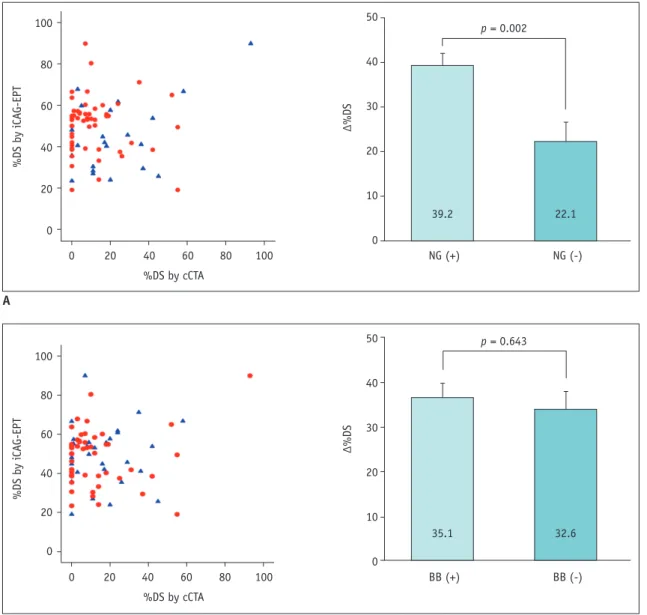
In terms of SL-NG use, the Δ%DS was significantly higher in lesions with pre-cCTA SL-NG (39.2% vs. 22.1%, p = 0.002) (Fig. 2). In contrast, there were no significant differences in Δ%DS according to the administration of pre-cCTA beta- blockers (35.1% vs. 32.6%, p = 0.643). Administration of SL-NG was associated with a significant difference in Δ%DS among those who were aged < 60 years; were male;
had BMI < 25 kg/m
2; and had no history of HTN, DM, or dyslipidemia, regardless of smoking history (Table 2).
However, beta-blockers exerted no significant influence on discordance in Δ%DS regardless of the presence or absence
of any cardiovascular risk factors. Although %DS assessed using iCAG-EPT was higher compared to that obtained from cCTA regardless of when it was performed, there was no significant Δ%DS (50.5% vs. 48.3%, p = 0.560 by iCAG- EPT and 14.0% vs. 15.0%, p = 0.814 by cCTA) and in Δ%DS (36.6% vs. 33.2%, p = 0.488) between lesions from cCTA performed from midnight to 10 AM or 10 AM to midnight (Fig. 3).
Diagnostic Performance of cCTA for Significant Spasms Compared to iCAG-EPT
Of the 75 lesions, 40 (53.3%) showed significant spasms on iCAG-EPT, whereas only five (6.7%) did so on cCTA.
Fig. 2. Effect of pre-medication on difference in detecting severity of spasm between cCTA and iCAG-EPT.
A. SL-NG. B. BBs. BB = beta-blocker, iCAG-EPT = iCAG with EPT, SL-NG = sublingual nitroglycerine, %DS = % diameter stenosis, Δ%DS = difference in %DS
100
80
60
40
20
0
50
40
30
20
10
0
%DS by iCA G-EPT Δ%DS
0 20 40 60 80 100
%DS by cCTA
NG (+) NG (-) p = 0.002
A
100
80
60
40
20
0
50
40
30
20
10
0
%DS by iCA G-EPT Δ%DS
0 20 40 60 80 100
%DS by cCTA
BB (+) BB (-) p = 0.643
B
39.2 22.1
35.1 32.6
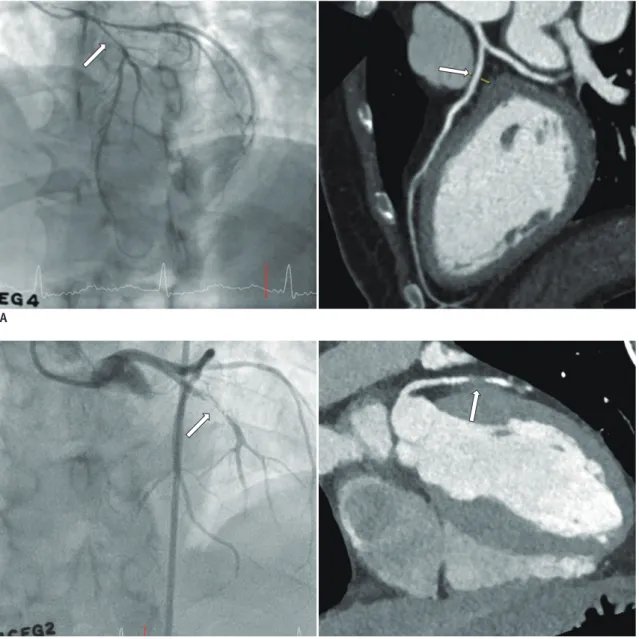
Overall, the discrepancy rate between the two diagnostic modalities was 52.0% (three [4.0%] Matched-Significant, 33 [44.0%] Matched-Insignificant, 37 [49.3%] Mismatched- Significant, and two [2.7%] Mismatched-Insignificant lesions) (Figs. 4, 5). With iCAG-EPT as the reference standard, the sensitivity, specificity, PPV, NPV, and
accuracy of cCTA for the diagnosis of VA were 7.5%, 94.0%, 60.0%, 47.1%, and 48.0%, respectively on a per-lesion analysis, and 11.5%, 100.0%, 100.0%, 23.3%, and 30.3%,
respectively on a per-patient analysis (Table 3).
DISCUSSION
The greatest clinical utility of cCTA is to reliably exclude fixed, obstructive coronary stenosis in patients with chest pain (5). Owing to its high NPV, cCTA was suggested to be a safe gatekeeper for iCAG (14, 15). Therefore, it is generally accepted that cCTA is the most accurate non- Table 2. Influence of cCTA Pre-Medication on Discrepancies of Spasm Severity Assessed by iCAG-EPT and cCTA According to Accompanied Cardiovascular Risk Factors
Variables SL-NG n Δ%DS P Beta-Blockers n Δ%DS P
Age
Age ≥ 60 Y 28 35.6 ± 4.6 0.116 Y 16 24.4 ± 6.7 0.089
N 13 23.8 ± 4.4 N 25 36.6 ± 3.7
Age < 60 Y 25 43.1 ± 3.0 0.003 Y 31 40.6 ± 3.2 0.067
N 9 19.8 ± 8.8 N 3 -0.8 ± 9.5
Sex
Male Y 45 36.9 ± 3.2 0.023 Y 39 33.9 ± 3.5 0.640
N 20 23.7 ± 4.5 N 26 31.3 ± 4.2
Female Y 8 52.1 ± 2.5 0.170 Y 8 41.0 ± 8.4 0.605
N 2 6.0 ± 13.5 N 2 50.5 ± 3.6
BMI
≥ 25 Y 12 43.6 ± 5.9 0.539 Y 15 38.8 ± 4.8 0.137
N 5 36.6 ± 9.7 N 2 61.9 ± 21.1
< 25 Y 41 37.9 ± 3.2 0.003 Y 31 34.5 ± 4.2 0.479
N 16 19.2 ± 4.6 N 26 30.4 ± 3.8
HTN
(+) Y 26 34.5 ± 4.8 0.099 Y 23 30.0 ± 5.3 0.987
N 13 21.0 ± 6.0 N 16 29.9 ± 5.8
(-) Y 27 43.7 ± 2.9 0.003 Y 24 39.9 ± 3.7 0.582
N 9 23.8 ± 6.6 N 12 36.3 ± 5.5
DM
(+) Y 5 42.6 ± 13.2 0.207 Y 0 N/A
N 6 23.3 ± 7.0 N 11
(-) Y 48 38.8 ± 2.9 0.005 Y 47 35.1 ± 3.2 0.737
N 16 21.7 ± 5.5 N 17 33.0 ± 4.9
Dyslipidemia
(+) Y 25 N/A Y 16 39.8 ± 5.2 0.748
N 1 N 10 42.5 ± 6.4
(-) Y 28 36.0 ± 4.2 0.049 Y 31 32.6 ± 4.1 0.407
N 21 23.5 ± 4.3 N 18 27.2 ± 4.8
Smoking
(+) Y 24 29.6 ± 3.7 0.024 Y 28 35.9 ± 3.5 0.302
N 14 23.9 ± 5.9 N 10 27.8 ± 8.5
(-) Y 29 38.8 ± 4.2 0.028 Y 19 33.8 ± 6.3 0.849
N 8 19 ± 6.4 N 18 35.3 ± 4.2
DM = diabetes mellitus, HTN = hypertension, iCAG-EPT = invasive coronary angiography with ergonovine provocation test, N = no, N/A = not applicable, Y = yes, Δ%DS = difference in %DS
0 25 50 75 0 25 50 75
invasive imaging tool for screening anatomically “fixed”
coronary artery stenosis in patients with chest pain.
Apart from obstructive and fixed coronary stenosis, coronary spasm also plays a pivotal role in creating acute chest pain. Coronary spasm as a predominant cause of acute chest pain is clinically referred to as VA, and this unique type of angina pectoris is frequently found in East Asian populations, including Korean (1, 2). According to guidelines (1), the confirmative diagnostic modality of choice for VA includes iCAG with ergonovine or acetylcholine provocation test, which can also provide anatomical information on the presence or absence of a high degree of fixed atherosclerotic stenosis. Further, as iCAG may induce rare but potentially life-threatening complications (3),
Fig. 4. Representative cases of Matched-Insignificant (A) and Matched-Significant (B) vasospasm between cCTA and iCAG-EPT.
A
B 60 50 40 30 20 10 0
%Ds
%DS by iCAG-EPT
50.5 48.3 14.0 15.0 36.6 33.2
%DS by cCTA p = 0.560
p = 0.814
p = 0.488
Δ%DS 10 AM–midnight Midnight–10 AM
Fig. 3. Difference in severity of spasm between lesions
according to time (from midnight to 10 AM or 10 AM to
midnight) when cCTA was performed.
effort has been made to develop a non-invasive imaging modality for the diagnosis of VA, such as ergonovine stress echocardiography (16). However, ergonovine stress echocardiography requires a non-invasive treadmill test or nuclear myocardial scan to pre-exclude significant coronary stenosis (14). In contrast, given its high accuracy and NPV (1, 6, 14), it has been suggested that cCTA would be an ideal imaging modality to simultaneously evaluate both anatomically fixed and vasospasm-induced stenosis.
Several studies have suggested the possible role of cCTA as a gatekeeper to iCAG-EPT (12, 17-19). However, cases with false positive results of cCTA in VA have also been reported (20, 21), leaving the position of cCTA in the diagnosis or exclusion of VA in doubt. This may be attributed to differences in the characteristic findings in cCTA suggesting VA between studies and time-varying presentation of symptomatic vasospasm. To overcome this practical limitation, Kang et al. (17) and Jin et al. (19) proposed a new protocol dedicated to the diagnosis of VA. In brief,
twenty patents clinically suspected of having VA underwent baseline cCTA in the early morning without administration of a vasodilator before the test followed by repeated cCTA within 3 days with a continuous intravenous infusion of nitrate. With this new proposed protocol, they showed significant improvements in the diagnostic performance of cCTA for the detection of significant coronary vasospasm (73%, 100%, 100%, and 56% for the sensitivity, specificity, PPV, and NPV of cCTA in a per-patient-based analysis, respectively). Application of this new protocol, however, is practically limited because of the double administration of contrast agent, dual radiation exposure, and availability of CT scanners early in the morning. In contrast, the current study reports disappointing results; the concordance rate in the detection of significant vasospasm between iCAG-EPT and cCTA (i.e., true positive or true negative lesions) was found in only 36 out of 75 spastic lesions, resulting in low sensitivity of 7.5%, NPV of 47.1%, and accuracy of 48.0%
on a per-lesion-based analysis. We also found that there was no significant difference in the severity of vasospasm on cCTA regardless of the time when the test was performed.
Taking these results together, the approaches that omit vasodilator (i.e., SL-NG) administration prior to cCTA, especially in the early morning, could be more informative in diagnosing vasospasm. However, further studies with a large number of patients would be required to validate this suggested protocol for the diagnosis of vasospasm.
Previously, Ito et al. (12) found that atherosclerotic plaques, mostly those that were non-calcified, were observed at all spasm sites by cCTA. In the present study, however, we could not confirm their findings; 23 (28.4%) lesions had atherosclerotic plaques and only seven lesions (8.6%) involved non-calcified plaques, while most spasm sites were free of atherosclerotic plaques. It is not clear why the discrepancy arises, but we speculate that the discrepancy may be related to the spatial/temporal
resolution of CT scanners (17). This speculation is based on a previous intravascular ultrasonographic study (a modality
Table 3. Diagnostic Performance of Coronary CT Angiography in Patients with Vasospastic Angina Per-Lesions Analysis Significant Spasm
iCAG cCTA Sensitivity Specificity PPV NPV Accuracy
41 (54.7%) 5 (6.67%) 7.5% 94.0% 60.0% 47.1% 48.0%
Per-Patient Analysis Significant Spasm
iCAG cCTA Sensitivity Specificity PPV NPV Accuracy
26 (78.8%) 3 (3.81%) 11.5% 100.0% 100.0% 23.3% 30.3%
NPV = negative predictive value, PPV = positive predictive value 100
80
60
40
20
0
%DS by iCA G-EPT
0 20 40 60 80 100
Mismatched-Significant = 37 (49.3%)
Mismatched-Insignificant = 2 (2.7%) Matched-Significant = 3 (4%)
Matched-Insignificant = 33 (44%)