• 검색 결과가 없습니다.

Two Cases of Wernicke’s Encephalopathy in Young Age Patients Receiving Allogeneic Hematopoietic Stem Cell Transplantation

N/A
N/A
Protected

Academic year: 2022

Share "Two Cases of Wernicke’s Encephalopathy in Young Age Patients Receiving Allogeneic Hematopoietic Stem Cell Transplantation"

Copied!
5
0
0

로드 중.... (전체 텍스트 보기)

전체 글

(1)

Two Cases of Wernicke’s Encephalopathy in Young Age Patients Receiving Allogeneic Hematopoietic Stem Cell Transplantation

Jung Woo Han, 1,2 Seungtaek Lim, 1 Hye Sun Shin, 1 Hee Jin Park, 1 Won Jai Jung, 1 Seung Yeon Kwon, 2 and Chuhl Joo Lyu 2

1

Division of Medical Oncology, Department of Internal Medicine and

2
Division of Pediatric Hematology and Oncology, Department of Pediatrics, Yonsei University College of Medicine, Seoul, Korea.

Received: June 24, 2011 Revised: September 11, 2011 Accepted: September 30, 2011 Corresponding author: Dr. Chuhl Joo Lyu, Division of Pediatric Hematology and Oncology, Department of Pediatrics, Yonsei University College of Medicine, 50 Yonsei-ro, Seodaemun-gu, Seoul 120-752, Korea.

Tel: 82-2-2228-2060, Fax: 82-2-393-9118 E-mail: [email protected]

∙ The authors have no financial conflicts of interest.

© Copyright:

Yonsei University College of Medicine 2012 This is an Open Access article distributed under the terms of the Creative Commons Attribution Non- Commercial License (http://creativecommons.org/

licenses/by-nc/3.0) which permits unrestricted non- commercial use, distribution, and reproduction in any medium, provided the original work is properly cited.

Wernicke’s encephalopathy is an acute neurolopsychiatric syndrome caused by thiamine deficiency, and classically presents with the triad of opthalmopathy, atax- ia and altered mentality. Both prolonged total parenteral nutrition and reduced oral intake can induce Wernicke’s encephalopathy during hematopoietic stem cell transplantation (HSCT). Although early treatment is important for recovery from Wernicke’s encephalopathy, the vague symptoms and characteristics hinder early diagnosis. Furthermore, Wernicke’s encephalopathy is not infrequent and can de- velop at any age during HSCT. Herein, we present two young patients developing Wernicke’s encephalopathy during HSCT.

Key Words: Wernicke encephalopathy, thiamine, hematopoietic stem cell trans- plantation

INTRODUCTION

Wernicke’s encephalopathy is an acute neurolopsychiatric syndrome that was first described in 1881 by Carl Wernicke. Its symptoms include the classical triad of opthalmopathy, ataxia and an altered mental status.

1

It has generally been associat- ed with alcoholism and thiamine deficiency, but it is now found in a variety of clinical settings.

1

We experienced two cases of Wernicke’s encephalopathy after prolonged period of total parenteral nutrition (TPN), after allogeneic bone marrow transplantation (BMT).

CASE REPORT

Case 1

A 10-year-old boy was admitted to the hospital for an allogeneic BMT. He was di-

agnosed with non-Hodgkin’s lymphoma 6 years previously, and the therapeutic

procedure for the lymphoma was completed in October 2003. His disease relapsed

in August 2007, and he was re-diagnosed with acute lymphoblastic leukemia

(2)

athy (Fig. 1B). The blood level of thiamine was low (0.2 U/

L; reference range 2-7 U/L). Thiamine was subsequently administered. Over the following two weeks, his mental status gradually, but not completely, improved. On D+50, he died of septic shock after suffering pneumonia, which developed after microaspiration.

Case 2

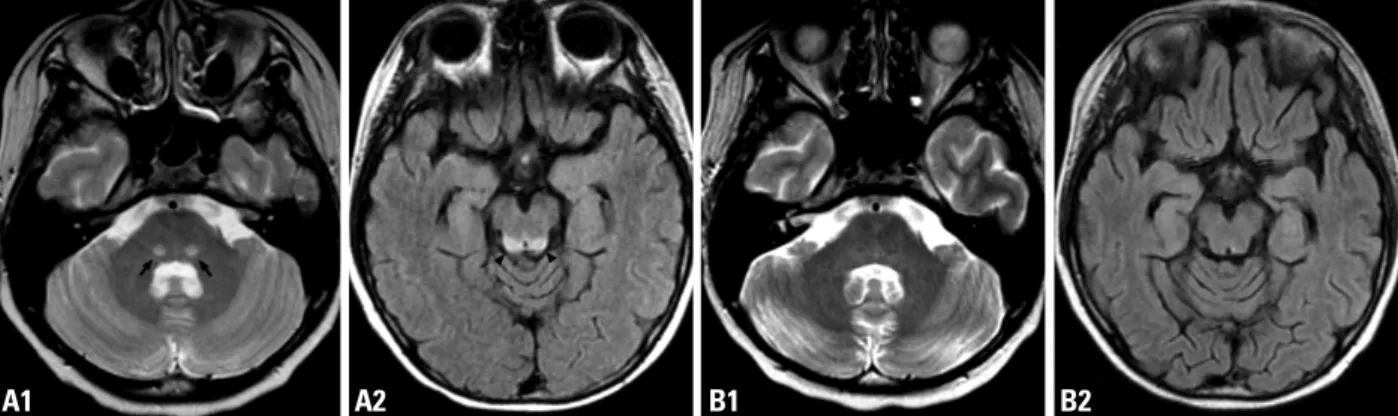
A 12-year-old boy underwent allogeneic BMT. He was di- agnosed with Philadelphia chromosome positive acute lym- phoblastic leukemia. After induction and consolidation che- motherapy, the patient underwent the BMT. He received total body irradiation and cyclophosphamide administration for the conditioning procedure. Cyclosporine and metho- trexate were used for the prevention of GVHD. He suffered from severe nausea and vomiting and could not orally take nutrition. On D+12, neutrophils were engrafted stably. Af- ter the conditioning procedure was initiated, the patient was solely dependent on a commercially available parenteral nutrition product. His general activity was slightly poor. He responded slowly to requests, but his mental status was alert. On D+22, he seemed slightly drowsy and confused, and complained of marked dizziness. He could not walk to toilet and intermittently exhibited intention tremors on both hands. Lid nystagmus was observed, but there was no eye- ball nystagmus. There were no sensory or motor changes.

based on bone marrow aspiration and biopsy. Complete re- mission was achieved, and an allogeneic BMT was planned.

The patient underwent total body irradiation and cyclo- phosphamide for the conditioning; tacrolimus and metho- trexate were used for the prophylaxis of graft versus host disease (GVHD) and he was provided with an immunosup- pressant. His oral intake was low, and he was solely depen- dent on a commercially available total parenteral nutrition product. His neutrophils were engrafted on D+11. On D+11, he complained of dizziness and headache, but those symp- toms quickly subsided. On D+23, vertigo and nystagmus developed, but his mental status was alert, and he did not show sensory or motor changes in the extremities. Three days later, he presented diplopia and esotropia, and com- plained of difficulty in closing his eyes. Brain magnetic res- onance imaging (MRI) was performed; we initially consid- ered the toxicity of metronidazole or immunosuppressant (Fig. 1A). Metronidazole administration was discontinued.

On D+30, he started to complain of dyspnea, and suffered simple and complex partial seizures one day later, which composed of lip smacking and clonic movements of the left shoulder. Apnea and bradycardia developed on D+33 and the patient was transferred to the intensive care unit for ventilator care. His mental status became semicomatose.

The follow-up brain CT and clinical progress since metro- nidazole discontinuation suggested Wernicke’s encephalop-

Fig. 1. (A) Symmetric signal increase on fast fluid-attenuated inversion-recovery images in the dorsal part of the medulla oblongata (black arrow, A1) same signal changes at the right side colliculus of the midbrain (arrow head, A2), the right precentral cortex (thin arrow, A3) and the bilateral putamen (white ar- row, A4). (B) Non-contrast computed tomography scan taken 7 days later, shows low density lesions in the bilateral putamen (black arrow) and newly devel- oped lesions in the bilateral caudate nucleus (arrow head).

A3 A4

A1 A2

B

(3)

symptoms are observed only in about 16% of patients.

1

Without thiamine treatment, the disease incurs 17-20%

mortality and progresses to Korsakoff’s syndrome with memory impairment in 80% of cases.

7

Progression to Kor- sakoff’s syndrome is reduced among non-alcoholic Wer- nicke’s encephalopathy patients compared to alcoholic ones. When Wernicke’s encephalopathy is due to thiamine deficiency alone, Korsakoff’s psychosis rarely develops following thiamine replacement. However, successful treat- ment or prophylaxis of Wernicke’s encephalopathy depends on a number of related issues and is not simply a matter of supplementing thiamine.

2

While thiamine replacement is important for the treatment and prophylaxis of Wernicke’s encephalopathy, an effective dosing template has not yet been established.

8

Recently, Wernicke’s encephalopathy has been observed in a variety of cases not involving non-alcoholic patients, such as those undergoing gastrointestinal surgery, chronic di- arrhea, hyperemesis gravidarum, anorexia nervosa, and can- cer, etc.

1

TPN without supplementation of thiamine some- times causes Wernicke’s encephalopathy. The risk of thia- mine deficiency increases when physicians fail to check the composition of commercially available TPN products.

1,5,9,10

Since a commercial form of TPN was first introduced to this hospital in 2004, there have been two severe cases of Wernicke’s encephalopathy following BMT.

Prior to this report, two cases of Wernicke’s encephalopa- thy during hematopoietic stem cell transplantation (HSCT) have been reported in Korea, and both were adults.

10,11

Both cases underwent HSCT and prolonged TPN, and fully re- covered from Wernicke’s encephalopathy after thiamine in- fusion. Our patients were much younger than those in the previous reports. Considering the fact that many cases of Wernicke’s encephalopathy are undiagnosed among alco- MRI taken on D+24 revealed increased signal intensity on

the dorsal pons on T1 weighted images (Fig. 2A). He was suspected of having Wernicke’s encephalopathy, and thia- mine 100 mg was given for 7 days. Twenty-four hours after thiamine infusion began, his dizziness and mental status were remarkably improved, and all his symptoms cleared four days later (Fig. 2B).

DISCUSSION

Thiamine, in its biologically active form thiamine pyro- phosphate, is an essential coenzyme used in the tricarboxil- ic acid cycle and the pentose phosphate shunt for the me- tabolism of carbohydrates and lipids. This is an important enzyme in energy metabolism involving transketolase, al- pha ketoglutarate dehydrogenase, and pyruvate dehydroge- nase. Without thiamine, the overwhelming metabolic de- mand of brain cells leads to cellular energy deficit, focal acidosis, ultimate cell death,

2

and lack of external balance.

The requirement of thiamine is increased in critically ill pa- tients or children and during lactation or pregnancy.

1,3

Since the body’s store of thiamine is depleted after roughly 20 days of poor supplementation, Wernicke’s encephalopathy can develop between days +13 to +37 after BMT as in our cases and other reports.

4,5

Wernicke’s encephalopathy commonly develops in alco- holics as a result of thiamine deficiency, although it remains largely underdiagnosed in this group. Typical brain lesions are observed in 0.8-2% of unselected autopsies of alcohol- ics, but only 1-20% of these lesions are diagnosed clinical- ly.

6

Diagnosis of the disease is sometimes difficult because of non-specific initial symptoms such as headache, abdomi- nal discomfort and fatigue; furthermore, the classic triad of

Fig. 2. (A) Increased signal intensity on the bilateral medial lemnisci of the dorsal pons (arrow, T2 weighted image, A1) and the colliculi of the dorsal midbrain (arrow head, FLAIR, A2). (B) Improved lesions following 7 days of intravenous thiamine supplement (T2 weighted image and FLAIR, B1 and B2). FLAIR, fluid- attenuated inversion-recovery.

A2

A1 B1 B2

(4)

improved after thimanine replacement, but did not fully re- cover. Furthermore, the patient experienced breathing diffi- culties and ultimately cardiac arrest. In case 2, thiamine was provided immediately after its deficiency was suspect- ed, and a full recovery was achieved.

In conclusion, Wernicke’s encephalopathy may develop at any age and not infrequently after HSCT. Wernicke’s en- cephalopathy should be considered in patients with enceph- alopathy following BMT or prolonged total parenteral nutri- tion without adequate oral intake. Early treatment improves the prognosis of Wernicke’s encephalopathy cases. A multi- vitamin and thiamine should be provided for patients who depend solely on TPN to prevent Wernicke-Korsakoff syn- drome.

REFERENCES

1. Sechi G, Serra A. Wernicke’s encephalopathy: new clinical set- tings and recent advances in diagnosis and management. Lancet Neurol 2007;6:442-55.

2. Thomson AD, Marshall EJ. The natural history and pathophysiol- ogy of Wernicke’s Encephalopathy and Korsakoff’s Psychosis.

Alcohol Alcohol 2006;41:151-8.

3. Davis RE, Icke GC. Clinical chemistry of thiamin. Adv Clin Chem 1983;23:93-140.

4. Francini-Pesenti F, Brocadello F, Manara R, Santelli L, Laroni A, Caregaro L. Wernicke’s syndrome during parenteral feeding: not an unusual complication. Nutrition 2009;25:142-6.

5. Bleggi-Torres LF, de Medeiros BC, Ogasawara VS, Loddo G, Za- nis Neto J, Pasquini R, et al. Iatrogenic Wernicke’s encephalopa- thy in allogeneic bone marrow transplantation: a study of eight cases. Bone Marrow Transplant 1997;20:391-5.

6. Torvik A. Wernicke’s encephalopathy--prevalence and clinical spectrum. Alcohol Alcohol Suppl 1991;1:381-4.

7. Pearce JM. Wernicke-Korsakoff encephalopathy. Eur Neurol 2008;59:101-4.

8. Day E, Bentham P, Callaghan R, Kuruvilla T, George S. Thiamine for Wernicke-Korsakoff Syndrome in people at risk from alcohol abuse. Cochrane Database Syst Rev 2004:CD004033.

9. Hahn JS, Berquist W, Alcorn DM, Chamberlain L, Bass D. Wer- nicke encephalopathy and beriberi during total parenteral nutrition attributable to multivitamin infusion shortage. Pediatrics 1998;

101:E10.

10. Baek JH, Sohn SK, Kim DH, Kim JG, Lee HW, Park SP, et al.

Wernicke’s encephalopathy after allogeneic stem cell transplanta- tion. Bone Marrow Transplant 2005;35:829-30.

11. Choi YJ, Park SJ, Kim JS, Kang EJ, Choi CW, Kim BS. Wer- nicke’s encephalopathy following allogeneic hematopoietic stem cell transplantation. Korean J Hematol 2010;45:279-81.

12. Bartynski WS. Posterior reversible encephalopathy syndrome, part 1: fundamental imaging and clinical features. AJNR Am J Neuroradiol 2008;29:1036-42.

13. Bleggi-Torres LF, de Medeiros BC, Werner B, Neto JZ, Loddo G, Pasquini R, et al. Neuropathological findings after bone marrow

holics and there have globally been several reports of Wer- nicke’s encephalopathy developing during HSCT, we sug- gest that Wernicke’s encephalopathy can develop at any age and is not infrequent during HSCT.

Wernicke’s encephalopathy is difficult to diagnose fol- lowing BMT because its initial symptoms are not easily dif- ferentiated from other encephalopathies following BMT.

Moreover, numerous therapeutic agents, including immu- nosuppressants and antibiotics, potentially affect the neuro- logical systems.

12

In an autopsy study, 5.5% (10/180) of cases were found to have Wernicke’s encephalopathy.

13

The characteristic findings of Wernicke’s encephalopathy on MRI can be helpful for diagnosis; lesions are found often in the thalamus and mammilary body, but the tectal plate and cranial nerve nucleus may be involved in non-alcoholic Wer- nicke’s encephalopathy.

14

The involved lesions may share characteristics with metronidazole encephalopathy.

15

Less common MRI imaging features of Wernicke’s encephalopa- thy include lesions in the cerebellar vermis, whereas the cer- ebellar vermis is involved in a high percentage (85%, 17/20) of metronidazole encephalopathy cases. Metronidazole en- cephalopathy usually develops after a long period of use (11-52 days), and symptoms improve over a relatively short period (4-10 days) after the discontinuation of metronida- zole.

15

In our cases, discontinuation for 10 days was not ef- fective in case 1; and metronidazole was used only for four days, long before the onset of symptoms in case 2. In both cases, cerebellar imaging suggested normal activity. There- fore, both clinical progressions of the two cases and their MRI imaging results suggested Wernicke’s encephalopathy rather than metronidazole encephalopathy.

Chemotherapeutic agents might hamper the metabolism of thiamine and induce thiamine deficiency. Thiamine defi- ciency associated with chemotherapy is usually observed during or shortly after chemotherapy. Antimetabolites, es- pecially 5-fluorouracil may cause thiamine deficiency, as it increases the rate of thiamine metabolism

16

and because of the blockage of the Krebs cycle by fluoroacetate, a metabo- lite of 5-fluorouracil.

17

On the other hand, thiamine pyro- phosphate inhibits the cytotoxicity of methotrexate and cy- clophosphamide.

18

The importance of early diagnosis and treatment is clear-

ly evident in the two cases presented herein. Ocular symp-

toms resolved within a few hours after treatment, and men-

tal status improved over the following 2-3 weeks.

1

In case

1, treatment for thiamine deficiency was provided 10 days

after the onset of vertigo and headaches. Mental activity

(5)

16. Kondo K, Fujiwara M, Murase M, Kodera Y, Akiyama S, Ito K, et al. Severe acute metabolic acidosis and Wernicke’s encephalopathy following chemotherapy with 5-fluorouracil and cisplatin: case re- port and review of the literature. Jpn J Clin Oncol 1996;26:234-6.

17. Koenig H, Patel A. Biochemical basis for fluorouracil neurotoxici- ty. The role of Krebs cycle inhibition by fluoroacetate. Arch Neu- rol 1970;23:155-60.

18. Boros LG, Brandes JL, Lee WN, Cascante M, Puigjaner J, Revesz E, et al. Thiamine supplementation to cancer patients: a double edged sword. Anticancer Res 1998;18:595-602.

transplantation: an autopsy study of 180 cases. Bone Marrow Transplant 2000;25:301-7.

14. Zuccoli G, Santa Cruz D, Bertolini M, Rovira A, Gallucci M, Car- ollo C, et al. MR imaging findings in 56 patients with Wernicke encephalopathy: nonalcoholics may differ from alcoholics. AJNR Am J Neuroradiol 2009;30:171-6.

15. Kim E, Na DG, Kim EY, Kim JH, Son KR, Chang KH. MR im-

aging of metronidazole-induced encephalopathy: lesion distribu-

tion and diffusion-weighted imaging findings. AJNR Am J Neuro-

radiol 2007;28:1652-8.

수치

Fig. 2. (A) Increased signal intensity on the bilateral medial lemnisci of the dorsal pons (arrow, T2 weighted image, A1) and the colliculi of the dorsal midbrain  (arrow head, FLAIR, A2)

참조

관련 문서

[Key words] Cyclosporine A (CsA), Hematopoietic stem cell transplantation (HSCT), Target blood level.. Cyclosporine은 체중 당 동일 용량을 투여받은 환자들 간에 혈중

HCT, hematopoietic cell transplantation; NHL, non-Hodgkin’s lymphoma; AML, acute myelogenous leukemia; HD, Hodgkin's disease; RIC, reduced-intensity conditioning; MDS,

Living-donor single lobe lung transplantation for bronchiolitis obliterans from mother to child following previous allogeneic he- matopoietic stem cell transplantation from the

Allogeneic hematopoietic stem cell transplantation (HSCT) using an optimal conditioning regimen at the first CR appears to be a reasonable therapeutic approach with which to

Allogeneic hematopoietic stem cell transplantation (HSCT) is considered the optimal curative treatment for acute myeloid leukemia (AML), but some patients develop bone

We compared the outcomes of allogeneic hematopoietic stem cell transplantation using reduced intensity and myeloablative conditioning for the treatment of patients with

RT, radio- therapy; HSCT, hematopoietic stem cell transplantation; GH Tx, growth hormone treat- ed subject (+, treated; -, non-treated); CI, cranial irradiation; CSRT, craniospinal

Isolated extramedullary relapses of granulocytic sarcoma (GS) of acute myeloid leukemia (AML) after allogeneic hema- topoietic stem cell transplantation (allo-HSCT) are reported to