Contributing Factors on Lymph Node Yield after Surgery for Mid-Low Rectal Cancer
Young Jae Ahn,
1Hye Youn Kwon,
1Yoon Ah Park,
2Seung-Kook Sohn,
1and Kang Young Lee
11Department of Surgery, Gangnam Severance Hospital, Yonsei University College of Medicine, Seoul;
2Department of Surgery, Samsung Medical Center, Sungkyunkwan University School of Medicine, Seoul, Korea.
Received: September 7, 2011 Revised: April 15, 2012 Accepted: April 18, 2012
Corresponding author: Dr. Kang Young Lee, Department of Surgery,
Yonsei University College of Medicine, 211 Eonju-ro, Gangnam-gu, Seoul 135-720, Korea.
Tel: 82-2-2019-3378, Fax: 82-2-3462-5994 E-mail: [email protected]
∙ The authors have no financial conflicts of interest.
© Copyright:
Yonsei University College of Medicine 2013 This is an Open Access article distributed under the terms of the Creative Commons Attribution Non- Commercial License (http://creativecommons.org/
licenses/by-nc/3.0) which permits unrestricted non- commercial use, distribution, and reproduction in any medium, provided the original work is properly cited.
Purpose: The purpose of the present study was to evaluate the contributing fac- tors to the lymph node status as well as to define the impact of preoperative con- current chemoradiotherapy (CCRT) on the number of lymph nodes retrieved in mid-low rectal cancer. Materials and Methods: We retrospectively analyzed 277 patients who underwent curative surgical resection for mid-low rectal cancer between 1998 and 2007. Eighty-two patients received long course preoperative CCRT followed by surgery. Results: A mean of 13.12±9.28 lymph nodes was re- trieved. In a univariate analysis, distance from the anal verge, pT stage, pN stage, lymphovascular invasion, preoperative CCRT had significant influence on the number of lymph nodes retrieved. In a multivariate model, patients in the CCRT group had fewer retrieved lymph nodes than the non-CCRT group (p<0.001). Both univariate and multivariate analyses showed that the ypN0 group had fewer re- trieved lymph nodes than the ypN1-2 group (p=0.027) in the CCRT group. Con- clusion: Preoperative CCRT was an independent risk factor for failure to harvest an appropriate number of lymph nodes, and node-negative patients who received CCRT had fewer lymph nodes harvested.
Key Words: Rectal neoplasm, lymph node, neoadjuvant therapy
INTRODUCTION
Metastatic lymph nodes are the most potent prognostic factor after curative resec- tion of rectal cancer.1 Whether the tumor metastasizes to regional lymph nodes is the key consideration not only for the prognosis,2 but also for applying adjuvant therapy. For accurate nodal staging after surgery, the number of lymph nodes ex- amined is clinically important.3,4 In particular, in patients with no metastatic lymph nodes, the number of lymph nodes identified in surgical specimens is critical for an accurate diagnosis. Inadequate lymph node assessment may affect survival, since it could be associated with understaging the disease. For this reason, the Col- lege of American Pathologists recommends examining a minimum of 12 lymph nodes to accurately stage node-negative rectal cancer5 and the Tumor-Node-Me- tastasis staging of the American Joint Committee on Cancer (AJCC) and the Inter- national Union Against Cancer (UICC) suggest obtaining at least 7-14 lymph
anterior resection with coloanal anastomosis or abdomino- perineal resection was performed instead. Resected speci- mens were evaluated for depth of tumor invasion, lymph node involvement, histologic type, lymphovascular inva- sion and resection margins according to standard patholog- ic evaluation. A careful manual lymph node dissection tech- nique was used to harvest regional lymph nodes. Mesenteric fat clearance technique using chemicals was not used in this study.
Of the 277 patients, 195 (70.4%) underwent radical sur- gery without preoperative CCRT, and 82 (29.6%) under- went radical surgery after preoperative CCRT. Patients with tumor invasion to mesorectal fascia or adjacent organ and lymph node metastasis on preoperative staging studies or with tumors within 5 cm of the anal verge received preop- erative CCRT. The schedule and technique at our institute was as follows. A total of 5040 cGy radiation was delivered in 25 fractions of 180 cGy/day over 5 weeks. Concurrent chemotherapy was administered with intravenous or oral fluorouracil in all the patients. Intravenous 5-FU (425 mg/
m2) and leukovorin (20 mg/m2) was administered for 5 days in a continuous manner during the first and fifth weeks of radiotherapy. Otherwise, oral doxifluridine (900 mg/m2, Furtulon, Roche, Seoul, Korea) and leukovorin (30 mg/day) were administered during the entire course of radiotherapy.
Radical surgery was performed around 6-8 weeks after completing radiation therapy.
Statistical analysis was performed with the statistical package SPSS for Windows (version 12.0 SPSS Inc., Chica- go, IL, USA). The Student’s t-test was used to analyze the statistical differences in lymph node retrieval between the surgery alone and preoperative CCRT groups, and applied to continuous variables. The χ2-test was used for categorical variables. Multivariate analysis using a multiple linear re- gression model was used to identify independent variables influencing lymph node retrieval. A value of p<0.05 was considered statistically significant.
RESULTS
Clinicopathologic characteristics
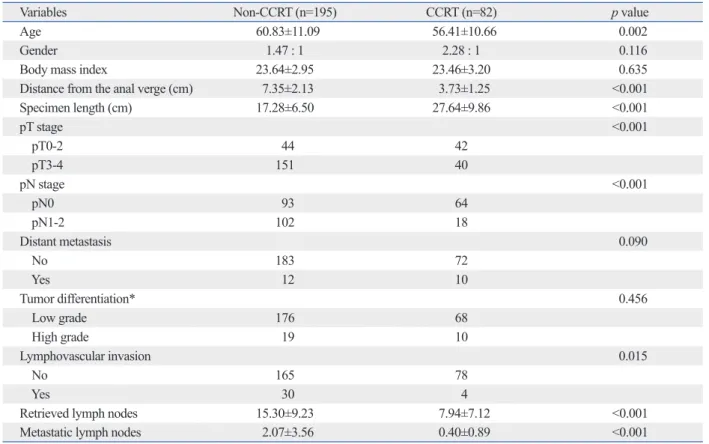
The clinicopathologic characteristics are described in Table 1. The median age was 60 (range; 24-85) years. The mean BMI was 23.59±3.02 kg/m2. The mean distance from the anal verge to the low edge of the tumor was 6.28±2.53 cm.
The mean length of the resected specimen was 20.35±8.98 nodes in radical resections.6 The number of lymph nodes re-
trieved could be affected by several factors. The extent of surgery and the examining pathologist could influence the number of lymph nodes.7-9 Even in similar surgical speci- mens, the number of lymph nodes retrieved could be affect- ed by age, body mass index, tumor location, tumor size, depth of tumor invasion,8,10-12 lymph node metastasis,13,14 and preoperative concurrent chemoradiotherapy (CCRT).3,10,15 Identifying high risk factors that could decrease lymph node retrieval would be valuable for accurate nodal staging, since other techniques could be used to harvest lymph nodes for high-risk patients.
The aim of this study was to identify risk factors associ- ated with a failure to harvest adequate lymph nodes for ac- curate nodal staging and to define the impact of CCRT on the number of lymph nodes retrieved in patients who un- derwent curative radical surgery for mid-low rectal cancer.
MATERIALS AND METHODS
Data from 277 patients who underwent radical surgery with curative intention for mid-low rectal cancer between Janu- ary 1998 and December 2007 were retrospectively ana- lyzed. All patients had histologically proven adenocarcino- ma located on the mid to low rectum, within 10 cm from the anal verge. The retrospective review of each patient’s medical records yielded clinicopathologic information. The number of lymph nodes harvested was derived from the pathologic report. Distant metastasis was diagnosed by clinical, radiologic examination (abdominopelvic computed tomography, chest computed tomography, pelvic magnetic resonance imaging, positron emission tomography or posi- tron emission tomography-computed tomography), or in- traoperative observation and pathologic confirmation. The tumors were categorized according to AJCC 7th edition.
Patients with synchronous distant metastasis were included in the analysis if radical surgery with curative intention was performed.
All patients underwent curative radical surgery based on standardized technique and principle, which did not change significantly during the study period. In all patients, surgery included total mesorectal excision with adequate resection margin and regional lymph node dissection with ligation of the inferior mesenteric artery at its origin. For surgery, low anterior resection was normally done. However, in cases where the distal resection margin was not secure, ultra low
icantly contributed to lymph node retrieval. Age, gender, BMI, specimen length, distant metastasis and tumor differ- entiation had no significant influence (Table 1).
Subsequent multivariate analysis using a multiple linear regression model showed that preoperative CCRT (p<0.001) was an independent variable influencing the number of lymph nodes retrieved (Table 3).
Factors contributing to lymph node retrieval after preoperative CCRT
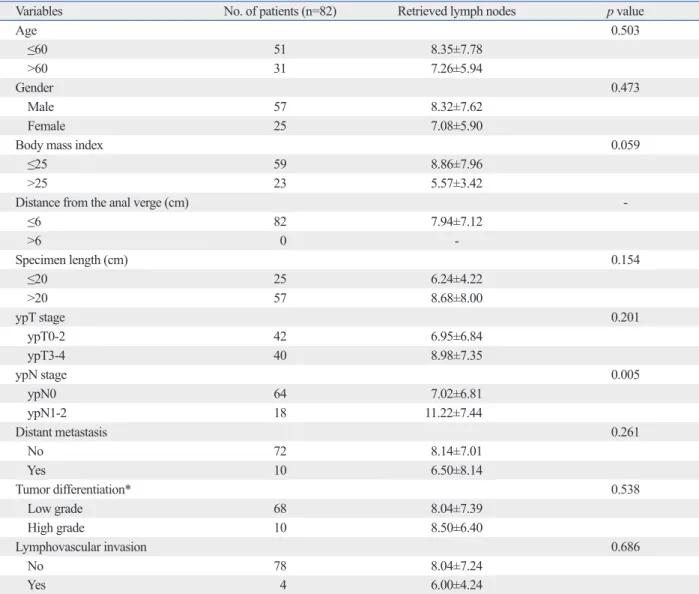
In patients receiving CCRT before surgery, regional lymph node metastasis was a significant factor influencing lymph node retrieval by univariate analysis (p=0.005) (Table 4).
cm. In patients receiving preoperative CCRT, the specimen was longer than in patients who received surgery alone (27.64±9.86 cm vs. 17.28±6.50 cm, p<0.001) (Table 2).
Preoperative CCRT was performed in 82 patients (29.6%).
The median number of lymph nodes retrieved was 12 (range;
1-52). Metastatic lymph nodes were detected in 119 (43.0%) patients, 80 of whom had up to three metastatic nodes (pN1) and 39 patients had four or more (pN2).
Factors contributing to lymph node retrieval
By univariate analysis, distance from the anal verge (p<
0.001), pT stage (p<0.001), pN stage (p<0.001), lymphovas- cular invasion (0.017), preoperative CCRT (p<0.001) signif- Table 1. Factors Contributing to Lymph Node Yield
Variables No. of patients (n=277) Retrieved lymph nodes p value
Age 0.882
≤60 147 13.04±9.37
>60 130 13.21±9.20
Gender 0.319
Male 173 12.69±9.37
Female 104 13.84±9.11
Body mass index 0.463
≤25 196 13.38±9.37
>25 81 12.48±9.06
Distance from the anal verge (cm) <0.001
≤6 154 11.05±8.43
>6 123 15.71±9.66
Specimen length (cm) 0.069
≤20 181 13.86±8.67
>20 96 11.73±10.23
pT stage <0.001
pT0-2 86 9.77±8.59
pT3-4 191 14.63±9.20
pN stage <0.001
pN0 157 11.36±9.26
pN1-2 120 15.42±8.82
Distant metastasis 0.656
No 255 13.19±9.22
Yes 22 12.27±10.20
Tumor differentiation* 0.499
Low grade 244 13.37±9.38
High grade 29 12.14±8.49
Lymphovascular invasion 0.017
No 243 12.62±9.09
Yes 34 16.68±9.98
Preoperative CCRT <0.001
No 195 15.30±9.23
Yes 82 7.94±7.12
CCRT, concurrent chemoradiotherapy.
*4 patients were omitted from the pathologic report.
curative resection of rectal cancer. In the current study, pre- operative CCRT was independently associated with the number of lymph nodes retrieved. In addition, BMI and re- gional lymph node metastasis were independent contribut- ing factors for the number of lymph nodes retrieved in pa- tients who received preoperative CCRT.
An adequate number of examined lymph nodes is crucial for accurate staging, especially in patients without regional lymph node metastasis.3,4,14,16 Moreover, not examining enough lymph nodes could be associated with poor progno- sis because of the chance of understaging the tumor.12 For this reason, the AJCC and UICC recommend harvesting at least 12 negative nodes in the surgical specimen of node negative patients to confirm adequate nodal staging. How- There was no significant difference in lymph node retrieval
by age, gender, BMI, distance from the anal verge, speci- men length, ypT stage, distant metastasis, tumor differentia- tion or lymphovascular invasion.
Likewise, by multivariate analysis using a multiple re- gression model, BMI (p=0.032) and regional lymph node metastasis (p=0.027) were independent variables influenc- ing the number of lymph nodes retrieved (Table 5).
DISCUSSION
The number of lymph nodes retrieved is one reference point to estimate the diagnostic accuracy of nodal staging after Table 2. Comparison between the Non-CCRT and CCRT Groups
Variables Non-CCRT (n=195) CCRT (n=82) p value
Age 60.83±11.09 56.41±10.66 0.002
Gender 1.47 : 1 2.28 : 1 0.116
Body mass index 23.64±2.95 23.46±3.20 0.635
Distance from the anal verge (cm) 7.35±2.13 3.73±1.25 <0.001
Specimen length (cm) 17.28±6.50 27.64±9.86 <0.001
pT stage <0.001
pT0-2 44 42
pT3-4 151 40
pN stage <0.001
pN0 93 64
pN1-2 102 18
Distant metastasis 0.090
No 183 72
Yes 12 10
Tumor differentiation* 0.456
Low grade 176 68
High grade 19 10
Lymphovascular invasion 0.015
No 165 78
Yes 30 4
Retrieved lymph nodes 15.30±9.23 7.94±7.12 <0.001
Metastatic lymph nodes 2.07±3.56 0.40±0.89 <0.001
CCRT, concurrent chemoradiotherapy.
*4 patients were omitted from the pathologic report.
Table 3. Independent Variables Influencing Lymph Node Retrieval
Variables Regression coefficient 95% CI p value
Distance from the anal verge (≤6 cm vs. >6 cm) 1.428 -1.082; 3.938 0.264
Specimen length (≤20 cm vs. >20 cm) 1.465 -0.953; 3.883 0.234
Depth of invasion (pT0-2 vs. pT3-4) 2.388 -0.061; 4.836 0.056
Lymph node metastasis (pN0 vs. pN1-2) 1.233 -1.120; 3.585 0.303
Lymphovascular invasion (high grade vs. low grade) 1.788 -1.455; 5.031 0.279
Preoperative CCRT -5.937 -9.054; -2.819 <0.001
CCRT, concurrent chemoradiotherapy; CI, confidence intervals.
managing advanced rectal cancer,17 since it decreases the risk of local recurrence,18 improves the prognosis of ad- vanced rectal cancer patients, and facilitates radical exci- sion of T4 cancer and sphincter saving surgery.19 However, one issue is that after preoperative CCRT, surgical speci- mens often do not contain enough lymph nodes to reach the recommended standard.10,15,20 In the current study, preopera- tive CCRT was an independent risk factor to decrease lymph node retrieval. Moreover, when we looked at tumors treated ever, the number of lymph nodes retrieved varies in rectal
cancer patients due to several factors. Using at least 12 nodes as the standard, Baxter, et al.10 found only 20% of pa- tients who underwent preoperative CCRT had adequate lymph node staging. We found only 24.4% of patients who underwent preoperative CCRT had adequate lymph node staging, although 52.4% of total patients had adequate lymph node staging.
Preoperative CCRT has become a standard treatment in
Table 4. Factors Contributing to Lymph Node Yield in the Preoperative CCRT Group
Variables No. of patients (n=82) Retrieved lymph nodes p value
Age 0.503
≤60 51 8.35±7.78
>60 31 7.26±5.94
Gender 0.473
Male 57 8.32±7.62
Female 25 7.08±5.90
Body mass index 0.059
≤25 59 8.86±7.96
>25 23 5.57±3.42
Distance from the anal verge (cm) -
≤6 82 7.94±7.12
>6 0 -
Specimen length (cm) 0.154
≤20 25 6.24±4.22
>20 57 8.68±8.00
ypT stage 0.201
ypT0-2 42 6.95±6.84
ypT3-4 40 8.98±7.35
ypN stage 0.005
ypN0 64 7.02±6.81
ypN1-2 18 11.22±7.44
Distant metastasis 0.261
No 72 8.14±7.01
Yes 10 6.50±8.14
Tumor differentiation* 0.538
Low grade 68 8.04±7.39
High grade 10 8.50±6.40
Lymphovascular invasion 0.686
No 78 8.04±7.24
Yes 4 6.00±4.24
CCRT, concurrent chemoradiotherapy.
*4 patients were omitted from the pathologic report.
Table 5. Independent Variables Influencing Lymph Node Retrieval in the Preoperative CCRT Group
Variables Regression coefficient 95% CI p value
Body mass index (≤25 vs. >25) -3.763 -7.203; -0.324 0.032
Specimen length (≤20 cm vs. >20 cm) 2.067 -1.190; 5.324 0.210
Depth of invasion (ypT0-2 vs. ypT3-4) 0.290 -2.932; 3.512 0.858
Lymph node metastasis (ypN0 vs. ypN1-2) 4.403 0.522; 8.283 0.027
CCRT, concurrent chemoradiotherapy; CI, confidence intervals.
more time.30-32
In conclusion, preoperative CCRT was an independent variable influencing lymph node retrieval after surgery for mid-low rectal cancer. In patients receiving CCRT before surgery, lower BMI and regional lymph node metastasis were independent variables, increasing lymph node retrieval.
REFERENCES
1. Dukes CE, Bussey HJ. The spread of rectal cancer and its effect on prognosis. Br J Cancer 1958;12:309-20.
2. Chapet O, Romestaing P, Mornex F, Souquet JC, Favrel V, Ardiet JM, et al. Preoperative radiotherapy for rectal adenocarcinoma:
which are strong prognostic factors? Int J Radiat Oncol Biol Phys 2005;61:1371-7.
3. Nagtegaal ID, van Krieken JH. The role of pathologists in the quality control of diagnosis and treatment of rectal cancer-an over- view. Eur J Cancer 2002;38:964-72.
4. Quirke P. Training and quality assurance for rectal cancer: 20 years of data is enough. Lancet Oncol 2003;4:695-702.
5. Compton CC, Fielding LP, Burgart LJ, Conley B, Cooper HS, Hamilton SR, et al. Prognostic factors in colorectal cancer. Col- lege of American Pathologists Consensus Statement 1999. Arch Pathol Lab Med 2000;124:979-94.
6. Greene FL, Page DL, Fleming ID, Fritz A, Balch CM, Haller DG, et al. AJCC (American Joint Committee on Cancer) Cancer Stag- ing Manual. 6th ed. New York: Springer-Verlag; 2002. p.127-38.
7. Dworák O. Number and size of lymph nodes and node metastases in rectal carcinomas. Surg Endosc 1989;3:96-9.
8. Görög D, Nagy P, Péter A, Perner F. Influence of obesity on lymph node recovery from rectal resection specimens. Pathol Oncol Res 2003;9:180-3.
9. Sigurdson ER. Lymph node dissection: is it diagnostic or thera- peutic? J Clin Oncol 2003;21:965-7.
10. Baxter NN, Morris AM, Rothenberger DA, Tepper JE. Impact of preoperative radiation for rectal cancer on subsequent lymph node evaluation: a population-based analysis. Int J Radiat Oncol Biol Phys 2005;61:426-31.
11. Thorn CC, Woodcock NP, Scott N, Verbeke C, Scott SB, Ambrose NS. What factors affect lymph node yield in surgery for rectal cancer? Colorectal Dis 2004;6:356-61.
12. Rullier A, Laurent C, Capdepont M, Vendrely V, Belleannée G, Bioulac-Sage P, et al. Lymph nodes after preoperative chemora- diotherapy for rectal carcinoma: number, status, and impact on survival. Am J Surg Pathol 2008;32:45-50.
13. Wong JH, Severino R, Honnebier MB, Tom P, Namiki TS. Num- ber of nodes examined and staging accuracy in colorectal carcino- ma. J Clin Oncol 1999;17:2896-900.
14. Tepper JE, O’Connell MJ, Niedzwiecki D, Hollis D, Compton C, Benson AB 3rd, et al. Impact of number of nodes retrieved on out- come in patients with rectal cancer. J Clin Oncol 2001;19:157-63.
15. Wichmann MW, Müller C, Meyer G, Strauss T, Hornung HM, Lau-Werner U, et al. Effect of preoperative radiochemotherapy on lymph node retrieval after resection of rectal cancer. Arch Surg 2002;137:206-10.
16. Goldstein NS, Sanford W, Coffey M, Layfield LJ. Lymph node
with preoperative CCRT, lymph nodes retrieved were signifi- cantly low in node negative tumors. Thus, there is a chance of understaging, especially in node negative patients.21,22 However, there may be no association between lymph node retrieval in patients treated by preoperative CCRT and cura- tive surgery with negative lymph node metastasis, and overall survival and disease-free survival.12,23,24 After preop- erative chemoradiation, retrieved lymph nodes could also be decreased from the therapeutic effect of radiation, result- ed in the sterilization of cancer cell and fibrosis in the lymph nodes. If that was the case, then the reduced number of ex- amined lymph nodes is caused by therapeutic effect of pre- operative chemoradiation and there would be no effect on patients’ survival. However, the clinical impact of reduced lymph nodes after preoperative chemoradiation is still be- ing debated and should be clarified with further study.
Manual lymph node dissection is the current standard at most institutions, and was also used in the present study.
Since 1938, when the fat clearance technique was first used,25 other similar methods have been developed to isolate lymph nodes in surgical specimens. Although there has been varia- tion in consistency among the different methods regarding harvesting and processing of lymph nodes, the fat clearance technique could be used for patients at risk of understag- ing.26,27 If patients received preoperative CCRT or fewer than 12 lymph nodes were retrieved from the surgical spec- imens by manual lymph node dissection, the fat clearance technique could be available to increase the staging accura- cy.26-28 A multivariate model of the present study revealed that in patients of the CCRT group with higher BMI, fewer lymph nodes were retrieved. For such patients, the fat clear- ance technique might deserve special consideration.
The current study included rectal cancer within 10 cm from the anal verge, since lymph node yield could be influ- enced by tumor localization or specimen length.8,13 Colonic bowel segments bear significantly more lymph nodes than rectal bowel segments, possibly because of a longer mesen- teric radix. In the present study, specimens from patients re- ceiving CCRT were longer than in patients who received surgery alone, since we carried out an anastomosis with un- irradiated bowel by removing all the sigmoid colon to avoid adverse effects and improve bowel function.29 The number of retrieved lymph nodes was significantly lower in patients who underwent preoperative CCRT despite the longer speci- mens. This is explained by the high radiosensitivity of lym- phoid tissue; lymphocytes can die within hours of radio- therapy without cell division, whereas tumor cells need
after radical surgery for distal rectal cancer and neoadjuvant chemoradiation therapy: what does it mean? Dis Colon Rectum 2008;51:277-83.
25. Gilchrist RK, David VC. Lymphatic spread of carcinoma of the rectum. Ann Surg 1938;108:621-42.
26. Scott KW, Grace RH. Detection of lymph node metastases in colorectal carcinoma before and after fat clearance. Br J Surg 1989;76:1165-7.
27. Wang H, Safar B, Wexner SD, Denoya P, Berho M. The clinical significance of fat clearance lymph node harvest for invasive rec- tal adenocarcinoma following neoadjuvant therapy. Dis Colon Rectum 2009;52:1767-73.
28. Kotanagi H, Fukuoka T, Shibata Y, Yoshioka T, Aizawa O, Saito Y, et al. The size of regional lymph nodes does not correlate with the presence or absence of metastasis in lymph nodes in rectal cancer.
J Surg Oncol 1993;54:252-4.
29. Dahlberg M, Glimelius B, Graf W, Påhlman L. Preoperative irra- diation affects functional results after surgery for rectal cancer: re- sults from a randomized study. Dis Colon Rectum 1998;41:543-9.
30. Marijnen CA, Nagtegaal ID, Klein Kranenbarg E, Hermans J, van de Velde CJ, Leer JW, et al. No downstaging after short-term pre- operative radiotherapy in rectal cancer patients. J Clin Oncol 2001;19:1976-84.
31. Lowenthal JW, Harris AW. Activation of mouse lymphocytes in- hibits induction of rapid cell death by x-irradiation. J Immunol 1985;135:1119-25.
32. Shvero J, Koren R, Marshak G, Sadov R, Hadar T, Yaniv E, et al.
Histological changes in the cervical lymph nodes after radiothera- py. Oncol Rep 2001;8:909-11.
recovery from colorectal resection specimens removed for adeno- carcinoma. Trends over time and a recommendation for a mini- mum number of lymph nodes to be recovered. Am J Clin Pathol 1996;106:209-16.
17. Legoux JL, Lehur PA, Penna C, Calais G, Roseau G, Calan LD.
Rectal cancer. Gastroenterol Clin Biol 2006;30 Spec No 2:2S43-51.
18. Kapiteijn E, Marijnen CA, Nagtegaal ID, Putter H, Steup WH, Wiggers T, et al. Preoperative radiotherapy combined with total mesorectal excision for resectable rectal cancer. N Engl J Med 2001;345:638-46.
19. Rullier E, Goffre B, Bonnel C, Zerbib F, Caudry M, Saric J. Pre- operative radiochemotherapy and sphincter-saving resection for T3 carcinomas of the lower third of the rectum. Ann Surg 2001;
234:633-40.
20. Sermier A, Gervaz P, Egger JF, Dao M, Allal AS, Bonet M, et al.
Lymph node retrieval in abdominoperineal surgical specimen is radiation time-dependent. World J Surg Oncol 2006;4:29.
21. Caplin S, Cerottini JP, Bosman FT, Constanda MT, Givel JC. For patients with Dukes’ B (TNM Stage II) colorectal carcinoma, ex- amination of six or fewer lymph nodes is related to poor progno- sis. Cancer 1998;83:666-72.
22. Cianchi F, Palomba A, Boddi V, Messerini L, Pucciani F, Perigli G, et al. Lymph node recovery from colorectal tumor specimens: rec- ommendation for a minimum number of lymph nodes to be exam- ined. World J Surg 2002;26:384-9.
23. Baxter NN. Is lymph node count an ideal quality indicator for can- cer care? J Surg Oncol 2009;99:265-8.
24. Habr-Gama A, Perez RO, Proscurshim I, Rawet V, Pereira DD, Sousa AH, et al. Absence of lymph nodes in the resected specimen