초등과학의‘지구와 우주’영역에서 초등예비교사의 지식수준과 공간지각 능력과의 관계
이 용 섭 부산교육대학교
Correlation between Knowledge level and Space Perception Ability of Pre-service Elementary School Teacher on 'Earth
and Space' of Elementary Science
Lee Yong-Seob
Busan National University of Education ABSTRACT
The purpose of this study is find out the correlation of level of knowledge of pre-service elementary teacher with space perception ability on 'Earth and Space' of elementary science.
During the second semester of 2013, for 15 weeks, the classes were conducted for 3 hours per week and we find out knowledge Understanding degree and select terms offered by 5th grade science courses 'The solar system and the stars', 'Earth and Moon', 'change of seasons' section and measured space perception ability degree of pre-service elementary school teacher with a questionnaire. We analyzed the correlation of understanding level of knowledge in the field of astronomy of pre-service elementary school teacher with space perception ability.
The results of the study are presented as follows.
First, pre-service elementary school teacher showed a low level of knowledge understanding as it goes the upper grades about upper concept in 'The solar system and the stars', 'Earth and Moon', 'change of seasons' section' of astronomy area of elementary science 'Earth and space sector'. The pre-service elementary school teachers needs to acquire knowledge of astronomy area in elementary school curriculum.
Second, pre-service elementary school teacher showed that there are differences individually in 'finding solid body' of sub-element of space perception ability. This shows that 'finding solid body' factor is associated with space perception ability.
Third, in the section of 'The earth and the Universe' for elementary education, 'Reflection' and 'Finding solid body' which are low-level components of space perception ability were verified that have a corelationship with general grades in the astronomy conception test.
Key words : Pre-service Elementary Teacher, Knowledge level, Space Perception Ability
Received 2 December, 2013; Revised 23 December, 2013; Accepted 29 December, 2013
*Corresponding author : Lee Yong-Seob Busan Nat'l Univ. of Education, Gyodae-ro 24, Yeonje-gu, Busan, 611-736, Korea
Phone: +82-51-500-7244 E-mail: [email protected]
ⓒ The Korean Society of Earth Sciences Education . All rights reserved.
This is an Open-Access article distributed under the terms of the Creative Commons Attribution Non-Commercial License (http://
creativecommons.org/licenses/by-nc/3.0) which permits unrestricted non-commercial use, distribution, and reproduction in any medium, provided the original work is properly cited.
Ⅰ. 서 론
2009 개정 과학과 교육과정에서는 학습내용에 대
한 성취기준을 강조하고 있다. 학습내용의 성취 기 준은 각 영역의 개관과 학습내용 성취기준, 탐구활 동으로 구성되어 있다. 영역의 개관에서는 왜 영역
을 가르쳐야 하는지 영역 설정의 배경, 학생들이 성 취하여야 할 목표, 이 영역을 학습하기 이전에 학습 한 내용과 다음에 학습할 내용을 기술하여 교사가 이 영역의 위치를 알고 지도하는 데 도움이 될 수 있도록 하였다(교육부, 2013). 2009 개정 교육과정은 학년군으로 되어 있다. 특히, 교육과정의 변천에서 초등과학 교과의 지구와 우주분야에서 천문영역의 내용은 변화가 거의 없었는데도 불구하고 교사와 학습자에게는 어려운 단원이다. 초등학교 예비교사 들은 제7차 및 2007년 개정 교육과정 적용에서 교육 을 이수한 학생들이다. 교육과정이 변할 때 마다. 교 육 철학에 근거한 교육패러다임의 변화가 있었다.
이러한 교육패러다임에서 강조하는 핵심은 그 시대 상을 반영하고 있다고 본다. 특히 초등학교 과학과 교육과정의 천문분야는 지속적으로 많은 연구의 산 출물이 있었으며, 변화를 거듭하는 교수방법에 대한 선행연구(이용섭, 2006; 정진우, 2010; 채동현, 2004) 에서도 효율적인 학습방법을 제시하고 있지만 급변 하는 교육현장의 변화시대에 적합한 교수방법은 드 물다고 판단된다.
교육대학교에 재학하고 있는 초등학교 예비교사 의 대부분은 중학교 교육과정에서 학습한 천문분야 의 학습내용이 전부인 경우가 많다. 우리나라 고등 학교 교육과정에서는 지구분야의 천문에 관한 학습 을 할 수 있는 ‘지구과학’이라는 교과목은 존재하지 만 고등학생들은 대학진학을 위해 문, 이과 반으로 구분되어 학습하고 있으며 교육대학교에 재학학고 있는 초등학교 예비교사의 대부분은 문과반의 교과 목은 이수하고 졸업한 학생이 대부분이다. 이석희와 이용섭(2012)에 의하면 ‘초등학교 예비교사는 지구 분야의 천문분야에 대한 지식 습득 수준이 매우 취 약하며 초등학교 과학과 지구분야의 천문내용에서 지식전달 및 교수방법에서 매우 어려워하고 있는 실정이다’라고 지적하고 있다.
2009 개정 초등과학 교육과정 내용은 학년군으로
‘물질과 에너지’, ‘생명과 지구’로 나누고 있다. 2007, 2009 개정 과학과 교육과정에서 초등학교 과학교과 의 천문에 관한 개념은 위상변화, 지구자전, 지구공 전, 공전궤도, 자전축, 남중고도 등의 개념으로 천문 분야에 대한 개념의 변화는 없다. 이러한 천문분야 에서 개념의 개수와 수준을 변화시키지 않은 것은 학생들의 발달단계에서 성장보다는 성숙에 관련이 많다는 선행연구(교육인적자원부, 2008)에서 근거를
두고 있다. 즉, 천문분야에서 제시되는 개념은 공간 지각 능력에 관련이 많다는 것이다. 이러한 공간지 각 능력은 개인에 따라 차이가 많다.
공간지각 능력에 관한 선행연구(김봉섭외, 1998;
임종옥, 2007; 이용섭과 김순식, 2012; 이용섭, 2012;
Alice, 2005; Bingham, 2005; Eramudugolla et al., 2011;
Jatsch, 2005; Ocklenburg et al., 2010; Wexler, 2003)에 서도 초등과학에서 천문분야의 개념습득을 위한 내 용을 지도하는데 있어 교사의 천문지식 수준과 교 수방법이 공간지각 개념 습득에 관련이 있음을 서 술하고 있다. 특히 초등학교 예비교사의 천문분야의 지식수준은 중학교 교육과정에 머물고 있다는 측면 에서 초등학교 예비교사의 지식수준과 공간지각 개 념습득과는 어느 정도 관련이 있는지 살펴볼 필요 가 있다.
따라서 이 연구에서는 초등과학 교육과정의 지구 와 우주분야에서 천문에 관한 개념습득 정도를 알 아보고 이에 대해 습득하고 있는 천문개념이 공간 지각 능력과 어떤 상관관계가 있는지 알아보고자 한다. 이에 대한 자세한 연구문제는 다음과 같다.
첫째, 초등예비교사들은 초등학교 과학과 교육과 정에서 ‘지구와 우주’ 분야의 천문에 관한 지식수준 이 어떠한가?
둘째, 초등예비교사의 공간지각 능력 수준은 어 떠한가?
셋째, 초등예비교사의 천문에 관한 지식수준과 공간지각 능력과의 상관관계는 어떠한가?
Ⅱ. 연구 절차 및 방법
1. 연구 절차
본 연구는 ‘천체관측’ 에 대하여 2013년 2학기 15 주 동안 주당 3시간씩 수업이 진행되었으며, 초등학 교 5학년 과학과 ‘태양계와 별’, ‘지구와 달’, ‘계절 의 변화’ 단원에서 제시하고 있는 용어를 선정하여 지식 이해 정도를 알아보았고 초등학교 예비교사의 공간지각 능력 정도를 검사지로 측정하였다. 그리고 초등예비 교사의 천문분야의 지식이해 수준과 공간 지각 능력과의 상관관계를 분석하였다.
2. 연구 대상
본 연구는 B 광역시의 B 교육대학교의 3학년 2학
Table 1. Question count by sub-element of space perception ability test
Sub-element Question Count Question Number Total
Two-dimensional rotation Three-dimensional rotation Reflection
Finding solid body The number of blocks Figure inference by pattern
4 3 2 5 3 3
1, 2, 3, 6 4, 5, 7 8, 9
10, 11, 15, 16, 17 12, 13, 14 18, 19, 20
20
Table 2. 'The solar system and the stars' lesson learning content of 5th grade(Ministry of Education, Science and Technology, 2010) Stage Class Class name Inquiry process
elements The aims of the lesson Core term
Fun science 1/10 Let's hunt for planets and constellations.
- Children are curious and interested in the planets and constellations and have explored attitudes.
Lab.
Experience
2/10 What makes up the solar system?
Observation, reasoning, expectation
- Children can explain the components of the solar system.
- Children can explain preciousness of sun.
Solar system, Planet, Satellite, asteroid
3/10 Let's compare the size of the solar system.
Classification, measurement, generalization
- Children can compare the relative size of the solar planet.
4/10
Let's compare to the distance of the planet from the sun?
Measurement, generalization
- Children can compare the relative distance from the sun to each planet.
5/10 How the planets are moving in solar system?
Observation, generalization
- Children are aware of the concept of revolution and can explained the solar planets revolve around sun.
Revolution
6/10
Let's observe the constellations in the northern sky?
Observation, reasoning, communication
- Children are aware of the shape of the constellation in the northern sky and can find it in the night sky.
Star, constellations
7/10
What variations in location of constellation for one night?
Observation, reasoning, expectation
- Children can explain variations in location of constellation for one night.
8/10
What constellation looks different depending on the season?
Classification, reasoning
- Children can find typical constellation of each season.
- Children can explain why varies constellation according to the season.
Organizing knowledge 9/10
Let's organize your thoughts about the solar system and the stars.
- Children can explain feature of the solar planets and movements of stars.
Willing to be
a scientist 10/10 Let's plan for space exploration.
- Children can explain why human beings explore the universe.
- Children raise dream about space exploration.
기에 재학 중인 1개 반 38명을 대상으로 2013년 2학 기 강좌인 ‘천체관측’을 수강하는 과학교육 심화과 정 전공인 학생들이다. 이들은 과학 교과전공의 특 성인 '천체관측‘ 교과목을 처음 수강하였다. 대학교 수강강좌인 ’천체관측‘은 2007, 2009 개정교육과정 에 근거한 초등과학의 천문분야에 대한 교육내용
및 교수법을 위주로 강의가 진행된다.
3. 검사도구 및 자료 처리
초등학교 ‘지구와 우주’ 분야의 천문영역에 대해 개념을 추출하여 천문개념 검사지를 만들었다. 천문 개념 검사지는 전문가 5인(교과교육전문가 3명, 교
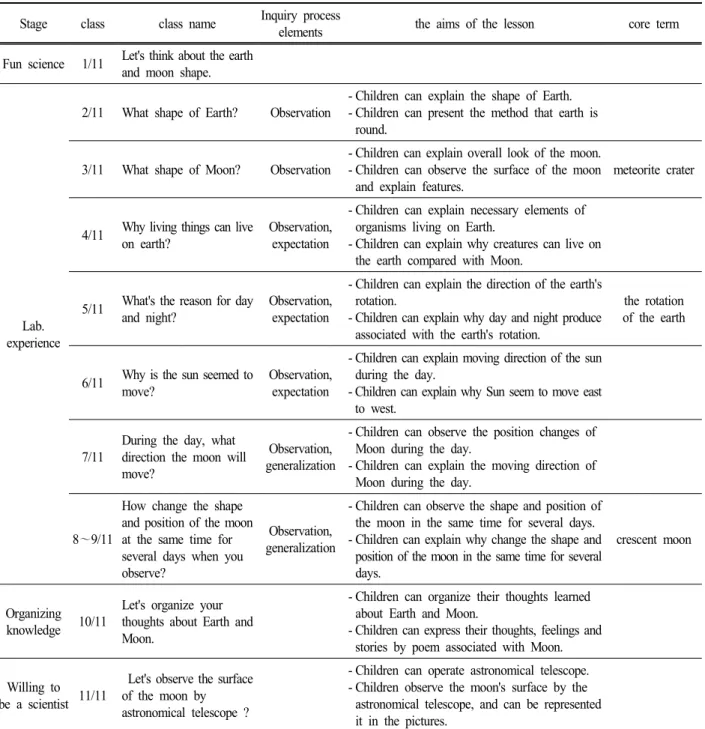
Table 3. 5th grade Earth and Moon Lesson learning content(Ministry of Education, Science and Technology, 2010) Stage class class name Inquiry process
elements the aims of the lesson core term
Fun science 1/11 Let's think about the earth and moon shape.
Lab.
experience
2/11 What shape of Earth? Observation
- Children can explain the shape of Earth.
- Children can present the method that earth is round.
3/11 What shape of Moon? Observation
- Children can explain overall look of the moon.
- Children can observe the surface of the moon and explain features.
meteorite crater
4/11 Why living things can live on earth?
Observation, expectation
- Children can explain necessary elements of organisms living on Earth.
- Children can explain why creatures can live on the earth compared with Moon.
5/11 What's the reason for day and night?
Observation, expectation
- Children can explain the direction of the earth's rotation.
- Children can explain why day and night produce associated with the earth's rotation.
the rotation of the earth
6/11 Why is the sun seemed to move?
Observation, expectation
- Children can explain moving direction of the sun during the day.
- Children can explain why Sun seem to move east to west.
7/11
During the day, what direction the moon will move?
Observation, generalization
- Children can observe the position changes of Moon during the day.
- Children can explain the moving direction of Moon during the day.
8~9/11
How change the shape and position of the moon at the same time for several days when you observe?
Observation, generalization
- Children can observe the shape and position of the moon in the same time for several days.
- Children can explain why change the shape and position of the moon in the same time for several days.
crescent moon
Organizing knowledge 10/11
Let's organize your thoughts about Earth and Moon.
- Children can organize their thoughts learned about Earth and Moon.
- Children can express their thoughts, feelings and stories by poem associated with Moon.
Willing to be a scientist 11/11
Let's observe the surface of the moon by astronomical telescope ?
- Children can operate astronomical telescope.
- Children observe the moon's surface by the astronomical telescope, and can be represented it in the pictures.
육내용 전문가 2명)으로 구성하여 내용타당도 검정 을 거쳐 ‘양호’한 검사지로 판명하였다. 한 문항당 5 점을 배정하여 채점하였다.
공간지각능력 검사지는 공간능력을 측정하기 위 해 최미연(2004)의 연구에서 사용되었던 것을 활용 하였다. 최미연(2004)에 따르면 공간능력 측정을 위 한 하위 요소는 시각적․작동적 조형, 도형 배경 지 각, 지각의 일관성, 공간에서의 위치 지각, 공간 관 계 지각, 시각적 변별, 시각적 기억, 밀기, 뒤집기, 돌리기의 항목 중 6개의 하위요소를 추출 재구성하
였다. 각각의 하위 요소들의 내용은 2차원 회전 3차 원 회전, 반사, 블록의 수, 입체 찾기 패턴으로 도형 유추하기이다. 검사지 신뢰도는 Cronbach α= .7601 이다.
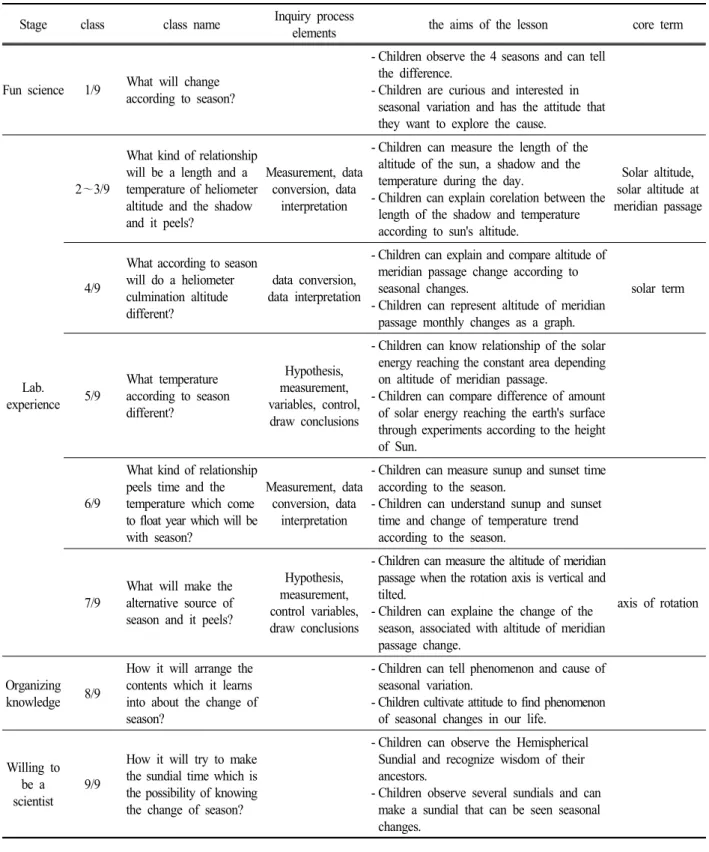
4. 초등과학의‘지구와 우주’분야에서 지식(개념) 2007 개정 과학과 교육과정의 ‘지구와 우주’ 분야 에서 천문에 관한 교육과정을 초등과학 5학년 ‘태양 계와 별’, ‘지구와 달’, 6학년 ‘계절의 변화’에 대해 다음과 같이 분석하였다.
Table 4. 6th grade, the change of seasons Section learning content(Ministry of Education, Science and Technology, 2010)
Stage class class name Inquiry process
elements the aims of the lesson core term
Fun science 1/9 What will change according to season?
- Children observe the 4 seasons and can tell the difference.
- Children are curious and interested in seasonal variation and has the attitude that they want to explore the cause.
Lab.
experience 2~3/9
What kind of relationship will be a length and a temperature of heliometer altitude and the shadow and it peels?
Measurement, data conversion, data
interpretation
- Children can measure the length of the altitude of the sun, a shadow and the temperature during the day.
- Children can explain corelation between the length of the shadow and temperature according to sun's altitude.
Solar altitude, solar altitude at meridian passage
4/9
What according to season will do a heliometer culmination altitude different?
data conversion, data interpretation
- Children can explain and compare altitude of meridian passage change according to seasonal changes.
- Children can represent altitude of meridian passage monthly changes as a graph.
solar term
5/9
What temperature according to season different?
Hypothesis, measurement, variables, control,
draw conclusions
- Children can know relationship of the solar energy reaching the constant area depending on altitude of meridian passage.
- Children can compare difference of amount of solar energy reaching the earth's surface through experiments according to the height of Sun.
6/9
What kind of relationship peels time and the temperature which come to float year which will be with season?
Measurement, data conversion, data
interpretation
- Children can measure sunup and sunset time according to the season.
- Children can understand sunup and sunset time and change of temperature trend according to the season.
7/9
What will make the alternative source of season and it peels?
Hypothesis, measurement, control variables, draw conclusions
- Children can measure the altitude of meridian passage when the rotation axis is vertical and tilted.
- Children can explaine the change of the season, associated with altitude of meridian passage change.
axis of rotation
Organizing knowledge 8/9
How it will arrange the contents which it learns into about the change of season?
- Children can tell phenomenon and cause of seasonal variation.
- Children cultivate attitude to find phenomenon of seasonal changes in our life.
Willing to be a scientist
9/9
How it will try to make the sundial time which is the possibility of knowing the change of season?
- Children can observe the Hemispherical Sundial and recognize wisdom of their ancestors.
- Children observe several sundials and can make a sundial that can be seen seasonal changes.
Ⅲ. 연구 결과 및 논의
본 연구에서는 초등학교 예비교사의 천문영역에 대한 개념 이해수준을 알아보고 공간지각 능력과의 상관관계에 대해 해석하였다.
1. 초등예비교사의 초등과학‘지구와 우주’분야 의 천문영역에서 지식이해 수준
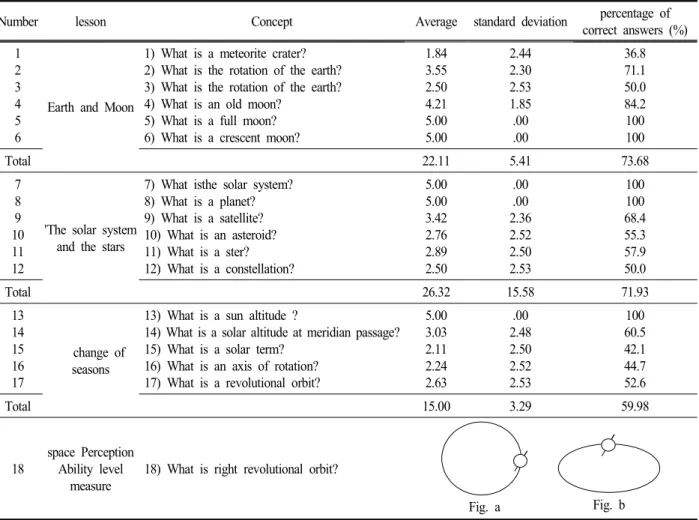
초등과학 ‘지구와 우주’ 분야의 천문영역에서 초 등 예비교사의 지식수준을 알아보기 위하여 ‘5-1-1, 지구와 달, 5-2-4. 태양계와 별, 6-1-3. 계절의 변화’
Table 5. The concept about astronomy of Earth and space sectors
Number lesson Concept Average standard deviation percentage of
correct answers (%) 1
2 3 4 5 6
Earth and Moon
1) What is a meteorite crater?
2) What is the rotation of the earth?
3) What is the rotation of the earth?
4) What is an old moon?
5) What is a full moon?
6) What is a crescent moon?
1.84 3.55 2.50 4.21 5.00 5.00
2.44 2.30 2.53 1.85 .00 .00
36.8 71.1 50.0 84.2 100 100
Total 22.11 5.41 73.68
7 8 9 10 11 12
'The solar system and the stars
7) What isthe solar system?
8) What is a planet?
9) What is a satellite?
10) What is an asteroid?
11) What is a ster?
12) What is a constellation?
5.00 5.00 3.42 2.76 2.89 2.50
.00 .00 2.36 2.52 2.50 2.53
100 100 68.4 55.3 57.9 50.0
Total 26.32 15.58 71.93
13 14 15 16 17
change of seasons
13) What is a sun altitude ?
14) What is a solar altitude at meridian passage?
15) What is a solar term?
16) What is an axis of rotation?
17) What is a revolutional orbit?
5.00 3.03 2.11 2.24 2.63
.00 2.48 2.50 2.52 2.53
100 60.5 42.1 44.7 52.6
Total 15.00 3.29 59.98
18
space Perception Ability level
measure
18) What is right revolutional orbit?
Fig. a
Fig. b 단원에서 중요개념인 태양계, 행성, 위성, 소행성,
공전, 별, 별자리, 운석 구덩이, 지구의 자전, 보름달, 초승달, 태양고도, 태양의 남중고도, 절기, 자전축에 대해 이해정도를 알아보았다.
Table 5에서 보는바와 같이 초등과학 ‘5-1-1. 지구 와 달’ 단원에서 정답율이 운석 구덩이(36.8%), 지구 의 자전(71.1%), 지구의 공전(50.0%), 그믐달(84.2%), 보름달과 초승달(100%)로 나타났다. 특히 운석구덩 이에 대한 지식이해 정도는 매우 낮다고 볼 수 있 다. ‘5-1-1. 지구와 달’ 단원에서 운석 구덩이에 대한 개념 지식 이해 수준이 낮은 것은 중학교 교육과정 에서 간단하게 제시되어 있어 중학교 지구와 우주 분야의 천문영역에서 중요개념으로 학습되지 않았 다고 추측할 수 있다.
따라서 초등학교 예비교사는 초등과학 ‘5-1-1. 지 구와 달’ 단원에서 초등학교 교육과정에서 교수할 수 있는 내용지식에서 달에 관한 내용으로 운석구 덩이(크리에이터), 달의 바다 등에 대한 개념을 습득 할 필요가 있다.
Table 5에서 보는바와 같이 초등과학 ‘5-1-2. 태양 계와 별’ 단원에서 정답율이 태양계, 행성이라는 개 념에 대해서는 초등학교 예비교사들은 모두 이해를 하고 있는 것으로 나타났다(100%). 위성(68.4%), 소 행성(55.3%), 별(57.9%), 별자리(50.0%)의 개념이해 수준에서는 초등학교 예비교사로서 태양계와 별에 대한 지식이해 수준이 높지 않았다고 해석할 수 있 다. 또한 ‘별자리’란 개념에서는 개념 이해정도가 50% 정도가 되었다.
따라서 초등과학 ‘5-1-2. 태양계와 별’ 단원에서 초등학교 교육과정에서 교수할 수 있는 내용지식 의 별자리, 계절별 별자리 등 지식수준을 습득할 필 요가 있다.
Table 5에서 보는바와 같이 초등과학 ‘6-1-3. 계절 의 변화’ 단원에서 정답율이 태양고도(100%), 태양 의 남중고도(60.5%), 절기(42.1%), 자전축(44.7%), 공 전궤도(52.6%)로 나타났다. 절기, 자전축, 공전궤도 에 대한 지식이해 수준은 초등학교 예비교사로서 지식이해 정도가 낮은 것으로 해석할 수 있다.
0 10 20 30 40 50 60 70 80
지구와 달 태양계와 별 계졀의 변화
Fig. 1. Level of concept understand about astronomy' of earth and space' field
Table 6. The result of Space Perception Ability test
Contents N Average Standard deviation
Two-dimensional rotation㉠
Three-dimensional rotation㉡ reflection㉢
finding solid body'㉣
The number of blocks㉤ figure inference by pattern㉥
Space Perception Ability(㉠+…+㉥)
38 38 38 38 38 38 38
7.89 11.18
7.76 21.05 11.45 10.00 76.71
3.42 3.57 3.23 10.01
4.18 5.07 16.61 따라서 초등과학 ‘6-1-3. 계절의 변화’ 단원에서
초등학교 교육과정에서 교수할 수 있는 내용지식 의 절기, 자전축, 공전궤도 등 지식수준을 습득할 필 요가 있다.
이러한 결과를 바탕으로 그래프로 도식하면 다음 과 같다(Fig. 1).
Fig. 1에서 보는 바와 같이 초등과학의 세 단원에 서 초등학교 6학년 ‘계절의 변화’ 단원에서 평균점 수가 낮음은 학년이 높아질수록 천문영역의 개념이 상위개념이라고 볼 수 있다. 초등학교 예비교사를 대상으로 공간지각 능력 수준을 척도할 수 있는 Fig.
a, b로 제시하였다. 제시된 그림은 지구의 공전궤도 에 지구가 그려져 있으며, 지구에 대해 자전축이 그 려져 있다. Fig. a는 공전궤도가 원형으로 그려져 있 어 자전축을 사선(/)으로 그릴 수 없다는 것을 인지 하는 학생 2명/38명으로 5.2%에 해당하는 학생뿐이 었다. Fig. b는 지구의 공전궤도를 타원으로 그렸을 때 지구의 자전축을 표시할 수 있느냐에 대한 질문 에서 Fig. 1에서 해석한 내용과 일치하는 2명의 학 생이 있었다. 즉, 공간지각 능력에 대한 인식 정도를 나타내는 척도라고 볼 있는데 초등학교 예비교사들 은 대부분 공간지각에 대한 인식이 매우 낮은 것으 로 나타났다. 이러한 결과에 대한 내용을 바탕으로 초등학교 예비교사들을 대상으로 교수한 결과, 전원
(38명/38명), 100%로 이해하였다. 초등학교 예비교 사들의 지식에 대한 이해정도는 매우 빠르다고 해 석되어 지나 평소 천문영역에 대한 공간지각에 대 한 내용지식에 대한 설명의 기회가 적었다고 반응 하는 학생들이 대부분이었다.
2. 초등학교 예비교사의 공간지각능력
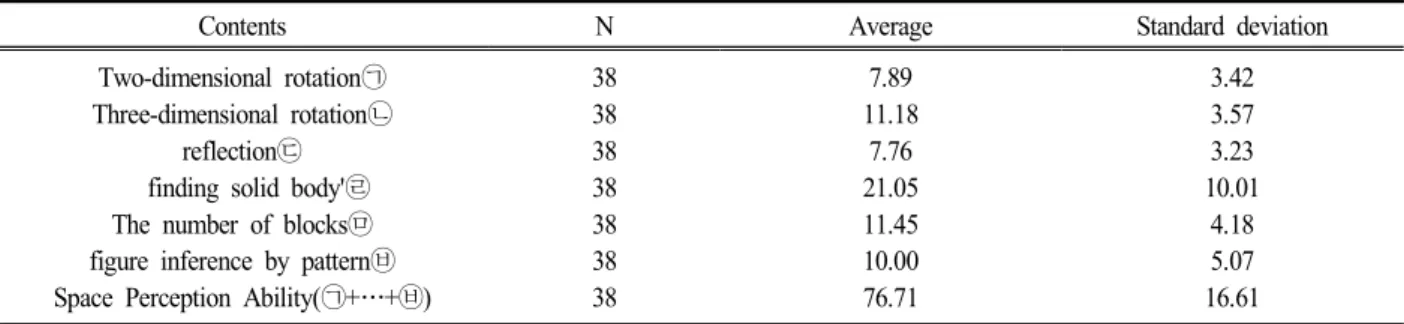
초등학교 예비교사의 공간지각 능력에 대한 검사 를 실시하여 얻은 결과는 다음과 같다(Table 6).
Table 6의 공간지각능력 검사 점수 분석 결과, 공 간지각능력의 하위요소인 ‘2차원 회전’에서 평균 7.89, 표준편차 3.42, ‘3차원 회전’에서 평균 11.18, 표준편차 3.57, ‘반사’에서 평균 7.76, 표준편차 3.23,
‘입체찾기’에서 평균 21.05, 표준편차 10.01, ‘블록의 수’에서 평균 11.45, 표준편차 4.18, ‘패턴으로 도형 유추’에서 평균 10.00, 표준편차 5.07로 나타났다. 하 위요소의 합인 공간지각 능력 검사에서는 평균 76.71, 표준편차 16.61로 나타났다. Table 6에서 보듯 이 다른 하위요소에 비해 입체찾기는 표준편차가 10.01로서 가장 편차가 크게 나타났다. 이는 공간지 각 능력의 하위요소 중에서 공간지각에 관련성이 가장 높은 ‘입체찾기’에서 개인별 차이가 있음을 나 타내고 있다.
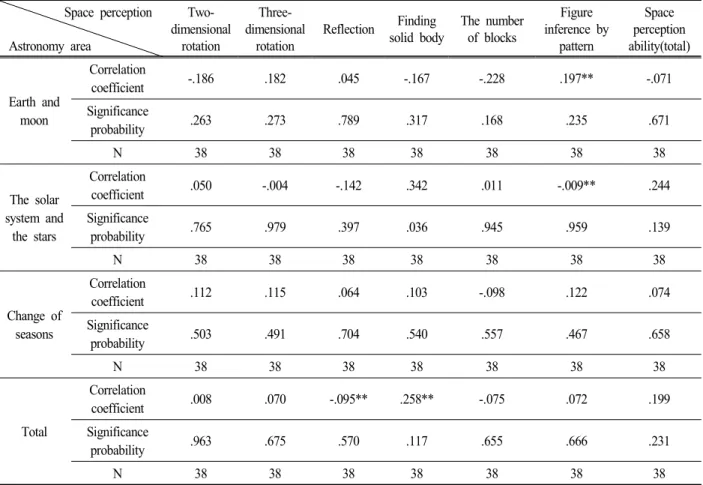
3. 천문영역의 지식수준과 공간지각능력과의 관계 천문영역의 지식수준과 공간지각능력과의 관계 에 대한 결과는 다음과 같다(Table 7)
Table 7에서 보는 바와 같이 천문영역인 ‘지구와 달’, ‘태양계와 별’에서 개념수준은 공간지각 개념인
‘패턴으로 도형유추’와 상관관계가 있는 것으로 나 타났다. 또한 초등학교 교육과정의 지구와 우주 분 야의 천문영역의 개념의 전체검사 점수에서는 공간 지각 능력의 하위요소인 ‘반사’, ‘입체찾기’에서 상
Table 7. Correlation between Knowledge level of astronomy and Space Perception Ability Space perception
Astronomy area
Two- dimensional
rotation
Three- dimensional
rotation
Reflection Finding solid body
The number of blocks
Figure inference by
pattern
Space perception ability(total)
Earth and moon
Correlation
coefficient -.186 .182 .045 -.167 -.228 .197** -.071
Significance
probability .263 .273 .789 .317 .168 .235 .671
N 38 38 38 38 38 38 38
The solar system and
the stars
Correlation
coefficient .050 -.004 -.142 .342 .011 -.009** .244
Significance
probability .765 .979 .397 .036 .945 .959 .139
N 38 38 38 38 38 38 38
Change of seasons
Correlation
coefficient .112 .115 .064 .103 -.098 .122 .074
Significance
probability .503 .491 .704 .540 .557 .467 .658
N 38 38 38 38 38 38 38
Total
Correlation
coefficient .008 .070 -.095** .258** -.075 .072 .199
Significance
probability .963 .675 .570 .117 .655 .666 .231
N 38 38 38 38 38 38 38
관관계가 있는 것으로 나타났다.
공간지각능력에 대한 선행연구 등(김수정 외, 2012; 김은선 외, 2011; 신명렬과 이용섭, 2011; 이석 희와 이용섭, 2012; 윤마병과 김희수, 2010; Barnett et al., 2005; Bingham, 2005; Eramudugolla et al., 2011; Fidler, 2009)에서 보면 공간지각능력 향상에 대한 연구는 국내․외에서 꾸준히 연구되어 왔다.
특히, Fidler(2009)의 연구에서는 초등학교 예비교 사는 ‘지구와 우주’분야의 천문영역에서 반드시 교 수능력을 함양해야 학습의 효과를 증가시킬 수 있 음을 지적하고 있다. 이는 초등학교 교사에게는 천 문영역에서 공간지각에 대한 지식(개념)의 소양을 쌓아야 된다는 것을 암시한다.
Ⅳ. 결론 및 제언
결과와 논의를 통하여 얻어진 결론을 제시하면 다음과 같다.
첫째, 초등학교 예비교사는 고학년으로 갈수록 초등과학 ‘지구와 우주 분야’의 천문영역인 ‘지구와
달’, 태양계와 별’, ‘계절의 변화’ 단원에서 상위개념 에 대한 지식이해 수준이 낮은 것으로 나타났다. 그 러므로 초등학교 예비교사는 초등학교 교육과정에 서 교수할 수 있는 천문영역의 내용지식을 습득할 필요가 있다.
둘째, 초등학교 예비교사는 공간지각 능력의 하 위요소 중 ‘입체찾기’에서 개인별 차이가 있음을 나 타내고 있다. ‘입체찾기’ 요소는 공간지각 능력과 상 관관계가 있음을 알 수 있다.
셋째, 초등학교 교육과정 ‘지구와 우주’ 분야에서 의 천문영역 개념의 전체검사 점수에서는 공간지각 능력의 하위요소인 ‘반사’와 ‘입체찾기’에서 상관관 계가 있는 것으로 나타났다.
참 고 문 헌
Alice, A. B. (2005). Spatial Ability and Earth Science Conceptual Understanding. Journal of Geoscience Education, 53(4), 402-414.
Barnett, M., Yamagata, L. L., Keating, T., Barab, S. A., &
Hay, K. E. (2005). Using Virtual Reality Computer
Models to Support Student Understanding of Astronomical Concepts. Journal of Computers in Mathematics and Science Teaching, 24(4), 333-356.
Bingham, G. P. (2005). Allometry and Space Perception:
Compression of Optical Ground Texture Yields Decreasing Ability to Resolve Differences in Spatial Scale. Ecological Psychology, 17(3-4), 193-204.
Bong-Seob Kim, Jin-Woo Jeong, Il-Ho Yang, Ji-Suk Jeong(1998). Concept on motion of earth and moon to spatial ability, visual-perception-recall ability, learning styles. The korean elementary science education soci- ety, 17(2), 103-111.
Dong-Hyun Chae(2004). The change of preservice and in- service elementary school teachers' concepts of the so- lar system based upon their exposure to the earth mo- tion centric solar system model24. The korean associ- ation for research in science education, 24(5), 886- 901.
Eramudugolla, R., Kamke, M. R., Soto-Faraco, S., &
Mattingley, J. B. (2011). Perceptual Load Influences Auditory Space Perception in the Ventriloquist Aftereffect. Cognition, 118(1), 62-74.
Eun-Sun Kim, Young-Sik Kwon, Kil-Jae Lee(2011). The Effect of Science Activity Activating Spatial Ability on Elementary School Students` Spatial Ability and Creativity Improvement. The korean elementary sci- ence education society, 30(2), 178-188.
Fidler, C. G. (2009). Preservice elementary teachers learning of astronomy. ProQuest Dissertations and Theses.
Jatsch, M. (2005). Debordered space; indeterminacy within the visual perception of space. Reference and Research Book News, 20(3), 127.
Jin-Woo Jeong, Shin Han(2010). The conceptions of astro- nomical distance of elementary school teachers.
Journal of the korean earth science society, 31(7), 827-838.
Jong-Ok Lim(2007). The concept on the rotation of the earth of the middle school students in the third year accord- ing to their spatial sensibility. korea national uni- versity of education. Korea National University of Education Master's Thesis.
Ma-Byong Yoon, Hee-Soo Kim(2010). Hierarchical Analysis of Astronomical Space Concepts Based on the
Knowledge Space Theory. Journal of the korean earth science society, 31(3), 259-266.
Ministry of education(2008). Atlas Elementary teachers.
Ministry of education.
Myeung-Ryeul Shin, Yong-Seob Lee(2011). A Survey on Astronomical Spatial Concept and Attitudes About Astronomy For Establishment of Effective Teaching Strategy In Astronomy Earth Science . Journal of the Korean society of earth science education, 4(2), 177-185.
Ocklenburg, S., Hirnstein, M., Hausmann, M., & Lewald, J.
(2010). Auditory Space Perception in Left- and Right-Handers. Brain and Cognition, 72(2), 210-217.
Seok Hee Lee, Yong-Seob Lee(2012). The effects of `solar system and star' using storytelling skill on science learning motivation and space perception ability.
Journal of the korean society of earth science education. 5(1), 105-113.
Su-Jeong Kim, Hyoung-Bum Kim, Shin Han, Jin-Woo Jeong(2012). The Analysis of Concept on The Rotation of The Earth of Elementary Students According to Difference of Spatial Ability. Journal of the Korean society of earth science education, 5(1), 20-30.
Wexler, M. (2003). Voluntary head movement and allocentric perception of space. Psychological Science, 14(4), 340-346.
Yong-Seob Lee(2006). The effects of cooperative learning through STAD model on elementary school student' learning achievements and science related attitudes in field of astronomy. The korean elementary science ed- ucation society, 25(2), 141-148.
Yong-Seob Lee(2012). The Effects of the Space Perception Ability and Creative Personality 'Source of Season Change' Using Small Inquiry Method. Journal of the Korean society of earth science education. 5(3), 307-315.
Yong-Seob Lee, Soon-Shik Kim(2012). The effects of the space perception ability and scientific attitudes through the science-based steam astronomical learning program. Journal of the korean society of earth sci- ence education. 5(3), 297-306.