초등학교 예비교사의 환경친화적 태도와 환경지식 분석
이용섭 ․ 김순식 부산교육대학교
Analysis of Environmental Friendly Attitude and Environmental Knowledge on Pre-service Elementary Teacher
Lee Yong-seob․Kim Soon-shik Busan National University of Education
ABSTRACT
The purpose of this study is to find out eco-friendly attitude and level of knowledge about environment of pre-service elementary teachers and find relationship between these. In this study, we investigate and analyse with surveys about eco-friendly attitudes and environmental knowledge questionnaire targeting the 2nd semester of 2013 32 people of fast stream class 2nd grade. Also, we analyzed correlation between environmental knowledge and the test results of eco-friendly attitudes. Results for the analysis are as follows.
First, pre-service elementary teachers' average of eco-friendly attitudes test result is 'cognitive area(60.22)> definitional area(53.69)> behavioral area(52.72)'. These results are re-service elementary teachers are knowledgeable about the environment, but they are passive at the execution act about environment.
Second, the average of pre-service elementary teachers' environmental knowledge result is the highest to the protect the environment, for the average(26.25). It is interpreted that they acquired the most the knowledge related to the conservation of the environment.
Third, It is no significant correlation between pre-service elementary teachers' eco-friendly attitudes and environmental knowledge. It means that although they acquired a lot of knowledge related to the environment, it is not affected to environmental friendly attitude putting ideas into action about environment.
Key words : Pre-Service Elementary Teacher, Environmental Friendly Attitude, Environmental Knowledge
Received 7 October, 2013; Revised 23 December, 2013; Accepted 28 December, 2013
*Corresponding author : Lee Yong-Seob Busan Nat'l Univ. of Education, Gyodae-ro 24, Yeonje-gu, Busan, 611-736, Korea
Phone: +82-51-500-7244 E-mail: [email protected]
ⓒ The Korean Society of Earth Sciences Education . All rights reserved.
This is an Open-Access article distributed under the terms of the Creative Commons Attribution Non-Commercial License (http://
creativecommons.org/licenses/by-nc/3.0) which permits unrestricted non-commercial use, distribution, and reproduction in any medium, provided the original work is properly cited.
Ⅰ. 서 론
1992년 6월, 리우 유엔환경회의에서 선진국가를 중심으로 지구환경의 보전과 개발에 대한 관심이 매우 강조되어 환경에 대한 문제가 국제적 이슈가 되었다. 선진국가들은 개발도상국들이 자국의 경제 성장을 위해 환경개발에 초점을 두고 지구환경의 오염원을 배출하는 것에 심각한 우려를 나타내고 있다.
환경의 올바른 개발과 보전에 대한 것은 개발 당 사자의 환경마인드에 따라 다르게 나타난다. 개발 당사자들은 지구환경의 올바른 보전을 위하는 일보 다 자국의 이익에만 몰입하다가 이웃 국가 또는 국 제적으로 환경오염원을 제공하게 되는 현상을 만들 게 된다. 이러한 국제적인 환경오염원에 대한 규제 를 설정하여 실천하는 것은 한계가 따른다. 선진국 가들은 개발국가들이 환경파괴를 최소화할 수 있는 조건을 제시하며 환경파괴에 대한 개발 부담금을
지불하고 최소한의 환경 개발에 초점을 두고 있는 실정이다. 이 또한 올바른 환경보전을 위해 미흡한 대책임에는 틀림없다. 이러한 자연환경의 개발과 보 전에 대한 가장 기초적인 환경보호 실천은 환경교 육에서 출발할 수 있다. 지속가능한 환경보전에 대 한 마인드 함양은 초등학교 시절부터 출발한다고 볼 수 있다. 특히, 환경보전에 대한 교육은 초등학생 을 가르치는 초등예비교사들이 올바른 환경보전에 대한 마인드를 갖고 있어야 가능한 것이다. 그러나 초등예비교사를 양성하는 교육대학교의 교양과정에 서 환경과 관련한 강좌를 개설한 교육대학교는 찾 기 힘들며 교육대학원에 환경교육 전공이 개설된 대학이 있어 환경과 관련한 교과목이 개설, 운영되 고 있는 실정이다. 이 또한 교육대학원에서 환경교 육을 전공하지 않는다면 환경과 관련된 교과목을 접할 수 있는 기회는 줄어들게 된다. 교육현장에서 는 교육대학원애서 환경교육을 전공한 교원들의 인 원이 매우 극소수에 불과하다. 따라서 교원양성 대 학인 교육대학교에서 교양과정 및 전공교과목에 환 경관련 내용을 제시하여 강의하는 것이 초등예비교 사들의 환경교육에 대한 올바른 마인드 함양을 위 한 방법이 될 수 있을 것이다.
올바른 환경교육을 위해서 노력하고 있는 정책이 나 국내외 선행연구(마현정과 이시원, 2010; 강성미 외, 2011; 오숙현과 김해경, 2013; 이용섭, 2012; 김 승현과 홍승호, 2010; 임해진과 이상원, 2011; 심상 미와 이상원, 2010; Alp et al., 2008; Buchcic &
Grodzinska, 2004; He et al., 2011; Lahiri, 2011)에서 보면 환경교육은 초등학교 때부터 시작되어야 하며 지속가능한 환경교육이 되어야 한다고 주장하고 있 다. 또한 Buchcic & Grodzinska(2004)에 의하면 초등 학생들을 대상으로 한 환경교육 정책이 필요하다고 주장한다. 대학생들의 환경지식과 환경태도, 환경행 동에 관한 연구(He et al., 2011)에 의하면 환경지식 과 환경행동과의 상관관계가 미약하다고 밝히고 있 다. 선행연구(이용섭, 2012)에서는 환경교육은 지속 되어야 하지만 환경에 대한 올바른 마인드를 갖고 올바른 환경보전에 관한 실천하는 행동이 중요하다 고 밝히고 있다.
따라서 본 연구에서는 초등예비교사들의 환경에 관련한 지식수준과 환경친화적 태도가 어느 정도 인지 알아보는 것은 미래의 환경교육에 대한 올바 른 방향을 제시하는데 좌표를 제시하는 방안이 될
수 있으므로 초등예비교사를 대상으로 환경친화적 태도와 환경지식 수준에 대한 설문을 조사하고 이 두 요소간의 상관관계를 알아보고자 한다. 이에 대 한 자세한 연구문제는 다음과 같다.
첫째, 초등학교 예비교사의 환경친화적 태도는 어떠한가?
둘째, 초등학교 예비교사의 환경지식은 어떠한가?
셋째, 초등학교 예비교사의 환경친화적 태도와 환경지식과의 상관관계는 어떠한가?
Ⅱ. 연구 절차 및 방법
1. 연구 절차
본 연구는 B 교육대학교의 2013학년도 2학기 초 등학교 예비 교사인 과학교육 심화반 2학년 학생 32 명을 대상으로 환경친화적 태도에 대한 설문지, 환 경지식 검사지를 활용하여 분석하였다. 또한 환경친 화적 태도의 검사결과와 환경지식 검사 결과간의 상관관계를 분석하였다.
2. 연구 대상
본 연구는 2013년 9월부터 12월에 걸쳐 B 광역시 의 B 교육대학교 2학년 2학기에 재학 중이며 ‘과학 과 교재연구’ 강좌를 수강하는 과학교육 심화 1개 반 32명 학생을 대상으로 설문을 조사하였다.
3. 검사도구
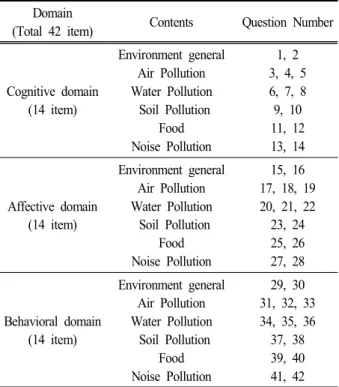
1) 환경 친화적 태도 검사지
본 연구의 환경 친화적 태도 검사 도구는 환경 친 화적 태도에 관한 연구(이향숙, 2005)에서 사용되었 던 검사 도구를 기본으로 이영미(2006)가 수정․보완 한 인지적 영역, 정의적 영역, 행동적 영역으로 구성 된 것을 사용하였다. 각 영역의 내용은 ‘환경 일반’,
‘공기 오염’, ‘물 오염’, ‘흙 오염’, ‘음식물’, ‘소음공 해’로 구분된다. 각 문항의 단계는 5단계인 Likert 척 도로 구성되어져 ‘매우 그렇다’, ‘거의 그렇다’, ‘보 통이다’, ‘거의 그렇지 않다’, ‘전혀 그렇지 않다’로 구분하여 5,4,3,2,1의 점수를 부여하였다. 본 환경 친 화적 태도 검사의 전체 문항에 대한 신뢰도 계수는 .802이다.
Table 1. Item of environmental Friendly Attitude test Domain
(Total 42 item) Contents Question Number
Cognitive domain (14 item)
Environment general Air Pollution Water Pollution
Soil Pollution Food Noise Pollution
1, 2 3, 4, 5 6, 7, 8 9, 10 11, 12 13, 14
Affective domain (14 item)
Environment general Air Pollution Water Pollution
Soil Pollution Food Noise Pollution
15, 16 17, 18, 19 20, 21, 22 23, 24 25, 26 27, 28
Behavioral domain (14 item)
Environment general Air Pollution Water Pollution
Soil Pollution Food Noise Pollution
29, 30 31, 32, 33 34, 35, 36 37, 38 39, 40 41, 42
Table 2. Result of Environmental Friendly Attitude
Domain N Mean Standard deviation Sum
Cognitive domain ㉠
Environment general Air Pollution Water Pollution
Soil Pollution Food Noise Pollution
32 32 32 32 32 32
7.75 13.28 13.56 8.69 8.34 8.59
.718 1.61 1.87 1.15 1.33 1.52
248.00 425.00 434.00 278.00 267.00 275.00
계 32 60.22 6.16 1927.00
Affective domain ㉡
Environment general Air Pollution Water Pollution
Soil Pollution Food Noise Pollution
32 32 32 32 32 32
7.47 12.25 11.34 7.00 6.94 8.69
1.44 1.87 2.06 1.41 1.81 1.15
239.00 392.00 363.00 224.00 222.00 278.00
계 32 53.69 6.92 1718.00
Behavioral domain ㉢
Environment general Air Pollution Water Pollution
Soil Pollution Food Noise Pollution
32 32 32 32 32 32
5.78 11.69 11.75 7.91 7.44 8.16
1.66 1.99 1.81 1.30 1.66 1.27
185.00 374.00 376.00 253.00 238.00 261.00
계 32 52.72 6.18 1687.00
Environmental Friendly Attitude (㉠+㉡+㉢) 32 166.63 15.44 5332.00
2) 환경지식 검사
환경지식 검사는 김종오(2006)가 개발한 환경에 대한 지식 관련 문항으로 구성하였으며, 환경관련
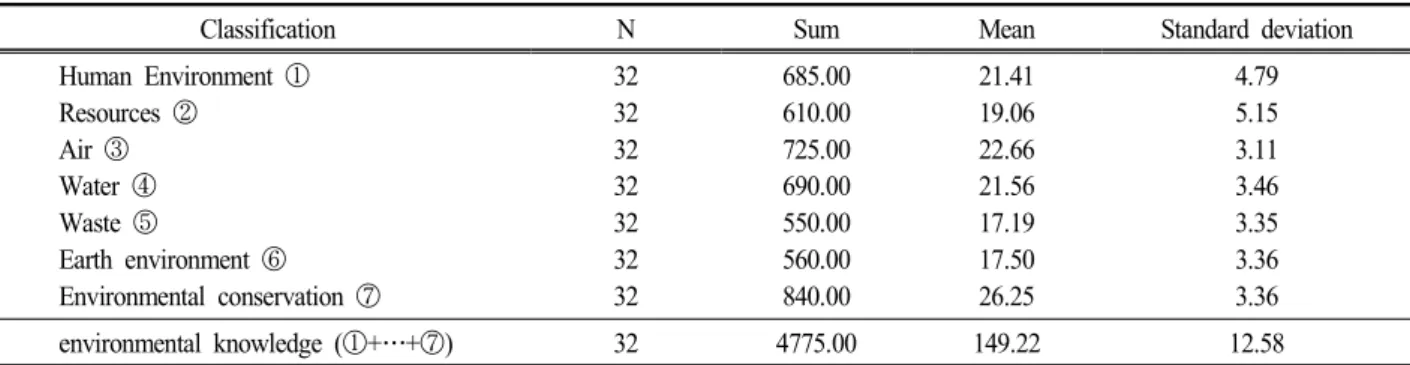
전문가 5인으로 구성하여 환경지식 검사의 내용타 당도 검증을 거쳤다. 문항은 인간과 환경 6문항, 자 원 4문항, 공기 6문항, 물 4문항, 폐기물 5문항, 지구 환경 6문항, 환경보전 5문항으로 총 36문항으로 구 성하였다. 해당되는 문항을 맞추면 5점, 틀리면 0점 으로 처리하였다.
4. 자료 분석 방법 및 해석
환경친화적 태도 검사와 환경지식 검사는 Likert 5척도로 구성되어 있으며, 채점의 신뢰성을 확보하 기 위하여 채점자 3인이 재검토하였다. 환경지식 습 득 점수와 환경친화적 태도와의 관련성을 알아보기 위하여 환경친화적 태도 검사 점수와 환경지식 검 사 점수간의 상관관계를 분석하였다.
Ⅲ. 연구 결과 및 논의
본 연구는 초등학교 예비교사의 환경친화적 태도 와 환경지식을 분석하였고, 두 변인간의 상관관계를 분석하였다. 환경친화적 태도 검사 결과는 다음과 같다(Table 2).
Fig. 1. Sub-domain mean of environmental friendly attitude.
Table 3. Test result of environmental knowledge
Classification N Sum Mean Standard deviation
Human Environment ① Resources ②
Air ③ Water ④ Waste ⑤
Earth environment ⑥ Environmental conservation ⑦
32 32 32 32 32 32 32
685.00 610.00 725.00 690.00 550.00 560.00 840.00
21.41 19.06 22.66 21.56 17.19 17.50 26.25
4.79 5.15 3.11 3.46 3.35 3.36 3.36
environmental knowledge (①+…+⑦) 32 4775.00 149.22 12.58
Fig. 2. Sub-domain mean of environmental knowledge.
Table 2에서 보는 바와 같이 환경친화적 태도의 하위요소인 인지적 영역에서 평균 60.22, 정의적 영 역에서 평균 53.69, 행동적 영역에서 평균 52.72이 다. 환경친화적 태도 검사의 평균에서 인지적 영역
<정의적 영역<행동적 영역의 순으로 나타나 행동적 영역에서 가장 낮은 점수를 보였다. 이는 환경관련 지식습득과 마음 소양이 함양되었더라도 환경관련 실천행동으로 옮기는데는 즉시적인 행동이 따르지 않음을 시사한다.
Fig. 1에서 보는 바와 같이 환경친화적 태도 검사 의 하위요소인 평균 점수에서는 인지적 영역>정의 적 영역>행동적 영역 순으로 나타났다.
2. 환경지식
초등예비교사들을 대상으로 환경에 관련된 지식 습득 정도를 알아본 결과는 다음과 같다.
환경지식 검사 점수에서는 환경보전 항목의 평균 점수가 26.25로 가장 높게 나타났으며, 자원(19.06), 페기물(17.19), 지구환경(17.50)의 요소에서는 평균 점수가 낮게 나타났다. 이는 환경보전에 대한 지식 적인 내용이 매스컴이나 자연환경 보호 운동 등에 서 환경보전에 대한 홍보가 있어 학교교육 혹은 사 회교육 등에서 접하는 경우가 있다고 본다. 이러한
이유로 환경보전에 대한 점수가 높아진 것으로 해 석된다. 또한 폐기물, 지구환경의 요소의 점수가 낮 게 나타난 것은 전문적인 지식의 내용을 요구하는 용어이기 때문이라고 해석된다. 환경운동, 환경교육 등의 환경에 관한 주요내용은 환경보전에 대한 내 용이 많이 들어있어 환경보전에 대한 점수가 높게 나타난 결과라 해석된다.
Fig. 2에서 보는 바와 같이 일상생활에서 접하는 용어인 ‘인간환경, 공기, 물, 환경보전’에 대한 용어 에서는 점수가 높게 나타났다. 이는 생활 속에서 접 하는 용어에 대해서는 쉽게 이해할 수 있기 때문이 라고 해석된다.
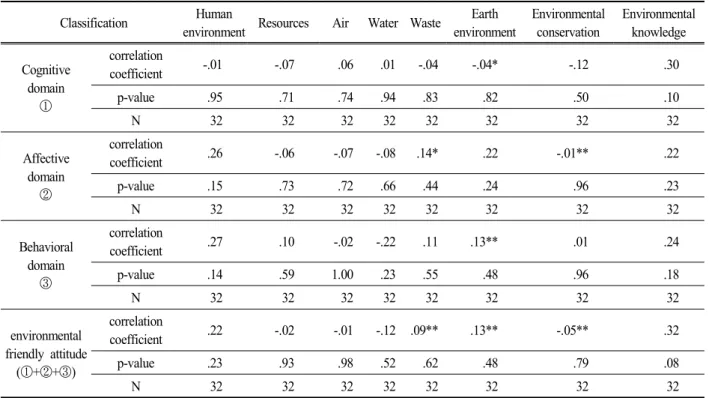
3. 환경친화적 태도와 환경지식과의 상관관계 초등예비교사들을 대상으로 환경친화적 태도 검 사와 환경지식 검사와의 상관관계를 알아본 결과는 다음과 같다.
환경친화적 태도의 하위영역인 ‘인지적 영역’과 환경지식의 하위영역인 ‘지구환경’과의 상관관계가 있는 것으로 나타났다. 또한 ‘정의적 영역’과 ‘환경 보전’에서도 상관이 있는 것으로 나타났다. 또한 ‘행 동적 영역’과 ‘폐기물’, ‘지구환경’, ‘환경보전’에서 도 상관이 있는 것으로 나타났다. 따라서 환경친화 적 태도와 환경지식간에는 상관이 없는 것으로 나
Table 4. Correlation between environmental friendly attitude and environmental knowledge
Classification Human
environment Resources Air Water Waste Earth environment
Environmental conservation
Environmental knowledge Cognitive
domain
①
correlation
coefficient -.01 -.07 .06 .01 -.04 -.04* -.12 .30
p-value .95 .71 .74 .94 .83 .82 .50 .10
N 32 32 32 32 32 32 32 32
Affective domain
②
correlation
coefficient .26 -.06 -.07 -.08 .14* .22 -.01** .22
p-value .15 .73 .72 .66 .44 .24 .96 .23
N 32 32 32 32 32 32 32 32
Behavioral domain
③
correlation
coefficient .27 .10 -.02 -.22 .11 .13** .01 .24
p-value .14 .59 1.00 .23 .55 .48 .96 .18
N 32 32 32 32 32 32 32 32
environmental friendly attitude
(①+②+③)
correlation
coefficient .22 -.02 -.01 -.12 .09** .13** -.05** .32
p-value .23 .93 .98 .52 .62 .48 .79 .08
N 32 32 32 32 32 32 32 32
타났다. 이는 환경지식이 습득되어 있다고 하더라도 환경행동 실천에는 상관이 미약한 것으로 해석된다.
본 연구의 결과는 환경친화적 태도와 환경행동과 는 상호 관련성이 약하다는 선행연구(Lahiri, 2011) 의 결과와 유사하다. 환경친화적 태도의 선행연구 (이동준, 2011)에 의하면 환경관련 지식과 환경친화 적 태도와는 매우 상관이 있는 것으로 밝히고 있다.
이는 본 연구의 결과와 상반되는 것이다. 이러한 결 과는 차량이용 행태에 대한 내용으로만 한정지어 환경지식과 환경친화적 태도와의 상호관련성을 제 한 것에서 비롯된 것으로 해석된다. 또한 환경교육 을 통한 환경친화적 태도에 미치는 효과에 대한 선 행연구(박세영, 2012; 이동준, 2011; 엄혜자와 양정 혜, 2008; 임재천, 2012)에 의하면 환경교육이 지속 적으로 이루어 진다면 환경친화적 태도에 효과가 있음을 밝히고 있다. 이는 본 연구의 결과에 비춰 환경에 대한 지식습득 정도 보다는 꾸준한 환경교 육 실천이 보다 환경친화적 태도에 영향을 미침을 있음을 제시하는 측면에서 본 연구의 결과와 유사 하다. 외국의 선행연구(Cutter & Edwards, 2013;
Hashimoto et al., 2012; Hong & Scardamalia, 2014;
Mihajlovic & Cupic, 2012; Robelia & Murphy, 2012;
Scheithauer et al., 2012; Zsoka et al., 2013)에 의하면 환경교육과 환경지식은 관련이 있다고 지적하고 있
다. 이는 환경교육을 꾸준히 실행한다면 환경지식이 습득된다는 결과이기도 하다. 그러나 본 연구에서 환경지식과 환경행동은 상관이 없는 것으로 나타났 으며, 환경에 관련된 환경지식을 습득하여 환경친화 적 태도를 함양하는 것은 바람직하다고 여겨진다.
따라서 환경친화적 태도를 함양하기 위해서는 꾸 준한 환경관련 지식을 습득하고 환경실천 행동을 이행하는 것이 중요하다. 초등예비교사들을 대상으 로 환경관련 교과목의 강좌를 신설하고 환경지식을 습득하도록 유도하면 초등학생을 대상으로 한 환경 교육이 내실있게 이루어 질 것이다.
Ⅳ. 결론 및 제언
초등예비교사들이 환경에 대한 지식 수준이 높고 환경보전에 대한 실천의지가 매우 중요하다. 본 연 구는 초등예비교사들의 환경친화적 태도 검사와 환 경관련 지식에 대한 것을 알아보고 이 두 요소간의 상관관계를 알아보는 것이다. 이러한 연구결과는 초 등예비교사의 환경교육에 대한 정책 혹은 환경운동 실천에 대한 환경교육의 대안을 제시하게 될 것이 다. 이러한 연구의 목적을 위하여 연구한 결과를 바 탕으로 결론을 내리면 다음과 같다.
첫째, 초등예비교사의 환경친화적 태도 검사 결 과의 평균은 ‘인지적 영역>정의적 영역>행동적 영 역’으로 나타났다. 이러한 결과는 초등예비교사는 환경에 대한 지식수준은 있으나 환경에 대한 실천 행동에는 소극적임을 나타낸다.
둘째, 초등예비교사의 환경지식 결과의 평균은
‘환경보전’의 점수가 가장 높게 나타났다. 이는 환경 보전에 관련된 지식을 가장 많이 습득하고 있는 것 으로 해석된다.
셋째, 초등예비교사의 환경친화적 태도와 환경지 식과의 상관관계에서는 상관이 없는 것으로 나타났 다. 이는 환경에 관련된 지식을 많이 습득하고 있더 라도 환경에 관련된 행동으로 옮길 수 있는 환경친 화적 태도에 영향이 미치지 않음을 의미한다.
본 연구를 통하여 나타난 결과의 논의와 시사점 을 바탕으로 후속 연구에 몇 가지 제언을 하면 다음 과 같다.
첫째, 초등예비교사의 환경교육을 위한 교육대학 교교육과정이 개편되어야 할 것이다. 초등학생들을 대상으로 환경교육을 실천하려며 대학교육에서 환 경에 대한 마인드를 함양할 수 기회가 제공되어야 할 것이다.
둘째, 초등학생들을 대상으로 환경교육이 지속 가능한 발전적인 교육이 이루어지기 위해서는 교육 대학교에 행·재정적인 뒷받침이 필요하다고 보아진 다.
참 고 문 헌
Alp, E., Ertepinar, H., Tekkaya, C., & Yilmaz, A. (2008). A Survey on Turkish Elementary School Students' Environmental Friendly Behaviors and Associated Variables. Environmental Education Research, 14(2), 129-143.
Buchcic, E. & Grodzinska, J. M. (2004). Environmental Education in Polish Primary Schools. International Research in Geographical and Environmental Education, 13(3), 264-268.
Cutter-Mackenzie, A. & Edwards, S. (2013). Toward a Model for Early Childhood Environmental Education:
Foregrounding, Developing, and Connecting Knowledge Through Play-Based Learning. The Journal of envi- ronmental education, 44(3), 195-213.
Dong-Jun Lee(2011). A Study on Impacts of Environmental Knowledge and Pro-Environmental Attitudes on Vehicle Use Behavior. master's thesis, Korea National
of Education University.
Hae-Jin Lim, Sang-Won Lee(2011). Effects of the Energy Campaign Environmental Education on Pro-Environ- mental Attitudes of Elementary School Students.
Journal of korean Society for environmental education, 24(2), 70-85.
Hashimoto-Martell, E. A., McNeill, K. L., & Hoffman, E. M.
(2012). Connecting Urban Youth with their Environ- ment: The Impact of an Urban Ecology Course on Student Content Knowledge, Environmental Attitudes and Responsible Behaviors. Research in science edu- cation, 42(5), 1007-1026.
He, X., Hong, T., Liu, L., & Tiefenbacher, J. (2011). A Comparative Study of Environmental Knowledge, Attitudes and Behaviors among University Students in China. International Research in Geographical and Environmental Education, 20(2), 91-104.
Hong, H. Y. & Scardamalia, M. (2014). Community knowl- edge assessment in a knowledge building environment.
Computers & education, 71, 279-288.
Hye-Ja Uhm, Jeong-Hye Yang(2008). The Effect of Portfolio Assesment on Students' Pro-Environmental Attitudes in the Practical Arts Education -Based on the chapter
「8. My life to protect Environment」 for 6th grade-.
Journal of Korean practical arts education, 21(1), 255-271.
Hyun-Jung Ma, Si-Won Lee(2010). Effects of environmental education using NIE on the pro-environmental atti- tudes of elementary school students. Journal of Korean practical arts education, 23(2), 1-25.
Jae-Cheon In(2012). The Effect of Integrated Subject Energy Education Using STS Approach on Young Children`s on Pro-environmental Attitudes and Scientific Attitudes. Korean Journal of Child Education and Care, 12(3), 83-101.
Jong-Oh Kim(2006). consciousness, recognition, and knowl- edge for environment in high school students in Busan. master's thesis, Kosin University.
Lahiri, S. (2011). Assessing the Environmental Attitude among Pupil Teachers in Relation To Responsible Environmental Behavior: A Leap towards Sustainable Development. Journal of Social Sciences, 7(1), 33-41.
Mihajlovic, Z. & Cupic, M. (2012). Software Environment for Learning and Knowledge Assessment Based on Graphical Gadgets. international journal of engineering education, 28(5), 1127-1140.
Robelia, B. & Murphy, T. (2012). What do people know about key environmental issues? A review of environ- mental knowledge surveys. environmental education research, 18(3), 299-321.
Sang-Mi Shim, Sang-Won Lee(2010). Effects of An Integrated Atmosphere Environmental Education Program on
Pro-Environmental Attitudes of Elementary Students.
Journal of korean Society for environmental education, 23(2), 16-31.
Scheithauer, S., Haefner, H., Schwanz, T., Lopez-Gonzalez, L., Bank, C., Schulze-Robbecke, R., Weishoff-Houben, M., & Lemmen, S. W. (2012). Hand hygiene in medi- cal students: Performance, education and knowledge.
international journal of hygiene and environmental health, 215(5), 536-539.
Seon-Mi Kang, Jeong-Hwa Lee, Yeon-Ok Jeong(2011). A Study on the Influence of Experience Activity Using School Forest on the Elementary School Students’
Environment Sensitivity and Environment-friendly Attitude. Journal of Korean practical arts education, 24(2), 105-124.
Seung-Hyun Kim, Seung-Ho Hong(2010). Effects of the Wetland Field Trip on the Pro-Environmental Attitudes
of Elementary School Students. Journal of korean Society for environmental education, 23(2), 32-45.
Sook-Hyun Oh, Hai-Gyoung Kim(2013). Effect of Education of Natural Disaster on Eco-friendly Attitude of Children in Integrated Class in the Lower Grades in Elementary School. The Korea Contents Society, 13(11), 1004-1013.
Yong-Seob Lee(2012). The Effects on Science Process Skills and Environment-Friendly Attitudes by Environmental class Using Free Inquiry Method. Journal of environ- mental science international, 21(3), 351-362.
Zsoka, A., Szerenyi, Z. M., Szechy, A., & Kocsis, T. (2013).
Greening due to environmental education? Environ- mental knowledge, attitudes, consumer behavior and everyday pro-environmental activities of Hungarian high school and university students. journal of cleaner production, 48, 126-138.