1. Introduction
Asian dust events, particularly dust storms in East Asia, affect ocean and human health (Goudie, 2014)
and occur frequently from spring to early summer (Lee and Sohn, 2011) over arid and semi-arid regions such as the Gobi Desert, Mongolia, and Inner Mongolia (Kimura et al., 2009). Previous studies (Kurosaki and
Effect of Hydro-meteorological and Surface Conditions on Variations in the Frequency of Asian Dust Events
Jae-Hyun Ryu*
,**, Sungwook Hong***
†, Sang Jin Lyu****, Chu-Yong Chung*, Inchul Shin* and Jaeil Cho**
*National Meteorological Satellite Center, Korea Meteorological Administration
**Department of Applied Plant Science, Chonnam National University
***Department of Environment, Energy, and Geoinfomatics, Sejong University
****Earthquake and Volcano Center, Korea Meteorological Administration
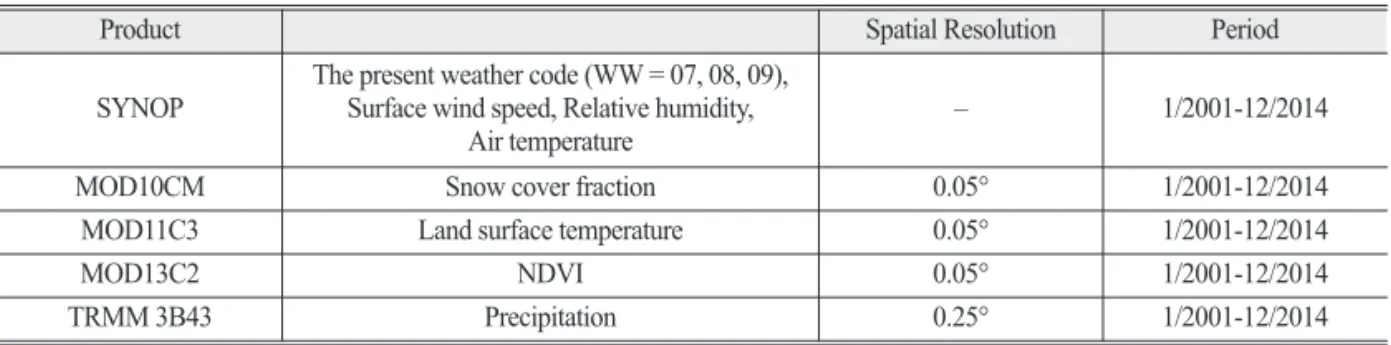
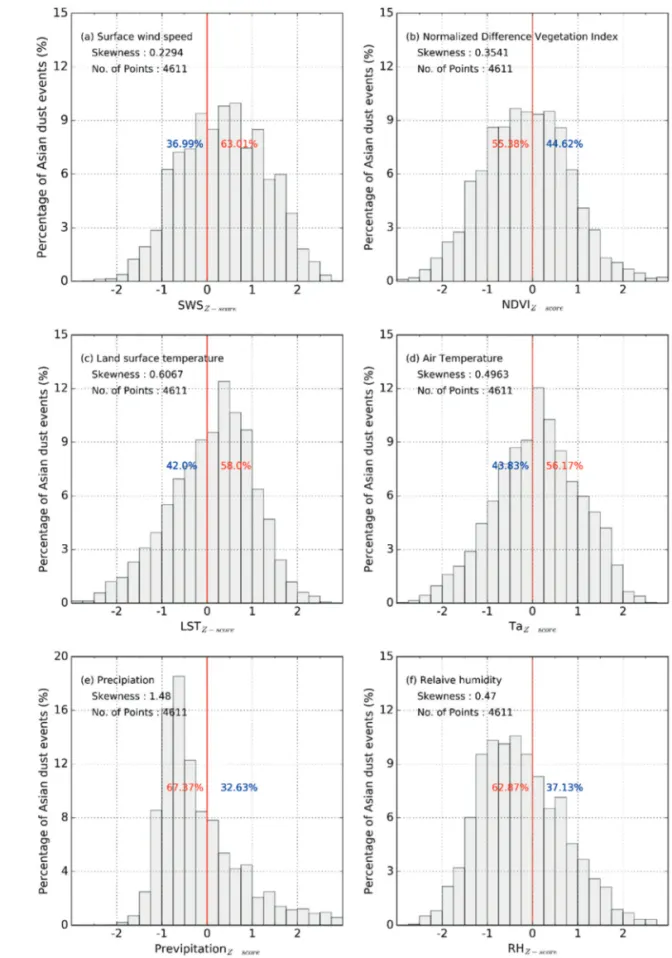
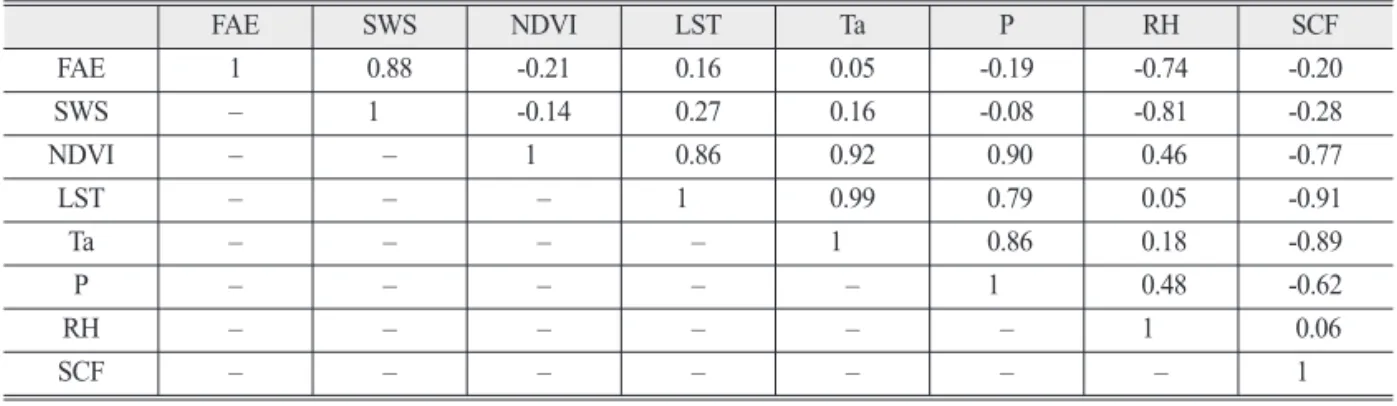
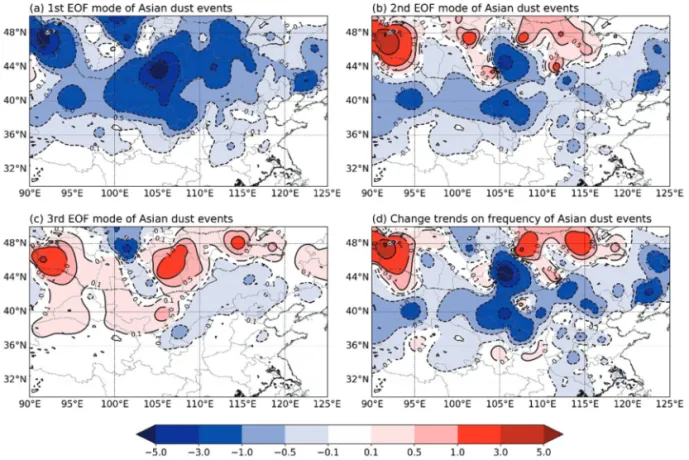
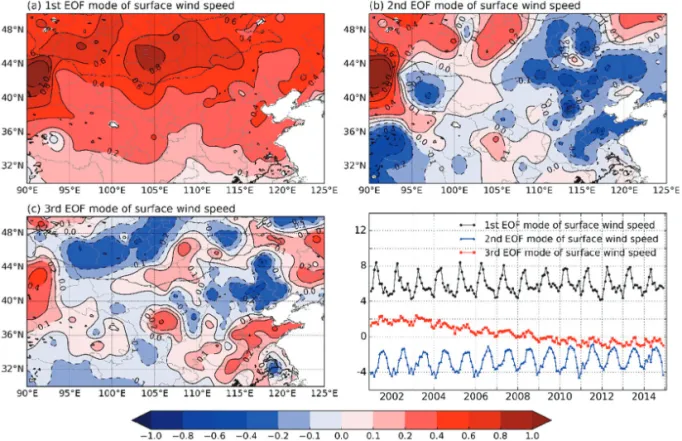
Abstract : The effects of hydro-meteorological and surface variables on the frequency of Asian dust events (FAE) were investigated using ground station and satellite-based data. Present weather codes 7, 8, and 9 derived from surface synoptic observations (SYNOP) were used for counting FAE. Surface wind speed (SWS), air temperature (Ta), relative humidity (RH), and precipitation were analyzed as hydro-meteorological variables for FAE. The Normalized Difference Vegetation Index (NDVI), land surface temperature (LST), and snow cover fraction (SCF) were used to consider the effects of surface variables on FAE. The relationships between FAE and hydro-meteorological variables were analyzed using Z-score and empirical orthogonal function (EOF) analysis. Although all variables expressed the change of FAE, the degrees of expression were different. SWS, LST, and Ta (indices applicable when Z-score was < 0) explained about 63.01, 58.00, and 56.17% of the FAE, respectively. For NDVI, precipitation, and RH, Asian dust events occurred with a frequency of about 55.38, 67.37, and 62.87% when the Z-scores were > 0. EOF analysis for the FAE showed the seasonal cycle, change pattern, and surface influences related to dryness condition for the FAE. The intensity of SWS was the main cause for change of FAE, but surface variables such as LST, SCF, and NDVI also were expressed because wet surface conditions suppress FAE. These results demonstrate that not only SWS and precipitation, but also surface variables, are important and useful precursors for monitoring Asian dust events.
Key Words : Asian dust event, Z-score, Empirical Orthogonal Function, Surface variables
Korean Journal of Remote Sensing, Vol.34, No.1, 2018, pp.25~43http://dx.doi.org/10.7780/kjrs.2018.34.1.3 ISSN 1225-6161 ( Print )
ISSN 2287-9307 (Online)
Article
Received January 5, 2018; Revised February 2, 2018; Accepted February 12, 2018; Published online February 21, 2018
†