대한내과학회지: 제 88 권 제 1 호 2015 http://dx.doi.org/10.3904/kjm.2015.88.1.1
특 집(Special Review) - Laxatives 제대로 알기
Correspondence to Tae Hee Lee, M.D., PhD.
Institute for Digestive Research, Soonchunhyang University College of Medicine, 53 Daesagwan-ro, Yongsan-gu, Seoul 140-743, Korea
Tel: +82-2-709-9691, Fax: +82-2-709-9696, E-mail: [email protected] Copyrightⓒ2015 The Korean Association of Internal Medicine
전통적 완하제
1부산대학교 의과대학 내과학교실, 2순천향대학교 의과대학 소화기연구소, 3이화여자대학교 의학전문대학원 내과학교실,
4계명대학교 의과대학 내과학교실, 5전남대학교 의과대학 내과학교실, 6단국대학교 의과대학 내과학교실,
7울산대학교 의과대학 소화기내과학교실, 8원광대학교 의과대학 내과학교실 및 소화기질환 연구소,
9서울대학교 의과대학 내과학교실, 10성균관대학교 의과대학 내과학교실
이봉은1ㆍ이태희2ㆍ김성은3ㆍ박경식4ㆍ박선영5 신정은6ㆍ정기욱7ㆍ최석채8ㆍ홍경섭9ㆍ홍성노10;
대한소화기기능성질환ㆍ운동학회 변비 및 항문직장기능 연구회
Conventional Laxatives
Bong Eun Lee1, Tae Hee Lee2, Seong-Eun Kim3, Kyung Sik Park4, Seon-Young Park5, Jeong Eun Shin6, Kee Wook Jung7, Suck Chei Choi8, Kyoung Sup Hong9, Sung Noh Hong10; and Constipation Research Group of the Korean Society of Neurogastroenterology and Motility
1Department of Internal Medicine, Pusan National University School of Medicine, Busan;
2Institute for Digestive Research, Soonchunhyang University College of Medicine, Seoul;
Department of Internal Medicine, 3Ewha Womans University School of Medicine, Seoul;
4Keimyung University School of Medicine, Daegu; 5Chonnam National University Medical School, Gwangju;
6Dankook University College of Medicine, Cheonan; 7Department of Gastroenterology, University of Ulsan College of Medicine, Seoul;
8Department of Internal Medicine and Digestive Disease Research Institute, Wonkwang University School of Medicine, Iksan;
Department of Internal Medicine, 9Seoul National University College of Medicine, Seoul;
10Sungkyunwan University School of Medicine, Seoul, Korea
Based on published guidelines on the management of chronic constipation, secondary causes should be excluded and then pa- tients should be told to increase their dietary fiber intake to 20-25 g per day. If these measures do not improve the symptoms, con- ventional laxatives are generally the next choice. Although there is limited evidence for the efficacy of these older laxatives due to a lack of well-designed clinical trials, most clinicians agree that they are effective at relieving the symptoms of constipation.
Conventional laxatives include bulk-forming, osmotic, and stimulant laxatives. Bulking laxatives consist of fiber such as psyllium, cellulose, and bran. Osmotic laxatives are classified into sugar-based laxatives and polyethylene glycol. Bisacodyl and sodium pi- cosulfate are stimulant laxatives. Understanding their mechanisms of action, efficacy, and side effects might improve the quality of life of patients suffering from chronic constipation. (Korean J Med 2015;88:1-8)
Keywords: Constipation; Laxatives
- The Korean Journal of Medicine: Vol. 88, No. 1, 2015 -
Contents Drugs Detailed contents (/1 pack or tablet)
Daily recommended dose
Adverse effects Contraindications
Psyllium Mutacil® Psyllium 3.25 g/4 g 1 P one to three times Abdominal cramps, constipation, diarrhea, esophageal or bowel obstruction
Hypersensitivity to psyllium or any component of the formulation, fecal impaction, gastrointestinal obstruction Agio® Psyllium 4.08 g/6 g 1-2 P once or twice
Alaxyl® Psyllium 2.17 g + Senna 0.47 g/4 g 1-2 P once or twice Calcium
polycarbophil
Sylcon® Wellcon®
Calcium polycarbophil 625 mg 2 T one to four times Abdominal fullness P, pack; T, tablet.
Table 1. Bulk forming laxatives 서 론
만성 변비는 유병률이 지역 인구의 14%로 보고된 흔한 질 환이고[1] 생명과 연계된 중증 질환은 아니지만 증상으로 인 한 불편감이 삶의 질 저하로 이어질 수 있기 때문에 식생활 습관에 대한 환자 교육과 적절한 약제의 사용이 중요하다.
만성 변비 환자가 내원하면 기질적인 질환 및 이차적인 원인에 대한 평가가 이루어지며, 변비 증상 완화를 위한 첫 단계로 생활 습관 및 식생활 개선이 시도된다. 하지만 증상 호전이 없는 경우에는 약제 투여가 필요하며, 적절한 약제를 선택하고 병합하기 위해서는 각 약제의 작용 기전 및 부작 용을 알고 효과를 예측하는 것이 필요하다.
본고에서는 만성 변비의 일차 치료 약제로 전통적으로 사 용되고 있는 부피형성 완하제, 삼투성 완하제, 자극성 완하 제에 대한 내용을 정리하였다.
본 론
부피형성 완하제(bulk forming laxatives)
부피형성 완하제는 식이섬유를 이용하여 만든 약제로 소장 에서 흡수되지 않고 장내 수분을 흡수하여 장관 내 대변 부피 및 대변량을 증가시켜 대장 통과 시간을 단축시키고 대변을 부드럽게 하여 변이 쉽게 배출될 수 있도록 도와준다[2].
부피형성 완하제에는 차전자(psyllium, ispaghula, plantago seed), 해초, 한천(agar), 카라야(karaya, plant gums), 메틸셀룰
로오스(methylcellulose) 유도체 및 칼슘폴리카르보필(calcium polycarbophil) 등이 있으며, 국내에서 주로 사용 중인 약제를 표 1에 정리하였다[3]. 아락실®과 같은 부피형성 완하제의 일부는 센나(senna)와 같은 자극성 완하제가 복합되어 있으 므로 주의해서 처방해야 하며, 장기간 사용은 피하는 것이 바람직하다.
변비 환자에서 하루 평균 20-25 g 정도의 식이섬유 섭취 가 권장되는데[4], 특히 정상 통과형 변비(normal transit con- stipation) 환자에게 효과적이며 일상에서 식이섬유를 충분히 섭취하지 못하는 환자에서도 부피형성 완하제가 유용할 것 으로 생각된다. 부작용이 거의 없어 임산부를 비롯한 변비 환자에서 안전하게 사용할 수 있다. 부작용으로는 장내 세균 에 의해 대사되어 이산화탄소나 수소와 같은 가스를 형성하 여 복부 팽만감이나 다량의 방귀를 유발할 수 있으므로 장 협착이나 장폐쇄 환자에서는 증상을 악화시킬 수 있어 주의 가 필요하다. 약제로 인한 복부 불편감을 줄이고 복용 순응도 를 높이기 위해서는 1-2주 정도의 기간 동안 적정 용량까지 점차적으로 약제를 증량하고, 충분한 양의 물과 함께 복용시 키는 것이 중요하다. 복용 후 약제의 효능이 12-72시간 후에 나타나므로 몇 주 정도의 시간이 소요될 수 있음을 환자에 게 설명하는 것이 필요하다.
우리나라 변비 혹은 변비우세형 과민성 장증후군 환자에 게 psyllium이 주성분인 아기오® 18 g을 매일 3주간 투여했 을 때 변비와 관련된 증상이 호전되고 대장 통과 시간도 단 축되었다[5]. 삼투성 완하제인 락툴로오스(lactulose)와 마그네
- Bong Eun Lee, et al. Conventional laxatives -
Contents Drugs Daily recommended dose Adverse effects Contraindications
Saline laxatives Magnesium hydroxide
Single: Magmil®, Manomil®, Marogel®, et al (500 mg/T) Combination with Aloe:
Madinol®, Maroel®, Maelline®, Magnol®, et al (MGO 500 mg/T)
1-2 g in 1 or 2 divided doses
1-2 g in 1 or 2 divided doses
Hypermagnesemia Hypersensitivity to magnesium or any component of the formulation, renal impairment,
neuromuscular diseases Hyperosmolar
laxatives
Lactulose Duphalac-easy Syr.® (15 mL/P), Monilac-S Syr.® (500 mL/B)
15-45 mL Abdominal discomfort, abdominal distention, belching, cramping, diarrhea (excessive dose), flatulence, nausea, vomiting
Patients requiring a low galactose diet
Lactitol Potalac Syr.® (10 mL/P), Potalac Powd.® (20 g/P)
15-30 mL (10-20 g)
PEGa Forlax Powd.® (PEG4000 10 g/P), Dulcolax balance Powd.® (PEG4000 10 g/P), Mylax Powd.® (PEG3350 17 g/P) Movilax Powd.® (PEG3350 +
electrolytes 13.125 g/P)
10-20 g Abdominal bloating,
cramping, diarrhea, flatulence, nausea
Hypersensitivity to PEG or any component of the formulation
T, tablet; MGO, magnesium hydroxide; Syr., syrup; P, pack; B, bottle; Powd.; powder; PEG, polyethylene glycol.
aPEG is so metabolically inert that is less likely to cause gastrointestinal-related adverse effects than the lactulose or lactitol.
Table 2. Osmotic laxatives
슘염 제제(magnesium sulafate)와의 비교연구에서도 ispaghula 를 복용한 군에서 배변의 형태가 좋아지고 대장 통과 시간 이 단축되었으며, 대변 지림, 복부 통증 및 설사 등의 부작용 이 적었다[6]. 차전자를 제외한 부피형성 완하제는 효과를 뒷받침할 연구 결과는 충분하지 않으나 많이 사용되고 있으 며, 그 중 합성섬유소인 칼슘폴리카르보필은 차전자와의 교 차연구에서 복용 3주 동안 배변의 빈도, 형태, 용이성 정도 에서 동일한 효과를 보여주었다[7].
국내 변비 치료에 관한 임상진료지침에서 부피형성 완하 제는 변비의 치료에 효과적이라고 제시하고 있다(권고 수준:
높음, 증거 수준: 높음) [2].
삼투성 완하제(osmotic laxatives)
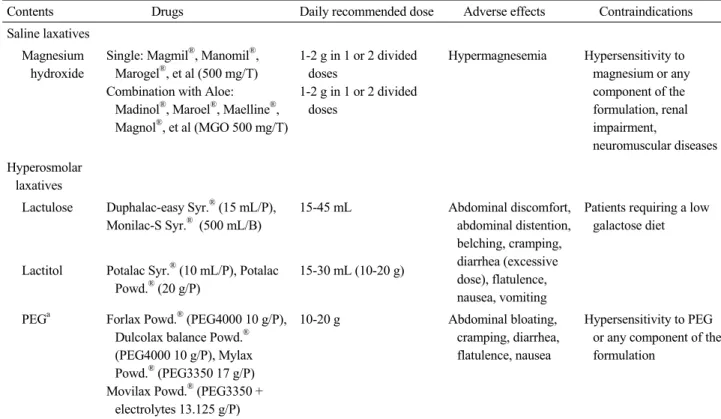
삼투성 완하제는 삼투성의 활성이온이나 분자로서 장관에 서 흡수되지 않고 삼투압에 의해 체내 수분을 장관 내로 이 동하게 하여 장내 수분을 증가시켜 배변을 용이하게 도와주 는 효과적인 변비 치료제이다. 약제 투여 시 수분의 손실을
막고 균형을 유지하기 위해서 수분을 충분히 섭취하는 것 이 중요하다. 삼투성 완하제는 크게 염류성 완하제(salts lax- atives)와 고삼투성 완하제(hyperosmolar laxatives)로 나뉜다 (Table 2).
염류성 완하제(saline laxatives)
염류성 완하제는 마그네슘염과 나트륨염으로 나뉘며, 마 그네슘염에는 수산화 마그네슘, 구연산 마그네슘, 황산 마그 네슘 등이 있고, 나트륨염으로는 인산나트륨이 있다. 염류성 완하제는 복용 30분-3시간 후 비교적 빠르게 효과가 나타난 다. 수산화 마그네슘이 대표적으로 처방되는 마그네슘염 제 제로 성인의 일반 권장량은 하루 2.4-4.8 g이다. 마그네슘염 의 경우 과량 복용 시 고마그네슘혈증을 일으킬 수 있어 신 기능 부전 환자에서는 사용하지 않는 것이 바람직하며, 소아 에서 투여 시에도 주의가 필요하다. 마그네슘염 제제의 경우 도 알로에(aloe)와 같은 자극성 완하제와 복합된 약제가 많 이 시판되고 있으므로 성분을 확인한 후 처방해야 한다. 인 산나트륨은 고인산혈증, 저칼슘혈증, 저칼륨혈증 등을 일으
- 대한내과학회지: 제 88 권 제 1 호 통권 제 653 호 2015 -
킬 수 있고 드물게 급성인산신병증을 유발할 수 있어서 현 재는 거의 사용되고 있지 않다[8,9].
염류성 완하제에 대한 위약대조군 연구는 거의 없으나, 복 용이 편하고 복용 후 불편감이 거의 없어 많이 사용되고 있다.
국내 임상진료지침에서 마그네슘제제는 변비의 치료에 효 과적이라고 제시하였으며(권고 수준: 높음, 증거 수준: 낮음), 경도 또는 중등도의 변비 환자에서 장기간 효과적으로 투여 할 수 있겠다[2].
고삼투성 완하제(hyperosmolar laxatives)
고삼투성 완하제는 크게 비흡수성 다당류 완하제와 합성고 분자(synthetic macromolecule)인 폴리에틸렌글리콜(polypethyle- neglycol, PEG)로 분류된다. 비흡수성 다당류 완하제에는 락 툴로오스(lactulose), 락티톨(lactitol), 소르비톨(sorbitol), 글리 세린(glycerine) 등이 있다. 락툴로오스는 갈락토오스(galactose) 와 과당(fructose)의 합성이당체로 소장에서 흡수되지 않고 대장에서 세균에 의해 대사되어 대장을 자극하는 산을 생성 하고 장내 삼투압과 산도를 높여 변에 수분을 축적시키고 변을 부드럽게 하는 효과가 있다. 대장에서 세균에 의해 발 효되는 과정에서 장내 가스를 형성하기 때문에 복부팽만이 나 방귀를 일으킬 수 있다. 하지만 그 외 중대한 부작용이 없는 안전한 약제로 장기간 복용이 가능하며 노인, 소아 및 임산부에게도 안전하게 처방할 수 있다. 혈중으로 흡수되지 않기 때문에 당뇨병 환자의 변비 치료에도 유용한데 맛이 달아서 복용을 어려워하는 환자도 있다. 성인에서 하루 일반 권장량은 15-60 mL로 복용 24-48시간 이후에 효과가 나타나 게 되며, 초기 적은 양으로 시작하여 점차적으로 약제를 증 량하는 것이 설사와 같은 부작용을 예방할 수 있다.
락툴로오스는 만성 변비 환자 150명에 대한 두 개의 무작 위 대조군 연구[10,11]와 opiate와 연관되어 발생한 57명의 변비 환자에 대한 무작위 대조군 연구[12]에서 배변 횟수의 정상화와 대변 굳기의 호전을 보였다. 우리나라의 소규모 단 기간 연구에서도 변비 환자에게 7일간 락툴로오스를 투여했 을 때 대장 통과 시간이 빨라지고 변비 증상이 개선되었다[13].
비흡수성 다당류 완하제는 우리나라에서 임상적으로 널 리 사용되고 있으며, 국내 임상진료지침에서 비흡수성 다당 류 완하제는 변비의 치료에 효과적이라고 제시하였다(권고 수준: 높음, 증거 수준: 높음) [2].
합성 고분자인 PEG는 대장내시경의 전처치 약제로 널리 사용되고 있는 약제로 변비 치료제로서는 PEG 3350 (마이락
스산, 모비락스산)과 macrogel 4000 (폴락스산, 둘코락스발란 스산)이 국내에서 시판되고 있다. PEG는 장내 세균에 의해 대사되지 않기 때문에 비흡수성 다당류 완하제보다 헛배부 름이나 방귀 증세가 덜하며, 매우 안전하게 사용할 수 있는 약제로 장기간 복용이 가능하고 노인, 소아 및 임산부에게도 처방이 가능하다. 드물게 과량 복용 시 전해질 및 수분 저류 가 일어날 수 있으므로 신장 및 심장 기능이 저하된 경우에 는 사용에 주의가 필요하다. 복용 후 1-4일째 효과가 나타나 며 하루 13-39 g으로 용량을 조절할 수 있다.
500명 이상의 만성 변비 환자를 대상으로 한 9개의 잘 설 계된 연구[12,14-21]에서 PEG 투여는 배변 횟수, 대변 굳기, 배변 시 힘주기를 개선시키고 다른 하제를 중단하게 할 수 있었으며, 6개월 동안 투여해도 부작용이 없었음을 보고했 다. PEG와 락툴로오스의 효과를 비교한 137명의 변비 환자 를 대상으로 했던 무작위 대조군 시험에서는 PEG가 배변 횟 수, 배변 시 힘주기, 환자 만족도, 부작용 등에서 더 나았음 을 보고하였으며[22], 10개의 위약대조군 연구를 종합하여 분석한 Cochrane systematic review에서도 PEG가 락툴로오스 보다 더 나은 효과를 보였다[23]. 우리나라 소아 변비 환자를 대상으로 6개월 이상 PEG를 투여했을 때 심각한 부작용은 관찰되지 않았다[24].
국내 임상진료지침에서 PEG는 변비의 치료에 효과적이라 고 제시하였다(권고 수준: 높음, 증거 수준: 높음) [2].
자극성 완하제(stimulant laxatives)
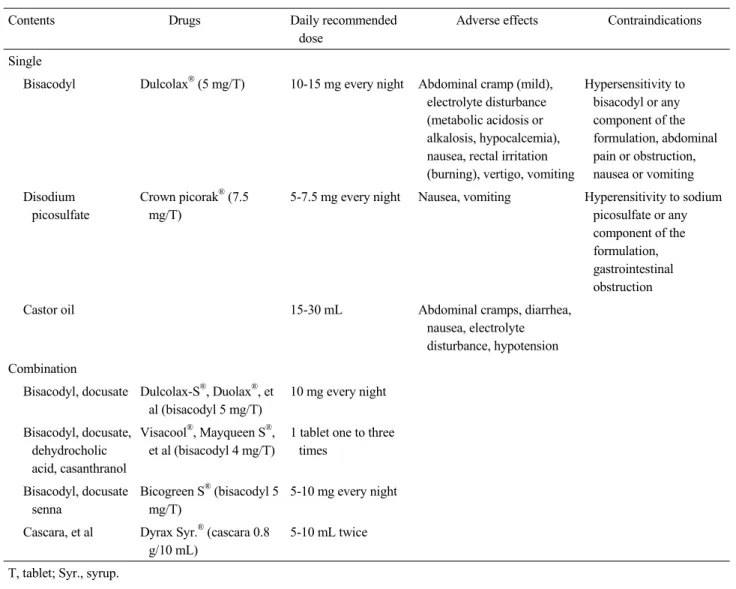
자극성 완하제의 작용 기전은 정확하게 알려져 있지는 않 지만 대장 내에서 수분 및 전해질의 흡수를 억제하고 대장 의 근육신경총을 자극하여 장운동을 촉진하는 것으로 알려 져 있다. 자극성 완하제로는 디하이드로콜린산(dehydrocho- lic acid), 피마자 기름(castor oil), 도큐세이트(docusate)와 같은 계면 활성제(surfactant laxatives)와 센나나 알로에, 카스카라 (cascara)와 같은 안트라퀴논(anthraquinone) 제제, 페놀프탈레 인(phenolphthalein)이나 비사코딜(bisacodyl)과 같은 폴리페놀 (polyphenol) 등이 있다(Table 3) [3]. 성분에 따라 작용 시간이 다양하며 비사코딜의 경우 복용 6-12시간(좌약은 15-60분), 안트라퀴논 제제는 복용 8-12시간 이내에 작용이 나타난다.
효과를 입증할 만한 임상 연구가 부족하며 대부분의 자극성 완하제가 복합 제제로 시판되고 있어 약제별 효과와 적절한 용량 및 용법이 불분명하다. 그럼에도 불구하고 배변 활동이
- 이봉은 외 9인. 전통적 완하제 -
Contents Drugs Daily recommended
dose
Adverse effects Contraindications
Single
Bisacodyl Dulcolax® (5 mg/T) 10-15 mg every night Abdominal cramp (mild), electrolyte disturbance (metabolic acidosis or alkalosis, hypocalcemia), nausea, rectal irritation (burning), vertigo, vomiting
Hypersensitivity to bisacodyl or any component of the formulation, abdominal pain or obstruction, nausea or vomiting Disodium
picosulfate
Crown picorak® (7.5 mg/T)
5-7.5 mg every night Nausea, vomiting Hyperensitivity to sodium picosulfate or any component of the formulation, gastrointestinal obstruction
Castor oil 15-30 mL Abdominal cramps, diarrhea,
nausea, electrolyte disturbance, hypotension Combination
Bisacodyl, docusate Dulcolax-S®, Duolax®, et al (bisacodyl 5 mg/T)
10 mg every night
Bisacodyl, docusate, dehydrocholic acid, casanthranol
Visacool®, Mayqueen S®, et al (bisacodyl 4 mg/T)
1 tablet one to three times
Bisacodyl, docusate senna
Bicogreen S® (bisacodyl 5 mg/T)
5-10 mg every night
Cascara, et al Dyrax Syr.® (cascara 0.8 g/10 mL)
5-10 mL twice T, tablet; Syr., syrup.
Table 3. Stimulant laxatives
활발한 아침에 배변을 유도할 목적으로 대부분의 약제가 취 침 전 복용할 것을 권고하고 있다.
일반적으로 부피형성 완하제나 삼투성 완하제에 효과가 없거나 불충분한 변비 환자에서 단기간 간헐적으로 투여되 고 있는데 일부에서 전해질 불균형, 복통, 오심, 팽창감 등의 부작용이 발생할 수 있으며, 장기간 사용하거나 남용 시 대 장흑색증, 대사성알칼리증, 전해질 이상, 뇨산혈증 및 고알 도스테론증 등의 합병증이 생길 수 있다. 과거 연구에서 자 극성 완하제가 장신경계에 손상을 가져올 수 있다고 하였지 만[25,26], 실제적으로 자극성 완하제 사용이 대장의 구조적 혹은 기능적 손상을 일으킨다는 보고는 없었다. 최근 미국소 화기학회에서는 장기간 사용을 금지할 직접적인 이유는 없 다고 언급하면서[27] 자극성 완하제의 장기 사용을 이전보
다는 허용하고 있다. 하지만 현재까지도 안전성에 대한 자료 가 불충분하기 때문에 장기간 유지 요법으로서의 일차 약제 가 아닌 급성 증상 완화를 위해 적절하게 사용하는 것이 바 람직하겠다. 자극성 완하제는 많은 변비 환자들이 약국이나 비의료 기관에서 임의로 쉽게 접할 수 있어 올바른 약제 사 용에 대한 환자 교육이 필요하다.
자극성 완하제에 대한 무작위 대조군 시험은 없으며, 환 자군을 대상으로 한 규모가 작은 증례 중심의 연구들로 주 로 보고되었다. 계면활성제는 대변연화제라고도 불리며, 이 중 도큐세이트는 대변의 표면장력을 낮춰 대변을 부드럽게 하고 소장과 대장에서 수분 흡수를 증가시켜 장내 액체에 의해 대변종괴를 이동시킨다. 부작용은 거의 없으나 다른 하 제에 비해 효과가 다소 떨어지며, 우리나라에서는 비사코딜,
- The Korean Journal of Medicine: Vol. 88, No. 1, 2015 -
Type Drugs Onset of action (hr) Daily recommended dose Proposed mode of action Bulk forming Psyllium
Calcium polycarbophil Methylcellulose
12-72 Titrate up to 20 g Titrate up to 20 g
Luminal water binding increases stool bulk and reduces consistency
Osmotic Saline laxative Luminal water binding, Increase
fluid excretion by creating an osmotic gradient
Magnesium salts 0.5-3 2.4-4.8 g
Hyperosmolar laxative
Poorly absorbed sugar 24-48 15-60 mL
Polyethelene glycol (PEG) 24-96 13-39 g
Stimulant Surfactant laxative Docusate
Dehydrocholic acid
Castor oil 15-30 mL
Act locally to stimulate colonic motility
Decrease water absorption from large intestine
Anthraquinones Senna Aloe Cascara
8-12
187 mg
325 mg (or 5 mL) Polyphenol
Bisacodyl Sodium picosulfate
6-12 4-6
5-10 mg 5-15 mg hr, hour.
Table 4. Summary of conventional laxatives
센나 등과 함께 복합 성분으로 만들어진 약제가 대부분이다. 비사코딜은 위약에 비해 급성 변비 치료에 있어서 배변 횟 수와 대변 굳기에서 호전을 보이며 부작용은 유사했고[28], 주로 상행결장의 운동을 촉진시켜 효과를 나타낸다[29]. 소 디움 피코설페이트(sodium picosulfate)는 triarylmethane 계열 의 약제로 대장 내시경의 전처치 약제로도 사용되고 있으며 복용 4-6시간 후에 비사코딜과 유사한 작용을 나타낸다. 만 성 변비 환자에서 4주간 투약했을 때 위약에 비해 배변 횟수 와 삶의 질이 향상되었다[30]. 변비 환자를 대상으로 비사코 딜과 소디움 피코설페이트를 4주간 투약하면서 효과를 비교 한 연구에서 두 약제는 동등한 효과를 보여주었다[31]. 자극 성 완하제의 효과를 보고한 국내 연구는 아직 없다.
자극성 완하제의 효과에 대한 임상적 근거는 부족하나 부 피형성 완하제 및 삼투성 완하제에 반응이 없는 일부 변비 환자와 급성 변비 증상의 완화에 효과적일 것으로 생각되며, 국내 임상진료지침에서 자극성하제는 일부 변비 환자의 치 료에 도움을 준다고 제시하였다(권고 수준: 낮음, 증거 수준:
중등도) [2].
결 론
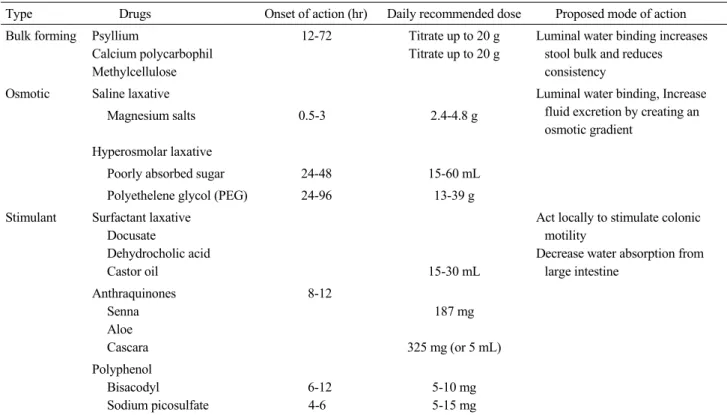
전통적 완하제는 변비 환자에서 약제 선택 시 우선적으로 투여되는 약제이다. 일반적으로 부작용이 거의 없어 안전한 부피형성 완하제가 먼저 투여되며, 이에 효과가 없거나 불충 분하면 삼투성 완하제로 전환하거나 병합하여 사용한다. 최 근 연구에 따르면 PEG가 락툴로오스에 비해 복부팽만 및 방 귀와 같은 부작용은 적으면서 더 나은 효과를 보였는데, 환 자의 증상 및 약제의 특성을 고려하여 적절하게 사용해 볼 수 있겠다. 자극성 완하제는 부피형성 완하제 및 삼투성 완 하제에 반응이 없는 일부 변비 환자와 급성 변비 증상의 완 화에 효과적일 것으로 보인다. 전통적 완하제에 대한 요약을 표 4에 정리하였다.
각 약제의 작용 기전 및 이에 따른 효과와 부작용에 대해 숙지하여 변비 환자의 삶의 질 개선을 위한 적절한 약제 투 여를 위한 노력이 필요하다.
중심 단어: 변비; 완하제
- Bong Eun Lee, et al. Conventional laxatives -
REFERENCES
1. Suares NC, Ford AC. Prevalence of, and risk factors for, chronic idiopathic constipation in the community: system- atic review and meta-analysis. Am J Gastroenterol 2011;
106:1582-1591; quiz 1581, 1592.
2. Park MI, Shin JE, Myung SJ, et al. Guidelines for the treat- ment of constipation. Korean J Gastroenterol 2011;57:100- 114.
3. The Korean Society of Neurogastroenterology and Motility.
Constipation. 3rd ed. Seoul: Medbook, 2013.
4. Lembo A, Camilleri M. Chronic constipation. N Engl J Med 2003;349:1360-1368.
5. Eum J, Rhee KH, Cho YK, et al. Therapeutic effects of agio® 18 g per day in patients with constipation dominant irritable bowel syndrome and chronic constipation. Korean J Neurogastroenterol Motil 2008;14:115-121.
6. Dettmar PW, Sykes J. A multi-centre, general practice com- parison of ispaghula husk with lactulose and other laxatives in the treatment of simple constipation. Curr Med Res Opin 1998;14:227-233.
7. Mamtani R, Cimino JA, Kugel R, Cooperman JM. A cal- cium salt of an insoluble synthetic bulking laxative in eld- erly bedridden nursing home residents. J Am Coll Nutr 1989;
8:554-556.
8. Nyberg C, Hendel J, Nielsen OH. The safety of osmotically acting cathartics in colonic cleansing. Nat Rev Gastroenter- ol Hepatol 2010;7:557-564.
9. Ainley EJ, Winwood PJ, Begley JP. Measurement of serum electrolytes and phosphate after sodium phosphate colono- scopy bowel preparation: an evaluation. Dig Dis Sci 2005;
50:1319-1323.
10. Sanders JF. Lactulose syrup assessed in a double-blind study of elderly constipated patients. J Am Geriatr Soc 1978;26:
236-239.
11. Wesselius-De Casparis A, Braadbaart S, Bergh-Bohlken GE, Mimica M. Treatment of chronic constipation with lactulose syrup: results of a double-blind study. Gut 1968;9:84-86.
12. Freedman MD, Schwartz HJ, Roby R, Fleisher S. Tolerance and efficacy of polyethylene glycol 3350/electrolyte sol- ution versus lactulose in relieving opiate induced constipa- tion: a double-blinded placebo-controlled trial. J Clin Phar- macol 1997;37:904-907.
13. Lee JS, Kim YD, Im HH, et al. The effect of lactulose on the colon transit and the various symptoms of constipation in patients with functional constipation. Korean J Neurogas- troenterol Motil 2006;12:127-135.
14. Andorsky RI, Goldner F. Colonic lavage solution (poly- ethylene glycol electrolyte lavage solution) as a treatment for chronic constipation: a double-blind, placebo-controlled
study. Am J Gastroenterol 1990;85:261-265.
15. Klauser AG, Mühldorfer BE, Voderholzer WA, Wenzel G, Müller-Lissner SA. Polyethylene glycol 4000 for slow tran- sit constipation. Z Gastroenterol 1995;33:5-8.
16. Corazziari E, Badiali D, Habib FI, et al. Small volume iso- smotic polyethylene glycol electrolyte balanced solution (PMF-100) in treatment of chronic nonorganic constipation.
Dig Dis Sci 1996;41:1636-1642.
17. Attar A, Lémann M, Ferguson A, et al. Comparison of a low dose polyethylene glycol electrolyte solution with lactulose for treatment of chronic constipation. Gut 1999;44:226-230.
18. Bassotti G, Fiorella S, Roselli P, Modesto R. Use of poly- ethylene glycol solution in slow transit constipation. Ital J Gastroenterol Hepatol 1999;31 Suppl 3:S255-S256.
19. Cleveland MV, Flavin DP, Ruben RA, Epstein RM, Clark GE. New polyethylene glycol laxative for treatment of con- stipation in adults: a randomized, double-blind, placebo- controlled study. South Med J 2001;94:478-481.
20. DiPalma JA, DeRidder PH, Orlando RC, Kolts BE, Cleveland MB. A randomized, placebo-controlled, multi- center study of the safety and efficacy of a new polyethylene glycol laxative. Am J Gastroenterol 2000;95:446-450.
21. Di Palma JA, Smith JR, Cleveland MV. Overnight efficacy of polyethylene glycol laxative. Am J Gastroenterol 2002;
97:1776-1779.
22. DiPalma JA, Cleveland MB, McGowan J, Herrera JL. A comparison of polyethylene glycol laxative and placebo for relief of constipation from constipating medications. South Med J 2007;100:1085-1090.
23. Lee-Robichaud H, Thomas K, Morgan J, Nelson RL. Lactu- lose versus polyethylene glycol for chronic constipation.
Cochrane Database Syst Rev 2010;7:CD007570.
24. Bae SH. Long-term safety of PEG 4000 in children with chronic functional constipation: a biochemical perspective.
Korean J Pediatr 2010;53:741-744.
25. Smith B. Pathologic changes in the colon produced by an- thraquinone purgatives. Dis Colon Rectum 1973;16:455-458.
26. Krishnamurthy S, Schuffler MD, Rohrmann CA, Pope CE 2nd. Severe idiopathic constipation is associated with a dis- tinctive abnormality of the colonic myenteric plexus. Gas- troenterology 1985;88(1 Pt 1):26-34.
27. Bharucha AE, Pemberton JH, Locke GR 3rd. American Gastroenterological Association technical review on consti- pation. Gastroenterology 2013;144:218-238.
28. Kienzle-Horn S, Vix JM, Schuijt C, Peil H, Jordan CC, Kamm MA. Efficacy and safety of bisacodyl in the acute treatment of constipation: a double-blind, randomized, pla- cebo-controlled study. Aliment Pharmacol Ther 2006;23:
1479-1488.
29. Manabe N, Cremonini F, Camilleri M, Sandborn WJ, Burton
- 대한내과학회지: 제 88 권 제 1 호 통권 제 653 호 2015 -
DD. Effects of bisacodyl on ascending colon emptying and overall colonic transit in healthy volunteers. Aliment Phar- macol Ther 2009;30:930-936.
30. Mueller-Lissner S, Kamm MA, Wald A, et al. Multicenter, 4-week, double-blind, randomized, placebo-controlled trial of sodium picosulfate in patients with chronic constipation.
Am J Gastroenterol 2010;105:897-903.
31. Kienzle-Horn S, Vix JM, Schuijt C, Peil H, Jordan CC, Kamm MA. Comparison of bisacodyl and sodium picosul- phate in the treatment of chronic constipation. Curr Med Res Opin 2007;23:691-699.
![Table 1. Bulk forming laxatives 서 론 만성 변비는 유병률이 지역 인구의 14%로 보고된 흔한 질환이고[1] 생명과 연계된 중증 질환은 아니지만 증상으로 인 한 불편감이 삶의 질 저하로 이어질 수 있기 때문에 식생활 습관에 대한 환자 교육과 적절한 약제의 사용이 중요하다.만성 변비 환자가 내원하면 기질적인 질환 및 이차적인 원인에 대한 평가가 이루어지며, 변비 증상 완화를 위한 첫 단계로 생활 습관 및 식생활 개선이 시도](https://thumb-ap.123doks.com/thumbv2/123dokinfo/4997131.304260/2.892.83.811.811.1072/유병률이-질환이고-아니지만-증상으로-불편감이-중요하다-내원하면-이루어지며.webp)