© 2015 European Crohn’s and Colitis Organisation (ECCO) 1449 doi:10.1016/j.crohns.2014.09.003
Advance Access publication October 17, 2015 Original Article
Original Article
Development of a Web-based, self-reporting symptom diary for Crohn's Disease, and its correlation with the Crohn's Disease Activity Index ☆
Eun Soo Kim
a, Kyung Sik Park
a, Kwang Bum Cho
a, Kyeong Ok Kim
b, Byung Ik Jang
b, Eun Young Kim
c,*, Jin Tae Jung
c, Seong Woo Jeon
d, Min Kyu Jung
d, Hyun Seok Lee
d, Chang Heon Yang
e, Yong Kook Lee
e, Daegu–Gyeongbuk Gastrointestinal Study Group (DGSG)
aDivision of Gastroenterology, Department of Internal Medicine, Keimyung University School of Medicine, Daegu, Republic of Korea bDivision of Gastroenterology and Hepatology, Department of Internal Medicine, Yeungnam University College of Medicine, Daegu, Republic of Korea cDivision of Gastroenterology and Hepatology, Department of Internal Medicine, Catholic University of Daegu School of Medicine, Daegu, Republic of Korea dDivision of Gastroenterology and Hepatology, Department of Internal Medicine, Kyungpook National University School of Medicine, Daegu, Republic of Korea eDivision of Gastroenterology and Hepatology, Department of Internal Medicine, Dongguk University School of Medicine, Gyeongju, Gyeongsang-buk-do, Republic of Korea
☆ This study was presented at 9th Congress of European Crohn's and Colitis Organisation 2014, Copenhagen, Denmark.
⁎Corresponding author at: Division of Gastroenterology and Hepatology, Department of Internal Medicine, Catholic Univer- sity of Daegu School of Medicine, Daegu, Republic of Korea, 3056-6 Daemyung-4 Dong, Namgu, Daegu, Republic of Korea, 705-718. Tel.: +82 53 250 8096; fax: +82 53 250 7088. E-mail address: [email protected] (E.Y. Kim).
Abstract
Background and Aims: Crohn's Disease Activity Index (CDAI) is complex, time-consuming, and impractical. The aim of this study was to investigate whether a newly developed, simple, web- based self-reporting Crohn's Disease symptom diary (CDSD) was as effective as CDAI in assessing disease severity.
Methods: CDSD consisted of 5 clinical parameters based on the Harvey–Bradshaw Index (HBI), which could easily be recorded online, by using CDSD website (www.cdsd.or.kr). Images were added to help patients better understand complications. All patients were asked to visit the website and record their symptoms 7 days before their next hospital appointment. CDAI scores were calculated at the subsequent hospital visit. The collected data were analyzed to determine if the CDAI scores correlated with those obtained from CDSD, and to define a cut-off value of CDSD that would be representative of disease remission.
Results: Analysis of 171 visits showed a positive correlation between scores from CDSD and CDAI (Spearman correlation coefficient r = 0.720, p < 0.001). Receiver Operating Characteristic curves showed CDSD score ≤5 points as corresponding with CDAI score ≤150 points (clinical remission).
Using a cut-off value of 5 points by CDSD, the positive and negative predictive values for clinical remission were 91.7% and 88.5%, respectively.
Conclusion: This study demonstrates that CDSD correlated well with CDAI. CDSD score of 5 is the cut-off value for clinical remission (CDAI score ≤150). Use of CDSD might permit a simple, patient-
Downloaded from https://academic.oup.com/ecco-jcc/article-abstract/11/12/1449/2907827 by KEIMYUNG UNIV MEDICAL LIBRARY user on 11 January 2019
friendly assessment of CD activity, which can provide useful early-phase information on patients with CD as part of their long-term clinical assessment.
Key Words: CDAI; Crohn's disease; correlation; symptoms; diary; web
1. Introduction
Crohn's disease (CD) is a longstanding inflammatory disorder of the gastrointestinal tract that often requires life-long medical treatment [1]. In general, the disease course of CD is unstable, characterized by remissions and exacerbations [2,3]. Flares of CD are often identi- fied by patients' symptoms including diarrhea, abdominal pain, and fatigue. As a large number of patients with CD (> 90%) experienced relapse within 20 years of their initial diagnosis [4], monitoring dis- ease activity is of utmost importance, not only for the control of inflammation, but also for assessing long-term progress.
A reliable index for assessing the degree of disease activity is therefore necessary. The Crohn's Disease Activity Index (CDAI) was developed in the early 1970s [5], and has since been consid- ered as the gold standard for evaluation of disease activity [6]. It allows the standardized access to inclusion criteria of patients, to data collection, and to patient management decisions during clinical investigations, and has been used to evaluate drug responses [7]. It is composed of 8 clinical variables; subjective symptoms derived from a 1-week patient diary, values requiring physical examination such as body weight and abdominal mass, as well as a laboratory test for hematocrit levels. In addition, various weighting factors are calcu- lated for the final score. CDAI values > 450 indicate severe disease, and values < 150 indicate clinical remission. Although CDAI is the most widely validated index, it has been criticized for being cumber- some, complex, impractical, and time consuming [8].
A simplified version of the CDAI, the Harvey–Bradshaw Index (HBI), was created in order to overcome the drawbacks of the CDAI.
The HBI uses only a single day's patient diary entries, and excludes 3 variables: body weight, hematocrit, and the use of anti-diarrheal drugs. Furthermore, code values can be simply added together rather than summing the products of code values and coefficients, making data collection and calculation easier [9]. Results from the HBI cor- relate well with those from the CDAI, with correlations ranging from 0.80 to 0.93 [9,10]. Although the HBI is considered to be a more simple and practical measure of clinical activity than the CDAI, it also has its own drawbacks. It requires patient assessment by medi- cal professionals at one single outpatient visit. Given that CD has an unpredictable clinical course, and that patients visit outpatient clin- ics only on a 1–2 month basis, a number of key clinical symptoms for disease activity might be missed using the CDAI and HBI systems during routine clinic visits. The ideal approach for the assessment of disease activity would be real-time monitoring of patient symptoms.
To do that, an easy, un-demanding, and patient-friendly assessment tool would be required, which was available for recording data any- time and anywhere.
For this reason, telemanagement has been implemented for use in inflammatory bowel disease (IBD) as well as various chronic con- ditions such as asthma, congestive heart failure, and diabetes—and has resulted in improved disease outcomes [11–15]. Although a self- managed, web-based monitoring system for patients with CD was already developed in a recent study, results using the monitoring system were not compared with results using the CDAI (which is the gold standard, and only currently validated system for CD activ- ity)—leading to doubts about its reliability [15].
We developed a novel, web-based, self-reporting CD symptom diary (CDSD), using the www.cdsd.or.kr website. The aim of this study was to compare this web-based monitoring system with the CDAI for their ability to assess disease severity. In addition, a cut-off value for disease remission was calculated based on CDSD scores.
2. Methods 2.1. Patients
Patients from 4 tertiary referral hospitals in the Daegu–Gyeongbuk area in southeastern Korea, who had been diagnosed with CD for at least 6 months, were eligible for inclusion. A diagnosis of CD was established based on a detailed history, physical examination, combi- nation of endoscopic findings, histology, radiographic findings, and laboratory investigations. Patients with stoma were excluded from the study. Informed consent was obtained from each participant, and the study was approved by the ethics review committee of the Institutional Review Board of all hospitals participating in the study.
This study was registered in World Health Organization interna- tional clinical trials registry platform (No. KCT0000759).
2.2. CDSD web site
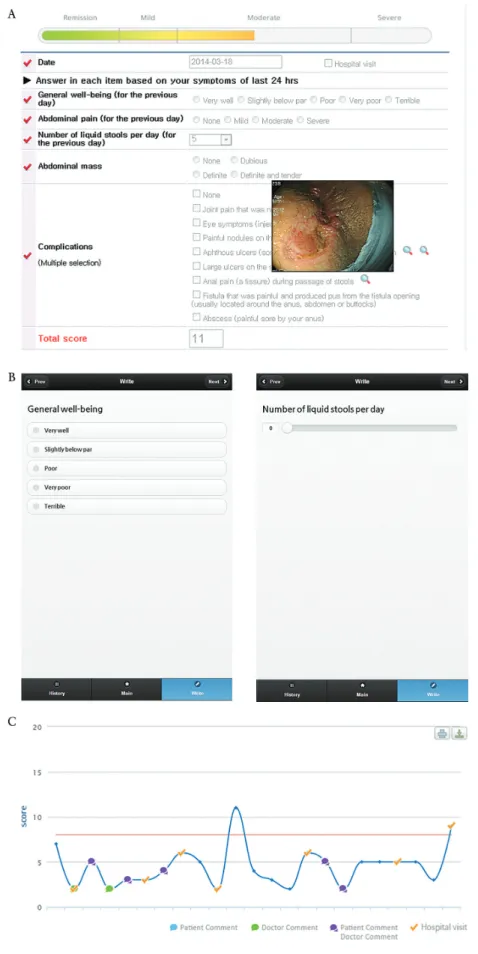
This novel, web-based, self-reporting diary system comprised 5 clini- cal parameters based on the Harvey–Bradshaw Index; general well being (very well, slightly below par, poor, very poor, or terrible), abdominal pain (none, mild, moderate, or severe), number of liquid stools per day, abdominal mass (none, dubious, definite, or definite and tender), and presence of CD associated complications. All parts of the CDSD recorded symptoms experienced during the last 24 h.
As this system was designed to be completed by patients themselves, it needed to be easy to use and understand, and patient-friendly. All variables could be completed by using a click box, and the total score was calculated automatically. To clarify the complications including arthralgia, uveitis, erythema nodosum, aphthous ulcer, pyoderma gangrenosum, anal fissure, fistula, and abscess, we added exam- ple pictures next to each item (Fig. 1A). These images popped up when the mouse cursor moved over each item. This system could be accessed through the website www.cdsd.or.kr. Recently, we have developed a mobile version of CDSD so that patients can connect and record their symptoms whenever and wherever using a smart phone (Fig. 1 B). The course of disease activity could be depicted as a flow chart, according to the scores that patients completed on the CDSD website (Fig. 1 C).
2.3. Study procedure
A username identification (ID) and password for connecting to the website were created and given to patients who provided informed consent. All patients were asked to visit the CDSD website and fill in their diary whenever they had symptoms. Even though they were in remission, they were advised to log in on a weekly basis. In addition, they were asked to visit the CDSD website and record their symptoms during the week prior to their next outpatient clinic appointment, so that an accurate analysis of the correlation between CDSD and
Downloaded from https://academic.oup.com/ecco-jcc/article-abstract/11/12/1449/2907827 by KEIMYUNG UNIV MEDICAL LIBRARY user on 11 January 2019
Figure 1. Crohn's disease symptoms diary (CDSD). A, Web portal site and parameters of CDSD. B, The mobile version of CDSD. C, A graph showing the pattern of patient's activity.
Downloaded from https://academic.oup.com/ecco-jcc/article-abstract/11/12/1449/2907827 by KEIMYUNG UNIV MEDICAL LIBRARY user on 11 January 2019
CDAI scores could be obtained. When there were multiple data of CDSD and CDAI in a patient, we included only the first pair of CDSD and CDAI to exclude a bias of familiarity. CDAI scores were col- lected and calculated by the medical staffs at the hospital, who were blinded to the results of the patients' CDSD assessment. The vari- ables that determined the CDAI score were based on the symptoms over the 7 days before the outpatient appointment, together with data from abdominal examination, a hematocrit and body weight. They included the number of liquid or very soft stools; abdominal pain (none, mild, moderate, or severe); general well-being (generally well, slightly under par, poor, very poor, or terrible); elevated body tem- perature; and use of anti-diarrheal agents. Scores ranged from 0 to approximately 600, with 150 points indicating remission.
2.4. Statistical analysis
The correlation between CDAI and CDSD was assessed using the Spearman correlation coefficient. This coefficient is a non-paramet- ric measure of statistical dependence between 2 numerical variables and +1 value denotes a perfect positive monotone relationship. For analyzing correlation for each CDSD cutoff value with CDAI remis- sion (≤150), which was dichotomous variable, we used the phi (Φ) coefficient [16]. A two-tailed P-value (p) < 0.05 was considered sta- tistically significant.
For calculating the cut-off value of remission in CDSD, CDAI was taken as the gold standard for CD activity, and patients were divided into 2 groups, ‘remission’ and ‘no remission’, according to their CDAI score (≤150). Next, 2 × 2 tables with cut-points at CDSD integers were generated, and both positive and negative predictive values were calculated for each cut-off value of CDSD. The positive predictive value refers to the proportion of patients obtaining a certain score in CDSD who are in remission according to their CDAI score (≤150).
Furthermore, the optimal point of defining remission in the CDSD scoring system was assessed using the specificity and sensitivity com- putations from receiver-operated characteristic (ROC) curves.
3. Results
Data from a total of 171 visits by 171 patients with CD were col- lected in 3 tertiary referral hospitals. The median age at inclusion was 26 years (range 16–69 years), and most of them were male (124 patients, 72.5%). Ileo-colonic (95 patients, 55.6%) and inflamma- tory type (89 patients, 52%) were the most common disease loca- tion and disease behavior, respectively. One hundred and forty one patients (82.5%) were taking immunomodulators, while 35 patients (20.5%) were receiving anti-TNF blockers. The baseline demographic and clinical characteristics of patients are described in Table 1.
3.1. Comparison of CDAI and CDSD scores
Among 171 data pairs in this study, the CDAI scores ranged from 2 to 358, and the CDSD scores ranged from 0 to 15. Overall, analy- sis of the data showed a positive correlation between the scores of CDAI and those of CDSD. The Spearman correlation coefficient was 0.720 (95% confidence interval, 0.639–0.785, p < 0.001) (Fig. 2).
3.2. Cut-off value for clinical remission based on CDSD score
Clinical remission, as determined by having a CDAI score of ≤150 points, correlated with having a CDSD value of 5 (Fig. 2). The 2 × 2 tables (with positive and negative predictive values for a range of CDSD cut-offs) revealed that a CDSD cut-off value of 5 was the
best score for most accurately designating clinical remission, defined by using the CDAI (≤150 points) (Table 2). In short, when a patient has a CDSD score of ≤5, there is a 91.7% chance that he or she is in remission according to the CDAI (positive predictive value), and when a patient has a CDSD score of >5, there is an 88.5% chance that he or she is not in remission according to the CDAI (negative predictive value). Using a score of 5 points on the CDSD system as defining remission, 8.7% of patients were misclassified compared with remission defined by using the CDAI scoring system. Among these, 7% were categorized as being in remission by using CDSD, but as not being in remission on the CDAI, whereas the other 1.7%
were categorized as not being in remission on CDSD, but were in remission according to the CDAI. A cut-off value of 5 points on the CDSD scale was confirmed as being indicative of clinical remission by analysis using the specificity and sensitivity computations from a ROC graph (area under curve 0.906, 95% confidence interval 0.846–0.966, p < 0.001) (Fig. 3) and Φ coefficient (Table 2).
4. Discussion
This study demonstrates that a novel web-based, self-reporting, symptom diary for patients with CD (CDSD) correlates well with the CDAI in assessing the severity of CD. A CDSD score of ≤5 cor- responds to a CDAI score of ≤150—the cut-off value accepted for defining clinical remission. To the best of our knowledge, this is the first study that compares a web-based, self-assessment system of dis- ease activity for CD with CDAI scores.
Recognizing the shortcomings of CDAI (such as impracticabil- ity and the inherent deviations arising from recall bias in data col- lection), and the importance of disease monitoring in CD, several published studies have used a self-reporting symptom collecting tool, using an electronic diary or web-based system to assess symptoms in Table 1. Baseline characteristics of patients.
CD patients N = 171 Age at inclusion (years), median (range) 26 (16–69) Age at diagnosis (years), median (range) 22 (11–64) Disease duration (months), median (range) 39 (6–295) Gender (%)
Male 124 (72.5)
Female 47 (27.5)
Education (%)
University 117 (68.4)
≤ High school 54 (31.6)
Marriage (%)
Yes 49 (28.7)
No 122 (71.3)
Disease location (%)
Small bowel 38 (22.2)
Colon 38 (22.2)
Ileocolonic 95 (55.6)
Disease behavior (%)
Inflammatory 89 (52)
Stricturing 30 (17.5)
Penetrating 52 (30.4)
Perianal disease (%) 78 (45.6)
Immunomodulators (%) 141 (82.5)
Anti-TNF blockers (%) 35 (20.5)
IBD operation (%) 74 (43.3)
1 operation 68 (39.8)
≥2 operations 6 (3.5)
Downloaded from https://academic.oup.com/ecco-jcc/article-abstract/11/12/1449/2907827 by KEIMYUNG UNIV MEDICAL LIBRARY user on 11 January 2019
patients with CD [15,17]. The study by Litcher-Kelly et al. reported the feasibility of an electronic diary for collecting symptoms using software installed on a handheld computer [17]. They described that overall compliance was 88%, and they attributed this high rate of compliance to the user-friendly features of the electronic diary.
However, they did not establish detailed parameters for the diary, and the sample size was very small (n = 16). Recently, a web-based telemanagement system has been introduced for patients with IBD, which has encouraged the active involvement of patients in the assessment and treatment of their disease [14,15]. The open-label pilot study reported the efficacy, and safety, of a web-based approach for the maintenance of infliximab treatment for patients with CD, suggesting that this novel method might be a promising concept for the individualization of infliximab treatment in IBD [15]. In that study, although patients recorded their disease activity using the HBI, as was the case in our study, they did not validate it compared with disease activity assessed by the CDAI. The main limitation of their study was a small sample size with only a few selected patients, who were responders to infliximab treatment.
One of the unique aspects of CDSD is the scoring system which can be accessed easily on the web, and filled out by the patients them- selves. It can be completed from anywhere by using smart phones. As clinical assessment using the HBI has been designed to be completed by health care professionals, some medical terminology, especially
regarding CD associated complications, needs to be clarified so that patients can understand and fill out the details on their own.
In order to do so, we inserted pictures of each type of complication, which pop up with the touch of a cursor. We believe that this easy, un-demanding, and patient-friendly design might be able to boost patients' active participation in the assessment of their disease activ- ity. Indeed, it has been suggested that widespread implementation of e-health care approach might reshape the current health care system for IBD into more efficient one and empower patients in disease self- management reducing dependency on doctors [18].
Patients with CD who have HBI scores of up to 4 are classi- fied as being in remission; those with scores of 5 to 7, as having mildly active disease; 8–16, as having moderately active disease; and those with a score > 16, as having severely active disease [19]. The study evaluating the correlation between CDAI and HBI (completed by a clinician) also showed that an HBI score of ≤4 corresponded with a CDAI score of ≤150 (clinical remission) [10]. However, we found that a CDSD score of ≤5, and not ≤4, correlated with the CDAI score of ≤150. Using a CDSD score of ≤5 for the diagnosis of clinical remission resulted in the misclassification of the fewest patients (8.7%). The rate of false negatives (a patient being classed as not in remission by CDSD, but classed as being in remission using the CDAI) was 8.8% (15/171 patients), in patients with a CDSD score of ≤4, while the false negative rate went down to 1.7% (3/171 patients) with CDSD scores of ≤5. The discrepancy between previous studies and ours (score 4 vs. score 5 for the cut-off value associated with remission) likely represents patient's overestimation of their symptoms on the self-reporting system compared with what they reported to the medical professional assessing the HBI. This concept was corroborated by the result of previous studies, which showed that patients tended to report more symptoms using a self-report
0
0 2 4
CDSD remission
CDAI remission
6 8 10 12 14
100 200
CDAI score
CDSD score 300
400
Figure 2. Comparison of the scores between CDAI and CDSD. Dashed lines indicate “CDAI remission” of ≤150 points, and “CDSD remission” of ≤5 points. The solid line indicates the regression curve. Spearman correlation coefficient, r = 0.720 (p < 0.001). CDSD, Crohn's disease symptoms diary;
CDAI, Crohn's disease activity index.
Table 2. Summary of 2 × 2 tables for correlation of a range of CDSD cutoffs with CDAI remission ( ≤ 150).
CDSD cutoff
Number of true positives
Number of false positives
Number of false negatives
Number of true negatives
Positive predictive value
Negative predictive value
Sensitivity Specificity Accuracy Φ coefficient
3 109 5 27 30 95.6% 52.6% 80.1% 85.7% 81.3% 0.564
4 121 7 15 28 94.5% 65.1% 89% 80% 87.1% 0.641
5 133 12 3 23 91.7% 88.5% 97.8% 65.7% 91.2% 0.714
6 133 21 3 14 86.4% 82.4% 97.8% 40% 85.9% 0.510
7 134 25 2 10 84.3% 83.3% 98.5% 28.6% 84.2% 0.428
1
0.8
0.6
Sensitivity 0.4
0.2
0 0 0.2 0.4
1-Specificity
0.6 0.8 1
Figure 3. ROC analysis for CDSD–CDAI remission. CDSD, Crohn's disease symptoms diary; CDAI, Crohn's disease activity index.
Downloaded from https://academic.oup.com/ecco-jcc/article-abstract/11/12/1449/2907827 by KEIMYUNG UNIV MEDICAL LIBRARY user on 11 January 2019
questionnaire while physicians minimized patients' symptoms [20,21]. Another study comparing a patient-based HBI with the cli- nician-based HBI in CD outpatients showed that patients were likely to report more symptoms while completing the patient-based ques- tionnaire compared to what they reported to the clinician during consultation [22]. There are several explanations for the overestima- tion of patients' symptoms with self-reporting, and underestimation with clinicians. First, the undisturbed environment associated with self-answering might enable patients to report their symptoms more freely than when they are under consultation with doctors. Second, some patients may not want to report their feeling accurately when asked by a clinician, since they may feel the need to give socially desirable answers, especially for the questions regarding well-being, which is one of the items of CDSD and CDAI.
Using a cut-off CDSD score of ≤5 for the definition of clinical remission was supported by the results of the ROC curve. The area under the ROC curve for patients assessed as being in remission in the study was 0.906, indicating that the CDSD is an excellent meas- ure for discriminating between patients in remission and those not in remission, as determined by the CDAI. This curve shows that there is more than 90% probability that a CDSD score for a randomly selected patient who is in remission will be lower than the CDSD score of a randomly selected patient who is not in remission.
The Spearman correlation coefficient (r) between CDSD and CDAI in this study was 0.720 indicating strong correlations. However, this degree of correlation was still lower than that of a previous study (r
= 0.800), which estimated a linear relationship between HBI (com- pleted by clinicians) and CDAI [10]. In the latter study, data were col- lected from 2 clinical trials (PRECiSE 1 and PRECiSE 2), where HBI and CDAI evaluations were made 2 times (at baseline and follow-up), during the same visit for each patient. Repeating the test twice during the study (at baseline and follow-up) and assessment using both HBI and CDAI on the same day might have resulted in patients getting more familiar with the different clinical parameters, and this may have biased the correlation between HBI and CDAI in that study. In fact, there was less correlation between CDAI and HBI at baseline (r = 0.595) than at follow-up (r = 0.891). In our study, CDSD and CDAI evaluations were made at different places, and on different days (within 7 days), making our data more reliable. Moreover, only first pair of CDSD and CDAI was selected in the present study to rule out a potential bias of familiarity when there were multiple assess- ments of CDSD and CDAI in one patient.
Despite the convenience and effectiveness of e-health system, we should be mindful of the security, privacy, and confidentiality of patients' data while planning e-health care for patients with IBD since health data is considered to be the most personal and sensitive information [23]. Potential impact of privacy breach on health data would be life threatening or cause a significant financial cost [23].
There are several requirements for guaranteeing and maintaining the security and privacy of an e-health record including authorized access, confidentiality with data encryption, patient's consent, and monitoring of system access [24]. In the present study, we imple- mented a role-based access system in which each user had its own ID and password. For instance, a physician with certain ID and pass- word could access only his or her patients' data while a patient could see only his or her data. Before inclusion of the study, all patients provided informed consent. Further, the ethics review committee of the Institutional Review Board of all hospitals regularly monitored the data system.
There are several limitations in this study. Biochemical indicators such as CRP or fecal calprotectin, required for precise monitoring of
bowel inflammation, were not used in the study. Furthermore, only outpatients were enrolled into the study; thus, most of the patients were in clinical remission at the time of the study (79.5%, 136/171 patients ≤ CDAI 150). In addition, data were not collected from clin- ical trials, so we could not estimate the appropriate level of CDSD scoring for clinical responses. However, as the main role of CDSD is to detect early relapse in outpatient, distinguishing non-remitters from remitters is the most important factor for CDSD.
In conclusion, this study demonstrates that disease activity assessed by using the novel web-based, self-reporting CDSD corre- lates with disease activity assessed by using the gold standard scoring system for CD, the CDAI. In particular, it was possible to distinguish between patients who were in remission, and those who were not in remission using the CDSD system. We believe that the simple design and lower burden bestowed on both patients and clinicians in the assessment of disease severity makes this diary an ideal tool, which could be promptly applied as standard in routine clinical practice, or for patients who require prolonged follow-up.
Conflict of Interest
The authors declare no conflict of interests.
Acknowledgment
ESK and EYK: study concept and design, drafting of the manuscript, analysis and interpretation of data. SWJ, KSP, KBC and JTJ: statistical analysis. BIJ, KOK, MKJ, HSL, CHY and YKL: participation in the design, acquisition of data, and critical revision of the manuscript. All authors read and approved the final manuscript.
References
1. Vermeire S, van Assche G, Rutgeerts P. Review article: altering the natural history of Crohn's disease—evidence for and against current therapies.
Aliment Pharmacol Ther 2007;25:3–12.
2. Husain A, Triadafilopoulos G. Communicating with patients with inflam- matory bowel disease. Inflamm Bowel Dis 2004;10:444–450 [discus- sion 451].
3. Henriksen M, Jahnsen J, Lygren I, Aadland E, Schulz T, Vatn MH. et al.
Clinical course in Crohn's disease: results of a five-year population- based follow-up study (the IBSEN study). Scand J Gastroenterol 2007;42:602–610.
4. Veloso FT, Ferreira JT, Barros L, Almeida S. Clinical outcome of Crohn's disease: analysis according to the Vienna classification and clinical activity.
Inflamm Bowel Dis 2001;7:306–313.
5. Best WR, Becktel JM, Singleton JW, Kern F Jr. Development of a Crohn's disease activity index. National Cooperative Crohn's Disease Study. Gas- troenterology 1976;70:439–444.
6. Sandborn WJ, Feagan BG, Hanauer SB, Lochs H, Lofberg R, Modigliani R. et al. A review of activity indices and efficacy endpoints for clinical trials of medical therapy in adults with Crohn's disease. Gastroenterology 2002;122:512–530.
7. Summers RW, Switz DM, Sessions JT. Jr., Becktel JM, Best WR, Kern F Jr.
et al. National Cooperative Crohn's Disease Study: results of drug treat- ment. Gastroenterology 1979;77:847–869.
8. Sands BE, Ooi CJ. A survey of methodological variation in the Crohn's disease activity index. Inflamm Bowel Dis 2005;11:133–138.
9. Harvey RF, Bradshaw JM. A simple index of Crohn's-disease activity. Lan- cet 1980;1:514.
10. Vermeire S, Schreiber S, Sandborn WJ, Dubois C, Rutgeerts P. Correla- tion between the Crohn's disease activity and Harvey–Bradshaw indi- ces in assessing Crohn's disease severity. Clin Gastroenterol Hepatol 2010;8:357–363.
Downloaded from https://academic.oup.com/ecco-jcc/article-abstract/11/12/1449/2907827 by KEIMYUNG UNIV MEDICAL LIBRARY user on 11 January 2019
11. Evangelista LS, Stromberg A, Westlake C, Ter-Galstanyan A, Anderson N, Dracup K. Developing a Web-based education and counseling program for heart failure patients. Prog Cardiovasc Nurs 2006;21:196–201.
12. Gomez EJ, Hernando ME, Garcia A, Del Pozo F, Cermeno J, Corcoy R.
et al. Telemedicine as a tool for intensive management of diabetes: the DIABTel experience. Comput Methods Programs Biomed 2002;69:163–
177.
13. Maiolo C, Mohamed EI, Fiorani CM, De Lorenzo A. Home telemonitor- ing for patients with severe respiratory illness: the Italian experience. J Telemed Telecare 2003;9:67–71.
14. Elkjaer M, Shuhaibar M, Burisch J, Bailey Y, Scherfig H, Laugesen B.
et al. E-health empowers patients with ulcerative colitis: a randomised controlled trial of the web-guided ‘Constant-care’ approach. Gut 2010;59:1652–1661.
15. Pedersen N, Elkjaer M, Duricova D, Burisch J, Dobrzanski C, Andersen N.N. et al. eHealth: individualisation of infliximab treatment and disease course via a self-managed web-based solution in Crohn's disease. Aliment Pharmacol Ther 2012;36:840–849.
16. Ulrich R, Wirtz M. On the correlation of a naturally and an artificially dichotomized variable. Br J Math Stat Psychol 2004;57:235–251.
17. Litcher-Kelly L, Kellerman Q, Hanauer SB, Stone AA. Feasibility and util- ity of an electronic diary to assess self-report symptoms in patients with inflammatory bowel disease. Ann Behav Med 2007;33:207–212.
18. Elkjaer M. E-health: Web-guided therapy and disease self-management in ulcerative colitis. Impact on disease outcome, quality of life and compli- ance. Dan Med J 2012;59:B4478.
19. Best WR. Predicting the Crohn's disease activity index from the Harvey–
Bradshaw Index. Inflamm Bowel Dis 2006;12:304–310.
20. Laugsand EA, Sprangers MA, Bjordal K, Skorpen F, Kaasa S, Klepstad P. Health care providers underestimate symptom intensities of cancer patients: a multicenter European study. Health Qual Life Outcomes 2010;8:104.
21. Lesage AC, Hagege H, Tucat G, Gendre JP. Results of a national survey on quality of life in inflammatory bowel diseases. Clin Res Hepatol Gastro- enterol 2011;35:117–124.
22. Evertsz FB, Hoeks CC, Nieuwkerk PT, Stokkers PC, Ponsioen CY, Bockting CL. et al. Development of the patient Harvey Bradshaw index and a comparison with a clinician-based Harvey Bradshaw index assessment of Crohn's disease activity. J Clin Gastroenterol 2013;47:850–856.
23. Williams PA, Hossack E. It will never happen to us: the likelihood and impact of privacy breaches on health data in Australia. Stud Health Tech- nol Inform 2013;188:155–161.
24. Rodrigues JJ, de la Torre I, Fernandez G, Lopez-Coronado M. Analysis of the security and privacy requirements of cloud-based electronic health records systems. J Med Internet Res 2013;15:e186.
Downloaded from https://academic.oup.com/ecco-jcc/article-abstract/11/12/1449/2907827 by KEIMYUNG UNIV MEDICAL LIBRARY user on 11 January 2019