This is an Open Access article distributed under the terms of the Creative Commons Attribution Non-Commercial License (http: //creativecommons.org/licenses/by- nc/4.0/) which permits unrestricted non-commercial Copyright: © 2019 Korean Journal of Agricultural Science
ANIMAL
Estimate of laying performance of two
crossbred Korean native chickens in 20 to 40 weeks
Jun Seon Hong1, Hyun Min Cho1, Samiru Sudharaka Wickramasuriya1, Yu Bin Kim1, Jung Min Heo1,*, Yong-Joo Yi2,*
1Department of Animal Science and Biotechnology, Chungnam National University, Daejeon 34134, Korea
2Division of Biotechnology, Safety Environment and Life Science Institute, Chonbuk National University, Iksan 54596, Korea
*Corresponding author: [email protected], [email protected]
Abstract
This study was conducted to investigate the laying period performance of two crossbred Korean native chicken (KNC) grand parent stock (GPS) layer during 20 to 40 weeks. A total of 351 20-week-old KNC GPS were allocated in a completely randomized design to give 4 birds per each cage. The chickens were fed commercial diets [i.e., week 20 - 32, crude protein (CP) 18.0% and metabolizable energy (ME) 2,850 kcal/kg; week 32 - 40, CP 17.0% and ME 2,800 kcal/kg)] and fresh water during the whole experiment period ad libitum basis. Body weight, age of sexual maturity, egg weight, hen-day egg production (HDP) and feed conversion ratio (FCR) were measured during the experiment period (week 20 - 40). The results show no significant difference in the Body weight, age of sexual maturity, egg weight, and hen-day egg production (HDP) except for egg weight. 1B had a higher egg weight on week 36 only.
We expect that the reason why most factors showed no significant difference is the lack of nutrients caused by limited feeding which follows the standard feeding system for the grand- parent stock. These results provide basic information for laying data in 2-way crossbred Korean native chickens.
Keywords: crossbreed, growth performance, Korean native chicken
Introduction
한국 재래닭은 깃털 색깔에 따라 적갈색종, 황갈색종, 흑색종, 백색종 및 회갈색종으로 구분 할 수 있으며 예로부터 우리나라에서 사육되어온 닭으로 최소 7세대 이상 다른 품종과 섞임이 없이 순수 혈통을 유지하여 온 재래종 품종 또는 내종으로 사육 유래가 명확하고, 품종 고유의 유전적 특성이 대를 이어 유지되는 닭을 뜻한다(NIAS, 2017a).
한국 재래닭은 식육의 기호성에 영향을 주는 aspartic acid, alanine, glycine, glutamic acid 등의 OPEN ACCESS
Accepted: November 07, 2019 Revised: October 30, 2019 Received: October 17, 2019 Citation: Hong JS, Cho HM,
Wickramasuriya SS, Kim YB, Heo JM, Yi YJ. 2019. Estimate of laying performance of two crossbred Korean native chickens in 20 to 40 weeks. Korean Journal of Agricultural Science 46:991-997. https://
doi.org/10.7744/kjoas.20190081
휘발성 향기 성분도 일반 육계에 비해 높은 함량을 가지고 있는 것으로 알려져 있어(Lee et al., 2012) 풍미가 뛰어나 수입 품종과의 차별화를 줄 수 있다.
국내 경제가 활성화되어 닭고기를 포함한 육류 소비량은 매년 꾸준히 증가하는 추세를 보였는데, 닭고기의 1인당 소비량은 2010년 10.7 kg에서 2016년 13.8 kg으로 증가하였으며 국내 닭고기 생산량 또한 매년 증가하여 2010년 436 천 톤에서 2013년 599천 톤으로 증가하였다(MAFRA, 2017). 또한 1인당 닭고기 소비량과 생산량이 증가하는 추세와 비슷하게 한국 재래닭의 소비량도 증가하였다고 보고된다(KNCA, 2019).
하지만 우리나라 닭고기 생산량은 브라질로부터의 닭고기 수입량인 72,099천 톤에 비하여 1% 수준에도 미치지 못하는 매우 낮은 수준이며, 국내 육계 생산 또한 Aviagen의 Ross 품종이나 Cobb-Vadtress의 Cobb 품종 등의 제한된 해외 종자 수입에 의존하고 있어 한국 고유의 품종 개발의 필요성이 대두된다. 따라서 본 실험은 선발된 2개 교배조 합의 산육능력 및 산란능력 검정을 통하여 토종닭 개발에 있어 기초자료로 사용하고자 실행되었다.
Materials and Methods
본 실험은 충남대학교 동물위원회 심의규정에 의해 검토된 후 수행 되었으며 공시된 닭의 사양은 본 대학교 닭 사 육 관리 지침에 따랐고, 동물의 관리 및 취급은 본 대학 동물실험윤리위원회의 규정을 준수하고, 승인을 받았다.
공시동물과 실험설계
실험에서 사용된 공시동물은 한협(한협농장, 충청남도 금산군)에서 생산된 순종재래닭 종계 부계 2계통, 모계 1 계통을 이용해 만든 2개의 교배조합 암컷을 각각 선발하여 총 351수를 이용하였다. 공시동물은 케이지별로 4수씩 완전 임의 배치하였다.
사육형태
실험에서 사용된 공시 동물은 20주간 battery cage (60 cm × 25 cm × 45 cm)에서 실험을 진행했다. Battery cage당 4 수씩 배치하였고 사료는 토종 육용종계 권장 사료급여량을 참고하여 제한급이를 실시하였고 물은 무제한급이를 실시했다.
사료 급여 체계
사육 단계별 사료 급여 형태는 NIAS (2017b) 한국가금사양표준에서 제시한 산란계 산란기의 사양 표준에 따라 산 란 초기(20 - 31주령), 산란 전기(32 - 40주령)로 나누어 총 20주간 시험을 실시하였다. 시험 사료는 옥수수-대두박 위 주의 사료로 산란초기(crude protein [CP] 18.0%, metabolizable energy [ME] 2,850 kcal/kg), 산란전기(CP 17.0%, ME 2,800
kcal/kg)를 사용하였다(Table 1).
점등 및 기타사양관리
20주령부터 광도 20 Lux로 자연 일조시간 보다 매주 20분씩 점증하여 17시간 점등 하였으며, 그 이후 검정종료시 인 40주령까지 고정 점등을 실시하였다.
체중
체중은 20주령부터 40주령까지 4주 간격으로 오전 8시에 사료 급여를 중단하고 오전 10시에 개체별로 측정하였 다.
초산일령
각 교배조합의 산란율이 연속 2일간 50%에 도달한 첫 일령을 측정하였다.
난중
난중은 시산 시부터 실험종료시까지 4주 간격으로 각 주 금요일날 산란한 총 난중(기형란, 연파란 제외)을 총 산란 수로 나누어 조사하였다.
산란율
시산시로부터 실험종료시까지 각 교배조합별 4주 간격으로 연 수수에 대한 산란수의 비율로 계산하여 매 주 간격 으로 집계하여 측정하였다.
사료요구율
사료요구율은 20주령부터 40주령까지 4주 간격으로 계란 1 kg을 생산하는데 필요한 사료(kg)의 중량비로 표시하 Table 1. Composition of the experimental diets (g/kg, as-fed basis).
Ingredient Diets
20 - 32 week 33 - 40 week
Corn 59.10 57.90
Wheat bean 2.50 6.25
Soybean meal 21.00 18.30
Corn gluten meal 5.00 5.00
Soybean oil 0.50 0.50
Dicalcium phosphate 1.20 1.00
Limestone 9.10 9.50
Salt 0.25 0.25
L-lysine 0.10 0.10
DL-methionine 0.25 0.20
Vitamin-mineral premixz 1.00 1.00
Chemical composition
ME (kcal/kg) 2,859 2,805
CP (%) 18.2 17.3
ME, metabolizable energy; CP, crude protein.
zVitamin and mineral mixture provided the following nutrients per kg of diet: Vitamin A, 24,000 IU; vitamin D3, 6,000 IU; vitamin E, 30 IU; vitamin K, 4 mg; thiamin, 4 mg; riboflavin, 12 mg; pyridoxine, 4 mg; folacine, 2 mg;
biotin, 0.03 mg; vitamin B8, 0.06 mg; niacin, 90 mg; pantothenic acid, 30 mg; Fe, 80 mg (as FeSO4・H2O); Zn, 80 mg (as ZnSO4・H2O); Mn, 80 mg (as MnSO4 ・H2O); Co, 0.5 mg (as CoSO4・H2O); Cu, 10 mg (as CuSO4・H2O); Se, 0.2 mg (as Na2SeO3); I, 0.9 mg (as Ca (IO3)・2H2O).
통계처리
교배조합 재래닭의 체중, 난중, 산란율, 사료요구율에 대한 분석은 SPSS 24.0 (SPSS Inc., Chicago, USA)의 Welch�s t-test 를 이용하여 분석하였으며, battery cage단위로 계산하였다.
Results and Discussion
체중
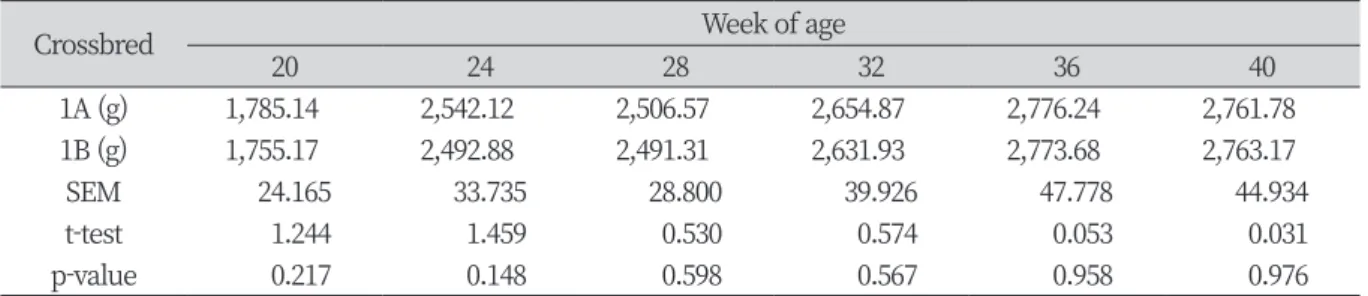
체중은 20주령부터 40주령까지 4주 간격으로 측정된 결과로서 Table 2에 나타내었다. 실험 전 구간에서 두 교배조 합 간의 유의적인 체중 차이는 나타나지 않았다. 이는 토종 육용종계 권장 급이량을 따라 제한급이를 실시하여 체중 을 조절하였으므로 유의적인 차이가 나타나지 않았다고 사료된다. 또한 Hong et al. (2012)에서의 산란전용 토종닭 종 계의 20주령 체중인 1,690 - 1,861 g 과 유사한 결과가 나타났지만 이는 제한급이에 따른 성장 제한 때문이라고 사료 되며, Kang et al. (1997)의 한국재래닭과 Rhode Island Red와의 교잡능력검정에서의 40주령 체중인 1,863 - 2,259 g 에 비하여 본 실험의 40주령 체중(2,761 - 2,763 g)이 높게 나타났다. 또한 Cho et al. (2018) 의 2,186 - 3,027 g 에 비하여 편 차가 낮게 나타났는데, 위 차이는 과거 실험과의 사료 품질이나 사양 관리 차이나 교배조합을 통한 형질 개선이 이 루어졌다고 사료된다.
초산일령
Table 3 는 2가지 교배조합의 초산일령에 대한 결과이다. 초산 일령에 대한 결과는 1A 교배조합에서 177일이었으 며 1B 교배조합에서 179일로 나타났다. 국립축산과학원에서 보유하고 있는 토종닭의 초산일령(165일)과 비교하였 을 때 1A는 12일, 1B는 14일 늦은 것으로 나타났는데 이 차이는 실험에 사용된 교배조합이 난육겸용으로 선발된 부 분과 사육환경의 차이에서 나타났을 것이라고 사료된다.
Table 2. Body weight of layer crossbred Korean native chickens for 20 to 40 weeks.
Crossbred Week of age
20 24 28 32 36 40
1A (g) 1,785.14 2,542.12 2,506.57 2,654.87 2,776.24 2,761.78
1B (g) 1,755.17 2,492.88 2,491.31 2,631.93 2,773.68 2,763.17
SEM 24.165 33.735 28.800 39.926 47.778 44.934
t-test 1.244 1.459 0.530 0.574 0.053 0.031
p-value 0.217 0.148 0.598 0.567 0.958 0.976
SEM, standard error of mean.
Table 3. Body weight of layer crossbred Korean native chickens for 20 to 40 weeks.
Crossbred ASMz
1A 177
1B 179
z Age of sexual maturity, defined as the first age reach to 50% production.
난중
Table 4는 교배조합에 따른 24주령부터 4주 간격으로 측정된 난중에 대한 결과이다. 난중은 36주령에서 1B가 1A 에 비해 높은 난중을 보였으며(p < 0.05), 그 외의 구간에서는 유의적인 차이가 나타나지 않았다. Kang et al. (1997)의 결과와 비교했을 때, 본 실험의 난중은 32주령을 제외하고 실험의 난중에 비해 낮게 나타났으나, Kang et al. (2012)이 보고했던 결과와 비교했을 때에는 전체적으로 높게 나타났다.
산란율
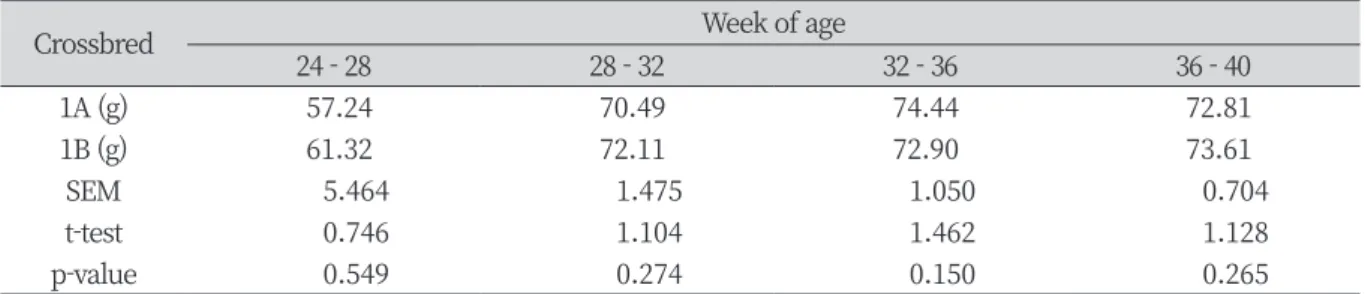
Table 5는 24주령부터 4주간격으로 산란율에 대하여 측정한 후 나타내었다. 산란율은 전 시험기간동안 두 교배조 합간에 유의적인 차이는 나타나지 않았다. 본 실험의 산란율은 Kang et al. (2012)과 Kang et al. (2011)의 결과와 비교해 보았을 때, 전체적으로 유사하거나 약간 낮은 산란율을 보여주었으며, 특히 본 실험의 24 - 28주령 산란율이 낮게 나 타났는데, 이는 공시계의 초산일령이 늦어졌기 때문이라고 사료된다.
사료요구율
Table 6에는 4주간격으로 측정된 사료섭취량과 난중을 이용하여 계산하였다. 사료요구율 역시 교배조합간 유의 적인 차이는 나타나지 않았다. Kang et al. (2012) 및 Kang et al. (2011)의 연구결과와 비교했을 때, 유사한 산란율을 나 타내었지만 본 연구결과에서 낮게 나타난 24주 사료요구율은 늦은 초산일령에 따른 늦은 산란율 증가의 영향을 받 았다고 사료되며, 특히 Kang et al. (2011)의 40주령 산란율인 78.5 - 85.4% 에 비하여 약간 낮은 산란율을 보인 것은 난 육겸용으로 선발된 부분이나 사료의 차이가 있었을 것이라고 사료된다.
Table 4. Egg weight of layer crossbreed Korean native chickens for 20-week.
Crossbred Week of age
24 28 32 36 40
1A (g) 44.22 52.10 55.15 59.91 61.37
1B (g) 41.83 52.39 57.07 60.45 61.95
SEM 1.737 0.566 0.724 0.745 0.746
t-test 1.374 0.398 2.648 0.726 0.780
p-value 0.180 0.691 0.009 0.469 0.436
SEM, standard error of mean.
Table 5. Hen-day egg production of layer crossbred Korean native chickens.
Crossbred Week of age
24 - 28 28 - 32 32 - 36 36 - 40
1A (g) 57.24 70.49 74.44 72.81
1B (g) 61.32 72.11 72.90 73.61
SEM 5.464 1.475 1.050 0.704
t-test 0.746 1.104 1.462 1.128
p-value 0.549 0.274 0.150 0.265
SEM, standard error of mean.
Conclusion
본 연구에서 두 교배조합의 체중, 초산일령, 산란율, 사료요구율간에 유의적 차이는 나타나지 않았으며, 난중에서 는 32주령의 1B 교배조합이 유의적으로 높은(p < 0.05) 차이를 제외하고 유의적인 차이는 나타나지 않았다. 교배조 합 간 유의적인 차이가 나타나지 않은 이유는 제한급이에 따른 영양소 섭취 제한 때문이라고 사료된다. 본 연구의 특수성으로 교배조합 1A, 1B의 계통정보를 기재하기 불가하지만, 위 결과는 잡종강세를 이용한 교배조합이 한국 재래닭의 생산성 향상을 시키기 위한 기초자료로 활용될 수 있을 것으로 사료된다.
Acknowledgement
본 연구는 IPET 농림수산식품기술기획평가원 Golden Seed Project (213010052SB240)의 연구비 지원에 의해 수행 되었으며, 이에 감사드립니다.
Authors Information
Jungmin Heo, Department of Animal Science and Biotechnology, Chungnam National University, Professor Samiru Sudharaka Wickramasuriya, https://orcid.org/0000-0002-6004-596X
Hyunmin Cho, https://orcid.org/0000-0002-9329-8824
Yubin Kim, Department of Animal Science and Biotechnology, Chungnam National University, Master student Young-Joo Yi, Chonbuk National University, Professor
Reference
Cho HM, Samiru SW, Shin TK, Kim EJ, Heo JM, Yi YJ. 2018. Comparison of the performance of the laying period of crossbred Korean native chickens from 20 to 40 weeks of age. Korean Journal of Agricultural Science 45:687-694. [in Korean]
Hong EC, Choo HJ, Kim HK, Kim CD, Heo KN, Lee MJ, Kang BS. 2012. Performance of growing period of two-way crossbreed parent stock for producing of laying-type Korean native commercial chickens.
Korean Journal of Poultry Science 39:177-182. [in Korean]
Kang BS, Cheong IC, Lee SJ, Kim SH, Ohh BK, Choi KS. 1997. Estimation of heterosis for some economic traits in crossbreds between Korean native chicken and Rhode island red I. Hatching and growing Table 6. Feed conversion ratio of layer crossbred Korean native chickens for 20-week.
Crossbred Week of age
24 - 28 28 - 32 32 - 36 36 - 40
1A (g) 6.05 3.90 3.68 3.75
1B (g) 5.44 3.79 3.75 3.70
SEM 1.038 0.078 0.055 0.058
t-test 0.590 1.358 1.206 1.589
p-value 0.557 0.180 0.234 0.118
SEM, standard error of mean.
performance in crossbreds between Korean native chicken and Rhode Island Red. Korean Journal of Poultry Science 24:117-126. [in Korean]
Kang BS, Choo HJ, Kim HK, Kim CD, Heo KN, Hwangbo J, Hong EC. 2012. Performance of laying period of two-way crossbreed parent stock Korean native chickens for producing of Korean native commercial chickens. Korean Journal of Poultry Science 39:133-141. [in Korean]
Kang BS, Hong EC, Kim HK, Kim CD, Heo KN, Choo HJ, Hwangbo J. 2011. Productivity and performance test of egg-type commercial Korean native chickens. Korean Journal of Poultry Science 38:331-338. [in Korean]
KNCA (Korean Native Chicken Association). 2019. The number of slaughtered chicken. KNCA, Seoul, Korea.
[in Korean]
Lee KH, Kim HJ, Lee HJ, Kang MG, Jo CR. 2012. A study on components related to flavor and taste in commercial broiler and Korean native chicken meat. Korean Journal of Food Preservation 19:385-392.
[in Korean]
MAFRA (Ministry of Agriculture Food and Rural Affair). 2017. Per capita consumption of livestock. MAFRA, Sejong, Korea. [in Korean]
NIAS (National Institute of Animal Science). 2017a. Definition of Korean native chicken. NIAS, Suwon, Korea. [in Korean]
NIAS (National Institute of Animal Science). 2017b. Korean feeding standard for poultry. NIAS, Suwon.
Korea. [in Korean]