Effect of natural antioxidant extracted from Citrus junos seib. or Prunus mume. on the quality traits of sun-dried Hanwoo beef jerky
Dong Gyun Lim
1, Jong Ju Kim
2, Kang Seok Seo
1, Ki Chang Nam
1*
1
Department of Animal Science and Technology, Sunchon National University, Suncheon 540-742, Korea
2
School of Biotechnology, Yeungnam University, Gyeongsan 712-749, Korea
유자 및 매실추출물 첨가가 천연건조 한우 육포의 품질특성에 미치는 영향
임동균
1ㆍ김종주
2ㆍ서강석
1ㆍ남기창
1*
1순천대학교 동물자원과학과, 2영남대학교 생명공학부
Received on 11 June 2012, revised on 14 June 2012, accepted on 14 June 2012
Abstract : The objective of the study was to evaluate the quality characteristics of sun-dried Hanwoo beef jerky added with the extract of Citrus junos seib. or Prunus mume. Hanwoo beef shank muscles were sliced, marinated, and sun-dried at 25°C, relative humidity of 35%. The physicochemical quality and microbiological safety of the Hanwoo beef jerky aerobically packaged were analyzed during the storage of 25°C. The moisture content of beef jerky with Citrus junos seib. was the lowest among the treatments after 20 d. Citrus junos seib. and Prunus mume jerky after 10 d had significantly lower a
wthan those after 0 and 20 d (p<0.05). The pH values of jerky generally ranged from 5.76 to 5.84. The pH value of Prunus mume jerky was significantly higher than those of other jerky samples (p<0.05). Prunus mume jerky showed significantly lower TBARS value than the others after 20 d (p<0.05). Citrus junos seib. jerky showed a significantly lower lightness (L*), redness (a*) and yellowness (b*) than the others during the storage (p<0.05). Prunus mume samples after 10 d had significantly higher L*, a*, and b* values than the others (p<0.05). With regard to sensory properties, Citrus junos seib. and Prunus mume jerky showed significantly higher flavor and overall acceptability scores than the control (p<0.05). The extracts of Prunus mume will be used in sun-dried Hanwoo beef jerky as a natural agent to retard lipid oxidation and to improve meat color.
Key words : Beef jerky, Sun-dried, Natural antioxidant, Meat quality
*Corresponding author: Tel: +82-61-750-3231 E-mail address: [email protected]
I. Introduction
Jerky is a word that derived from the Spanish word
“charque” which means dried meat. Historically, jerky is one of the oldest types of meat product that is preserved by salting and drying to reduce water activity and control microbial survival and growth (Han et al., 2008). Intermediate moisture (IM) meat products such as jerky are the result of application of the so-called hurdle technology which involves factors such as
temperature, water activity, and preservatives such as organic acids and spices in the preparation (Leistner, 1987).
Jerky is the result of application of the so-called hurdle technology which involves factors such as temperature, water activity, and preservatives such as organic acids and spices in the preparation (Fernández- Salguero et al., 1994; Leistner, 1987). Intermediate moisture (IM) meat products such as jerky can be preserved by salting and drying to reduce water activity.
Drying is the world's oldest and most common method
of food preservation in production of meat and meat
products. By drying, the IM meat products reach a w
of 0.6-0.9 equivalent to a RH of 60-90% at ambient temperature and the growth of microorganisms can be efficiently inhibited by a low a w system (Chang et al., 1996).
There are several types of drying methods in the process of making jerky. For example, natural drying, hot and cold air-drying, vacuum drying, freeze-drying and so on can be used (Edward and Pauline, 1965;
Holdsworth, 1971; Karel et al., 1978; Kim, 1990; Labelle and Moyer, 1996). Two types of natural drying are used mainly, which is sun and shade drying as traditional system. Both sun and shade-drying occur in the air, only shade one occurs without heat. Sun-drying sometimes takes place in a special container that catches and captures the sun's heat. These types of drying are used mainly for fruits such as apricots, tomatoes, and grapes. However, it is not recommended for making meat jerky due to a lack of a steady heat source and the potential for contamination from animals, insects, dust, and bacteria (FSIS, 2011). Furthermore, this traditional process could be very time-consuming in drying and hard to control moisture contents (Holdsworth, 1971; Lee and Park, 2004; Park et al., 2002).
Lipid oxidation can have negative effects on the quality of meat and meat products causing changes in sensory attributes (color, texture, odor, and flavor) and nutritional quality. Synthetic antioxidants such as butylated hydroxyanisole (BHA) and butylated hydroxy- toluene (BHT) have been widely used in meat to suppress or retard the lipid oxidation (Chastain et al., 1982).
However, the use of synthetic antioxidants has come under more scrutiny due to their potential toxicological effects (Rababah et al., 2004). Consumer preferences for
“natural” products have resulted in increased interest in the use of natural antioxidants. Scientists have demonstrated that some fruits and berries are a good source of antioxidants due to their flavonoid and polyphenol content (Skrede and Wrolstad, 2002; Wang et al., 1996). They can remove free radical which may cause various diseases, carcinogenesis, and aging (Pokomy,
1991).
The Prunus mume , a deciduous tree of the genus Rosaceae, originated in central China, has more than 400 varieties worldwide. The fruit has been used in folk medicine to alleviate fever, cough, and intestinal disorders. However, the raw fruit is poisonous due to two types of cyanogenic glucosides, i.e., prunasin and amygdalin (Ohtsubo and Ikeda, 1994), making it necessary to remove or destroy the toxins by processing methods such as pickling in vinegar, preparing it as liquor or syrup, and making a fruit-juice concentrate. Prunus mume has been traditionally used for preparation of liquor in Korea, and thousands tons of byproducts of Prunus mume after manufacturing liquor are annually produced in Korea.
Citrus junos Sieb is a citrus fruit native to northeast Asia, including Korea, China, and Japan (Taninake et al., 1964). Particularly in Korea, it has been commonly used as a raw material for beverages and herbal medicines due to its unique flavor and effectiveness against colds (Choi et al., 2000; Sawamura et al., 1999). The high content of vitamin C and phenolic substances in Citrus junos Sieb might be associated with significant health benefits (Gorinstein et al., 2001).
Citrus junos seib . is industrially used in sweet production, beverages, cosmetics and perfumery, and also in aromatherapy (Sawamura et al., 2005). This fruit has been known for its antioxidant activity that was reported to be higher in peel than in flesh (Yoo et al., 2004) and anti-carcinogenic property (Sawamura et al., 2005).
So far, there has been little information to assess
the quality and microbiological aspects of sun-dried
Hanwoo beef jerky added with natural antioxidants
such as Prunus mume or Citrus junos Sieb . Therefore,
the aim of the study was to evaluate the effects of
natural antioxidant extracts on the quality characteristics
in sun-dried Hanwoo (Korean native cattle) beef jerky
during storage.
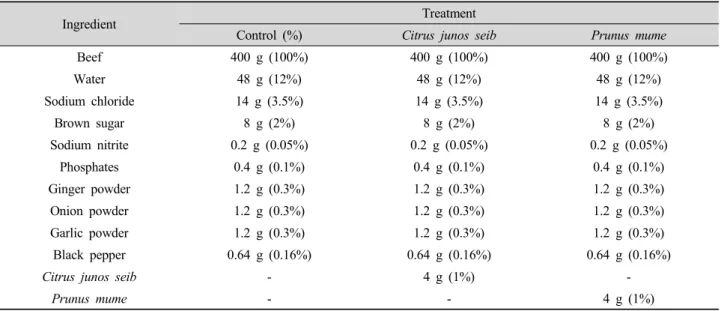
Table 1. Formula for the preparation of Hanwoo beef jerky added with different natural antioxidants.
Ingredient Treatment
Control (%) Citrus junos seib Prunus mume
Beef 400 g (100%) 400 g (100%) 400 g (100%)
Water 48 g (12%) 48 g (12%) 48 g (12%)
Sodium chloride 14 g (3.5%) 14 g (3.5%) 14 g (3.5%)
Brown sugar 8 g (2%) 8 g (2%) 8 g (2%)
Sodium nitrite 0.2 g (0.05%) 0.2 g (0.05%) 0.2 g (0.05%)
Phosphates 0.4 g (0.1%) 0.4 g (0.1%) 0.4 g (0.1%)
Ginger powder 1.2 g (0.3%) 1.2 g (0.3%) 1.2 g (0.3%)
Onion powder 1.2 g (0.3%) 1.2 g (0.3%) 1.2 g (0.3%)
Garlic powder 1.2 g (0.3%) 1.2 g (0.3%) 1.2 g (0.3%)
Black pepper 0.64 g (0.16%) 0.64 g (0.16%) 0.64 g (0.16%)
Citrus junos seib - 4 g (1%) -
Prunus mume - - 4 g (1%)
II. Materials and Methods
1. Preparation of beef jerky
Four fresh Hanwoo beef shank muscles (Goheung, Jeonnam province) were randomly purchased from local retail shops to make 4-replication and were frozen at -45 o C and stored until analysis. Prior to 1 d, the frozen beef samples were thawed until internal temperature shows below -1 o C in the refrigerator, sliced to 0.5 cm thick pieces with a meat slicer (HFS 350G, Hankook Fugee Industries Co. Ltd., Korea) and cut into cubes.
Sliced jerky samples were cut parallel in direction to muscle fibers and all subcutaneous and intramuscular fat and visible connective tissue were removed from the fresh muscles. The formulation in production of Hanwoo beef jerky is presented in Table 1. The manu- facturing process of Hanwoo beef jerky is as follows.
The fruits of Citrus junos seib . and Prunus mume . were dried at 70 o C for 24 h, then was crushed by an electric mixer (Model FM-909T; Hanil Electric, Seoul, Korea).
The crushed samples were passed through a 65 mesh sieve. Each 10 g of samples was extracted with 100 mL of methanol in a shake incubator overnight at room temperature and filtered through a Whatman no. 1 filter
paper. The residue was re-extracted under the same conditions. The first and second extracts were pooled and filtered through a Whatman nylon membrane filter (0.2-lm; Millipore filtration kit, Millipore Co., Bedford, UK). The methanol in the filtrate was evaporated using a rotary evaporator (Model Eyela N-1000; Tokyo Rikakikai Co., Japan). The dry extract was stored in glass vials at -70 o C until tested and analyzed. Three different beef jerky formulation containing 0% (control), 1% ( Citrus junos seib .) and 1% ( Prunus mume ) added natural antioxidants were formulated (Table 1). The sliced beef samples were then cured for 24 h in a cure solution. All cured muscle samples were mixed using a mixer (5K5SS, KitchenAid Co. Ltd., USA) for 1 min and aged for 24 h in refrigerated temperature. After aging, all cured muscles samples were sun-dried for the experiments and it was dried directly in the sun with autumn breezes at a temperature of 25-28 o C, 26 to 28%
relative humidity for 3.5 h until below 0.75 a w is
achieved. The jerky samples were loosely packed, without
vacuum, in oxygen impermeable plastic bags (single
package), display to laying flat on the desk per each
samples and stored at room temperature for up to 20
d.
2. Moisture contents and a w
Moisture content was obtained with a slightly modified method of AOAC methods (AOAC, 2000). The total moisture content of 3 g of finely chopped samples placed in aluminum moisture dishes were determined from their pre-dry and dry weights (dried in an air oven at 104 o C for 24 h) and expressed as the percen- tage of pre-dry weight and gram water per gram dry weight. The moisture content was determined in tripli- cate on each jerky product. Three pieces of the dried jerky samples from each treatment were selected and cut into small pieces using sharp scissors and were homogenized prior to measurement of water activity.
The pieces were put into aw cups, and their water activities determined with a aw meter (BT-RS1, Rotronic, Switzerland), calibrated at ambient temperature (25 o C) with distilled water (a w = 0.999)
3. pH
The pH of samples was determined with a pH meter (Orion 2 Star, Thermo scientific, Beverly, MA, USA).
The pH values of jerky were measured by blending a 3 g sample with 27 mL distilled water for 60 s in a homogenizer (Polytron PT 10-35 GT, Kinematica AG, Luzern, Switzerland). The pH meter was calibrated daily with standard buffers of pH 4.0 and 7.0 at 25 o C.
4. Instrument color
The surface color value of the jerky samples were measured by the CIE L*, a* and b* system using a Minolta chromameter (Model CR-410, Minolta Co. Ltd., Japan), with measurements standardized with respect to a white calibration plate (L* = 89.2,a* = 0.921, b*
= 0.783) after 30 min blooming at room temperature.
Color measurements for each of three replicates were taken and the L*, a* and b* value was recorded.
5. TBARS (2-thiobarbituric acid reactive substance)
The TBARS of jerky samples were analyzed by the method described by the procedure of Ahn et al. (1998).
A 2.5 g jerky sample was homogenized using a homogenizer (Polytron PT 10-35 GT, Kinematica Co., Switzerland) with 15 ml of distilled water for 2 min and then transferred to 100 ml falcon tube. 1 ml of solution was placed in test tubes and 50 μL buylated hydroxytoluene (7.2% in ethanol, w/v) and 2 ml thiobarbituric acid/trichloroacetic acid solution (20 mM TBA/15%, w/v) were added to the tubes. The mixture was vortexed and then incubated in a 90 o C boiling water bath for 15 min to develop color. The sample was cooled in cold water for 10 min, and centrifuged for 15 min at 3,000 g. The absorbance of the resulting supernatant solution was determined at 531 nm against a blank containing all the reagents minus the sample. One ml of distilled water was added to test tube and mixed with 2 ml of TBA/TCA solution for blank sample. The TBARS was determined in triplicate on each jerky product. The amount of color was measured in a UV spectrophotometer (T60 U., Karaltay Scientific Instruments Co., China). The results were expressed as mg malonaldehyde/kg sample.
6. Microbiological analysis
The jerky samples were analyzed by the method described by the procedure of Ahn et al. (1998). A 2.5 g jerky sample was homogenized using a homogenizer.
The jerky samples (10 g) were placed in 90 ml sterilized
peptone water (1% sterile peptone,w/v) in a sterile
stomacher bag. Samples were then homogenized using
a stomacher (Interscience BagMixers, Hanover, MA,
USA) for 2 min and diluted with peptone water for a
microbial count. One ml of stomached and serially
diluted with saline solution by 10-fold was plated in
triplicates. Total aerobic bacteria and Yeast/Mold
were determined by plating the diluted samples onto
Table 2. Moisture content and water activity of sun-dried Hanwoo beef jerky added with natural antioxidants during storage.
Treatment Storage (days)
SEM
10 10 20
Moisture (%)
Control 24.33
b24.00
b25.22
ab0.78
Citrus junos seib Prunus mume
27.33
ay23.67
by29.47
ax24.03
by24.03
bz26.89
ax2.43 1.63
SEM 1.74 2.76 1.45
Water activity
Control 0.69
c0.66
b0.65 0.03
Citrus junos seib Prunus mume
0.71
bx0.74
ax0.65
bz0.67
az0.68
y0.69
y0.03 0.03
SEM 0.02 0.01 0.03
1
Standard error of the means (n = 9).
a-c
Figures with different letters within the same column differ significantly (p<0.05).
x-z
Figures with different letters within the same row differ significantly (p<0.05).
plate count agar (PCA, Difco, Detroit, MI, USA) and incubating the plates at 37 o C for 48h. Each microbial count was the mean of three determinations. Microbial colonies were counted and expressed as colony forming units per gram of sample (CFU/g).
7. Sensory evaluations
The sensory scores were evaluated independently by trained sensory panelists for each sample after making sun-drying jerkys using a nine-point quan- titative descriptive method, varying from dislike/weak extremely (score 1) to like/strong extremely (score 9). The mean value from three repeated measurements was determined.
8. Statistical methods
An analysis of variance were performed on all the variables measured using the General Linear Model (GLM) procedure of the SAS statistical package (SAS Inst., 1999). The Duncan’s multiple range test ( p <0.05) was used to determine differences among the treatment means.
III. Results and Discussion
1. Moisture contents and water activity (a w )
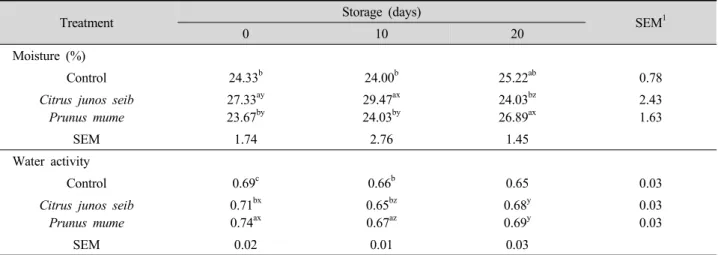
One of the most important attributes of jerky products is moisture content (Yang et al., 2009). Changes in moisture content and a w of beef jerky added with natural antioxidants during storage are shown in Table 2. In the present experiment, drying process of beef jerky have finished by reaching below 0.75 a w to be given under the similar drying condition between control and treatments. Moisture content (0 and 10 d) of Citrus junos seib . one was higher than others (p<0.05). Initial a w (0 d) of control (sun-dried one) was the lowest among the treatment (p<0.05). In the study of Bone (1973) and Chang et al. (1996), the a w of jerky generally ranged from 0.65 to 0.90. In this investigation, the a w values of sun-dried samples were very similar to the a w values of about 0.70 found by Torres et al.
(1994) for the Charqui, a typical Brazilian meat product obtained by salting and sun-drying beef jerky under the similar condition.
As presented in Table 2, moisture content of Citrus
junos seib . one was the lowest among the treatment
Table 3. pH and TBARS values of sun-dried Hanwoo beef jerky added with natural antioxidants during storage.
Treatment Storage (days)
SEM
10 10 20
pH
Control 5.77
by5.82
xy5.84
ax0.04
Citrus junos seib Prunus mume
5.81
ab5.82
a5.81 5.76
5.80
b5.82
b0.03 0.04
SEM 0.03 0.05 0.02
TBARS (mg malonedialdehyde/kg)
Control 0.68
az1.14
y1.39
ax0.32
Citrus junos seib Prunus mume
0.65
aby0.61
bz1.09
x0.99
x1.10
bx0.90
cy0.22 0.17
SEM 0.05 0.11 0.21
1
Standard error of the means (n = 9).
a-c
Figures with different letters within the same column differ significantly (p<0.05).
x-z
Figures with different letters within the same row differ significantly (p<0.05).
after storage of 20 d. Citrus junos seib . and Prunus mume jerky after storage of 10 d showed significantly lower aw than that after storage of 0 and 20 d sample (p<0.05), which may be due to the water evaporation that could be caused by low relative humidity (about 20-25%) during storage. In general, commercial inter- mediate moisture foods have moisture contents of 17%
to 25% (Chen et al., 2004; Jose et al., 1994; Jung et al., 1994) and similar results were obtained in this investigation. In this experiment, the pattern of moisture content and a w decrease did not observed in all samples during storage. This result may be due to the low temperature in comparison of conventional (hot air drying) jerky producing method.
When producing jerky products, it is crucial to control the moisture contents because a w is closely related to moisture contents (Leistner, 1987). Jerky products need to have a stable aw to avoid changes in quality during storage (Yamaguchi et al., 1986). Normally, jerky manufacturing methods include addition of meats with humectants to lower a w (Chang et al., 1996; Han et al., 2008). The composition of jerky products is controlled by use of humectants, which prevent migration of moisture (Han et al., 2011). Eventually, it may be postulated that no decrease in moisture contents and
a w during storage could be attributed to no use of humectants and the low temperature in the process of beef jerky production.
2. pH and TBARS
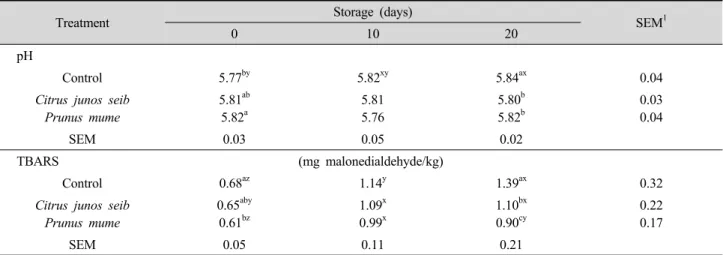
Changes in pH and TBARS values of beef jerky added with natural antioxidant during storage are presented in Table 3. The pH values of jerky generally ranged from 5.76 to 5.84. The pH value of Prunus mume jerky was significantly higher than those of other jerky samples (p<0.05). The high levels of pH value seem to be due to the denaturation in meat protein by heating and dehydration (Lee et al., 1997).
Jose et al. (1994) reported that the pH for beef jerky products was in the broad range of 4.72–6.73. Yang and Lee (2002) observed that the pH of commercial beef jerky samples was within the range of 5.4–5.8.
Several studies have demonstrated that pH values of beef jerky samples decreased slightly during the storage periods (Choi et al., 2007; Okonkwo et al., 1992).
According to Leistner (1987), spoilage of various dried meat products by mold growth can be inhibited or delayed by a lowering pH.
TBARS value is the most common indicator used to
Table 4. CIE color values of sun-dried Hanwoo beef jerky added with natural antioxidants during storage.
Treatment Storage (days)
SEM
10 10 20
L*
Control 32.05
ax30.21
by29.24
az1.28
Citrus junos seib Prunus mume
30.70
bx32.28
ax28.06
cy31.04
ay28.11
cy28.61
bz1.36 1.63
SEM 0.92 1.33 0.49
a*
Control 15.76
ax4.63
by4.84
ay5.52
Citrus junos seib Prunus mume
13.12
bx13.99
bx2.34
cy7.46
ay2.44
cy4.00
bz5.39 4.42
SEM 1.39 2.22 1.06
b*
Control 7.17
ax3.98
by3.96
ay1.61
Citrus junos seib Prunus mume
5.95
bx6.55
abx2.46
cy5.01
ay2.54
cy3.48
bz1.74 1.34
SEM 0.62 1.12 0.63
1
Standard error of the means (n = 9).
a-c
Figures with different letters within the same column differ significantly (p<0.05).
x-z
Figures with different letters within the same row differ significantly (p<0.05).
measure the degree of lipid oxidation in meat products (Chen et al., 2004). As presented in Table 3., Prunus mume jerky showed significantly lower TBARS value than others after storage of 0 and 20 d (p<0.05). This may be due to the fact that the extract of Prunus mume showed antioxidative and free radical scavenging activity (Shim et al., 2002). It contains several flavonoids such as naringenin and rutin has been identified as one of antioxidant components of Prunus mume (Han et al., 2001). The findings of this study agree with Oh et al. (2007) indicated that the extract of Prunus mume had a great effect in inhibiting the lipid oxidation of jerky during storage. This also in agreement with Jo et al. (2006) reported that addition of Prunus mume in chicken breast meat had lower TBARS values than the control by about 45%. Similar findings were obtained by Lee et al. (2004) who observed that TBARS values of sausage containing 0.9% citron peel powder showed lower than control. Except the decrease of Prunus mume samples after storage of 20 d, the TBARS value of all jerky samples increased during storage, regardless
of control and treatments (p<0.05). It is normally accepted that TBARS value increases in meat with increasing storage time (Jung et al., 1994; Yang et al., 2009). Chen et al. (2004) noted that as aw value decreases, there was a proportional increase of lipid oxidation and this is closely related to the presence of NaCl which acts as pro-oxidant (Torres et al., 1994). It is assumed that Prunus mume samples had influence in controlling the lipid oxidation of jerky from these results.
3. Color measurements
Meat color is one of the most important quality
traits and could be affected by a number of factors
such as pH, protein denaturation, and water content
(Feiner, 2006; Young and West, 2001). Color values
of beef jerky added with natural antioxidant during
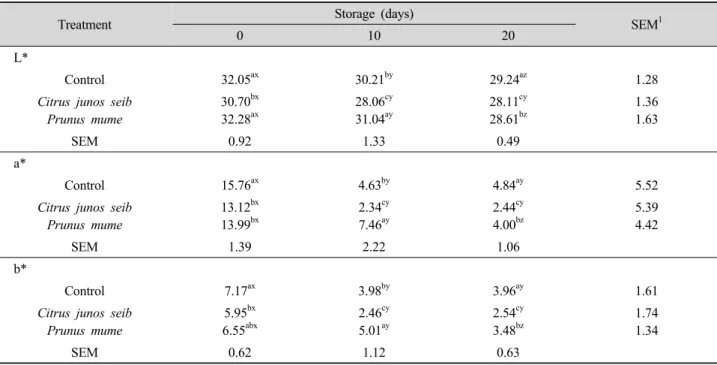
storage are shown in Table 4. Citrus junos seib . jerky
showed a significantly lower lightness (L*), redness
(a*) and yellowness (b*) than others during the storage
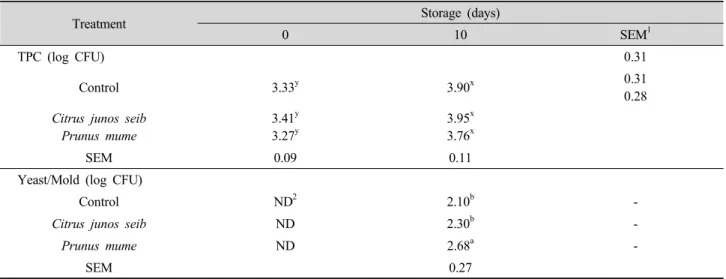
Table 5. Total plate counts (TPC) and Yeast/ Mold of sun-dried Hanwoo beef jerky added with natural antioxidants during storage
Treatment Storage (days)
0 10 SEM
1TPC (log CFU) 0.31
Control 3.33
y3.90
x0.31
0.28 Citrus junos seib
Prunus mume
3.41
y3.27
y3.95
x3.76
xSEM 0.09 0.11
Yeast/Mold (log CFU)
Control ND
22.10
b-
Citrus junos seib ND 2.30
b-
Prunus mume ND 2.68
a-
SEM 0.27
1
Standard error of the means (n = 9).
2
Not detected.
a,b
Figures with different letters within the same column differ significantly (p<0.05).
x,y
Figures with different letters within the same row differ significantly (p<0.05).
period (p<0.05). Prunus mume samples after storage of 10 d showed a significantly higher lightness (L*), redness (a*) and yellowness (b*) than others (p<0.05).
The findings of this study agree with Oh et al. (2007) noted that the redness (a* values) of jerky added with the Prunus mume had a similar level as the one with nitrite. This is due to the fact that rutin or naringenin, antioxidant compounds isolated from the Prunus mume ., could maintain the meat color stability (Han et al., 2001). Sherwin and Labuza (2003) showed that discolo- ration of jerky products could be affected by temperature.
All treatments caused a significant decrease in L*, a*
and b* (p<0.05). The findings of the study agree with Teixeira et al. (2011) who air-drying in meat samples could reduce L*and b* values, which became less luminous, yellow and vivid.
4. Microbiological analysis
Changes in total plate counts and Yeast/Mold of beef jerky added with natural antioxidants during storage are provided in Table 5. The total microbial counts of jerky were within a range of low level from 3.27 to 3.41 log CFU at 0 d of storage. There were no
significant differences observed TPC at 0 and 10 d of storage, regardless of treatments. However, yeast/mold of Prunus mume beef jerky was significantly higher than that of others after storage of 10 d (p<0.05). Yang and Lee (2002) evaluated that TPC of domestic and imported commercial beef jerky was within 3 to 4 log CFU range, which this finding was in correspondence to these criteria in this experiment. Microbial growth could deteriorate the meat and meat products quality.
The low microbial levels seem to be due to the fact
that microbial growth is inhibited at low aw (Gould
and Christian, 1988; Hocking, 1988; Torres et al.,
1994). The aw, which is the measure of the free water
present in food products, can sustain the growth of
microorganisms (Choi et al., 2008). It is speculated
that the growth of microorganisms can be efficiently
controlled and inhibited by additional drying, treatment
of antimicrobial or organic acid and vacuum packaging
and so on. Presently, there is no legal limit for total
aerobic counts in dried preserving meats such as jerky
products on standards for processing and ingredients
specifications of livestock products in Korea (QIA
Notification, 2011). Regulation in jerky should be
established by government authority for meat safety
Table 6. Sensory evaluation of sun-dried Hanwoo beef jerky added with natural antioxidants at day 0.
Treatment Control Citrus junos seib Prunus mume SEM
1Color 6.25 5.00 5.50 0.90
Flavor 6.00
z8.25
x7.25
xy1.27
Tenderness 6.00 6.50 6.75 0.67
Juiciness 5.50 6.00 5.75 0.75
Acceptability 5.75
y8.00
x6.75
xy1.27
1
1: extremely bad ~ 9: extremely good.
2
Standard error of the means (n = 15).
x-z