46(4) : 327∼ 333 (2015)
327
모과 에탄올 추출물의 아세틸콜린에스테라제 저해활성과 신경세포에서 아밀로이드 전구단백질의 대사에 미치는 영향
김주은·조윤정·임재윤* 우석대학교 약학대학
The Acetylcholinesterase Inhibitory Activity of the EtOH Extract of Chaenomelis Fructus and its effects on the Metabolism of Amyloid
Precursor Protein in Neuroblastoma Cells
Ju Eun Kim, Youn Jeong Jo, and Jae Yoon Leem* College of Pharmacy, Woosuk University, Jeonju 55338, Korea
Abstract − Alzheimer's disease (AD) is a progressive neurodegenerative disorder symptomatically characterized by impair- ment in memory and cognitive abilities. AD is characterized pathologically by the deposition of β-amyloid (Aβ) peptides of 40-42 residues, which are generated by processing of amyloid precursor protein (APP). Aβ has been believed to be neurotoxic and now is also considered to have a role on the mechanism of memory dysfunction. In this study, we tested that EtOH extract of the fruits of Chaenomeles sinensis Koehne (CSE) affects on the processing of APP from the APPswe over-expressing Neu- ro2a cell line. We found that CSE increased over 2 folds of the sAPPα secretion level, a metabolite of α-secretase. We showed that CSE reduced the secretion level of Aβ42 and Aβ40 by down regulation of β-secretase (BACE) without cytotoxicity. Fur- thermore, we found that CSE inhibited BACE and acetylcholinesterase activity in vitro. We suggest that Chaenomelis Fructus may be an useful source to develop a herbal medicine for AD.
Key words − Chaenomeles sinensis (Thouin) Koehne, Alzheimer's disease, β-amyloid, Acetylcholinesterase, APPswe, BACE
국내의 65세 이상의 노인인구 비율은 2015년 현재 약 13%
이나 2030년에는 약 24%, 2060년에는 약 40%로 증가할 것 으로 예상된다. 고령화와 더불어 치매환자 수도 급속히 증 가하고 있어 개인의 삶의 질을 저하시킬 뿐만 아니라 과다 한 의료비 지출로 인한 커다란 사회·국가적 문제로까지 대 두되고 있다.1)알츠하이머 질환은 치매의 가장 주요한 발병 요인으로서 familial type과 sporadic type으로 분류되며, 전 체 질환의 90% 이상이 주로 65세 이상의 노인에게 나타나 는 sporadic type이다.2) Familial type은 amyloid precursor protein(APP), presenilin 1(PS1), presenilin 2(PS2) 유전자의 돌연변이가 병인으로 알려져 있으며,3) sporadic type의 경우 는 그 원인이 노화 및 ApoE4 대립형질의 다양성이 병인으 로 보고되었다.4,5) Aβ(β-amyloid)의 축적에 의한 노인 반은 familial type과 sporadic type 모두에서 공통적으로 나타나
는 병리현상이다. Aβ는 베타 아밀로이드 전구단백질인 APP(Amyloid precursor protein)가 β-secretase(BACE)6) 및 γ-secretase에 의해 분해되어 생기는 펩티드이다.7)알츠하이 머 질환 치료제 개발을 위한 표적 중 하나인 γ-secretase는 presenilin(PS), nicastrin(NCT)과 anteria pharynx defective gene의 단백질 산물인 APH-1, presenilin enhancer gene의 단백질 산물인 PEN-2 등으로 이루어진 complex로서 활성 을 나타낸다. BACE knock-out 생쥐는 정상적으로 발육되 므로 BACE가 치매 치료제 개발의 중요한 표적이 되고 있 다. APP는 기질로서 α-secretase와 BACE에 의해 경쟁적으 로 대사되므로 α-secretase의 효소활성이 증가되면 BACE의 활성이 감소된다.7-9) 최근 이와 같은 발병기전의 연구와 더 불어 효소 저해제 및 Aβ 백신요법 등과 같은 치료제 개발 을 위한 연구가 활발히 진행되고 있으나, 임상에서는 Acetylcholinesterase(AChE) 저해제가 치료개선제로서 사용 되고 있을 뿐 효과적인 치료제는 없는 실정이다.10-12)
본 연구에 사용한 모과(Chaenomelis Fructus)는 모과나무
*교신저자(E-mail):[email protected] (Tel): +82-63-290-1560
(Chaenomeles sinensis (Thouin) Koehne, 장미과 Rosaceae) 의 열매로서 중국 원산이며 전라도, 충청도, 경기도에서 많 이 나고 중국, 일본 등지에 분포한다. 달걀모양반구형이며 길이 10~20 cm, 지름 8~15 cm이며 9월에 황색으로 익으며 향기가 좋으나 신맛이 강하다. 한방에서는 잘 익은 열매를 건조한 것을 모과(木瓜)라 하며 약성은 온(溫)하고 미(味)는 산(酸)하다. 서근(舒筋), 청간(淸肝), 화위(和胃), 제습(除濕), 조혈(造血)의 효능이 있어 목과탕, 백작목과탕, 오수목과탕 등에 사용한다.13-15) 한편, 모과의 활성성분으로 β-sistosterol, oleanolic acid, ursolic acid, flavonoids 등이 보고되었으며16) 에탄올 추출물이 Aβ(25-35)의 투여에 의한 신경세포사멸 및 생쥐 기억손상을 억제한다는 보고가 있다.17)
본 연구에서는 Aβ의 분비를 감소시키는 약물을 선발하기 위해 국내 자생식물의 추출물을 Aβ를 과량 발현하는 알츠 하이머 질환의 신경세포 모델(APP 변이유전자 APPswe 발 현세포주)에서 그 효능을 스크리닝한 결과, 모과 과육의 에 탄올 추출물이 α-secretase의 활성을 증가시킴과 동시에 Aβ 의 분비를 감소시켰다. 이는 세포모델에서 BACE의 단백질 발현 또는 stability를 감소시켜 효소활성을 조절하는 것으로 생각된다. 더불어 in vitro에서 BACE 및 AChE에 대한 저 해활성을 나타내었기에 그 결과를 보고하고자 한다.
재료 및 방법
세포주 − APP swedish 유전자가 과잉 발현되는 생쥐유래 신경세포주인 Neuro2a(APPswe)를 동경대학의 Iwatsubo 교 수로부터 제공받아 5% FBS(Gibco, Grand Island, NY), L- glutamic acid, penicillin/streptomycin, hygromycin이 함유된 Dulbecco's Modified Eagel's Medium(Gibco, Grand Island, NY)과 OPTI MEM(Gibco, Grand Island, NY)의 혼합 배지 에서 37oC, 5% CO2의 조건으로 배양하였다.
시약 − 모과(Chaenomelis Fructus) 과육의 EtOH 추출물 (이하 CSE로 略함)은 한국 추출물은행으로부터 구입하여 일 정량의 DMSO에 용해하여 사용하였다. β-secretase inhibitor III(Calbiochem, Darmstadt, Germany), Galantamine hydro- bromide(USP, Rockbille, MD), Tacrine hydrochloride (Cayman, Ann arbor, MI) protease inhibitor (Sigma, St.
Louis, MO), anti-human sAPPα monoclonal antibody 2B3 (IBL, MN, USA), rabbit anti-amyloid precursor protein polyclonal antibody CT(Stressgen, Victoria, Canada), rabbit anti-amyloid precursor protein polyclonal antibody CT20 (Calbiochem, Darmstadt, Germany), rabbit anti-BACE1 polyclonal antibody LK-16(Sigma, St. Louis, MO), rabbit anti-actin polyclonal antibody(Sigma, St. Louis, MO), human amyloid β assay kit(IBL, Kunma, Japan), Enhanced Cell Viability Assay Kit, Ez-Cytox(Daeil, Korea)를 사용하
였고 그 밖의 시약은 특급을 사용하였다.
Aβ의 분비에 대한 저해효과 검정 − APPswe 세포주로부 터 분비되는 Aβ의 양을 측정하기 위해 sandwich ELISA를18) 실시하였다. 1×10⁶ 세포를 60 mm dish에서 배양하여 serum- free DMEM으로 교환하고 16 시간이 경과한 후 DMSO에 용해시킨 CSE 5, 50 μg/ml 또는 양성대조군인 β-secretase inhibitor III19) 10 µM을 처리하였다. 24시간 배양 후, 배양 액을 protease inhibitor의 존재 하에 회수하여 시료로 사용 하였다. Aβ(35-40) 특이적 monoclonal antibody 또는 Aβ (38-42) 특이적 polyclonal antibody가 각각 coating된 plate 에 100 μl의 시료를 넣고 4oC에서 16시간 동안 반응시키고 7회 세척한 후, HRP conjugation된 Aβ(11-28) 특이적 monoclonal antibody를 4oC에서 1시간 동안 반응시켰다. 다 시 9회 세척한 후 tetramethyl benzidine(TMB) 기질액을 넣 고 실온에서 30분 동안 반응시킨 후 정지액 100 μl를 첨가 하여 450 nm에서 Model 680 Microplate Reader(Bio-Rad, Hercules, CA)를 이용하여 흡광도를 측정하였다.
세포독성 분석 − EZ-CYTOX 키트를 사용하여 CSE의 APPswe 세포주에 대한 세포독성을 측정하였다. 5×10³ 세포 를 96 well plate에서 배양하여 DMSO에 용해시킨 CSE를 1, 5, 10, 50μg/ml 농도로 24시간 처리하였다. Water-soluble tetrazolium 용액 10 μl를 첨가하여 1시간 배양한 후, 450 nm 에서 Model 680 Microplate Reader(Bio-Rad, Hercules, CA)를 이용하여 흡광도를 측정하였다.
단백질 분석 − 단백질 분석은 Western blotting 방법에 의 해 수행하였다.20) 1×10⁶ 세포를 60 mm dish에서 배양하여 24시간 후에 DMSO 또는 CSE 1, 5, 50 μg/ml을 처리하였 다. 24 시간 후, 배양액을 PMSF 존재 하에 회수하고 PBS 로 세척한 세포에 protease inhibitor를 첨가한 cell lysis buffer(150 mM NaCl, 50 mM Tris-HCl, pH 7.4, 0.5% NP- 40, 0.5% sodium deoxycholate, 5 mM EDTA)를 넣고 초음 파 분쇄하여 시료로 사용하였다. 단백질 50 μg을 7%, 10%
Tris-glycine 또는 16.5% Tris-tricine SDS-PAGE로 분리한 후, immunoblotting에 의해 APP, sAPPα, APP carboxy terminal fragment α(CTF-α) 등의 단백질 양상을 Azure C- 600(Azure Biosystems, Dublin, CA)을 이용하여 분석하였다.
3회 반복 실험에 의해 얻어진 단백질 밴드를 AzureSpot software(Azure Biosystems, Dublin, CA)에 의해 정량하였 으며 actin 밴드를 기준으로 보정하였다.
BACE 저해 활성 분석 − BACE에 대한 저해활성은 BACE-1 FRET(fluorescence resonance energy transfer) 분석 키트(PanVera Co, Madison, WI)를 사용하여 측정하였다.21) 96 well plate 에 DMSO 또는 CSE 1, 5, 50 μg/ml, BACE-1 기질(Rh-EVNLDAEFK quencher, in 50 nmol/L ammonium bicarbonate), BACE-1 효소[in 50 mM Tris (pH7.5), 10%
glycerol) (1.0 U/ml)]를 각각 10 μl씩 넣은 후 차광하여 실
온에서 반응시킨다. 반응 1시간 후 정지액(2.5 mol/L sodium acetate) 10μl를 넣고 multiwell spectrofluorometer(infinite F200, TECAN, Switzerland)를 이용하여 emmision 585 nm, excitation 545 nm에서 형광을 측정하였다. 이 때 양성대조 군은 β-secretase inhibitor III(β-SI) 10 μM을 사용하였으며, 각 시료에 대한 BACE-1 저해활성을 3회 반복하여 분석한 후 통계 처리하였다.
Acetylcholinesterase 저해 활성 분석 − Acetylcholine- sterase(AChE)에 대한 저해 활성은 Acetylcholinesterase Activity Colorimetric assay 키트(BioVision, Milpitas, CA) 를 사용하여 측정하였다. 96 well plate에 DMSO 또는 CSE 1, 5, 10, 50μg/ml, acetalcholinesterase 효소를 각각 30, 10μl씩 넣은 후 rection mixture를 50 μl씩 넣고 차광하여 실 온에서 반응 시킨다. 대조약물로는 1 μM tacrine 혹은 10 μM galantamine을 사용하고, AChE 효소활성은 시료를 첨가하 지 않은 대조군의 흡광도를 100%로 하여 Model 680 Microplate Reader(Bio-Rad, Hercules, CA)를 사용하여 570 nm에서 흡광도를 측정하였다. 각 시료에 대한 AChE 저 해활성을 3회 반복하여 분석한 후 통계 처리하였다.
통계처리 − 각 실험군(n=3) 간의 유의성 검정은 one-way ANOVA(Prism5) 프로그램으로 하였으며, P값이 0.05, 0.01 및 0.001 이하를 기준으로 유의성 여부를 판정하였다.
결 과
Aβ 분비 저해효과 및 세포독성 − APPswe 세포주에 CSE 를 처리한 후 배양액으로 분비된 Aβ의 양을 sandwich ELISA 방법으로 측정하여 비교 정량하였다. 즉, 음성 대조 군(C)인 DMSO를 처리한 시료의 Aβ의 분비량을 100%로 하여 CSE를 처리한 경우의 분비량을 백분율로 표시하였다.
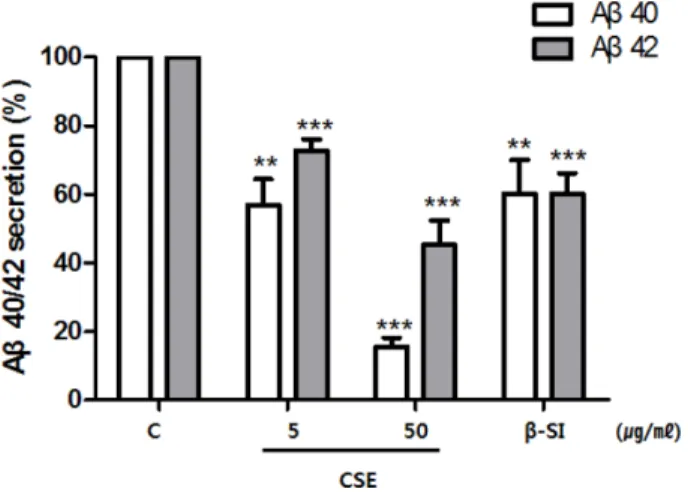
CSE 5, 50μg/ml 처리 시 Aβ40의 분비량이 음성대조군의 각각 56.97±7.4, 15.49±2.7%이었으며 Aβ42의 분비량은 각 각 72.61±3.3, 45.27±7.0%이었다. 양성 대조군으로 사용한 β-secretase inhibitor III(β-SI) 10 µM도 두 종의 Aβ에 대하 여 약 60%의 저해활성을 나타내었다(Fig. 1). 한편, CSE의 APPswe 세포주에 대한 독성분석을 실시한 결과, 1, 5, 10, 50μg/ml 처리 세포의 생존력은 대조군의 세포 생존력과 비 교하여 각각 99.12±1.1, 99.06±1.2, 98.94±2.2, 90.48±1.2%
을 나타내었다(Fig. 2).
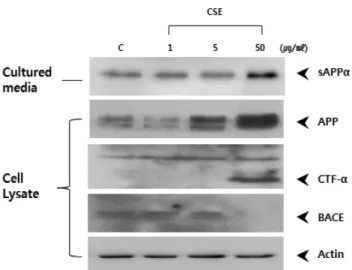
APP 및 관련 단백질 양상에 미치는 효과 − 위에서 확인 한 CSE에 의한 Aβ 분비 감소효과의 메커니즘을 규명하기 위해 CSE를 처리한 APPswe 세포주로부터 lysate를 회수하 여 Western blotting에 의해 APP, sAPPα, BACE, CTF-α의 단백질 양상을 분석한 결과를 Fig. 3에 나타내었다. CSE 처 리 세포주의 배양액으로부터 sAPPα 단백질 양상을 분석한 결과, CSE 5, 50 μg/ml로 처리한 경우 DMSO 처리군(C)에 비해 각각 1.15, 2.36 배로 농도 의존적으로 현저히 증가하 였다(Fig. 4). CSE 50 μg/ml 처리 시 APP와 CTF-α는 세포 내 분획에 다량으로 축적되나, BACE의 단백질 발현은 현
Fig. 1. Effects of CSE on the secretion of Aβ peptides.
APPswe cells were treated with DMSO (control), 5, or 50μg/
ml of CSE for 24 h and collected conditioned media in the presence of protease inhibitor. Quantitative analysis of secreted Aβ x-40 and Aβ x-42 in the conditioned media was performed using sandwich ELISAs. The secreted Aβ peptides were sig- nificantly decreased in the presence of CSE in a dose depen- dent manner. β-SI at a concentration 10 µM were used as positive control. The means±SE from three independent exper- iments performed in triplicate are shown. *P<0.05, **P<0.01,
***P<0.001 C; control, CSE; Chaenomeles sinensis Koehne EtOH extract, β-SI; β-secretase inhibitor III, Aβ; β-amyloid
Fig. 2. Effect of CSE on the cell viability of APPswe cell lines. APPswe cells were cultured at confluency in a 96 well plate with various concentrations of CSE for 24 h.Cells were subjected to water-soluble tetrazolium solution and incubated for 1 h. The absorbance at 450 nm was measured using a microplate reader (Bio-Rad, Hercules, CA). CSE does not show a toxicity at a concentration of 1, 5, 10, 50μg/ml.
*P<0.05, **P<0.01, ***P<0.001 C; control, CSE; Chaenome- les sinensis Koehne EtOH extract
저히 감소하였다.
BACE 저해 활성 분석 − sAPPα의 현저한 증가는 BACE 의 활성감소를 예상할 수 있기 때문에 in vitro에서의 BACE 의 활성을 측정하기 위해 BACE-1 FRET 분석을 실시하였 다. 그 결과, CSE 1, 5, 50 μg/ml 처리는 농도 의존적으로 BACE-1 활성을 저해하여 DMSO 처리군(C)에 비해 각각 Fig. 3. Effects of CSE on the protein level of APP, sAPPα,
CTF-α, BACE. APPswe cells were treated with DMSO (con- trol), 1, 5, or 50μg/ml of CSE for 24 h, then collected con- ditioned media and lysed with cell lysis buffer. Medium or detergent lysates were loaded on the 7%, 10% Tris-glycine or 16.5% Tris-tricine SDS-PAGE and analyzed by immunoblot- ting with anti-human sAPPα monoclonal antibody 2B3, rabbit anti-amyloid precursor protein polyclonal antibody CT, rabbit anti-amyloid precursor protein polyclonal antibody CT20, rab- bit anti-BACE1 polyclonal antibody LK-16, rabbit anti-actin polyclonal antibody. Note that sAPPα was increased in a dose dependent manner. Actin was used as a control protein. C;
control, CSE; Chaenomeles sinensis Koehne EtOH extract, sAPPα; soluble APPα, APP; Amyloid precursor protein, CTF- α; APP carboxy terminal fragment α, BACE; β-site APP cleaving enzyme
Fig. 4. The quantification of sAPPα. The levels of protein, shown in Fig. 3 were analyzed by relative density using Azurespot software. sAPPα secreted by α-secretase was sig- nificantly increased in the presence of CSE in a dose depen- dent manner. The means±SE from three independent experiments performed in triplicate are shown. *P<0.05,
**P<0.01 C; control, CSE; Chaenomeles sinensis Koehne EtOH extract
Fig. 5. Effects of CSE on the BACE-1 activity. BACE-1 FRET assay shown that BACE activity was specifically decreased in the presence of CSE. The means±SE from three independent experiments performed in triplicate are shown.
*P<0.05, **P<0.01, ***P<0.001 C; control, CSE; Chaenome- les sinensis Koehne EtOH extract, BACE; β-site APP cleaving enzyme, β-SI; β-secretase inhibitor III
Fig. 6. The AChE inhibitory activity of CSE. AChE inhibitory activity was assessed using an Acetylcholinesterase Aactivity Colorimetric assay (BioVision). 30 µl of CS extracts were added into 96-well plate at concentration of 1, 5, 10, 50 µg/ml.
As positive controls, 1 µM of tacrine and 10 µM of galantam- ine were used as AChE inhibitor. Then 50 µl of reaction mix- ture was added into each sample, after 10 µl of diluted AChE was added. The absorbance was measured at 570 nm by using an ELISA reader (Bio-Rad). The means±SE from three inde- pendent experiments performed in triplicate are shown.
*P<0.05, **P<0.01 ***P<0.001 C; control, CSE; Chaenomeles sinensis Koehne EtOH extract, AChE; Acetylcholinesterase, tac; tacrine, gal; galantamine
12.7±5.2, 32.8±6.9, 75.3±8.1%의 효소저해활성을 나타냈다.
양성 대조군으로 사용한 β-SI 10 µM은 약 30%의 저해활성 을 나타내었다(Fig. 5).
Acetylcholinesterase 저해 활성 − 현재 임상에서 사용하 고 있는 치매 개선제의 표적 중의 하나인 AChE에 대한 저 해활성을 분석한 결과, CSE 50 μg/ml의 농도에서 15.72±
0.2%의 저해활성을 나타내었으며, 이 활성은 양성대조군으 로 사용한 tacrine 1 µM, galantamine 10 µM 농도에서 각각 18.14±0.5, 16.96±0.2%로 비슷한 결과를 얻었다(Fig. 6)
고 찰
치매(dementia)는 뇌의 위축과 신경세포의 감소 및 노인 반(senile plaque)의 출현으로 인한 뇌신경의 비가역적인 파 괴가 원인이 되어 기억력 저하와 언어장애, 행동장애 등의 다양한 후천적 인지기능 장애 증상을 수반하는 질환을 말 한다.22) 현재 치매 개선약물로서 memantine, donepezil, galantamine, rivastigmine 등이 사용되고 있으나 치료효율이 낮고 부작용이 심하며 Aβ 또는 tau를 표적으로 하는 치료 제는 아직 개발되지 않았다. 한편, 안전성을 고려하여 기억 력 개선 효과가 있는 천연물 및 한약 처방 연구도 활발히 이루어지고 있다.23,24)알츠하이머 질환 치료제 개발을 위한 표적 중 하나인 γ-secretase는 presenilin(PS)을 비롯하여 여 러 단백질의 complex로서 활성을 나타내며 이 효소는 많은 물질을 기질로 반응하므로 APP 특이적인 저해제를 개발해 야하는 문제점 때문에25-27) 최근에는 BACE를 저해하는 치 료제 개발에 많은 노력을 기울이고 있는 추세이다. 한편, APP는 합성된 후, endoplasmic reticulum(ER)과 골지체로 이동하며 당의 수식과정을 거쳐 성숙한 APP가 된 후, 다시 trans-golgi network(TGN)를 거쳐 세포막으로 이동한다. 이 과정에서 α-secretase, BACE 및 γ-secretase 등에 의해 대사 되어 Aβ를 비롯한 대사물질을 생성한다.28,29) BACE 및 γ- secretase에 의해 생성되는 Aβ40 및 Aβ42는 oligomer를 형 성하며 서로 응집하여 신경세포의 폐쇄를 유발함으로써 비 가역적인 퇴행성 파괴를 일으킨다.30,31)특히 치매 환자의 뇌 및 척수액에서 Aβ42가 정상인의 경우보다 많이 검출된다.31) 본 실험에 사용한 APPswe 세포주는 치매환자의 병리와 유 사하게 Aβ42의 분비량이 정상세포에 비해 2배 이상 증가되 어 있어 분비저해 활성을 검색하기에 용이하다.32)
결과에 기술한 바와 같이, CSE는 Aβ40 및 Aβ42의 분비 량을 농도 의존적으로 감소시켰다. 양성 대조군인 β-SI가 두 종의 Aβ에 대해 동일한 정도의 분비저해활성을 나타낸데 반면, CSE는 Aβ42 보다는 Aβ40에 대한 저해 활성이 더 크 게 나타났다. 이는 CSE가 γ-secretase의 APP의 Aβ1-40 및 Aβ1-42 절단 부위에 대한 각각의 affinity에 선택적 영향을 주는 것으로 추측된다. 또한 CSE는 sAPPα의 분비량을 현
저하게 증가시켰으며 이는 α-secretase의 활성이 증가했음 을 의미하는 것으로 동시에 APP와 경쟁적으로 작용하는 BACE의 활성은 감소되었음을 간접적으로 시사한다. 실제 본 연구의 결과에서도 sAPPα와 BACE의 단백질 발현은 서 로 상반되는 양상을 나타내었으며, 이는 CSE가 BACE 단 백질 발현량 또는 stability를 감소시킬 것으로 추정되며, 동 시에 APP에 경쟁적으로 작용하는 α-secretase의 활성을 증 가시켜 sAPPα의 분비가 증가된 것으로 생각된다. 이 결과 를 뒷받침 하듯이 CSE는 in vitro에서 BACE-1의 효소활성 을 농도 의존적으로 저해하였으며, CSE는 기질과 상호작용 하여 효소활성을 조절하는 것으로 사료된다.
최근 보고에 의하면 sAPPα가 BACE1과 직접 결합함으 로써 Aβ의 생성을 저해하는 것으로 알려졌는데,33) 이는 CSE 가 sAPPα의 분비를 증가시킴으로써 BACE를 저해할 가능 성을 뒷받침한다. 한편, 본 연구를 통해 모과의 치매에 대 한 약리활성의 표적이 BACE 및 AChE, 두 가지에 모두 유 효한 활성을 나타낸다는 것을 알았다. 이상의 결과를 종합 해보면, CSE를 치매 치료제 개발을 위한 BACE 및 AChE 저해 후보약물로 응용할 수 있다고 사료된다. 향후 모과에 의한 Aβ 분비저해활성의 기전을 명확히 규명하기 위해서는 면역형광염색법에 의해 APP 및 관련 분자의 세포내 분포 를 확인하여 모과의 약리활성 성분과의 상호작용 여부와 α- secretase 및 γ-secretase의 in vitro 효소활성도 측정해야 할 것이다.
결 론
모과 에탄올 추출물은 APP의 대사 과정 중 α-secretase 효소활성을 증가시키고 Aβ의 분비를 감소시켰다. 또한 in vitro에서 BACE-1를 5 μg/ml의 농도에서, AChE를 50 μg/
ml의 농도에서 각각의 양성대조군인 β-SI 10 µM, tacrine 1 µM과 galantamine 10 µM과 비교하였을 때 동등한 활성 을 보였다. 이러한 결과를 종합해보면 모과는 BACE 및 AChE를 표적으로 하는 치매 치료제 개발을 위한 후보자원 으로서 개발가치가 있을 것으로 사료된다.
사 사
이 논문은 산업통상자원부 지역주력산업기술개발 사업 (R0004383)의 지원 및 광역경제권연계협력사업(R0002019) 을 받아 연구되었으며 이에 감사드립니다.
인용문헌
1.통계청 자료(http://kosis.kr/statHtml/statHtml.do?orgId=101&
tblId=DT_1B35001).
2. Morris, J. C. (1996) Classification of dementia and Alz- heimer's disease. Acta Neurol. Scand. 165: 41-50.
3. Selkoe, D. J. (1998) The cell biology of beta-amyloid pre- cursor protein and presenilin in Alzheimer's disease. Trends Cell Biol. 8: 447-453.
4. Strittmatter, W. J., Weisgraber, K. H. Huang, D. Y., Dong, L.
M., Salvesen, G. S., Pericak-Vance, M., Schmechel, D., Saun- ders, A. M., Goldgaber, D. and Roses, A. D. (1993) Binding of human apolipoprotein E to synthetic amyloid beta peptide isoform-specific effects and implications for late-onset Alz- heimer disease. Proc. Natl. Acad. Sci. USA 90: 8098-8102.
5. Corder, E. H., Saunders, A. M., Strittmatter, W. J., Schmechel, D. E., Gaskell, P. C., Small, G. W., Roses, A .D., Haines, J. L. and Pericak-Vance, M. A. (1993) Gene dose of apolipoprotein E type 4 allele and the risk of Alzheimer's dis- ease in late onset families. Science 261: 921-923.
6. Vassar, R., Bennett, B. D., Babu-Khan, S., Kahn, S., Men- diaz, E. A., Denis, P., Teplow, D. B., Ross, S., Amarante, P., Loeloff, R., Luo, Y., Fisher, S., Fuller, J., Edenson, S., Lile, J., Jarosinski, M. A., Biere, A. L., Curran, E., Burgess, T., Louis, J. C., Collins, F., Treanor, J., Rogers, G. and Citron, M. (1999) β-Secretase cleavage of Alzheimer's amyloid precursor pro- tein by the transmembrane aspartic protease BACE. Science 286: 735-741.
7. Selkoe, D. J. (1999) Translating cell biology into therapeutic advances in Alzheimer's disease. Nature 399: 23-31.
8. Cai, H., Wang, Y., McCarthy, D., Wen, H., Borchelt, D. R., Price, D. L. and Wong, P. C. (2001) BACE1 is the major β- secretase for generation of Aβ peptides by neurons. Nature Neurosci. 4: 233-234.
9. Fu, H., Dou, J., Li, W., Cui, W., Mak, S., Hu, Q., Luo, J., Lam, C. S., Pang, Y., Youdim, M. B. and Han, Y. (2009) Promising multifunctional anti-Alzheimer's dimer bis(7)- Cognitin acting as an activator of protein kinase C regulates activities of alpha-secretase and BACE-1 concurrently. Eur. J.
Pharmacol. 623: 14-21.
10. Sugimoto, H. (2001) Donepezil hydrochloride. a treatment drug for Alzheimer's disease. Chem. Rec. 1: 63-73.
11. Zarotsky, V., Sramek, J. J. and Cutler, N. R. (2003) Galan- tamine hydrobromide. an agent for Alzheimer's disease. Am.
J. Health Syst. Pharm. 60: 446-452.
12. Jann, M. W. (2000) Rivastigmine, a new-generation cho- linesterase inhibitor for the treatment of Alzheimer's disease.
Pharmacotherapy 20: 1-12.
13.대한약전외한약(생약)규격집.
14.배기환 (2001) 한국의 약용식물, 212-213, 교학사, 서울.
15.박종희 (2012) 대한약초백과도감, 628-629, 신일북스, 서울.
16. Hamaza, Y., Irie, M, Kondo, M. and Fugita, T. (2008) Anti- ulcerative properties of crude polyphenols and juice of apple, and chinese quince extracts. Food Chem. 108: 488-495.
17. Jung, MH., Song, KS. and Seong, YH. (2012) Inhibitory Effect of Chaenomeles sinensis Fruit on Amyloid β Protein
(25-35)-Induced Neurotoxicity in Cultured Neurons and Memory Impairment in Mice. 20: 8-15.
18. Wang, R., Sweeney, D., Gandy, S. E. and Sissodia, S. S.
(1996) The profile of soluble amyloid β protein in cultured cell media. J. Biol. Chem. 271: 31894-31902.
19. Harun A., Muhammad J. J. R., Lim S. M, Bakar A. M. A., Cole A. L. J. and Ramasamy K. (2011) BACE1 inhibitory activity of fungal endophytic extracts from Malaysian medic- inal plants. BMC Complement Altern. Med. 11: 79.
20. Leem, J. Y., Saura, C. A., Pietrzik, C., Christianson, J., Wana- maker, C., King, L. T., Veselits, M. L., Tomita, T., Gasparini, L., Iwatsubo, T., Xu, H., Green, W. N., Koo, E. H. and Thi- nakaran, G. (2002) A role for presenilin 1 in regulating the delivery of amyloid precursor protein to the cell surface. Neu- robiol. Dis. 11: 64-82.
21. Tung, J. S., Davis, D. L., Anderson, J. P., Walker, D. E., Mamo, S., Jewett, N., Hom, R. K., Sinha, S. and Thorsett, E.
D., John, V. (2002) Design of substrate-based inhibitors of human beta-secretase. J. Med. Chem. 45: 259-262.
22. Iqbal, K., Sisodia, S. S. and Winblad, B. (2001) Alzheimer’s disease. Advances in etiology, pathogenesis and therapeutics.
John Wiley & Sons, Ltd.
23. Li, N., Zhou, L., Li, W., Liu, Y., Wang, J. and He, P. (2015) Protective effects of ginsenosides Rg1 and Rb1 on an Alz- heimer's disease mouse model: A metabolomics study. J.
Chromatogr. B Analyt. Technol. Biomed. Life Sci. 985C: 54-61.
24. Uchida, N., Takasaki, K., Sakata, Y., Nogami, A., Oishi, H., Watanabe, T., Shindo, T., Egashira, N., Kubota, K., Kat- surabayashi, S., Mishima, K., Fujiwara, M., Nishimura, R.
and Iwasaki, K. (2013) Cholinergic involvement and synaptic dynamin 1 expression in Yokukansan-mediated improvement of spatial memory in a rat model of early Alzheimer's disease.
Phytother. Res. 27: 966-972.
25. Steiner, H., Winkler, E., Edbauer, D., Prokop, S., Basset, G., Yamasaki, A., Kostka, M. and Haass, C. (2002) PEN-2 is an integral component of the γ-secretase complex required for coordinated expression of presenilin and nicastrin. J. Biol.
Chem. 277: 39062-39061.
26. Hardy, J. and Selkoe, D. J. (2002) The amyloid hypothesis of Alzheimer’s disease: progress and problems on the road to therapeutics. Science 297: 353-356.
27. Sambamurti, K., Hardy, J., Refolo L. M. and Lahiri, D. K.
(2002) Targeting APP metabolism for the treatment of Alz- heimer’s disease. Drug Dev. Res. 56: 211-227.
28. Skovronsky, D. M., Moore, D. B., Milla, M. E., Doms, R. W.
and Lee, V. M. (2000) Protein kinase C-dependent alpha- secretase competes with beta-secretase for cleavage of amy- loid-beta precursor protein in the trans-golgi network. J. Biol.
Chem. 275: 2568-2575.
29. Nunan, J. and Small, D. H. (2000) Regulation of APP cleav- age by alpha-, beta- and gamma-secretases. FEBS Lett. 483:
6-10.
30. Citron, M., Westaway, D., Xia, W., Carlson, G., Diehl, T., Levesque, G., Johnson-Wood, K., Lee, M., Seubert, P., Davis, A., Kholodenko, D., Motter, R., Sherrington, R., Perry, B., Yao, H., Strome, R., Lieberburg, I., Rommens, J., Kim, S., Schenk, D., Fraser, P., St George Hyslop, P. and Selkoe. D. J.
(1997) Mutant presenilins of Alzheimer's disease increase production of 42-residue amyloid beta-protein in both trans- fected cells and transgenic mice. Nat. Med. 3: 67-72.
31. Kuo, Y. M., Emmerling, M. R., Vigo-Pelfrey, C., Kasunic, T.
C., Kirkpatrick, J. B., Murdoch, G. H., Ball, M. J. and Roher, A. E. (1996) Water-soluble Abeta (N-40, N-42) oligomers in normal and Alzheimer disease brains. J. Biol. Chem. 271:
4077-4081.
32. Takahashi, Y., Hayashi, I., Tominari, Y., Rikimaru, K., Moro- hashi, Y., Kan, T., Natsugari, H., Fukuyama, T., Tomita, T.
and Iwatsubo, T. (2003) Sulindac sulfide is a noncompetitive gamma-secretase inhibitor that preferentially reduces Abeta 42 generation. J. Biol. Chem. 278: 18664-18670.
33. Obregon, D., Hou, H., Deng, J., Giunta, B., Tian, J., Dar- lington, D., Shahaduzzaman, M., Zhu, Y., Mori, T., Mattson, M. P. and Tan, J. (2012) Soluble amyloid precursor protein- α modulates β-secretase activity and amyloid-β generation.
Nat. Commun. 3: 777.
(2015. 12. 2 접수; 2015. 12. 14 심사; 2015. 12. 15 게재확정)