J http://dx.doi.org/10.13065/jksdh.2013.13.05.713 Original Article
Copyrightⓒ2013 by Journal of Korean Society of Dental Hygiene
This is an open-access article distributed under the terms of the Creative Commons Attribution Non-Commercial License (http://creativecommons.org/
licenses/by-nc/3.0/), which permits unrestricted non-commercial use, distribution, and reproduction in medium, provided the original work is properly cited.
치과위생사의 직무수행능력 평가도구 개발
김지희·황태윤1
경남정보대학교 치위생과・1영남의대 예방의학교실
Development of job performance assessment tool for dental hygienists
Ji-Hee Kim·Tae-Yoon Hwang1
Department of Dental Hygiene, Kyungnam College of Information & Technology·1Department of Preventive Medicine &
Public Health, College of Medicine Yeungnam University
Received : 25 July, 2013 Revised : 26 September, 2013 Accepted : 10 October, 2013
ABSTRACT
Objectives : The purpose of this study is to develop a job performance assessment tool for dental hygienists.
Methods : The development consisted of three steps. The first step was to construct the contents of the assessment tool and a pretest questionnaire. In the second step, validity and reliability tests were done and modified for the pretest questionnaires and an assessment tool was made.
The third step was verification of the assessment tool. A total of 678 data from the dental hygienists were analyzed to verify the validity and reliability. The assessment tool consisted of two areas such as job performance and competency/attitude: the job performance area covered four sub-areas including oral health education, preventive dental care, assistance for dental treatment, and administrative management.
Corresponding Author Tae-Yoon Hwang
Department of Preventive Medicine and Public Health
College of Medicine, Yeungnam University Hyeonchung-ro 170
Nam-gu, Daegu 705-717, Korea.
Tel : + 82-53-620-4374 + 82-10-8772-7335 Fax : + 82-53-653-2061 E-mail : [email protected]
Results : The number of questions and reliability test result for each sub-area were as follows.
Reliability coefficient for oral health education (10 questions) was 0.899, preventive dental care (8 questions) was 0.861, assistance for dental treatment (18 questions) was 0.915, administrative management (8 questions) was 0.919, competency of dental hygienists (11 questions) was 0.947, and attitude of dental hygienists (15 questions) was 0.955. Cronbach α coefficient for reliability of total 70 questions of the assessment tool was 0.980.
Conclusions : The validity of the assessment tool was verified by three steps and the reliability proved to be significant. Consequently the assessment tool was found to be useful as an objective and valid job performance assessment tool for the dental hygienists.
Key Words : assessment tool, dental hygienist, job performance 색인 : 직무수행능력, 치과위생사, 평가도구
서론
치과위생사는 구강보건교육, 예방치과처치, 치과진료협조 및 경영관리지원의 역할을 함으로써 국민 구강건강증진의 일 익을 담당하는 전문보건인력을 말한다1). 대한치과위생사협회 에서는 치과위생사의 4가지 역할을 구강건강증진가, 예방치과
처치자, 치과진료협조자, 병원관리자 등으로 제시하고 있다.
우리나라 치과위생사 제도는 40여년의 역사를 지내오면서 1994년 교육연한이 3년으로 늘어나 치위생교육기관의 수가 증가하기 시작하였고, 2002년에 4년제 학사학위 과정이 신설 되어2) 2013년 현재 3년제 전문학사과정 56개교, 4년제 학사 과정 25개교 등 전국 81개교에 학위과정이 개설되어 있다3).
우리나라 치과위생사 교육과정은 표준화된 기준이 없고, 종합적 계획에 따른 교육과정을 운영하기 보다는 치과대학 교육과정의 축소된 형태로 구성되어 있어 지나치게 과목의 수가 많고, 예방치과 업무가 아닌 치과진료 보조에 더 비중을 두고 있다는 지적에 따라 치과위생사의 실제 직무와 연계되 고 수행능력에 기반한 실무중심 교육과정 개선과 치과위생사 의 실제 직무영역 가운데 가장 큰 비중을 차지하고 있는 임상 구강위생 영역의 교육과정 개선이 요구되어 왔다4-6). 치과위 생사의 직무능력을 높이기 위해서는 먼저 임상현장에서 요구 되는 수행능력이 무엇인지 파악하여 임상현장의 요구가 치위 생(학)과의 교육과정에 효과적으로 반영되어야 하며, 치과위 생사 면허시험 또한 임상현장의 관점에서 직무수행능력을 객관적으로 평가할 수 있어야 한다.
1974년 의료기사법에 의해 도입된 치과위생사 국가시험제 도는 1999년부터 학제 개편에 따른 전공과목들을 반영하고 치과위생사의 직무수행능력을 높이기 위해 대학 교육과정과 임상실무와의 연관성을 확보하고자 하였다. 또한 의료현장의 직무능력 제고 요구를 교육과정에 반영하고자 노력하였다.
그러나 현행 치과위생사 국가시험은 현 교육과정에 반영된 세분화된 진료보조 위주의 교과목으로 구성된 단순 암기 능력 을 평가하는 이론시험과 특정기구를 중심으로 기구조작을 평 가하는 실기시험으로 나뉘어 시행되고 있어4) 실무수행 능력과 문제해결 능력, 종합적인 사고력 등을 평가하기에는 타당성이
미흡하고4,7,8) 치과위생사 실무와의 연계성이 부족하여 면허 취
득 후 졸업생들은 임상 실무에 적응하기 어려운 실정이다4-6,9). 남 등10)의 연구에서는 국가실시시험에 대한 신뢰도가 매우 낮 았으며, 시험 항목이 적절하지 못한 것으로 보고하였다.
이를 개선하기 위해서는 신규 치과위생사에게 요구되는 수 행능력을 파악하고 수행능력 평가 방법을 개발하는 것이 필 요하다. 또한 직원의 업무수행능력과 태도를 올바르게 평가 하는 것은 조직의 목표달성과 자아실현을 위해서도 중요하 다. 직무와 관련된 개인의 지식, 능력 및 태도와 업적정도를 파악하는 것, 즉 직원들의 직무수행능력에 대한 평가는 승진, 임금 및 교육훈련의 기준을 결정하는데 매우 유용한 자료가 되기 때문에 조직의 인적자원 관리 차원에서도 필수적이라 할 수 있다11). 이와 같이 치위생 교육과 치과위생사의 실무 간의 격차를 좁혀 치과위생사의 임상 현장에서 요구되는 직 무수행능력을 향상시키기 위한 실무교육은 치위생계가 가지 고 있는 현실적인 문제이지만 실무교육 프로그램이나 직무수 행능력 평가도구 개발 등에 관한 연구는 거의 없는 실정이다.
그러므로 임상현장에서 기본적으로 요구되는 수행능력이 무 엇인지 파악하는 것과 치과위생사의 직무수행능력이 임상현 장에서 요구하는 수준에 도달하였는지를 평가하기 위한 타당
한 평가기준을 마련하는 것이 매우 중요하다고 생각된다. 이 를 통하여 임상치과위생사 업무의 질적 향상과 전문성 확보 를 통해서 국민 구강의료서비스의 수준을 높이고 의료 환경 의 변화와 시대적 요구에 부응하는 치과의료서비스를 제공할 수 있을 것이다.
이에 본 연구는 체계적이고 객관적인 치과위생사의 직무수 행능력 평가도구를 개발하고자 하며, 구체적으로는 치과위생 사의 직무내용을 분석하고, 치과위생사의 직무수행능력 평가 도구를 개발하며 치과위생사의 직무수행능력 평가도구의 타 당도와 신뢰도를 검증하고자 수행되었다.
연구 대상 및 방법
1. 연구절차
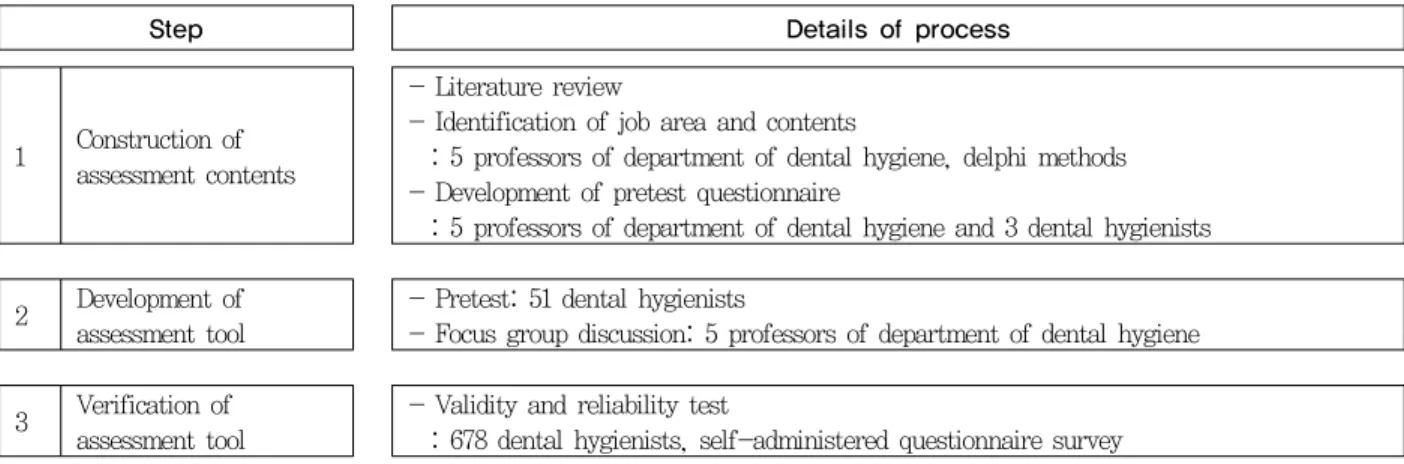
이 연구는 치과위생사 직무기술서와 업무분석에 관한 문헌 고찰을 통하여 사전평가도구를 개발한 후 타당도와 신뢰도 검정을 실시한 방법론적 연구이며, 치과위생사의 직무수행능 력 평가도구 개발을 위한 연구절차는 다음과 같다<Fig. 1>.
1 단계: 평가도구 내용구성 단계
평가도구의 내용 구성을 위해 먼저 한국보건의료인국가시 험원의 치과위생사 직무기술서와 직무분석에 관한 문헌고찰 을 통하여 직무수행, 능력/태도의 두 가지 직무영역과 각 영역 에 따른 직무내용을 선정하였다. 2011년 3월 5일부터 2011년 3월 10일까지 치위생과 교수 5명에게 연구 목적을 설명하고 선정된 직무영역과 직무내용을 대상으로 델파이 방법12)으로 최종 직무내용을 확정하였다. Likert식 5점 척도를 사용한 설 문지에 4점과 5점에 응답한 수가 5명 중 4명이 넘는 문항을 치과위생사의 직무내용으로 확정하였으며13), 확정된 내용에 대하여 평가문항을 만들었다. 평가문항의 내용 타당도 검증을 위해 2011년 4월 2일부터 2011년 4월 27일까지 치위생과 교수 5명, 실장급 치과위생사 3명의 3차례 토의를 통하여 개발된 평가문항에 대한 의견을 수렴 후 사전평가도구를 완성하였다.
2 단계: 평가도구 개발 단계
1단계에서 내용 타당도가 검증된 사전평가도구를 활용하 여 2011년 5월 1일부터 2011년 5월 15일까지 자기기입식 설문 지법으로 임상치과위생사 51명을 대상으로 사전조사를 실시 하여 구성타당도와 신뢰도를 검증하였다. 설문지의 회수율 을 높이기 위해 직접 면담과 전화 통화로 연구목적을 설명하 고 적극적 협조를 요청하고 조사를 실시하였다. 자료 분석을 위한 통계분석 프로그램은 SPSS 17.0K를 이용하였으며, 타당 도는 각 문항 기술통계와 1요인 주성분 분석(확인적 요인분
Step Details of process
1 Construction of assessment contents
- Literature review
- Identification of job area and contents
: 5 professors of department of dental hygiene, delphi methods - Development of pretest questionnaire
: 5 professors of department of dental hygiene and 3 dental hygienists
2 Development of assessment tool
- Pretest: 51 dental hygienists
- Focus group discussion: 5 professors of department of dental hygiene
3 Verification of assessment tool
- Validity and reliability test
: 678 dental hygienists, self-administered questionnaire survey Fig. 1. Development process of job performance assessment tool
Variable No.(%)
Age(years) 20 ~ 24 25 ~ 29 30 ≤
316(47.2) 228(34.0) 126(18.8)
Mean±SD 26.08±4.75
Marital status unmarried married
556(82.2) 120(17.8) Educational level College
University Master or higher
477(77.9) 105(17.2) 30( 4.9)
Total 678(100.0)
1)Excluding non-respondents
Table 1. General characteristics of the subjects1) 석), Pearson 상관관계 분석을 실시하였고, 신뢰도는
Cronbach's α 계수를 구하였다. 추가적으로 전문가 집단의 3차례 토의를 통해 내용타당도를 검증한 후 수정․조정하여 평가도구를 완성하였다.
3 단계: 평가도구 검증 단계
평가도구의 타당도와 신뢰도를 검증하기 위해 2011년 8월부 터 2011년 9월까지 임상치과위생사 800명을 편의 표본 추출하였 다. 자기기입식 설문지법으로 총 686부가 회수되었으며, 이 중 응답 방법에 오류가 있거나 무응답이 많은 8부를 제외한 678명 을 최종 분석대상으로 하여 타당도와 신뢰도를 검증하였다.
2. 자료분석방법
2.1. 빈도 분석 및 기술통계
조사대상자의 일반적 특성, 근무관련 특성은 빈도 분석을 실시하였고 연속변수의 경우 기술통계량을 구하였다.
2.2. 타당도 분석
이 연구에서는 같은 개념을 측정하는 변수들이 동일한 요인 으로 묶이는지를 확인하고자 하였으며, 각 영역별로 요인을 1개 로 지정한 1요인 주성분 요인분석을 실시하여 측정도구의 타당 성을 검증하였다. 구성 개념 타당성을 확인하기 위해 Amos 4.0 통계분석 프로그램을 이용하여 확정적 요인 분석을 실시하였 다. 요인 부하량이 0.5 이상의 항목을 추출하여 관측변수로 사 용한 후, 추출된 인자를 인자 구조모델로 배치하고 구조방정식 모델링을 이용하여 데이터에 대한 적합도를 판단하였다.
적합도 판정에는 설명력의 지표로서 χ2 통계량(χ2), 표준 χ2(χ2/df), 적합도 지수(Goodness of Fit Index: 이하 GFI), 비교 적합도지수(Comparative Fit Index: 이하 CFI), Tucker-Lewis 지수(Tucker-Lewis Index: 이하 TLI), 근사 원소 평균 자승 잔차(Root Mean Square Error of Approximation: 이하 RMSEA)
를 사용하였다. χ2 통계량을 자유도로 나눈 값을 표준 χ2라고 하며, 그 값이 1.0∼2.0이면 적합도가 좋고14). GFI는 가장 일반적으로 사용하는 적합지수로써 주어진 모델이 자료를 얼마나 잘 설명하는지 보여주며, 0.90 이상이면 좋은 모델이 라고 할 수 있다15). CFI는 0.9 이상이면 적합한 모델이고 0.95 이상이면 좋은 모델이라고 할 수 있고16) TLI는 0.9 이상이면 양호하고 적합한 모델이라 평가되며17) RMSEA값이 0.08 이하 면 잘 맞는 모델로 간주된다16).
2.3. 신뢰도 분석
본 연구에서 신뢰도를 측정하는 방법으로 Cronbach` α 계수법(내적일관성 분석, internal consistency analysis)을 사 용하였다.
연구 성적
1. 대상자의 일반적 특성
조사대상자의 연령은 20∼24세가 316명(47.2%)으로 가장
Variable No.(%)
Type of facilities Clinic
Hospital
General/University Hospital
341(55.4) 298(44.1) 37( 5.5)
Turnover experience Yes
No
257(38.6) 409(61.4) Total job carrier(years) 1 under
1 ~ 3 under 3 ~ 5 under 5 ~ 10 under 10 over
141(21.0) 180(26.8) 124(18.4) 155(23.0) 73(10.8)
Mean±SD 4.48±4.30
Current job carrier(years) 1 under 1 ~ 3 under 3 ~ 5 under 5 ~ 10 under 10 이상
195(29.0) 231(34.3) 116(17.2) 99(14.7) 32( 4.8)
Mean±SD 3.00±3.01
Duty of charge2) Clinical services
Consultation services Coordinator
Administrative duties Others
587(87.6) 144(21.5) 37( 5.5) 36( 5.4) 27( 4.0)
Areas of care Comprehensive care
Orthodontics Prosthetics Periodontology
Oral and Maxillofacial Surgery Conservative Dentistry Pediatric Dentistry Others
343(56.7) 102(16.9) 44( 7.3) 25( 4.1) 25( 4.1) 12( 2.0) 8( 1.3) 46( 7.6)
Position Team leaders
Dental hygienist
158(23.5) 514(76.5)
Performance assessment Yes
No
289(43.3) 379(56.7)
Total 678(100.0)
1)Excluding non-respondents, 2)Multiple responses
Table 2. Work-related characteristics of the subjects1)
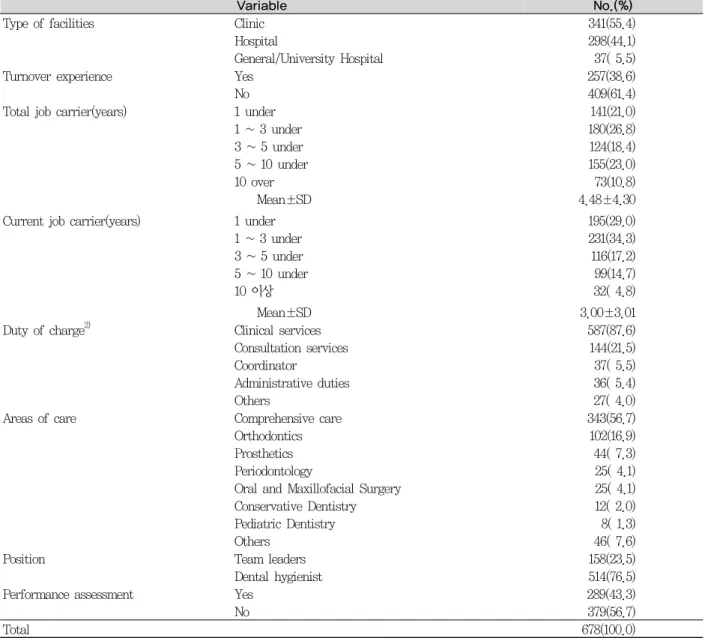
많았고, 25∼29세 228명(34.0%), 30세 이상 126명(18.8%)의 순이었으며, 평균연령은 26.1세였다. 결혼상태는 미혼 82.2%, 기혼 17.8%였으며, 최종학력은 전문학사가 77.9%로 가장 많았다<Table 1>.
2. 대상자의 근무관련 특성
근무 의료기관 종별은 의원급이 55.4%, 병원급이 44.1%였 으며, 대상자 중 38.6%는 이직 경험이 있었다. 총 경력은 평균 4.5년이었으며, 1∼3년 미만이 26.7%로 가장 많았고, 5∼10 년 미만 23.0%, 1년 미만 21.0%의 순이었다. 현재 직장 경력 은 평균이 3.0년이었고, 1∼3년 미만이 34.3%로 가장 많았다.
현재 담당업무는 진료실 담당이 87.5%로 가장 많았고, 진료
분야는 포괄진료 56.7%, 교정 16.9%의 순으로 많았으며, 직위 는 전체의 71.9%가 치과위생사였다. 직장 내 근무평점 제도 는 56.7%가 ‘없다’고 응답하였다<Table 2>.
3. 직무수행 영역의 타당도 검증 3.1. 구강보건교육
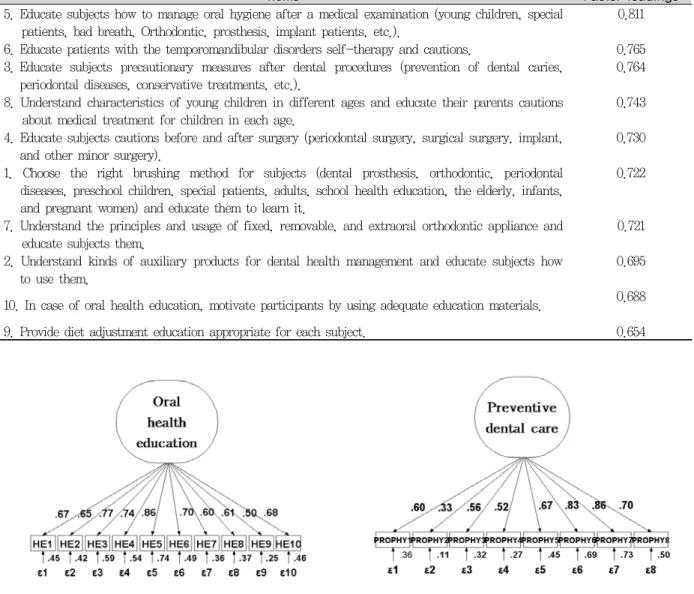
구강보건교육 하부영역의 10문항을 1인자 주성분 요인분 석을 한 결과 요인 적재치는 0.654∼0.811이였으며, 0.5 이하 문항은 없었다<Table 3>. 확정적 요인분석 결과 적합도 판정 지표인 표준 χ2/df 2.627, GFI 0.984, TLI 0.976, CFI 0.991, RMSEA 0.054로 나타나 구강보건교육 하부영역의 구성개념 타당성이 인정되었다<Fig. 2>.
Items Factor loadings 5. Educate subjects how to manage oral hygiene after a medical examination (young children, special
patients, bad breath, Orthodontic, prosthesis, implant patients, etc.).
0.811
6. Educate patients with the temporomandibular disorders self-therapy and cautions. 0.765 3. Educate subjects precautionary measures after dental procedures (prevention of dental caries,
periodontal diseases, conservative treatments, etc.).
0.764
8. Understand characteristics of young children in different ages and educate their parents cautions about medical treatment for children in each age.
0.743
4. Educate subjects cautions before and after surgery (periodontal surgery, surgical surgery, implant, and other minor surgery).
0.730
1. Choose the right brushing method for subjects (dental prosthesis, orthodontic, periodontal diseases, preschool children, special patients, adults, school health education, the elderly, infants, and pregnant women) and educate them to learn it.
0.722
7. Understand the principles and usage of fixed, removable, and extraoral orthodontic appliance and educate subjects them.
0.721
2. Understand kinds of auxiliary products for dental health management and educate subjects how to use them.
0.695
10. In case of oral health education, motivate participants by using adequate education materials. 0.688
9. Provide diet adjustment education appropriate for each subject. 0.654
Table 3. Sub-area of the oral health education factor analysis (factor extraction)
Fig. 2. Sub-area of the oral health education construct validity
3.2. 예방치과처치
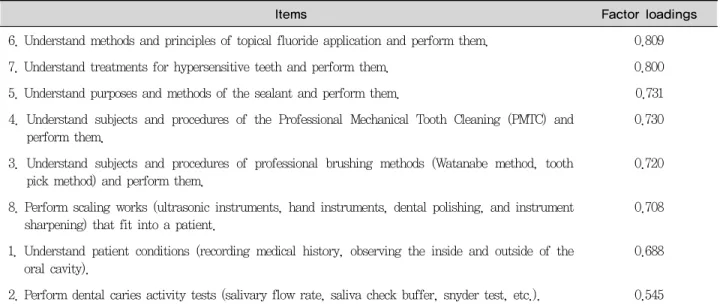
예방치과처치 하부영역의 8문항을 1인자 주성분 요인분석 을 한 결과 요인 적재치는 0.809∼0.545로 나타났으며, 0.5 이하 문항은 없었다<Table 4>. 확정적 요인분석 결과 적합도 판정 지표인 표준 χ2/df 2.516, GFI 0.984, TLI 0.977, CFI 0.988, RMSEA 0.055로 나타나 예방치과처치 하부영역의 구 성개념 타당성이 인정되었다<Fig. 3>.
Fig. 3. Sub-area of preventive dental care construct validity
3.3. 치과진료협조
치과진료협조 하부영역의 20문항을 각 항목별로 1인자 주 성분요인분석을 한 결과 요인 적재치는 0.411∼0.783으로 나 타났으며, 0.5 이하 문항으로는 ‘와이어 결찰 및 엘라스틱 (ligature wire, elastomeric ring, power chain, elastic thead) 장착의 원리와 방법을 알고 장착하고 제거한다’가 0.411, ‘고 정성 교정장치(band, bracket 등)를 환자의 불편을 최소화하 여 제거한다’가 0.424, ‘소아환자의 진정마취를 준비하고 진정 마취 후 관리한다’가 0.499였다<Table 5>. 전문가 내용타당도
Items Factor loadings 6. Understand methods and principles of topical fluoride application and perform them. 0.809
7. Understand treatments for hypersensitive teeth and perform them. 0.800
5. Understand purposes and methods of the sealant and perform them. 0.731
4. Understand subjects and procedures of the Professional Mechanical Tooth Cleaning (PMTC) and perform them.
0.730
3. Understand subjects and procedures of professional brushing methods (Watanabe method, tooth pick method) and perform them.
0.720
8. Perform scaling works (ultrasonic instruments, hand instruments, dental polishing, and instrument sharpening) that fit into a patient.
0.708
1. Understand patient conditions (recording medical history, observing the inside and outside of the oral cavity).
0.688
2. Perform dental caries activity tests (salivary flow rate, saliva check buffer, snyder test, etc.). 0.545
Table 5. Sub-area of assistance for dental treatment factor analysis (factor extraction)
Items Factor
loadings 6. Understand and perform post operation treatments (periodontal surgery, surgical surgery, implant, and
other minor surgery).
0.783
4. Prior to a medical examination, understand the medical treatment plan (dental prosthesis, conservative, child, and orthodontic treatments, etc.) sufficiently and prepare for the examination.
0.742
14. Take an abutment impression and occlusion precisely. 0.739
13. Understand kinds and purposes of temporary fillers and use them properly. 0.739 15. Understand how to produce a temporary dental crown and produce and install it accurately and quickly. 0.737
5. Prior to an operation, understand the operation plan (periodontal surgery, surgical surgery, implant, and other minor surgery) correctly and prepare for the operation by arranging devices in order.
0.735
12. Understand procedures of the matrix band and install and remove one. 0.735 16. After installing a prosthesis, remove cement accurately and quickly. 0.730
9. Cope with an emergency during a medical examination appropriately. 0.692
2. Understand principles of intraoral dental radiography and scan without an error. 0.689 8. Understand the principles and location of topical anesthesia and perform it. 0.665 10. Prevent infection in the medical examination room with thorough sterilization of medical devices and
strict management of goods for sterilization
0.646
7. Understand the rubber dam procedures and install and remove a rubber dam. 0.629
3. Develop and manage a film perfectly. 0.589
18. Take facial and intraoral pictures of a correction patient without a mistake. 0.525 1. Measure vital signs (blood pressure, body temperature, pulse, and breathing) and catch hold of and
record the patient condition.
0.520
11. Perform tasks for health insurance claims. 0.517
17. Prepare sedation for a child patient and manage the patient after anesthesia. 0.499 20. Remove fixed orthodontic appliance(band, bracket, etc.) while minimizing discomfort of the patient. 0.424 19. Understand principles and methods of the ligature wire, elastomeric ring, power chain, and elastic
thread and install and remove them properly.
0.411 Table 4. Sub-area of preventive dental care factor analysis (factor extraction)
Items Factor loadings 5. Check and report repair, damage, and loss of medical devices and facilities. 0.845 3. Manage and keep medical examination data and documents (medical examination record, photos,
and dentures) thoroughly.
0.840
6. Analyze actual conditions of a patient and take necessary steps to cope with the situation. 0.836
7. Follow safety measures for the prevention of risk factors. 0.829
4. Manage medical supplies, medicines, and fixtures so that they can be supplied smoothly. 0.817 8. Save commodities by applying the concept of the prime cost to practical bossiness. 0.766 1. Check employee's working attitude and aid in practical education. 0.746 2. Check conditions of specimen and wastes and dispose of them following the required regulations. 0.718 Table 6. Sub-area of administrative management factor analysis (factor extraction)
검증을 거쳐 최종 평가도구에는 ‘고정성 교정장치(band, bracket 등)를 환자의 불편을 최소화하여 제거한다’와 ‘소아환 자의 진정마취를 준비하고 진정마취 후 관리한다’는 제거하 였으며, 와이어 결찰 및 엘라스틱(ligature wire, elastomeric ring, power chain, elastic thead) 장착의 원리와 방법을 알고 장착하고 제거한다’는 ‘와이어 결찰(ligature wire, elastomeric ring)의 원리와 방법을 알고 장착하고 제거한다’로 수정하였 다. 치과진료협조 하부영역의 구성개념 타당성은 요인적재 치가 0.5 이하인 문항 중 전문가 내용타당도 검증을 거쳐 2문항을 제외한 18문항에 대해 확정적 요인분석을 실시하였 다. 그 결과 적합도 판정 지표인 표준 χ2/df 2.126, GFI 0.955, TLI 0.969, CFI 0.977, RMSEA 0.045으로 나타나 치과진료협조 하부영역의 구성개념 타당성이 인정되었다<Fig. 4>.
Fig. 4. Sub-area of assistance for dental treatment construct validity
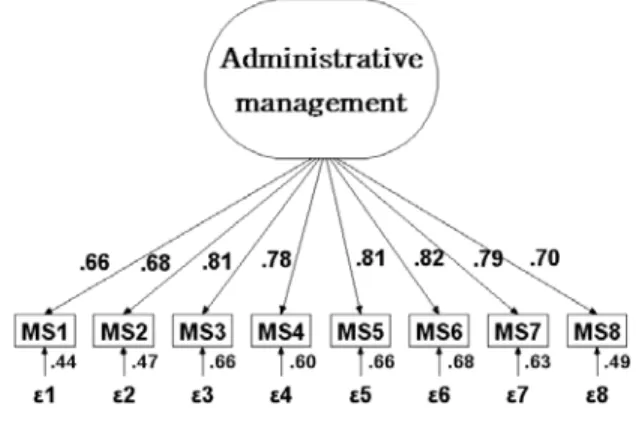
3.4. 경영관리지원
경영관리지원 하부영역의 8문항을 1인자 주성분 요인분석 을 한 결과 요인 적재치는 0.718∼0.845로 높게 나타났다
<Table 6>. 확정적 요인분석 결과 적합도 판정 지표인 표준
χ2/df 2.163, GFI 0.986, TLI 0.988, CFI 0.994, RMSEA 0.045로 나타나 경영관리지원 하부영역의 구성개념 타당성이 인정되 었다<Fig. 5>.
Fig. 5. Sub-area of administrative management construct validity
4. 능력/태도 영역의 타당도 검증 4.1. 치과위생사의 능력
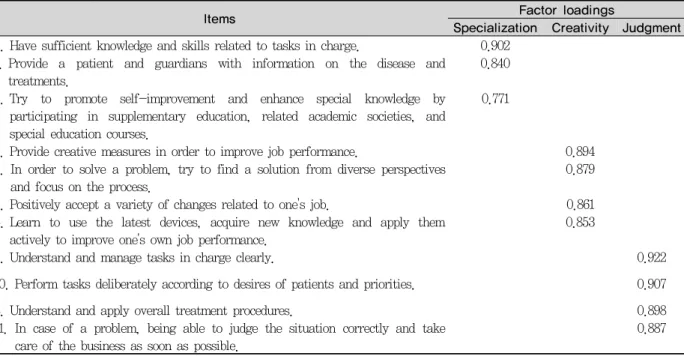
치과위생사의 능력 하부영역의 11문항을 각 항목별로 1인 자 주성분 요인분석을 한 결과 전문성 항목의 요인 적재치는 0.771∼0.902, 창의력 항목에서는 0.853∼0.894, 이해판단력 항목에서는 0.887∼0.922로 나타났다<Table 7>. 확정적 요인 분석 결과 적합도 판정 지표인 표준 χ2/df 2.793, GFI 0.974, TLI 0.982, CFI 0.989, RMSEA 0.053으로 나타나 치과위생사의 능력 하부영역의 구성개념 타당성이 인정되었다<Fig. 6>.
Items Factor loadings
Specialization Creativity Judgment 3. Have sufficient knowledge and skills related to tasks in charge. 0.902
1. Provide a patient and guardians with information on the disease and treatments.
0.840
2. Try to promote self-improvement and enhance special knowledge by participating in supplementary education, related academic societies, and special education courses.
0.771
5. Provide creative measures in order to improve job performance. 0.894 7. In order to solve a problem, try to find a solution from diverse perspectives
and focus on the process.
0.879
6. Positively accept a variety of changes related to one's job. 0.861 4. Learn to use the latest devices, acquire new knowledge and apply them
actively to improve one's own job performance.
0.853
9. Understand and manage tasks in charge clearly. 0.922
10. Perform tasks deliberately according to desires of patients and priorities. 0.907
8. Understand and apply overall treatment procedures. 0.898
11. In case of a problem, being able to judge the situation correctly and take care of the business as soon as possible.
0.887 Table 7. Sub-area of dental hygienist's competency factor analysis (factor extraction)
n=635, χ2=94.955, df=34, χ2/df=2.793, GFI=0.974, TLI=0.982, CFI=0.989, RMSEA=0.053 F1: specializaton, F2: creativity, F3: judgment
Fig. 6. Sub-area of dental hygienist's competency construct validity
4.2. 치과위생사의 태도
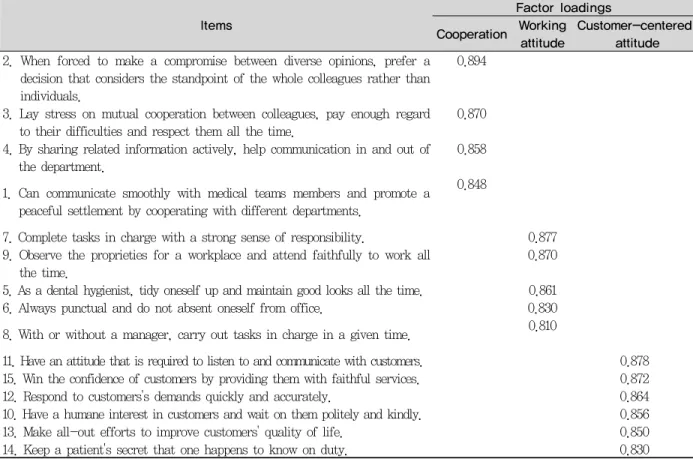
치과위생사의 태도 하부영역 15문항을 각 항목별로 1인자 주성분 요인분석을 한 결과 협조성 항목의 요인 적재치는 0.848∼0.894, 근무자세 항목에서는 0.810∼0.877, 고객지향 성 항목에서는 0.830∼0.878로 나타났다<Table 8>. 확정적
요인분석 결과 적합도 판정 지표인 표준 χ2/df 2.960, GFI 0.955, TLI 0.972, CFI 0.978, RMSEA 0.057로 나타나 치과위생사 의 태도 하부영역의 구성개념 타당성이 인정되었다<Fig. 7>.
Items
Factor loadings Cooperation Working
attitude
Customer-centered attitude 2. When forced to make a compromise between diverse opinions, prefer a
decision that considers the standpoint of the whole colleagues rather than individuals.
0.894
3. Lay stress on mutual cooperation between colleagues, pay enough regard to their difficulties and respect them all the time.
0.870
4. By sharing related information actively, help communication in and out of the department.
0.858
1. Can communicate smoothly with medical teams members and promote a peaceful settlement by cooperating with different departments.
0.848
7. Complete tasks in charge with a strong sense of responsibility. 0.877 9. Observe the proprieties for a workplace and attend faithfully to work all
the time.
0.870
5. As a dental hygienist, tidy oneself up and maintain good looks all the time. 0.861 6. Always punctual and do not absent oneself from office. 0.830 8. With or without a manager, carry out tasks in charge in a given time. 0.810
11. Have an attitude that is required to listen to and communicate with customers. 0.878 15. Win the confidence of customers by providing them with faithful services. 0.872
12. Respond to customers's demands quickly and accurately. 0.864
10. Have a humane interest in customers and wait on them politely and kindly. 0.856
13. Make all-out efforts to improve customers' quality of life. 0.850
14. Keep a patient's secret that one happens to know on duty. 0.830
Table 8. Sub-area of dental hygienist's attitude factor analysis (factor extraction)
n=671, χ2=251.610, df=85, χ2/df=2.960, GFI=0.955, TLI=0.972, CFI=0.978, RMSEA=0.057 F1: cooperation, F2: working attitude, F3: customer-centered attitude
Fig. 7. Sub-area of dental hygienist's attitude construct validity
Area Sub-area Number of items Cronbach`’ α
Job performance
oral health education 10 0.899
0.965
0.980
preventive dental care 8 0.861
assist for dental treatment 18 0.915
administrative management 8 0.919
Competency/
Attitude
competency of dental
hygienists 11 0.947
0.967
attitude of dental hygienists 15 0.955
Table 10. Reliability of the final assessment tool for each area
Area Sub-area Items
Number of items Steps to
configure the content assessment tools
Steps to develop assessment tools
The final assessment
tool
Job performance
oral health education
oral health
education 12 10 10
preventive dental care
preventive dental
care 12 8 8
assist for dental treatment
assist for dental
treatment 24 20 18
administrative management
administrative
management 8 8 8
Competency/
Attitude
competency of dental hygienists
specialization 3 3 3
creativity 4 4 4
judgment 5 4 4
attitude of dental hygienists
cooperation 6 4 4
worked posture 6 5 5
customer-centered
attitude 7 6 6
2 6 10 87 72 70
Table 9. Item of the final job performance assessment tool information for dental hygienist and development step of configuring questions
5. 치과위생사 직무수행능력 최종 평가도구
3단계 평가도구 검증단계에서 타당도 검증 결과, 치과진료 협조 항목에서 2문항을 삭제하여 치과위생사 직무수행능력 최종 평가도구는 2개 영역, 6개 하부 영역, 10개 항목, 70개의 평가문항으로 확정되었다<Table 9>.
6. 최종 평가도구의 신뢰도 검증
최종 평가도구 전체 신뢰도 Cronbach` α 계수는 0.980이었 으며, 직무수행의 신뢰도 Cronbach` α 계수는 0.965, 능력/태 도의 신뢰도 Cronbach` α 계수는 0.967이였다. 각 하부영역 별 신뢰도 Cronbach` α 계수는 구강보건교육 하부영역 0.899, 예방치과처치 하부영역 0.861, 치과진료협조 하부영역 0.915, 경영지원관리 하부영역 0.919, 치과위생사의 능력 하부영역 0.947, 치과위생사의 태도 하부영역 0.955이었다<Table 10>.
총괄 및 고안
의료서비스 조직에서도 성과 평가 시도가 점차 증가하고 있으며, ‘측정할 수 없는 것은 관리할 수 없다18)라는 말처럼 모든 의료서비스 활동은 객관적으로 측정 가능해야하며 이를 바탕으로 체계적이고 정확한 평가가 이루어질 수 있을 것이 다. 이 연구는 치과위생사의 직무수행능력 향상과 전문성 확 보를 위한 방안을 마련하고 후속 연구의 기초자료로 활용될 수 있도록 치과위생사 직무수행능력 평가도구를 개발하기 위해 수행되었다.
평가도구 개발과정에서 치과위생사의 직무수행능력을 직 무수행, 능력과 태도의 두 가지 영역으로 나누어서 평가하여 야 한다는 점에는 전문가들 모두 동의하였다. 이는 임상간호 사 평정도구 개발 연구에서 간호사 근무실적과 근무수행능력
및 근무수행태도로 나누어 개발한 신19)의 연구와 간호사 업 무수행 평가도구개발 연구에서 간호사의 업무수행을 업적과 능력 및 태도로 나누어 평가도구를 개발한 이20)의 연구에서 적용한 내용과 유사하였다. 또한 이 연구는 치과위생사가 수 행하는 업무를 포괄적으로 측정하는 도구로서 치과위생사의 능력과 태도를 포함하여 각 행위를 하부영역, 항목, 평가문항 으로 분류한 것이 특징이라 할 수 있다.
한국보건의료인국가시험원이 2000년에 발간한 치과위생 사의 직무기술서에서 치과위생사의 직무가 구강보건교육, 예 방치과처치, 치과진료협조, 공공보건사업, 경영관리지원, 전 문성향상 등 6개의 임무(Duty), 42개의 일(Task), 269개의 일 의 요소(Task Element)로 기술되어있다. 대한치과위생사협 회는 치과위생사의 업무확장을 위한 연구보고서8)에서 구강 위생 상태 관찰, 구강위생 진단 및 계획, 교육, 예방처치, 치주 처치, 공통진료협조, 보존진료협조, 보철진료협조, 소아진료 협조, 교정진료협조, 행정/관리 등 11개의 일과 80개의 일의 요소로 나누어 분류하였다. 이 등21)의 연구에서는 치과위생 사의 임무를 구강보건교육, 치면세마, 공중구강보건사업, 진 료지원(협조), 치과방사선촬영, 치과건강보험청구, 치과의료 관리업무의 7개로 분류하였는데, 이 연구에서는 한국보건의 료인국가시험원이 발간한 직무기술서와 선행논문 고찰을 토 대로 치과위생사의 직무로 구강보건교육, 예방치과처치, 치 과진료협조, 경영관리지원 등 4개의 하부영역으로 분류하였 다. 하와 윤22)의 연구에서도 본 연구와 같이 치과위생사의 직무를 구강보건교육, 예방치과처치, 치과진료협조, 경영관 리지원 등 4개의 임무로 분류하여 실시하였다.
능력은 어떤 업무를 달성할 수 있는 잠재력으로, 조직 목적 을 효과적으로 달성하기 위해 직무수행 과정에서 필요한 능 력을 의미하며23), 조직의 성장과 발전에 공헌하는 능력의 평 가는 중요하다24). 또한 태도는 어떠한 대상에 대한 믿음, 느 낌, 행위의도가 결합되어 있는 정신적 준비 상태로25), 개인행 동에 있어서 태도는 지각에 영향을 받고 행동에 영향을 준다
26). 주어진 직무에 임하는 자세, 어떤 자각과 의욕을 가지고 행동하였는지를 파악하는 태도에 관한 평가는 개인의 발전을 조직의 성장으로 연결할 수 있으므로 중요하다고 할 수 있다
26,27)
. 선행연구20,28,29)를 통하여 치과위생사의 능력, 치과위생 사의 태도 등의 2개 하부영역으로 나누고 치과위생사의 능력 은 전문성, 창의력, 이해판단력 3개 항목에 각 3개, 4개, 4개 문항 총 11문항으로 구성하였고, 치과위생사의 태도는 협조 성, 근무자세, 고객지향성 3개 항목에 각 4개, 5개, 6개 총 15문항으로 구성하였다. 이29)의 연구에서는 직무능력은 개선 및 창의력, 전문성, 이해판단력, 지도육성능력, 관리능력의 6개 항목에 각 8개, 5개, 8개, 9개, 7개 총 36개 문항으로 구성
하였으며, 직무태도는 간호윤리, 협조성, 고객지향성, 근무자 세, 책임감 5개 항목에 각 5개, 6개, 9개, 7개, 7개로 총 34개 문항으로 신뢰도는 Cronbach` α 계수가 0.960이었다. 이 연 구는 항목 수와 문항 수가 기존 연구와 차이가 있었지만 능력 과 태도 영역의 Cronbach` α 계수가 0.967로 내적일관성이 높았다.
치과위생사 직무수행능력 최종 평가도구 전체의 Cronbach`
α계수는 0.980이었다. 최13)의 연구에서 보건교사의 직무수 행 평가도구의 전체신뢰도는 Cronbach` α 계수가 0.946이었 고, 이29)의 간호사를 대상으로 한 연구에서 간호업무수행 평 가도구의 신뢰도는 Cronbach` α 계수가 0.894∼0.959로 나 타났다. 이러한 분석결과를 토대로 볼 때 이 연구의 치과위생 사 직무수행능력 평가도구는 신뢰도가 높은 도구라고 평가 할 수 있다.
치과위생사의 직무수행능력 평가도구의 타당도 검증을 위 해 각 하부영역별 문항을 각 항목별로 1인자 주성분 요인분석 을 한 결과, 대부분 요인 적재치가 0.5 이상으로 나타났다.
일반적으로 각 요인에 포함된 문항의 요인 적재치가 0.5 이상 이면 바람직한 것13,30)으로, 본 도구의 요인구성은 적절한 것 으로 판단된다. 하지만 치과진료협조 영역 중 0.5 이하였던 문항으로 ‘고정성 교정장치(band, bracket 등)를 환자의 불편 을 최소화하여 제거한다’가 0.424, ‘소아환자의 진정마취를 준비하고 진정마취 후 관리한다’가 0.499로 나타나 제거하였 다. 그리고 ‘와이어 결찰 및 엘라스틱(ligature wire, elasto- meric ring, power chain, elastic thead) 장착의 원리와 방법을 알고 장착하고 제거한다’는 요인 적재치가 0.411이었으나 치 과위생사의 법정 업무인 와이어 결찰(ligature wire, elasto- meric ring)과 치과위생사의 법정 업무로 간주하기 어려운 엘라스틱 장착(power chain, elastic thead)이 평가문항에 함 께 제시되어 설문과정에서 오류가 있었던 것으로 판단하여
‘와이어 결찰(ligature wire, elastomeric ring 이용)의 원리와 방법을 알고 장착하고 제거한다’로 수정하여 최종 평가도구 에 포함하였다. 구성개념 타당성은 적합도 판정 지표인 표준 χ2/df가 모든 영역에서 2.0∼3.0범위에 있어 보통의 적합도를 갖는 것으로 나타났으며, GFI 0.90 이상, CFI 0.90 이상, TLI 0.9 이상, RMSEA 0.08 이하로 나타나 모든 영역에서 구성개념 타당성이 인정되었다. 이 연구는 치과위생사의 직무내용을 바탕으로 직무수행과 능력 및 태도 평가도구를 개발함으로써 임상현장에서 자기평가, 직원평가 등에 실제 적용이 가능한 결과를 도출할 수 있었다.
이 연구의 결과를 활용하여 직무수행능력 평가를 통해 동 기 부여의 근거로 활용하여 직무만족도를 높이고, 치과위생 사의 직무수행능력 및 전문성 향상에 기여할 수 있을 것으로
생각한다. 또한 치과위생사의 직무수행능력 평가도구를 개 발하기 위한 선행연구와 문헌고찰을 통해 직무를 분석하고 문항을 개발하여 타당도와 신뢰도를 검증하는 일련의 과정을 통해 치위생 연구방법 측면에서도 기여하였다고 생각하며, 앞으로 더욱 합리적이고 다양한 방법으로 치과위생사의 직무 수행을 평가할 수 있는 발전된 평가도구를 개발하기 위한 연구에 도움이 되기를 기대한다. 그리고 치위생과의 교육과 치과위생사의 실무능력 간의 격차를 해소하고 임상 현장에서 의 요구를 반영할 수 있는 실무 중심의 교육 이론 개발 및 연구의 기초자료가 될 수 있을 것으로 생각한다.
이 연구에서는 공공보건 분야의 직무는 평가문항에 포함되 지 않았는데 추후에 이 연구에 포함되어 있지 않은 공공보건 분야에 근무하는 치과위생사를 위한 후속 연구가 필요할 것 으로 생각한다. 또한 앞으로 치과전문의 제도에 발맞춰 전문 분야별로 세분화되고 진료과 특성에 알맞은 평가도구의 개발 로 치위생사의 직무능력 수준을 높여 전문화된 치과 의료서 비스 제공에 기여하기 위한 추가적인 노력이 필요할 것이다.
결론
이 연구는 치과위생사의 직무수행능력 평가도구를 개발하 기 위해 시도되었다.
개발 과정은 3단계로 구성되었으며, 첫 단계는 평가도구 내용구성 단계로 치위생사 직무기술서와 직무분석 문헌을 고찰한 후 전문가 델파이방법으로 직무 영역과 직무내용을 선정하고 평가문항을 구성하여 사전평가도구를 개발하였다.
두 번째 단계는 평가도구 개발 단계로 치과위생사 51명을 대상으로 사전평가도구에 대한 타당도와 신뢰도 검증을 실시 한 후 수정·보완하여 평가도구를 개발하였다. 세 번째 단계 는 평가도구 검증 단계로 치과위생사 678명을 대상으로 타당 도 및 신뢰도를 검증 후 최종 평가도구를 확정하였다.
최종 평가도구는 직무수행, 능력/태도의 2개 영역으로 구성 되었으며, 직무수행 영역은 구강보건교육, 예방치과처치, 치 과진료협조, 경영관리지원의 4개 하부영역으로, 능력/태도 영역은 치과위생사 능력과 치과위생사 태도의 2개 하부영역 으로 구성되었다. 이들 6개 하부영역의 평가 문항은 1단계에 서 87개 문항, 2단계에서는 72개 문항으로 수정되었으며, 3단 계에서 최종 평가도구는 70개 문항으로 확정되었다.
각 하부영역 별 문항 수와 신뢰도 분석 결과는 다음과 같다.
구강보건교육(10문항) 신뢰도 0.899, 예방치과처치(8문항) 0.861, 치과진료협조(18문항) 0.915, 경영관리지원(8문항) 0.919, 치과위생사 능력(11문항) 0.947, 치과위생사 태도(15 문항) 0.955였다. 치과위생사 직무수행능력 최종 평가도구
총 70개 문항 전체의 신뢰도 Cronbach`α 계수는 0.980로 높게 나타났다.
본 연구결과 평가도구는 3단계에 걸쳐 내용타당도와 구성 타당도가 검증되었고, 모든 평가문항이 신뢰도가 높은 것으 로 검증되었다. 따라서 본 연구에서 개발된 평가도구는 객관 적이고 타당성 있는 치위생사 직무수행능력 평가도구로 활용 될 수 있을 것으로 기대한다.
References
1. Kim EK, Kim YJ, Kim CH, Park MS, An GS, Yoon MS, et al.
Standardized training and development direction of dental hygiene studies. Korean Dental Hygienist Association ․ Korean Association of Hygiene Professors; 2005.
2. Kang BW, Kang JK, Kang HK, Koo IY, Kwon HS, Kwon HM, et al. Introduction to dental hygiene studies. Seoul: Jee Seung Publisher;
2010: 1-232.
3. Korean Dental Hygienist Association. About the Association, Introduction to College and Graduate School[Internet]. [cited 2013 July 01]. Available from: http://www.kdha.or.kr.
4. Kim SH, Jang GW, Won BY, Jang JH, Kang YM, Kim JS, et al.
Study on the execution of the test subjects improved dental hygienist country. National Health Personnel Licensing Examination Board; 2008.
5. Cho YS. Developing a competency-based curriculum for dental hygiene program. J Namseoul Univ 2004; 10: 409-47.
6. Cho YS, Lee SY. Developing a integrated curriculum for a clinical dental hygiene. J Dent Hyg Sci 2005; 5(1): 33-8.
7. Nam YO, Song KH, Kang HS, Sim HS, Yoo JH, Lee MY, et al.
Dental hygienist study on the improvement of long-term practical examination. National Health Personnel Licensing Examination Board; 2011: 1-242.
8. Park JR, You JS, Choi BG, Han SJ, Heo SS, Hwang SH. Study on the dental hygienist job expansion. Korean Dental Hygienist Association; 2004: 1-93.
9. Hwang MY. Development of an intergrated curriculum model for dental hygienist[Doctoral dissertation]. Seoul: Univ. of Sungshin woman′s, 2002.
10. Nam YO, Ju OJ, Kim MJ. A study on the improvement of the national dental hygienist practical examination. J Korean Soc Dent Hyg 2013; 13(2): 201-9.
11. Lee DY, Moon JH. A study on the job attitude and job ability between male and female office workers. J Ins Soci Sci 1999; 5:
1-37.
12. Lee JS. Delphi method. Seoul: Kyoyookbook; 2006: 1-138.
13. Choi JB. Development of a competency evaluation scale for
korean health teachers[Doctoral dissertation]. Yeonggi: Univ. of Ajou, 2011.
14. Kim KS. Analysis structural equation modeling. Seoul:SPSS Korea Datasolution; 2004: 116.
15. Lee SM. Methodology corner:nursing resarch and causal modeling:LISREL. Journal of nursing query 1994; 3(2): 94-100.
16. Lee HS, Yim JH. Structural equation modeling with AMOS 6.0.
Yeonggi: Bobmunsa; 2007: 33-54.
17. Bae BR. Understand and take advantage of the LISREL structural equation model. Daejeon: Daekyung Publishing;
2002: 208.
18. Korea Economic Research Institute. Performance measurement.
Seoul: Book21; 1999.
19. Shin SC. Development of evaluation tool for hospital nurses[Doctoral dissertation]. Daegu: Univ. of Keimyung, 2002.
20. Lee YS. Development of nursing performance appraisal tool using management by objective[Doctoral dissertation]. Seoul:
Univ. of Seoul National, 2002.
21. Lee YS, Ahn YS, Lim DS. A study on the job analysis of dental hygienists in dental (clinics) hospitals the capital region -focusing on job importance and education-training need analysis-. J Dent Hyg Sci 2004; 4(1): 33-8.
22. Ha MO, Youn HJ. A study on the job analysis of dental hygienist in Gwangju. J Korean Soc Dent Hyg 2010; 10(5): 807-17.
23. Park YH. Organizational Behavior. Seoul: Parkyoungsa; 2000:
1-546.
24. Kim IG, Lee KN. Research on the appraisal of personnel for the development of skills. J Jangan College 22(1): 6-43, 2002.
25. Hwang GD. Human resource management. Seoul: Parkyoungsa;
2004: 1-594.
26. Min KH. Organizational behavior. Seoul:Muyokpub; 2005: 1-409.
27. Yoon JG. The analysis of officials' job attitudes influenced by forming mentoring relationship[Doctoral dissertation]. Daegu:
Univ. of Daegu, 2000.
28. Youn KH. A study on the effects of internal marketing and organization citizenship behavior on employees effort, satisfaction and customer directivity in financial institution [Doctoral dissertation]. Pusan: Univ. of Dong-A, 2006.
29. Lee EM. Development of nursing performance appraisal instrument [Doctoral dissertation]. Seoul: Univ. of Kyung Hee, 2008.
30. Lee JR, Park CM. Structural model on hypertensive patient's lifestyle and quality of life. J Health Policy and Administration 2004; 14(3): 66-96.