1. INTRODUCTION
As an important technology of human-computer interaction, human behavior detection has always received extensive attention from computer vision.
However, in the real environment, there are some complicated backgrounds, the human body is cov- ered by objects, and the human body moves in var- ious poses, which make the task of human behavior detection more difficult.
The R-CNN (regions with CNN features)[1]
model is a classic algorithm applied to object de- tection tasks. The algorithm idea of this model is to first read in the image and then generate ap- proximately 2,000 category-independent candidate
regions for the input image. Use a convolutional neural network to obtain feature vectors of the same length from each candidate area, and then use a support vector machine (SVM)[2] to detect and classify objects in each candidate area[3]. The R-CNN model uses image affine deformation to calculate the input of a convolutional neural net- work with a fixed size for each candidate window, regardless of the window shape.
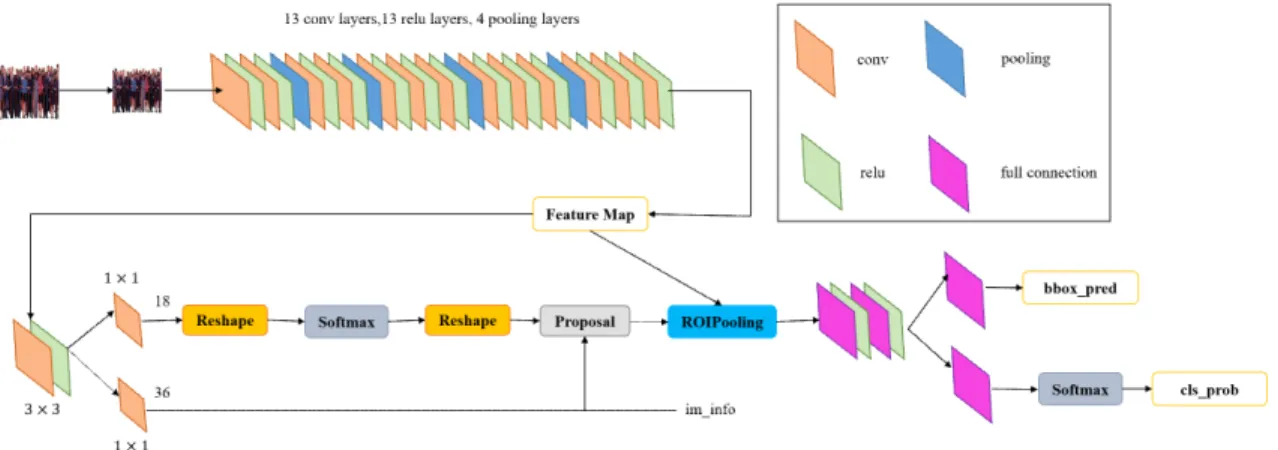
Fast R-CNN[4] and Faster R-CNN[5] developed on the basis of R-CNN are more effective in object detection. The Fast R-CNN model is based on the R-CNN model and combines the characteristics of the SPP-Net[6] network to improve the speed of training and testing, and at the same time improve
Activity Object Detection Based on Improved Faster R-CNN
Ning Zhang
†, Yiran Feng
††, Eung-Joo Lee
†††ABSTRACT
Due to the large differences in human activity within classes, the large similarity between classes, and the problems of visual angle and occlusion, it is difficult to extract features manually, and the detection rate of human behavior is low. In order to better solve these problems, an improved Faster R-CNN-based detection algorithm is proposed in this paper. It achieves multi-object recognition and localization through a second-order detection network, and replaces the original feature extraction module with Dense-Net, which can fuse multi-level feature information, increase network depth and avoid disappearance of network gradients. Meanwhile, the proposal merging strategy is improved with Soft-NMS, where an attenuation function is designed to replace the conventional NMS algorithm, thereby avoiding missed detection of adjacent or overlapping objects, and enhancing the network detection accuracy under multiple objects. During the experiment, the improved Faster R-CNN method in this article has 84.7% target detection result, which is improved compared to other methods, which proves that the target recognition method has significant advantages and potential.
Key words: Human activity object; Faster R-CNN; Dense-Net; Soft-NMS
※ Corresponding Author : Eung-Joo Lee, Address: (48520) 428, Sinseon-ro, Nam-gu, Busan, Korea, TEL : +82-51- 629-1143, FAX : +82-51-629-1143, E-mail : [email protected] Receipt date : Jan. 19, 2021, Approval date : Mar. 15, 2021
†
Dept. of Information and Communication Engineering, Tongmyong University, Busan, Korea
Dept. of Duoyuan Technology Co., Ltd. Shenyang, China (E-mail : [email protected])
†††
Dept. of Information and Communication Engineering, Tongmyong University, Busan, Korea
(E-mail : [email protected])
†††