Journal of Internet Computing and Services(JICS) 2019. Jun.: 20(3): 61-68 61
스마트 안전모와 비콘을 이용한 건설현장 안전관리 시스템 설계 및 구현☆
Design and Implementation of Construction site Safety management System using Smart Helmet and BLE Beacons
서 귀 빈1 민 세 동2 이 승 현3 홍 민4*
Kwi-Bin Seo Se Dong Min Seung-Hyun Lee Min Hong
요 약
과거 건설공사의 목표는 원가절감과 공사기간의 단축을 통한 효율성 증진이었다. 하지만 최근 안전관리의 중요성이 부각되고 있
으며, 고용 노동부는 산업 재해로 인한 사망자를 절반으로 감소하겠다는 목표를 설정하였으며, 이에 따라 제도적 및 법적 개선이 추
구되고 있으며 안전에 대한 필요성이 강조되고 있다. 하지만 일부 대형 건설 회사를 제외한 대부분의 건설업체는 안전관리에 많은
부족함을 보이고 있다. 이러한 건설현장의 안전문제를 해결하기 위하여 본 논문에서는 스마트 안전모와 비콘을 이용하여 건설현장
안전관리 시스템을 설계 및 구현하였다.
☞ 주제어 : 스마트 안전모, 비콘, 안전관리 시스템, 안드로이드, 블루투스 통신
ABSTRACT
The goal of the construction work in the past was to improve the efficiency through cost reduction and shortening the construction period. However, the importance of safety management has recently been emphasized, and the Ministry of Employment and Labor has set a goal of reducing the number of deaths caused by industrial accidents by half. As a result, institutional and legal improvements are pursued and the need for safety is emphasized. However, most construction companies, except for some large construction companies, are lacking in safety management. So, In this paper, we design and implement a safety management system for construction site using smart helmets and beacons.
☞ keyword : Smart Helmet, BLE Beacons, Safety Management System, Android, Bluetooth Communication
1Department of Computer Science, Soonchunhyang University, Asan, 31538, Korea.
2Department of Medical IT Engineering, Soonchunhyang University, Asan, 31538, Korea.
3School of Architectural Engineering, College of Science&Technology, Hongik University, Sejong, 30016, Korea.
4Department of Computer Software Engineering, Soonchunhyang University, 31538, Korea.
* Corresponding author ([email protected])
[Received 31 December 2018, Reviewed 23 January 2019(R2 20 March 2019), Accepted 1 April 2019]
☆ This research was supported by the MSIP(Ministry of Science, ICT and Future Planning), Korea, under the ITRC(Information Technology Research Center) support program (IITP-2018-2014- 1-00720) supervised by the IITP(Institute for Information &
communications Technology Promotion) and was supported by Basic Science Research Program through the National Research Foundation of Korea(NRF) funded by the Ministry of Education(No.2017R1A2B 1011776)
1. Introduction
The goal of the construction work in the past was cost reduction and efficiency improvement by shortening the time.
However, safety management has been neglected for a long time[1]. Recently, a paradigm shift in safety management has been taking place in the construction industry, and the importance of safety management has been emphasized accordingly. Also, the ministry of employment and labor also set a goal of reducing the death toll from industrial accidents by half before the end of 2022. Therefore, institutional and legal improvements are being pursued and the need for safety is emphasized[2]. However, most construction companies,
☆ A preliminary version of this paper was presented at APIC-IST 2018 and was selected as an outstanding paper.
ISSN 1598-0170 (Print) / ISSN 2287-1136 (Online) http://www.jics.or.kr
Copyright ⓒ 2019 KSII
except some large construction companies, lack safety management system capability, and professional construction companies, which are responsible for actual construction work on site, are in poor condition for safety management[3].
In order to solve the safety problem of the construction site, In this paper, we design and implement a safety management system for construction site using smart helmets and BLE Beacons.
2. Related works
2.1 Floor&Safety area detection system Recently, studies have been actively conducted to combine construction safety systems and information and communication technologies to prevent safety accidents at construction sites. Among them, a location tracking and risk detection system for tracking the position of the worker at the construction site, a method for tracking the location of the worker at the construction site using the MEMS sensor, a construction site safety management and maintenance system using the VR / AR , And Buliding Information Modeling (BIM) application methods that utilize Big Data when designing and constructing a construction site are attracting attention and are being researched and developed[4-8]. There are various methods such as Wi-Fi, geomagnetic sensor, and BLE Beacons to measure the current position of the user.
However, existing methods for indoor location determination have a disadvantage that many infrastructures must be constructed. To solve these drawback, methods for measuring a user's indoor position more easily have been studied. Among them, studies on the method of measuring the indoor position using the BLE beacons are being performed with great interest.
BLE Beacons is a wireless communication technology that uses BLE (Bluetooth Low Energy) technology of Bluetooth 4.0 to lower power consumption and improve user's accessibility.
The BLE Beacons-based positioning method uses various algorithms based on triangulation method. Like Wi-Fi, it uses the RSSI value and distance formula to calculate the distance between the BLE Beacons and the smart device. However, RSSI of BLE Beacons is reflected on walls or objects and generates a lot of noise. Therefore, much research has been conducted to correct RSSI noise. Mori studied the method of
locating in indoor or outdoor with an average of 2.4m error by applying template matching method using 22 beacons. Ji analyzed the accuracy between BLE signal attenuation and BLE Beacons according to distance[9-14]. In this paper, we evaluate the number of users by receiving and correcting RSSI value of BLE Beacons.
2.2 Smart helmet based on Arduino Recently, various natural disasters and disasters are occurring continuously, and there is an increasing interest in coping with prevention and occurrence[15]. Therefore, there is a need to increase the effectiveness of safety equipment in response to disaster situations. As interest in these safety devices has increased, studies have been actively conducted to determine the safety of users using various sensors.
Among them, many researches and developments have been made on studies on monitoring the current status and the situation of the worker by attaching various sensors to the safety smart helmet. In this paper, we design and implement a smart helmet that monitors the user's current state using a 3 - axis accelerometer, a carbon monoxide sensor, an Ultrasonic sensor, and a Real Time sensor.
3. Design of Construction site safety management system
In this paper, we use BLE Beacons to determine the number of indoor floors and hazardous areas of users and design and implement smart helmets using Arduino and various sensors. In the following, we explain the construction safety management system algorithm using smart helmets and BLE Beacons designed.
3.1 Configuration of Floor&Safety area detection system based on BLE Beacons
In this chapter, noise filtering algorithm and layer number and safe area judgment algorithm are explained in order to accurately determine the number of indoor floors and safety area of users by utilizing BLE Beacons.
3.1.1 Design of RSSI noise filtering algorithm based on BLE Beacons In this paper, we use the RSSI(Received Signal Strength Indicator) of the BLE Beacons to determine the number of indoor floors and the safe area of the user. However, sensor data may be subject to errors due to noise, which can be corrected by estimating the internal state using various algorithms. especially, in the caste of the RSSI value of the BLE Beacons, there is a case where the accuracy is reduced by generating noise by being reflected on a wall or a structure of a room. In order to compensate for these disadvantage, we corrected the RSSI value of the beacon using the Kalman filter which compensates the sensor noise.
The formula below is the Kalman filter formula used in our research. The calculates the corrected RSSI value using the formula (3) for the received RSSI value. Then initialize the values Q, R, P and X with the values shown in formula (1).
Q denotes a Process Noise Covariance, R denotes a Measurement Noise Covariance, and P denotes an Estimate Error Covariance. X is the estimated RSSI value, and is initialized to the RSSI value received first.
(1)
(2)
(3)
(2) formula is the Kalman gain value, and P in (3) formula is the estimated error covariance updated in (2).
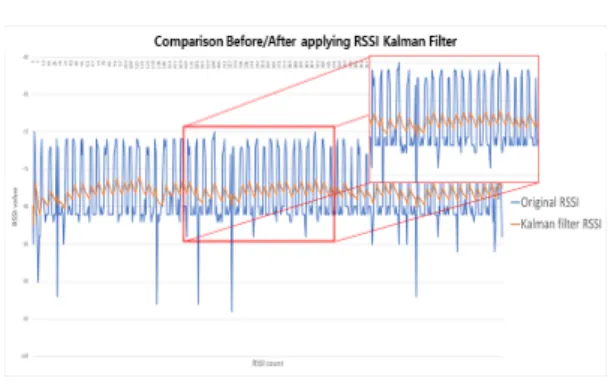
Also, the X value is updated by the formula (3). Figure 1 is a graph comparing the results before and after applying the Kalman filter after receiving the RSSI value of Beacon at 1m distance. The blue graph means raw data, and the orange data means data after applying the Kalman filter.
Table 1 shows the maximum and minimum values of the RSSI values compared.
(Figure 1) Comparison before/after applying RSSI Kalman filter
(Table 1) Result of Kalman filter calibration
Calibration List
Before Calibration
After Calibration
Max -69 -75.9596
Min -94 -82.4714
Average -77.9961165 -78.02993714
Error Range 25 6.511
3.1.2 Design of Floor&Safety area detection algorithm based on BLE Beacons
We use the RSSI value of the calibrated beacon to detect the current number of rooms and the safe area of the user.
Figure 2 shows the beacon-based indoor floor number and safety area detection flowchart proposed in this paper. Among the information of the received beacons, only the registered beacons are detected and the RSSI value is corrected. Also, a beacon having the largest RSSI value is detected to determine the number of indoor floors and the safe area of the current user.
In addition, when the existing scanned beacon is not re-scanned within 3 seconds, it is removed from the currently detected beacon list to improve the algorithm speed of detecting the user's current position.
3.2 Design of Smart helmet based on Bluetooth
In this chapter, we describe the algorithm to measure and
(Figure 4) Bluetooth communication protocol for Arduino and Andriod application (Figure 2) Flowchart of Indoor location detection
based on Beacons
judge the user's risk situation on the construction site by using Arduino, ultrasonic sensor, carbon monoxide sensor, and 3-axis accelerometer.
3.2.1 Design of Smart Helmet based on Arduino and Multi-Sensors
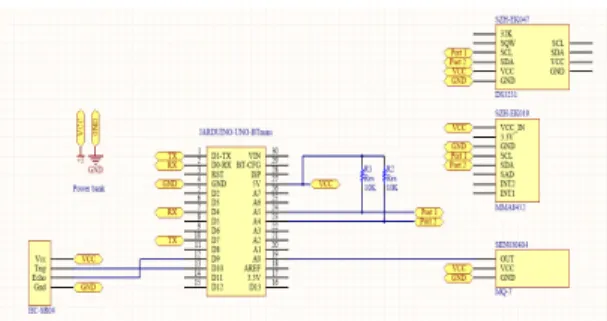
In this paper, we implement smart helmet to judge the risk situation at the construction site by using Arduino and various sensors. Figure 3 shows the Arduino-based smart helmet sensor design.
(Figure 3) Blueprint of Smart helmet sensors
(Table 2) Specs of Arduino Sensors
Categories
List Sensor Functions Pin
Number
MCU Jarduino-UNO
BTmini MCU&BT RX:4
TX:7
Accelerometer MMA8452
3-axis accelerometer measurement
SCL:A5 SDA:A4
CO Sensor MQ-7
Carbon monoxide measurement
A0
Ultrasonic
Sensor HC-SR04
Distance measurement
Trig:10 Echo:9
Real Time
Clock DS3231
Real time measurement
SCL:A5 SDA:A4
Table 2 shows the details of each sensor used in our research. The accelerometer and RTC(Real Time Clock) use 12C communication. And the carbon monoxide sensor and the ultrasonic sensor communicate using ADC(Analog to Digital) port. Arduino has a 10-bit ADC resolution, and all sensor values are transmitted to the Android application via Bluetooth communication. Figure 4 shows the Bluetooth communication protocol between Arduino and Android applications.
Figure 5 shows the flowchart of data reception using Bluetooth of smart device and smart helmet. After confirming the Bluetooth connection of smart helmet and
android device, it receives sensor data of smart helmet. After that, the received data is separated for each sensor and it is checked whether data is normally received. If the data is normally received, the data is transmitted to the smartphone.
(Figure 5) Flowchart of Data sensing based on Smart helmet
3.3 Design of Construction site safety management system
In this paper, we design and implement a construction site safety management system using BLE Beacons and smart helmet based on Arduino.
(Figure 6) Flowchart of Construction site safety management system using Smart Helmet and BLE Beacons
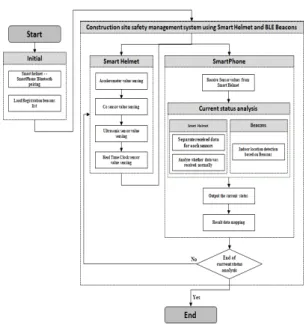
Figure 6 is a flowchart of the construction site safety management system using BLE Beacons and smart helmet.
During the initialization phase, the smartphone is connected to the smart helmet using Bluetooth, and the registered BLE Beacons list is loaded. After transmitting the data of four sensors (Accelerometer, Co Sensor, Ultrasonic Sensor, and RTC Sensor) to the smartphone, the status of the current user is analyzed using the information of the scanned BLE Beacons and the sensor data of the smart helmet.
4. Implementation of
Construction site safety management system
Figure 7 is a smart helmet and data sensing application designed and implemented in this paper. An ultrasonic sensor was placed on the top of the helmet to determine the falling objects. On the left side of the helmet, a carbon monoxide sensor was installed to measure the carbon monoxide emitted from the site. Also, the android device receives the 3-axis accelerometer data(x, y, z) of the smart
Actual
Predicted 1 Floor 2 Floor 3 Floor 4 Floor 5 Floor
1 Floor 242/292 82.88%
50/292 17.12%
0/292 0%
0/292 0%
0/292 0%
2 Floor 0/979 0%
937/979 95.71%
0/979 0%
42/979 4.29%
0/979 0%
3 Floor 0/1,223 0%
250/1,223 20.45%
954/1,223 78.00%
19/1,223 1.55%
0/1,223 0%
4 Floor 0/1,353 0%
0/1,353 0%
255/1,353 18.85%
944/1,353 69.77%
154/1,353 11.38%
5 Floor 0/2,198 0%
0/2,198 0%
0/2,198 0%
119/2,198 5.41%
2,079/2,198 94.59%
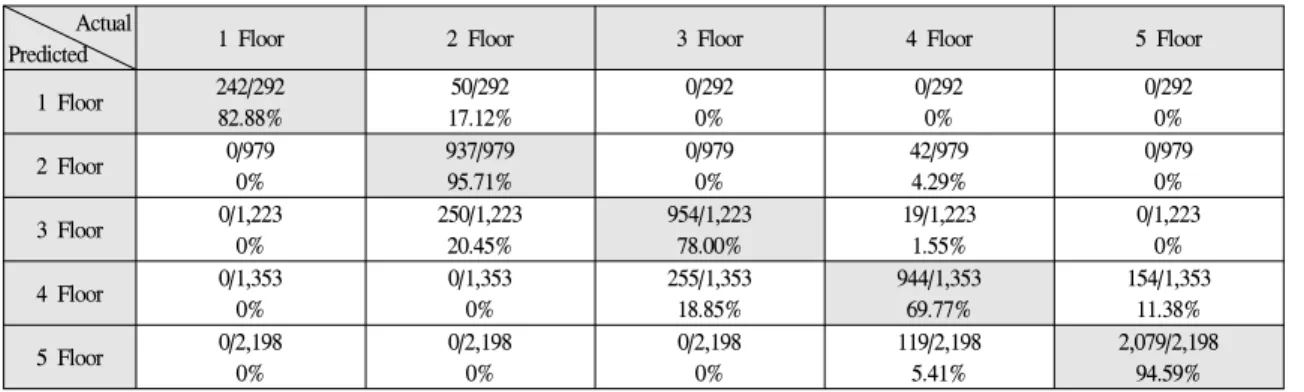
(Table 3) Result of the floor detection using Beacons
helmet, the carbon monoxide sensor data, and the ultrasonic sensor data, and provides the current external state change amount to the user using the graph.
Table 3 shows the test results of the floor detection algorithm based on BLE Beacons implemented in this paper.
A total of 6,045 beacon data were collected, and the current user's position was judged and compared. As a result, an average of 85.29% accuracy was detected.
(Figure 7) Implementation of Smart Helmet and Data sensing application
5. Conclusions
In this paper, we design and implement a construction site safety management system using BLE Beacons and smart helmet based on Arduino. Accelerometer, Co sensor, Ultrasonic sensor and RTC sensor were used together with
JARDUINO-UNO based MCU to design and implement smart helmets that measure the user's condition at the construction site. Also, BLE Beacons of Estimote were used to detect the number of indoor floors and safety areas in the construction site. In the future, we will improve the construction site safety management system by applying the algorithm that measures the user's walking status and the carrying weight, which will help to more efficient safety management.
Reference
[1] Hyun-Soo Lee, Kwangpyo Lee, Moonseo Park, Hyunsoo Kim and Sabum Lee, “A Construction safety management system based on Building Information Modeling and Real-time Locating System”, Korean Journal of Construction Engineering and Management, Vol 10, No.6, pp.135-145, 2009.
http://www.riss.kr/link?id=A100927305
[2] Korea Ministry of Employment and Labor. Measures to Reduce Industrial Accident Deaths—Intensive Management of High Risk Areas and Diffusion of Safety Priority Culture; Korea Ministry of Employment and Labor: Seoul, Korea, 2018.
[3] Chang-Baek Son, Chan-Sik Park, Sung-Ho Hong, Seok-In Choi, “An Evaluation of Safety Management Performance in Head Office and Job Site of Large Construction Firms”, JOURNAL OF THE ARCHITECTURAL INSTITUTE OF KOREA Structure
& Construction, Vol 18, No.6, pp.135-142, 2002.
http://www.riss.kr/link?id=A75915203
[4] C.H Lee, K.H Kim, J.W Kim and S.B Choi,
“Construction Site Safety Management System Using ZigBee Communication”, Journal of the Institute of Electronics and Information Engineers, Vol 54, No.3, pp.39-51, 2017.
http://www.riss.kr/link?id=A103045138
[5] C. Zhou and L.Y. Ding, “Safety barrier warning system for underground construction sites using Internet- of-Things technologies”, Automation in Construction, Vol 83, pp.372-389, 2017.
https://doi.org/10.1016/j.autcon.2017.07.005
[6] J.Y Kim, S.S Ahn and J.H Kang, “Development of Location/Safety Tracking System for Construction Site Workers by Using MEMS Sensors”, The Institute of Electronics Engineers of Korea, Vol 49, No.1, pp.12-17, 2012.
http://www.riss.kr/link?id=A60088913
[7] Md Fasiul Alama, Serafeim Katsikasb, Olga Beltramelloc and Stathes Hadjiefthymiadesa, “Augmented and virtual reality based monitoring and safety system: A prototype IoT platform”, Journal of Network and Computer Applications, Vol 89, pp.109-119, 2017.
https://doi.org/10.1016/j.jnca.2017.03.022
[8] Zainab Riaz, Erika A. Parn, David J. Edwards, Muhammad Arslan, Charles Shen and Feniosky PenaMora, “BIM and sensor-based data management system for construction safety monitoring”, Journal of Engineering, Design and Technology, Vol 15, pp.738-753, 2017.
https://doi.org/10.1108/JEDT-03-2017-0017
[9] T. Mori, S. Kajioka, T. Uchiya, I. Takumi and H. Matsuo,
“Experiments of position estimation by BLE beacons on actual situations,” Consumer Electronics(GCCE), 2015 IEEE 4th Global Conference on IEEE, pp.683-684, 2015.
http://dx.doi.org/10.1109/GCCE.2015.7398727
[10] M. G. Ji, J. Y. Kim, and J. I. Jeon, “Analysis of positioning accuracy corresponding to the number of BLE beacons in indoor positioning system”, Journal of Advanced Communication Technology, 17th International Conference on IEEE, pp.92-95, 2015.
http://dx.doi.org/10.1109/ICACT.2015.7224764 [11] Wook Song, et al. “Implementation of Android
Application for Indoor Positioning System with Estimote BLE Beacons”, Journal of Internet Technology Vol 19, No.3, pp.871-878, 2018.
http://dx.doi.org/10.3966/160792642018051903022 [12] JaeGu Lee, Jin Kim, SeonWoo Lee and YoungWoong
Ko, “A Location Tracking System using BLE Beacon Exploiting a Double-Gaussian Filter,” KSII Transactions on Internet and Information Systems, Vol 11, No.2, pp.1162-1179, 2017.
http://dx.doi.org/10.3837/tiis.2017.02.031
[13] Chi-Shian Yang, Sang-Joong Jung and Wan-Young Chung, “Three Dimensional Indoor Location Tracking Viewer”, KSII Transactions on Internet and Information Systems, Vol 3, No.1, pp.108-118, 2009.
http://dx.doi.org/10.3837/tiis.2009.01.006
[14] Woosik Lee, Heeyoul Kim, Min Hong, Min-Goo Kang, Seung Ryul Jeong and Namgi Kim, “A Survey of the Transmission-Power-Control Schemes in Wireless Body-Sensor Networks”, KSII Transactions on Internet and Information Systems, Vol.12, No.4, pp.1854-1868, 2018.
http://dx.doi.org/10.3837/tiis.2018.04.025
[15] Jinbae Kim, junho Jung, kyunggon Jo, Jo jiho Jang.
“Development for Smart helmet using the sensor and RMI technology”, Journal of Korean Information Science, pp.2117-2119, 2015.
http://www.riss.kr/link?id=A100640881
◐ 저 자 소 개 ◑
서 귀 빈(Kwi-Bin Seo)
2017년 순천향대학교 컴퓨터소프트웨어공학과(공학사) 2017년~Present 순천향대학교 컴퓨터학과 재학(석사과정)
관심분야 : Computer Vision, Bio Informatics, Machine Learning, Sensor Processing E-mail : [email protected]
민 세 동(Se Dong Min)
2001년 고려대학교 응용전자공학과(공학사) 2004년 연세대학교 생체공학과(공학석사) 2010년 연세대학교 전기전자공학과(공학박사) 2012년~Present 순천향대학교 의료IT공학과 교수
관심분야 : Biomedical signal processing, Healthcare sensor application, Mobile healthcare technologies E-mail : [email protected]
이 승 현(Seung-Hyun Lee) 1996년 인하대학교 건축공학과(공학사)
1999년 University of Colorado at Boulder(공학석사) 2003년 University of Florida at Gainesville(공학박사) 2008년~Present 홍익대학교 건축공학부 교수
관심분야 : Progress Simulation, Productivity, Safety, IoT, Sensing, Image Processing, and Automatic Data Acquisition
E-mail : [email protected]
홍 민(Min Hong)
1995년 순천향대학교 전산학과(공학사)
2001년 University of Colorado at Boulder(공학석사) 2005년 University of Colorado at Denver(공학박사)
2006년~Present 순천향대학교 컴퓨터소프트웨어공학과 교수
관심분야 : Computer Graphics, Dynamic Simulation, Bio Informatics, Computer Vision E-mail : [email protected]