Abstract
Purpose - This study was conducted to identify the impact of teachers’ professional development on students’ performance. It examines the nature of association between teachers’ pro- fessional development and students’ performance, and analyzes how students can be affected by different factors of teachers’
professional development.
Research design, data, and methodology - In order to obtain the required goals, Data were randomly collected from 100 stu- dents and 45 teachers from three different institutes that are af- filiated with KPK Agriculture University, Peshawar. To test the association between teachers’ professional development and stu- dents’ performance, the Chi-square test was applied. Gamma measurement was computed to check the direction of association.
Results - The results of the study supported the statement that there exists a positive relationship between teachers’ pro- fessional development and students’ performance.
Conclusion - Based on the findings it is surmised that, in or- der to create a clear learning relationship between teachers and students, management must support the teachers through peer group discussions and training opportunities, and should choose- teachers who can make students pursue the learning of subject knowledge with practical implementation.
Keywords: Professional Development, Association, Impact, Student Performance.
JEL Classifications: O15, C1, C1, M50.
* Corresponding Author, NUML University, Pakistan. E-mail: mahwish.
** Peshawar Business School, Pakistan. E-mail: [email protected]
*** Peshawar Business School, Pakistan. E-mail: muhammadsalam77@
gmail.com
**** Peshawar Business School, Pakistan. E-mail: [email protected]
1. Introduction
1.1. Background of the study
The best feeling as a young teacher is to walk in any class room like a teaching whiz without any fear (Palmer, 1998).
"Professional Development specifically with respect to teaching can be defined as one’s strength to strength movement towards being recognized as experienced teacher (Glatthorn, 1995).
Professional development amalgamates all kinds of formal expe- riences and informal experiences(Granser, 2000). While defining the path of professional development one must take the items into consideration which are entitled to be included as contents (Ganser, 2000; Fielding and Scholack, 1985).
Calderhead and Shorrock (1997) explored that, in addition to
‘knowing what’ and ‘knowing how’, teachers must also be com- petent in ‘knowing why’ and ‘knowing when’."Penny Freppon (2001) in her book "What it takes to be a teacher: The role of personal and professional development" stated that professional learning is the period of one’s growth that consolidates both the experiences of within the class and other formal experiences of outside the class as well such as conferences.
Great teachers help create great students. In fact, research shows that the inspiring teachers are those who can provide conditions to the students so that they can learn. If the learning of students becomes efficient then they can ensure the comely operations in their every walk of life.
1.2. Statement of the Problem
Investment in teacher’s growth and development means growth of the students who will brighten the future of Pakistan.
As skills and knowledge vary from person to person in the same way two teachers in the same university, school or col- lege may have difference in their skills. Ongoing professional development will help them to learn new tools for providing bet- ter education with their practical implementation and can create an environment of understanding among the student and the teacher.
1.3. Objectives of the study
The objective of the study is to collect data regarding how Print ISSN: 2233-4165 / Online ISSN: 2233-5382
doi: http://dx.doi.org/10.13106/jidb.2014.vol5.no3.15.
Impact of Teachers’ Professional Development on Students’ Performance
2)
Mahwish Parveen*, Obaid Ullah**, Muhammad Salam***, Naeem Zakir****
Received: March 30, 2014. Revised: July 04, 2014. Accepted: September 15, 2014.
professional development help teacher in upgrading their knowl- edge and how to deliver that to students for their benefits and practical learning. The main objectives of the study are outlined below to serves the following interests.
To investigate various factors of professional development.
y
y To find out association between teacher’s Professional Development and student’s performance.
y To find out the strength of association between teacher’s Professional Development and student’s performance.
1.4. Scope of the Study
This study aims to gather data regarding the professional de- velopment opportunities that have been given to the teachers of the affiliated institutes of KPK agriculture University Peshawar, and to know about that how these opportunities help them in improving their job skill and enhance creativity and efficiency, and how does the peer collaboration can contribute in the train- ing sessions. This can also be testified by collecting data from the students of the same institutes by witnessing the students learning improvements.
2. Review of Literature
This chapter provides a detailed literature review of the teacher’s professional development, impact of teacher’s knowl- edge reform on students and the culture of the classroom. This chapter outlined the need for the professional development and educational content changes for the development of the stu- dent’s outcome, it also out lines key features in detail necessary to support the research.
Crowther and Gaffney (1994) investigated the problem area that what are the Australian teachers needs regarding changing priorities in school educations, and secondly how do teachers perceive "best practice" during professional development.
Representative teachers were selected for one day focus-group seminars for data collection.
Browell (1997) examined the cooperative model and outlined that staff development help in development of both further and higher education. It was a case study based research.
Kennly (1998) found that teacher may not meet to transfer the syllabus knowledge in firm manners but put students in ac- tivities that enable them to learn. Teacher must be able to re- spond to the class situation that may occur haphazardly,author’s interest laid in the practical knowledge of the teachers that a teacher can have after experience.
Driel (2001)reported that teachers are the leading factor in changing /restructuring the educational setup they conducted in reform in science education that how can it help in developing teacher’s practical knowledge. Authors showed high degree of agreement with the fact that syllabus play a major role.
Robinson and Carrington (2001) reported in "Professional de- velopment for inclusive schooling", Professional development through knowledge and learning changes the student caliber,
writer stress down on the process of professional development in which involvement of the administrative staff and other teach- ing staff can be helpful for progress. In his paper he focused on professional development model in which he stated that re-culturing, collaboration with the professional teaching faculty and opportunities of learning are the main concern .Research method used by the researchers were focus group interviews and other secondary data which reveals that individual choice, idea about sustaining Professional development about learning and desire learning help teachers to create their sense of own- ership and also significance of professional development .
Jogthong and Ratchasima (2001) found that how Thai educa- tors were provoked by the reform in the 5 year bachelors cur- riculum and the concern about cooperative teacher professional development Schools (CTPDS). Two studies were conducted at primary school to observe the pattern for school development and also the factors essential for teacher and learning.
Participatory Action Research (PAR) was followed to conduct studies supportive group discussion, individual interviews and classroom observations whereas documentation was used as a tool for collecting the data.
Judith (2002) conducted a research to ensure that partner- ships of school and universities help in expanding teachers Professional Development. In his research he took sample size of 4 schools of same partnership of same school and universities. Methodology used was interview of 24 teachers (6 from each school), task and informal observation to identify those opportunities that teachers value, conditions requirement of professional development and to plan the implementation of process and how university does and school partnership contrib- ute to the professional development of teachers.
Harwell (2003) identified that in the last two decades stu- dents’performance have been improved very little, reason being they ignored the classroom activities. This paper regains atten- tion on activities or environment of class and the importance of class culture and how professional development can improve student’s performance through changing classroom behavior. Its primary observation is that how sustainable Professional devel- opment help teachers in enhancing their skill and produce great- er outcomes. It concluded that online professional development and face- to face training are most effective and efficient way of educating the educators and also provide the ease of accessi- bility that conventional Professional development program do not provide .
Jatoi (2004) mentioned in his report for USAID survey
"Pakistan Teacher education and professional development pro- gram(PTEPDP)" which was about the performance gap analysis and training need assessment (TNA) of teachers training in- stitutions in public sector throughout country and also to pro- mote the TNA. Main focus was to access quality education, effi- ciency level in training, need for resources and curriculum rele- vance with the demand of today’s education and professional development opportunities for teachers. Research sample was 24 teachers’ institutions overall country and methodology used gather data was questionnaires from individuals, groups focused interviews from the head of department. All teachers’ institution
are provincially administered with unique structure of organ- ization and syllabus. Report revealed fact that there is a clash between BOCs (bureaus of curriculum) and PITEs Provincial Institute of teacher education that must be resolved. They lack communication channel about certain academic issues. PTEPDP is a US based program for educating the teachers and to re- form such a system which can help in survival of the PD of teachers based on their research following were the findings that need to meet their action plan role and responsibilities clari- ty of BOC and PITE, separate level of teachers education, qual- ity text book and reference material libraries should be well equipped to regulate an appraisal system to evaluate the teach- er educators performance, improve physical environment of classroom to ensure activity based learning and bridges up the linkages between BOC, PITE and Universities.
Snow-Renner and Lauter (2005) focused on the three basic variables related to teacher and student learning i.e. standard curriculum, standard instructions and assessments that provide feed back about the learning.
Holdsworth (2006) studied to assess the degree to which pro- fessional development is involved in Australian universities. This was a web based survey for the sake of identifying that either which university is offering the opportunity for PD or providing any contents regarding the sustainability of the PD. The re- searchers found that out of the number of university there was only one university that was offering PD courses for teacher sustainability and provide the guidelines for exploring PD that could be effective and efficient in facilitation of the sustainability of teacher’seducation.
Shalton (2006) reported that professional development is a story of four T’s. i.e. Time, Training, Technology and Teacher – Type Tasks. initially teachers should be provided the time for PD training by the Universities and Schools so that they can avail the chance to attend the sessions and training must be in- corporated with the classroom activities so that a teacher can take interest in the work and besides training teachers must be provided by the equipment and software’s and the trainees must participate actively to learn and review the activity being taught.
Qazi (2008) investigated the fact that how professional devel- opment program offered with the follow up to the selected dis- trict of Pakistan sustained impact on teachers learning attitude and the skills. Data collected through class room observation, interviews with teachers and head teachers of those schools and teachers lessons plan Findings unfold the fact that follow up support the teachers to sustain their changed role even after the professional development with out the collegial or any peer support and staff encouragement.
Hussain (2009) conducted study aiming to analyze the facili- ties, training capacities and current practice problems being faced by teacher’s educational institute. Author chose Punjab for the research and used Likert scale questionnaires and inter- viewed for data collection from the head of institution which lacked the necessary technologies and were not aware of the appropriate use. Only few of the institution at university level have linkage and collaboration with international teacher’s edu- cations center. In light of his findings he concluded that all the
institution should be equipped with the modern teaching aid and trained educators and also these institutions should be allied with the international training centers through exchange programs.
Chalies (2009) evaluated the impact of the program on the pre service teachers training. Program was based on the class room techniques and sessions under his supervision of the uni- versity supervisors, so that they can deliver their best in the practical life. This study examine the circumstances under which teachers are able to overwhelm their training experience in class room and practice situations. And it also put forward the idea for expressing the supervisors work.
Morge (2010) reported in his article "Training programme on managing science class interaction: its impact on teacher’s prac- tices and on their pupils’ achievement" Evaluated that the main focus of the program was the interaction of the students and teachers. During the lectures 8 teachers and 172 students were taken as a sample. Aqualitative analysis was conducted regard- ing the teachers performance and awareness about the mis- conception of the students after the teachers had the sessions and the result was the improved students
Clayton (2010)examined that early learning Institute was one of the major contributions in the field of professional develop- ment and was found refined and effective, the process followed was basically research based in which there were few important factors that can most likely have a positive effect on the teach- ers training, i.e. specific child and teacher response in class, with due course of time training monitoring opportunities, collab- oration with peers and support by the internal department. He further focused on the fact that teacher child interaction is the– main element of learning and transformation of the literacy.
Data from the several research studies revealed professional development opportunities; it is truly individualized experiences that vary from teacher to teacher. It might be possible that two colleagues in same university school or college might have dif- ferent teaching capabilities.
3. Research Methodology
This chapter introduces determination of sample size, data collection procedure and statistical technique that will be used for data analysis. The detailed procedure that will be adopted to reach the conclusions is explained below.
Teacher’s Professional Development is one of the major is- sues in today’s world that have a lasting effect on the student’s performance. This chapter aims to find out that how teacher’s Professional development will effect the class room learning environment.
3.1. Population
Total population of the research study comprises of the busi- ness institutes in Peshawaraffiliated with Khyber Pakhtoonkhawa Agriculture University. Wetargeted the teaching staff and stu-
dents to find out that what is their personal caliber and learning skill and implementation of their work in the class room that brings out as clear performance standards for students. There are total in 3 institutes affiliated with Khyber Pakhtoonkhawa Agriculture University Peshawar, out of which we selected 15 faculty members by using convenient sampling and student are selected by using proportional random sampling for collecting data.
3.2. Sampling Design
Selecting a sample from a population takes many factors into account, including cost, confidence level, and sampling method, defining the smallest possible sample size depends on what is known about the population. Teachers were selected by apply- ing convenient sampling and students were selected by applying proportional random sampling for data collection from each institute.
By doing so, a total of 45 questionnaires were distributed among the teaching staff and 100 questionnaires among students.
Following is the table showing information about the number of management science institution, faculty and students from which sample will be collected.
<Table 1> Total number of students and teachers in the selected Business Institutions
S.No Name in Institution Sample Number of
faculty
Sample number
of Students
Population of student in each institute 1 PakistanEducationFoundation
College 15 18 62
2 MuslimCollege of Commerce 15 54 187
3 KhyberCollege of Commerce 15 28 95
Total 45 100 344
3.3. Hypothesis
To test the objectives developed we have established a hy- pothesis statement that is testable and can give the clear pic- ture of the objectives.
H0: There is no association between teacher’s Professional Development and student performance.
H1: Teacher Professional Development and student’s perform- ance are associated.
3.4. Data Collection
Data for conducting research was a primary source and was collected through designed questionnaires. Two different ques- tionnaires were prepared to obtain information regarding impact of teacher’s professional development on student’s performance.
Both the questionnaires contain closed ended questions and variables defining professional development. These quantitative
statements were measured by using five point Likert scale. The five points of measurement are, 1=strongly agree;2=Agree;
3=Uncertian; 4=Disagree; 5= Strongly disagree.
3.5. Data Analysis
As we have categorical variables, a Likert scale which is the measure of non-parametric measures was used. Chi-square test is applied at 5% level of significance. To test the association between teacher’s professional development and student’s performance. The Chi square test is defined as.
(3.1)
Which under the null hypothesis follows a -distribution with degrees of freedom. In equation (3.1), and
are the observed and expected frequencies of cell in ith row and jth column, respectively. Gamma measure was calcu- lated for obtaining the type of association (whether negative or positive) between teacher’s professional development and stu- dent’s performance.
To obtain the required objectives, the data was analyzed by using a statistical package for social sciences (SPSS) V.16. All the results are shown in terms of frequencies and percentages.
4. Results and Discussion
This chapter shows the outcome of collected data after being computed by the statistical model. It also elaborates the result that support research hypothesis.
Both student and teacher questionnaire results are discussed one by one to know about that how collected data affect the mentioned factors one way or the other.
4.1. Total responses collected from students 4.1.1. Classroom environment
Statement 1-8 indicates that respondents opinion are 61 (3.6%), 44 (2.6%), 46 (2.7%), 63 (3.7%), 36 (2.1%), 36 (2.1%), 44 (2.6%), 44 (2.6%) respectively. Response percentages show that respondents (students) highly agree to the point that class- room environment play an important role in student performance.
Hence this statement provides the grounds that class room en- vironment is one of important factor of professional development and leaves an impact on student’s performance and learning.
Harwell (2003) support the idea that classroom environment and culture can help in improving student performance and is an im- portant part of teacher’s professional development.
<Table 2> Response percentages regarding importance of classroom environment Classroom Environment
S.No Statement S.Agree Agree U.C Disagree S.Disagree Total
1 I take interest in his/her lecture during class. 61
(3.6) 26
(1.5) 10
(0.6) 0
(0) 3
(0.2) 100
(5.9) 2 My lecturer is always prepared for his/her lectures. 34
(2) 44
(2.6) 12
(0.7) 7
(0.4) 3
(0.2) 100
(5.9)
3 She/he explains new concepts well. 30
(1.8) 46
(2.7) 12
(0.7) 8
(0.5) 4
(0.2) 100
(5.9)
4 She/he comes in time for class 63
(3.7) 21
(1.2) 6
(0.4) 7
(0.4) 3
(0.2) 100
(5.9) 5 He/she makes us to willingly participate in class
activities and presentations 36
(2.1) 26
(1.5) 19
(1.1) 8
(0.5) 11
(0.6) 100
(5.9) 6 He/she provides proper notes and visual aid during
lectures. 19
(1.1) 36
(2.1) 16
(0.9) 13
(0.8) 16
(0.9) 100
(5.9) 7 She/he has complete control over the class discipline. 44
(2.6) 28
(1.6) 9
(0.5) 12
(0.7) 7
(0.4) 100
(5.9) 8 My lecturer focus is on student learning and behaviors 41
(2.4) 44
(2.6) 8
(0.5) 4
(0.2) 3
(0.2) 100
(5.9)
<Table 3> Response percentages regarding importance of staff and administration support Staff and Administration support
S.No Statement S.Agree Agree U.C Disagree S.Disagree Total
1 Administrative staff supports my lecturer in facilitating
his/her lectures. 23
(1.4) 33
(1.9) 19
(1.1) 14
(0.8) 11
(0.6) 100
(5.9) 2 My lecturer always help me whenever I need his help. 53
(3.1) 38
(2.2) 8
(0.5) 0
(0) 1
(0.1) 100
(5.9)
<Table 4> Response percentages regarding subject knowledge
Subject knowledge
S.No Statement S.Agree Agree U.C Disagree S.Disagree Total
1 I feel my lecturer is highly knowledgeable in the subject
being taught. 38
(2.2) 41
(2.4) 13
(0.8) 5
(0.3) 3
(0.2) 100
(5.9) 2 She/he made on effort to make the subject matter
interesting and stimulating 32
(1.9) 40
(2.4) 15
(0.9) 9
(0.5) 4
(0.2) 100
(5.9) 3 His/her training are relevant to class room situations. 25
(1.5) 49
(2.9) 10
(0.6) 5
(0.3) 11
(0.6) 100
(5.9)
4.1.2. Staff and administration support
The table 3 represents the fact that staff and administration support is one of the factors of professional development and affect student performance. Analysis of statement 1 and 2 re- veals that majority of the respondents (students) shows con- formity to the idea that with percentage 33 (1.9%) and 53 (3.1%) administration support is important for lecturer and teach- er willingness makes a big difference. Hence this statement pro- vides the grounds that staff and administration support is an im- portant factor of professional development and leaves an impact of student’s performance and learning. Robinson and Carrington (2001) supported the idea that in involvement of administration support and teaching staff help teachers in their progress.
4.1.3. Subject knowledge
The above table 4 describe that how teacher’s subject knowl- edge plays a role in professional training and development.
Results of statement 1-3 are 41 (2.4%), 40 (2.4%), 49 (2.9%) highlight the fact that lecturer’s subject knowledge and his/her effort to make lecture understandable to the students is an im- portant factor of professional development that leaves an impact on student’s performance. Hence this statement provides the grounds that subject knowledge is one of important factor of professional development and leaves an impact on student’s performance and learning. Kennly (1998) stated that teacher’s practical and subject knowledge can be a great tool for devel- oping student’s interest in the class and subject.
4.1.4. Training need
Result of the table 5 indicates that respondents (students) highly favored the statements with response of 30 (1.8%) and 43 (2.5%) that training brings a visible change in teaching meth- od and those who took part in seasonal trainings, practice it in their class to make contents easy and develop student’s interest. Hence this statement provides the grounds that training need is one of important factor of professional development and leaves on impact an student’s performance and learning. Browell (1997) and Hussain (2009) throwlight on the concept of teach- er’s training and its effect on student’s upbringing both agreed to the idea that teacher training and development helps in de- velopment of both teacher and student.
4.1.5. Motivation and feeling about work
Table 6 shows results regarding student’s interest in the class room and his feeling toward the subject learning is neces- sary for lecture understanding. Responses with 58 (3.4%), 47 (2.8%) reveals that respondents highly favored the statement 1 and 2, that emotion and feelings are the factors that drive stu- dents to maintain interest in the subject and develop classroom understandings. Hence this statement provides the grounds that emotion and feeling about work is one of important factor of professional development and leaves an impact on student’s performance. Snow Renner and Lauter (2005) said that emotion and feelings regarding teacher and subject can act as feedback tool that can judge student’s learning capabilities.
Table 7chi-square value is 254.70 with 64 d.f and also we observed that P-value = 0.00 is less than -value = 0.05 i.e.α (p-value = 0.00 < -value = 0.05), so we reject our null hypothα - esis that there is no relationship between teacher’s professional
development on student’s performance. It means that teacher’s professional developments and student’s performance are closely related and teacher’s development affects the students’
performance. So we accept our alternate hypotheses, that teach- er’s professional developments and student’s performance are dependent.
Gamma value shows the strength of association between teacher’s professional development and student performance, hence gamma value =0.23 indicates that there is positive asso- ciation between teacher’s professional development and student performance. We conclude that using information on respondent help us to improve the prediction of their satisfaction by 23%.
a. Total responses collected from teachers 4.3.1. Classroom environment
The table 8reveal that when the respondents (teachers) were asked about the role of the classroom environment in teaching practices the results were 24 (2.5%), 20 (2.1%), 25 (2.6%), 16 (1.7%), 15 (1.6%), 19 (2%), 24 (2.5%), 25 (2.6%).Overall re- sponse percentages shows that respondents (teachers) role in developing the class room culture and maintaining the discipline can help students to improve their learning by focusing behav- ioral change. Hence this statement provides the grounds that class room environment is one of important factor of pro- fessional development and leaves an impact on student’s per- formance and learning. Harwell (2003) support the idea that classroom environment and culture can help in improving stu- dent performance and is an important part of teacher’s pro- fessional development.
<Table 5> Response percentages regarding training need
Training need
S.No Statement S.Agree Agree U.C Disagree S.Disagree Total
1 My teacher is mostly engaged with seasonal trainings. 18
(1.1) 30
(1.8) 19
(1.1) 15
(0.9) 18
(1.1) 100
(5.9) 2 She/he presents lectures in a way that makes subject
a bit easier for me to understand. 33
(1.9) 43
(2.5) 9
(0.5) 6
(0.4) 9
(0.5) 100
(5.9)
<Table 6> Response percentages regarding motivation and feeling about work
Motivation and feeling about work
S.No Statement S.Agree Agree U.C Disagree S.Disagree Total
1 My interest motivated me to choose this field. 58
(3.4) 31
(1.8) 6
(0.4) 2
(0.1) 3
(0.2) 100
(5.9) 2 Being a student answering classroom session is
challenging. 47
(2.8) 36
(2.1) 14
(0.8) 2
(0.1) 1
(0.1) 100
(5.9)
<Table 7> Chi-square and Gamma value of the student questionnaire
S.NO Chi-square d-f P value Gamma value
1 254.7 64 0.000 0.23
<Table 8> Results in percentage regarding role of the classroom environment in teaching practices Classroom Environment
S.No Statement S.Agree Agree U.C Disagree S.Disagree Total
1 My students take interest in lecture during class 18
(1.9) 24
(2.5) 1
(0.1) 1
(0.1) 1
(0.1) 45
(4.8) 2 I am always prepared for delivering my lectures. 20
(2.1) 20
(2.1) 4
(0.4) 1
(0.1) 0
(0.0) 45
(4.8)
3 Students easily understand my lectures. 14
(1.5) 25
(2.6) 4
(0.4) 1
(0.1) 1
(0.1) 45
(4.8)
4 Students come in time for class 6
(0.6) 16
(1.7) 14
(1.5) 7
(0.7) 2
(0.2) 45
(4.8) 5 Student willingly participate in class activities and
presentations 6
(0.6) 15
(1.6) 14
(1.5) 8
(0.8) 2
(0.2) 45
(4.8) 6 I provide proper notes and visual aid during lectures. 13
(1.4) 19
(2.0) 8
(0.8) 4
(0.4) 1
(0.1) 45
(4.8) 7 I do have complete control over class discipline. 24
(2.5) 14
(1.5) 5
(0.5) 1
(0.1) 1
(0.1) 45
(4.8) 8 My focus is on student learning and behavior
change. 25
(2.6) 12
(1.3) 6
(0.6) 1
(0.1) 1
(0.1) 45
(4.8)
<Table 9> Results in percentage regarding staff and administration support
Staff and Administration Support
S.No Statement S.Agree Agree U.C Disagree S.Disagree Total
1 Administration support me in providing technology
i.e.(multimedia, projector) to facilitate my lectures. 17
(1.8) 12
(1.3) 9
(1.0) 5
(0.5) 2
(0.2) 45
(4.8) 2 My colleagues support me in learning new concepts
through discussion 14
(1.5) 21
(2.2) 4
(0.4) 4
(0.4) 2
(0.2) 45
(4.8) 3 I get guidance from my colleagues in teaching. 21
(2.2) 17
(1.8) 6
(0.6) 1
(0.1) 0
(0) 45
(4.8)
<Table 10> Results in percentage regarding subject knowledge
Subject Knowledge
S.No Statement S.Agree Agree U.C Disagree S.Disagree total
1 I do have complete command over the subject in
term of practice and theory. 20
(2.1) 20
(2.1) 4
(0.4) 0
(0) 1
(0.1) 45
(4.8) 2 I try hard to make subject contents more
understandable for students. 25
(2.6) 16
(1.7) 3
(0.3) 1
(0.1) 0
(0) 45
(4.8) 3 I try to present contents in easiest way. 28
(3.0) 12
(1.3) 3
(0.3) 0
(0) 2
(0.2) 45
(4.8)
4.3.2. Staff and administration support
Referred to table 9 that aims to know about that how staff administration support can be a tool to better teaching practice.
Analysis reveals that majority of the respondents (Teachers) shows conformity to the idea that administration support is im- portant for teacher and peer collaboration, subject discussion and management support can be of great use to teacher’s learning. Hence this statement provides the grounds that Staff and administration support is one of important factor of pro- fessional development and leaves an impact of student’s per- formance and learning. Robinson and Carrington (2001) sup- ported the idea that involvement of administration support and teaching staff help teachers in their progress. Shalton (2006) mentioned that professional development is story of 4 T’s, which should be provided by the management i.e., time, training, tech-
nology, and teacher type task.
4.3.3. Subject Knowledge
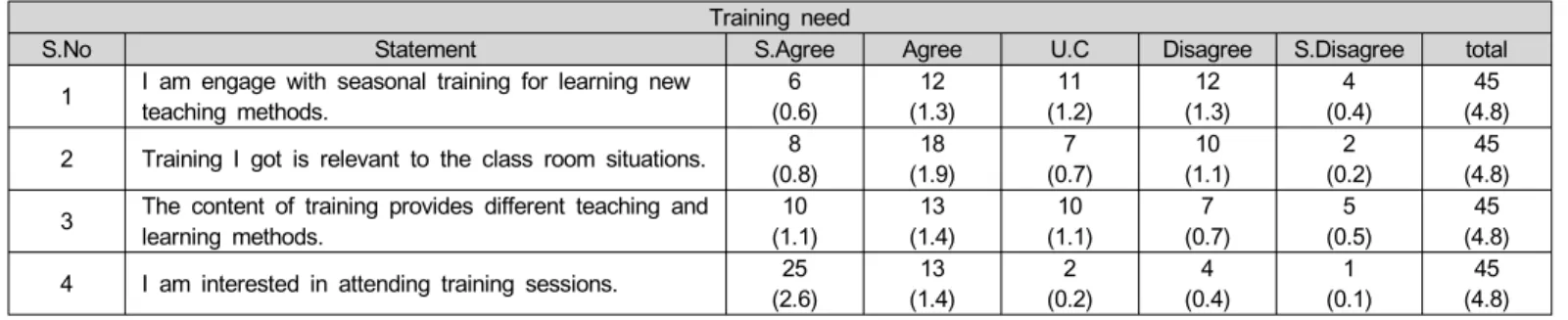
The table 10 indicates that how teacher’s subject knowledge plays a role in professional training and development. Results of the statement 1-3 are 20 (2.1%), 25 (2.6%), 28 (3%) re- spectively highlight the fact that teacher should have sound sub- ject knowledge, so that he/she can make concepts through stu- dent minds easily. Hence this statement provides the grounds that Subject knowledge is one of important factor of professional development and leaves an impact on student’s performance and learning. Driel (2001) and Kennly (1998) stated that teach- er’s practical and subject knowledge can be a great tool for de- veloping student’s interest in the class and subject.
<Table 11> Results in percentage regarding training need
Training need
S.No Statement S.Agree Agree U.C Disagree S.Disagree total
1 I am engage with seasonal training for learning new
teaching methods. 6
(0.6) 12
(1.3) 11
(1.2) 12
(1.3) 4
(0.4) 45
(4.8) 2 Training I got is relevant to the class room situations. 8
(0.8) 18
(1.9) 7
(0.7) 10
(1.1) 2
(0.2) 45
(4.8) 3 The content of training provides different teaching and
learning methods. 10
(1.1) 13
(1.4) 10
(1.1) 7
(0.7) 5
(0.5) 45
(4.8) 4 I am interested in attending training sessions. 25
(2.6) 13
(1.4) 2
(0.2) 4
(0.4) 1
(0.1) 45
(4.8)
<Table 12> Results in percentage regarding motivation and feeling about work
Motivation and Feeling about Work
S.No Statement S.Agree Agree U.C Disagree S.Disagree total
1 I enjoy my work 25
(2.6) 17
(1.8) 3
(0.3) 0
(0) 0
(0) 45
(4.8) 2 My interest motivated me to become a lecturer 21
(2.2) 14
(1.5) 8
(0.8) 2
(0.2) 0
(0) 45
(4.8) 3 Lecture preparation and class room sessions are
challenging work. 18
(1.9) 14
(1.5) 5
(0.5) 6
(0.6) 2
0.2) 45
(4.8)
<Table 13> Chi-square and Gamma value of the teacher’s questionnaire
S.No Chi-square d-f P value Gamma value
1 212.0 80 0.000 0.45
4.3.4 Training need
The table 11 describes that respondents (Teachers) desire to participate in trainings and learn new way of classroom teaching methods. To improve the quality of their lectures and to develop the student performance at the other hand. Hence this statement provides the grounds that training need is one of important factor of professional development and leaves an impact on student’s performance and learning. Browell (1997) and Hussain (2009) put light on the concept of teacher’s training and its effect on student’s upbringing both agreed to the idea that teacher training and development helps in development of both teacher and student. Jatoi (2004) also suggested the idea that performance gap can be bridged up by proper training sessions.
4.3.5. Emotion and feeling about work
Table 12 shows results regarding teacher’s interest in their work and their commitment toward the job. Responses highly fa- vored the fact with response 25(2.6%), 21 (2.2%), 18 (1.9%).
That, although teachers find it a challenge to prepare and deliv- er a lecture but their interest drives them to always deliver their best. Hence this statement provides the grounds that emotion and feeling about work is one of important factor of professional development and leaves an impact on student’s performance.
Snow Renner and Lauter (2005) said that emotion and feelings regarding teacher and subject can act as feedback tool that can judge student’s learning capabilities.
Table 13 reflected that chi-square value is 212.0 with 80 d.f and also we observed that P-value = 0.00 is less than -value = 0.05α i.e. (p-value = 0.00 < -value = 0.05), so we reject our null hyα - pothesis that there is no relationship between teacher’s professional development on student’s performance. It means that teacher’s pro- fessional developments and student’s performance are related and teacher’s development affects the students’ performance. So we accept our alternate hypotheses, that teacher’s professional devel- opments and student’s performance are dependent.
Gamma value shows the strength of association between teacher’s professional development and student performance, hence gamma value =0.45 indicates that there is positive asso- ciation between teacher’s professional development and student performance because of the different factors and variables that effect teacher’s personality i.e. class room environment, staff and administration support, subject knowledge, training need, motivation and feeling about work. We conclude that using in- formation on respondent help us to improve the prediction of their satisfaction by 45%.
5. Summary, Conclusions and Recommendations 5.1. Summary
Professional development is a continuous process; teachers
are in continuous learning process through interaction and expe- rience sharing with their peer group ,several development techni- ques either formal or informal (workshops,seminars,training,news- paper reading, networking, watching TV) help teachers to invest in their professional grooming. Experienced and informed teach- ers can create great students.
This research covers the broader area of teachers pro- fessional development and its impact on students performance, but more specifically it covers the area that how teacher pro- fessional development influence students ability through different factors that may be the same for both teachers and students but affect them differently.
This primary research is carried out to know about the asso- ciation trend between teacher’s professional development and student’s performance, for that purpose questionnaires were floated to collect data from teachers and students. Three in- stitutes were selected for data collection and 45 respondents were selected from teacher’s population through convenient sampling and 100 respondents were selected from student pop- ulation through proportional sampling.
Data collected was then tested by using the statistical test chi square, that tell us about the presence of the association between the two variables i.e. teacher’s professional develop- ment and student’s performance. And gamma measurement was used to know about the strength of the association.
Analysis of the teachers data show that teachers development leaves a positive impact on student’s performance and same does the student data reveals that student’s performance de- pend on teacher’s class room investment.
5.2. Conclusions
After evaluating the study conducted and the data colleted through questionnaires from teachers and students, I have reached to the conclusion that teachers development and stu- dents performance are related. After applying Chi-square test and Gamma measurement the results came out to be in com- plete favour that there is an Impact of teacher’s professional de- velopment on student’s performance.
According to the students responses which were collected from the three different institutes as the institutes vary also the capabilities and mind frame of the student vary and their ability to perceive things is different from other students, class room is the place where students interact with teachers regarding the subject matter, clear his/her mis conceptions about the topic and if the teacher is clear in his/her point it would be easier for students to understand although, students may sometime ques- tion teachers ability for not delivering the topic clearly, this may arise conflicts between student and teacher and can disturb the class room environment ,so a teacher should be well equipped with the best teaching tools and techniques which can create an understanding environment in the class to gain the student interest.
Teacher’s data revealed the fact that the teacher is of the same subject teaching the same class may differ in their teach- ing methods, no two teachers are the same. Being a student, to me teacher should be a person who share his/her knowledge in a way that reaches to students mind. Data was collected from three different institute’s teachers, for most of the teachers their profession choice was the basic source of motivation for them, and their drive for continuous learning and training willing- ness made them more effective teachers.
Analysis shows that different variables involved in professional development like class room environment, staff and admin- istration support, subject knowledge, training need and motiva- tion and feeling associated with work leaves a on going im- pression on developing the students and maintaining class room discipline.
In a nut shell the principal conclusion of the study is that
"there exist a relation between teacher’s professional develop- ment and student performance"and ongoing "impact of teacher’s professional development on Student’s performance."
5.3. Recommendations
Based on conclusion of the study following recommendations have been sprouted, if they would be followed by the institutes management can brings out more sustainable results in teach- er’s professional development and student performance.
Following are few of the recommendations for teachers.
1. Lecture should be easy and contents should be understandable.
2. Teacher should provide proper notes and guidelines for subject matter.
3. Teacher should develop class room norms in order to maintain class room discipline.
4. Management should arrange workshops and provide train- ing opportunities to teachers for knowledge up gradation and new tools and techniques for class rooms.
5. Teacher interest can be enhanced by proper motivation by the management such as acknowledging the teacher serv- ices i.e. reward for their contributions.
Following are few of the recommendations for students.
1. Field trips should be arranged for student to bridge up the class contents with practical setup.
2. Student should be provided proper counseling by the teachers.
3. Student interest can be enhanced in subject by making contents more easy and interesting.
4. Students should be engaged in more of the challenging activities, such a as assignments, surveys, research, case studies, etc.
5. Students should be properly counseled about the scope of the subject chosen.
Reference
Ader, H. J., Mellenbergh, G.J., and Hand, D.J.(2008). Advising on research methods: A consultant's companion. Huizen, The Netherlands: Johannes van Kessel Publishing.
Browell, S.(2000). Staff development and professional education:
a cooperative model. Journal of work place learning:
Employee counseling Today, 12(2), 57-65.
Chalies, Bruno-Meard. (2009). Training Pre-service Teachers Rapidly, Journal of Teaching and Teacher Education, 8(1), 1-8.
Crowther, F., and Gaffney, M. (1994). National Educational Priorities: a Challenge for Professional Development.
International Journal of Education Management,8(4), 11-15.
Fisher, D. (1999). Teachers perspectives of curriculum and cli- mate changes: benefits of inclusive education. Journal for a just and caring education, 5(3), 256-68.
Harwell, H.S. (2003). Journal Teacher professional development:
it’s not an event, it’s a Process. Cord., 2, 2-51.
Holdsworth, S. (2008). Professional development for education for sustainability how advance are Australian universities.
International journal of sustainability in higher education, 9 (2), 131-146.
Hussain, I., and Adeeb, A.M. (2009). Professional development of teachers in Pakistan. M-2009, 2-128
Jatoi, A.M. (2004).Pakistan Teacher education and professional development program. Report USAID. 6-44.
Jogthong, C., and Pimolbunyong, R. (2001). Participatory Action
research for school-based management teacher pro- fessional development. Research in higher education Journal, 2(1), 1-8.
Law, S. (1999).Leadership for learning the changing culture of professional development in schools. Journal of Education Administration, 37(1), 66-79.
Morge, L. (2010). A training Program on Managing Science Class Interaction. Journal of Teaching and Teacher Education, 26, 415-426.
Noon, P. (1994). CDP: Professional Development-Continuing and compulsory?. Librarian Career Development, 2(4), 4-8.
Palmer, P. J. (1998). The courage to teach: Exploring the inner landscape of a teacher's life. San Francisco:
Jossey-Bass.
Robinson, R., and Carrington, S. (2002). Professional Development for inclusive Schooling. the International Journal of Educational Management,16(5), 239-247.
Sandholtz, H.J. (2002). In-service Training of professional Development. Teaching and Teachers education, 18, 815-830.
Snow-Renner, R., and Lauer, A.P. (2005). McREL insights:
Professional development analysis. Retrieved July 11, 2007, from
http://www.mcrel.org/PDF/ProfessionalDevelopment/
5051IR_Prof_dvlpmt_analysis.pdfVan, H.J. (2001). Professional Development and Reform in Science Education: Role of Teachers Practical Knowledge. Journal of Research in Science teaching, 38(2), 137-158.