• 검색 결과가 없습니다.

Polymer Thin Film of Phthalic Anhydride via Plasma Polymerization

N/A
N/A
Protected

Academic year: 2021

Share "Polymer Thin Film of Phthalic Anhydride via Plasma Polymerization"

Copied!
6
0
0

로드 중.... (전체 텍스트 보기)

전체 글

(1)

Vol.10, No.1, 2009

<연구논문(Original Article)>

Polymer Thin Film of Phthalic Anhydride via Plasma Polymerization

Hyun Min Kang, Fevzian Basarir, Kwan Yeol Paek, and Tae-Ho Yoon

Department of Materials Science and Engineering Gwangju Institute of Science and Technology, Gwangju 500-712, Korea (Received February 23, 2009; Revised March 20, 2009; Accepted March 20, 2009)

플라즈마 중합에 의한 프탈릭 안하이드라이드 고분자 박막 필름 제조 연구

강현민⋅Fevzian Basarir⋅백관열⋅윤태호

광주과학기술원 신소재공학과

(2009년 2월 23일 접수, 2009년 3월 20일 수정, 2009년 3월 20일 채택)

Abstract: Polymer thin films were prepared by radio frequency (RF) plasma polymerization of phthalic anhy- dride (PA). First, monomer vaporization temperature (100∼160°C) was optimized by evaluating the thermal properties of thin films using differential scanning calorimeter (DSC) and measuring the root-mean-square (RMS) roughness with atomic force microscope (AFM) at the fixed plasma power of 10 W and time of 5 min in a continuous-wave (CW) mode. Plasma power (5∼20 W) was then optimized by measuring the film solubility in solvents such as toluene, acetone, dimethylsulfoxide (DMSO) and 1 methylpyrrolidine (NMP). Next, pulsed mode plasma polymerization was also studied by varying the duty cycle of on-time (5, 20%) under optimized conditions of continuous-wave (CW) mode (120°C, 10 W) in order to increase the anhydride func- tional groups. Finally, polymer thin films were characterized by Fourier transform infrared spectroscopy (FT-IR), thermogravimetric analyzer (TGA) and α-step.

Keywords: plasma polymerization, pulsed, continuous-wave, phthalic anhydride

1. Introduction

1)

Due to the increasing interest in polymer thin films in various applications, there have been considerable re- search conducted on the preparation of defect-free polymer thin films [1]. Currently, wet processes such as Langmuir- Blodgett and spin coating, and dry processes such as physical or chemical vapor deposition and plasma poly- merization are being widely investigated. Among them, plasma polymerization is of particular interest since it can provide pinhole-free thin films with controlled chem- istry by the careful tailoring of plasma processing con- ditions [2]. Furthermore, it is an environmentally friendly technique and can provide good adhesion to most sub- strates. Consequently, plasma polymerization has been uti- lized in adhesion promotion [3,4], corrosion-protective coatings [5], and electrical [6] and biomedical applica- tions [7].

Corresponding author: Tae-Ho Yoon ([email protected])

However, severe fragmentation of monomers taking place during continuous-wave (CW) plasma polymer- ization results in polymer thin films that do not possess monomer characteristics [2]. Consequently, pulsed plasma polymerization has been introduced and was proven to be very good at minimizing monomer fragmentation by controlling the duty cycle [8]. To date, pulsed plasma polymerization has been utilized with a number of mon- omers to provide thin films with high retention of mon- omer functionalities. Among the monomers, anhydride monomers have received great attention since they can provide reactive functional groups for further chemical reactions [9-12].

In this study, therefore, plasma polymerization of

phthalic anhydride (PA) was attempted via radio fre-

quency (rf) plasma polymerization in CW mode, as well

as pulsed mode. Plasma polymerization was carried out

as a function of monomer vaporization temperature and

plasma power under fixed plasma polymerization time in

order to obtain polymer thin films with good chemical

(2)

resistance. The conditions were optimized by measuring the thermal properties via DSC, surface roughness via AFM, and film solubility in solvents such as toluene, acetone, NMP and DMSO. The polymer thin films were also characterized by FT-IR, TGA and α-step 500. Under optimum conditions, pulsed plasma polymerization was attempted to increase the retention of anhydride groups by varying the duty cycle of on-time (5, 20 %).

2. Experimental

2.1. Materials

Phthalic anhydride (PA, Aldrich, 99%, mp = 130.8°C) was purchased from Sigma-Aldrich and used without fur- ther purification. Small pieces of silicon wafers (10 × 10 mm) were used to prepare the samples for FT-IR and AFM analysis. Silicon wafers were cleaned by im- mersing in 49% HF solution for 10 sec, followed by washing with distilled water and drying.

2.2. Plasma Polymerization of PA

Plasma polymerization of PA was carried out in a RF (13.56 MHz) plasma reactor consisting of cylindrical glass chamber (30 × 30 cm), manual impedance match- ing, pressure gauge, and gas inlet connected to a mass flow controller (MFC), as reported earlier [13]. Three heating stages were installed inside the glass chamber to vaporize the solid monomer. For the pulsed mode plasma polymerization, a pulse function generator (Yokogawa, Model FG110) was employed.

Prior to each experiment, the reactor was cleaned with acetone-soaked Kimwipe

, followed by oxygen plasma etching (100 W, 30 mTorr, 10 min). Silicon wafers were placed on the sample stage at the center of the chamber, and PA powder (0.3 g) was placed on the heating stage.

Next, the temperature of the heating stage was raised to its pre-set temperature (100∼160°C), while the chamber was evacuated to 1 mTorr. Once the temperature was stabilized, plasma polymerization was carried out.

First, the monomer vaporization temperature (100∼

160°C) was optimized under the fixed plasma polymer- ization time of 5 min and power of 10 W by evaluating the thermal properties of thin films with DSC and their surface roughness with AFM. Second, the plasma power (5∼20 W) was optimized by measuring the solvent re- sistance of the films in acetone, toluene, DMSO and NMP at RT for 24 hrs. The pulsed plasma polymer-

ization of PA was also carried out as a function of duty cycle of on-time (5, 20%) at the cycle time of 10 ms, under the optimized conditions of CW plasma polymer- ization, (120°C, 10 W) in order to maximize the anhy- dride functionalities without lowering solvent resistance.

The films were characterized by FT-IR, TGA and α -step 500.

2.3. Characterization of Plasma Polymer Films

For the thermal analysis, the plasma polymer film of PA was scraped off from the silicon wafer and sub- jected to DSC (TA-2010) and TGA analysis (TA-2980) at a heating rate of 10 °C/min. The plasma polymer films of PA on silicon wafers were also analyzed by FT-IR (Perkin Elmer IR-2000 Series) at a resolution of 4 cm

-1

, and 32 scans were made on the average. The film thickness was evaluated by α-step 500 (Tencor) with a scan length of 100 µm at a speed of 10 µm/s.

The samples were prepared by scraping off a portion of the film with a razor blade to create a step. All charac- terizations were performed immediately after plasma pol- ymerization to minimize the hydrolysis of anhydride groups in plasma polymer films.

3. Results and Discussion

3.1. Plasma Polymerization of PA

First, the vaporization temperature of PA (100∼160

°C) was optimized by analyzing thermal property of plasma polymer films with DSC, which were prepared via plasma polymerization at 10 W and 5 min, as shown in Figure 1. The plasma polymer films of PA monomers vaporized at 100°C provided no thermal tran- sition in the 50∼250°C range, while Tg of 160°C was detected from those vaporized at 120°C. This can be ex- plained by crosslinking of PA monomer (vapor) via plasma polymerization. At 100°C, the monomer vapor- ization is slow and thus plasma energy of 10 W was enough to dissociate all monomers, making them highly crosslinked, while much more monomers were vaporized at 120°C vaporization, resulting in much less cross- linking and thus showing Tg.

On the other hand, a melting peak instead of Tg was

observed at around 130°C from the samples prepared by

140 and 160°C vaporization. The melting point of these

samples is similar to that of PA monomer (130.8°C), at-

tributing to just condensation without much crosslinking.

(3)

Figure 1. DSC thermograms of continuous wave plasma polymerized phthalic anhydride films prepared at 10 W and 5 min.

Figure 2. AFM image of continuous wave plasma polymer thin films of phthalic anhydride prepared at 10 W and 5 min; A) 120°C, B) 140°C.

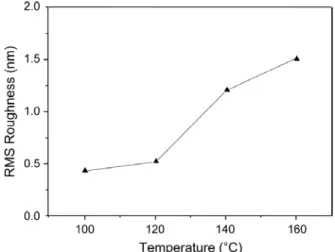
Figure 3. RMS roughness of continuous-wave plasma poly- mer thin films of phthalic anhydride prepared at 10 W and 5 min.

Table 1. The solubility of the plasma polymer thin films prepared at the deposition time of 5 min and monomer va- porization temperature of 120°C

Plasma Power Toluene Acetone NMP DMSO

5 W P P P P

10 W I I I I

20 W I I I I

* I : insoluble, P : partially soluble
This can be attributed to fast vaporization at 140 and 160°C and thus plasma energy of 10 W was only enough to dissociate small portion of PA vapor, allow- ing them to condense rather than crosslinking. This is supported by the larger melting peak from the samples prepared at 160°C vaporization, compared to the one at 140°C. Other samples prepared at 5 and 20 W exhibited similar thermal behavior as those prepared at 10 W.

In the AFM analysis, the samples prepared at 100 and 120°C exhibited a smooth surface with only a few par- ticles, but roughness increased as the vaporization tem- perature increased (Figure 2). However, the plasma poly- mer films prepared at 140 and 160°C showed a rough surface with numerous small particles, which can be ex- plained by monomer condensation, instead of plasma polymerization, as observed from the DSC analysis. The measured RMS roughness values increased slightly at 120°C, but rather rapidly at 140 and 160°C (Figure 3).

Considering the thermal behavior and RMS roughness, 120°C was chosen as the optimum vaporization temper- ature for plasma polymerization.

Next, plasma power (5∼20 W, at 5 min) was opti- mized by measuring the solubility of the plasma polymer films in order to obtain chemically-stable plasma poly- mer films. The films prepared at 5 W were partially soluble in acetone, toluene, NMP and DMSO, but those prepared at 10 and 20 W were insoluble in all four sol- vents, demonstrating the crosslinked nature of the films (Table 1). Since chemically stable films with functional groups are needed, 10 W was chosen as the optimum plasma power, resulting in the optimum conditions of 120°C and 10 W, and plasma polymerization time of 5 min.

3.2. Characterizations of Plasma Polymer Thin Films of PA 3.2.2. FT-IR analysis of Plasma Polymer Films

The plasma polymer films of PA in CW mode ex-

hibited a very different FT-IR spectrum from that of the

PA monomer, as shown in Figure 4. PA monomers ex-

hibited characteristic peaks such as C=O stretching

(1851, 1767 cm

-1

), aromatic C=C (1595, 1458 cm

-1

),

C-O stretching (1257, 900 cm

-1

), and C-H bending (790,

(4)

Figure 4. FT-IR spectra of continuous-wave plasma polymer thin films of phthalic anhydride prepared at 120°C and 5 min.

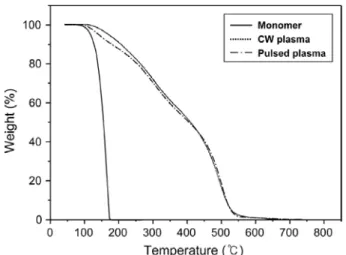
Figure 6. TGA thermograms of continuous-wave and pulsed plasma polymer thin films of phthalic anhydride prepared at 120°C, 10 W, 5 min and/or 20% on-time.

Figure 5. FT-IR spectra of the pulsed plasma polymer thin films of phthalic anhydride prepared at 120°C, 10 W and 5 min.

710 cm

-1

). Upon plasma polymerization at 10 W, the peaks at 710, 790, 900, 1257, 1458 and 1851 cm

-1

near- ly disappeared, while peaks at 1767 (C=O) and 1595 cm

-1

(C=C) still remained clearly. This can be partially explained by the fragmentation of phthalic anhydride monomers upon plasma polymerization at 10 W. The new peaks observed at 1680 and 1705 cm

-1

indicate oxi- dation and possible crosslinking of PA fragments. When plasma polymerization was carried out at 20 W, all the peaks disappeared with the exception of ones at 1851 and 1767 cm

-1

, which still showed weak intensity, while a large peak appeared in the 1500∼1800 cm

-1

range, which is again attributed to the fragmentation of PA

monomers and their subsequent oxidation and cross- linking of the fragments [2].

In the pulsed plasma polymerization, as the duty cycle of on-time decreased, the FT-IR spectrum became sim- ilar to that of PA monomer, as shown in Figure 5. The thin films from the pulsed plasma polymerization at the on-time duty cycle of 5 and 20% exhibited greatly in- creased intensity of the peaks at 710, 790, 900, 1257, 1458, 1595, 1767 and 1851 cm

-1

. In comparison, the in- tensity of peaks at 1680 and 1705 cm

-1

clearly de- creased and the decrement was much larger for 5% than 20% on-time, indicating much less fragmentation, oxida- tion, and crosslinking at 5% on-time, as reported by Ryan et al. [14].

3.2.2. TGA Analysis of Plasma Polymer Films

In the TGA analysis, CW and pulsed plasma-poly-

merized (20% on-time) thin films exhibited 5% weight

loss in air at the respective temperature of 150 and

120°C, followed by slow degradation and complete deg-

radation at around 530°C (Figure 6). This can be com-

pared to the results obtained from the monomers, which

showed 5% weight loss at 105°C and complete degrada-

tion at 180°C. Therefore, the enhanced thermal stability

of plasma-polymerized thin films can be attributed to the

crosslinked structure of the films, as demonstrated by

their insolubility in NMP and DMSO. However, their

thermal degradation in the 200∼400°C range may be

explained by the incomplete crosslinking of plasma poly-

mer films. It should be noted that there was no differ-

(5)

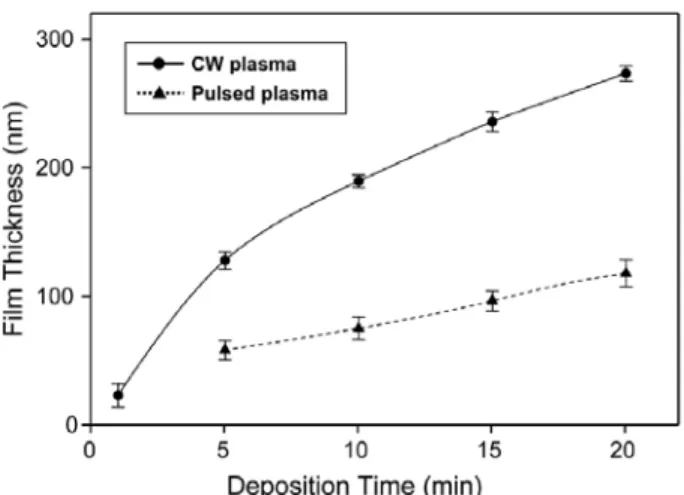
Figure 7. Film thickness of continuous-wave and pulsed plasma polymer thin films of phthalic anhydride prepared at 120°C, 10 W and/or 20% on-time.

ence in the thermal stability of CW and pulsed plasma polymers, which can be attributed to the similar cross- linking density despite the greater number of functional groups in the pulsed plasma polymer films.

3.2.3. Thickness of plasma polymer films

The film thickness increased almost linearly as the deposition time increased, as shown in Figure 7. The CW plasma polymerization provided only ∼30 nm thick- ness at 1 min, which then increased rather rapidly to 130, 180, 235 and 275 nm at 5, 10, 15 and 20 min, respectively. However, the increase in the film thickness in pulsed plasma polymerization was much smaller, re- sulting in a thickness of 55, 75, 97, 115 nm at 5, 10, 15 and 20 min, respectively. A comparison of film thickness between the two modes of polymerization sho- wed that CW plasma polymerization resulted in films with approximately 2.4 times greater thickness than pul- sed plasma polymerization at a given plasma polymer- ization time, instead of 5 times the thickness considering the 20% duty cycle of on-time. This discrepancy can be explained by the film formation process that continues to take place even during the plasma-off period [13].

4. Conclusions

Polymer thin films of PA were successfully obtained via RF plasma polymerization in both continuous-wave (CW) and pulsed mode, providing films with anhydride functional groups and good solvent resistance. Major findings are summarized as follows:

1) By evaluating the thermal properties of thin films via DSC and surface roughness by AFM, an optimum monomer vaporization temperature of 120°C was ob- tained, which provided crosslinked plasma polymer films instead of monomer condensation.

2) 10 W was chosen as the optimum plasma power for obtaining good solvent resistance in toluene, acetone, DMSO and NMP, with some anhydride functional groups still remaining, as confirmed by FT-IR.

3) Pulsed mode plasma polymerization (duty cycle of 10 ms, 20% on-time) provided more anhydride functional groups without lowering the solvent resistance.

4) The CW and pulsed mode plasma polymer films exhibited greatly enhanced thermal stability in TGA analysis, compared to PA monomers, but it were still in- ferior to that of the polymers, possibly owing to in- complete crosslinking.

5) The thickness of plasma polymer films increased almost linearly with deposition time, but the thickness of films from CW plasma polymerization was only 2.4 times greater than that from pulsed plasma polyme- rization.

References

1. F. F. Shi, Surf. Coat. Technol., 82, 1 (1996).

2. R. d’Agostino, Plasma Deposition, Treatment, and Etching of Polymers, London: Academic Press (1990).

3. H. M. Kang, N. I. Kim, and T. H. Yoon, J. Adhesion Sci. Technol., 16, 1809 (2002).

4. J. H. Roh, J. H. Lee, and T. H. Yoon, J. Adhesion Sci. Technol., 16, 1529 (2002).

5. Y. Lin and H. Yasuda, J. Appl. Polym. Sci., 60, 543 (1996).

6. L. M. Han, R. B. Timmons, and W. W. Lee, J.

Vac. Sci. Technol. B, 18, 799 (2000).

7. H. G. P. Lewis, D. J. Edell, and K. K. Gleason, Chem. Mater., 12, 3488 (2000).

8. M. E. Ryan, A. M. Hynes, and J. P. S. Badyal, Chem. Mater., 8, 37 (1996).

9. D. Beyer, W. Knoll, H. Ringsdorf, G. Elender, and E. Sackman, Thin Solid Films, 284, 825 (1996).

10. J. M. D. Gooijer, A. D. Haan, M. Scheltus, L. S.

Vondervoort, and C. Koning, C. Polymer, 40, 6493 (1999).

11. S. A. Evenson, C. A. Fail, and J. P. S. Badyal,

Chem. Mater., 12, 3083 (2000).

(6)

12. S. Schiller, J. Hu, A. T. A. Jenkins, R. B. Timmons, F. S. Sanchez-Estrada, W. Knoll, and R. Forch, Chem. Mater., 14, 235 (2002).

13. N. M. Mackie, N. F. Dalleska, D. G. Castner, and

E. R. Fisher, Chem. Mater., 9, 349 (1997).

14. C. J. Ahn and T. H. Yoon, J. of Adhesion &

Interface, 7, 23 (2006).

수치

Figure 1. DSC thermograms of continuous wave plasma  polymerized phthalic anhydride films prepared at 10 W  and 5 min.
Figure 4. FT-IR spectra of continuous-wave plasma polymer  thin films of phthalic anhydride prepared at 120°C and 5  min.
Figure 7. Film thickness of continuous-wave and pulsed  plasma polymer thin films of phthalic anhydride prepared at  120°C, 10 W and/or 20% on-time.

참조

관련 문서

- Transition to H-mode: state with reduced turbulence at the plasma edge - Formation of an edge transport barrier: steep pressure gradient at the edge...

Titanium surface modification was carried out by depositing an thin polymeric layer containing carboxyl, amine and hydroxyl groups through plasma

Coadministration of naringenin increased the absorption rate constant (Ka), the area under the plasma concentration-time curve (AUC) and peak concentration (C max

In this study, we have deposited poly acrylic acid films on three-dimensional (3D) PCL scaffolds using plasma polymerization and then plasma-polymerized 3D

skeleton bond energy differences of monomer, oligomers, and polymer. Skeletal bond energy difference

AUC: Area under the plasma concentration-time curve from time zero to time infinity, C max, Peak concentration, T max : The time to reach peak plasma concentration, t 1/2 :

Mean arterial plasma concentration-time profiles of 4-hydroxytamoxifen after an oral administration of tamoxifen (10 mg/kg) to rats in the presence or absence

- The magnetic pressure and plasma pressure each produce positive (outward forces) near the outside of the plasma...