• 검색 결과가 없습니다.

Effects of Nitrogen Fertilization on Leaf Yield and Pyranocurmarine Accumulation in Angelica gigas Nakai

N/A
N/A
Protected

Academic year: 2021

Share "Effects of Nitrogen Fertilization on Leaf Yield and Pyranocurmarine Accumulation in Angelica gigas Nakai"

Copied!
7
0
0

로드 중.... (전체 텍스트 보기)

전체 글

(1)

Effects of Nitrogen Fertilization on Leaf Yield and Pyranocurmarine Accumulation in Angelica gigas Nakai

Young-Jin Seo*, Jong-Su Kim, Kee-Choon Park

1

, Chun-Geun Park

1

, Young-Sup Ahn

1

, Seon-Woo Cha

1

, and Yoon-Ju Kang

2

Bonghwa Medicinal Plant Research Station, Gyeongsangbuk-do Agricultural Research and Extention Services, Bonghwa 36229, Republic of Korea

1

Department of Herbal Crop Research, National Institute of Horticultural and Herbal Science, RDA, Eumseong, 27709, Republic of Korea

2

Department of Life Environmental Research, Gyeongsangbuk-do Goverment Public Institute of Health and Environment, Yeongcheon, 38874, Republic of Korea

(Received: July 9 2015, Revised: October 15 2015, Accepted: October 15 2015)

Angelica gigas Nakai is one of the most widely used herbal medicines and is known to have many pharmaceutical effects including an anti-oxidant, anti-cancer etc. This study was carried out to investigate an effect of fertilization on leaf yield, production of dry-matter and accumulation of pyranocurmarine compounds such as decursin (DE) and decursinol angelate (DA) in Angelica gigas Nakai. Effect of fertilization was determined from response surface regression equation composing of 2 by 3 factorial arrangement of urea, sodium dihydrogen phosphate and potassium chloride. Yield of leaf in Angelica gigas Nakai significantly increased until 100 days after transplanting. Production of leaf also tended to increase with increasing nitrogen fertilization. Model of regression equation showed that leaf production depended upon nitrogen (Pr>|t| : 0.087, 0.256 and 0.079). Also, statistical results between nitrogen application level and production of dry-matter showed significant relationship (p<0.05) and contents of dry-matter was highest in 10 kg 10a-1 treatment on 24 Sep. Active compound isolated and purified from leaf and root of Angelica gigas Nakai was identified as DE and DA by gas chromatograph-mass spectrophotometry (GC-MS). Concentration of DA as prevalent compound in leaf was highest on 20 Aug. but decreased on 24 Sep. Amount of DE and DA accumulated in Angelica gigas Nakai significantly increased with growth stages and nitrogen level. The result of our investigation imply that nitrogen fertilization is important factor for production of leaf and accumulation of pyranocurmarine in Angelica gigas Nakai as a medicinal/food materials.

Key words: Nitrogen, Fertilization, Decursin, Decursinol angelate, Angelica gigas Nakai

Effects of nitrogen application level on pyranocurmarine in Angelica gigas Nakai.

Same letters are not significant at p<0.05 probability level by duncan’s multiple range test.

1)

*Corresponding author : Phone: +8254673804, Fax: +82546738066, E-mail: [email protected]

§

Acknowledgement : This work was carried out with the support of “Cooperative Research Program for Agriculture Science &

Technology Development (Project No. PJ90693813)” Rural Development Administration, Republic of Korea.

(2)

Table 1. Chemical properties of soils before experiment.

pH EC O.M. Av.P

2

O

5

Exch. cations

NO

3-

Texture

K Ca Mg

(1:5) ds m

-1

g kg

-1

mg kg

-1

--- cmol

c

kg

-1

--- mg kg

-1

6.1 0.42 27 269 0.87 4.6 1.7 65.5 Loam

Introduction

참당귀 (Angelica gigas Nakai)는 미나리과에 속하는 다 년생 초본식물로서 (Yoon, 1994) 재배면적은 582 ha 달하고 약용작물중 8번째로 많이 재배되는 작물로 (Ministry of Agriculture, Food and Rural affair, 2014), 경북 봉화를 비 롯한 강원 평창, 태백 등 백두대간 인근 지역이 주산지를 이 루고 있다.

당귀는 그 기원식물이 달라 한국에서는 Angelica gigas (참당귀), 중국은 Angelica sinensis (중국당귀), 일본은 Angelica acutiloba (일당귀)를 약전에 규정하고 있으며 (Sung et al., 2004) 한방에서 빈혈치료, 혈액순환 장애로 인한 어혈증과 혈전증, 진정작용, 관절염, 당뇨성 고혈압 치료 등에 효과를 가지는 생약재로 사용되어 지고 있다 (Ahn et al., 1996a;

Yamada, 1992; Kano, 1981). 특히 예로부터 부인병 치료에 주 로 사용되어 왔기 때문에 본초학자들에 의해 “female ginseng”

으로 불린다.

참당귀의 뿌리와 줄기에 nodakenin, umbelliferone, decursin, decursinol angelate을 비롯한 다양한 pyranocurmarine계 화합물이 존재하는 것으로 알려졌고 (Konosima et al., 1968;

Kim et al., 1980) 대표적인 물질로 dihydropyranocurmarine 계열의 decursin과 decursinol angelate가 다량 함유 된 것으 로 밝혀지면서 (Ryu and Yook, 1967; Kim et al., 2009) 유 효성분의 이용이 증가하고 있다 (Konoshima et al., 1968;

Woo et al., 1970). 참당귀 뿌리에서 분리된 decursin 및 decursinol angelate (C

19

H

20

O

5

, 분자량 328)는 이차 알콜기 가 각각 3,3-dimethyl acryloyl 그룹과 angeloyl 그룹이 에 스터화 되어 있는 구조 이성질체로 물성이 거의 유사하여 HPLC 등의 조작으로 분리가 어려운 것으로 보고되었다 (Lee et al., 2006; Park et al., 2007a).

당귀의 생리활성 연구가 활발히 진행되고 있으며 dihydro- pyranocurmarine 계열 물질의 항암효과 (Park et al., 2007b;

Lee et al., 2003b)와 decursin의 자발작용 억제효과 및 protein kinase C의 활성 증진 (Kang et al., 2001; Ahn et al., 1996b), 에탄올 추출물의 당뇨개선 (Park et al., 2009), 항산화 효 과 (Kang et al., 2004; Park et al., 2007a), 염증억제 반응 (Lee, 2008), 항균활성 (Yun and Choi, 2004; Lee et al., 2003a) 및 면역증강 (Ahn et al., 1996a) 등에 대한 보고가 이루어 졌다.

이와 같은 유용한 효능과 함께 당귀는 맛이 달고 자극적

이며 한약의 특유한 냄새로 인해 참당귀 잎을 이용한 샐러 드, 각종 혼합차, 사료의 원료, 화장품 원료 등 그 수요가 증가되고 있어 기능성을 가지는 식품소재로 수요가 높아지 고 있다 (Choi et al., 2003; Kawg et al., 1998; Kim et al., 2008; Cho, 195; Min and Jeong, 1995).

현재까지 당귀는 한약재로 사용되어 왔으나 식품으로서 연구가 매우 미흡한 편이며 대부분 뿌리를 대상으로 한약재 의 사용을 위한 재배법 개발을 위해 지대별 적산온도와 수 량 및 decursin 함량에 대한 연구 (Kim et al., 2009), 산지 별 당귀의 유효성분과 토양중 무기성분과의 관계 (Chang and Choi, 1986a), 삼요소 시용이 당귀의 decursin 및 당함 량 (Chang and Choi, 1987) 및 생육시기별 성분변화 (Chang and Choi, 1986b)에 대한 연구가 이루어졌다. 반면 최근 건 강 기능식품에 대한 국민의 관심 증가로 참당귀 잎을 채소로 사용하기 위하여 생육특성, 수량성 평가에 대한 연구는 거의 전무한 실정이며 유용성분인 decursin, decursinol angelate 등의 화합물 변화에 관한 연구가 필요한 실정이다.

따라서 본 연구에서는 식품소재로서 참당귀 잎 생산을 위한 추비시용 효과 분석 및 유효성분 함량 변화에 대한 기 초자료를 확보하고자 실험을 수행하였다.

Materials and Methods

재배방법 참당귀 재배시험은 경북 봉화군 춘양면 서벽 리 543번지에 위치하는 봉화고냉지약초시험장 시험포장에 서 수행하였다. 시험포장은 선상지에 위치하고 행곡통(loamy skeletal, mixed, mesic family of Aquic Udifluvents)으로 분류된 논토양으로 양토의 토성을 가지는 흙을 약 80 cm정 도 성토하여 조성된 시험포장으로 시험전 토양의 화학성은 Table 1과 같다.

만추당귀를 공시품종으로 하였으며, 종자를 흐르는 물에 3일간 침종 후 플러그 트레이에 옮겨 60일간 육묘한 모종을 재배시험에 사용하였다. 본밭 준비는 요소, 용성인비, 염화 가리를 질소-인산-칼리의 성분량이 각각 8 kg 10a

-1

, 7 kg 10a

-1

, 6 kg 10a

-1

되도록 하여 3월 하순에 기비를 시용하였 으며 경운 후 피복하고 50×25 cm의 간격으로 재배하였다.

생육기간별 당귀의 생육 및 잎 생산량 구명시험은 난괴법 3

반복으로 시험구를 배치하고 구당면적을 20 m

2

으로 하였으

며, 추비 시용수준 결정을 위하여 중심구합성계획을 사용하

여 시험구배치를 하였으며 질소-인산-칼리가 0.0-8.0-6.0

(3)

Table 2. Instrumental conditions for analysis of pyranocurmarin compounds in Angelica gigas Nakai.

HPLC

Instrument Waters HPLC Alliance 2695 with photodiode array detector Column Luna C18 5 ㎛ 100 Å (4.6×250 mm)

Gradient profile Acetonitrile:Water : 0 min(20:80) →3 min (20:80)→8 min (30:70) →19 min (50:50)→40 min (50:50)→41 min (90:10) → 60 min (90:10)

Wavelength 330 nm

Flow late 1 ml/min

GC/MS

Instrument Shimadzu GC Q2010 with mass spectrometer QP-2010 Plus Column DB-5MS capillary column (J&W Scientific, USA)

(30 m×0.25 m i.d., 0.25 ㎛ film thickness) Temperature

Column oven programmed from 100°C (2 min) to 180°C at 10°C/min to 280°C

Injector 260°C

Interface 300°C

Ion source 200°C

Injection volumn 1 ㎕ Injection mode Splitless

Carrier gas He 1 ml/min

Ionization EI, 0.75 kV

kg 10a

-1

, 2.5-4.0-3.0 kg 10a

-1

, 2.5-4.0-9.0 kg 10a

-1

, 2.5-12.0-3.0 kg 10a

-1

, 2.5-12.0-9.0 kg 10a

-1

, 5.0-0.0-6.0 kg 10a

-1

, 5.0-8.0-0.0 kg 10a

-1

, 5.0-8.0-6.0 kg 10a

-1

, 5.0-8.0-12.0 kg 10a

-1

, 5.0-16.0-6.0 kg 10a

-1

, 7.5-4.0-3.0 kg 10a

-1

,, 7.5-4.0-9.0 kg 10a

-1

, 7.5-12.0-3.0 kg 10a

-1

, 7.5-12.0-9.0 kg 10a

-1

, 10.0-8.0-6.0 kg 10a

-1

및 무비구 등 16처리를 하였다. 추비는 요소, 일인산이수소나트륨, 염 화가리를 관개수 1톤에 녹여 5월 상순부터 9월 상순 까지 1 개월 간격으로 1회 시용하였다.

생육 및 수량조사 당귀의 생육 및 수량은 20주를 채취

히여 조사를 하였다. 초장, 엽폭, 엽병장은 표토로 부터 가 장 선단부 까지의 높이, 가장 넓은 잎의 폭과 엽병의 길이를 각각 측정하였으며 잎의 색도는 휴대용 색차계를 이용하여 L, a, b값으로 나타내었다. 잎의 수량은 엽병을 포함한 잎 을 시기별로 채취하여 무게를 측정하였다. 잎의 건물중 측 정은 수확한 잎을 수돗물로 세척하고 열풍건조기를 이용하 여 50°C에서 48시간 건조하여 무게를 측정하였다. 유효성 분 총 함량은 decursin과 decursinol angelate의 농도에 건 물을 곱하여 계산하였다.

유효성분 분석 성분분석용 시료는 흐르는 수도물에

세척하고 다시 증류수로 2회 세척한 다음 열풍건조기를 이

용하여 50°C에서 48시간 건조하고 분쇄하여 사용하였다.

당귀 잎에 함유된 decursin과 decursinol angelate의 동정, 함량분석을 위해 건조시료 0.2 g을 100% methanol로 30분 간 초음파로 추출하고 0.45 ㎛ membrane filter로 여과한 여액을 분석에 사용하였다. 성분 동정은 GC/MS (GC 2010 with QP-2010 Plus Mass spectrometer, Shimadzu Inc.)를 사용하였고, decursin과 decursinol angelate의 함량 분석 은 photodiode array 검출기 (Waters Corp. Milford MA)가 부착된 HPLC (Alliance 2695, Waters Corp.)를 이용하였고 성 분분리는 역상칼럼 (C18 column, Luna 5 ㎛ 100 Å, 4.6×250 mm)을 사용하였다. 이동상은 Table 2와 같이 gradient 방 법을 사용하여 0.1% of formic acid를 함유하는 Water/

acetonitrile (80:20)용액을 Water/acetonitrile (10:90)용액 이 되도록 60분간 분석을 하였고 유속은 분당 1.0 ml 속도 로 하고 UV 330 nm에서 분석을 하였다.

통계분석 통계처리는 SAS 통계프로그램 (Ver. 9.13,

2006)을 사용하였으며, 당귀 잎 생산에 미치는 N, P, K의

영향은 반응표면분석법을 사용하여 수확시기별 잎 수량에

영향을 미치는 반응변수와의 관계에 대한 2차 다항 회귀식,

회귀계수, 상관계수 및 변이계수를 구하였다. 질소 시용수

준에 따른 효과분석을 위하여 분산분석(GLM)과 던칸검정

(p≤0.05)에 의한 처리평균간 비교를 실시하였다.

(4)

Table 3. Growth characteristics and leaf yield of top plant depending on days after transplanting in Angelica gigas Nakai.

Days after transplanting

Plant height (cm)

Leaf width (cm)

Leaf blade length (cm)

Leaf color Leaf yield

(kg/10a

-1

)

L a b

45 30.8b 13.9b 16.9b 35.7a -14.5b 20.8a 184.8c

80 49.7a 27.1a 22.6a 36.3a -13.2ab 19.0a 708.7b

100 51.2a 28.2a 23.0a 32.8b -12.7a 17.6ab 812.0a

120 52.9a 29.4a 23.1a 33.1b -11.7a 15.2b 864.0a

Same letters within column are not significant at p<0.05 probability level by duncan’s multiple range test.

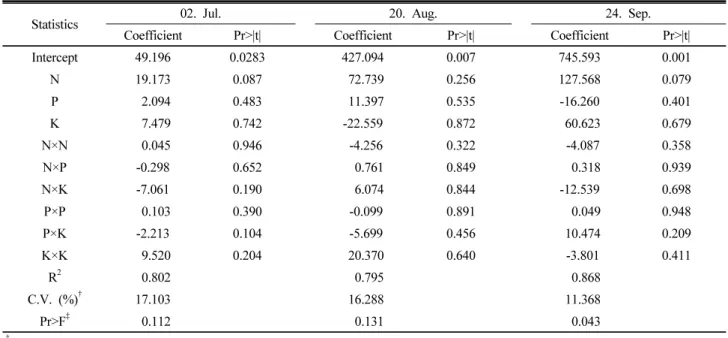
Table 4. Regression coefficients and probability values of fertilization effect on yield for leaf yield in Angelica gigas Nakai by response surface methodology.

Statistics 02. Jul. 20. Aug. 24. Sep.

Coefficient Pr>|t| Coefficient Pr>|t| Coefficient Pr>|t|

Intercept 49.196 0.0283 427.094 0.007 745.593 0.001

N 19.173 0.087 72.739 0.256 127.568 0.079

P 2.094 0.483 11.397 0.535 -16.260 0.401

K 7.479 0.742 -22.559 0.872 60.623 0.679

N×N 0.045 0.946 -4.256 0.322 -4.087 0.358

N×P -0.298 0.652 0.761 0.849 0.318 0.939

N×K -7.061 0.190 6.074 0.844 -12.539 0.698

P×P 0.103 0.390 -0.099 0.891 0.049 0.948

P×K -2.213 0.104 -5.699 0.456 10.474 0.209

K×K 9.520 0.204 20.370 0.640 -3.801 0.411

R

2

0.802 0.795 0.868

C.V. (%)

17.103 16.288 11.368

Pr>F

0.112 0.131 0.043

C.V. means coefficient of variation.

Results and Discussion

적정 수확시기 선발 참당귀 잎의 적정 수확시기 결정

을 위해 정식후 일수별 생육, 수량 및 품질을 조사한 결과는 Table 3과 같았다. 생육기간별 당귀의 초장은 정식후 45일 부터 80일까지 급격히 증가하였고 이후에는 큰 변화가 없었 다. 당귀 잎의 엽장 및 엽병장도 초장과 동일한 경향을 나타 내었다. 당귀 잎의 품질을 나타내는 색도를 조사한 결과, 당 귀 잎의 색도는 L값과 붉은 정도를 나타내는 a값은 정식 후 100일경부터 낮아지는 경향을 보였으며 생육단계가 진행됨 에 따라 b값이 낮아지는 경향으로 정식 120일에는 b값이 낮 아져 품질감소를 초래하였다. 당귀 잎의 수량은 정식 45일 경 185 kg 10a

-1

, 정식 후 80일경 709 kg 10a

-1

로 3.8배 증가 하였고 정식후 100일경에는 812 kg 10a

-1

으로 80일 경에 비 해 1.2배 증가하여 증가폭이 완만하였으며 120일경에는 수 량의 차이가 없었다.

따라서 정식후 80~100일 사이에 노화가 진행되며 120일 경에는 잎의 적황색화에 따라 품질이 급격히 떨어져 수량과

품질을 고려한 적정 수확시기는 100일이 적절할 것으로 판 단된다.

적정 추비시용량 선발 당귀 잎 생산에 영향을 미치는 3요소 비료의 영향을 조사하기 위하여 중심구합성계획에 의하여 N, P, K 요인별 5수준과 무비구의 16개 실험 처리구 와 시기별 당귀 잎의 수량반응을 조사하였다. 독립변수인 질소, 인산, 칼리와 종속변수인 당귀 잎의 회귀관계, 모형설 명력 (r

2

)과 반응표면분석을 통해 얻은 다항 회귀식은 Table 4와 같았다.

회귀모형의 설명력이 높은 특성은 절편이 가장 높았는데 이는 토양에서 공급되는 기비가 큰 영향을 미치는 것으로 사료된다. 다음으로 질소에 대한 1차 회귀관계가 높았다.

당귀의 생육이 증가하는 7월 상순과 9월 하순에 질소비료의

영향이 매우 큰 것으로 나타났지만 8월 중순에는 상대적으

로 질소의 영향이 다소 낮았는데 이러한 이유는 7월에 추비

로 공급된 질소성분에 의한 당귀의 생장이 충분히 이루어지

는 반면, 9월에는 토양중 양분 부족에 의한 추비공급이 필

(5)

Table 5. Effect of nitrogen application levels on dry-matter of leaf in Angelica gigas Nakai.

N level Dry-matter of leaf

02 Jul. 20 Aug. 24 Sep.

--- kg 10a

-1

---

Non-Fert. 8.2b 45.6c 95.6d

1.5 11.8ab 79.3b 101.2cd

3.0 13.6ab 82.2b 125.1bc

4.5 13.7a 94.0b 138.9b

10.0 15.7a 115.4a 175.0a

Same letters within column are not significant at p<0.05 probability level by duncan’s multiple range test.

Fig. 1. HPLC chromatograms of pyranocurmarins standards and methanol extract of leaf sample in Angelica gigas Nakai.

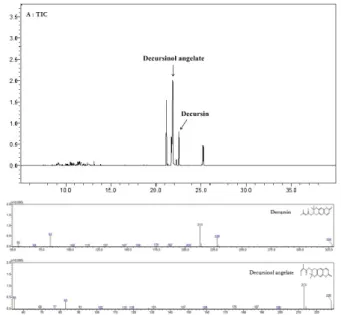
Fig. 2. Total ion chromatogram (TIC) and electron ionization (EI) mass spectras of decursin and decursinol angelate isolated from leaf sample in Angelica gigas Nakai by GC/MS.

요하기 때문으로 판단된다. 당귀 잎 생산을 위해서는 질소 의 시비효과가 크고 인산과 칼리의 효과는 낮은 편이었다.

분석결과 질소의 추비가 잎의 수량반응에 대한 설명력이 가 장 높았으며 반응표면분석을 통해 얻은 회귀식의 설명력은 86.8%였고 변이계수는 11.37%로 나타났다. 다항 회귀식의 절편은 무비구에서 당귀 잎 수량을 의미하므로 토양에서 공 급되는 양분과 유의한 관계를 가지는 것을 의미한다. 따라 서 토양의 지력양분을 증진하는 것이 가장 중요하며, 다음 으로 합리적인 추비관리가 이루어져야 할 것으로 사료된다.

질소 추비 수준별 잎과 뿌리의 건물생산량에 대한 영향 을 조사한 결과는 Table 5와 같았다. 생육기간이 경과함에 따라 잎과 뿌리의 건물생산은 증가하였으며 7월에는 질소 수준별 건물생산량 차이는 적었지만 잎의 생장은 4.5 kg 10a

-1

, 10 kg 10a

-1

로 처리구에서 높은 편이었으며 8월 이후 부터는 10 kg 10a

-1

처리구에서 잎과 뿌리 모두 건물생산이 높았다. 9월 24일 무비구에서 잎의 건물생산량은 95.6 kg 10a

-1

인 반면 질소 10 kg 10a

-1

처리구에서는 175 kg 10a

-1

로 1.8배 높았고, 뿌리는 무비구가 242.7 kg 10a

-1

에 비해 질소 10 kg 10a

-1

처리구 480 kg 10a

-1

로 2.0배 높은 수준을 나타 내었다.

유효성분 함량 변화 참당귀 잎에 존재하는 pyrano- curmarin계 화합물 분리, 동정을 위하여 GC/MS 분석을 실 시하였고 분석된 성분의 total ion chromatogram (TIC)과 mass spectrum의 전체 fragment ion은 Fig. 1과 같았다.

dihydropyranocurmarine isomer의 target ion을 213 m/z, 228 m/z로 하여 분석 결과, 잎에 함유된 주요 dihydropy- ranocurmarine isomer는 decursin과 decursinol angelate (C

19

H

20

O

5

, M.W. 328)로 동정되었다.

당귀에 함유된 decursin과 decursinol angelate의 함량을 HPLC를 이용하여 질소 추비수준별, 수확시기별로 분석을 하였다 (Fig. 3). 당귀 잎에서 decursinol angelate의 농도는 7월 2일에는 2.02% (1.83~2.39), 8월 20일에는 2.26% (1.80~

2.61), 9월 24일은 1.89% (1.80~2.05)의 수준으로 생육중기 에 약간 높아지다 생육기간이 경과할수록 낮아지는 경향이 었으며 질소 시용수준에 따른 처리간 차이는 없었다. decursin 농도는 7월 2일에는 0.20% (0.19~0.22), 8월 20일에는 0.29%

(0.18~0.37), 9월 24일은 0.33% (0.27~0.41)로 생육기간이

경과함에 따라 높아지는 경향을 나타내었으며 질소시비 수

(6)

Fig. 3. Effects of nitrogen application level on accumulation of decursin and decursinol angelate in Angelica gigas Nakai.

Same letters are not significant at p<0.05 probability level by duncan’s multiple range test.

준간에는 유의한 차이는 없었다. 잎의 decursinol angelate 의 총 함량은 7월 2일 0.28 kg 10a

-1

, 8월 20일 3.78 kg 10a

-1

, 9월 24일 6.47 kg 10a

-1

으로 7월에 비해 23.1배의 증 가를 나타내었다.

당귀 뿌리에서 decursin과 decursinol angelate의 함량은 재배지역의 해발고도와 적산온도에 영향을 받으며 해발고 도가 높아지고 적산온도가 낮을수록 농도가 높다고 보고하 였다 (Kim et al., 2009). 주산지별 당귀의 성분과 토양중 무기성분함량과의 관계를 분석한 결과 토양중 NH

4

-N함량 과 뿌리의 질소함량과 부의 상관을 나타내었고 뿌리와 지상 부 수량은 증가한다고 보고하였고 (Chang and Choi, 1986a), 질소시용량이 증가할수록 뿌리의 decursin 농도는 낮아진 다고 보고하였다 (Chang and Choi, 1987). 생육후기에 일반 적으로 뿌리의 비대가 많이 이루어져 건물생산량이 증가하고 decursin의 농도가 높아지므로 잎에서 생성된 decursinol angelate 가 뿌리로 전이되어 decursin으로 변환되는 것으로 추정되지 만 이에 대한 추가적인 연구가 있어야 할 것으로 사료된다.

잎과 뿌리의 수량과 유효성분 농도를 고려할 때 당귀 재 배지의 양분관리는 잎과 뿌리의 수량 뿐만 아니라 pyrano- curmarin 함량에도 큰 영향을 미치는 것으로 나타났다.

Conclusion

추비시용이 참당귀 잎의 수량 및 pyranocurmarin 함량에 변화에 미치는 영향을 구명하기 위하여 생육단계별 N, P, K

의 효과 및 질소 추비수준별 효과를 조사하였다.

반응표면분석법을 이용한 분석 결과, 토양의 양분공급력 이 잎 수량에 가장 큰 영향을 주었으며 다음으로 질소가 1차 회귀에 대한 관계가 높았다. 생육초기인 7월 상순과 생육후 기인 9월 하순에 질소비료의 영향이 매우 큰 것으로 나타났 고 생육중기인 8월 중순에는 상대적으로 질소의 영향이 다 소 낮았다. 질소 시용량이 증가할수록 잎의 건물생산은 증 가하였다. 참당귀 잎에 존재하는 pyranocurmarin계 화합물 은 decursin과 decursinol angelate로 동정되었고, 잎에서 decursinol angelate의 농도는 생육중기까지 높아지다 생육 기간이 경과할수록 낮아졌고 decursin은 생육기간이 경과 함에 따라 높아지는 경향을 나타내었으며 질소시비 수준간 에는 유의한 차이는 없었다. 당귀 재배시 질소비료 시용은 건물생산량과 decursin과 decursinol angelate의 함량에 영 향을 주었다.

References

Ahn, K.S., W.S. Shim, H.M. Kim, S.B. Han, and I.H. Kim.

1996a. Immunostimulating components from the root of Angelica gigas Nakai. Korean J. Pharmacogn. 27:254-261.

Ahn, K.S., W.S. Shim, and I.H. Kim. 1996b. Decursin ; a cytotoxic agent and protein kinase C activator from root of Angelica gigas Nakai. Planta Med. 62:7-9.

Ahn, K.S., W.S. Shim, and I.H. Kim. 1995. Detection of anti

cancer activity from the root of Angelica gigas in vitro. J.

(7)

Microbiol. Biotechnol. 5:105-109.

Chang, S.M., and J. Choi. 1986a. Effect of the contents of inorganic nutrients in soils on the available constituents of Angelica gigas Nakai by the cultivating locations. J. Korean Agric. Chem. Soc. 29:381-391.

Chang, S.M., and J. Choi. 1986b. Variation mode of the absorption contents of N, P and K and the contents of available constituents of Angelica gigas Nakai at different growth stages. J. Korean Agric. Chem. Soc. 29:392-398.

Chang, S.M., and J. Choi. 1987. Effect of N, P and K application on the contents of the decursin and total sugar in Angelica gigas Radix. J. Korean Agric. Chem. Soc. 30:9-16.

Cho, S.K. 1995. Effect of dietary root power of Angelica gigantis on the growth performance, organ weight and serum components in broiler chicken. Kor. J. pollut Sci. 22:145-153.

Choi, M.G., J.K. Bang, and Y.A. Chae. 2003. Comparision of volatile compounds in plant parts of Angelica gigas Nakai and Angelica acutiloba Kitagawa. Korean J. Medicinal Crop Sci.

11:352-357.

Kang, S.A., J.A. Ham, K.H. Jang, and R. Chone. 2004. DPPH radical scavenger activity and antioxidant effects of Cham Dang Gui (Angelica gigas Nakai). J. Korean Soc. Food Sci.

Nutr. 33:1112-1118.

Kang, S.Y., K.Y. Lee, S.H. Sung, M.J. Park, and Y.C. Kim. 2001.

Coumarins isolated from Angelica gigas inhibit acetylcho- linesterase structure activity relationships. J. Nat. Prod.

64:683-685.

Kano, Y. 1981. Physiological actions of Angelicae and Cnidii. J.

Traditional sino Japanese Medicine. 2:43-48.

Kawg, J.J., J.G. Lee, H.H. Chang, and O.C. Kim. 1998. Volatile flavors compounds of the domestic angelica root (Angelica gigas Nakai) extracts. J. Korean Soc. Tabacco Sci. 20:210-217.

Kim, C.H., M.C. Kwon, J.G. Han, C.S. Na, H.G. Kwak, G.P.

Choi, U.Y. Park, and H.Y. Lee. 2008. Skin whitening and UV protective effects of Angelica gigas Nakai extracts on ultra high pressure extraction process. Korean J. Medicinal Crop Soc. 16:255-260.

Kim, G.S., C.G. Park, T.S. Jeong, S.W. Cha, N.I. Baek, and K.S.

Song. 2009. ACAT(acetyl-CoA:cholesterol acytransferase) inhibitory effect and quantification of pyranocumarin in different parts of Angelica gigas Nakai. J. Appl. Biol. Chem.

52:188-194.

Kim, H.S., H.J. Park, and H.J. Chi. 1980. A study of the effects of the root components of Angelica gigas. Kor. J. Pharmacol.

11:11-14.

Kim, Y.G., Y.S. Ahn, T.J. An, J.H. Yeo, C.B. Park, and H.G.

Park. 2009. Effect of yield and decursin content according to the accumulative temperature and seeding size in cultivation areas of Angelica gigas Nakai. Korean J. Medicinal Crop Sci.

12:67-72.

Konoshima, M., H. Chi, and K. Hata. 1968. Coumarines from the root of Angelica gigas Nakai. Chem. Pharm. Bull. 16:1139-1140.

Lee, J.H., Y.S. Choi, J.H. Kim, H.G. Jeong, D.H. Kim, M.Y.

Yun, J.S. Kim, S.H. Lee, S.H. Cho, G.N. Shen, E.G. Kim, W.Y.

Jin, and G.Y. Song. 2006. A mass preparation method of (+) decursinol from the roots of Angelica gigas Nakai. Pharmac.

Soc. Korea. 50:172-176.

Lee, S.G. 2008. Comparison of activity of Angelica gigas and Angelica acutiloba from Kangwon. Korean J. Ori. Med.

Physiol. Pathol. 22:1158-1162.

Lee, S.H., D.S. Shin, J.S. Kim, B.K. Kim, and S.S. Kang. 2003a.

Antibacterial coumarins from Angelica gigas roots. Arch.

Pharm. Res. 26:449-452.

Lee, S.H., Y.S. Lee, S.H. Jung, K.H. Shin, B.K. Kim, and S.S.

Kang. 2003b. Anti-tumor activities of decursinol angelate and decursin from Angelica gigas Nakai. Arch. Pharm. res.

26:727-730.

Min, Y.K., and H.S. Jeong. 1995. Manufacture of some Korean medicinal herb liquor by soaking. Korean J. Food Sci. Technol.

27:210-215.

Ministry of Agriculture, Food and Rural affair. 2014. Report of specialized industrial crops production. 12.

Park, K.W., S.R. Choi, H.R. Hong, J.Y. Kim, M.Y. Shon, and K.I. Seo. 2007a. Biological activities of methanol extract of Angelica gigas Nakai. Korean J. Food Preserve. 14:655-661.

Park, K.W. S.R. Choi, M.Y. Shon, T.Y. Jeong, K.S. Kang, S.T.

Lee, K.H. Shim, and K.I. Seo. 2007b. Cytotoxic effects of decursin from Angelica gigas Nakai in human cancer cells. J.

Korean Soc. Food Sci. Nutr. 36:1385-1390.

Park, M.J., S.J. Kang, and A.J. Kim. 2009. Hypoglycemic effect of Angelica gigas Nakai extract in streptozotocin induced diabetic rats. Korean J. Food Nutri. 22:246-251.

Ryu, K.S., and C.S. Yook. 1967. Studies on coumarins of the root of Angelica gigas Nakai. Pharmac. Soc. Korea. 11:990-992.

Sung, J.S., K.H. Bang, C.H. Park, C.G. Park, H.S. Yu, H.W. Park, and N.S. Seong. 2004. Discrimination of Angelicae radix based on anatomical characters. Korean J. Medicinal Crop Sci.

12:67-72.

Woo, W.S., K.H. Shin, and K.S. Ryu. 1970. Annual report of Natural products research Institute. Seoul National Univ.

21:59-64.

Yamada, H. 1992. Pharmacological and clinical effects of Angelicae radix. J. Traditional Japanese Medicine. 13:102-109.

Yoon, C.H. 1994. A taxonomic study on the genus Angelica L. in Korea and the adjacent region. Ph.D. Dissertation, Korea Univ.

Korea.

Yun, K.W., and S.K. Choi. 2004. Antimicrobial activity in 2

Angelica species extracts. Korean J. Plant Res. 17:278-282.

수치

Table 1. Chemical properties of soils before experiment.
Table 2. Instrumental conditions for analysis of pyranocurmarin compounds in Angelica gigas Nakai.
Table 4. Regression coefficients and probability values of fertilization effect on yield for leaf yield in Angelica gigas Nakai by  response surface methodology.
Table 5. Effect of nitrogen application levels on dry-matter of  leaf in Angelica gigas Nakai.
+2

참조

관련 문서

Effect of planting date on growth and seed yield of Danfa black

Objectives: This study aimed to investigate the relationship between job stress and turnover intention of employed opticians and to investigate the mediating effect of burnout

In order to investigate the effects of process parameters on qualities of the drilled hole quantitatively, laser drilling experiments were carried out using

This study was conducted to investigate the effects of 12 weeks after school physical activity program on body composition and PAPS in obese elementary

This study examined the achievement, satisfaction and interest of an English grammar class based on flipped learning in order to find out the effect of

The purpose and necessity of this study was to investigate the effect of the 8-week GX complex exercise program on the stress index, blood lipid and APG

In an effort to develop a new method to remove nitrogen, this study examined the effects of C/N ratio, carbon source and nitrogen concentration on

This study was conducted to investigate the effects of a 12-week swimming exercise program on body composition, blood lipids and inflammatory indicators in