Article
구리-오염 토양에서 토마토 식물의 생장과 스트레스-관련 유전자 발현에 미치는 구리-내성 Pseudomonas의 영향
김민주 ・ 송홍규*
강원대학교 생명과학과
Effect of Cu-resistant Pseudomonas on growth and expression of stress-related genes of tomato plant under Cu stress
Min-Ju Kim and Hong-Gyu Song*
Department of Biological Sciences, Kangwon National University, Chuncheon 24341, Republic of Korea
(Received September 25, 2017; Accepted October 27, 2017)
*For correspondence.
E-mail: [email protected];
Tel.: +82-33-250-8545; Fax: +82-33-259-5665
Pseudomonas veronii MS1 and P. migulae MS2 have several mechanisms of copper resistance and plant growth promoting capability, and also can alleviate abiotic stress in plant by hydrolysis of a precursor of stress ethylene, 1-aminocyclopropane- 1-carboxylic acid (ACC) by ACC deaminase. In 4-week pot test for tomato growth in soil contained 700 mg/kg Cu, inoculation of MS1 and MS2 significantly increased root and shoot lengths, wet weight and dry weight of tomato plants compared to those of uninoculated control. The inoculated tomato plants contained less amounts of proline that can protect plants from abiotic stress, and malondialdehyde, an oxidative stress marker than those of control. ACC synthase genes, ACS4 and ACS6, and ACC oxidase genes, ACO1 and ACO4, both involved in ethylene synthesis, were strongly expressed in Cu stressed tomato, whereas significantly reduced in tomato inoculated with MS1 and MS2. Also, a gene encoding a metal binding protein metallothionein, MT2 showed similar expression pattern with above genes. All these results indicated that these rhizobacteria could confer Cu resistance to tomato plant under Cu stress and allowed a lower level of Cu stress and growth promotion.
Keywords: ACC deaminase, copper resistance, plant growth promotion, stress-related genes
구리(Cu)는 생물체의 필수 미량원소이지만 고농도에서는 생물에 독성을 나타내는데 직접적으로 효소적 기능을 가진 필 수 원소들을 대체하여 단백질 3차 구조를 파괴하거나 DNA에 결합하여 전사과정에 이상을 유발하며 간접적으로는 해로운 활성 산소종의 발생을 촉매하여 이차적인 산화 스트레스를 유 발한다(Ahsan et al., 2007). 토양에 금속이 유입되면 입자에 흡 착 또는 화합물을 형성하며, 분해되지 않기 때문에 지속적으로 축적되므로 식물 생장이 억제되고 농업에 피해를 미치므로 금 속 존재 시 식물 생장을 지속시킬 수 있는 방법이 필요하다. 또 한 금속 오염 토양의 정화를 위한 식물추출법에서도 식물의 금 속에 대한 내성과 빠른 생장이 중요하다(Pandey et al., 2013).
식물이 비생물적 스트레스를 받게 되면 S-adenosylmethionine
이 1-aminocyclopropane-1-carboxylic acid (ACC)를 거쳐 생
성된 에틸렌이 식물의 생장 억제, 성숙과 노화에 관여한다
(Morgan and Drew, 1997). 스트레스 반응에 의한 식물의 피해
감소 방법 중 하나로 근권에서 식물에 도움을 주는 식물생장촉
진 근권세균(plant growth promotiong rhizobacteria, PGPR)을
이용할 수 있는데 PGPR의 indole-3-acetic acid (IAA) 같은 호르
몬 및 질소, 인 등의 공급은 이미 잘 알려져 있다(Glick, 1995). 이
들은 금속 존재 시 흡착, 결합 등으로 식물로 금속의 흡수를 막으
며(Cervantes and Gutierrez-Corona, 1994), ACC deaminase를
분비하여 에틸렌의 전구체인 ACC를 α-ketobutyrate와 ammonia
로 가수분해하여 에틸렌의 농도를 낮춘다(Glick et al., 1998).
또한 금속으로 인한 산화 스트레스를 줄이고 식물에서 금속결 합 단백질인 metallothionein 생성을 촉진하여 금속의 독성을 감 소시키며(Xia et al., 2012) salicylic acid를 분비하여 스트레스 를 받는 식물의 생장을 촉진시킨다(Yusuf et al., 2008).
PGPR 분비 IAA는 식물 합성 IAA와 함께 식물에 영향을 미 치는데 IAA는 생장을 자극하지만 고농도에서는 ACC synthase (ACS) 유전자(ACS) 전사 유도로 에틸렌 합성을 자극하여 식 물 생장을 억제하며 에틸렌 피드백에 의하여 IAA 신호전달이 저해된다(Van Der Straeten et al., 1997). 그러나 ACC deaminase 와 IAA를 모두 분비하는 세균은 ACC deaminase의 활성 때문 에 에틸렌 생성이 억제되며 IAA 신호전달은 저해되지 않아 IAA에 의한 식물생장촉진이 일어난다(Glick et al., 1998). 한 편 ACC oxidase (ACO)는 ACC에서 에틸렌의 합성을 촉매하 는데 비생물적 스트레스에도 반응하여 ACS와 ACO 발현 증가 로 에틸렌 생합성이 촉진된다(Nakatsuka et al., 1997). ACS와 ACO 발현에 대해서는 과실의 성숙 및 노화와 관련된 연구가 주로 수행되었으며 스트레스 반응과 관련해서는 아직 많은 연 구가 이뤄지지 않았으므로(Nakatsuka et al., 1997; Dorling et al., 2011) 이를 조사함으로써 스트레스에 대한 반응 정도를 파 악할 수 있을 것이다. 한편 metallothionein (MT)은 금속과 결 합하는 저 분자량의 단백질로 금속 무독화와 활성 산소종 제 거를 통해 식물 스트레스 내성을 향상시키는데(Zhou and Goldsbrough, 1995), MT 유형들 중 일부 유전자의 발현에 대 한 금속 오염 및 무독화와의 관련성에 논란이 있다(Ouziad et al., 2005). 또한 식물에서 아미노산 proline은 금속 킬레이트 제와 무독화 대사의 활성자로 작용하며 자유 라디칼을 제거할 수 있으므로 다양한 비생물적 스트레스 존재 시 이의 합성을 통해 스트레스를 극복할 수 있다(Hossain et al., 2014).
금속-오염 토양에서 식물 생장이 저해 받으므로 이를 극복 하기 위한 PGPR의 접종이 실제로 금속-오염 토양에서 식물의 생장을 촉진하는지 그리고 식물내 금속 스트레스-관련 유전 자의 발현에도 영향을 미치는지 조사하기 위해 본 연구에서는 식물생장촉진능이 있는 구리-내성 균주 Pseudomonas veronii MS1과 P. migulae MS2 (Kim and Song, 2017)를 구리-오염 토 양의 토마토 식물에 접종하여 생장에 미치는 영향과 여러 스 트레스-관련 유전자의 발현을 조사하였다.
재료 및 방법
구리 존재 시 토마토 생장
강원대학교 구내의 비오염 토양(Seo and Song, 1994)을 채
취하여 5 mm체로 거른 후 구리의 농도가 350 또는700 mg/kg 이 되도록 CuSO
4용액을 넣어 고루 섞고 퇴비 (가축분 퇴비, 두 루미영농조합)와 7:3의 비율로 혼합하여 200 g씩 pot에 담았 다. 토마토(Lycopersicon esculentum Mill.) 종자[예광토마토, 다농(주)]는 70% ethanol로 10분간 소독하여 증류수로 5~6회 세척한 후, 여과지를 넣고 멸균하여 5 ml의 멸균증류수를 넣은 페트리 접시에 넣어 배양기(25°C)에서 발아시켰다. 발아 후 5 일 지난 토마토 유묘를 pot 당 3개씩 약 2 cm 깊이로 심었다. 균 주는 LB 배지(Difco Lab)에서 배양(72 h, 30°C, 200 rpm) 후 원 심분리(3,400 × g, 10 min) 하여 회수한 세포를 계수하여 토양 1 g당 10
7cell을 pot에 접종하였다. 4주간 식물생장상[16 h광 조건(25°C, 97.5 μmol photons/m
2/sec)과 8 h 암조건(20°C), 상 대습도 60%]에서 매일 1회 씩 증류수 25 ml를 보충하며 토마 토를 재배한 후 뿌리와 줄기 길이, 습윤중량 및 건조중량을 측 정하였으며 결과의 통계적 유의성은 Analysis of variance (ANOVA, SYSTAT ver 10, 2000, Systat Software, SPSS Inc.) 를 이용하여 분석하였다.
토마토 내 스트레스-관련 성분 조사
자라난 토마토의 proline 함량 조사는 Bates 등(1973)의 방 법을 이용하였는데 토마토 잎을 sulfosalicylic acid에 넣고 homogenizer로 균질화하고 원심분리 후 상등액으로부터 추 출하여 측정하고 L-proline을 사용한 표준곡선을 이용하여 정 량하였다. 한편 산화스트레스의 지표인자인 malondialdehyde (MDA) 생성량 변화는 Mazhoudi 등(1997)의 방법을 따랐는 데 토마토 뿌리를 균질화하고 원심분리 후 회수한 상등액을 thiobarbituric acid를 포함한 trichloroacetic acid 용액과 반응 시켜 상등액의 흡광도로부터 정량하였다.
구리 존재 시 토마토의 스트레스-관련 유전자 발현 분석
토마토 total RNA 추출과 cDNA 합성: 위의 방법과 동일하게 토마토를 재배하면서 7, 14와 21일 째에 변형된 TRIzol method 를 이용해서 토마토 total RNA를 추출하였다(Chomczynski and Sacchi, 2006). 재배한 토마토 유식물 10 g 이상을 액체질소를 이용하여 파쇄하여 0.1 g을 1 ml TRIzol reagent (Invitrogen Corp.)에 넣고 15초간 vortexing하고 상온에서 5분간 반응 후 chloroform 200 μl를 추가하여 15초간 섞은 뒤, 원심분리 (10,000 × g, 15분) 하여 상등액을 회수하였다. 상등액에 4°C 의 isopropyl alcohol 500 μl를 넣고 15초간 섞고 얼음에서 15분 간 반응시킨다. 반응 후 원심분리(10,000 × g, 10분) 하여 침전 된 RNA pellet을 회수하여 세척을 위해 70% ethanol : 30%
diethyl pyrocarbonate water (1 ml DEPC를 1 L 증류수에 혼합
하고 overnight 후 고압멸균) 용액 1 ml을 넣어 원심분리 (10,000 × g, 5분) 하였다. RNA pellet을 상온에서 건조시킨 후 DEPC water 44 μl를 추가하여 RNA를 녹였다. cDNA의 합성 에는 PrimeScript
TM1st strand cDNA Synthesis kit (TaKaRa Inc.) 의 매뉴얼에 따라 oligo dT를 사용해 추출한 토마토 RNA 를 template로 넣어 cDNA를 합성하였다.
ACS, ACO와 MT2 유전자의 상대적 발현: 토마토 유식물 에서 분리한 total RNA로부터 합성한 cDNA의 농도를 Microplate reader Infinite M200 (Tekan) 을 이용하여 정량하 고 RNase free water로 희석해 20 ng/μl로 보정하여 4 μl씩 template로 사용하였다. 분석기기는 StepONE
TMReal-Time PCR Systems (Applied Biosystems)를 이용하였고 다음과 같 이 real-time PCR을 수행하였다. PCR 시료는 template 4 μl와 primer forward 와 reverse 각각 1 μl, TOPreal
TMqPCR 2X PreMIX (Enzynomics Inc.) 10 μl를 혼합하고 RNase free water 를 더하여 20 μl로 준비하였다. Real-time PCR 조건은 holding stage (95°C 10 min 1 cycle), cycling stage (95°C 15 sec/60°C 1 min 40 cycles), melt curve stage (95°C 15 sec/60°C 1 min/
95°C 15 sec)로 수행하였다. 각 시료는 triplicate로 수행하였으 며 유전자 증폭산물의 표준화를 위해 LeActin을 사용하여 각 시료의 mRNA양을 상대정량 하였다.
실험에 사용한 primer는 ACS4 발현량 분석을 위해 forward primer; 5 ′-TTATTGAAAGCGCGAAAAGGTT-3′와 reverse primer; 5′-ACAATAAACCCCTGCATTGCTT-3′를 사용하 였고, ACS6 분석에는 forward primer; 5′-TTGTTGGATGCA ACGATGATTT-3 ′와 reverse primer; 5′-TGACAACGGCA TCATTGTACG-3 ′를 사용하였다(Chang et al., 2008). ACO1 발현량 분석을 위해 forward primer; 5′-GCAGGAGGCATC ATACTTCTGTTC-3′와 reverse primer; 5′-ACAATAGAGT GGCGCATGGG-3′를 사용하였고, ACO4 분석에는 forward primer; 5 ′-AAGATGGCACTAGGATGTCAATAG-3′와 reverse primer; 5′-TCCTCTTCTGTCTTCTCAATCAAC-3′를 사용 하였다(Yim et al., 2014). MT2 발현량 분석을 위해 forward primer; 5′-GCTGTGGATCTAGCTGCAAGTGCG-3′와 reverse primer; 5 ′-AAGGGTTGCACTTGCAGTCAGATCC-3′, LeActin 은 forward primer; 5′-GGGATGGAGAAGTTTGGTGGTGG- 3′와 reverse primer; 5′-CTTCGACCAAGGGATGGTGTAGC- 3′를 사용하였다(Tombuloglu et al., 2012).
IAA 처리 시 유전자 발현: 위의 방법과 동일하게 토마토 종 자를 발아시켜 10일간 기른 토마토 유식물에 다음의 용액을 각각 처리하였다. 먼저 30 ml 증류수에 chemical IAA (Sigma Chemical Co.)를 녹여 25, 50, 75와 100 μM 용액을 만들었다.
또한 100 μM tryptophan과 MS1과 MS2 균주를 각각 증류수에 넣어 배양 후 원심분리하여 얻은 상등액의 세균 생성 IAA를 증류수 30 ml에 50 μM이 되도록 보정하였다. 페트리 접시에 이 용액들과 토마토 유식물 50개체를 같이 넣은 후 30°C 암조 건에서 30분간 배양하였다. IAA를 처리한 토마토 유식물은 앞에서 기술한 방법대로 RNA를 추출하여 cDNA 합성 후 위 의 5개 유전자에 대한 real-time PCR을 실시하였다.
결과 및 고찰
구리 존재 시 토마토 생장
많은 식물의 생장이 저해되는 구리 농도인 175 mg/kg과 350 mg/kg에서 MS1과 MS2 처리 시 토마토 생장촉진을 확인 (결과 미제시) 후 구리 농도 700 mg/kg의 토양에서 토마토 유 묘를 4주간 재배하였다. 균주 처리 토마토 식물은 미처리 대조 군 보다 지상부 길이가 평균 0.7배, 뿌리 길이는 2.8 배 이상 증 가하였으며, 두 균주 모두 유의성 있게 생장촉진을 보였으나 MS2가 약간 더 높았다(Fig. 1A and B). 습윤중량(FW)은 MS1 과 MS2가 각각 3.5와 3.0배, 건조중량은 각각 3.6과 3.4배 증가 하였으며 대부분 유의성이 있었다(Fig. 1C and D). 이들의 토 마토 생장촉진능은 비록 대상 식물이 다르지만 약 37 mg/kg의 구리 농도에서 검정겨자(Brassica nigra)의 뿌리와 지상부에 대한 Kocuria sp. CRB15의 각각 19와 37%의 길이 신장 (Hansda et al., 2017), 5 가지 균주의 약 19 mg/kg 구리 농도에 서 유채(B. napus) 뿌리에 대한 17~38%의 길이 증가(He et al., 2010)나 4 mg/kg 구리 농도에서 32개 구리-내성 식물내생 세균의 유채 뿌리와 지상부 건조중량의 각각 132~155%와 63~125% 증가(Sun et al., 2010)와 비교할 때 훨씬 높은 생장촉 진임을 알 수 있다. 구리 스트레스 하에서 MS1과 MS2의 식물 생장촉진은 이들의 구리 흡착과 siderophore의 chelation에 의 한 식물로의 흡수 방지뿐만 아니라 균주 분비 ACC deaminase 에 의한 스트레스 에틸렌 생성의 저하 및 salicylic acid와 IAA 생성을 통한 스트레스 환경에서의 생장촉진 등에 의한 것으로 추정된다(Kim and Song, 2017).
토마토 내 스트레스-관련 성분 조사
구리 첨가 시 토마토 잎의 proline 농도는 스트레스 반응으
로 약 4.5배 증가하지만 MS1과 MS2 접종 시 각각 12.6과 15.1
μmol/g FW로 비접종 대조군에 비해 각각 58.0과 49.7% 감소
하였다(Table 1). 또한 뿌리에서 지질과산화의 산물인 MDA
도 구리 첨가 시 거의 2배 증가하지만 MS1과 MS2 접종군 모
Fig. 1. Shoot length (A), root length (B), fresh weight (C), and dry weight (D) of tomato plant treated with P. veronii MS1 and P. migulae MS2 (10
7cells/g) in a pot test. Tomato plants were cultivated under copper stress conditions (700 mg/kg) for 4 weeks (* P < 0.05, **P< 0.005).
Table 1. Proline and malondialdehyde production in tomato plant treated with P. veronii MS1 and P. migulae MS2 under copper stress conditions (350 mg/kg)
Uninoculated control MS1 inoculated MS2 Inoculated No Cu control
Proline ( μmol/g FW) 30.0 ± 2.0 12.6 ± 1.1 15.1 ± 1.2 6.7 ± 1.4
Malondialdehyde ( μmol/g FW) 1.9 ± 0.2 1.2 ± 0.1 1.2 ± 0.1 1.0 ± 0.1
두 1.2 μmol/g FW로 비접종 대조군에 비해 36.8% 감소하였다 (Table 1). 이는 구리 스트레스에 대한 방어작용으로 합성되는 proline 과 산화 스트레스 지표인 MDA가 접종 균주에 의한 토 마토 식물에 구리 스트레스에 대한 내성 부여와 생장촉진으로 인하여 두 물질의 생성이 감소된 것으로 추정된다. 금속 존재 시 식물 내에서 proline 함량이 증가되며(Hossain et al., 2014), proline 첨가에 의해 Cd 스트레스를 받는 대추야자의 Cd 스트 레스의 완화가 보고되었으나(Zouari et al., 2016) PGPR 접종 시 구리 스트레스하의 식물 내 proline 함량 변화에 대해서는 보고된 바 없는데 MS1과 MS2 접종 시 토마토 내 proline 농도 가 크게 감소되어 구리 스트레스 반응의 완화를 나타내었다.
한편 아연 1,000 mg/kg 존재하에 자란 밀에 아연-내성 PGPR 인 Pseudomonas aeruginosa 접종 시 MDA 함량이 비접종 대 조군에 비해 33.9% 감소한 결과는 본 연구 결과와 상당히 유사 하다(Islam et al., 2014).
구리 존재 시 토마토의 스트레스-관련 유전자 발현
식물에서 스트레스 존재 시 증가하는 ACC synthase (ACS)
와 ACC oxidase (ACO) 유전자의 상대적 발현량 분석 결과 토
마토의 ACS4는 구리 스트레스를 받을 때 구리 미처리 대조군
에 비해 발현이 크게 증가하지만 균주 접종군에서는 21일째까
지 비접종 대조군보다 발현량이 감소하였다. ACS6는 균주 처
리 후 14일째까지는 구리 처리 대조군 보다 상대적 발현 수준
이 낮게 유지되나 21일째에는 대조군보다 증가하였는데 균주
접종 효과의 감소 때문인지 확인할 필요가 있다(Fig. 2). ACO1
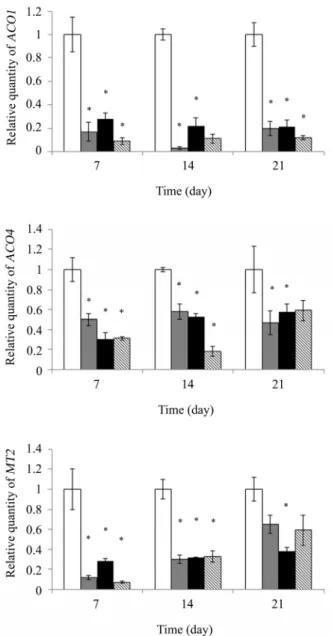
와 ACO4도 구리 처리 시 구리 미처리 대조군보다 발현이 크게
증가하지만 균주 접종군의 발현량은 21일 동안 비접종 대조군
보다 모두 유의성 있게 훨씬 낮은 수준으로 비교적 일정하게
유지되었다(Fig. 3). 병원체 존재 시 토마토에서 ACO 발현 증
가(Yim et al., 2014)와 Mn 존재하의 white clover에서 ACO 발
Fig. 2. Relative quantities of ACS4 and ACS6 transcript after Cu treatment for 7, 14, and 21 day on tomato plant treated with P. veronii MS1 (gray bar) and P. migulae MS2 (black bar). Tomato plants were cultivated under copper stress conditions (350 mg/kg). The relative expression levels were determined by qRT-PCR and normalized with housekeeping Actin transcripts. Bars represent mean values ± SD from three CT values of two independent experiments (* P < 0.05). Uninoculated control (white bar);
No Cu control (hatched bar).
Fig. 3. Relative quantities of ACO1, ACO4, and LeMT2 transcript after Cu treatment for 7, 14, and 21 day on tomato plant treated with P. veronii MS1 (gray bar) and P. migulae MS2 (black bar). Tomato plants were cultivated under copper stress conditions (350 mg/kg). The relative expression levels were determined by qRT-PCR and normalized with housekeeping Actin transcripts. Bars represent mean values ± SD from three CT values of two independent experiments (* P < 0.05). Uninoculated control (white bar); No Cu control (hatched bar).
현의 변화가 없지만 ACO 활성의 차이(Dorling et al., 2011) 만 보고되었을 뿐 비생물적 스트레스하의 식물에서 균주 접 종에 의한 ACS와 ACO 발현 연구는 없었지만 이 유전자들은 스트레스 존재 시 발현이 증가하여 에틸렌 생합성을 유도하 기 때문에 그 발현량의 감소는 스트레스 반응의 감소를 암시 한다.
또한 금속 결합 단백질 metallothionein 유전자의 하나인 MT2의 상대적 발현량 분석 결과 ACS와 ACO와 유사하게 구 리 스트레스 부여가 애기장대에서처럼 발현량을 크게 증가시 키지만(Zhou and Goldsbrough, 1995), 균주 접종 시 발현이 유 의성 있게 크게 감소하며 시간 경과에 따라 약간씩 증가하는 데 균주 접종의 효과가 점차 줄기 때문인 것으로 추정된다(Fig.
3). 이 결과는 Cd 첨가 토양에서 수지상 균근균인 Glomus intraradices 접종 시 토마토 MT2의 발현량이 비접종 대조군 에 비해 감소한 결과와 일치하였다(Ouziad et al., 2005). 이같
이 토마토에서 5개의 스트레스-관련 유전자의 발현이 21일째
의 ACS6 유전자를 제외하고는 구리 존재 시 발현이 모두 증가
하지만 균주 접종군은 모두 비접종군보다 발현량이 감소하였
다. 이는 금속 스트레스를 받는 식물에 균주가 내성을 부여하
며 스트레스에 대한 반응을 감소시켰기 때문인 것으로 추정
된다.
Fig. 4. Comparison of relative mRNA levels of ACS4 and ACS6 gene after 30 min treatment of bacterial IAA (50 μM) and chemical IAA in 10-day
grown tomato under copper stress (0.3 mM Cu). Fig. 5. Comparison of relative mRNA levels of ACO1, ACO4, and MT2 gene after 30 min treatment of bacterial IAA (50 μM) and chemical IAA in 10-day grown tomato under copper stress (0.3 mM Cu).
균주 접종이 어떻게 토마토 유전자 발현에 영향을 미치는 지 알아보기 위해 MS 균주가 분비하는 대표적인 식물생장 호 르몬인 IAA 처리 시 앞서 관찰한 5개의 유전자 발현 변화를 조 사하였다. 5개의 유전자 모두 매우 유사한 경향을 나타내었는 데 구리가 없을 때 낮은 수준의 발현이 구리 첨가 시 크게 증가 하고 식물 생장에 도움을 주는 100 μM 이하의 chemical IAA (Shinkle and Briggs, 1984) 처리 시 5개 유전자는 모두 유의성 있게 발현이 감소하였으며 특히 50 μM이 가장 높은 효과를 보 이고 농도 증가에 따라 발현량이 약간 증가하였다(Figs. 4 and 5). Bacterial IAA (50 μM) 처리 시에도 chemical IAA와 유사 하게 5개의 유전자 모두 비접종 대조군보다 발현량이 유의성 있게 상당히 감소하였다(Figs. 4 and 5). 일반적으로 고농도 IAA 처리 시 ACS 발현이 증가하지만(Van Der Straeten et al., 1997) 스트레스를 받는 식물에 생장이 촉진되는 범위의 IAA 처리는 오히려 ACS 유전자 발현을 스트레스만 받는 대조군보 다 낮출 수 있으며 중금속 스트레스 시 발현이 증가되는 ACO 와 MT (Goupil et al., 2009) 역시 IAA 처리에 의해 스트레스 반 응의 완화로 발현이 감소되었다. 이는 MS1과 MS2 균주가 구 리 스트레스 시 토마토 식물에서 스트레스를 완화시키는 유전 자 수준의 증거가 될 수 있으며 따라서 중금속 존재 시 식물생 장을 촉진하고 폐광산 같은 중금속 오염지역에서 식생복원 및
식물정화법에 이용되는 금속 과축적식물에 내성 부여, 금속 흡수와 생장 촉진 목적 등으로 활용될 수 있을 것이다.
적 요
Pseudomonas veronii MS1과 P. migulae MS2는 여러 가지
의 구리-내성 및 식물 생장 촉진 방법을 갖고 있으며 또한 스트
레스 에틸렌의 전구체인 1-aminocyclopropane-1-carboxylic
acid (ACC)의 ACC deaminase에 의한 가수분해를 통해 식물
에서 비생물적 스트레스를 완화시킬 수 있다. 구리 농도 700
mg/kg 토양에서의 4주간 소규모 토마토 재배 실험에서 MS1과
MS2 접종은 비접종 대조군에 비해 토마토 식물의 지상부와 뿌
리 길이 및 습윤중량과 건조중량을 모두 유의성 있게 증가시켰
다. 접종 토마토 식물은 비생물적 스트레스로부터 식물을 보호
할 수 있는 proline및 산화 스트레스 지표인 malondialdehyde도
비접종 대조군보다 적게 함유하였다. 에틸렌 생합성에 관여하
는 ACC synthase 유전자, ACS4와 ACS6 그리고 ACC oxidase
유전자, ACO1와 ACO4는 구리 스트레스를 받는 토마토에서
강하게 발현된 반면 MS1과 MS2 접종 토마토에서는 유의성
있게 감소했다. 또한 금속 결합 단백질인 metallothionein 암호
화 유전자인 MT2도 위의 유전자들과 유사한 발현 양상을 보 였다. 이 모든 결과들은 이 근권세균들이 구리 스트레스 하의 토마토 식물에 구리 내성을 부여하여 낮은 수준의 구리 스트 레스와 생장 촉진을 허용하는 것을 가리킨다.
References