SSR 마커를 이용한 국내산 인삼 품종 및 국외 수집종의 유전적 다양성 분석
방경환*1†·조익현*1·정종욱**·김영창*·이제완***·서아연*·박종현**
김옥태*·현동윤*·김동휘*·차선우*
*농촌진흥청 국립원예특작과학원 인삼특작부, **농촌진흥청 국립농업과학원 농업유전자원센터,
***산림청 국립산림과학원 대외협력과
Analysis of Genetic Polymorphism of Korean Ginseng Cultivars and Foreign Accessions using SSR Markers
Kyong Hwan Bang*1†, Ick Hyun Jo*1,Jong Wook Chung**, Young Chang Kim*, Jei Wan Lee***, A Yeon Seo*, Jong Hyun Park**, Ok Tae Kim*, Dong Yun Hyun*,
Dong Hwi Kim* and Seon Woo Cha*
*Department of Herbal Crop Research, NIHHS, RDA, Eumseong 369-873, Korea.
**National Agrobiodiversity Center, NAAS, RDA, Suwon 441-707, Korea.
***Korea Forest Research Institute, Seoul 130-712, Korea.
ABSTRACT : In this study, simple sequence repeat (SSR) analyses were utilized for evaluation of genetic diversity and dis- crimination of 17 accessions. Five cultivars, which were developed from Korea, and 12 foreign accessions, which were col- lected from China, Japan, Russia and USA, were evaluated by nine markers out of 22 SSR markers. A total of 39 alleles were detected, ranging from 2 to 8, with an average of 4.3 alleles per locus. The expected heterozygosity and PIC values were 0.627 and 0.553, with a range from 0.21 (GB-PG-078) to 0.76 (GB-PG-142) and from 0.19 (GB-PG-078) to 0.70 (GB-PG- 142), respectively. Four makers out of nine SSR markers, GB-PG-026, GB-PG-043, GB-PG-142 and GB-PG-177, were selected as key factors for discrimination of Korean ginseng cultivars and foreign accessions. All of Korean ginseng cultivars and foreign accessions were individually by the combination of four SSR markers. Consequently, the SSR markers devel- oped in this study may prove useful for the evaluation of genetic diversity and discrimination of Korean ginseng cultivars and foreign accessions.
Key Words : Korean Ginseng, Foreign Ginseng, Genetic Polymorphism, Discrimination, Simple Sequence Repeat Markers
서 언
세계 인삼 속 식물은 약 12종이 있는 것으로 알려져 있는 데, 이중 10종 (Panax ginseng C. A. Mey., P. japonicus (Nees) C. A. Mey., P. major (Burkill) K. C. Ting ex C.
Pei & Y. L. Chou, P. notoginseng (Burkill) F. H. Chen ex C. H. Chow, P. omeiensis J. Wen, P. pseudoginseng Wall., P. sinensis J. Wen, P. stipuleanatus H. T. Tsai &
K. M. Feng, P. wangianus S. C. Sun, P. zingiberensis C.
Y. Wu & K. M. Feng) 은 동북아시아에 분포하고, 2종 (P.
quinquefolius L., P. trifolius L.) 은 북아메리카에 존재하고 있 는 것으로 보고되었다 (Wen and Zimmer, 1996).
이중 경제적으로 가치를 인정받아 재배되고 있는 인삼은 Panax ginseng C. A. Mey. ( 고려인삼), P. quinquefolius L.
( 화기삼) 및 P. notoginseng (Burkill) F. H. Chen ex C. H.
Chow ( 전칠삼)의 3종이며, 이들이 주로 한약재 및 인삼류 제 품의 원료로 이용되고 있다. 한국이 주 원산지인 고려인삼은 두릅나무과 (Araliaceae), 인삼속 (Panax)이며 뿌리가 직근형으 로 주근이 잘 발달되어 사람 형태이고, 캐나다와 미국이 원산 지인 화기삼은 주근과 지근이 짧고 세근 발달이 미약하며, 중 국이 원산지인 전칠삼은 뿌리의 모양이 울퉁불퉁하고 검정색 을 띠는 것이 특징이다 (The Compilation Committee of Korean Ginseng, 2002).
인삼의 주요 활성성분은 dammarane 계열의 triterpenoid 사
†
Corresponding author: (Phone) +82-43-871-5534 (E-mail) [email protected]
Received 2011 September 8 / 1st Revised 2011 October 5 / 2nd Revised 2011 October 7 / Accepted 2011 October 8
*1
Kyong Hwan Bang and Ick Hyun Jo contributed equally to this paper.
포닌 또는 진세노사이드로 알려져 있는데, 면역체계 활성화 (Liu et al., 1995), 항암 (Shin et al., 2000; Yun et al., 2001), 혈당 조절 (Dey et al., 2003), 항고지혈 (Kim and Park, 2003), 정력증강 (de Andrade et al., 2007), 스트레스 완화 (Wang and Lee, 2000), 간과 신장 보호 (Kang et al., 2007) 등 다양한 효능이 보고된바 있다.
인삼은 한 세대가 3~4년으로 우수한 인삼개체를 선발하여 하나의 품종을 만드는데 30~40년이 소요되며, 교배작업 또한 타작물에 비하여 까다로워 교배육종을 통한 품종 개발 시 선 발육종에 비하여 더 많은 시간과 노력이 필요한 작물이다. 이 렇듯 육종적인 측면에서 인삼이 지니고 있는 단점들을 개선해 나가기 위한 다양한 기초 기반 연구가 필요하다. 그러나, 아직 까지 인삼의 유전생리 구명 및 육종기간을 단축시키는 등 육 종의 효율을 높이기 위한 연구가 미흡한 실정이다. 또한 지금 까지 개발된 인삼 9품종 (천풍, 연풍, 고풍, 금풍, 선풍, 선원, 선운, 선향, 청선)은 뿌리의 수량 등 한정된 우수형질을 지니 고 있는 유전자원으로부터 순계분리 육종방법을 이용하여 육 성되었기 때문에, 품종 간 유전적인 변이 즉 유전적인 다양성 이 작은 것으로 알려져 있다 (Kwon et al., 1991, 1998, 2000, 2003).
따라서 국내·외에서 다양한 유전자원을 수집하고, 이들 유 전자원을 식물학적 분류, 외부 형태적 특성 및 유전학적인 평 가를 통해 우수한 형질을 선발하는 것은 육종의 효율을 높이 기 위해 매우 중요한 일이다 (Goulão et al., 2001). 그러나, 인삼의 경우 외부 형태적 특성에 의한 유전자원의 평가는 유 전자형과 환경 간의 상호작용과 해가림 시설 등 재배방법에 따라서 표현형이 달라지기 때문에 적당하지 않다. 이러한 문 제점을 보완하기 위하여, 환경에 영향을 받지 않는 DNA 마 커를 이용한 유전적 다양성 분석과 품종 판별 에 관한 연구가 진행되어, 오이 (Bernet et al., 2003), 대청 (Choi et al., 2009), 유채 (Tommasini et al., 2003), 고추 (Kwon et al., 2005), 밀 (Noil et al., 2008), 사과 (Cho et al., 2010) 등 주요작물을 대상으로 RAPD, SSR, AFLP 등의 DNA 분석기 법들이 적용되어왔다.
그 중에서 SSR (Simple Sequence Repeats)은 유전체 전반 에 널리 분포하는 2~6개의 단순하게 반복되는 염기서열을 대 상으로 DNA 변이를 분석할 수 있는 방법이다. 한편 SSR 마 커를 개발하기 위해서 반복염기서열의 클론 확보, 염기서열 분 석 및 프라이머 제작 등 초기 개발비용이 많이 소요되는 어려 움이 있다. 그러나 loci마다 많은 alleles를 가지고 있고 Polymorphic Information Content (PIC) 가 높아서 유전적 다 양성을 분석하는데 이상적인 공우성 마커로 알려져 있다. 이 러한 이유로 SSR 마커에 대한 연구는 Harmada et al.
(1982) 과 Trautz and Renz (1984)에 의해서 단순반복염기서열 이 진핵생물 유전체에 골고루 풍부하게 존재하고 있다는 연구
보고를 시작으로, 쌀, 보리, 콩, 밀 등의 주곡작물을 중심으로 다양한 SSR 마커가 개발되어왔다 (Wu and Tanksley, 1993;
Saghai-Maroof et al., 1994; Morgante et al., 1995;
Ogbonnaya et al., 2008).
하지만 현재까지 인삼의 SSR 마커 개발 연구는 시작 단계 에 있고 일부 국내 연구진을 중심으로 약 80여종이 SSR 마 커가 개발되었으며, 주로 국내·외 수집종과 지역 재배종에 대한 유전적 다양성 평가와 국내 육성 품종 판별에 국한된 연 구가 진행되어왔다 (Ma et al., 2007; Kim et al., 2007;
Nguyen et al., 2010).
따라서 본 연구는 SSR 마커를 이용하여 국내·외에서 수 집되어 재배중인 유전자원에 대한 유전적 다양성을 평가하여, 국내 육성 품종 판별에 대한 가능성을 검토하고, 향후 인삼 품종 육성 시 신품종의 구별성 확보를 통한 대내·외 지적재 산권 확보 및 종자의 균일성 검정에 활용하여 과학적인 종자 관리 체계를 구축하고자 수행되었다.
재료 및 방법
1. 시험재료 및 DNA 추출
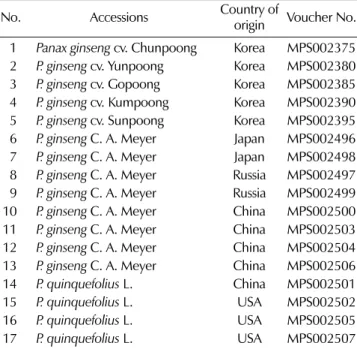
본 연구에 사용된 재료는 농촌진흥청 국립원예특작과학원 인삼특작부 인삼과 시험포장에서 재배중인 천풍, 연풍, 고풍, 금풍, 선풍의 국내산 5품종과 중국, 러시아, 일본, 미국에서 수 집하여 재배중인 12 종류의 유전자원을 포함한 총 17점을 대 상으로 하였다. 실험에 사용된 재료는 인삼특작부 육종전문가 의 도움을 받아 지상부의 형태적 특징을 1차적으로 파악하여 품종 및 수집종 당 5개체씩의 샘플을 채취하였으며, 확증표본 을 제작하여 인삼특작부 Korea Medicinal Herbarium에 보관 하였다 (Table 1). 인삼의 genomic DNA를 확보하기 위해서 3 년생 잎을 채취하여 세척한 후 액체질소로 급냉시켜 막자사 발을 이용하여 분말상태가 되도록 마쇄한 후, DNeasy Plant Mini Kit (QIAGEN, Germany) 을 이용하여 제작사가 제공한 Protocol 에 따라 DNA를 추출하였다. 추출된 DNA는 BioSpec- nano (Shimadzu, Japen) 를 이용하여 인삼 DNA의 quality 및 quantity 를 확인하였고 PCR 반응을 위해서 DNA 농도를 20 ng/uL 로 정량 후 사용하였다.
2. SSR 분석
Ma et al. (2007) 이 발표한 논문에서 polymorphic informa-
tion content (PIC) 값이 높고 allele 수가 많은 9개 SSR 마
커를 선발하여 분석에 사용하였다 (Table 2). PCR 반응을 위
해서 Schuelke (2000)의 방법을 변형하여 수행하였다. 주형
DNA 40 ng, M13-tailed forward primer 0.2 µM, reverse
primer 0.6 µM, 형광 M13 primer 0.5 µM, dATP, dGTP,
dCTP, dTTP 를 각각 200 µM, 50 mM KCl, 10 mM Tris-
HCl, 1.5 mM MgCl
2, 0.25 unit Taq DNA polymerase 를 사 용하였으며, 형광물질로는 6-FAM, HEX, NED를 사용하였다.
유전자형을 분석하기 위하여 PCR 산물 1.2 uL, internal size standard 500 ROX (ABI, Foster city, CA) 0.3 uL, Hi- di formamid (ABI, Foster City, CA) 9 uL 을 첨가 후 ABI 3130xl Genetic Analyzer (ABI, Foster City, CA) 를 이용하 여 분석하였다. 자료 분석을 위하여 Genemapper 4.0 (ABI PRIZM Applied Biosystems) 을 이용하였다.
3. 유전자형 분석
마커에 대한 number of allele (N
A), major allele frequency (M
AF), gene diversity (GD) 및 polymorphic information content (PIC) 에 대한 분석은 PowerMarker (ver 3.25)를 이용
하였다. 유연관계분석은 PowerMarker에 포함되어 있는 CS Chord 1967 distance 를 이용하여 각각의 품종 및 국외 수집종 에 대한 유전적 거리를 분석 후 UPGMA 방법을 이용하여 dendrogram 을 작성하였다.
SSR 마커를 이용하여 국내산 인삼 품종 및 국외 수집종에 대한 구분성 여부를 검정하기 위하여 9개 마커 중 allele 수 및 PIC 값이 가장 높은 GB-PG-142 마커를 이용하여 dendrogram 을 작성 후 1차 품종 및 국외 수집종에 대한 판별 분석을 수행하였다. 구분이 되지 않은 자원에 대해서는 자원 들이 갖고 있는 특정 allele를 포함하고 있는 마커 (GB-PG- 043, GB-PG-177, GB-PG-026) 를 선발하여 각각의 단계별로 하나의 마커를 추가하여 dendrogram을 작성하여 최종 4단계 로 국내산 인삼 품종 및 국외 수집종에 대한 판별을 하였다.
결과 및 고찰
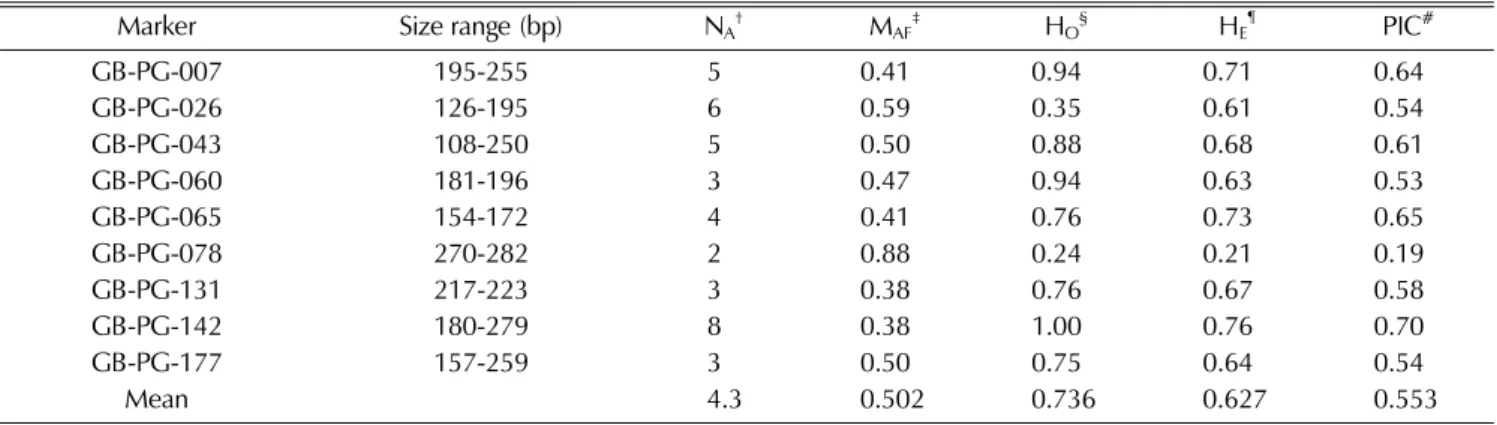
9 개의 SSR 마커를 이용하여 천풍, 연풍, 고풍, 금풍, 선풍의 국내산 5품종과 중국, 러시아, 일본, 미국에서 수집하여 재배 중인 12 종류의 유전자원에 대하여 유전적 다양성을 분석하였 다. 그 결과, 총 39개의 allele가 관찰되었으며, allele 수는 2 개 (GB-PG-078)에서 8개 (GB-PG-142)로 나타났고, 평균 allele 수는 4.3개였다. Allele의 변이는 GB-PG-131에서 6 bp 로 가장 좁았으며, GB-PG-043이 142 bp로 가장 넓은 변이를 나타냈다. M
AF범위는 GB-PG-131과 GB-PG-142에서 0.38로 가장 낮았고, GB-PG-078에서 0.88로 가장 높게 나타났으며, 평균은 0.502였다. 분석에 사용한 마커에 대한 유전적 다양성 을 나타내는 PIC는 GB-PG-078 마커에서 0.19로 가장 낮았으 며, GB-PG-142에서 0.70으로 가장 높게 나타났고, 평균은 0.553 이었다 (Table 3). Park et al. (2009)은 5개의 다형성 SSR 마커를 선발하여 국내 재배종에 대한 유전적 다양성을 분 석 하였는데, 그 결과 평균 대립유전자 수는 3.45 개였으며, 평균 Gene diversity는 0.367로 보고하여, 본 연구에 활용한
Table 2. Information of nine SSR markers used in this study.Marker Primer sequence
Repeated motif TA (℃)†
Forward Reverse
GB-PG-007 CAGAGCTGGTGGTCGAAG ATTCTTTTCTCCAGCGCC (GA)7,(GA)8 60
GB-PG-026 CTGGAATCGGAAATGGGT CAGGCGCCCCTCTAAC (TGG)10,(TGG)10 60
GB-PG-043 AGCCAGGTGCTTGTCTCA GTCAGACGGATTGCTGCT (CT)9,(TC)3(CT)(TC)5 60
GB-PG-060 CGACTGGAATCGGAAATG CGCCCCTTCTCAATTCTC (TGG)4 60
GB-PG-065 CCGAGCGCTACAAAGAGA CCTTCTGCTCAATCGACG (CGC)7 60
GB-PG-078 GTGACGGGTTAAGAGGGC CTCCTTTCCTTCGCCACT (GTT)2(GAG)(GTT)3 (GCG)2(CTT)(GCG)4 60
GB-PG-131 TCATGATGAGTTGGCGGT TCTAGGCGCTCTTCATGG (CAG)6(CA)(CAG)3 60
GB-PG-142 CTGGTGATGGAACCGACA AGTCAGCTCGTCTTCCCC (TGG)3(CAG)(TGG)3(GA)9 60
GB-PG-177 TTTGATCCGCAACTGTCC AATGAGAGGCACCCGAAT (GCA)4 60
†: Annealing temperature
Table 1. Information of 17 ginseng accessions used in this study.
No. Accessions Country of
origin Voucher No.
1 Panax ginseng cv. Chunpoong Korea MPS002375 2 P. ginseng cv. Yunpoong Korea MPS002380 3 P. ginseng cv. Gopoong Korea MPS002385 4 P. ginseng cv. Kumpoong Korea MPS002390 5 P. ginseng cv. Sunpoong Korea MPS002395 6 P. ginseng C. A. Meyer Japan MPS002496 7 P. ginseng C. A. Meyer Japan MPS002498 8 P. ginseng C. A. Meyer Russia MPS002497 9 P. ginseng C. A. Meyer Russia MPS002499 10 P. ginseng C. A. Meyer China MPS002500 11 P. ginseng C. A. Meyer China MPS002503 12 P. ginseng C. A. Meyer China MPS002504 13 P. ginseng C. A. Meyer China MPS002506 14 P. quinquefolius L. China MPS002501 15 P. quinquefolius L. USA MPS002502 16 P. quinquefolius L. USA MPS002505 17 P. quinquefolius L. USA MPS002507
SSR 마커가 더 높은 다양성을 보이는 것으로 나타났다. 한편 유칼립투스, 벼, 구기자 등 다양한 식물을 대상으로 유전적 다 양성 탐색을 위해 SSR 마커가 RFLP, RAPD 등에 비해 효율 적이라는 보고와 같이 (Powell et al., 1996; Brondani et al., 1998; Kwon et al., 2000; Chung et al., 2009), 인삼 품종, 재배종 등에 대한 변이 분석에도 SSR 마커가 더 효율적으로 활용 될 수 있을 것으로 판단된다.
국내산 품종과 수집종 (중국, 러시아, 일본 및 미국 원산지) 에 대한 유전적 다양성을 분석한 결과는 다음과 같다. 국내산, 중국산, 러시아산, 일본산 및 미국산 인삼 집단의 평균 expected heterozygosity (H
E) 는 중국산이 0.642로 가장 높게 나타났고, 국내산 (0.533), 일본산 (0.537), 러시아산 (0.556)은 비슷한 수치를 나타냈으며 미국산이 0.467로 가장 낮게 나타 났다. 평균 PIC 값 역시 중국산이 0.578로 가장 높게 나타났
으며 그 다음은 국내산 (0.480), 러시아산 (0.417), 미국산 (0.389) 순으로 나타났으며 일본산이 0.375로 가장 낮게 나타 났다. 중국 집단에서 H
E와 PIC 값이 높게 나타난 이유는 기 원이 다른 두 종 즉 고려인삼 (P. ginseng C. A. Mey.)과 화 기삼 (P. quinquefolius L.)의 자원이 집단 내에 포함되어 있었 기 때문이다 (Table 4).
각 원산지별로 집단 내에 존재하는 특이적 allele는 본 연구 에 사용된 9개의 마커 중 5개의 마커에서 관찰되었는데, 이들 마커에서 총 11개의 특이적인 allele가 관찰되었다. 특이적인 allele 수는 국내산과 미국산에서 4개, 중국산이 2개, 일본산에 서 1개 순으로 나타났으며, 마커별로는 GB-PG-142에서 4개로 가장 높게 나타났고 GB-PG-065에서 1개로 가장 낮았다 (Table 4).
SSR 마커를 이용하여 국내산 품종과 중국산, 러시아산, 일
Table 3. Characterization of nine SSR markers used in this study.Marker Size range (bp) NA† MAF‡ HO§ HE¶ PIC#
GB-PG-007 195-255 5 0.41 0.94 0.71 0.64
GB-PG-026 126-195 6 0.59 0.35 0.61 0.54
GB-PG-043 108-250 5 0.50 0.88 0.68 0.61
GB-PG-060 181-196 3 0.47 0.94 0.63 0.53
GB-PG-065 154-172 4 0.41 0.76 0.73 0.65
GB-PG-078 270-282 2 0.88 0.24 0.21 0.19
GB-PG-131 217-223 3 0.38 0.76 0.67 0.58
GB-PG-142 180-279 8 0.38 1.00 0.76 0.70
GB-PG-177 157-259 3 0.50 0.75 0.64 0.54
Mean 4.3 0.502 0.736 0.627 0.553
†: Number of allele
‡: Major allele frequency
§: Observed heterozygosity
¶: Expected heterozygosity
#: Polymorphic information content
Table 4. The expected heterozygosity (HE), polymorphic information content (PIC) and number of specific allele (NSA) of nine SSR markers within five populations.
Marker HE† PIC‡ NSA (bp)§
KOR JPN RUS CHN USA KOR JPN RUS CHN USA KOR JPN RUS CHN USA
GB-PG-007 0.56 0 0.67 0.73 0.73 0.50 0 0.50 0.66 0.61 1(249) 1(231)
GB-PG-026 0.53 0 0 0.76 0 0.48 0 0 0.68 0 1(195) 1(192)
GB-PG-043 0.60 0.83 0.83 0.60 0.73 0.54 0.63 0.63 0.54 0.61 2(108, 202) GB-PG-060 0.56 0.67 0.67 0.64 0.53 0.50 0.50 0.50 0.58 0.44
GB-PG-065 0.82 1 0.67 0.80 0 0.74 0.75 0.50 0.72 0 1(166)
GB-PG-078 0 0 0 0.20 0.60 0 0 0 0.18 0.50
GB-PG-131 0.56 0.67 0.67 0.71 0 0.50 0.50 0.50 0.64 0
GB-PG-142 0.64 0.67 0.67 0.73 0.80 0.58 0.50 0.50 0.66 0.67 1(231) 3(201, 231, 252) GB-PG-177 0.53 1 0.83 0.60 0.80 0.48 0.50 0.63 0.54 0.67
Mean 0.533 0.537 0.556 0.642 0.467 0.480 0.375 0.417 0.578 0.389 0.4 0.1
− 0.1
0.4†: Expected heterozygosity
‡: Polymorphic information content
§ : Number of specific allele
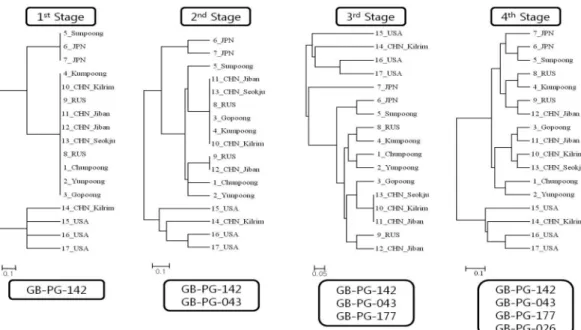
본산 및 미국산 수집종의 판별을 위하여 9개의 마커 중 allele 수, gene diversity 및 PIC 값이 가장 높은 GB-PG-142 마커 를 우선 적용하여 dendrogram을 작성하여 분석을 하였다. 그 후 GB-PG-043, GB-PG-177, GB-PG-026 순으로 마커를 추 가하여 단계별로 tree를 작성하여 분석을 수행하였다 (Fig. 1).
GB-PG-142 마커를 이용하여 1단계 판별을 수행한 결과 총
17 점의 인삼 자원 중 4점 (미국산 3점, 중국산 1점)이 판별되 었다. 판별이 되지 않은 13점은 자원들이 가지고 있는 유전자 형에 따라 2개의 그룹을 형성하였다 (Fig. 1). 2단계에 GB- PG-043 마커를 추가하여 분석한 결과 1단계에서 판별되지 않 았던 13점 중에서 5점 (국내산 3점, 일본산 2점)이 판별되었 다. 또한 GB-PG-177 마커를 이용한 3단계에서는 4점 (국내산
Fig. 1. Diagrammatic display of cultivar discrimination by UPGMA dendrogram using 17 ginseng accessions at each stage by fourSSR markers.
Table 5. Genotype information of 17 ginseng accessions by four SSR markers.
No. Origin 1st stage 2nd stage 3rd stage 4th stage
142N 43F 177H 26F
1 KOR 180/192 202† 256/259 144/195
2 KOR 180/192 108/202† 256/259 144/186
3 KOR 180/192 202/250 256† 144/174
4 KOR 184/192 202/250† 256/259 144
5 KOR 180/192 202/250 256/259† 144
6 JPN 184/192 202/224† 256/259 144
7 JPN 184/192 200/224† - 144
8 RUS 180/192 202/250 259† 144
9 RUS 180/192 202/224 157/256† 144
10 CHN 180/192 202/250 157/256 144/192†
11 CHN 180/192 202/250 157/256 144/174†
12 CHN 180/192 202/224 256/259† 144
13 CHN 180/192 202/250 157/256 144/186†
14 CHN 231/279† 202/202 256/256 126
15 USA 201/279† 200/224 157/256 126
16 USA 222/279† 202/224 259/259 126
17 USA 252/279† 202/224 157/256 126
†: Allele size of 17 ginseng accessions which were discriminated by four SSR markers
2 점, 러시아산 2점), 4단계 (GB-PG-026)에서는 3점 (중국산 3 점)이 판별되었다. 본 연구에 사용한 인삼의 원산지에 따른 국 내산 품종 및 국외 수집종에 대한 판별은 4단계까지의 마커 조합 (GB-PG-142, GB-PG-043, GB-PG-177, GB-PG-026)으 로도 판별이 가능하였다 (Fig. 1, Table 5).
DNA 마커를 이용한 인삼 유전분석은 주로 종이 다른 고려 인삼, 미국삼, 삼칠삼, 죽절삼 등을 대상으로 이들을 구분하기 위하여, ITS (Internal transcribed spacer), 5.8S ribosomal DNA 을 대상으로 염기서열 분석 또는 특정 제한효소 처리에 의한 PCR-RFLP 방법이 이용되어왔다 (Wen and Zimmer, 1996; Ngan et al., 1999; Zhu et al., 2008). 최근에 인삼의 SSR 마커 개발 및 유전분석에 관한 연구가 보고되고 있으며, 주로 국내산 수집종 간 (Park et al., 2009)과 산양삼과 재배 삼 간의 유전적 다형성 분석 (Jo et al., 2009) 및 고려인삼과 중국삼의 구별에 관한 연구 (Ahn et al., 2009)가 일부 진행 되었다. 하지만 아직까지 SSR 마커를 이용하여 국내·외 유전 자원의 유전적 다형성 분석에 관한 연구 결과는 없는 실정이다.
결론적으로 4개 SSR 마커 (GB-PG-026, GB-PG-043, GB- PG-142, GB-PG-177) 를 이용하여 국내산 품종과 중국산, 러시 아산, 일본산 및 미국에서 도입한 수집종에 대한 판별이 가능 하였다. 본 연구에 사용된 4개 SSR 마커는 인삼 원산지에 따 른 품종 및 수집종 판별, 종자의 순도 검정, 품종보호와 종자 관리체계 확립을 위한 품종의 구별성 (Distinctness), 균일성 (Uniformity) 및 안정성 (Stability) 검정에 활용될 수 있을 것 이다. 향후에도 인삼 품종 육성 시 구별성과 재현성이 높은 SSR 마커 등과 같이 다양한 DNA 마커를 지속적으로 개발하 여 육종의 효율을 높이기 위한 기술로 적극 활용하여 과학적 인 종자관리 체계를 구축해 나간다면, FTA 등 수입개방화 시 대를 맞이하여 중국, 미국 등 인삼 산업경쟁국을 대상으로 국 내산 육성 품종에 대한 대내·외 지적재산권을 선점할 수 있 고, 유전적으로 균일한 원재료를 생산할 수 있어 이들 국내산 인삼을 원재료로 사용할 우리나라 기업들의 브랜드 가치 차별 화에 도움을 줄 수 있을 것으로 기대된다.
감사의 글
본 연구는 농촌진흥청 바이오그린지사업 (과제번호 2007501034007) 의 지원에 의해 이루어진것으로 감사를 드립 니다.
LITERATURE CITED
Ahn CH, Kim BB, Yoon ES and Choi YE. (2009). Development of microsatellite markers to distinguish south Korean and Chinese ginseng. Journal of Korean Forest Society. 98:568-575.
Bernet GP, Bramardi S, Calvache D, Caebonell EA and Asins
MJ. (2003). Applicability of molecular markers in the context of protection of new varieties of cucumber. Plant Breeding.
122:146-152.
Brondani RPV, Brondani C, Tarchini R and Grattapaglia D.
(1998). Development, characterization and mapping of microsatellite markers in Eucalyptus grandis and E. urophylla.
Theoretical and Applied Genetics. 97:816-827.
Cho KH, Heo S, Kim JH, Shin IS, Kim SH, Kim DH, Han SE and Kim HR. (2010). Analysis of genetic diversity of apple cultivars using RAPD and SSR markers. Korean Journal of Breeding Science. 42:525-533.
Choi JS, Huh MK and Sung JS. (2009). Seed purity test and evaluation in Isatis tinctoria var. yezoensis (Ohwi) Ohwi using AFLP markers. Korean Journal of Medicinal Crop Science.
17:198-203.
Chung JW, Lee GA, Lee SS, Bang KH, Park CB and Park YJ.
(2009). Cultivar discrimination of Korean and Chinese Boxthorn(Lycium chinense Mill. and Lycium barbarum L.) using SSR markers. Korean Journal of Medicinal Crop Science.
17:445-451.
de Andrade E, de Mesquita AA, de Claro JA, de Andrade PM, Ortiz V, Paranhos M and Srougi M. (2007). Study of the efficacy of Korean Red Ginseng in the treatment of erectile dysfunction. Asian Journal of Andrology. 9:241-244.
Dey L, Xie JT, Wang A, Wu J, Maleckear SA and Yuan CS.
(2003). Anti-hyperglycemic effects of ginseng: Comparison between root and berry. Phytomedicine. 10:600-605.
Goulo L, Cabrita L, Oliveira CM and Leito JM. (2001).
Comparing RAPD and AFLPTM analysis in discrimination and estimation of genetic similarities among apple(Malus domestica Borkh.) cultivars. Euphytica. 119:259-270.
Hamada SR, Petrino MG and Kakunaga T. (1982). A novel repeated element with Z-DNA-forming potential is widely found in evolutionarily diverse eukaryotic genomes. Proceedings of the National Academy of Sciences of the United States of America. 79:6465-6469.
Jo BH, Suh DS, Cho EM, Kim JK, Ryu GH and Chung KW.
(2009). Characterization of polymorphic microsatellite loci in cultivated and wild Panax ginseng. Genes and Genomics.
31:119-127.
Kang KS, Kim HY, Yamabe N, Park JH and Yokozawa T.
(2007). Preventive effect of 20(S)-ginsenoside Rg(3) against lipopolysaccharide induced hepatic and renal injury in rats. Free Radical Research. 41:1181-1188.
Kim JK, Jo BH, Lee KL, Yoon ES, Ryu GH and Chung KW.
(2007). Identification of new microsatellite markers in Panax ginseng. Molecules and Cells. 24:60-68.
Kim SH and Park KS. (2003). Effects of Panax ginseng extract on lipid metabolism in humans. Pharmacological Research.
48:511-513.
Kwon SJ, Ahn SN, Suh JP, Hong HC, Kim YK, Hwang HG, Moon HP and Choi HC. (2000). Genetic diversity of Korean native rice varieties. Korean Journal of Breeding Science.
32:186-193.
Kwon WS, Chung CM, Kim YT and Choi KT. (1991).
Comparisons of growth, crude saponin, ginsenosides, and anthocyanins in superior lines of Panax ginseng C. A. Meyer.
Korean Journal of Breeding Science. 23:219-228.
Kwon WS, Chung CM, Kim YT, Lee MG and Choi KT.
(1998). Breeding process and characteristics of KG101, a superior line of Panax ginseng C. A. Meyer. Journal of Ginseng Research. 22:11-17.
Kwon WS, Lee MG and Choi KT. (2000). Breeding process and characteristics of Yunpoong, a new variety of Panax ginseng C.
A. Meyer. Journal of Ginseng Research. 24:1-7.
Kwon WS, Lee JH, Park CS and Yang DC. (2003). Breeding process and characteristics of Gopoong, a new variety of Panax ginseng C. A. Meyer. Journal of Ginseng Research. 27:86-91.
Kwon YS, Lee JM, Yi GB, Yi SI, Kim KM, Soh EH, Bae KM, Park EK, Song IH and Kim BD. (2005). Use of SSR markers to complement tests of distinctiveness, uniformity, and stability (DUS) of Pepper(Capsicum annuum L.) varieties.
Molecules and Cells. 19:428-435.
Liu J, Wang S, Liu H, Yang L and Nan G. (1995). Stimulatory effect of saponin from Panax ginseng on immune function of lymphocytes in the elderly. Mechanisms of Aging and Development. 83:43-53.
Ma KH, Dixit A, Kim YC, Lee DY, Kim TS, Cho EG and Park YJ. (2007). Development and characterization of new microsatellite markers for ginseng(Panax ginseng C. A. Meyer).
Conserved Genetics. 8:1507-1509.
Morgante M, Rafalski A, Biddle P, Tingey S and Olivieri AM.
(1995). Genetic mapping and variability of seven soybean simple sequence repeat loci. Genome. 37:763-769.
Ngan F, Shaw P, But P and Wang J. (1999). Molecular authentication of Panax species. Phytochemistry. 50:787-791.
Nguyen VD, Nirala R, Choi SR, Uhm TS, Yang TJ, Ahn IO and Lim YP. (2010). Development and characterization of new microsatellite markers in Panax ginseng C. A. Meyer from BAC end sequences. Conserved Genetics. 11:1223-1225.
Noil E, Teriaca MS, Sanguineti MC and Conti S. (2008).
Utilization of SSR and AFLP markers for the assessment of distinctness in durum wheat. Molecular Breeding. 22:301-313.
Ogbonnaya FC, Imtiaz M, Ye G, Hearnden PR, Hemandez E, Eastwood RF, van Ginkel M, Shorter SC and Winchester JM. (2008) Genetic and QTL analyses of seed dormancy and preharvest sprouting resistance in the wheat germplasm CN10955. Theoretical and Applied Genetics. 116:891-902.
Park SW, Hyun YS and Chung KW. (2009). Genetic polymorphism of microsatellite in Panax ginseng C. A. Meyer.
Journal of Ginseng Research. 33:199-205.
Powell W, Machray GC and Provan J. (1996). Polymorphism revealed by simple sequence repeats. Trends in Plant Science.
1:215-222.
Saghai-Maroof MA, Biyashev RM, Yang GP, Zhang Q and Allard RW. (1994). Extraordinarily polymorphic microsatellite DNA in barley: species diversity, chromosomal locations and population dynamics. Proceedings of the National Academy of Sciences of the United States of America. 91:5466-5470.
Schuelke M. (2000). An economic method for the fluorescent labeling of PCR products. Nature Biotechnology. 180:233-234.
Shin HR, Kim YJ, Yun TK, Morgan G and Vainio H. (2000).
The cancer-preventive potential of Panax ginseng: a review of human and experimental evidence. Cancer Causes and Control.
11:565-576.
The Compilation Committee of Korean Ginseng. (2002). The Koran Ginseng History. The Public Relations Firm of Korean Ginseng. Seoul, Korea. p. 50-51.
Tommasini L, Batley J, Arnold GM, Cooke RJ, Donini P, Lee D, Law JR, Lowe C, Moule C, Trick M and Edwards KJ.
(2003). The development of multiplex simple sequence repeat (SSR) markers to complement distinctness, uniformity and stability testing of rape(Brassica napus L.) varieties. Theoretical and Applied Genetics. 106:1091-1101.
Trautz D and Renz M. (1984). Simple sequence are ubiquitous repetitive components of eukaryotic genomes. Nucleic Acids Research. 12:4127-4138.
Wang LC and Lee TF. (2000). Effect of ginseng saponins on cold tolerance in young and elderly rats. Planta Medica. 66:144-147.
Wen J and Zimmer EA. (1996). Phylogeny and biogeography of Panax L. (the ginseng genus, Araliaceae): inferences from ITS sequences of nuclear ribosomal DNA. Molecular Phylogenetics and Evolution. 6:167-177.
Wu KS and Tanksley SD. (1993). Abundance, polymorphism and genetic mapping of microsatellites in rice. Molecular and General Genetics. 241:225-235.
Yun TK, Lee YS, Lee YH, Kim SI, and Yun HY. (2001).
Anticarcinogenic effect of Panax ginseng C. A. Meyer and identification of active compounds. Journal of Korean Medical Science. 16:S6-18.
Zhu S, Fushimi H and Komatsu K. (2008). Development of a DNA microarray for authentication of ginseng drugs based on 18S rRNA gene sequence. Journal of Agricultural and Food Chemistry. 56:3953-3959.