양식장 배출수 퇴적층에서 분리된 미생물의 다당분해효소 활성 및 특성
김만철․장태원․Ramasamy Harikrishnan․문영건․송창영․김기영1․허문수*
제주대학교 해양과학대학 수산생명의학과, 1제주대학교 해양생명과학과
Received December 3, 2008 /Accepted February 21, 2009
Amylase Activity and Characterization of Microorganism Isolated from in Aquacultural Effluents Sediment Layer. Man-Chul Kim, Tae-Won Jang, Ramasamy Harikrishnan, Young-Gun Moon, Chang-Young Song, Gi-Young Kim
1and Moon-Soo Heo*. Department of Aquatic Life Medicine, Faculty of Marine Science, Jeju National University, Jeju 690-756, Korea,
1Department of Marine Life Sciences, Jeju National University, Jeju 690-756, Korea - In the course of screening of useful enzyme-producing micro- organisms from marine sedimentary layers, we isolated 2 amylase producing strains and tested their amylase producing activities. Analyses of 16S rDNA sequences and biochemical methods (BIOLOG) of two isolates showed that they were confirmed to be a gram positive Bacillus sp. and gram negative Pseudoalteromonas sp., respectively. Excellent amylase producing strains were termed Bacillus sp. ST-63 and Pseudoalteromonas sp. ST-140, and further studies were conducted on their amylase producing characteristics. Optimum conditions for cell growth in amylase activity were obtained when the isolate (Bacillus sp. ST-63 and Pseudoalteromonas sp. ST-140) was cultured at 30
oC and pH 7~8.
Key words : Amlyase, 16S rDNA, BIOLOG, Bacillus sp., Pseudoalteromonas sp.
*Corresponding author
*Tel:+82-64-754-3473, Fax:+82-64-756-3493
*E-mail : [email protected]
서 론
일반적인 육상 양식시설은 넓은 부지와 다량의 해수를 이용 한 사육방식이기 때문에 유지 관리 차원에서 비경제적이며, 배출수는 그 수량이 막대하고, 오염물질 배출농도의 변화폭이 대단히 크다는 점 등의 제한요인들에 의하여 기존의 통상적인 물리․화학적, 생물학적인 폐수처리공법의 도입이 거의 불가 능한 특성을 가지고 있다. 또한 양식장이 해안가를 중심으로 넓게 분포하고 있다는 점은 국내외를 불문하고 많은 연구자들 의 표준적인 처리법 개발에 걸림돌이 되고 있어 이에 대한 방안이 시급한 실정이다. 이러한 취지에서 이들 배출수의 관 리 방안 연구는 절실히 요구된다[1,10].
또한 배출물 오염을 저감시키기 위한 별도의 처리 방법이 확립되어있지 않을 뿐만 아니라 이러한 배출물을 이용한 사료 등의 재활용에 있어, 아직 안전성에 대한 검토가 전무한 실정 이다. 따라서 양식장 배출수에 존재하고 있는 유기물 성분들 은 일차적인 해안에 퇴적층을 이루며 환경적인 문제점을 일으 키고 있기 때문에 이에 대한 환경친화적인 처리 방안이 절실 하다. 미생물을 이용한 오폐수처리는 일본에서 처음 시도되었 으며[7], 국내에서는 양식장 배출물의 제거를 위한 여과장치의 개발 및 순환여과식 양식법 개발에 따른 수질관리기술 확립과 관련된 연구들이 보고되고 있다[5,6]. 일반적으로 육상 양식장 의 대부분의 배출물은 양식어류가 섭이하고 남은 잔류 생사료 이며, 탄수화물, 지방, 단백질 함량이 높은 것이 특징이다[12].
따라서 이러한 유기물들을 효과적 및 친환경적으로 분해할
수 있는 미생물 자원의 개발이 필요하다.
Glucose 중합체인 starch는 가장 널리 이용되는 식물체의 탄수화물로서 amylase는 이러한 starch를 분해하는 효소이다.
Amylase는 α-amylase, β-amylase, glucoamylase와 isoamylase 로[2,14,15] 크게 구분할 수 있는데 α-amylase (endo- amylase) 는 amylose나 amylopectin의 α-1,4결합을 무작위로 가수분해 하여 dextrin을 형성하고 α-amylase의 계속적인 작용에 의해 maltose, maltotriose, maltotetraose등의 oligosaccharide를 형 성한 뒤 glucose와 maltose로 분해하는 효소이다. β-amylase (exo-amylase)는 starch의 비환원성 말단으로부터 maltose 단 위로 가수분해하는 효소로서 α-1,6결합을 포함하는 dextrin을 형성한다.
Gluconamylase는 starch에 작용하여 amylose와 amylo- pectin의 α-1,4, α-1,6 결합을 가수분해하여 glucose를 생성하 는 당화효소이며, isoamylase는 starch의 α-1,6 결합에만 작용 하는 효소이다[3,4,9]. 이러한 전분의 분해에 관련하는 효소는 효모, 곰팡이, 세균, 맥아 및 동물체내에 널리 존재한다.
본 연구에서는 제주도 육상수조양식장의 밀집지역의 배출 수 배출 지역을 중심으로 퇴적층 분해에 관련된 미생물을 탐 색하여 amylase 활성을 측정하였으며, 활성이 강한 균주를 선 별하여 amylase의 생산을 위한 조건을 검토하였다. 또한 차후 미생물의 생태적 지위를 파악하여 환경적 및 산업적인 이용가 능성을 확인하고자 본 연구를 수행하였다.
재료 및 방법
균주의 선별
본 연구에 사용된 균주는 제주도 양식장(표선, 성산) 배출수
연안에 형성된 퇴적층으로부터 분리되었으며, 멸균된 모종삽 을 이용하여 멸균 위생팩에 시료를 넣고 채집 후, 4
oC를 유지 하면서 실험실로 운반하여 실험에 이용하였다. 채집된 퇴적층 1 g를 멸균해수 9 ml에 넣고 충분히 섞어준 후, 이 시료를 원액 으로 10의 지수로 희석한 후, 각각의 멸균된 배지에 100 μl씩 접종하고 25
oC에서 7일간 배양하였다.
종속영양세균의 분리 및 배양은 marine agar (MA; Difco.
Co. USA)배지, 성장속도가 느린 세균의 배양은 R2A agar (Difco. Co. USA) 배지, 영양이 풍부한 일반적인 배지로 일반 세균의 배양을 nutrient agar (NA; Difco. Co. USA)배지, 효모, 곰팡이 또는 내산균의 배양은 YM agar (Difco. Co. USA) 배지 를 사용하여 균주를 분리하였다.
Amylase 생산 미생물 분리
높은 다당 분해효소를 생산하는 균종을 분리할 목적으로 연안 퇴적층에서 분리된 200균주를 이용하여 다당 분해능 측 정 실험에 이용하였다.
본 실험의 경우 soluble starch (Difco. Co. USA) 1%를 첨가 한 NA (nutrient agar)배지를 멸균해수를 이용하여 제조한 후, 각각의 분리된 균종을 백금이를 이용하여 도말하고, 25
oC 배 양기에서 48시간 동안 배양한 후, 배지에 1 M 요오드용액을 떨어뜨려 전분이 가수분해 되어 투명환(clear zone or halo)을 보이는 균주를 분리하여 본 연구에 이용하였다. 또한 본 균주 의 보관을 위하여 멸균된 glycerol stock solution을 사용하여 냉동 보관하였으며, 실험은 전분분해능의 활성유지를 위해 1% soluble starch가 첨가된 NA배지에서 계대 배양하면서 실 험에 이용하였다.
분리균주의 생화학적 특성 분석
분리균주의 생화학적 특성 분석은 3%로 KOH를 이용하여 간이그람동정을 한 후, Biolog사(BIOLOG Inc., USA)의 GN2, GP2 plate를 이용하여 95가지의 기질이용 특이성을 시험하였 으며, 분석은 MicroLog
TMsystem (release 4.05) program을 이 용하였다.
순수 분리된 균주를 BUGM (Biolog Inc., USA) 사면배지에 접종하여 30
oC에서 48시간 배양 한 후, 현탁하여 탁도계(Biolog 21907, USA)를 이용하여 균주 현탁액을 각각 GP의 경우 20%, GN의 경우 52~59%가 되도록 조절한 후 GP2와 GN2 micro plate의 각 well에 150 μl씩 접종한 후, 30
oC에서 24시간 배양 후, 보라색을 발색되는 well을 양성으로 판정하였다.
이때 현탁액은 NaCl 150 g, MgCl
2․6H
2O 51 g, KCl 3.7 g을 증류수 912 ml에 녹인 MCS stock solution [13]을 증류수 로 10배 희석한 후, 멸균하여 사용하였다.
16S ribosomal DNA 염기서열 분석
분리 균주의 동정을 위해 16S ribosomal DNA 염기서열을
이용하였으며, 16S rDNA 유전자 단편을 PCR 반응으로 증폭 하여 염기 서열을 결정하였다. PCR 반응에 사용된 primer는 27F (forward primer; AGAGTTTGATCCTGGCTCAG)와 1492R (reverse priver; GGTTACCTTGTTACGACTT)을 사용 하였고, ABI 3730XL capillary DNA sequencer를 이용하여 se- quencing 분석을 하였으며, 염기조성, 상호비교(pairwise comparisons)를 위한 염기치환 양상, codon usage 및 각 개 체․개체군의 유전자 차이는 MEGA 3.0 프로그램으로 계산되 었으며, 미생물 군집 분석에 이용된 계통수는 distance 방법으 로 MEGA 3.0[8] 프로그램의 pair-distance를 이용하여 작성하 였다. 결정된 염기서열을 NCBI BLAST를 이용하여 Genbank 에 보고 된 균주와의 상동성을 조사하였으며, Genbank에 분 리균주의 유전자 염기서열을 등록한 후, Accession number를 각각 부여 받았다.
다당분해 효소 생산 미생물의 온도별 생육도 및 amylase 활성 측정
Amylase 활성이 확인된 균주를 MB broth (Difco. Co. USA) 에 배양 후, 각각의 시간대별로 균주 배양액을 1 ml씩 취하여 분광광도계를 이용하여 660 nm에서 각각의 성장도를 측정하 였으며, 분리균주의 증식과 amylase 생산의 최적 조건을 알기 위하여 증식 온도와 초기 배지의 pH에 변화를 주면서 효소활 성을 조사하였다. 기본배지로 MB broth를 사용하였으며, 배양 온도를 20~40
oC 까지 10
oC 간격으로 각각 액체 배양하였다.
초기 배지의 pH는 4~10 까지 조성하여 실험을 수행하였다.
선별된 균주는 MB broth(Difco, USA)에 배양 후, 시간대별 로 배양액을 9,600× g에서 3분간 원심분리하여, 상등액을 조효 소액으로 사용하였다.
분리된 균주의 amylase 활성은 1% soluble starch 0.1 ml에 조효소액 0.1 ml를 넣고 37
oC에서 5분간 반응시킨 후, 생성된 환원당을 DNS법[11]을 변형하여 700 nm에서 흡광도에서 당 분해능을 측정하였다.
결과 및 고찰
다당 분해 효소 생산 미생물의 분리 및 동정
다당분해 효소를 생산 하는 미생물을 분리하기 위하여 총 200여 균주를 대상으로 실험해본 결과 colony 주변위에 0.2%
(W/V) KI-I2용액으로 염색하여 clear zone이 생기는 균주만을 amylase 분해능이 있는 균주로 확인되어, 총 10균주를 선별하 였으며, 이들 중 가장 amylase 활성이 좋은 균주를 선정하여 각각 ST-63, ST-140라 명명하였다.
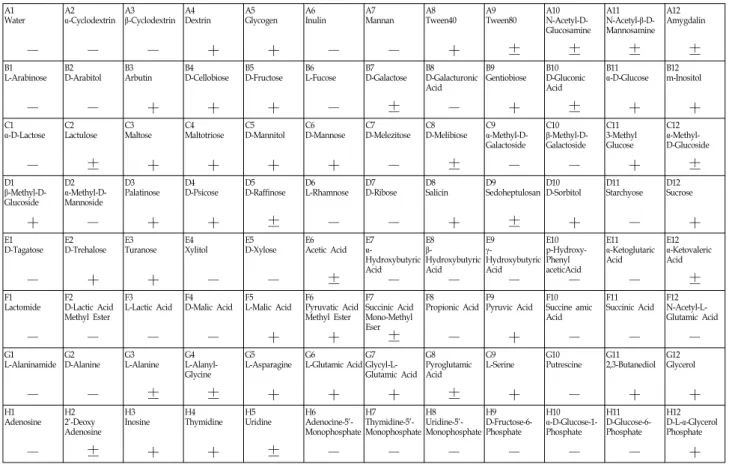
분리된 효소생산 균주의 생화학 특성을 조사한 결과를
Table 1, Table 2에 나타내었다. 분리균주 ST-63은 β-cyclodex-
trin, dextrin, tween 40, glycogen, arbutin, D-cellobiose,
D-fructose, genfiobiose, maltose, maltotriose, D-mannitol,
Table 1. Biochemical characteristics of isolation strain tested by BIOLOG (ST-63)
A1
Water A2
α-Cyclodextrin A3
β-Cyclodextrin A4
Dextrin A5
Glycogen A6
Inulin A7
Mannan A8
Tween40 A9
Tween80 A10
N-Acetyl-D- Glucosamine
A11 N-Acetyl-β-D- Mannosamine
A12 Amygdalin
B1 L-Arabinose
B2 D-Arabitol
B3 Arbutin
B4 D-Cellobiose
B5 D-Fructose
B6 L-Fucose
B7 D-Galactose
B8 D-Galacturonic Acid
B9 Gentiobiose
B10 D-Gluconic Acid
B11
α-D-Glucose B12 m-Inositol
C1
α-D-Lactose C2 Lactulose
C3 Maltose
C4 Maltotriose
C5 D-Mannitol
C6 D-Mannose
C7 D-Melezitose
C8 D-Melibiose
C9 α-Methyl-D- Galactoside
C10 β-Methyl-D- Galactoside
C11 3-Methyl Glucose
C12 α-Methyl- D-Glucoside
D1β-Methyl-D- Glucoside
D2α-Methyl-D- Mannoside
D3 Palatinose
D4 D-Psicose
D5 D-Raffinose
D6 L-Rhamnose
D7 D-Ribose
D8 Salicin
D9 Sedoheptulosan
D10 D-Sorbitol
D11 Starchyose
D12 Sucrose
E1 D-Tagatose
E2 D-Trehalose
E3 Turanose
E4 Xylitol
E5 D-Xylose
E6 Acetic Acid
E7 α- Hydroxybutyric Acid
E8 β- Hydroxybutyric Acid
E9 γ-
Hydroxybutyric Acid
E10 p-Hydroxy- Phenyl aceticAcid
E11 α-Ketoglutaric Acid
E12 α-Ketovaleric Acid
F1
Lactomide F2 D-Lactic Acid Methyl Ester
F3
L-Lactic Acid F4
D-Malic Acid F5
L-Malic Acid F6 Pyruvatic Acid Methyl Ester
F7 Succinic Acid Mono-Methyl Eser
F8
Propionic Acid F9
Pyruvic Acid F10 Succine amic Acid
F11
Succinic Acid F12 N-Acetyl-L- Glutamic Acid
G1 L-Alaninamide
G2 D-Alanine
G3 L-Alanine
G4 L-Alanyl- Glycine
G5 L-Asparagine
G6 L-Glutamic Acid
G7 Glycyl-L- Glutamic Acid
G8 Pyroglutamic Acid
G9 L-Serine
G10 Putrescine
G11 2,3-Butanediol
G12 Glycerol
H1 Adenosine
H2 2'-Deoxy Adenosine
H3 Inosine
H4 Thymidine
H5 Uridine
H6 Adenocine-5'- Monophosphate
H7 Thymidine-5'- Monophosphate
H8 Uridine-5'- Monophosphate
H9 D-Fructose-6- Phosphate
H10 α-D-Glucose-1- Phosphate
H11 D-Glucose-6- Phosphate
H12 D-L-α-Glycerol Phosphate
Table 2. Biochemical characteristics of isolation strain tested by BIOLOG (ST-140)
A1 Water
A2α-Cyclodextrin A3
β-Cyclodextrin A4 Dextrin
A5 Glycogen
A6 Inulin
A7 Mannan
A8 Tween40
A9 Tween80
A10 N-Acetyl-D- Glucosamine
A11 N-Acetyl-β-D- Mannosamine
A12 Amygdalin
B1 L-Arabinose
B2 D-Arabitol
B3 Arbutin
B4 D-Cellobiose
B5 D-Fructose
B6 L-Fucose
B7 D-Galactose
B8 D-Galacturonic Acid
B9 Gentiobiose
B10 D-Gluconic Acid
B11
α-D-Glucose B12 m-Inositol
C1α-D-Lactose C2 Lactulose
C3 Maltose
C4 Maltotriose
C5 D-Mannitol
C6 D-Mannose
C7 D-Melezitose
C8 D-Melibiose
C9α-Methyl-D- Galactoside
C10β-Methyl-D- Galactoside
C11 3-Methyl Glucose
C12α-Methyl-D- Glucoside
D1 β-Methyl-D- Glucoside
D2 α-Methyl-D- Mannoside
D3 Palatinose
D4 D-Psicose
D5 D-Raffinose
D6 L-Rhamnose
D7 D-Ribose
D8 Salicin
D9 Sedoheptulosan
D10 D-Sorbitol
D11 Starchyose
D12 Sucrose
E1 D-Tagatose
E2 D-Trehalose
E3 Turanose
E4 Xylitol
E5 D-Xylose
E6 Acetic Acid
E7 α- Hydroxybutyric Acid
E8 β- Hydroxybutyric Acid
E9 γ-
Hydroxybutyric Acid
E10 p-Hydroxy- Phenyl aceticAcid
E11 α-Ketoglutaric Acid
E12 α-Ketovaleric Acid
F1 Lactomide
F2 D-Lactic Acid Methyl Ester
F3 L-Lactic Acid
F4 D-Malic Acid
F5 L-Malic Acid
F6 Pyruvatic Acid Methyl Ester
F7 Succinic Acid Mono-Methyl Eser
F8 Propionic Acid
F9 Pyruvic Acid
F10 Succine amic Acid
F11 Succinic Acid
F12 N-Acetyl-L- Glutamic Acid
G1 L-Alaninamide
G2 D-Alanine
G3 L-Alanine
G4 L-Alanyl- Glycine
G5 L-Asparagine
G6 L-Glutamic Acid
G7 Glycyl-L- Glutamic Acid
G8 Pyroglutamic Acid
G9 L-Serine
G10 Putrescine
G11 2,3-Butanediol
G12 Glycerol
H1 Adenosine
H2 2'-Deoxy Adenosine
H3 Inosine
H4 Thymidine
H5 Uridine
H6 Adenocine-5'- Monophosphate
H7 Thymidine-5'- Monophosphate
H8 Uridine-5'- Monophosphate
H9 D-Fructose-6- Phosphate
H10α-D-Glucose-1- Phosphate
H11 D-Glucose-6- Phosphate
H12 D-L-α-Glycerol Phosphate
- - - + + - - + ± ± ± ±
- - + + + - ± - + ± + +
- ± + + + + - ± - - + ±
+ - + + ± - - + ± + - +
- + + - - ± - - - - - ±
- - - - + + ± - + - - -
- - ± ± + + + ± + - + +
- ± + + ± - - - - - - +
- - - + + - - - - + ± +
- - + + + - - - + - + -
- - + + + + - + - - ± +
+ - + + ± - ± - - + - +
- + + - - ± - - - - - ±
- - - - - + - - + - - -
- - - ± ± + - - ± - - -
- - ± + + - ± + + + + ±
Fig. 1. Photos of amylase producing bacteria by using nutrient Agar (Added soluble starch) agar plates.
D-mannose, palatinose, D-psicose, salicin, D-sorbitol, su- crose 및 turanose, 등의 탄수화물이 대사됨을 확인하였다. 또 한 분리균주 ST-140은 dextrin, glycogen, arbutin, D-cello- biose, D-fructose, gentiobiose, α-D-glucose, palatinose, D-sorbitol, thymidine 등의 탄수화물이 대사됨을 확인하였 다. 최종적으로 분리균주 ST-63은 BIOLOG 분석 결과에서 Bacuillus amyloiquefaciens 균주와 가장 유사한 생화학적 특성 을 보이는 것으로 나타났으며,분리균주 ST-140은 Alteromonas sp.종들과 Pseudoalteromonas marina의 생화학적 특성이 가장 유사하게 나타났다. 분리균주의 확실한 동정을 위해서 16S ri- bosomal DNA 염기서열 분석을 실시하였으며, 분리균주 ST-63, ST-140의 계통학적 분석결과를 Fig. 2, Fig. 3에 나타내 었다. 일반적으로 리보솜 RNA (rRNA)는 전 생물에 보편적으 로 존재하는 보존성이 높은 핵산분자이며, 미생물의 진화계 통의 연구에 가장 유용한 분자마커로 이용되고 있다. 특히 범
4355 6174766780
0.02
Bacillus velezensis FJ426275 Strain ST-63
Bacillus amyloliquefaciens NC009725 Bacillus subtilis subsp. endophyticus AF399911 Bacillus subtilis subsp. chungkookjang AF233579
Bacillus subtilis FJ435234 Bacillus subtilis strain CB115 FJ426277 Bacillus pumilus SAFR-032 AY167879
Halobacillus aidingensis AY351389 Virgibacillus carmonensis AJ316302 Oceanobacillus iheyensis NC004193
Paenibacillus favisporus EU798300 100
100
4355 6174766780
0.02
Bacillus velezensis FJ426275 Strain ST-63
Bacillus amyloliquefaciens NC009725 Bacillus subtilis subsp. endophyticus AF399911 Bacillus subtilis subsp. chungkookjang AF233579
Bacillus subtilis FJ435234 Bacillus subtilis strain CB115 FJ426277 Bacillus pumilus SAFR-032 AY167879
Halobacillus aidingensis AY351389 Virgibacillus carmonensis AJ316302 Oceanobacillus iheyensis NC004193
Paenibacillus favisporus EU798300 100
100
Fig. 2. Neighbour-joining tree based on nearly complete 16S rDNA sequences, showing relationships between strain ST-63 and member of the Bacillus sp.. Number at the nodes are levels of bootstrap support (%), based on neighbour-joining analyses of 1000 resampled database.
Virgibacillus carmonensis, Oceanobacillus iheyensis, Paenibacillus favisporus was used as an outgroup. Bar,
0.02 nucleotide substitution per position.0.02
Pseudoalteromonas marina FJ200648 Pseudoalteromonas agarivorans FJ200640
Pseudoalteromonas ruthenica AF316891 Pseudoalteromonas ganghwensis DQ011614
Pseudoalteromonas tunicata DQ005908 Alteromonas marina EU189226
Microbulbifer agarilyticus AB304800 Marinobacter koreensis DQ097526 Strain ST-140
100 94
100
100 36 76
0.02
0.02Pseudoalteromonas marina FJ200648 Pseudoalteromonas agarivorans FJ200640
Pseudoalteromonas ruthenica AF316891 Pseudoalteromonas ganghwensis DQ011614
Pseudoalteromonas tunicata DQ005908 Alteromonas marina EU189226
Microbulbifer agarilyticus AB304800 Marinobacter koreensis DQ097526 Strain ST-140
100 94
100
100 36 76
0.02
Fig. 3. Neighbour-joining tree based on nearly complete 16S rDNA sequences, showing relationships between strain ST-140 and member of the Pseudoalterromonas sp..
Number at the nodes are levels of bootstrap support (%), based on neighbour-joining analyses of 1000 resampled database. Microbulbifer agarilyticus AB304800, Marinobacter
koreensis DQ097526 was used as an outgroup. Bar, 0.02
nucleotide substitution per position.용성이 높은 분자는 small subunit rRNA (AAU rRNA)로서 분류에 이용되는 16S 및 16S유사(18S) rRNA가 이에 속한다.
현재 미생물의 분류체계는 SSU rRNA의 정보를 근거로 재구 축되어 있으며, 이 방법은 미생물 분류학에 필수적인 것으로 인식되기에 이르렀다. 특히 미지의 분리균주의 계통학적 위 치를 알기위한 최초의 실험단계에서 SSU rRNA 분석은 필수 적이다.
분리균주 ST-63, ST-140의 16S rRNA PCR 증폭을 통해 얻 은 염기서열을 National Center Biotechnology Information (NCBI)의 Basic Local Alignment Search Tool (BLAST)를 이 용하여 수행한 결과 균주 ST-63은 Bacillus velezensis FJ426275, Bacillus amyloliquefaciens NC009725 균주와 유전적 99% 상동 성을 보였으며, 분리균주 ST-63을 BIOLOG의 생화학적 분석 결과 및 염기서열 분석결과를 종합했을 때 Bacillus sp.로 동정 되었으며, 최종적으로 Bacillus sp. ST-63으로 명명하였다. 또한 분리균주 ST-140의 염기서열 분석결과 Pseudoalteromonas mar- ina FJ200648, Pseudoalteromonas agarivorans FJ200640 균주와 99%의 상동성을 보였으며, 최종적으로 BIOLOG의 생화학적 특성 및 염기서열 분석결과를 기초로하여 Pseudoalteromonas sp. ST-140으로 명명하였다. 또한 분석된 염기서열 데이터들 은 Genbank에 각각 등록한 후, 분리균주 Bacillus sp. ST-63는 FJ595989, Pseudoalteromonas sp. ST-140은 FJ595990으로 Accession number를 부여받았다.
배양 온도 및 pH에 따른 균체증식 및 효소 활성의 영향
분리 균주 Bacillus sp. ST-63과 Pseudoalteromonas sp. ST-140
의 증식을 위한 최적 배양온도를 확인하고 증식온도에 따른
다당 분해 효소 활성의 변화를 조사하였으며, 이를 위하여 배 양 온도를 20
oC에서 40
oC까지 10
oC간격으로 배양하여 균체의 증식과 분비되는 다당분해 효소의 활성을 조사하였다.
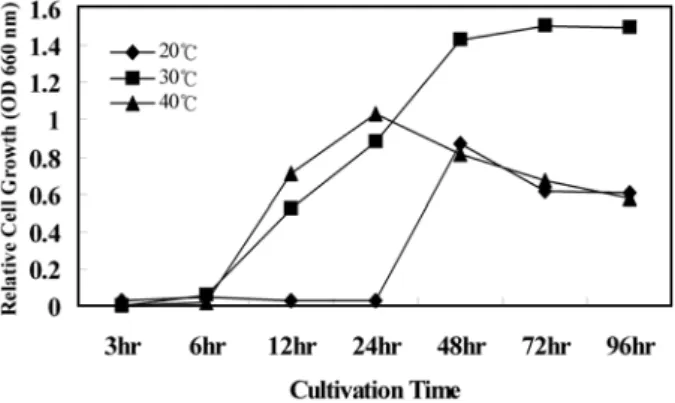
Bacillus sp. ST-63은 초기 배양온도가 20
oC에서 약 10시간의 유도기를 거친 후, 대수기로 접어들어 24시간대에 가장 높은 미생물 성장을 보였으며, 24시간 이후에는 정체기를 거쳐 사 멸기에 접어드는 것으로 나타났다. 하지만, 30
oC와 40
oC의 경 우 유도기가 30
oC의 경우 6시간 지속된 반면, 40
oC배양의 경우 이보다 짧은 3시간으로 나타났다. 대수증식기의 경우 20
oC배 양에서는 24시간대에 가장 높은 증식을 보인 후, 바로 정체기 와 사멸기를 거친 것으로 나타난 반면, 30
oC배양의 경우, 30시 간대에 최대의 증식을 보였으며, 40
oC배양의 경우 다른 온도 의 배양보다는 더욱 빠른 대수기를 진행하였으나, 결론적으로 최대 증식량은 30
oC배양보다 떨어지고 대수기는 길게 나타났 다(Fig. 4).
Pseudoalteromonas sp. ST-140은 배양온도가 20
oC의 경우 36 시간의 유도기를 거친 후 대수기로 접어들어 48시간대에 최대 증식량을 보인 후 바로 정체기 없이 사멸기로 접어들었다.
30
oC배양의 경우, 6시간의 유도기를 거친후 대수증식기로 접어들고 48시간대에 최대 증식량을 보였다. 반면, 40
oC배양 의 경우 30
oC배양과 비슷한 시간대에 대수증식기에 접어들었 으나 최대 증식량은 30
oC배양에 비하여 현저히 낮은 증식량을 보였다(Fig. 5).
분리균주 Bacillus sp. ST-63과 Pseudoalteromonas sp. ST-140 의 각각의 온도별 증식 속도 및 증식에 따른 효소활성의 변화 를 Fig, 6~7에 나타내었다.
균주 Bacillus sp. ST-63의 경우 Fig. 6와 같이 20
oC와 30
oC배 양에서는 시간의 흐름에 따라 amylase 활성이 시간이 흐름에 따라 점차적으로 증가하는 양상을 나타내었으나, 40
oC의 경우 최초 3시간에도 amylase 활성이 나타남을 확인 할 수 있었다.
이는 Bacillus sp. ST-63균주의 40
oC배양의 경우 유도기가 거의 없이 바로 대수 증식기로 접어드는 양상을 보였기 때문인 것 으로 사료된다. 또한 전체적으로 배양온도에 따라서 20~40
oC
Fig. 4. Effect of temperature in marine broth medium on the cell growth of strain Bacillus sp. ST-63.
Fig. 5. Effect of temperature in marine broth medium on the cell growth of strain Pseudoalteromonas sp. ST-140.
Fig. 6. Effect of temperature on bacterial growth and activity Bacillus sp. ST-63 produced enzyme by the 96 hours culture in marine broth.
Fig. 7. Effect of temperature on bacterial growth and activity
Pseudoalteromonas sp. ST-140 produced enzyme by the
96 hours culture in marine broth.모든 실험구에서 24시간 배양 후, 최대 효소활성을 보였으며,
배양일수가 길어져도 효소활성이 거의 떨어지지 않는 것으로
확인되어, 본 균주가 온도에 대한 효소활성에 크게 민감하게
작용하지는 않는 것으로 사료 된다(Fig. 6). 그리고 균주가 배
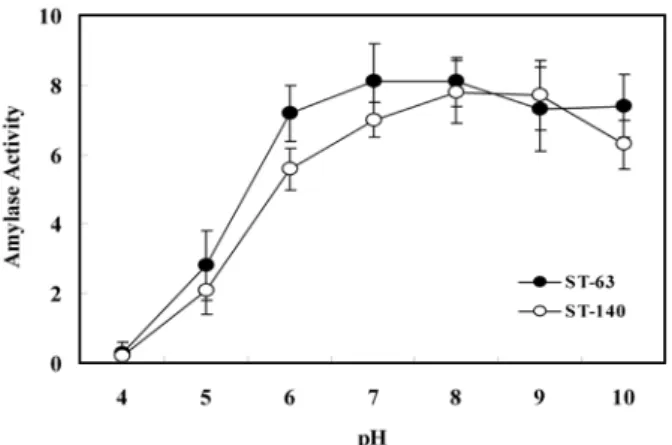
지의 초기 pH에 따른 효소활성을 조사하기 위하여 pH 4~10
범위의 배지를 사용하여 조사하였다(Fig. 8). 초기 pH 4인 배
지에서는 균체의 증식을 관찰 할 수 없었으며, pH 6인 배지
Fig. 8. Effect of pH of medium at the beginning of the culture on amylase activity of Bacillus sp. ST-63 and
Pseudoalteromonas sp. ST-140.
에서부터 왕성하게 증식이 이루어져 pH 7배지에서 가장 높은 효소활성을 보였다.
또한 균주 Pseudoalteromonas sp. ST-140의 경우 20
oC와 40
oC배양의 경우 시간의 흐름에 따라 amylase 활성의 차이는 있었으나, 활성의 점진적으로 증가하는 양상을 보인 반면, 30
oC배양의 경우 12시간 까지는 효소활성의 거의 없다가 24시 간대에 들면서 급격한 효소활성을 보이면서 96시간까지 지속 적인 높은 활성을 보였다. 이는 대수증식기를 거쳐 최대 증식 시간과 비슷한 양상으로 증가함을 확인 할 수 있었다. 그리고 모든 실험구에서 배양시간 24시간을 기준으로 효소활성이 증 가하는 것을 보였으며, 30
oC와40
oC 실험구에서는 배양 시간 96시간에도 높은 효소활성을 보이는 것으로 나타났다(Fig. 7).
그리고 Pseudoalteromonas sp. ST-140 균주 또한 배지의 초기 pH에 따른 효소활성을 조사하기 위하여 pH 4~10 범위의 배 지를 사용하여 조사하였으며(Fig. 8), 초기 pH 4인 배지에서는 균체의 증식 및 효소활성을 거의 관찰 할 수 없었으며, pH 6인 배지에서부터 왕성하게 증식이 이루어져 pH 8배지에서 가장 높은 효소활성을 보였다.
요 약
제주도 양식장 배출수 퇴적층에서 다당 분해효소를 생산하 는 세균을 분리되었으며, 각각 ST-63, ST-140라고 명명하였다.
분리균주 ST-63의 16S rDNA의 염기서열 분석 결과 Bacillus amyloliquefaciens와 Bacillus velezensis의 염기서열과 99%의 상 동성을 보였으며, BIOLOG를 이용한 생화학적 분석에서도 Bacillus amyloliquefaciens와 가장 유사한 특성을 보여 최종적으 로 분리균주 ST-63을 Bacillus sp. ST-63으로 명명하였다. 또한 분리균주 ST-140의 16S rDNA의 염기서열 분석 결과 Pseudoalteromonas marina와 Pseudoalteromonas agarivorans의 염기서열과 99%의 상동성을 보였으며, BIOLOG를 이용한 생 화학적 분석에서도 Pseudoalteromonas 종과 유사한 특성을
보여 최종적으로 분리균주 ST-140을 Pseudoalteromonas sp.
ST-140이라고 명명하였다. 다당 분해효소 생산 균주인 Bacillus sp. ST-63과 Pseudoalteromonas sp. ST-140의 증식을 위한 최적 배양온도를 확인하고 증식온도에 따른 다당 분해효소 활성의 변화를 조사하였다. 그 결과 균주 Bacillus sp. ST-63는 20
oC 및 40
oC 배양실험구 보다 30
oC 배양실험구에서 가장 높은 균 생육도를 보였으며, 효소활성에 대한 영향을 확인해본 결과 20~40
oC 모든 실험구에서 24시간 이후 매우 높은 활성을 보 이는 것으로 나타나서 본 균주는 효소활성의 생산에 있어서 온도에 매우 민감하게 작용하지 않는 것으로 나타났다. 또한 Pseudoalteromonas sp. ST-140 균주는 20
oC 및 40
oC 배양실험구 보다 30
oC 배양실험구에서 가장 높은 균 생육도를 보였으며, 효소활성에 대한 영향을 확인해본 결과 20~40
oC 배양실험구 모두에서 24시간을 기준으로 효소활성이 계속적으로 증가하 였으며, 30
oC와 40
oC 배양 실험구에서는 배양 시간 96시간에 도 높은 효소활성을 보이는 것으로 나타났다. 그리고 분리균 주가 배지의 초기 pH에 따른 효소활성의 변화를 확인하기 위 하여 pH 4~10 범위의 배지를 사용하여 조사하였다. 그 결과 Bacillus sp. ST-63과 Pseudoalteromonas sp. ST-140 균주 모두다 비슷한 결과를 보였으며, pH 6을 기준으로 효소활성이 급격히 증가하다가 7~8에서 최고 활성을 보였다. 차후 분리균주의 효소생산을 위한 최적배양조건 및 물질분리 방법을 통하여 미생물 유래의 효과적인 효소를 생산하는 기술을 개발할 수 있을 것으로 사료된다.
감사의 글
본 연구는 2006년도 제주지역환경기술개발센터의 연구개 발사업의 연구비 지원으로 수행되었으며, 이에 감사드립니다.
References
1. Folmar, L. C. 1993. Effects of chemical contaminants on blood chemistry of teleost fish: A bibliography and synopsis of selected effects. Environ. Toxicol. Chem. 12, 337-375.
2. Gerrenwood, C. F. and E. A. Milne. 1965. In Advances in
Carbohydrate Chemistry. M. L. Wolform, Academic Press, N.
Y.
3. John, R. and Dexter French. 1963. arch. Biochem. Biophys.,
100, 451.
4. John, R. Whitaker. 1972. Principles of Enzymology for the Food
Science. pp. 442, Marccel Dekker Inc. N. Y.
5. Kim, J. K. 1999. Characterization of denitrifying photo- synthetic bacteria isolated from photosynthetic sludge.
Aquacult. Eng. 19, 179-193.
6. Kim, S. K., I. S. Kong, J. K. Seo, B. J. Kim, M. G. Lee, and K. H. Suh. 1997. Removal of total ammonia-nitrogen(TAN) using immobilized nitrifier consortium. Kor. J. Biotechnol.
Bioeng. 12, 543-549.
7. Kobayashi, M. 1972. Utilization of photosynthetic bacteria.
Proc. IV. Internal. Ferment. Sympo. 527-531.
8. Kumar, S., K. Tamura, and M. Nei. 2004. Mega 3: Integrated software for molecular evolutionary genetics analysis and sequence alignment. Brief Bioinformatics. 5, 150-163.
9. Kung, J. T., V. M. Hanraan, and M. L. Caldwell. 1953. J.
AM. Chem. Soc. 75, 5548.
10. McDonald, D. G. and C. L. Milligan. 1992. Chemical proper- ties of the blood, pp. 55-133, In Hoar, W. S., D. J. Randall, and A. P. Farrell (eds.), Fish Physiology Academic Press Inc., San Diego.
11. Miler, G. L. 1959. Use of dinitrosalicylic acid reagent for
determination of reducing sugar. Anal. Chem. 31, 426.
12. Moon, S. W., J. B. Lee, Y. D. Lee, S. J. Kim, B. J. Kang, and Y. B. Go. 2002. Recycling marine fish farm effluent by microorganisms. J. Aquaculture 15, 261-266.
13. Noble, L. D. and J. A. Gow. 1998. The effect of suspending solution supplemented with marine cations on the oxida- tion of Biolog GNMicroPlate substrates by Vibrionaceae bacteria. Can. J. Microbiol. 44, 251.258.
14. Wayne, W. 1965. Umbreit, Advances in Applied Microbiology.
pp. 273, 7th eds., Academic Press Inc., N. Y.
15. Whwlan. 1965. In Methods in Carbohydrate Chemistry. pp. 252, 4th eds., Whistler.