Effects of Dietary Probiotics as an Alternative to Antibiotics on Growth Performance, Biochemical Characteristics and Immune Response in Weaning Pigs
Sang-Bum Lee
1,2†, Jae-Sung Lee
2†, Tao Wang
3, Min-Jeong Kim
2, Woo-Suk Jung
2, Seung-Woo Jeon
2, Yun-Jeong Park
2, Teak-Soon Shin
1, Sang-Hong Park
4and Hong-Gu Lee
2*
1
Department of Animal Science, Pusan National University, Miryang 627-700, Korea
2
Department of Animal Science and Technology, College of Animal Bioscience and Technology, Konkuk University, Seoul 143-701, Korea
3
College of Animal Science and Technology, Jilin Agricultural University, Changchun, 130118, P. R, China
4
Myeongryun Co. Ltd., Busan 607-010, Korea
Received January 13, 2014 /Revised April 17, 2014 /Accepted April 21, 2014
We evaluated the growth performance, biochemical characteristics, and immune responses in weaning pigs given a diet containing MR-1 (0.2%/feed) or antibiotics (0.1%/feed) for 45 days. In vitro study showed that MR-1 has antibacterial activity against a variety of strains of pathogenic bacteria, espe- cially a strain of cattle-derived Escherichia coli K99 (E. coli K99) by agar diffusion assay. In the in vivo model, 0.2% MR-1-given group clearly ameliorated the weight gain and feed efficiency in the growth performance of weaning pigs compared to the basal diet group (p<0.05). Additionally, 0.2% MR-1 in- duced an elevation in the levels of mean corpuscular hemoglobin (MCH) and mean corpuscular he- moglobin concentration (MCHC) and showed a similar pattern (TNFα and IFNγ production) to the antibiotic treated pigs. Taken together, we suggest that 0.2% MR-1 makes probiotics an alternative to antibiotics in weaning pigs.
Key words : Antibacterial activity, biochemical characteristics, cytokine production, probiotics, weaning pigs
†Authors contributed equally.
*Corresponding author
*Tel : +82-2-450-0523, Fax : +82-2-455-1044
*E-mail : [email protected]
This is an Open-Access article distributed under the terms of the Creative Commons Attribution Non-Commercial License (http://creativecommons.org/licenses/by-nc/3.0) which permits unrestricted non-commercial use, distribution, and reproduction in any medium, provided the original work is properly cited.
Journal of Life Science 2014 Vol. 24. No. 4. 352~360 DOI : http://dx.doi.org/10.5352/JLS.2014.24.4.352
서 론
현재 우리나라의 양돈 산업은 2006년 말부터 이어진 국제 원료 사료가격의 상승과 더불어 양돈 선진국인 덴마크 , 네덜 란드 , 프랑스 등 EU (2011) 및 미국(2010) 등과 FTA를 체결하 면서 무한 경쟁구도에 직면해 있다 . 현재 우리나라 MSY (Market pig per Sow per Year, 모돈1마리당 년 간 돼지 판매 두수 )는 2009년 15.2두로 유럽 선진 축산국의 약 59% 수준(네 덜란드 26두, 덴마크 25.6두)으로 낮은 실정이다[42]. 이렇게 MSY가 양돈 선진국에 비해 낮은 이유는 질병 및 열악한 사육 환경 등에 의한 폐사율이 높기 때문인 것으로 알려져 있으며 [32], 현재 국내 양돈 농가의 평균 포유자돈 폐사율은 11.1%으 로 나타났다 [33]. 그러므로 포유자돈의 폐사율을 감소시키는 것은 국내 양돈농가들의 수익성 개선은 물론 생산성 향상을
통한 국내 양돈산업의 경쟁력 확보를 위해 매우 중요한 과제 이다 .
항생제는 병원균을 억제하기 위하여 의학 및 수의학적 목적
으로 개발되었으나 , 많은 연구자들에 의해 가축의 질병 예방
효과뿐만 아니라 , 성장촉진[41] 및 사료효율[24] 등 생산성 또
한 개선시키는 효과가 있다는 것이 검증되면서 1940년대 중반
부터 1960년대까지 축산업에 있어서 성장촉진용 항생제인
AGPs (Antibiotic Growth Promoters)의 사용은 급속도로 확
산되었다 . 하지만 축산물의 항생제 잔류 및 전이[38]와 항생제
에 내성 [4, 11, 55]을 가진 슈퍼박테리아의 등장 등 여러 문제점
이 대두되면서 전 세계적으로 AGPs의 규제가 강화되었다. EU
(유럽연합)는 2006년부터 AGPs의 사용을 수의사 처방에 의한
경우를 제외하고 전면 금지시켰으며 , 국내에서 또한 세계의
흐름과 소비자의 요구에 맞춰 2011년부터 가축의 사료 내
AGPs의 사용을 전면 금지시켰다. 사료 내 AGPs의 사용이 금
지됨에 따라 예상되는 문제점은 소화기질병 발생 증가와 출하
일령 지연 등이 있는데 , 특히 소화기질병은 이유 자돈의 경우
이유 시 모돈으로부터 격리됨으로써 오는 환경의 변화와 고형
물 사료 등으로 인해 설사발생으로 이어져 면역력이 약한 개
체일수록 발육정체 및 폐사율이 증가하게 된다 . 이러한 문제
점을 해결하기 위해서 항생제 대체제로 국내에서는 생균제
[22], 효소제[25], 유기산제[61], 식물추출물[30], Prebiotics
[26], Bacteriophage [60] 등 많은 물질이 연구되고 있는데, 그 중 생균제에 관한 연구는 세계적으로 오랜 기간 진행되어 왔 으며 [12, 36, 47], 각광받고 있다. Fuller [12]는 생균제를 장내 미생물의 균형을 개선함으로써 숙주에 유익한 작용을 하는 미생물 사료첨가제라고 하였고 , Havenaar과 Huis in’t Veld [15]는 생균제의 사용이 인간 또는 가축의 장내 미생물총의 특성을 개선하여 숙주에 유익한 작용을 하는 단독 또는 혼합 된 살아있는 배양균이라 정의하였다 . 생균제는 돼지에서 장내 E. coli 억제 및 유산균 수 증가[54], 이유자돈 설사 예방[34, 35], 육성돈의 칼슘 흡수량 증가[43], 성장률과 사료효율 개선 [6, 14, 44], 면역 능력 향상[10] 등에도 효과가 있는 것으로 보고되고 있다 .
현재 국내에서도 다양한 생균제가 개발 , 보급되어 사용되고 있는데 , 사료회사뿐만 아니라 일반 양돈농가에서 사용하고 있 는 생균제의 종류 및 첨가 수준도 매우 다양한 실정이다 [22].
또한 현재까지의 생균제에 관한 대부분의 연구들은 주로 돼지 의 성장 , 영양소 이용률, 설사 및 폐사 지수 등 생산적인 측면 에서 연구가 진행되어왔으며 , 미생물의 작용 기전 또한 각각 달라 효과적인 생균제에 대한 정확한 규명이 되지 않았다 .
따라서 본 연구는 이유자돈의 성장기 면역력을 증강시키는 항생제 대체 물질을 개발하기 위한 방안의 일환으로 목장토에 서 자체 분리 동정한 19종의 복합 미생물로 구성된 혼합생균 제 (MR-1)를 축 종별 병원성 미생물에 대한 항균력을 확인한 후 돼지 사료에 첨가시켜 돼지의 생산성 및 혈액 내 생화학적 조성 그리고 면역 반응 조사를 실시하여 산업적인 이용방안을 제시코자 하였다 .
재료 및 방법
공시동물 및 시험장소
본 연구에서는 38일령 이유자돈([Landrace × Yorkshire] × Duroc) 69두(10.1±0.12)를 사용하였으며, 23두씩하여 3개 돈 방에 임의로 배치하였다 . 시험장소는 경상남도 김해에 소재하 는 P농장에서 실시하였다.
혼합 미생물(MR-1)의 준비 및 기초사료
본 연구에 이용한 미생물은 목장토에서 자체 분리 동정한 19종(Micrococcus luteus; MR-WR, Acetobacter Pasteurianus;
MR-R1, Acetobacter sp.; MR-R2, Corynebacterium imitans;
MR-L1, Bacillus subtilis; MR-L2, Gluconobacter cerinus; MR-C1, Lysinibacillus fusiformis nov.; MR-C2, Sphingomonas sp. Novel;
MR-HR1, Pseudomonas saccharophila; MR-HR2, Methylobacte- rium sp.; MR-HR3, Mesorhizobium sp.; MR-HR4, Burkholderia gladioli; MR-OS1, Bacillus subtilis; MR-OS2, Sporolactobacillus nakayamae; MR-O2, Lactobacillus plantarum; MR-O3, Bacillus racemilactius; MR-O4, Pichia sp.; MR-CD1, Bacillus sp.;
MR-CD3, Lactobacillus casei; MR-CD)을 이용하였으며, MR-1 제조 공정은 배양 및 준비과정을 거쳐 탈지미강 (defatted rice bran)에 H
2O와 19종 균 주를 1:1비율로 혼합하여 분사, 교반, 숙성 , 건조 과정을 거쳐 포장한 제품을 이용하였다. 기초사료 는 NRC의 요구수준으로 배합된 Crude protein 18.0%, Crude fat 6.0%, Crude ash 10.0%, Crude fiber 5.0%, P 1.0%, Ca 0.7%, Lysine 1.35% 그리고 ADE (Apparent Digestible Energy) 3.6%, DCP (Digestible Crude Protein) 15.0%인 사료를 시험 전 기간 동안 급여시켰다 .
시험설계 및 사양기준
38일령 이유자돈 69두를 처리구 당 23두씩 체중이 유사하도 록 배치한 후 실험에 이용하였다 . 각 처리구별 사료급여 기준 은 1) C (basal diet; No-Antibiotics), 2) T1 (Antibiotics;
Tiamulin 0.1%/feed), 3) T2 (No-Antibiotics + MR-1 0.2%/
feed)로 설계하여 45일 동안 급여시켰다. 시험기간 동안 처리 별 사료와 물은 자유채식토록 하였다 .
조사 항목 및 실험방법
축 종별 병원성 미생물에 대한 항균효과 검사 축 종별 병원성 미생물 (Escherichia coli K88: K88, Escherichia coli K99: K99, Salmonella Typhimurium: ST)에 대한 MR-1의 항균효과를 검증하기 위하여 구축된 agar diffusion assay방법 을 이용하여 최종 혼합 미생물을 선정하였다 . K88 균의 경우 돼지에서 이유기의 자돈에서 설사를 일으키는 가장 중요한 원인 균이며 [39,40], K99 균은 송아지에서 설사를 일으키는 다 양한 병원체 중 항원형 K를 표현하는 균이다[8]. 그리고 ST의 경우 감염 및 발병 대상에 대한 특이성이 없이 사람과 동물 모두에서 식중독이나 만성 장염을 일으키는 균으로 알려져 있다 [7]. Agar diffusion assay 방법은 다음과 같다. Petri-dish (90×15 mm)에 MRS agar (BD Difco, USA) 20 ml를 먼저 분주 하여 bottom agar를 형성시킨 후 tryptic soy broth (TSB; BD Difco, USA)와 0.7% agarose (Certified Molecular Biology Agarose, Bio-Rad Laboratories, Spain)의 혼합액 3 ml를 제조 한 후 병원균 희석액 (K88, K99, ST: 10
-3) 50 ul를 넣고 bottom agar 위에 분주하여 굳혔다. 굳힌 후 plate 3부분에 well을 소 독된 cork bore로 뚫고 MR-1을 40 ul 분주시켰다. 분주 후 37℃ (24 hr)에서 배양 후 clear zone의 직경을 측정하였다.
측정된 clear zone의 직경은 0 mm (-; 항균효과 없음), 15 mm
> (+; 약한 항균효과), 15~25 mm (++; 보통 항균효과), 26~35
mm (+++; 강한 항균효과), 35 mm < (++++; 아주 강한 항균효
과 )으로 표현하였다. 본 MR-1의 항균효과를 검증하기 위해
사용된 병원성 미생물의 종류와 특성에 관한 정보는 Table 1
에서 나타내었다 .
Table 1. Strain and property of pathogenic bacteria
Strain Property
Escherichia coli
K88Escherichia coli
K99Salmonella
Typhimurium
(ST)Porcine / diarrhea (
E. coli
) Cattle (calf) / diarrhea (E. coli
) Chicken, porcine /diarrhea (typhoid)
일 당 증체량, 사료섭취량 및 사료요구율
체중은 시험개시 (0)와 45일에 조사하였으며, 일 당 증체량 (weight gain)은 15일간의 증체량을 1일로 나누어 1두 당 1일 증체량 (Dairy weight gain)으로 표시하였다. 일 당 사료섭취량 (Feed intake)은 사료 총 급여량에서 잔량을 제하여 총 섭취량 을 구하고 사육 두수로 나누어 1두 당 증체량으로 표시하였으 며 , 15일을 나누어 1두 당 1일 사료섭취량(Dairy feed intake) 로 표시하였다 . 사료효율(Gain / Feed)은 일 당 증체량을 일 당 사료섭취량으로 나누어 계산하였으며 , 사료요구율(Feed / Gain)은 일 당 사료섭취량을 일 당 증체량으로 나누어 계산하 였다 .
혈액 생화학적 분석
혈액 생화학적 분석은 실험 개시 후 15일과 30일에 이유자 돈의 경정맥에서 채혈하여 EDTA 튜브(BD vacutainer, BD Franklin, USA)에 보관한 혈액을 이용하여 분석하였다. 4℃
하에 EDTA튜브에 보관된 혈액은 자동혈액분석기(ACT-Diff, Beckman-Coulter, USA)를 이용하여 WBC (백혈구; white blood cells), RBC (적혈구; red blood cells), HGB (혈색소; he- moglobin concentration), HCT (헤마토크리트; hematocrit), MCV (평균적혈구용적; mean corpuscular volume), MCH (평 균혈구혈색소량 ; mean corpuscular hemoglobin), MCHC (평 균혈구혈색소농도 ; mean corpuscular hemoglobin concen- tration), PLT (혈소판; platelet)를 측정하였다.
혈장 내 cytokine production의 농도 측정
Cytokine production의 농도 분석은 실험 개시 후 20일에 각 그룹으로부터 채혈한 혈액 내 혈장을 이용하였다 . 이유자 돈 경정맥에서 채혈한 혈액 sample (5 ml)을 EDTA 튜브에 옮겨 담은 후 원심분리 (3,500 rpm, 15 min)하여 혈장을 얻었으 며 , clean bench하에서 혈장을 1.5 ml 튜브에 옮겨 담고 cyto- kine production (TNFα: Tumor Necrosis Factor-alpha, IFNγ:
Interferon gamma) 분석을 하기 전까지 -80℃에 보관하였다.
혈장 내 TNFα와 IFNγ의 cytokine production 농도는 ELISA kit (Abcam plc., Cambridge, MA, USA)내 Instruction’s guide 에 따라 측정하였다 .
통계 분석
시험 및 분석 등을 통해서 얻어진 성적들은 SPSS 14.0K의 ANOVA Procedure로 분산분석을 실시하고, Duncan New
Multiple Range Test를 이용하여 유의성 검정을 실시하였으 며 , 처리구간의 비교는 Student’s t-test를 이용하였다. 이 때 유의수준은 p<0.05일 때 유의성이 있다고 판단하였다.
결과 및 고찰
축 종별 병원성 미생물에 대한 항균효과 검사
축 종별 병원성 미생물 (K88, K99, ST)에 대한 MR-1의 항균 효과 결과는 Table 2에서 나타내었다. 목장토에서 자체 분리 동정한 각 19종에 대한 축 종별 병원성 미생물의 항균 효과는 E. coli K88 균에서 8종류의 균 종(MR-WR, MR-R1, MR-R2, MR-C1, MR-HR2, MR-HR3, MR-CD3, MR-CD4)에서 약한 항 균효과 (+)만을 나타내었으며, E. coli K99 균에서는 2종류의 균 종 (MR-L2, MR-O4)에서 약한 항균효과(+), 9종류의 균 종 (MR-R1, MR-R2, MR-C1, MR-C2, MR-OS2, MR-O3, MR-CD1, MR-CD3, MR-CD4)에서 보통 항균효과(++) 그리고 6종류의 균 종 (MR-HR1, MR-HR2, MR-HR3, MR-HR4, MR-OS1, MR-O2)에서 강한 항균효과(+++)를 나타내었다. 그리고 S.
Typhimurium 균에서는 1 종류의 균 종(MR-HR3)에서 약한 항 균효과 (+), 2종류의 균 종(MR-HR2, MR-HR4)에서 보통 항균 효과 (++)를 나타내었다. Bacillus 속은 다양한 종류의 peptide 계 항균물질을 분비하여 넓은 범위의 항균효과를 가지고 있으 며 [19], Bactericin (항균물질)이나 bacteriocin-like substances (BLS)를 생산하는 Bacillus속으로는 B. subtilis, B. coagulans, B. cereus, B. thuringiensia, B. megaterium등에 관한 보고들이 있다 [56]. 19종의 혼합 배양액(Mix)의 경우 E. coli K88 균에서 는 약한 항균효과 (+), E. coli K99균에 대해서는 강한 항균효과 (+++), S. Typhimurium 균에서는 보통 항균효과(++)를 나타내 어 결과적으로는 단독 균주인 MR-HR2와 동일한 항균효과를 나타내었다 . 하지만 in vivo 연구일 경우 단일 균주보다 혼합 미생물을 이용하였을 때 일당증체량 및 사료효율 등 생산성 효과가 크다는 연구가 많으며 [17, 20, 28, 46], 이러한 이유는 일반적으로 건강한 동물의 소화기에는 혐기성 세균이 우점하 고 있으며 , 소화기 상부에는 L. acidophilus, 중부에는 B. subtilis, 하부에는 S. faecium이 정착하기 알맞게 되어있으므로 이를 고려하여 혼합 미생물제를 사용하면 그 효과를 증진시킬 수 있다고 하였다 [45]. 최종적으로 19 종의 혼합 배양액을 제품으 로 생산된 혼합 미생물 제제 MR-1의 경우 E. coli K88와 S.
Typhimurium균에서는 약한 항균효과(+)를 나타내었으며, E.
coli K99균에 대해서는 아주 강한 항균효과(++++)를 나타내 는 것으로 나타났다 .
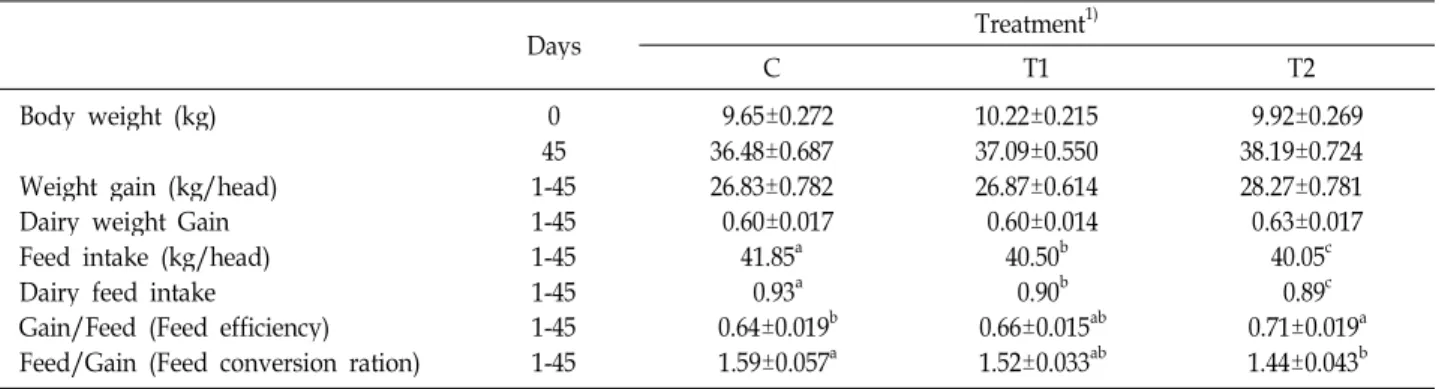
일 당 증체량, 일 당 사료섭취량 및 사료요구율
이유자돈에 있어서 MR-1의 사료 내 첨가가 일 당 증체량,
일 당 사료섭취량 및 사료요구율에 미치는 영향에 대한 결과
는 Table 3에 표기하였다. 일 당 증체량의 경우 MR-1를 사료
Table 2. Antibacterial activity of MR-1 against pathogenic bacteria by agar diffusion assay
Strain Pathogenic bacteria
E. coli
K88E. coli
K99S. Typhimurium Micrococcus luteus
MR-WRAcetobacter pasteurianus
MR-R1Acetobacter sp.
MR-R2Corynebacterium imitans
MR-L1Bacillus subtilis
MR-L2Gluconobacter cerinus
MR-C1Lysinibacillus fusiformis nov.
MR-C2Sphingomonas sp. Novel
MR-HR1Pseudomonas saccharophila
MR-HR2Methylobacterium sp.
MR-HR3Mesorhizobium sp.
MR-HR4Bukholderia gladioli
MR-OS1Bacillus subtilis
MR-OS2Sporolactobacillus nakayamae
MR-O2Lactobacillus plantarum
MR-O3Bacillus racemilactius
MR-O4Pichia sp.
MR-CD1Bacillus sp.
MR-CD3Lactobacillus casei
MR-CD4+ ++ - +- -- ++ -- - -- -- ++
- ++++
- +++ +++++
++++++
++++++
++
+++++
+++ ++++
- -- - -- -- +++ ++- - -- -- --
Mix + +++ ++
MR-1 + ++++ +
1)Growth inhibition size of clear zone; -, not detected; +, smaller than 15 mm; ++, 15~25 mm; +++, 26~35 mm; ++++, large than 35mm.
Table 3. Effects of dietary MR-1 on the growth performance in weanling piglets
Days Treatment1)
C T1 T2
Body weight (kg) Weight gain (kg/head) Dairy weight Gain Feed intake (kg/head) Dairy feed intake
Gain/Feed (Feed efficiency) Feed/Gain (Feed conversion ration)
450 1-451-45 1-451-45 1-45 1-45
9.65±0.272 36.48±0.687 26.83±0.782 0.60±0.017
41.85a 0.93a 0.64±0.019b 1.59±0.057a
10.22±0.215 37.09±0.550 26.87±0.614 0.60±0.014
40.50b 0.90b 0.66±0.015ab 1.52±0.033ab
9.92±0.269 38.19±0.724 28.27±0.781 0.63±0.017
40.05c 0.89c 0.71±0.019a 1.44±0.043b Values were expressed as mean ± SEs (n=23).
a,b,c,dMeans with different superscripts in the same row significantly differ (
p
<0.05).1)C, basal diet; T1, Antibiotics 0.1%, T2, MR-1 0.2%.
내 첨가함에 있어서 대조구와 항생제구에 비해 유의하게 영향 을 주지 않았으나 , 다른 처리구에 비해 일당 증체량이 30 g 증가된 것으로 나타났다 . 그리고 일 당 사료섭취량의 경우 항 생제구와 MR-1구에서 대조구 대비 유의하게 감소한 것으로 나타났다 (p<0.05). 결과적으로 사료효율과 사료요구율에 있어 서 MR-1구는 항생제구와는 유의적인 차이가 없었으나, MR-1 구는 대조구와 비교하여 유의하게 개선된 것으로 나타났다 (p<0.05). 일반적으로 가축에 있어서 생균제 급여 시 유기산, 항생물질 , 소화효소, 비타민 등의 유익한 대사산물의 생성[16]
과 사료의 소화촉진 [5, 48], 영양소 흡수촉진[63] 등 영양적인 효과가 있으며 , 본 in vivo실험에서는 모든 처리구에서 설사증 세가 나타나지 않아 특별히 확인할 순 없었으나 , 항균물질 생 성으로 장내 부패균 및 유해균의 증식 억제 [27], 유익균의 증식 촉진 [62]으로 인해 설사 예방 등 살균효과가 있는 것으로 보고 되었다 .
특히 Bifidobacteria, Latobacillus, Bacillus 및 Yeast는 가축의
성장을 증진시킨다고 하였는데 [1, 2, 3, 9, 37], Smith와 Jones
[54]는 돼지에 있어서 유산균의 급여는 결과적으로 장내 E.
Table 4. Effects of dietary MR-1 on biochemical analysis of blood collected from weanling piglets
Days Treatment1)
C T1 T2
WBC (103/ul) 0
AVG45
20.62±2.456 22.90±2.843 21.38±1.854
16.41±2.663 27.70±1.941 19.73±2.318
17.93±0.593 29.32±1.954 21.73±1.604
RBC (106/ul) 0
45 AVG
6.75±0.087 6.52±0.648 6.68±0.210
6.31±0.223 7.57±0.216 6.68±0.220
6.59±0.175 7.27±0.204 6.82±0.156
HGB (g/dl) 0
45 AVG
9.55±0.166 10.26±0.871 9.79±0.304
9.01±0.413 11.28±0.231 9.68±0.392
9.79±0.247 11.62±0.263 10.40±0.293
HCT (%) 0
45 AVG
30.54±0.485 31.78±2.643 30.95±0.889
28.09±1.347 35.38±0.721 30.24±1.268
30.74±0.683 36.00±0.873 32.49±0.844
MCV (fl) 0
45 AVG
45.24±0.341ab 49.12±1.238 46.53±0.659ab
44.39±0.705b 46.84±1.112 45.11±0.640b
46.80±1.112a 49.64±1.573 47.75±0.946a
MCH (pg) 0
45 AVG
14.15±0.119 15.84±0.397 14.71±0.258ab
14.23±0.205 14.96±0.409 14.44±0.199a
14.91±0.423 16.00±0.523 15.27±0.349b
MCHC (g/dl) 0
45 AVG
31.24±0.143b 32.26±0.147 31.58±0.165b
32.09±0.099a 31.94±0.108 32.05±0.077a
31.85±0.160b 32.24±0.075 31.98±0.118a
PLT (103/ul) 0
45 AVG
431.80±40.486 64.75±39.552b 319.20±51.813
532.60±68.119 219.60±43.335a 428.27±61.013
533.25±22.383 183.00±46.934ab 416.50±53.769 Values were expressed as mean ± SEs (n=5).
a,b,cMeans with different superscripts in the same row significantly differ (
p
<0.05).1)C, basal diet; T1, Antibiotics 0.1%, T2, MR-1 0.2%.
coli 수가 감소하고, 유산균 수가 증가하여 성장률과 사료효율 이 개선되며 , 영양소 이용률이 증가된다고 하였다. Collington 등 [6]은 생균제가 이유자돈의 성장과 사료효율을 개선할 뿐만 아니라 lactase의 활성을 높인다고 하였으며, Newman 등[43]
은 Lactobacillus faecium은 lysine을 분비하여 lysine의 공급량 이 부족한 육성돈의 성장률을 개선시키며 , 건강한 돼지에게 Lactobacillus를 급여하면 칼슘의 흡수량이 증가된다고 하였다.
따라서 본 연구결과는 이유자돈에 혼합 미생물 제제인 MR-1을 사료 내 첨가함으로써 유익한 대사산물의 생성과 더 불어 장내 병원성 미생물 감소 및 유익균 증가에 따른 사료의 소화촉진 및 영양소 흡수 촉진이 진행되었으며 , 결과적으로 사료효율을 개선시킨 것으로 판단된다 .
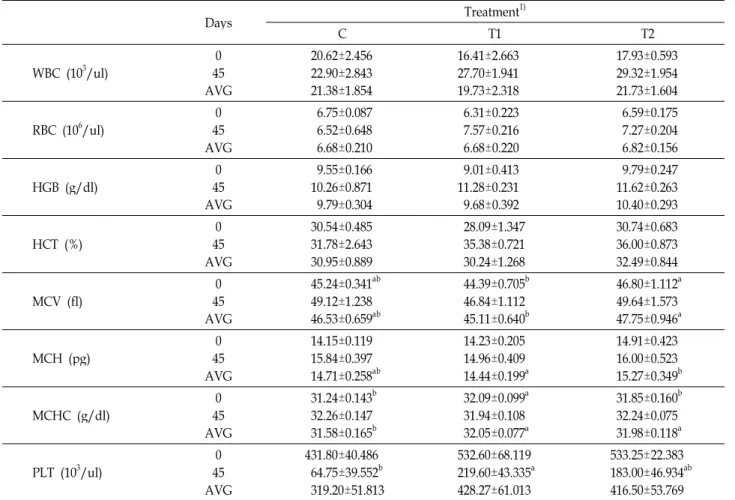
혈액 생화학적 분석
혈액학 분석결과 MR-1구에서 다른 처리구보다 시험개시전 보다 WBC (백혈구)의 증가가 가장 높은 것으로 확인되었으며, MCH (평균 혈구 헤모글로빈 량)농도와 MCHC (평균 혈구 헤모글로빈 농도 )농도가 각각 항생제 처리구와 대조구보다 유
의하게 증가하였다 (p<0.05). 이는 MR-1의 사료 내 첨가에 인하 여 면역과 깊은 관련성이 있는 백혈구 수치를 증가시켜 항병 력이 증가되는 결과를 가져왔을 것으로 예상된다 . 일반적으로 비병원성 물질인 생균제의 균체는 병변을 유도하지 않는 수준 에서 가축의 면역기능을 자극함으로써 장내 유해 세균에 대한 면역능력을 증강시켜주며 장기간에 걸친 생균제의 급여는 장 관 내 면역기능을 개선하는 효과가 있는 것으로 알려져 있다 . Jang 등[21]은 probiotics를 사료 내 첨가에 의해 백혈구의 활 성이 증가할 수 있다고 하였는데 , 이러한 이유는 probiotics에 의해 질병저항성에 중요한 역할을 하는 식세포 활성이 증가되 는 것과 연관이 있다고 하였다 .
혈장 내 cytokine production의 농도 측정
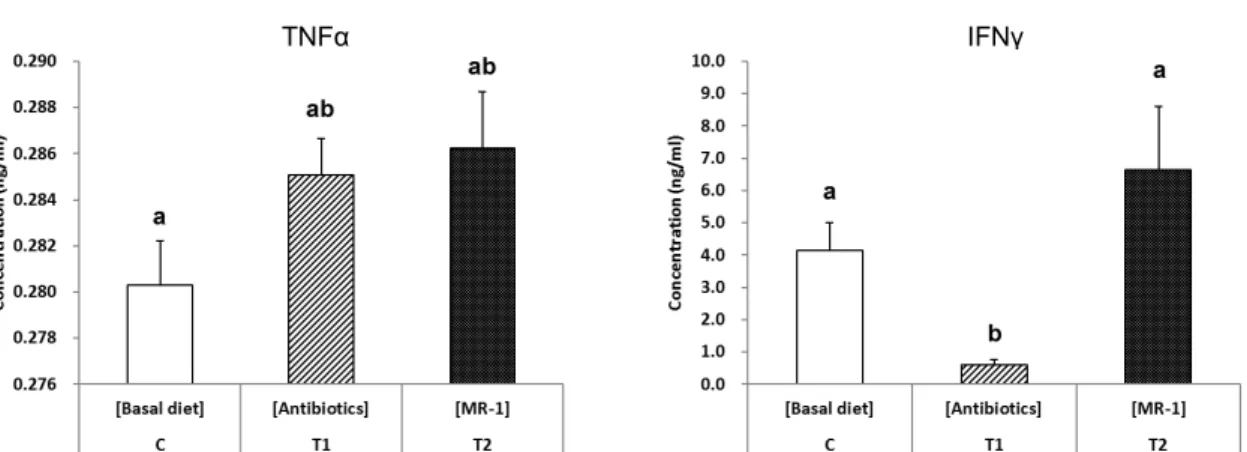
이유자돈에 있어서 MR-1의 사료 내 첨가가 혈장 내 cyto- kine production의 농도에 미치는 영향에 대한 결과는 Fig.
1에 제시하였다. 면역 세포의 조절에 의해 염증반응에 밀접한
연관이 있는 TNFα의 경우 처리구간의 유의한 차이는 나타나
지 않았다 . 하지만 인체에 바이러스가 침투해 오거나 암세포
TNFα IFNγ
Fig. 1. Changes in the production of TNFα and IFNγ in plasma of weanling piglets given diet containing MR-1. Values were expressed as mean ± SEM (n=6). a,b
p
<0.05, by Tukey HSD test가 생기면 그것을 저항하기 위해 생체 내의 세포들을 자극을 유도하는 물질인 IFNγ의 경우 대조구와 비교하여 MR-1구에 서는 변화가 나타나지 않았으나 , 항생제구에서는 IFNγ의 농도 가 유의하게 감소된 것으로 나타났다 (p<0.05). Sacha 등[50]의 논문에 의하면 진균 세팔로스포륨에서 얻어진 항생 물질인 cephalosporines 계열과 gentamicin, streptomycin 등이 포함 된 aminoglycosides 계열의 항생 물질은 쥐의 림프구 T에 의 해 IFNγ의 생산을 억제시켰다고 보고하였다. 이러한 항생제구 의 IFNγ production 수치의 감소 현상은 Tiamulin이라는 항생 제에 의해 장관 환경 내 내재성 박테리아들의 변화에 따른 항바이러스 인자 (INFγ)가 급속도로 감소한 것으로 사료된다.
결과적으로 이유자돈에 있어서 MR-1의 사료 내 첨가 급여는 생체에 있어서 어떠한 유해한 염증반응을 나타내지 않았으며 , 항생제구와 같이 항바이러스 인자를 감소시키는 현상은 나타 나지 않았다 .
일반적으로 probiotics 중 Lactobacillus의 경우 장관 및 비뇨 생식기의 미생물 균 총을 유지시키고 [51], 식품의 영양학적 가 치를 증진시키며 [49], 면역을 증강시키는 작용[23] 등의 유익 한 효과가 있는 것으로 보고되었다 . 그리고 이러한 면역 증강 작용은 Lactobacillus이 특이 및 비특이적 면역체계의 증강에 의해 숙주를 보호하는 역할을 한다고 한다 [13]. Kim 등[29]과 Kim 등[31]의 논문에 의하면 Lactobacillus에 의해 선천성 면역 계 (백혈구, 대식세포 탐식능 증가 및 NK세포 활성)와 후천성 면역계 (림프구 증식 및 항체생산 증가)의 증강작용 등 다양한 면역작용을 보이는 것으로 밝혀졌으며 , Shin 등의 연구에 의 하면 in vivo [52]와 in vitro [53] 상에서 또 다른 probiotics인 bifidobacteria의 세포벽 획분에 의해 장관면역 활성을 통한 골 수세포 증식활성이 보고되는 등 장관면역 활성화를 통한 전신 면역계 활성이 증명되었다고 하였다 . 그리고 Yeast의 세포벽 에서 추출한 고분자 다당류인 β-glucan은 바이러스 증식 억제 물질인 T-cell IFNγ 수준을 증진시킨다고 하였는데[59], 이러 한 긍정적인 효과는 숙주와 장내미생물의 상호작용이 항체생 산을 증가시키고 점막 임파조직 (GALT)을 발달시켜 전반적인
면역력을 높인다고 밝혔다 [18, 57, 58].
하지만 본 연구 결과에서는 아쉽게 혼합 미생물제제인 MR-1에서 면역 지표인 TNFα와 IFNγ의 변화에 의해 면역력을 높였다는 결과는 보여주지 못하였다 . 하지만 또 다른 한편으 로는 본 연구 결과를 통하여 항생제를 대체제로서는 우수한 역할을 할 수 있을 것으로 판단된다 . 본 연구에서 사용된 MR-1 은 축 종별 병원성 미생물에 대한 항균력이 뛰어났으며 , 대조 구와 비교하여 사료효율을 개선시켰다 . 그리고 또 다른 면역 지표인 WBC (백혈구)와 MCV (평균 적혈구 용적) 그리고 MCH (평균 혈구 혈색소)의 경우 항생제구보다 증가하였으며, MR-1는 항생제에 의한 IFNγ의 수치 감소현상을 나타내지 않 았다 . 그러므로 결과적으로 MR-1은 항생제 대체용 사료 첨가 제로서 개발 가능한 잠재력 물질임을 시사하고 있다 .
감사의 글
본 연구는 농림식품부의 농업기술개발사업 ((No. 61005-03- 3-SB310)과 ㈜명륜 지원에 의하여 수행되었으며, 이에 감사 드립니다 .
References
1. Abe, F., Ishibashi, N. and Shimamura, S. 1995. Effect of ad- ministration of bifidobacteria and lactic acid bacteria to new- born calves and piglets.
J Dairy Sci
78, 2838-2846.2. Alexopoulus, C., Georgoulakis, I. E., Tzivara, A., Govaris, A. and Kyriakis, S. C. 2004b. Field evaluation of the effect of a probiotic-containing
Bacillus licheniformis
andBacillus subtilis
spores on the health status, performance and carcass quality of grower and finisher pigs.J Vet Med A Physiol Clin Med
51, 306-312.3. lexopoulus, C., Georgoulakis, I. E., Tzivara, A., Kritas, S.
K., Siochu, A. and Kyriakis, S. C. 2004a. Field evaluation of the efficacy of a probiotic containing
Bacillus licheniformis
andBacillus subtilis
spores, on the health status and perform-ance of sows and their litters.
J Anim Physiol Anim Nutr
88, 381-392.4. Barnes, H. 1958. Regarding the southern limits of
Balanus balanoides
(L.).Oikos
9, 139-157.5. Bougon, M., Launay, M. and Le Menec, M. 1988. Influence d’un probiotique, I’Biocroissance, sur les performances des pondeuses.
Bull Inf St Exp Avicult Ploufragan
28, 110-115.6. Collington, G. K., Parker, D. S., Ellis, M. and Armstring, D. G. 1988. The influence of probings or tyrosine on growth of pigs and development the castro-intestial tract.
Anim Prod
46, 521.7. Cover, T. L. and Aber, R. C. 1989. Medical Progress.
Yersinia enterocolitica
.N Engl J Med
321. 16-21.8. Chon, S. K., Lee, H. K. and Kim, N. S. 2007. Detection of
Escherichia coli
(K99),Clostridium perfringens
andCryptospori- dium parvum
in Diarrhetic Feces of Korean Native Calves.J Vet Clin
24, 588-592.9. Danek, P., Novak, J., Semradova, H. and Diblikova, E. 1991.
Administration of the probiotics
Lactobacillus casei
CCM- 4160 to sows-its effects on piglet efficiency.Zivocisna Vryoba
36, 411-415.10. Dugas, B., Mercenier, A., Lenoir-Wijnkoop, I., Arnaud, C., Dugas, N. and Postaire, E. 1999. Immunity and probiotics.
Immunol Today
20, 387-390.11. Elliot, S. D. and Barnes, E. M. 1959. Changes in serological type and antibiotic resistance on Lancefield group D
strepto- cocci
in chickens receiving dietary chlortetracycline.J Gen Microbiol
20, 426-433.12. Fuller, R. 1989. Probiotics in man and animals.
J Appl Bacteriol
66, 365-378.13. Gill, H. S. 1998. Stimulation of immune system by lactic acid cultures.
Int Dairy J
8, 535-544.14. Han, I. K., Park, J. H., Lee, S. C., Yoo, M. I. and Kwon, K. 1982. Growth-stimulating effects of Salinomycin for growing-finishing swine.
Korean J Anim Sci
24, 336.15. Havenaar, R. and Huis in’t Veld, J. 1992. Probiotics: A gen- eral view. In: wood ed. The lactic acid bacteria in health and disease.
London Elsevier Applied Science,
209-224.16. Helle, S. S., Duff, S. J. B. and Cooper, D. G. 1993. Effect of surfactants on cellulose hydrolysis.
Biltechnol Bioengin
42, 611-617.17. Hong, J. W., Kim, I. H., Kwon, O. S., Kim, J. H., Min, B.
J. and Lee, W. B. 2002. Effects of dietary probiotics supple- mentation on growth performance and fecal gas emission in nursing and finishing pigs.
J Anim Sci Technol (Kor)
44, 305-314.18. Hooper, L. V. and Gordon, J. I. 2001. Commensal host–bac- teria relationships in the gut.
Science
292, 1115-1118.19. Jack, R. W., Tagg, J., Tagg, R. and Ray, B. 1995. Bacteriocin of gram-positive bacteria.
Microbiol Rev
59, 171-200.20. Jang, H. D., Kim, H. J., Cho, J. H., Chen, Y. G., Yoo, J. S.
and Kim, I. H. 2007. Effects of dietary probiotic complex on growth performance, blood immunological parameters and fecal malodor gas emission in growing pigs.
J Anim Sci Technol (Kor)
49, 501-508.21. Jang, I. S., Kim, D. H. and Heo, M. S. 2013. Dietary admin-
istration of probiotics, bacillus sp. IS-2, Enhance the innate immune response and disease resistance of
Paralichthys oli- vaceus
against streptococcusiniae. Korean J Microbiol
49, 172-178.22. Jang, Y. D., Oh, H. K., Piao, L. G., Choi, H. B., Yun, J. H.
and Kim, Y. Y. 2009. Evaluation of probiotics as an alter- native to antibiotic on growth performance, nutrient digesti- bility, occurrence of diarrhea and immune response in weaning Pigs.
J Anim Sci Technol (Kor)
51, 25-32.23. Jayaprakasha, H. M., Yoon, Y. C. and Paik, H. D. 2005.
Probiotic functional dairy foods and health claims: An overview.
Food Sci Biotechnol
13, 523-528.24. Jukes, T. H., Stokstad, E. L. R., Taylor, R. R., Cunha, T. J., Edwards, H. M. and Meadows, G. B. 1950. Growth-promot- ing effect of aureomycin on pigs.
Arch Biochem
26, 324-325.25. Kang, S. N., Kim, J. D., Kim, I. S., Jin, S. K. and Lee, M.
H. 2007. Effect of replacing antibiotics by herb extracts and digestive enzymes containing vitamin E and oriental medic- inal plants byproduct on blood serum cholesterol and meat qualities in the hong loin meat.
Korean J Food Sci Ani Resour
27, 87-94.26. Kim, D. W., Chae, S. J., Kim, Y. H., Jung, H. J., Lee, S. D., Park, J. C., Cho, K. H., Sa, S. J., Kim, I. C. and Kim, I. H.
2013. Effects of Prebiotics and probiotics on swine intestinal microflora and fermentation products i
n vitro
fermentation.Korean J Microbiol
49, 24-29.27. Kim, J. D., Chung, H. W., Shim, K. S., Park, S. Y., Ju, J.
C., Song, J. J., Lee, K. H., Park, J. K., Park, D. Y. and Kim, C. H. 2010. Effects of probiotics as an alternative for anti- biotics on growth performance, nutrient digestibility, nox- ious gas emission and fecal microbial population in growing piglets.
Korean J Organic Agric
18, 527-539.28. Kim, J. H., Kim, C. H. and Ko, Y. K. 2001. Effect of dietary supplementation of fermented Feed (Bio-αⓇ) on perform- ance of finishing pigs and fecal ammonia gas emission.
J Anim Sci Technol (Kor)
42, 193-202.29. Kim, J. H., Shin, K. S. and Lee, H. 2002. Characterization and action mode of anti-complementary substance prepared from
Lactobacillus plantarum
.Korean Food Sci Technol
34, 290-295.30. Kim, K. H., Kim, K. S., Kim, J. E., Jung, H. J., Lee, S. D., Sa, S. J., Hong, J. K., Hur, T. Y., Park, J. C. and Kim, Y.
H. 2013. Effects of dietary supplementation of
Codonopsis pilosula
extract powder on the productivity and immunity in sows and piglets.Korean J Organic Agric
21, 423-435.31. Kim, S. Y., Shin, K. S. and Lee, H. 2004. Immunopotentiating activities of cellular components of
Lactobacillus brevis
FSB-1.J Korean Soc Food Sci Nutr
33, 1552-1559.32. Kim, Y. H., Lee, S. D., Kim, D. H., Jeong, H. J., Kim, D.
W., Cho, K. H., Sa, S. J., Hur, T. Y., Kim, S. H. and Kim, I. C. 2011. Effect of warm curtain installation on growth per- formance, blood hormone levels and immunity of weaning pigs.
J Lives Hous Env
17, 115-122.33. Korea pork producers Association, 2010. Research of the ac- tual condition for the pig farms management in whole country.
34. Kyriakis, S. C., Tsiloyiannis, V. K., Vlemmas, J., Sarris, K., Tsinas, A. C., Alexopoulos, C. and Jansegers, L. 1999. The effect of probiotic LSP 122 on the control of post-weaning diarrhoea syndrome of piglets.
Res Vet Sci
67, 223-228.35. Männer, K. and Spieler, A. 1997. Probiotics in piglets-An alternative to traditional growth promoters.
Micoecol Ther
26, 243-256.36. Martin, S. A. and Nisbet, D. J. 1992. Effect of direct-fed mi- crobials on rumen microbial fermentation.
J Dairy Sci
75, 1736-1744.37. Mathew, A. G., Chattin, S. E., Robbings, C. M. and Golden, D. A. 1998. Effects of a direct fed yeast culture on enteric microbial populations, fermentation acid, and performance of weanling pigs.
J Anim Sci
76, 2138-2145.38. Mee, B. J. 1984. The selective capacity of pig feed additives and growth promotants for coliform resistance in anti- microbials in agriculture (M. Woodbine ed).
Butter worths, London,
349-358.39. Moon, H. W., Kohler, E. M., Schneider, R. A. and Whipp, S. C. 1980. Prevalence of pilus antigens, enterotoxin types, and enteropathogenicity among K88-negative enterotoxigenic
Escherichia coli
from neonatal pigs.Infect Immun
27, 222-230.40. Moon, H. W. and Bunn, T. O. 1993. Vaccines for preventing enterotoxigenic
Escherichia coli
infections in farm animals.Vaccine
11, 213-220.41. Moore, P. R., Evenson, A., Luckey, T. D., McCoy, E., Elvehjem, C. A. and Hart, E. B. 1946. Use of sulfasuxidine, streptothricin, and streptomycin in nutritional studies with the chick.
J Biol Chem
165, 437-441.42. National Agricultural Cooperative Federation. 2010.
Competitiveness reinforcement symposium of domestic ani- mal type for the FTA policies; competitiveness reinforce- ment plans of pig industry for the FTA preparation.
43. Newman, C. W., Sands, D. C., Megeed, M. E. and Newman, R. K. 1988. Replacement of soybean meal in swine diets with L-lysine and
Lactobacillus
ferments.Nutr Rep Int
37, 347.44. Noh, S. H., Moon, H. K., Han, I. K. and Shin, I. S. 1995.
Effect of dietary growth promoting substances on the growth performance in pig.
Korean J Anim Sci
37, 66-72.45. Paik, I. K. 1989. Probiotics in animal production.
Korean J Anim Nutr Feed
13, 175-183.46. Ra, J. C., Han, H. J. and Song, J. E. 2004. Effect of probioties on production and improvement of environment in pig and broilers.
Korean J Vet Publ Hlth
28, 157-167.47. Rowghani, E. and Akbarian, A. 2007. Effects of a probiotic and other feed additives on performance and immune re- sponse of broiler chicks.
Int J Poult Sci
6, 261-265.48. Rychen, G. and Nunues, S. 1995. Effects of three microbial probiotics on postprandial concentration differences of glu- cose, galactose and amino-nitrogen in the young pig.
Br J Nutr
74, 19-26.49. Saarela, M., Lahteenmaki, L., Crittenden, R., Salminen, S.
and Mattila-Sandholm, T. 2002. Gut bacteria and health foods-the European perspective.
Int J Food Microbiol
78, 99-117.50. Sacha, P. T., Zaremba, M. L. and Jakoniuk, P. 1999. The ef- fect of selected antibacterial antibiotics on production of in- terferon gamma (IFN-G) by mouse T lymphocytes stimu- lated by Listeria monocytogenes.
Europepmc
51, 413-419.51. Sanders, M. E. 1999. Probiotics.
Food Technol Chicago
53, 67-77.52. Shin, M. S., Yu, K. W., Shin, K. S. and Lee, H. 2004.
Enhancement of immunological activity in mice with oral administration of cell wall components of
Bifidobacterium bifidum
.Food Sci Biotechnol
13, 85-89.53. Shin, M. S., Yu, K. W., Shin, K. S. and Lee, H. 2004.
In vitro
bone marrow cell proliferation of cell wall preparation fromBifidobacterium bifidum
SL-21.Korean J Food Sci Technol
6, 484-489.54. Smith, J. W. and Jones, J. W. 1963. Observation on the ali- mentary tract and its bacterial flora in healthy and diseased pigs.
J Path Bact
86, 387-412.55. Starr, M. P. and Reynolds, D. M. 1951. Streptomycin resist- ance of coliform bacteria from turkeys fed streptomycin.
Proceedings of the 51st General Meeting of the Society of American Bacteriology
41, 1375-1380.56. Tagg, G. R., Dajani, A. S. and Wannamarker, L. W. 1976.
Bacteriocin of gram-positive bacteria.
Bacteriol Rev
40, 722-756.57. Tlaskalova-Hogenova, H., Stepankova, R. and Hudcovic, T.
2004. Commensal bacteria (normal microflora), mucosal im- munity and chronic inflammatory and autoimmune diseases.
Immunol Lett
93, 97-108.58. Wilson, M., McNab, R. and Henderson, B. 2002. Bacterial Disease Mechanisms. Cambridge:
Cambridge University Press.
59. Xiao, Z., Trincado, C. A. and Murtaugh, M. P. 2004.
Beta-glucan enhancement of T cell IFN gamma response in swine.
Vet Immunol Immunopathol
8102, 315-320.60. Yan, L., Hong, S. M. and Kim, I. H. 2012. Effect of bcter- iophage spplementation on the gowth prformance, ntrient dgestibility, bood caracteristics, and fcal mcrobial sedding in gowing pigs.
Asian Aust J Anim Sci
25, 1451-1456.61. Yoon, H. K., Kim, Y. H. and Han, J. H. 2009. Effects of or- ganic acids on prevention against
S. Typhimurium
in wean- ing pigs.Korean J Vet Serv
32, 77-82.62. Zani, J. L., Dacruz, F. W., Dossantos, A. F. and Gilturnes, C. 1998. Effect of probiotic CenBiot on the control of diar- rhoea and feed efficiency in pigs.
J Appl Microbiol
84, 68-71.63. Zhang, Q., Ma, H. M., Mai, K. S., Zhang, W. B., Liufu, Z.
G., and Xu, W. 2010. Interaction of dietary