Effect of Ascorbic Acid on the Gravitropic Response of Primary Roots in Maize
Chung Su Kim1, Timothy J. Mulkey2 and Soon Young Kim1*
1Department of Biological Sciences, Andong National University, Andong 760-749, Korea
2Department of Biology, Indiana State University, Terre Haute, IN, 47809, USA
Received August 19, 2014 /Revised September 15, 2014 /Accepted November 10, 2014
Ascorbic acid (AA) is a multifunctional metabolite in plants that is essential for plant development and growth. We examined the effect of AA, an antioxidant, on the gravitropic response of primary roots in maize. The application of 10-3 M AA to the elongation zone did not affect the gravitropic response and slightly inhibited the root growth. However, treatment with both 10-5 M and 10-3 M AA at the root tip increased the gravitropic response and inhibited root growth. Differences in indole-3- acetic acid (IAA) activity between the upper and lower hemispheres of the root resulted in differential elongation along the horizontal root. Roots are extremely sensitive to IAA, and increasing the amount of IAA in the lower hemisphere of the root inhibited elongation. Therefore, we examined the effect of IAA in the presence of AA. The inhibitory effect of AA on the gravitropic response was greater in combination with IAA. To understand the role of AA in the regulation of root growth and the gravi- tropic response, we measured ethylene production in the presence of AA in the primary roots of maize. AA stimulated ethylene production via the activation of the 1-aminocyclopropane-1-carboxylic acid (ACC) oxidase gene, which regulates the conversion of ACC to ethylene. These results suggest that AA alters the gravitropic response of maize roots through modification of the action of ethylene.
Key words : Ascorbic acid (AA), ACC oxidase, ethylene, gravitropic response
*Corresponding author
*Tel : +82-54-820-5647, Fax : +82-54-820-7705
*E-mail : [email protected]
This is an Open-Access article distributed under the terms of the Creative Commons Attribution Non-Commercial License (http://creativecommons.org/licenses/by-nc/3.0) which permits unrestricted non-commercial use, distribution, and reproduction in any medium, provided the original work is properly cited.
Journal of Life Science 2014 Vol. 24. No. 12. 1364~1370 DOI : http://dx.doi.org/10.5352/JLS.2014.24.12.1364
Introduction
Plants detect and respond to external signals from the environment including light and gravity. After perceiving these stimuli, plants respond through various physiological pathways. Gravity is one of the important stimuli involved in the regulation of plant growth and development [5]. In response to gravity, roots exhibit downward growth into the soil permits absorption of water and minerals, and stems grow upright to utilize sunlight for photosynthesis [4]. Gravitropism is a fundamental response required for plants to survive on land. Roots of maize sense gravity in the columella cells of the root tip in which amyloplast sedi- ment based on the gravitational vector. The gravity signal is passed from root cap to the elongation zone where asym- metric auxin distribution is established which induces cur- vature as a result of differential growth in horizontally-ori- ented root [3]. Additionally, the gravity signal affects sev-
eral physiological responses, such as ions concentrations and reactive oxygen species [10, 12, 18]. The signal de- tection and transduction steps of gravitropic response are not fully understood.
Ascorbic acid (AA) is a multifunctional metabolite in plants that is essential for plant development and growth.
Ascorbic acid has been shown to play a role in redox sys- tems as an antioxidant in plants [2]. Ascorbic acid prevents cellular damage associated with ozone exposure in plants due to the ability of AA to scavenge reactive oxygen species (ROS) [6]. Besides its protective role against oxidative dam- age, it is proposed that AA may be involved in other proc- esses including cell signaling, differentiation, and pro- grammed cell death [7, 9]. The ROS generated in the cell may be a potential signaling molecule in the control of physiological responses, such as gravitropism [12]. Ascorbic acid oxidase (AAO) catalyzes the dioxygen reaction, the re- duction of molecular O2. AAO oxidizes two ascorbic acid molecules and reduces molecular O2 to two water mole- cules, yielding two dehydroascorbic acid (DHA) molecules [8].
Ethylene, a gaseous plant hormone, is one of the stress hormones and participates in various plant development and differentiation reactions including seed germination, fruit ripening and senescence [1]. Ethylene synthesis begins - Note -
from methionine via two major intermediates, S-ad- enosylmethionine (AdoMet) and 1-aminocycopropane-1- carboxylic acid (ACC), in sequence. The enzyme of ACC synthase (ACS) and ACC oxidase (ACO) regulate the steps from AdoMet to ACC and from ACC to ethylene, re- spectively. Several factors regulate these two enzymes, es- pecially auxin which stimulates the ethylene production through increasing the expression level of the ACS gene [25]. There are findings that ethylene regulates the root growth and gravitropism via alteration of auxin transport [14, 21], and ethylene is require for root penetration in soil with auxin [22].
In this research, we examine the effect of AA on the gravitropic response since ROS is suggested as one of the signal to regulate cellular responses, including gravitropism in roots. According to Joo et al. [12], ROS stimulated gravi- tropic curvature and antioxidants, such as N-acetylcyctein, inhibited gravitropism. Recently, Lee et al. [16] suggested that AA stimulated the gravitropic curvature in Arabidopsis root, and Jiang et al. [11] suggested that exogenously ap- plied H2O2 inhibits the root curvature during germination in grass pea (Lathyrus sativus L.). Based on these reports, we examined the role of ascorbic acid on the gravitropic re- sponse in maize root. An agar block system was used to apply the chemicals to specific regions such as root tip or elongation zone in maize root. Further, we investigated the possibility that ascorbic acid plays a role in gravitropic re- sponse via ethylene production.
Material and Methods Plant Material
Maize seeds (Zea mays L., Golden × Bantam 70) were soaked in aerated tap water for 12 hr and then placed on wet paper towels held between opaque plastics trays in a vertical position. The trays were kept in the incubator at 27
℃. The seedlings were used when the primary roots were approximately 1.5 cm long (42 hr after planting).
Measurement of Ethylene Production
Ethylene production was measured in 10 mm root seg- ments excised from the tips of maize roots. The root tips were placed in 25 ml, silicon-capped vials containing 0.5 ml of potassium phosphate buffer (50 mM, pH 6.8) containing the test compounds. The vials were shaken in the dark at 27℃ in an incubator. After incubation, 1-ml of gas sample
was withdrawn from the vial with a syringe and injected to the gas chromatograph (HP5890 Series II; Hewlett- Packard, USA) equipped with an alumina column (80/100 Porapak-Q; 1.8-m × 2.1-mm).
Determination of root growth and gravitropic curvature Chemicals to be tested were incorporated into agar blocks (0.6% agar; 1 mm3). The agar blocks were applied to the root tip and the seedling oriented horizontal or verti- cal in a chamber with near saturating humidity (>98%).
Growth rate and curvature were monitored using a camera (Rexsa, DS-400 PC-camera) and time-interval software (SupervisionCam ver. 3.2.2.4; http://supervisioncam.com).
Images were recorded at 15 min intervals. The images were analyzed using UTHSCSA Image Tool Program (ver. 3.0;
http://comdent.uthscsa.edu/dig/itdes.html).
Assay of in vivo ACC oxidase (ACO) activity The analysis of ACO activity was performed in vivo as described by Wang and Woodson (1989). Root segments were incubated in a 50 mM potassium phosphate buffer (pH 6.8) containing 0.1 mM aminoethoxyvinylglicine (AVG).
After 1 hr incubation, the root segments were washed with distilled water, and infiltrated for 2 hr with 1 mM ACC at 27℃ in the dark. After the infiltration of ACC, roots are completely washed with distilled water, and ethylene pro- duction was performed using the prior procedure in potas- sium phosphate buffer, without ACC or other chemicals.
The ethylene production is regarded as in vivo ACO activity.
Extraction of Total RNA and RT-PCR
Tissue samples were ground into a powder with a mor- tar and pestle under liquid nitrogen. The powder was sus- pended with an RNA extraction buffer [0.1 M Tris-HCl (pH 9.0), 0.1 M NaCl, and 1% SDS]. A volume of phenol: chloro- form: isoamylalcohol (25:24:1; v:v:v) equal to the volume of the buffer was added and the mixture incubated for 10 min at 50℃. The reaction mixture was centrifuged at 13,000 rpm for 15 min at 4℃; the supernatant was transferred into new tubes and incubated with 2.5 M LiCl for 30 min at -20℃.
The mixture was centrifuged for 15 min at 13,000 rpm (4℃);
the pellet was washed with 70% ethanol and dissolved in DEPC-treated water. Total RNA was quantified at 260/280 using a microplate reader (Microplate Reader Infinite® 200, Tecan Group Ltd, Morrisville, NC, USA).
Fig. 1. Effect of ascorbic acid (AA) on the gravitropic curvature and growth in the elongation zone for 4 hr. AA was applied to the root tip using an agar block (0.6%, 1 mm3). The gravitropic curvature and growth was meas- ured at 4 hr after treatment. Bars are mean values ± SE from 9 independent experiments.
Table 1. Gene-specific primers used for RT-PCR experiments
Gene (accession no.) Forward (5’ to 3’) Reverse (5’ to 3’)
ZmACO31 (HM_001111764) ZmACS7 (HM_001152929) GAPDH
CTGTTCAGGACGACAAGGT GTTGGACCTGATCGAGCAAT CTGGTTTCTACCGACTTCCTTC
GCCTGGAACTTCTGCTTGAC AGCTTCACTCCTGACCTCCA CGGCATACACAAGCAGCAAC ZmACO31 and ZmACS7 are primers for the ACC oxidase and ACC synthase gene from maize (Zea mays L.), respectively.
The purified total RNA was used for first-strand comple- mentary DNA synthesis in a AccuPower® RT Premix (Bioneer, Korea). Polymerase chain reaction (PCR) con- ditions included 30 cycles of denaturing at 95℃ for 5 min, annealing at 55℃ for 20 s, and extension at 72℃ for 5 min;
and, a final elongation step at 72℃ for 10 min. The gene-specific primers were used as listed in Table 1.
ZmACO31 and ZmACS7 are primers for ACC oxidase and ACC synthase gene in maize, respectively. The gels were analyzed using Gel Image Analysis System (Core, i-MAX- D500, Korea). The band density was measured and normal- ized with that of the GAPDH gene expression.
Statistical Analysis
All experiments were conducted at least three times, with no fewer than 40 primary roots each. To test for significance at p values of <0.05, the data mean values were calculated according to Student’s t-test.
Results and Discussion
Effects of AA on the growth and gravitropic response in the elongation zone
Agar blocks (0.6% agar; 1 mm3) containing each concen- tration of ascorbic acid provided point application of the compound to the maize roots. The gravitropic response could be mediated by alteration of the sensory mechanism in the tip of the root and/or by effects in the elongation zone. To examine the effect of ascorbic acid on the root growth, the point applications of agar blocks containing AA were made to the elongation zone of root. Root growth was slightly inhibited at 10-3 M AA application, whereas it was not inhibited at 10-5 M AA. Gravitropic curvature was not significantly inhibited nor stimulated by AA application to the elongation zone (Fig. 1). These data suggest that AA ap- plied to the elongation zone did not alter differential elon- gation to result in gravitropic curvature, but AA application did slightly inhibited growth. Based on this result, we sug- gested that the high concentration of AA could inhibit root growth. The gravity signal is passed from root cap to the
elongation zone where asymmetric auxin distribution is es- tablished which induces curvature as a result of differential growth in horizontally-oriented root [3]. To examine the possibility of the role of AA in the gravitropic response, we applied the AA to the root tip which may affect the IAA redistribution in the elongation zone when roots perceive gravity.
Effects of AA on the growth and gravitropic response in the root tip
Application of AA to the tip region of the root stimulated the gravitropic response at concentrations of 10-5 M and 10-3 M after 4 hr while inhibiting root growth (Fig. 2).
Especially, the gravitropic response was stimulated 16%
and 50% of control by the treatment of 10-5 M and 10-3 M AA respectively. The root growth was inhibited about 20%
of control by the treatment of both 10-5 M and 10-3 M AA.
Dehydroascorbic acid (DHA), a fully oxidized form of AA, did not affect the both gravitropic response and root growth (data not shown).
The curvature of roots in response to gravity results from differential growth along opposing sides of the organ. The gravitational signal recognized in the root cap is transduced
Fig. 2. Effect of ascorbic acid (AA) on the gravitropic curvature and growth in the root tip for 4 hr. AA was applied to the root tip using an agar block (0.6%, 1 mm3). The gravitropic curvature and growth was measured at 4 hr after treatment. Symbols are mean values ± SE from 9 independent experiments.
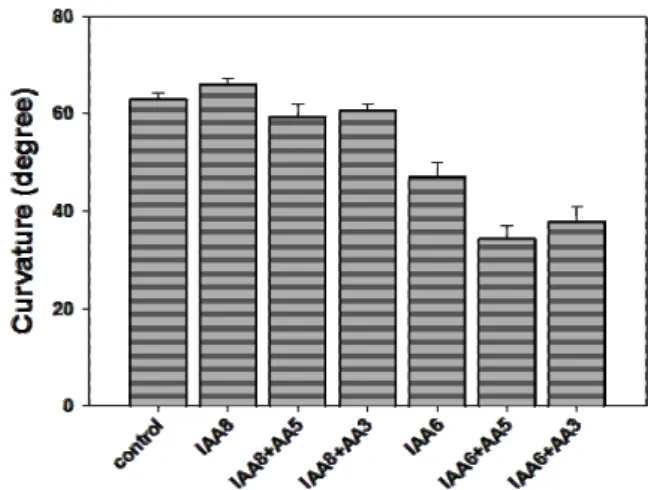
Fig. 3. Effect of ascorbic acid (AA) and IAA on the gravitropic curvature in the root tip for 4 hr. AA and IAA was ap- plied to the root tip using an agar block (0.6%, 1 mm3).
The gravitropic curvature was measured at 4 hr after treatment. IAA8: 10-8 M IAA; IAA6: 10-6 M IAA; AA5:
10-5 M AA; AA3: 10-3 M AA. Bars are mean values ± SE from 9 independent experiments.
from the tip to the elongation zone resulting in differential growth. It is widely accepted that differences in indole- 3-acetic acid (IAA) activity between the upper and lower hemispheres of the root results in the differential elongation along the horizontal root [20]. Roots are extremely sensitive to IAA and increasing the amount of IAA in the lower hemisphere of the root results in inhibition of elongation [19]. Therefore, IAA is one of the major factors to induce the differential elongation during the gravitropism curva- ture [18]. Ascorbic acid might induce transport of IAA to the elongation zone, resulting in the inhibition of growth;
ascorbic acid also may play a role of redistribution of IAA in the elongation zone between upper and lower side of the root and result in stimulation of gravitropic curvature. The findings of Lee et al. [16] suggest that AA can alter the aux- in transport system in Arabidopsis roots. They reported that AA stimulated gravitropic response over a range of concen- trations from 10 μM to 1 mM in Arabidopsis root. In those studies, an AA biosynthesis mutant of Arabidopsis exhibit- ing a greatly reduced level of AA, showed the suppression of root elongation and gravitropic response [16]. These data suggests that AA may act on the IAA redistribution in the elongation zone when the root perceived the gravity in the root cap.
In order to determine the relationship between AA and IAA, we measured the curvature of roots treated with IAA and AA. Roots were pretreated with the solution containing both IAA and AA for 30 min in vertical position, and meas- ured the gravitropic response in horizontal roots. When 10-8
M IAA was applied to the root, the gravicurvature did not change compared to the control (Fig. 3). And the treatment of 10-8 M IAA with AA to the root also did not have a sig- nificant effect on the inhibition of curvature (Fig. 3).
However, gravicurvature was inhibited about 25% of con- trol by the treatment of 10-6 M IAA alone. However, AA exerted the inhibition of gravitropic curvature in the pres- ence of 10-6 M IAA, even though 10-3 M AA stimulated the curvature without IAA, as shown in Fig. 2 (Fig. 3). These data suggested that AA may have an effect on lateral trans- port of IAA from the upper to the lower side when root tip perceive the gravity.
It has been reported that ethylene inhibits the elongation of stem and roots [23]. Inhibition of root elongation by IAA can be reversed by the treatment of the tissue with ethylene antagonists [13]. Lee et al. [15] suggested ethylene may modify positive curvature in the primary roots of maize by affecting gravity induced-lateral auxin transport. Kim et al.
[14] suggested that an optimal concentration of ethylene might be required for the regulation of gravitropism in maize roots. Based on these results, AA may affect the grav- ity induced-lateral IAA transport in maize root resulting in the inhibition of curvature by AA in the presence of IAA.
In an attempt to explain the effect of AA, we measured modification of ethylene production in the presence of AA.
These data may provide insight into the inhibition of growth and gravicurvature in the elongation zone by AA.
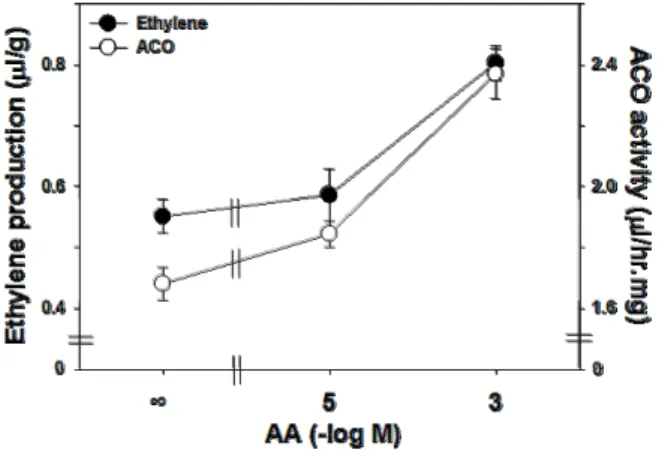
Fig. 4. Effect of ascorbic acid (AA) on the ethylene production and ACO activity in the root segments for 4 hr. Root segments were incubated for 4 hr in solution containing 10-5 M and 10-3 M AA. At 4 hr, 1 ml of gas sample was withdrawn from the vials for measuring ethylene production. ACO activity was assayed with intact root segments incubated for 4 hr in solution containing 0.1 mM AVG with AA as described in Material and Methods. AA5: 10-5 M AA; AA3: 10-3 M AA. Symbols are mean values ± SE from 9 independent experiments.
Fig. 5. Effect of ascorbic acid on gene expression levels for ACC oxidase and ACC synthase. Root segments were incubated for 4 hr in solution containing potassium phosphate buffer (50 mM, pH 6.8) with AA. Total RNAs were extracted and used for RT-PCR as de- scribed in Material and Methods. AA5: 10-5 M AA;
AA3: 10-3 M AA; ZmACO31: ACC oxidase gene; ZmACS7:
ACC synthase gene; GAPDH: control. Gel image shows results with consistent patterns from 6 independent experiments. The values of band density are mean val- ues ± SE from 6 independent experiments.
Effect of AA on the ethylene production
External application of AA stimulated the ethylene pro- duction in the concentration of 10-5 M and 10-3 M AA for 4 hr (Fig. 4). The treatment of 10-3 M AA increased about 60% of control at 4 hr. Typically, ethylene affects the growth pattern of plants by reducing the rate of elongation and in- creasing lateral expansion, leading to swelling of the tissue and modifying the gravitropic response [1]. Thus, the slight inhibition of growth by AA in the elongation zone (Fig. 1) may be due to the increasing ethylene production by AA treatment. Additionally, the inhibition of gravitropic re- sponse by in combination with IAA (Fig. 3) could be related to the modification of gravity-induced lateral auxin trans- port in the root by ethylene. Ruzicka et al. [21] reported that ethylene stimulated auxin biosynthesis and increased the capacity of auxin transport by regulating the transcription of auxin transport components such as AUX1 and PIN2.
The increase in auxin production due to ethylene could al- ter redistribution of auxin, by polar auxin transport, from root cap to the elongation zone via outer cell layer, to the elongation zone where auxin could inhibit cell elongation.
Recently, Ma and Ren [17] reported during the germination of flax, the gravitropic response of the flax root becomes weaker due to a decrease in auxin sensitivity and decrease in auxin transport regulated by ethylene. Therefore, stim- ulation of ethylene production by AA treatment could regu-
late auxin movement and/or lateral auxin transport in hori- zontal roots. To confirm the action of AA on ethylene pro- duction (Fig. 4), we measured the activity of ACC oxidase (ACO). ACO is involved in the conversion of ACC into ethylene. ACO activity was increased depending on the AA concentrations at 4 hr in the same pattern as the ethylene production (Fig. 4). Therefore in this system, AA stimulates ethylene production via the activation of ACO.
To confirm this result, we determined whether AA acti- vates the expression of the ACO and ACS gene through conducting RT-PCR. The expression level of ACO31 was in- creased about 1.41 and 1.46 fold by 10-5 M AA and 10-3 M AA, respectively (Fig. 5). However, AA had no apparent in- fluence on the ACS gene. ACS is the enzyme catalyzing the step from AdoMet to ACC in the ethylene production in plants.
Conclusion
In these studies, AA stimulated gravitropic curvature of maize roots and increased the ethylene production via acti- vation of ACO when AA was applied to the root tip.
However, AA applied to the elongation zone of the root did not stimulate the gravitropic response, and root growth slightly was inhibited. The increased ethylene may regulate
the auxin transport and/or lateral auxin transport from root tip to elongation zone resulting in differential growth in the elongation zone and lateral transport of auxin from upper to the lower side in horizontal position. These data sug- gested that redox environment in soil in which AA in- volved might affect the root growth and gravitropism.
Acknowledgement
This research was supported by a grant from 2011 Advanced College of Education (ACE) program of Andong National University.
References
1. Abeles, F. B., Morgan, P. W. and Saltveit, M. E. Jr. 1992.
Ethylene in plant physiology. 2nd edn, Academic Press. San Diego, USA.
2. Asensi-Fabado, M. and Munné-Bosch, S. 2010. Vitamins in plants: occurrence, biosynthesis and antioxidant function.
Trends Plant Sci 15, 582-592.
3. Blancaflor, E. B. 2013. Regulation of plant gravity sensing and signaling by the actin cytoskeleton. Am J Bot 100(1), 143-152.
4. Blancaflor, E. B. and Masson, P. H. 2003. Plant gravitrop- ism. Unraveling the ups and downs of a complex process.
Plant Physiol 133, 1677-1690.
5. Boonsiricha,i K., Guan, C., Chen, R. and Masson, P. H.
2002. Root gravitropism: An experimental tool to inves- tigate basic cellular and molecular processes underlying mechanosensing and signal transmission in plants. Annu Rev Plant Biol 53, 421-447.
6. Conklin, P. L. and Barth, C. 2004. Ascorbic acid, a familiar small molecule intertwined in the response of plants to ozone, pathogens, and the onset of senescence. Plant Cell Environ 27, 959-970.
7. De Pinto, M. C. and De Gara, L. 2004. Changes in the ascor- bate metabolism of apoplastic and symplastic spaces are as- sociated with cell differentiation. J Exp Bot 55, 2559-2569.
8. Farver, O., Wherland, S. and Pecht, I. 1994. Intramolecular electron transfer in AA oxidase is enhanced in the presence of oxygen. J Biol Chem 269, 22933-22936.
9. Foyer, C. H. and Noctor, G. 2005. Oxidant and antioxidant signaling in plants: a re-evaluation of the concept of oxida- tive stress in a physiological context. Plant Cell Environ 28, 1056-1071.
10. Fuchs, I., Philippar, K. and Hedrich, R. 2006. Ion channels meet auxin action. Plant Biol 8, 353-359.
11. Jiang, J., Su, M., Wang, L., Jiao, C., Sun, Z., Cheng, W., Li, F. and Wang, C. 2012. Exogenous hydrogen peroxide rever- sibly root gravitropism and induces horizontal curva-ture
of primary root during grass pea germination. Plant Physiol Biochem 53, 84-93.
12. Joo, J. H., Bae, Y. S. and Lee, J. S. 2001. Role of auxin-in- duced reactive oxygen species in root gravitropism. Plant Physiol 126, 1055-1060.
13. Kim, S. Y. and Mulkey, T. J. 1997. Effect of ethylene antago- nists on auxin-induced inhibition of intact primary root elongation in maize (Zea mays L). J Plant Biol 40, 256-260.
14. Kim, S. Y., Kim, Y. K., Kwon, K. S. and Kim, K. W. 2000.
Action of malformin A1 on gravitropic curvature in pri- mary roots of maize (Zea mays L.). J Plant Biol 43, 183-188.
15. Lee, J. S., Chang, W. K. and Evans, M. L. 1990. Effects of ethylene on the kinetics of curvature and auxin redis- tribution in gravistimulated roots of Zea mays. Plant Physiol 94, 1770-1775.
16. Lee, Y., Park, C. H., Kim, A. R., Chang, S. C., Kim, S. H., Lee, W. S. and Kim, S. K. 2011. The effect of ascorbic acid and dehydroascorbic acid on the root gravitropic response in Arabidopsis thaliana. Plant Physiol Biochem 49, 909-916.
17. Ma, Z. and Ren, Y. 2012. Ethylene interacts with auxin in regulating developmental attenuation of gravitropism in flax root. J Plant Growth Regul 31, 509-518.
18. Morita, M. T. 2010. Directional gravity sensing in gravitrop- ism. Annu Rev Plant Biol 61, 705-720.
19. Mulkey, T. J., Kuzmanoff, K. M. and Evans, M. L. 1982.
Promotion of growth and hydrogen ion efflux by auxin in roots of maize pretreated with ethylene biosynthesis inhibitors. Plant Physiol 70, 186-188.
20. Ottenschläger, I., Wolff, P., Wolverton, C., Bhalerao, R. P., Sandberg, G., Ishikawa, H., Evans M. and Palme, K. 2003.
Gravity-regulated differential auxin transport from colum- ella to lateral root cap cells. Proc Natl Acad Sci USA 100, 2987-2991.
21. Ruzicka, K., Ljung, K., Vanneste, S., Podhorska, R., Beeck- man, T., Friml, J. and Benkova, E. 2007. Ethylene regulates root growth through effects on auxin biosynthesis and transport-dependent auxin distribution. Plant Cell 19, 2197- 2212.
22. Santhisree, P., Nongmaithem, S., Sreelakshmi, Y., Ivanchen- ko, M. and Sharma, R. 2012. The root as a drill: An ethyl- ene-auxin interaction facilitates root penetration in soil.
Plant Signal Behav 7, 151-156.
23. Swarup, R., Perry, P., Hagenbeek, D., Van Der Straeten, D., Beemster, G. T., Sandberg, G., Bhalerao, R., Ljung, K. and Bennett, M. J. 2007. Ethylene up-regulates auxin biosyn- thesis in Arabidopsis seedlings to enhance inhibition of root cell elongation. Plant Cell 19, 2186-2196.
24. Wang, H. and Woodson, W. R. 1989. Reversible inhibition of ethylene action and interruption of petal senescence on carnation flowers by norbornadiene. Plant Physiol 89, 434- 438.
25. Zarembinski, T. I. and Theologis, A. 1994. Ethylene biosyn- thesis and action: a case of conservation. Plant Mol Biol 26, 1579-1597.
초록:옥수수 일차뿌리에서 Ascorbic acid가 굴중성 반응에 미치는 효과 김충수1․Timothy J. Mulkey2․김순영1*
(1안동대학교 생명과학과, 2인디애나 주립대학교 생물학과)
Ascorbic acid (AA)는 식물 발달과 생장에 필수적인 다기능성 대사산물이다. 본 연구에서는 항산화제인 AA가
옥수수 일차 뿌리에서 굴중성 반응에 미치는 효과를 조사하였다. 10-3 M AA를 신장대에 처리하면 뿌리 굴중성
반응은 영향을 받지 않고 뿌리 생장은 약간 억제되었다. 그러나 10-5 M과 10-3 M AA를 뿌리 끝에 처리하였을
때, 뿌리 굴중성 반응은 촉진된 반면, 뿌리 생장은 억제되었다. 수평으로 놓인 뿌리의 윗면과 아랫면에서 IAA함량 의 차이는 차등 생장을 유발한다. 뿌리는 IAA에 대하여 매우 민감하여 아랫면에 증가된 IAA는 뿌리 생장을 억제 한다. 그러므로 본 연구에서 AA가 존재할 때 IAA의 효과를 조사하였다. AA는 IAA와 함께 처리하면 굴중성 반응 을 더욱 억제시켰다. 뿌리 생장과 굴중성 반응의 조절에 관여하는 AA의 작용을 알아보기 위하여, AA를 처리한 후 에틸렌 생성을 측정하였다. AA는 ACC가 에틸렌으로 전환되는 단계를 조절하는 ACC oxidase gene을 활성화 시켜 에틸렌 생성을 촉진하였다. 이 결과는 AA가 에틸렌 작용의 조절을 통하여 옥수수 뿌리에서 굴중성 반응에 영향을 준다는 것을 제시한다.