• 검색 결과가 없습니다.

Response Surface Optimization of Phenolic Compounds Extraction From Steam Exploded Oak Wood (Quercus mongolica)

N/A
N/A
Protected

Academic year: 2021

Share "Response Surface Optimization of Phenolic Compounds Extraction From Steam Exploded Oak Wood (Quercus mongolica)"

Copied!
19
0
0

로드 중.... (전체 텍스트 보기)

전체 글

(1)

1. INTRODUCTION

Natural phenolic compounds obtained from plants are well recognized for their antioxidant activities. These compounds show various phys- iological and pharmacological properties such as molluscicidal, anthelmintic, and antihepatoxic activities. The use of natural products such as

phenols as antifungal drugs is of great importance. Many natural phenolic compounds extracted from natural plants have been reported to have antifungal activities. Some examples of such phenolic compounds are flavonoids, phe- nolic acids, stilbenes, tocopherols, tocotrienols, ascorbic acid and carotenoids (Zhao et al., 2014). Natural phenolic compounds are being

Original Article

Response Surface Optimization of Phenolic Compounds Extraction From Steam Exploded Oak Wood (Quercus mongolica) 1

Ji Young Jung 2 ⋅Si Young Ha 2 ⋅Jae-Kyung Yang 2,†

ABSTRACT

Steam explosion was applied to extract phenolic compounds from oak wood (Quercus mongolica). The effects of three independent factors (ethanol concentration, extraction temperature and extraction time) on the total phe- nolic content, DPPH radical scavenging activity, and antimicrobial activity from the steam exploded oak wood were optimized using response surface methodology (RSM). The independent variables were coded at three lev- els and their actual values were selected on the basis of preliminary experimental results. The following optimal extraction conditions were selected: ethanol concentration 82.0%, extraction temperature 71.7 ℃, and extraction time 60.5 min for total phenolic content; ethanol concentration 78.3%, extraction temperature 70.3 ℃, and ex- traction time 57.6 min for DPPH radical scavenging activity; ethanol concentration 80.6%, extraction temper- ature 68.4 ℃, and extraction time 59.0 min for antimicrobial activity. The experimental values agreed with those were predicted within con fidence intervals indicating the suitability of RSM in optimizing the ethanol extraction of phenolic compounds from the steam exploded oak wood. Under the optimized conditions, the experimental value of the total phenolic content was 111.8 mg GAE/g dry steam exploded oak wood, DPPH free radical scavenging activity was 65.7%, and antimicrobial activity was 17.0 mm, and those are reasonably close to the predicted values (109.2 mg GAE/g dry steam exploded oak wood, 62.3% and 15.9 mm, respectively).

Keywords : oak wood, steam explosion, ethanol extraction, phenolic compound, response surface methodology

1 Date Received August 24, 2017, Date Accepted October 30, 2017

2 Division of Environmental Forest Science and Institute of Agriculture & Life Science, Gyeongsang National University, Jinju 52828, Republic of Korea

Corresponding author: Jae-Kyung Yang (e-mail: [email protected], ORCID: 0000-0003-0423-6398)

(2)

extensively researched in recent years due to the increasing limitations on the use of syn- thetic antioxidants (such as butylated hydrox- ytoluene, butylated hydroxyanisole and tertiary butylhydroquinone) and increased public con- cern on health issues. In addition, research is also being conducted to identify novel anti- oxidants from natural sources such as low-cost agricultural, forest, or industrial wastes (Meullemiestre et al., 2016; Wang et al., 2015;

Wong et al., 2015; Fu et al., 2014; Salem et al., 2014).

Quercus trees, commonly known as oaks, that forest comprise 64% of the total land area in Korea, and tree species in the genus Quercus are dominant covering about 27% of total for- ested area (Sim and Han, 2003). Oaks are a rich source of saponins and polyphenols, partic- ularly tannins, flavonoids, and proanthocyani- dins and important potential source of natural antioxidants. Acorns, the fruit of oak trees, have long been employed as a source of boar feed, tannin, oil, and especially food because of the high content of carbohydrates, amino acids, proteins, lipids, and various sterols (Lopes and Bernardo-Gil, 2005; Cantos et al., 2003). Oak bark is known to accumulate large amounts of polyphenols and these compounds are mainly defined as ellagitannins and condensed tannins.

So, bark of some oak has been used in medi- cine (Panchal and Brown, 2013). Oak heart- wood shows high levels of ellagitannins, hy- droxybenzoic and hydroxycinnamic acids and aldehydes, and volatile compounds that can vary greatly depending on the species and geo-

graphical origin of the wood as well as the processing it undergoes in cooperage. The most abundant polyphenols are the monomer ellagi- tannins, castalagin, roburin E, vescalagin, and grandinin, and low molecular weight phenolic compounds such as ellagic and gallic acids, besides lignin constituents, especially vanillin (Sanz et al., 2010).

Generally, oak heartwood is used for oak bar- rels for wine aging and oak barrels is toasting or seasoning. Several studies have described changes in the composition of oak as it is toasted (Chatonnet, 1992; Cutzach et al., 1997).

The process of barrel toasting probably has the

main influence on the chemical compounds of

the oak such as hemicellulose, cellulose and

lignin. A toasting is carried out to help a super-

ficial degradation of oak that produces new ar-

omatic compounds, which are susceptible to mi-

grate into wine or spirits during their aging, af-

fecting their organoleptic properties (Chatonnet,

1992). The type of heat treatment, toasting was

the process that most influenced the phenolic

composition of wood on medium intensity con-

dition (160 - 170 ℃, 35 min) (Cadahía et al.,

2001). Also, it was also observed that phenolic

compound quality and quantity are narrowly re-

lated to toasting intensity. At the beginning of

heat treatment, there is a breakdown of cellu-

lose that acts as the initiating stage in the deg-

radation of lignin. The breaking of hydrogen

and covalent bonds between cellulose and lignin

destroys the cohesion of the lignocellulose net-

work and facilitates the depolymerization by

means of the rearrangement of the terminal

(3)

units of lignin. The formation of cinnamic alde- hydes can be a result of the breaking of aryl ether bonds ( α-O-4 and β-O-4), which are less stable than C-C bonds (Sarni et al., 1990).

Recently, among heat treatment methods, which do not require the addition of chemicals and short treatment time, steam explosion has been widely applied to lignocellulosic biomass.

The steam explosion has been attractive for the degradation and separation of not only struc- tural components, i.e. cellulose, hemicellulose, and lignin, but also antineoplastic constituents from plant biomass. The principle of steam ex- plosion treatment is the steam hydrolysis at high temperature and pressure, followed by sud- den reduction of the pressure for physical treat- ment of the hydrolyzed product to produce low-molecular weight substances. The lignin is broken down into low-molecular-weight prod- ucts (M r 400 - 8000) which retain the basic lig- nin structure and are moderately reactive. Since the lignin has been extensively depolymerized by cleavage of the β-aryl-ether bonds, it is soluble in alkaline solutions or certain organic solvents. Also the hemicellulose is partially bro- ken down and is predominantly soluble in water.

The qualitative and quantitative studies of bi- oactive compounds such as lignin-derived or sugar-derived compound from plant materials mostly rely on the selection of proper extraction method (Sasidharan et al., 2011). There are several methods established for the extraction of phenolic compound from plant materials. Those methods vary in solvents and conditions used.

The extraction method is essential for the accu- rate quantification of antioxidant content and capacity.

Solvent extraction is frequently used for iso- lation of antioxidant and extraction yield is de- pendent on the solvent and method of extraction, due to the different antioxidant potentials of compounds with different polarity. Many factors such as solvent composition, extraction time, ex- traction temperature (Wettasinghe and Shahidi, 1999), solvent to solid ratio (Cacace and Mazza, 2003) and extraction pressure (Cacace and Mazza, 2002), among others, may significantly influence on the extraction efficacy.

Several extraction techniques have been re- ported for extraction of phenolic compounds from different matrices using solvents with dif- ferent polarities, such as ethanol, methanol, wa- ter, ethyl acetate and petroleum ether (Cheung et al., 2003). Type of solvent has been the most investigated factor. Alcoholic solvents have been commonly employed to extract phe- nolics from natural sources: they give quite high yield of total extract even though they are not highly selective for phenolic compound.

Particularly, mixtures of alcohols and water

have revealed to be more efficient in extracting

phenolic constituents than the corresponding

mono-component solvent system (Yilmaz and

Toledo, 2006; Pinelo et al., 2005). Since the

use of ethanol (a dietary alcohol) may be pref-

erable than methanol in view of a food applica-

tion of the extracts, in the present paper the ef-

fect of ethanol concentration on phenolic com-

pound extraction from steam exploded oak was

(4)

investigated.

Extraction time and temperature are important parameters to be optimized even in order to minimize energy cost of the process. Many au- thors agree in the fact that an increase in the working temperature favors extraction enhanc- ing both the solubility of solute and the dif- fusion coefficient, but also that beyond a cer- tain value phenolic compounds can be dena- tured (Spigno and De Faveri, 2007; Pinelo et al., 2005; Yilmaz and Toledo, 2006).

Response surface methodology (RSM) is an effective optimization tool for investigating many factors and their interactions in fluencing the response with fewer experimental trials.

Accordingly, RSM has been increasingly uti- lized to optimize extraction conditions for anti- oxidative phenolic compounds over the past few years (Belwal et al., 2016; Sa’adi et al., 2014).

However, little researches have been done on the optimization of phenolic compound ex- traction from steam exploded source by re- sponse surface methodology (RSM).

We investigated phenolic compounds of steam exploded treated Quercus mongolica, as well as their antioxidant activity using steam explosion condition. Therefore, the aim of this work was to analyze the influence of ethanol extraction conditions on the total phenolic con- tent, antioxidant capacity and antimicrobial ac- tivity of steam exploded oak wood using an ex- perimental design and the response surface methodology. The parameters to be optimized were temperature and time, both related with the minimization of the energy cost of the proc-

ess and solvent concentration.

2. MATERIALS and METHODS 2.1. Material

Oak wood (Quercus mongolica) was supplied by a Korea Forest Research Institute. The di- mensions of the oak wood chips were smaller than 30 × 50 × 30 mm, while dusts (particles <

1 mm) were removed before steam explosion.

An external dryer was used to dry the chips to below 15% before steam explosion.

2.2. Steam Explosion

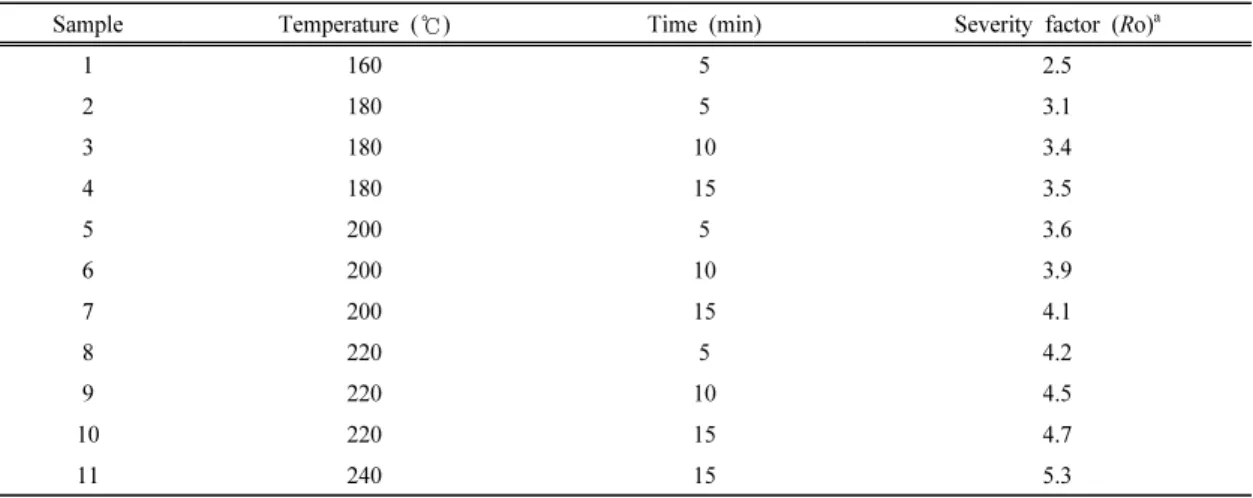
The “severity factor: log (Ro)” is used to map the destruction, desegregation, and depoly- merization of oak wood. Ro is calculated using the following relation, Eq. (1) (Heitz et al, 1987):

Ro = {t × exp [(T-100)/14.75]} ··· Eq. (1) where T is the temperature ( ℃) and t the time (min). A steam temperature of 160 - 240 ℃ and treatment time of 5 - 15 min were applied to realize a log (Ro) = 2.5, 3.1, 3.4, 3.5, 3.6, 3.9, 4.1, 4.2, 4.5, 4.7 and 5.3 (Table 1). The steam exploded oak wood was recovered in a cyclone and after cooling to about 40 ℃ filtered for liquid and solid fraction.

2.3. Extraction procedure of steam exploded oak wood

Extractions of steam exploded oak wood

(5)

were done in glass bottles using ethanol as solvent. In general, 1 g of steam exploded oak wood was placed in glass bottle with 40 m ℓ of solvent, and then placed in a shaking water bath at a speed of 100 rpm. Upon completion of extraction, the extract was filtered through paper filter (Whatman No. 2). The filtrates were collected, placed in glass centrifuge tubes, and stored at -4 ℃ until use. Each extraction was run in triplicate.

2.4. Determination of total phenolic content The total phenolic content (TPC) was de- termined by Folin-Ciocalteu method according to the reported procedure (Li et al., 2008).

Briefly, a extracts (1 m ℓ) with proper dilution were mixed with 1 m ℓ of Folin-Ciocalteu re- agent (10 times dilution) and allowed to react for 3 min at 30 ℃ in the dark. Then 0.8 mℓ of saturated Na 2 CO 3 solution was added and al-

lowed the mixture to stand for 1 h. The absorb- ance of the reaction mixture at 765 nm was measured by using UV- spectrophotometer (HITACHI U-3000, Tokyo, Japan). A calibra- tion curve of gallic acid was prepared, and the TPC was standardized against gallic acid and expressed as mg GAE acid equivalent per gram of dry steam exploded wood.

2.5. Determination of DPPH free radical scavenging activity

DPPH radical scavenging activity (DPPH) were calculated based on the change of absorb- ance due to the decrease in 2,2-diphenyl-1-pic- rylhydrazyl in relation to the control value (Ghasemi et al., 2009). Considering the color of extract, the ethanol solution (1 m ℓ) instead of 0.5 mM DPPH in ethanol (1 m ℓ) was used as a color blank. As a control water or ethanol (1 m ℓ) was added instead of the extract.

Sample Temperature ( ℃) Time (min) Severity factor (Ro)

a

1 160 5 2.5

2 180 5 3.1

3 180 10 3.4

4 180 15 3.5

5 200 5 3.6

6 200 10 3.9

7 200 15 4.1

8 220 5 4.2

9 220 10 4.5

10 220 15 4.7

11 240 15 5.3

a

Severity factor (Ro) = {t × exp [(T-100)/14.75]}. T is the temperature (℃) and t is the duration of treatment (min) (Overend and Chornet, 1987)

b
Based on water-washed, exploded wood fibers.

Table 1. Steam explosion conditions, calculated severity factor and yield of ethanol extract

(6)

Briefly, a 0.1 mM of ethanolic DPPH sol- ution was prepared. The initial absorbance of the DPPH in ethanol was measured at 517 nm and did not change throughout the period of assay. An aliquot (0.1 m ℓ) of each extract (with appropriate dilution if necessary) was mixed with 3.0 m ℓ of ethanolic DPPH solution and incubated for 30 min at 30 ℃ in dark. Then the absorbance at 517 nm was measured. The DPPH (%) was calculated by the following equation:

DPPH (%) = (1 - A sample / A control ) × 100 ·· Eq. (2)

where A sample is the absorbance in the presence of sample and A control is the absorbance in the absence of sample, respectively.

2.6. Determination of antimicrobial activity The disc diffusion method was used to the antimicrobial activity. In vitro antimicrobial ac- tivity was screened by using MRS agar (1.0%

peptone, 1.0% beef extract, 0.4% yeast extract, 2.0% glucose, 0.5% sodium acetate trihydrate, 0.1% polysorbate 80 (also known as Tween 80), 0.2% dipotassium hydrogen phosphate, 0.2% triammonium citrate, 0.02% magnesium

Run Independent variables (coded) Independent variables (actual)

X

1

X

2

X

3

X

1

X

2

X

3

1 1 0 -1 90 70 30

2 0 0 0 80 70 60

3 1 0 1 90 70 90

4 -1 1 0 70 80 60

5 0 0 0 80 70 60

6 0 -1 -1 80 60 30

7 -1 0 -1 70 70 30

8 1 -1 0 90 60 60

9 -1 0 1 70 70 90

10 0 -1 1 80 60 90

11 1 1 0 90 80 60

12 0 1 1 80 80 90

13 0 0 0 80 70 60

14 0 0 0 80 70 60

15 -1 -1 0 70 60 60

16 0 1 -1 80 80 30

17 0 0 0 80 70 60

Independent variables Levels

-1 0 1

X

1

, Ethanol concentration (%) 70 80 90

X

2

, Extraction temperature ( ℃) 60 70 80

X

3

, Extraction time (min) 30 60 90

Table 2. The Box-Behnken design for the RSM

(7)

sulfate heptahydrate, 0.005% manganese sulfate tetrahydrate, 1.0% agar). For antimicrobial ac- tivity determination and growth studies, 24 hrs cultures (ranging from 1 to 5 × 10 8 colony- forming units (CFU)/m ℓ) of Staphylococcus aureus were used. The MRS agar plates were prepared by pouring 15 m ℓ of molten media into sterile petri plates. The plates were allowed to solidify for 12 hrs and 50 µ ℓ inoculum sus- pension was swabbed uniformly and the in- oculum was allowed to dry for 5 minutes. The different of extracts (30 µ ℓ/disc) were loaded on 6 mm sterile disc. The loaded disc was placed on the surface of medium and the com- pound was allowed to diffuse for 5 minutes and the plates were kept for incubation at 37 ℃ for 24 hrs. At the end of incubation, inhibition zones formed around the disc were measured with transparent ruler in millimeter. These stud- ies were performed in triplicate.

2.7. Experimental design of RSM

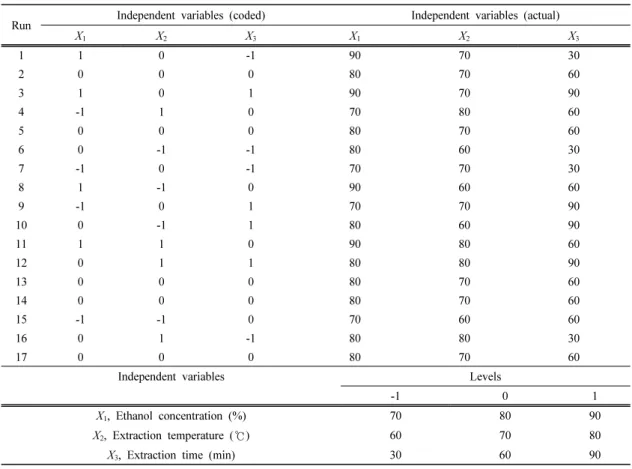
The process conditions for ethanol extraction of total phenolic content from steam exploded oak wood were optimized by RSM. Response surface methodology (RSM) was used to opti- mize the extraction process to yield the highest amount of total phenolic content and DPPH by controlling the process variables: ethanol con- centration (70 - 90%, x 1 ), temperature (60 - 80 ℃, x 2 ), time (30 - 90 min, x 3 ). A Box-Behnken de- sign was adopted to optimize the extraction conditions, as shown in Table 2. The 17 experi- ments were run in random order to minimize

the effects of unexpected variability in observed responses due to extraneous factors. Response surfaces, as represented by Fig. 3 and Fig. 4 were drawn by using the RSREG (SAS: stat- istical analysis system, SAS institute U.S.A).

The experimental data were fitted to a second order polynomial model (Eq. (3)) and the re- gression coefficients were obtained by multiple linear regression

··· Eq. (3)

where Y is the predicted response (total sugar, reducing sugar and antimicrobial activity); β0, βi, βii and βij are the regression coefficients for intercept, linear, quadratic and interaction terms, respectively; Xi and Xj are the in- dependent variables (i ≠ j). Measurements were performed in duplicate and a Statistical Analysis System was used to fit the sec- ond-order polynomial equation to the ex- perimental data.

2.8. Statistical Analysis

Obtained data were subjected to analysis of

variance to determine the growing medium

effects. Statistical analysis had been carried out

with SAS statistical software and according to

analyzing from ANOVA test and comparing

data mean to Duncan test. Duncan’s multiple

comparison range test was used to determine

significant differences between the means.

(8)

3. RESULTS and DISCUSSION 3.1. Effect of Steam Explosion on

Extraction Yield of Oak Wood Oak wood chips were steam-exploded at tem- peratures ranging from 160 ℃ to 240℃ and af- ter various times in the interval of 5-15 min.

The severity factor (Ro), commonly used for the comparison of steam explosion treatments at different temperatures and times (Heitz et al., 1987), was calculated for each experiment (Table 1). After water washing and drying of the exploded material, the material was ex- tracted with the ethanol solvent. The steam ex- plosion treatment resulted in the extraction yield of 8.3 - 33.1% (Fig. 1). Most of the hemi- cellulose and lignin were modified becoming soluble in ethanol solvent, respectively. The steam explosion significantly improved the ex- traction yield. Similar increase in extraction yields after steam explosion were previously re- ported (Conde et al., 2009). Further increases in treatment severity led to the decrease of ex-

traction yield, probably due to thermal decom- position of phenolic compound and carbohy- drate, which coincided with the previous report that the steam explosion could destroy the tight plant texture to enhance the extract yield.

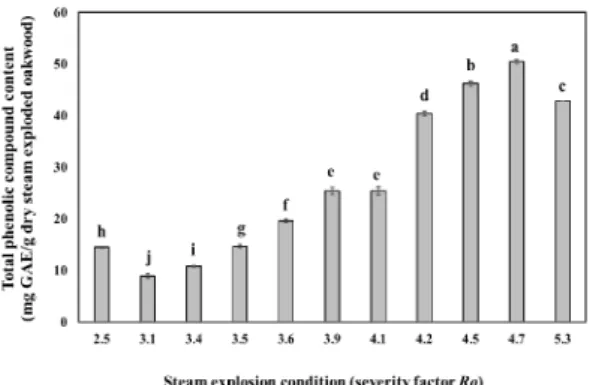
Fig. 2 shows the effect of steam explosion condition on the amount of total phenolic con- tent in oak wood. At a steam temperature of severity factor Ro 3.1 and severity factor Ro 4.7 the amount of total phenolic content in- creased gradually with the increase of steaming time. The amount of total phenolic content reached their highest equivalent of 50.5 mg GAE/g dry steam exploded oak wood, at a steam temperature of 220 ℃ and a steaming time of 15 min (severity factor Ro 4.7). It seems that the part of lignin was low molec- ularised and dissolved as low molecular phe- nolic compounds in water by the hydrolysis re- action with a high temperature and pressure steam followed by the rapid decompression (Cadahía et al., 2001). However, the amount of phenolic compounds decreased at a temperature Fig. 2. Effect of steam explosion on total phenolic compound content. The data are expressed as the mean ± SD (n = 3).

Fig. 1. Effect of steam explosion on extraction yield.

The data are expressed as the mean ± SD (n = 3).

(9)

of 240 ℃ (severity factor Ro 5.3).

Thermal pretreatment with temperatures of 160 ℃ and higher, causes, besides the solubili- zation of hemicellulose, also the solubilization of lignin. The produced compounds are almost always phenolic compounds and have in many cases an inhibitory or toxic effect on bacteria, yeast and methanogens/archae (Gossett et al., 1982). Temperatures of 250 ℃ and higher should be avoided during treatment for recovery of phenolic compound, as unwanted pyrolysis reactions start to take place at such temper- atures (Brownell et al., 1986).

3.2. Single Factor Experimental Analysis for RSM

In the preliminary study, the effects of etha- nol concentration, extraction temperature and time on the extraction of total phenolic content were investigated to determine the appropriate experimental ranges for RSM design. To inves- tigate the effect of ethanol concentration on the extraction of total phenolic content, a range from 30 to 90% of ethanol concentration was used for the investigation.

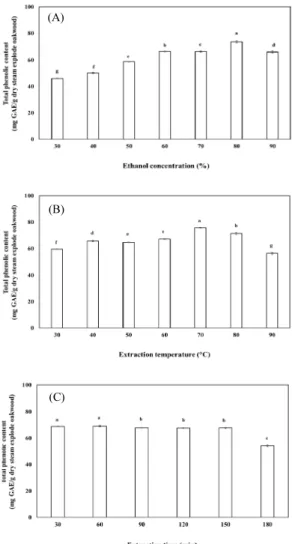
As shown in Fig. 3(A), the extraction amount of total phenolic content was greatly influenced by the concentration of ethanol. The total phe- nolic content of the extract initially increased with increasing ethanol concentration until reaching a maximum (73.5 mg GAE/g dry steam exploded wood) at 80%, after which the total phenolic content decreased. The reason might be related to the polarity of ethanol and

solubility of polyphenols in steam exploded oak wood. Ethanol was more effective in extracting phenolic compounds from steam exploded oak wood than water, with 80% ethanol being the

(A)

(B)

(C)

Fig. 3. Effects of ethanol concentration with a 60

min extraction at 60 ℃ (A), extraction temperature

with an extraction time of 60 min and ethanol con-

centration 80% (B), and extraction time with ethanol

concentration 80% at 70 ℃ (C), on the total phenolic

content of extracts from steam exploded oak wood

(severity value (Ro) 4.71). The data are expressed as

the mean ± SD (n = 3).

(10)

most efficient extraction solvent.

In the present study, the effect of temperature on the extraction of total phenolic content was investigated. The statistical analysis showed that significant differences existed among the tested temperatures. As shown in Fig. 3(B), the total phenolic content of the extract increased with increasing temperature up to 70 ℃, resulting in a maximum total phenolic content (75.8 mg GAE/g dry steam exploded wood) at 70 ℃. This finding can be easily explained considering that the increase in temperature positively affect the polyphenol solubility in the extraction of the to- tal phenolic content. The results may be ex- plained by the fact that an increase in ex- traction temperature may be benefit for anti- oxidant compound to release from plant compo- nent, while temperature higher than optimized level may cause the degradation of some ther- mo-sensitive compounds.

The effect of extraction time on total phe- nolic content was investigated as the final step in a series of preliminary experiments. It was found that the total phenolic content in the ex- tract increased with decreasing extraction time from 30 min to 180 min (Fig. 3(C)). Over 150 min, the total phenolic content decreased, possi- bly due to the decomposition of phenolic com- pounds during the prolonged extraction time.

3.3. Optimization of Ethanol Extraction from Steam Exploded Oak Wood In a preliminary study, ethanol extraction was found to be effective in extracting phenolic

compounds from steam exploded oak wood.

The ethanol extraction of phenolic compounds from steam exploded oak wood was optimized through the RSM approach. 17 experiments were employed to optimize the parameters, in- cluding ethanol concentration, extraction tem- perature, and extraction time.

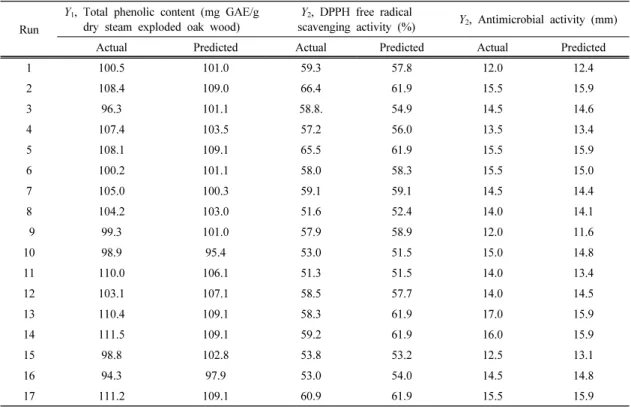
The experimental conditions and correspond- ing responses of the dependent variables (total phenolic content, DPPH radical scavenging ac- tivity and antimicrobial activity) are listed in Table 3.

Among the 17 experiments including 5 repli-

cates (Table 3), experiment 14 (ethanol concen-

tration 80%, extraction temperature 70 ℃ and

extraction time 60 min) has the greatest total

phenolic content (111.5 mg GAE/g dry steam

exploded oak wood) and experiment 16 (ethanol

concentration 80%, extraction temperature 80 ℃

and extraction time 30 min) has the smallest to-

tal phenolic content (94.3 mg GAE/g dry steam

exploded oak wood). Experiment 2 for DPPH

radical scavenging activity (ethanol concen-

tration 80%, extraction temperature 70 ℃ and

extraction time 60 min) has the greatest anti-

oxidant capacity (66.4% for DPPH radical scav-

enging activity). Experiment 11 for DPPH radi-

cal scavenging activity (ethanol concentration

90%, extraction temperature 80 ℃ and ex-

traction time 60 min) has the smallest anti-

oxidant capacity (51.3% obtained by DPPH rad-

ical scavenging activity methods). Also, experi-

ment 13 (ethanol concentration 80%, extraction

temperature 70 ℃ and extraction time 60 min)

has the greatest antimicrobial activity (17.0

(11)

mm) and experiment 1 and experiment 9 (ethanol concentration 90%, extraction temper- ature 70 ℃ and extraction time 30 min; ethanol concentration 70%, extraction temperature 70 ℃ and extraction time 90 min) has the smallest antimicrobial activity (12.0 mm).

3.4. Response Surface Analysis of total Phenolic Content

The experimental data for total phenolic con- tent, DPPH radical scavenging activity and anti- microbial activity were fitted to a response sur- face quadratic model, and the acquired equation was tested for adequacy of fit to the data. The

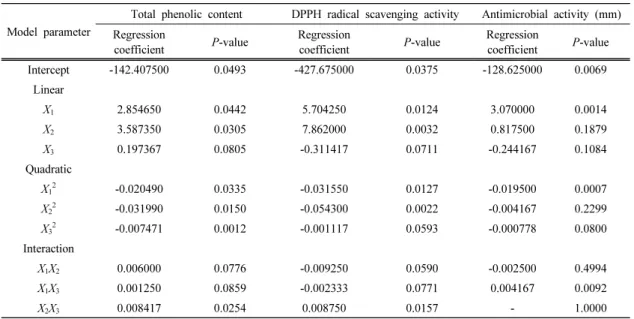
regression coefficients and the response surface were used to study the impacts of variables on the extraction of total phenolic content, DPPH radical scavenging activity and antimicrobial activity. Regression coefficients of the predicted second - order polynomial models total phenolic content, DPPH radical scavenging activity and antimicrobial activity are shown in Table 4.

The model was adequate and explained most of the variability for extraction of phenolic compound from steam exploded oak wood. For the model fitted, software generates model co- efficients, p-values and significant probabilities and hence one can justify the significance of each experimental variable. The maximum pre-

Run

Y

1

, Total phenolic content (mg GAE/g dry steam exploded oak wood)

Y

2

, DPPH free radical

scavenging activity (%) Y

2

, Antimicrobial activity (mm)

Actual Predicted Actual Predicted Actual Predicted

1 100.5 101.0 59.3 57.8 12.0 12.4

2 108.4 109.0 66.4 61.9 15.5 15.9

3 96.3 101.1 58.8. 54.9 14.5 14.6

4 107.4 103.5 57.2 56.0 13.5 13.4

5 108.1 109.1 65.5 61.9 15.5 15.9

6 100.2 101.1 58.0 58.3 15.5 15.0

7 105.0 100.3 59.1 59.1 14.5 14.4

8 104.2 103.0 51.6 52.4 14.0 14.1

9 99.3 101.0 57.9 58.9 12.0 11.6

10 98.9 95.4 53.0 51.5 15.0 14.8

11 110.0 106.1 51.3 51.5 14.0 13.4

12 103.1 107.1 58.5 57.7 14.0 14.5

13 110.4 109.1 58.3 61.9 17.0 15.9

14 111.5 109.1 59.2 61.9 16.0 15.9

15 98.8 102.8 53.8 53.2 12.5 13.1

16 94.3 97.9 53.0 54.0 14.5 14.8

17 111.2 109.1 60.9 61.9 15.5 15.9

Table 3. Experimental results for the total phenolic content, DPPH free radical scavenging activity and anti-

microbial according to the Box-Behnken design

(12)

dictable response for total phenolic content, DPPH radical scavenging and antimicrobial ac- tivity obtained based on a total of 17 experi- ments required for determining 10 regression coefficients of the model. In general, proceed- ing with exploration and optimization of a fitted response surface may produce poor or mislead- ing results unless the model exhibits an ad- equate fit (Myers and Montgomery, 2002).

The relationship between extraction parame- ters and total phenolic content were investigated by response surface plots. Figs. 4 - 6 shows the effect of ethanol concentration, extraction tem- perature, extraction time and their mutual inter- action on the total phenolic content.

Fig. 4(A) reflects the effects of extraction temperature and extraction time on the ethanol extraction of total phenolic content of steam ex- ploded oak wood. The highest total phenolic

content is observed at a higher extraction tem- perature and higher extraction time. The effect of extraction time and ethanol concentration shown in Fig. 4(B) demonstrated that the total phenolic content increased with the increase of ethanol concentration. The highest total phe- nolic content was observed with ethanol con- centration and extraction time of approximately 80% and 60 min respectively. According to the literatures a maximum of phenolic compounds of most plants is extracted with 80% of ethanol concentration. Similar results have been ob- served for the ethanol extraction of phenolic compounds from steam exploded oak wood.

The highest total phenolic content was observed at a higher extraction temperature (Fig. 4(C)).

High temperatures might have increased the dif- fusion and solubility rate of many compounds resulting in antioxidant compounds being ex-

Model parameter

Total phenolic content DPPH radical scavenging activity Antimicrobial activity (mm) Regression

coefficient P-value Regression

coefficient P-value Regression

coefficient P-value

Intercept -142.407500 0.0493 -427.675000 0.0375 -128.625000 0.0069

Linear

X

1

2.854650 0.0442 5.704250 0.0124 3.070000 0.0014

X

2

3.587350 0.0305 7.862000 0.0032 0.817500 0.1879

X

3

0.197367 0.0805 -0.311417 0.0711 -0.244167 0.1084

Quadratic

X

12

-0.020490 0.0335 -0.031550 0.0127 -0.019500 0.0007

X

22

-0.031990 0.0150 -0.054300 0.0022 -0.004167 0.2299

X

32

-0.007471 0.0012 -0.001117 0.0593 -0.000778 0.0800

Interaction

X

1

X

2

0.006000 0.0776 -0.009250 0.0590 -0.002500 0.4994

X

1

X

3

0.001250 0.0859 -0.002333 0.0771 0.004167 0.0092

X

2

X

3

0.008417 0.0254 0.008750 0.0157 - 1.0000

Table 4. Regression coefficients and of the predicted second order polynomial models for total phenolic content,

DPPH free radical scavenging activity and antimicrobial activity

(13)

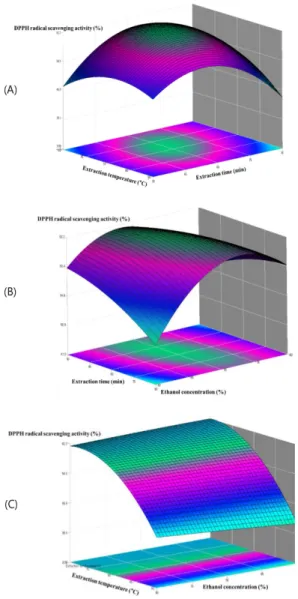
Fig. 5. Response surface plots showing the effects of extraction temperature ( ℃) and extraction time (min) while kept ethanol concentration at 78.2% (A), ex- traction time (min) and ethanol concentration (%) while kept extraction temperature at 70.0 ℃ (B), extraction temperature ( ℃) and ethanol concentration (%) while kept extraction time at 53.3 min (C) on the DPPH radi- cal scavenging activity (%) of extracts with ethanol as solvent.

Fig. 4. Response surface plots showing the effects of

extraction temperature ( ℃) and extraction time (min)

while kept ethanol concentration at 82.0% (A), ex-

traction time (min) and ethanol concentration (%)

while kept extraction temperature at 71.7 ℃ (B), ex-

traction temperature ( ℃) and ethanol concentration

(%) while kept extraction time at 60.5 min (C) on

the total phenolic content (mg GAE/g dry steam ex-

ploded oak wood) of extracts with ethanol as

solvent.

(14)

tracted at a higher rate.

The relationships among parameters for every assay can be seen in the contour plots pre- sented in Fig. 5. The contours of the phenolic compounds and the contours of the antioxidant activity were similar resulted. This indicates that the phenolic compound amount is related to the antioxidant activity. As shown in Fig.

5(A), the extraction amount of DPPH radial scavenging activity was greatly in fluenced by the extraction temperature. The DPPH radial scavenging activity of the extract initially in- creased with increasing ethanol concentration until reaching a maximum at 78.2%, after which the DPPH radial scavenging activity was decreased. The reason might be related to the polarity of ethanol and the solubility of anti- oxidant compound in steam exploded oak wood. Fig. 5(B) depicts 3D graphic surface and contour plot of the effects of the two variables, namely, the interaction effect of ethanol con- centration (%) and extraction time on the DPPH radial scavenging activity. The DPPH ra- dial scavenging activity initially increased when there was an increase in the ethanol concen- tration and extraction time. However, the round- ed contour plot and the smooth surface showed that interactions between the variables were insignificant. Fig. 5(C) represents the effects of ethanol concentration (%) and extraction tem- perature on the DPPH radial scavenging activ- ity, while the extraction time was fixed. The extraction temperature gave the increase in DPPH radial scavenging activity whereas the ethanol concentration became almost constant at Fig. 6. Response surface plots showing the effects of

extraction temperature ( ℃) and extraction time (min)

while kept ethanol concentration at 80.6% (A), ex-

traction time (min) and ethanol concentration (%)

while kept extraction temperature at 68.4 ℃ (B), ex-

traction temperature ( ℃) and ethanol concentration

(%) while kept extraction time at 59.0 min (C) on the

antimicrobial activity of extracts with ethanol as

solvent.

(15)

the following ethanol concentration from 70%

to 90%. Nevertheless, results showed that inter- actions between the variables were insignificant.

Fig. 6(A) shows the plots at a different ex- traction time and extraction temperature at fixed ethanol concentration 80.6%. The antimicrobial activity increased within the extraction time from 45 to 75 ℃, and the antimicrobial activity increased with the increase of extraction tem- perature from 60 to 70. Fig. 6(B) showed the plots at varying extraction time and the ethanol concentration at a fixed extraction temperature 68.4 ℃. It can be observed that maximum anti microbial activity could be achieved when the extraction time and the ethanol concentration were 60 min and 80, respectively. The plots in

Fig. 6(C), which gives the antimicrobial activity of oak wood as a function of extraction temper- ature and ethanol concentration at fixed ex- traction time, indicated that the antimicrobial activity of oak wood increased rapidly with the increasing of the extraction temperature from 60 to 80 ℃, and the antimicrobial activity of oak wood was found to increase with the increase of ethanol concentration from 75 to 85 min.

3.5. Optimization of Extraction Parameters and Validation of the Model

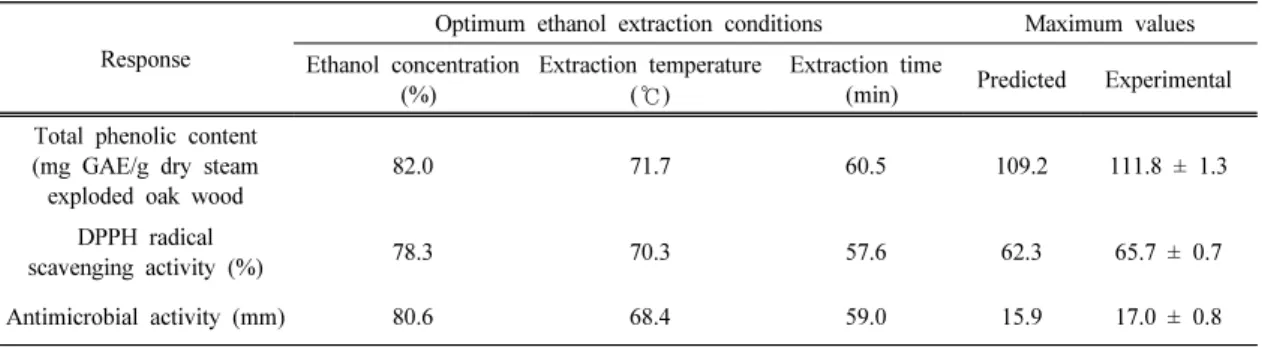
The optimum ethanol extraction conditions for the total phenolic content, the DPPH radical scavenging activity and antimicrobial activity

Response

Optimum ethanol extraction conditions Maximum values Ethanol concentration

(%)

Extraction temperature ( ℃)

Extraction time

(min) Predicted Experimental Total phenolic content

(mg GAE/g dry steam exploded oak wood

82.0 71.7 60.5 109.2 111.8 ± 1.3

DPPH radical

scavenging activity (%) 78.3 70.3 57.6 62.3 65.7 ± 0.7

Antimicrobial activity (mm) 80.6 68.4 59.0 15.9 17.0 ± 0.8

Table 6. Optimum conditions, predicted and experimental values of responses

Response Second order polynomial equation R

2

Total phenolic content

Y

1

= – 142.407500 + 2.854650 X

1

+ 3.587350 X

2

+ 0.197367 X

3

– 0.020490 X

12

+ 0.006000X

1

X

2

– 0.031990 X

22

+ 0.001250 X

1

X

3

+ 0.008417 X

2

X

3

– 0.007471X

32

0.7293

DPPH radical scavenging activity

Y

2

= – 427.675000 + 5.704250 X

1

+ 7.862000 X

2

– 0.311417 X

3

– 0.031550 X

12

– 0.009250X

1

X

2

– 0.054300 X

22

– 0.002333 X

1

X

3

+ 0.008750 X

2

X

3

– 0.00117X

32

0.7836

Antimicrobial activity

Y

3

= – 128.625000 + 3.070000 X

1

+ 0.817500 X

2

– 0.244167 X

3

– 0.019500 X

12

– 0.002500X

1

X2 – 0.004500 X

22

+ 0.004167 X

1

X

3

– 0.000778X

32

0.8885

Table 5. The fitted quadratic model in terms of coded variables for Y

1

, Y

2

and Y

3

responses

(16)

from steam exploded oak wood are given in Table 6. Ethanol concentrations in the range of 78.3 - 82.0%, extraction temperature of 68.4 - 71.7 ℃ and extraction time in the range of 57.6 - 60.5 min can result the optimal total phenolic content (109.2 mg GAE/g dry steam exploded oak wood), DPPH radical scavenging activity (62.3%) and antimicrobial activity (15.9 mm) from steam exploded oak wood. The predicted results matched well with experimental results obtained using optimum extraction conditions which validated the response surface method- ology model with a good correlation. As a re- sult, the model from Box-Behnken design was considered to be accurate and reliable for pre- dicting the total phenolic compound content and the DPPH radical scavenging activity of steam exploded oak wood for ethanol extraction.

4. CONCLUSION

Optimized solvent extraction is proposed here as fast and low cost methodology for the recov- ery of high-added value phenolic compound in terms of their total phenolic content and DPPH radical scavenging activity from steam exploded oak wood.

The three variables (ethanol concentration, extraction temperature, extraction time) inves- tigated in the present study could be ranked as follows in terms of in fluence on the extraction performance. Extraction temperature was found to be a significant parameter with major influ- ence on the total phenolic content, antioxidant activity (DPPH radical scavenging) and anti-

microbial activity of the extract from stem ex- ploded oak wood. The ethanol to water ratio was also significant for the total phenolic con- tent, antioxidant activity (DPPH radical scav- enging) and antimicrobial activity of the extract from stem exploded oak wood. Extraction time was found to be insignificant in this range (30 - 90 min).

The conditions for ethanol extraction of steam exploded [severity (Ro) 4.7] oak wood was optimized by using a Box-Behnken design and RSM. The optimal conditions were found to be as follows; (a) total phenolic content:

82.0% ethanol concentration, 71.7 ℃, 60.5 min, (b) DPPH radical scavenging activity: 78.3%

ethanol concentration, 70.3 ℃, 57.6 min, and (c) antimicrobial activity: 80.6% ethanol concen- tration, 68.4 ℃, 59.0 min. Under these con- ditions, the predicted value of total phenolic content (109.2 mg GAE/g dry steam exploded oak wood), DPPH radical scavenging activity (62.3%) and antimicrobial activity (15.9 mm) was close to the observed values (111.8 mg GAE/g dry steam exploded oak wood, 65.7%

and 17.0 mm respectively).

Using steam exploded oak wood as a starting

material for the extraction of phenolic com-

pounds via this simple and inexpensive method

constitutes a viable use for this forest waste

product. The results, by applying fast and low

cost technique to obtain added value phenolic

compound are of real importance and may have

several applications in food and pharmaceutical

industry. The contribution of the major con-

stituents of the obtained fractions, to antioxidant

(17)

as well as to other biological activities as a re- sult of synergism are under current investigation.

ACKNOWLEDGEMENTS

This study was carried out with the support of

‘R&D Program for Forest Science Technology (Project No. 2013070D10-1719-AA03)’ provided by Korea Forest Service(Korea Forestry Promotion Institute).

REFERENCES

Belwal, T., Dhyani, P., Bhatta, I.D., Rawal, R.S., Pande, V. 2016. Optimization extraction con- ditions for improving phenolic content and anti- oxidant activity in Berberis asiatica fruits using response surface methodology. Food Chemistry 207: 115 ∼124.

Brownell, H.H., Yu, E.K.C. Saddler, J.N. 1986.

Steam-explosion pretreatment of wood: effect of chip size, acid, moisture content and pressure drop. Biotechnol Bioeng 28: 792 ∼801.

Cacace, J.E. Mazza (2003). Mass transfer process during extraction of phenolic compounds from milled berries. Journal of Food Engineering 59(4): 379 ∼389.

Cacace, J.E. Mazza, G. 2002. Extraction of antho- cyanins and other phenolics from black currants with sulfured water. Journal of Agricultural Food Chemistry 50(4): 5939 ∼5946.

Cadahía, E., Muñoz, L., Fernández de Simón, B.

García-Vallejo, M.C. 2001. Changes in low mo- lecular weight phenolic compounds in spanish, prench, and american oak woods during natural seasoning and toasting. Journal of Agricultural Food Chemistry 49(4): 1790 ∼1798.

Cantos, E., Espin, J., Lopez-Bote, C.C., De La Hoz,

L., Ordonez, J.A., Tomas-Barberan, F.A. 2003.

Phenolic compounds and fatty acids from acorns (Quercus spp.), the main dietary constituent of free ranged iberian pigs. Journal of Agricultural Food Chemistry 51: 6248 ∼6255.

Chatonnet, P., Dubourdie, D., Jean-noël Boidron, Pons, M. 1992. The origin of ethylphenols in wines. Journal of the Science of Food and Agriculture 60(2): 165 ∼178.

Cheung, L.M., Cheung, P.C.K. Ooi, V.E.C. 2003.

Antioxidant activity and total phenolics of edible mushroom extracts. Food chemistry 81(2): 249 ∼ 255.

Conde, E., Cara, C., Moure, A., Ruiz, E., Castro, E, Domínguez, H. 2009. Antioxidant activity of the phenolic compounds released by hydrothermal treatments of olive tree pruning. Food Chemistry 114(3): 806 ∼812.

Cutzach, I., Chatonnet, P., Henry, R. Dubourdieu, D.

1997. Identification of Volatile Compounds with a “Toasty” Aroma in Heated Oak Used in Barrelmaking. Journal of Agricultural Food Chemistry 45(6): 2217 ∼2224.

Fu, R., Zhang, Y., Guo, Y., Liu, F. Chen, F. 2014.

Determination of phenolic contents and anti- oxidant activities of extracts of Jatropha curcas L. seed shell, a by-product, a new source of nat- ural antioxidant. Industrial Crops and Products 58: 265 ∼270.

Ghasemi, K., Ghasemi, Y. Ebrahimzadeh, M.A.

2009. Antioxidant activity, phenol and flavonoid contents of 13 citrus species peels and tissues.

Pakistan Journal of Pharmaceutical Sciences 22(3): 277 ∼281.

Gossett, J.M., Stuckey, D.C., Owen, W.F. Mccarty, P.L. 1982. Heat treatment and anaerobic diges- tion of refuse. Journal of Environmental Engineering Division 108: 437 ∼454.

Heitz M., Carrasco, F., Rubio, M., Brown, A.

(18)

Chornet, E. 1987. Physicochemical character- ization of lignocellulosic substrates pretreated via autohydrolysis: an application to tropical woods.

Biomass 13: 255 ∼273.

Li, H.B., Wong, C.C., Cheng, K.W. Chen, F. 2008 Antioxidant properties in vitro and total phenolic contents in methanol extracts from medicinal plants. Lebenson Wiss Technology 41(3): 385 ∼ 390.

Lopes, I.M.G. Bernardo-Gil, M.G. 2005.

Characterization of acorn oils extracted by hex- ane and by supercritical carbon dioxide.

European Journal of Lipid Science and Technology 107: 12 ∼19.

Meullemiestre, A., Petitcolas, E., Maache-Rezzoug, Z., Chemat, F. Rezzoug, S.A. 2016. Impact of ultrasound on solid-liquid extraction of phenolic compounds from maritime pine sawdust waste.

Kinetics, optimization and large scale experiments. Ultrason Sonochem 28: 230 ∼239.

Myers, R.H. Montgomery, D.C. 2002. Response sur- face methodology process and product opti- mization using designed experiments, John Wiley and Sons, Inc., 2nd ed., New-York, USA.

Panchal, S.K., Brown, L. 2013. Cardioprotective and hepatoprotective effects of ellagitannins from European oak bark (Quercus petraea L.) extract in rats. European Journal of Nutrition 52(1): 397

∼408.

Pinelo, M., Rubilar, M., Jerez, M., Sineiro, J. Núñez, M.J. 2005. Effect of Solvent, Temperature, and Solvent-to-Solid Ratio on the Total Phenolic Content and Antiradical Activity of Extracts from Different Components of Grape Pomace.

Journal of Agricultural and Food Chemistry 53(6): 2111 ∼2117.

Sa’adi, R.A., Kamaludin, N.H.I., Zakaria, Z., Arbain, D., MohdIdris, Z., Abdullah, N.A.H. 2014.

Evaluation of Phenolic Compound Extraction

from LimauKasturi (Citrus macrocarpa) Peels Extract. Advances in Environmental Biology 8(22): 73 ∼76.

Salem, M.Z.M., Abdel-Megeed, A., Ali, H.M. 2014.

Stem Wood and Bark Extracts of Delonix regia (Boj. Ex. Hook): Chemical Analysis and Antibacterial, Antifungal, and Antioxidant Properties. BioResources 9(2): 2382 ∼2395.

Sanz, M., Cadahía, E., Esteruelas, E., Muńoz, Á.M., Fernández De Simón, B., Hernández, T., Estrella, I. (2010). Phenolic Compounds in Chestnut (Castanea sativa Mill.) Heartwood.

Effect of Toasting at Cooperage. Journal of Agricultural and Food Chemistry 58: 9631 ∼ 9640.

Sarni, F., Moutounet, M., Puech., J.L. Rabier, P.

1990. Effect of heat treatmant of oak wood ex- tractable compounds. Holzforschung 44: 461 ∼ 466.

Sasidharan, S., Chen, Y., Saravanan, D., Sundram, K.M., Latha, L.Y. 2011. Extraction, Isolation And Characterization of Bioactive Compounds From Plants’ Extracts. African Journal of Traditional, Complementary and Alternatives medicines 8(1): 1 ∼10.

Sim, J.S. Han, S.S. 2003. Ecophysiological character- istics of deciduous oak species (III) - Photosynthetic responses of leaves to change of light intensity. Journal of Korean Forestry Society 93: 208 ∼204.

Spigno, G. De Faveri, D.M. 2007. Antioxidants from grape stalks and marc: Influence of extraction procedure on yield, purity and antioxidant power of the extracts. Journal of Food Engineering 78(3): 793 ∼801.

Wang, W., Guo, J., Zhang, J., Peng, J., Liu, T. Xin,

Z. 2015. Isolation, identification and antioxidant

activity of bound phenolic compounds present in

rice bran. Food Chemistry 171: 40 ∼49.

(19)

Wettasinghe, M., Shahidi, F. 1999. Antioxidant and free radical-scavenging properties of ethanolic extracts of defatted borage (Borago officinalis L.) seeds. Food Chemistry 67(4): 399 ∼414.

Wong, W.H., Lee, W.X., Ramanan, R.N., Tee, L.H., Kong, K.W., Galanakis, C.M., Sun, J., Prasad, K.N. 2015. Two level half factorial design for the extraction of phenolics, flavonoids and anti- oxidants recovery from palm kernel by-product.

Industrial Crops and Products 63: 238 ∼248.

Yilmaz, Y. Toledo, R.T. 2006. Oxygen radical absorbance capacities of grape/wine industry byproducts and effect of solvent type on ex- traction of grape seed polyphenols. Journal of Food Composition Analysis 19(1): 41 ∼48.

Zhao, H.X., Zhang, H.S. Yang, S.F. 2014. Phenolic

compounds and its antioxidant activities in etha-

nolic extracts from seven cultivars of Chinese

jujube. Food Science and Technology-Leb

3(3-4): 183 ∼190.

수치

Table 1. Steam explosion conditions, calculated severity factor and yield of ethanol extract
Table 2. The Box-Behnken design for the RSM
Fig. 2 shows the effect of steam explosion  condition on the amount of total phenolic  con-tent in oak wood
Fig. 3. Effects of ethanol concentration with a 60  min extraction at 60 ℃  (A), extraction temperature  with an extraction time of 60 min and ethanol  con-centration 80% (B), and extraction time with ethanol  concentration 80% at 70 ℃ (C), on the total ph
+5

참조

관련 문서

Comparison of the monthly average difference between surface temperature and sea surface temperature at Chilbaldo on foggy(f_avg) and no foggy(nf_avg) day cases from

In SDE extraction, a total of 117, 115 and 120 volatile compounds were detected in Aster yomena, Aster tataricus and Chrysanthemum zawadskii, individually, whereas their total

To measure antioxidant effects of the yuzu seed oil, DPPH radical scavenging and lipid peroxidation were investigated... DPPH radical scavenging

Comparison of the proportion of permanent teeth extraction according to oral disease by tooth type in the upper jaw ··· 21... Comparison of the proportion of permanent

DPPH radical scavenging activity of Yanggaeng added with different levels of Molokhia( Corchorus olitorius L.) powder.. Bars with different letters

The 5-day-old seedlings overexpressing the AtTX12 -like genes originated from crops of Brassicaceae were used for the extraction of the total RNA from which cDNA was

Antiinflammatory and superoxide radical scavenging activities of procyanidins containing extract from the bark of Pinus pinaster Sol.. and

The crude extract and its solvent-partitioned fractions were evaluated for their antioxidant and antiproliferative effects.. In the DPPH radical assay system,