DOI:10.3796/KSFT.2010.46.2.157
* Corresponding author: [email protected], Tel: 82-51-629-5880, Fax: 82-51-629-5885
Target strength estimation of dominant species in marine ranching ground of Jeju coastal water by KRM model
Seung-Jong L EE , Yoo-Won L EE
1*, Joo-Il K IM
2, Taeg-Yun O H
3, Bo-Kyu H WANG
4, Byung-Yeob K IM and Kyoung-Hoon L EE
5Subtropical Fisheries research center, Southwest Sea Fisheries Research Institute, National Fisheries Research and Development Institute, Jeju 690-192, Korea
1
Division of Marine Production System Management, Pukyong National University, Busan 608-737, Korea
2
Fisheries Resources Management Division, Southeast Sea Fisheries Research Institute, NFRDI, Busan 619-705, Korea
3
Fisheries Resources Management Division, NFRDI, Busan 619-705, Korea
4
Research Center for Ocean Industry Development, Pukyong National University, Busan 608-737, korea
5
Fisheries System Engineering Division, NFRDI, Busan 619-705, Korea
The indirect target strength (TS) estimation method which uses the Kirchhoff ray mode model (KRM model) was discussed to apply for a biomass estimation in the water of mixed species. TS of 25 live scorpion fishes for 120kHz were measured by a tethered method and of others dominant 5 species in the marine ranching ground of Jeju coastal water including a scorpion fish were also estimated by KRM model. The measurement TS of scorpion fish well agreed with the theoretical values and the standard formula of scorpion fish was estimated as TS
120kHz20Log (L) 72.9 (r
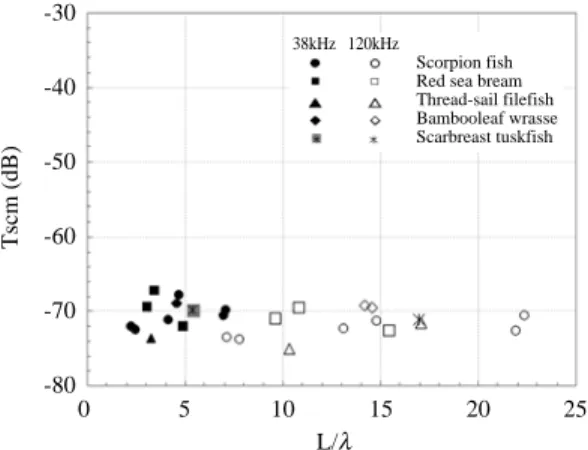
20.67). TScm values estimated on trial to each sample of dominant 5 species were from 69.3dB to 75.1dB at 120kHz and they were in the general range of swimbladdered fish. It was clarified that TS by KRM model can be used to estimate fish biomass estimation by increasing a sample number and is more effective under the condition that there is rare TS information for inhabiting species in mixed-species area.
Keywords: Target strength, Dominant species, Kirchhoff ray mode model, Marine ranching ground
.
1999 , ,
4
(total allowable catch: TAC)
2010 11 , 41
.
, ,
.
,
(Kim, 1991).
.
(target strength:
TS) ,
TS ,
TS . TS
, ,
(Simmonds and MacLennan, 2005).
(Hwangbo et al., 2009; Lee, 2005; Lee and Shin, 2005; Moon et al., 2006), Oh and Ahn (2001)
, Kang and Hwang (2003) 38, 120, 200kHz
, Kang et al. (2005,
2009) .
,
TS ,
38, 70, 120, 200kHz TS
. ,
, TS
,
.
5 ,
TS ,
.
TS Kirchhoff-ray
mode model (Clay and Horne, 1994; KRM
) . KRM
,
.
(
body) (1) .
body
f (f
r, θ
tilt, S
b, ρ
w, ρ
b, c
w, c
b) (1) , f
r, θ
tilt, S
b,
ρ
w( ) , ρ
b, c
w( ) , c
b.
, (
bladder) (2)
.
bladder
f (f
r, θ
tilt, S
sb, ρ
b, ρ
sb, c
b, c
sb) (2)
, S
sb,
ρ
sb, c
sb.
, ,
(
fish)
fish body bladder
(3)
, (4)
. TS 10log
102