• 검색 결과가 없습니다.

Patterns of rpoC Mutations in Drug-Resistant Mycobacterium tuberculosis Isolated from Patients in South Korea

N/A
N/A
Protected

Academic year: 2021

Share "Patterns of rpoC Mutations in Drug-Resistant Mycobacterium tuberculosis Isolated from Patients in South Korea"

Copied!
6
0
0

로드 중.... (전체 텍스트 보기)

전체 글

(1)

Introduction

The worldwide emergence of multidrug-resistant tubercu- losis (MDR-TB) and extensively drug-resistant tuberculosis (XDR-TB) threatens global efforts to control tuberculosis

1,2

. Isoniazid (INH) and rifampicin (RFP) are the main compo- nents of first-line anti-tuberculosis treatment and are effective drugs for the treatment of tuberculosis

3-5

. MDR-TB is resistant to INH and RFP, and the emergence of MDR-TB is placing an increasing burden on South Korea

4-6

.

Mycobacterium tuberculosis can acquire resistance to RFP through mutations in rpoB, which encodes the β subunit of RNA polymerase

7-9

. Mutations in rpoC, which encodes the β′

subunit of RNA polymerase, have also been associated with

Patterns of rpoC Mutations in Drug-Resistant Mycobacterium tuberculosis Isolated from

Patients in South Korea

Yeo Jun Yun, Ph.D.

1,

*, Jong Seok Lee, Ph.D.

2,

*, Je Chul Yoo, M.D., Ph.D.

3

, Eunjin Cho

2

, Dahee Park

3

, Yoon-Hoh Kook, M.D., Ph.D.

4

and Keun Hwa Lee, Ph.D.

3

1

Ewha Medical Research Institute, Ewha Womans University, Seoul,

2

International Tuberculosis Research Center, Masan,

3

Department of Microbiology and Immunology, Jeju National University College of Medicine, Jeju,

4

Department of Microbiology and Immunology, Seoul National University College of Medicine, Seoul, Korea

Background: Rifampicin (RFP) is one of the principal first-line drugs used in combination chemotherapies against Mycobacterium tuberculosis , and its use has greatly shortened the duration of chemotherapy for the successful treatment of drug-susceptible tuberculosis. Compensatory mutations have been identified in rpoC that restore the fitness of RFP- resistant M. tuberculosis strains with mutations in rpoB . To investigate rpoC mutation patterns, we analyzed 93 clinical M.

tuberculosis isolates from patients in South Korea.

Methods: Drug-resistant mycobacterial isolates were cultured to determine their susceptibility to anti-tubercular agents.

Mutations in rpoC were identified by sequencing and compared with the relevant wild-type DNA sequence.

Results: In total, 93 M. tuberculosis clinical isolates were successfully cultured and tested for drug susceptibilities. They included 75 drug-resistant tuberculosis species, of which 66 were RFP-resistant strains. rpoC mutations were found in 24 of the 66 RFP-resistant isolates (36.4%). Fifteen different types of mutations, including single mutations (22/24, 91.7%) and multiple mutations (2/24, 8.3%), were identified, and 12 of these mutations are reported for the first time in this study.

The most frequent mutation involved a substitution at codon 452 (nt 1356) resulting in amino acid change F452L.

Conclusion: Fifteen different types of mutations were identified and were predominantly single-nucleotide substitutions (91.7%). Mutations were found only in dual isoniazid- and RFP-resistant isolates of M. tuberculosis . No mutations were identified in any of the drug-susceptible strains.

Keywords: Mycobacterium tuberculosis ; Drug Resistance, Multiple; Beta' Subunit of RNA Polymerase; Mutation

Address for correspondence: Keun Hwa Lee, Ph.D.

Department of Microbiology and Immunology, Jeju National University College of Medicine, 15 Aran 13-gil, Jeju 63241, Korea

Phone: 82-64-754-8111, Fax: 82-64-726-3803 E-mail: [email protected]

*Yeo Jun Yun and Jong Seok Lee contributed equally to this work.

Received: Feb. 23, 2017 Revised: May. 31, 2017 Accepted: Nov. 13, 2017 Published online: Mar. 7, 2018

cc

It is identical to the Creative Commons Attribution Non-Commercial License (http://creativecommons.org/licenses/by-nc/4.0/).

Copyright © 2018

The Korean Academy of Tuberculosis and Respiratory Diseases.

(2)

increased in vitro fitness and were overrepresented in MDR- TB isolates from countries with high MDR-TB burdens

10,11

. One study showed that M. tuberculosis isolates harbouring an rpoB mutation also carried nonsynonymous mutations in rpoC

10

.

In this study, we investigated rpoC mutation patterns in drug-resistant and susceptible M. tuberculosis isolates from patients in South Korea to determine the epidemiological rele- vance of rpoC nonsynonymous mutations in a high-incidence setting of MDR- and XDR-TB.

Materials and Methods

1. Mycobacterial isolates and susceptibility testing Ninety-three M. tuberculosis isolates with clinically ob-

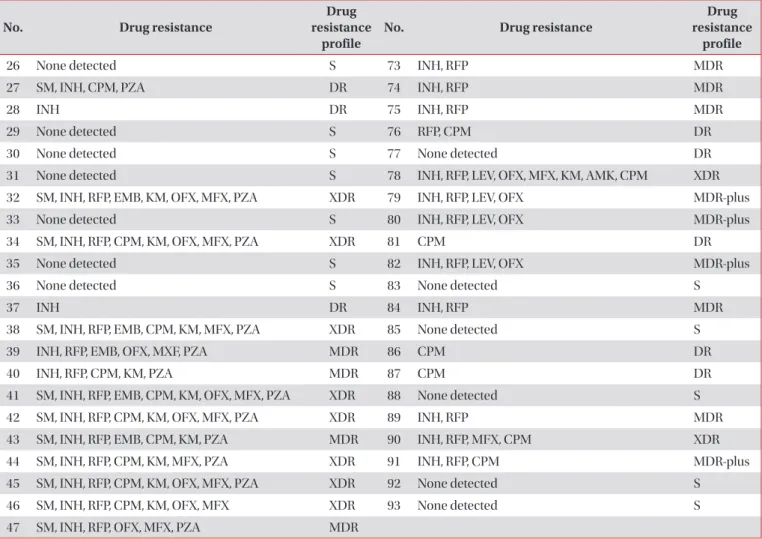
served drug resistance were collected at National Masan Hospital and Pusan National University College of Medicine in South Korea and were cultured to determine their suscepti- bility to anti-tubercular agents (Table 1). Each isolate was cul- tured on Löwenstein-Jensen medium at 37°C for 3–4 weeks and tested for resistance to critical concentrations of capreo- mycin (40 μg/mL), ethambutol (2.0 μg/mL), INH (0.2 μg/mL), kanamycin (40 μg/mL), ofloxacin (2 μg/mL), streptomycin (4 µg/mL), pyrazinamide (100 μg/mL, Wayne’s pyrazinami- dase assay

12

), and RFP (40 μg/mL). M. tuberculosis H37Rv (American Type Culture Collection [ATCC] 27294) was used as a positive control in all of the experiments. The following drug-resistant profiles were defined: MDR, resistance to both RFP and INH; MDR-plus, resistance to any of the second-line injectable drugs (INH+RFP+Inj.D) or to any fluoroquinolone drugs (INH+RFP+FQ); XDR, extensively drug-resistant; DR, drug resistance other than MDR (including MDR-plus and

Table 1. Drug resistance profiles of 93 Mycobacterium tuberculosis isolates

No. Drug resistance Drug

resistance

profile No. Drug resistance Drug

resistance profile

1 SM, INH, RFP, CPM, KM, OFX, MFX, PZA XDR 48 None detected S

2 SM, INH, RFP, CPM, KM, OFX, MFX, PZA XDR 49 CPM DR

3 SM, INH, RFP, EMB, CPM, KM, OFX, MFX, PZA XDR 50 INH, RFP, OFX, MFX, PZA MDR

4 INH, RFP, CPM, KM, PZA MDR 51 INH, RFP, KM, OFX, MFX, PZA XDR

5 SM, INH, RFP, EMB, OFX, MFX, PZA MDR 52 INH, RFP MDR

6 INH, RFP, OFX, MFX MDR 53 SM, INH, RFP, EMB, CPM, KM, OFX, MFX, PZA XDR

7 SM, INH, RFP, EMB, CPM, KM, MFX, PZA XDR 54 SM, INH, RFP, EMB, OFX, PZA XDR

8 SM, INH, RFP, MFX, PZA MDR 55 SM, INH, RFP, OFX, MFX, PZA XDR

9 INH, RFP, CPM, KM, OFX, MFX, PZA XDR 56 SM, INH, RFP, CPM, OFX, MFX, PZA XDR 10 SM, INH, RFP, CPM, KM, OFX, MFX, PZA XDR 57 SM, INH, RFP, EMB, CPM, KM, OFX, MFX, PZA XDR 11 SM, INH, RFP, EMB, CPM, KM, OFX, MFX, PZA XDR 58 INH, RFP, CPM, OFX, MFX, PZA XDR 12 SM, INH, RFP, KM, OFX, MFX, PZA XDR 59 SM, INH, RFP, CPM, KM, OFX, MFX, PZA XDR

13 INH, RFP, CPM, KM, OFX, MFX, PZA XDR 60 RFP, CPM DR

14 SM, INH, RFP, EMB, CPM, KM, OFX, MFX XDR 61 INH, RFP MDR

15 INH, RFP, CPM, KM, OFX, MFX, PZA XDR 62 INH DR

16 SM, INH, RFP, CPM, KM, OFX, MFX, PZA XDR 63 INH, RFP, LEV, OFX, MFX, MDR-plus 17 SM, INH, RFP, CPM, KM, PZA MDR 64 INH, RFP, LEV, OFX, MFX, KM, AMK, CPM XDR

18 INH, RFP, OFX, MFX, PZA MDR 65 INH, RFP, LEV, OFX, MFX, KM, AMK, CPM XDR

19 INH, RFP, CPM, KM, OFX, MFX, PZA XDR 66 INH, RFP, OFX, KM XDR

20 INH, RFP, CPM, KM, OFX, MFX, PZA XDR 67 RFP DR

21 INH, RFP, CPM, KM, MFX, PZA XDR 68 INH, RFP, MDR

22 None detected S 69 INH, RFP, CPM MDR-plus

23 None detected S 70 None detected S

24 None detected S 71 INH, RFP, LEV, OFX MDR-plus

25 None detected S 72 INH, RFP MDR

(3)

XDR); and S, susceptibility to all of the drugs. Sixty-six M. tu- berculosis isolates were RFP resistant (Table 1).

This study was approved by the institutional review board (IRB) at the International Tuberculosis Research Centre, and all subjects signed an informed consent form.

2. Polymerase chain reaction and sequencing of rpoC The rpoC region (1,730 bp) was amplified by polymerase chain reaction (PCR) using the GeneAmp PCR System 9600 (PerkinElmer, Foster City, CA, USA) with primers 5 ′-CGAAAACCTCTACCGCGAAC-3′ and 5′-CACG- GAAGGAGGACTTGACC-3′

10

.

Briefly, the PCR parameters were 5 minutes at 95°C, fol- lowed by 40 cycles of 45 seconds at 94°C, 45 seconds at 60°C, and 60 seconds at 72°C, with a final extension step at 72°C for 10 minutes. The PCR products were purified using a QIAEX

II Gel Extraction Kit (Qiagen Inc., Mainz, Germany) accord- ing to the manufacturer’s instructions and sequenced using a BigDye Terminator cycle sequencing kit with AmpliTaq DNA polymerase (Applied Biosystems, Foster City, CA, USA) using primers 5′-CGAAAACCTCTACCGCGAAC-3′ and 5′-CACGGAAGGAGGACTTGACC-3′

10

. The nucleotide se- quences were analyzed using BioEdit software version 5.0.9.1 (Ibis Biosciences, Carlsbad, CA, USA), Chromas version 2.33 (Technelysium, Brisbane, QLD, Australia, http://www.

technelysium.com.au/chromas.html), and the Basic Local Alignment Search Tool (BLAST, National Center for Biotech- nology Information, Bethesda, MD, USA, http://blast.ncbi.nlm.

nih.gov/Blast.cgi). Mutations in the rpoC-encoding regions were defined as any nucleotide changes that led to transla- tional changes in RpoC compared with the RFP-susceptible strain, H37Rv (ATCC 27294).

Table 1. Continued

No. Drug resistance

Drug resistance

profile No. Drug resistance

Drug resistance

profile

26 None detected S 73 INH, RFP MDR

27 SM, INH, CPM, PZA DR 74 INH, RFP MDR

28 INH DR 75 INH, RFP MDR

29 None detected S 76 RFP, CPM DR

30 None detected S 77 None detected DR

31 None detected S 78 INH, RFP, LEV, OFX, MFX, KM, AMK, CPM XDR

32 SM, INH, RFP, EMB, KM, OFX, MFX, PZA XDR 79 INH, RFP, LEV, OFX MDR-plus

33 None detected S 80 INH, RFP, LEV, OFX MDR-plus

34 SM, INH, RFP, CPM, KM, OFX, MFX, PZA XDR 81 CPM DR

35 None detected S 82 INH, RFP, LEV, OFX MDR-plus

36 None detected S 83 None detected S

37 INH DR 84 INH, RFP MDR

38 SM, INH, RFP, EMB, CPM, KM, MFX, PZA XDR 85 None detected S

39 INH, RFP, EMB, OFX, MXF, PZA MDR 86 CPM DR

40 INH, RFP, CPM, KM, PZA MDR 87 CPM DR

41 SM, INH, RFP, EMB, CPM, KM, OFX, MFX, PZA XDR 88 None detected S

42 SM, INH, RFP, CPM, KM, OFX, MFX, PZA XDR 89 INH, RFP MDR

43 SM, INH, RFP, EMB, CPM, KM, PZA MDR 90 INH, RFP, MFX, CPM XDR

44 SM, INH, RFP, CPM, KM, MFX, PZA XDR 91 INH, RFP, CPM MDR-plus

45 SM, INH, RFP, CPM, KM, OFX, MFX, PZA XDR 92 None detected S

46 SM, INH, RFP, CPM, KM, OFX, MFX XDR 93 None detected S

47 SM, INH, RFP, OFX, MFX, PZA MDR

SM: streptomycin; INH: isoniazid; RFP: rifampicin; CPM: capreomycin; KM: kanamycin; OFX: ofloxacin; MFX: moxifloxacin; PZA: pyrazin-

amide; EMB: ethambutol; XDR: extensively drug-resistant; MDR: multidrug-resistant; S: susceptibility to all of the drugs; DR: drug resistance

other than MDR (including MDR-plus and XDR); MDR-plus: INH+RFP+fluoroquinolone or INH+RFP+injectable drugs.

(4)

Results

Ninety-three clinical isolates were included in this study, and all were from South Korean patients. Drug susceptibility testing identified 75 multidrug-resistant isolates: 20 were cat- egorized as MDR-TB, seven were categorized as MDR-plus, 36 were categorized as XDR-TB, and 12 were categorized as DR- TB. Moreover, 66 of the cultured M. tuberculosis isolates were found to be RFP-resistant. Eighteen isolates were categorized as S (Table 1).

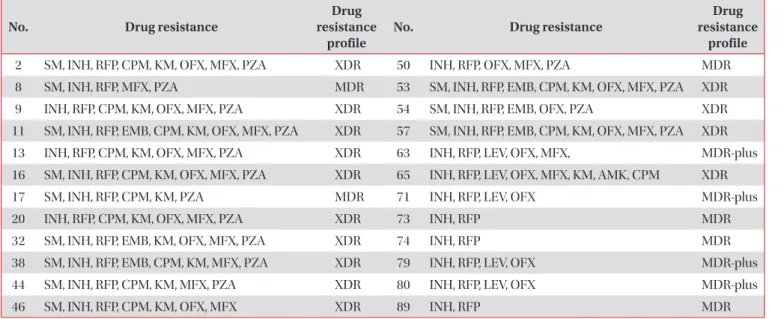
rpoC PCR products were amplified from 93 isolates and se- quenced. Fifteen different types of mutations were identified in 24 isolates (24/93, 25.8%), all of which were resistant to both INH and RFP. The rpoC mutation rate of the MDR- and XDR- TB isolates was 37.0% (10/27) and 38.9% (14/36), respectively (Table 2).

Single mutations (22/24, 91.7%) and multiple mutations (2/24, 8.3%) in the rpoC region were identified, but no deletion nor insertion mutations were detected in any of the isolates.

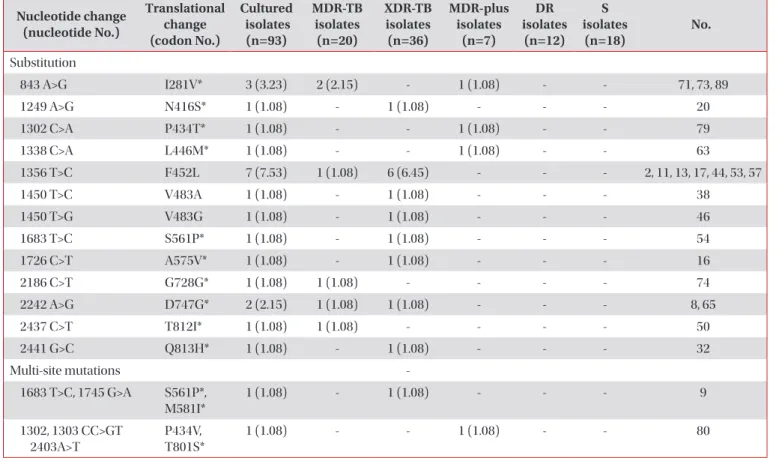
No mutations were identified in the rpoC region of any drug- susceptible strains. A mutation at codon 452 (nt 1356) was the most common mutation (7/24, 29.2%) and a mutation at codon 531 (nt 1594), which is the most frequently mutated nucleotide in rpoB, was also detected in these isolates (Sup- plementary Table S1)

7-9

. Twelve different mutation sites (at codon 281 [nt 843], 416 [nt 1249], 434 [nt 1302], 446 [nt 1338], 561 [nt 1683], 575 [nt 1726], 581 [nt 1745], 728 [nt 2186], 747 [nt 2242], 801 [nt 2403], 812 [nt 2437], and 813 [nt 2441]) are reported for the first time in this study

10,11

; these new muta-

tions are shown in Table 3.

Discussion

RFP is one of the principal first-line drugs used in combina- tion chemotherapy for tuberculosis, and RFP resistance is a valuable surrogate marker of MDR-TB. Over 90% of RFP- resistant clinical M. tuberculosis isolates possess genetic al- terations in rpoB

2,8

.

rpoC encodes the β′ subunit of RNA polymerase, and Co- mas et al.

11

suggested that the acquisition of particular muta- tions in rpoC by RFP-resistant M. tuberculosis strains leads to the emergence of MDR strains with high fitness over time.

Additionally, de Vos et al.

10

showed that nonsynonymous mutations in the rpoC region were prevalent among RFP- resistant isolates in a South African high-burden setting; these mutations were strongly associated with the transmission of RFP-resistant strains.

rpoC mutations have not been studied in South Korea; thus, we investigated the rpoC mutation patterns in drug-resistant and susceptible M. tuberculosis isolates from patients in South Korea. Fifteen different types of mutations were identi- fied, 12 of which were reported for the first time in this study (Table 3)

10,11

. A mutation at codon 452 was the most common mutation (7/24, 29.2%), and a mutation at codon 531, which is the most frequently mutated nucleotide in rpoB, was also detected in these isolates (Supplementary Table S1)

7-9

.

Mutations were found only in the MDR-TB isolates and no

Table 2. Isolates with rpoC mutations (n=24)

No. Drug resistance Drug

resistance

profile No. Drug resistance Drug

resistance profile

2 SM, INH, RFP, CPM, KM, OFX, MFX, PZA XDR 50 INH, RFP, OFX, MFX, PZA MDR

8 SM, INH, RFP, MFX, PZA MDR 53 SM, INH, RFP, EMB, CPM, KM, OFX, MFX, PZA XDR

9 INH, RFP, CPM, KM, OFX, MFX, PZA XDR 54 SM, INH, RFP, EMB, OFX, PZA XDR

11 SM, INH, RFP, EMB, CPM, KM, OFX, MFX, PZA XDR 57 SM, INH, RFP, EMB, CPM, KM, OFX, MFX, PZA XDR

13 INH, RFP, CPM, KM, OFX, MFX, PZA XDR 63 INH, RFP, LEV, OFX, MFX, MDR-plus

16 SM, INH, RFP, CPM, KM, OFX, MFX, PZA XDR 65 INH, RFP, LEV, OFX, MFX, KM, AMK, CPM XDR

17 SM, INH, RFP, CPM, KM, PZA MDR 71 INH, RFP, LEV, OFX MDR-plus

20 INH, RFP, CPM, KM, OFX, MFX, PZA XDR 73 INH, RFP MDR

32 SM, INH, RFP, EMB, KM, OFX, MFX, PZA XDR 74 INH, RFP MDR

38 SM, INH, RFP, EMB, CPM, KM, MFX, PZA XDR 79 INH, RFP, LEV, OFX MDR-plus

44 SM, INH, RFP, CPM, KM, MFX, PZA XDR 80 INH, RFP, LEV, OFX MDR-plus

46 SM, INH, RFP, CPM, KM, OFX, MFX XDR 89 INH, RFP MDR

Isolates with mutations in rpoC are resistant to both INH and RFP.

SM: streptomycin; INH: isoniazid; RFP: rifampicin; CPM: capreomycin; KM: kanamycin; OFX: ofloxacin; MFX: moxifloxacin; PZA: pyrazin-

amide; EMB: ethambutol; XDR: extensively drug-resistant; MDR-plus: INH+RFP+fluoroquinolone or INH+RFP+injectable drugs.

(5)

rpoC mutations were identified in any of the drug-susceptible strains (Tables 2, 3).

Therefore, we suggest that rpoC mutations could be used DNA-based diagnosis for detection of INH and RFP drug resis- tance; however, more extensive studies on larger collections of isolates are needed.

In summary, 15 different types of mutations were identified.

Substitutions in a single nucleotide were the most common mutation found (22/24, 91.7%), and mutations were found only in dual INH- and RFP-resistant isolates in this study.

Authors’ Contributions

Conceptualization: Lee KH. Methodology: Yun YJ, Lee JS, Yoo JC, Cho E, Park D. Formal analysis: Lee KH, Yun YJ, Lee JS, Yoo JC, Park D. Data curation: Yun YJ, Lee JS, Yoo JC, Lee KH, Cho E, Park D. Validation: Lee KH, Yun YJ, Lee JS, Yoo JC, Kook YH. Investigation: Lee KH. Writing-original draft preparation:

Yun YJ, Lee KH. Writing-review and editing: Yun YJ, Lee JS, Yoo

JC, Lee KH. Approval of final manuscript: all authors.

Conflicts of Interest

No potential conflict of interest relevant to this article was reported.

Acknowledgments

This work was supported by a research grant from the Jeju National University Hospital Research Fund of Jeju National University in 2013.

Supplementary Material

Supplementary material can be found in the journal homepage (http://www.e-trd.org).

Table 3. Mutations detected in the rpoC gene of 93 Mycobacterium tuberculosis isolates Nucleotide change

(nucleotide No.)

Translational change (codon No.)

Cultured isolates

(n=93)

MDR-TB isolates

(n=20)

XDR-TB isolates (n=36)

MDR-plus isolates

(n=7)

DR isolates

(n=12) S isolates

(n=18) No.

Substitution

843 A>G I281V* 3 (3.23) 2 (2.15) - 1 (1.08) - - 71, 73, 89

1249 A>G N416S* 1 (1.08) - 1 (1.08) - - - 20

1302 C>A P434T* 1 (1.08) - - 1 (1.08) - - 79

1338 C>A L446M* 1 (1.08) - - 1 (1.08) - - 63

1356 T>C F452L 7 (7.53) 1 (1.08) 6 (6.45) - - - 2, 11, 13, 17, 44, 53, 57

1450 T>C V483A 1 (1.08) - 1 (1.08) - - - 38

1450 T>G V483G 1 (1.08) - 1 (1.08) - - - 46

1683 T>C S561P* 1 (1.08) - 1 (1.08) - - - 54

1726 C>T A575V* 1 (1.08) - 1 (1.08) - - - 16

2186 C>T G728G* 1 (1.08) 1 (1.08) - - - - 74

2242 A>G D747G* 2 (2.15) 1 (1.08) 1 (1.08) - - - 8, 65

2437 C>T T812I* 1 (1.08) 1 (1.08) - - - - 50

2441 G>C Q813H* 1 (1.08) - 1 (1.08) - - - 32

Multi-site mutations -

1683 T>C, 1745 G>A S561P*, M581I*

1 (1.08) - 1 (1.08) - - - 9

1302, 1303 CC>GT 2403A>T

P434V, T801S*

1 (1.08) - - 1 (1.08) - - 80

Values are presented as number (%).

*New mutation not reported in previous studies. Isolates with mutations in rpoC are resistant to both INH and RFP.

MDR-TB: multidrug-resistant tuberculosis; XDR-TB: extensively drug-resistant tuberculosis; MDR-plus: INH+RFP+fluoroquinolone or

INH+RFP+injectable drugs; DR: drug resistance other than MDR (including MDR-plus and XDR); S: susceptibility to all of the drugs; INH: iso-

niazid; RFP: rifampicin.

(6)

Supplementary Table S1. Mutations detected in the rpoB gene of 80 isolates.

References

1. Gandhi NR, Nunn P, Dheda K, Schaaf HS, Zignol M, van Soolingen D, et al. Multidrug-resistant and extensively drug- resistant tuberculosis: a threat to global control of tuberculo- sis. Lancet 2010;375:1830-43.

2. World Health Organization. Global tuberculosis report 2015.

Geneva: World Health Organization; 2015.

3. Abate D, Tedla Y, Meressa D, Ameni G. Isoniazid and rifampi- cin resistance mutations and their effect on second-line anti- tuberculosis treatment. Int J Tuberc Lung Dis 2014;18:946-51.

4. Jeon D. Medical management of drug-resistant tuberculosis.

Tuberc Respir Dis 2015;78:168-74.

5. Park JS. Issues related to the updated 2014 Korean guidelines for tuberculosis. Tuberc Respir Dis 2016;79:1-4.

6. Islam T, Hiatt T, Hennig C, Nishikiori N. Drug-resistant tu- berculosis in the WHO Western Pacific Region. Western Pac Surveill Response J 2014;5:34-46.

7. Yun YJ, Lee KH, Haihua L, Ryu YJ, Kim BJ, Lee YH, et al. De-

tection and identification of Mycobacterium tuberculosis in joint biopsy specimens by rpoB PCR cloning and sequencing.

J Clin Microbiol 2005;43:174-8.

8. Yue J, Shi W, Xie J, Li Y, Zeng E, Wang H. Mutations in the rpoB gene of multidrug-resistant Mycobacterium tuberculo- sis isolates from China. J Clin Microbiol 2003;41:2209-12.

9. Cavusoglu C, Hilmioglu S, Guneri S, Bilgic A. Characterization of rpoB mutations in rifampin-resistant clinical isolates of Mycobacterium tuberculosis from Turkey by DNA sequenc-

ing and line probe assay. J Clin Microbiol 2002;40:4435-8.

10. de Vos M, Muller B, Borrell S, Black PA, van Helden PD, War- ren RM, et al. Putative compensatory mutations in the rpoC gene of rifampin-resistant Mycobacterium tuberculosis are associated with ongoing transmission. Antimicrob Agents Chemother 2013;57:827-32.

11. Comas I, Borrell S, Roetzer A, Rose G, Malla B, Kato-Maeda M, et al. Whole-genome sequencing of rifampicin-resistant Mycobacterium tuberculosis strains identifies compensatory mutations in RNA polymerase genes. Nat Genet 2011;44:106- 10.

12. Wayne LG. Simple pyrazinamidase and urease tests for

routine identification of mycobacteria. Am Rev Respir Dis

1974;109:147-51.

수치

Table 1. Drug resistance profiles of 93  Mycobacterium tuberculosis isolates
Table 1. Continued
Table 2. Isolates with rpoC mutations (n=24)
Table 3. Mutations detected in the rpoC gene of 93 Mycobacterium tuberculosis isolates Nucleotide change  (nucleotide No.) Translational change  (codon No.) Cultured  isolates(n=93) MDR-TBisolates(n=20)  XDR-TBisolates(n=36)  MDR-plusisolates(n=7) DR isola

참조

관련 문서

Treatment outcomes and long-term survival in patients with extensively drug- resistance tuberculosis, Am J Respir Crit Care Med 2009; 178: 1075-82.. �

MDR-TB was not uncommon among HIV-infected patients in our present study, although the rate was not significantly higher than in the general population.. The patients with MDR- TB

Finally, overall failure, relapse, and acquired drug resistance were more common in patients with INH-resistant TB than those with drug-susceptible TB treated

Miliary tuberculosis (TB) is a rare extrapulmonary form of TB, and there have been only two reports of miliary TB associated with infection with multidrug-resistant

Clinical evaluation of surgical resection on pulmo- nary tuberculosis: multiple drug resistant pulmonary tuberculosis.. High-burden countries in secondary MDR-TB: up

Background : The resurgence of tuberculosis and outbreaks of multidrug resistant (MDR) tuberculosis have increased the emphasis for the development of

Considering the high levels of drug resistance, the shorter MDR-TB treatment regimen may not be feasible; in- stead, an individually tailored regimen based on the results of

Our results revealed that drug resistance of MDR-TB patients appears to have been amplified especially for second-line oral drugs be- cause the likelihood of previous MDR-TB