Manuscript received March 14, 2016, revised April 15, 2016, accepted April 18, 2016 ISSN 2465-8111(Print), 2466-0124(Online), DOI http://dx.doi.org/10.18770/KEPCO.2016.02.02.285
Performance Comparison of Spray-dried Mn-based Oxygen Carriers Prepared with γ-Al
2O
3, α-Al
2O
3, and MgAl
2O
4as Raw Support Materials
Jeom-In Baek
*†, Ui-Sik Kim
*, Hyungeun Jo
*, Tae Hyoung Eom
*, Joong Beom Lee
*, Ho-Jung Ryu
***
Creative Future Lab., KEPCO Research Institute, Korea Electric Power Corporation, Korea 105 Munji-ro Yuseong-gu, Daejeon 34056, Republic of Korea
**
Climate Change Research Division, Korea Institute of Energy Research, Korea 152 Gajeong-ro Yuseong-gu, Daejeon 34129, Republic of Korea
† [email protected]
Abstract
In chemical-looping combustion, pure oxygen is transferred to fuel by solid particles called as oxygen carrier. Chemical-looping combustion process usually utilizes a circulating fluidized-bed process for fuel combustion and regeneration of the reduced oxygen carrier. The performance of an oxygen carrier varies with the active metal oxide and the raw support materials used. In this work, spray- dried Mn-based oxygen carriers were prepared with different raw support materials and their physical properties and oxygen transfer performance were investigated to determine that the raw support materials used are suitable for spray-dried manganese oxide oxygen carrier. Oxygen carriers composed of 70 wt% Mn
3O
4and 30 wt% support were produced using spray dryer. Two different types of Al
2O
3, -Al
2O
3and -Al
2O
3, and MgAl
2O
4were applied as starting raw support materials. The oxygen carrier prepared from -Al
2O
3showed high mechanical strength stronger than commercial fluidization catalytic cracking catalyst at calcination temperatures below 1100 C, while the ones prepared from -Al
2O
3and MgAl
2O
4required higher calcination temperatures. Oxygen transfer capacity of the oxygen carrier prepared from -Al
2O
3was less than 3 wt%. In comparison, oxygen carriers prepared from -Al
2O
3and MgAl
2O
4showed higher oxygen transfer capacity, around 3.4 and 4.4 wt%, respectively. Among the prepared Mn-based oxygen carriers, the one made from MgAl
2O
4showed superior oxygen transfer performance in the chemical-looping combustion of CH
4, H
2, and CO. However, it required a high calcination temperature of 1400 °C to obtain strong mechnical strength. Therefore, further study to develop new support compositions is required to lower the calcination temperature without decline in the oxygen transfer performance.
Keywords: Carbon dioxide, chemical looping combustion, oxygen carrier, manganese oxide
I. INTRODUCTION
Post-2020 Climate Agreement adopted at Confernce of Parties (COP21) decided to cap the increase in the global average temperature to well below 2 C above pre-industrial levels.
Carbon capture and storage (CCS) is recognized as one of the major options to mitigate CO
2emission. Among the carbon capture technologies, post-combustion and pre-combustion technologies require a CO
2capture facility to separate CO
2from a gas stream. The installation and operation of the CO
2capture facility result in considerable a efficiency loss and increase in energy cost. Oxyfuel combustion has been studied as an alternative carbon capture technology which does not need a CO
2capture facility because CO
2is inherently separated during fuel combustion. However, the cost to produce pure oxygen from air is still too high to apply oxyfuel combustion to a commercial scale. Chemical-looping combustion (CLC) has been noticed as another promising technology with the feature of inherent separation of CO
2without a capture facility. CLC also uses pure oxygen for fuel combustion. However, the oxygen required for fuel combustion is supplied by a solid particle containing oxygen, or an oxygen carrier (OC). It is expected that the cost penalty and the system efficiency loss accompanied by CO
2capture will be less in CLC than other CO
2capture technologies [1]–[3].
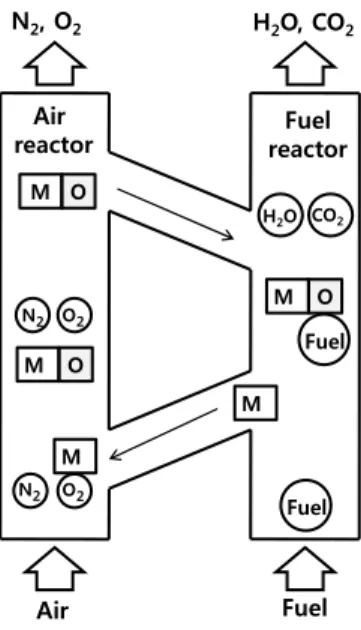
A circulaing fluidized-bed process which is consisted of two
interconnected fluidized-bed reactors, a fuel reactor and an air reactor, is usually used in a CLC process as shown in Fig. 1. An OC transfers oxygen from air to fuel while circulating between the two reactors. In the fuel reactor, the OC gives its oxygen to the fuel for fuel combustion. The fuel is oxidized and emits CO
2and H
2O. In the air reactor, the reduced OC is regenerated to oxidized state by receiving oxygen in the air supplied into the air reactor. The flue gas from the fuel reactor theoretically contains only CO
2and H
2O. Pure CO
2can be obtained after condensation of H
2O. Therefore, the OC requires excellent physical properties suitable for the fluidized-bed process applications and high oxygen transfer performance for complete combustion of fuel.
Long term durability to endure cyclic redox reaction at high temperatures is also important to be a quality OC.
An OC is composed of acive metal and support. The active
metal transfers oxygen and the support enhances physical and
chemical properties of OC such as porosity, surface area,
dispersion of metal oxide, and mechanical strength. Oxidized-
and reduced-forms of primary transition metal, NiO-Ni, Mn
3O
4-
MnO, Fe
2O
3-Fe
3O
4, and CuO-Cu, are commonly studied forms
of active metal for CLC of gaseous fuels in a temperature range
of 800 to 1200 °C . The oxygen ratios of each pair are 21.4, 7.0,
3.3, and 20.1, respectively. NiO has been the most extensively
studied metal oxide for CLC because it has high oxygen ratio and
NiO-based OCs have high oxygen transfer capacity, good
reactivity, and superior physical properties [4][5]. However, NiO
is expensive and a small amount of CO and H
2is emitted in the outlet gas of the fuel reactor due to the thermodynamic restrictions [6][7]. Although CuO has high oxygen ratio and the capability of complete fuel conversion to CO
2and H
2O, low melting temperature of Cu, 1085 C, inhibits its use. Fe
2O
3is cheap and environmently safe, but the amount of transferable oxygen is small and its reactivity with CH
4is poor. Mn
3O
4has relatively high oxygen ratio. It can fully convert CH
4to CO
2and H
2O and has good reactivity [7][8]. Morevoer, it is inexpensive and non-toxic.
Several inorganic materials such as Al
2O
3, SiO
2, TiO
2, or ZrO
2, etc. were tested as suppot matrials for above metal oxides.
The test results were well summarized in the literature [9][10].
The use of Al
2O
3resulted in high reactivity with fuel gases and good physical properties on the NiO-, CuO-, Fe
2O
3-based OCs.
SiO
2was suitable for CuO-based OCs and TiO
2was recommendable for CuO-, Fe
2O
3-based OCs. Most metal oxides supported on ZrO
2showed good reactivity, but poor mechnical stability. In Mn-based OC, particles derived from ZrO
2stabilized with MgO showed good reactivity and physical stability. On the whole, alumina was well machted with most metal oxides as a support material. Structurally less-stable alumina like -Al
2O
3forms metal compounds such as NiAl
2O
4, CuAl
2O
4, FeAl
2O
4, and MnAl
2O
4, after calcination due to the strong metal-support interaction [11][12]. The reactivity of NiAl
2O
4and MnAl
2O
4is poor [13][14] while CuAl
2O
4has similar reduction reaction rate to that of CuO [12]. FeAl
2O
4had positive effect on the oxygen transfer capacity of Fe-based OCs. Structurally more stable materials such as -Al
2O
3and MgAl
2O
4have been tested to lessen the metal-support interaction.
An OC can be prepared by physical mixing, impregnation, and spray drying method. Among them, spray drying is the most suitable method to produce a large amount of OC with spherical shape for the devlopment of MW or larger scale CLC processes.
The result of the tests on the OCs prepared by laboratorial preparation method such as physical mixing and impregnation is not always consistent with that by spray drying method as shown in our previous works [15][16]. This is due to that a high proportion of metal oxide is preferred in the spray drying method.
Therfore, support materials for spray-drying method should be
searched for or tested separately, along with the study by the laboratorial preparation methods.
In this paper, Mn-based OCs were designed using sructurally less-stable and stable raw support materials to develop low-cost OCs. The designed OCs were prepared by spray drying method and their performances were investigated in terms of the physical properties and reactivity to determine whether the support materials used are suitable for spray-dried Mn-based OC. Different calcination temperatures by the type of raw support materials were applied to obtain sufficient mechanical strength and the resultant physical characteristics were analyzed. The combustion performance was measured using CH
4, CO, and H
2as fuel gases.
The best support material among the tested ones and future works were suggested based on the results of this work.
II. EXPERIMENTAL
A. Preparation of oxygen carriers
Commercially available powder-type Mn
3O
4was well- mixed with support materials in pure water. -Al
2O
3was used as structurally less-stable raw support material and -Al
2O
3and MgAl
2O
4were used as structurally stable ones. -Al
2O
3turns to
-Al
2O
3by structure change when it was calcined above 1100 C.
The ratio of Mn
3O
4to support was 7 : 3 on the dry weight basis.
During the mixing of solid powder, an organic dispersant was added to prevent the agglomeration of the solid powder. The suspension was comminuted with a ball mill to make a homogeneous colloidal slurry. The homogenized slurry was sprayed throuhg a nozzle positiond in the center of hot chamber to form spherical particles, i.e., green body. The green body was calcined at targetted temperatures in a muffle oven for 5 h after pre-drying at 120 C overnight. The prepared OCs were designated by abbreviation implying information on the proportion of Mn
3O
4, the raw support material and the calcination temperature. GA, AA, and MA in the names of the OCs mean γ-Al
2O
3, -Al
2O
3, and MgAl
2O
4, respectively. For example, “Mn70GA-900” indicates that the OC was prepared using 70 wt% Mn
3O
4and 30 wt% γ- Al
2O
3, and was calcined at 900 C for 5 hours.
B. Characterization of oxygen carriers
The spray-dried OCs were characterized by the physical properties related to fluidization and reactivity. After calcination, the mechanical strength, or attrition resistance, was measured first to decide whether the prepared OC can be used in an actual CLC process. A three-hole air-jet attrition test apparatus based on American Society for Testing and Materials (ASTM) D 5757-95, which is the standard fluidized-bed test method for determination of attrition and abrasion of powdered catalysts, was used to measure the attrition resistance of the prepared OCs. The attrition resistance was determined at 10 slpm over 5 hours, as described in the ASTM method. The attrition index (AI), or attrition loss is the percentage of fines generated over 5 hours. The fines are particles collected at the thimble, which was attached to the gas outlet.
AI = [amount of total fine collected for 5 hours/amount of initial
sample (50 g)] 100% (1)
Lower AI values indicate better attrition resistance of the
Fig. 1. Schematic of chemical looping combustion process (M: metal, O: oxygen).
Air
reactor Fuel
reactor
Air Fuel
N2, O2 H2O, CO2
O
Fuel Fuel M
M M
N2 O2 N2 O2 O M
O M H2O CO2
bulk particles. The AI of the commercial fluid-catalytic-cracking (FCC) catalyst, Akzo, was 22.5% and it was used as a comparison standard.
The shape and surface image of the OCs were obtained by a field emission scanning electron microscope (FE-SEM; JOEL JSM 6400). The particle size distribution and average particle size of the sample were measured following ASTM E-11.
Autotap instrument (Quantachrome) described in ASTM D 4164- 88 was used to measure the packing density of the sample.
Brunauer-Emmett-Teller (BET) surface area of the sample was determined by N
2physisorption using an ASAP 2420 (Micro meritics Inc.) automated system. Porosity and the distribution of pore volume by pore size were calculated from Hg intrusion data collected with an AutoPore IV 9500 (Micromeritics Inc.).
C. Reactivity investigation in TGA
The OCs with sufficient mechanical strength were selected for the oxygen transfer reactivity test. The cyclic reaction data on reduction and oxidation of OCs were obtained using thermo- gravimetric analyzer (TGA; Thermo Cahn, TherMax500) under ambient pressure. Approximately 30 mg of sample was placed on the alumina crucible and heated up to 950 C in a nitrogen atmosphere. 10 vol% CH
4balanced with CO
2, 40 vol% CO balanced with CO
2, or 40 vol% H
2balanced with CO
2were used for a fuel gas and air was used to oxidation of the reduced OC.
After each reduction and oxidation reaction, N
2was introduced to prevent direct contact of gaseous fuels and air. The total flow rate of gases was kept at 0.3 slpm. For the OCs with very slow reaction rate, the fuel or air was switched to N
2after 30 minutes from the beginning of the reaction.
The oxygen transfer reactivity was analyzed in terms of oxygen transfer capacity and oxygen transfer rate. Oxygen transfer capacity is the maximum percentage of oxygen mass transferable to a fuel under a given experimental condition. It is calculated on the basis of the mass of the fresh OC in its fully- oxidized state. For example, if 5 g of oxygen is transferred to a fuel at the end of reduction from 100 g of a fully oxidized fresh OC under a given experimental condition, the oxygen transfer capacity of the OC is 5 wt%. The degree of conversion, X, of an OC is defined as:
x = (2)
where m is the instantaneous mass of an OC measured by the TGA. m
0and m
redare the theoretical masses of the OC in its fully- oxidized and fully-reduced state, respectively. The denominator of Eq. 2, the weight difference between m
0and m
red, is the theoretical maximum amount of oxygen that can be transferred to a fuel. Oxygen utilization is percentage of the mass of oxygen
actually transferred to a fuel among the total mass of oxygen transferable to a fuel. A mass-based conversion, , was used to compare the mass change as a function of time. It is defined as:
ω = (3)
The oxygen transfer rate is expressed as the mol of transferred oxygen per unit kilogram of OC per unit time (mol O/kg/s).
III. RESULTS AND DISCUSSION
A. Physical properties
The physical properties measured by the standard test methods were summarized in Table 1. The most important property is mechanical strength, or attrition loss. The AI values were quite different even at the same calcination temperature, depending on the raw support materials used. The OC prepared from γ-Al
2O
3showed the highest mechanical strength at the same calcination temperature. Even at the calcination temperature of 900 C, it showed much higher mechanical strength than the commercial FCC catalyst, Akzo. In comparison, The OCs prepared from -Al
2O
3and MgAl
2O
4required 1200 and 1400 C, respectively, to obtain high mechanical strength less than 10% in AI value. This resulted from the fact that the structurally less- stable material, γ-Al
2O
3, strongly interact with active metal oxide, Mn
3O
4, even at a lower calcination temperature while structurally stable materials, -Al
2O
3and MgAl
2O
4, have loose interaction with Mn
3O
4. Therefore, they required a much higher calcination temperature to obtain sufficent mechanical strength by the binding of raw materials.
The average particle size of the OCs was 120±15 m and tapped density was 2.0±0.5 g/mL, which are suitable range for fluidization of particles. All OCs with high mechanical strength, or AI values less than 10%, had very low BET surface area below 0.5 m
2/g. Their porosity were also not high. Mn70GA-900 only had a little high surface area and porosity. The majority of the pore volume of all OCs was contributed by macropore as given in Table 2. Well developed macropore and mesopore will enhance the transport of the reactant gases.
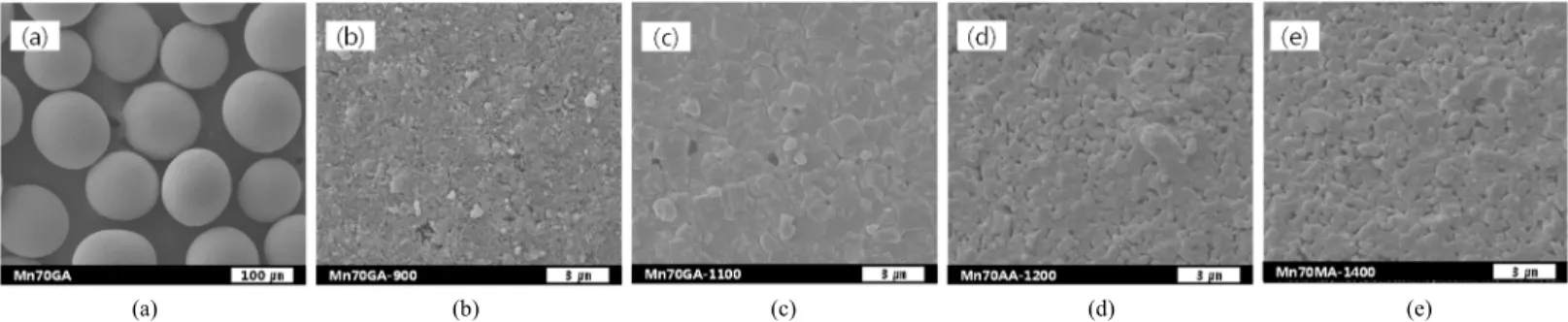
All OCs had sphere-like shape as shown in Fig. 2(a) as an example. Spherical or sphere-like shape is preferred in fluidization process to reduce attrition loss. The surface image of Mn70GA calcined at 900 C, Fig. 2(b), revealed that the grains of raw materials still maintained their body shapes although they combined each other. However, in Mn70GA calcined at 1100 C the grains grew to form bigger crytalloid structures as shown in Fig. 2(c). Mn70AA and Mn70MA calcined at 1200 and 1400 C,
Table 1. Physical properties of the spray-dried Mn3O4 oxygen carriers Oxygen
carrier
Composition of raw materials
(wt%)
Calcination temperature
(°C)
Average particle size (m)
Tapped density (g/mL)
BET surface area
(m2/g)
Specific pore volume1) (mL/g)
Hg porosity (%)
Attrition Index (%) Total Mesopore Macropore
Mn70GA Mn3O4 (70),
γ-Al2O3 (30), 900
1100 123
111 1.5
2.5 9.2
0.3 0.18
0.00 0.01
0.00 0.17
0.001 21.0
0.3 11.1 0.2 Mn70AA Mn3O4 (70),
-Al2O3 (30)
1100
1200 -
133 -
2.1 -
0.3 -
0.04 -
0.00 -
0.04 -
6.5 86.3 7.5 Mn70MA Mn3O4 (70),
MgAl2O4 (30) 1300
1400 -
113 -
1.7 -
0.2 -
0.03 -
0.00 -
0.03 -
4.8 27.2 9.4
1) Calculated from Hg intrusion data
respectively, also showed grain growth through the combining of the raw grains as shown in Fig. 2(d)(e). As expected from the attrition loss test results, grain growth was observed in OCs with high mechanical strengh.
B. TGA reactivity
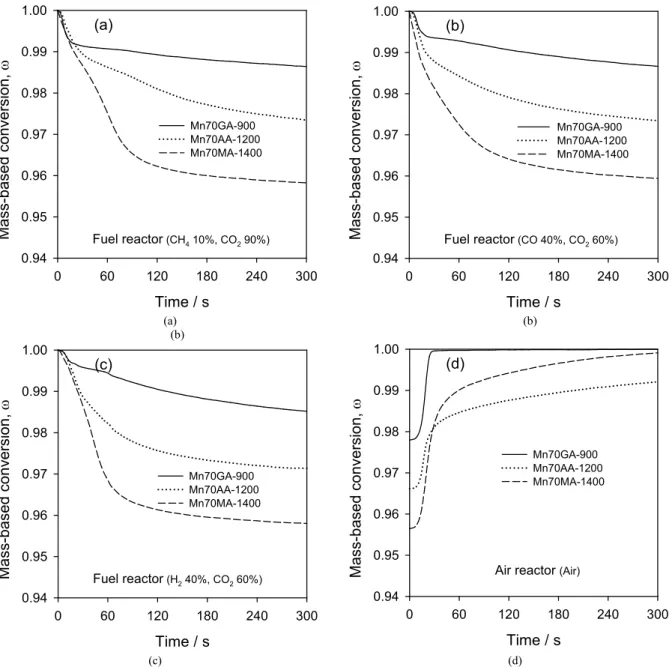
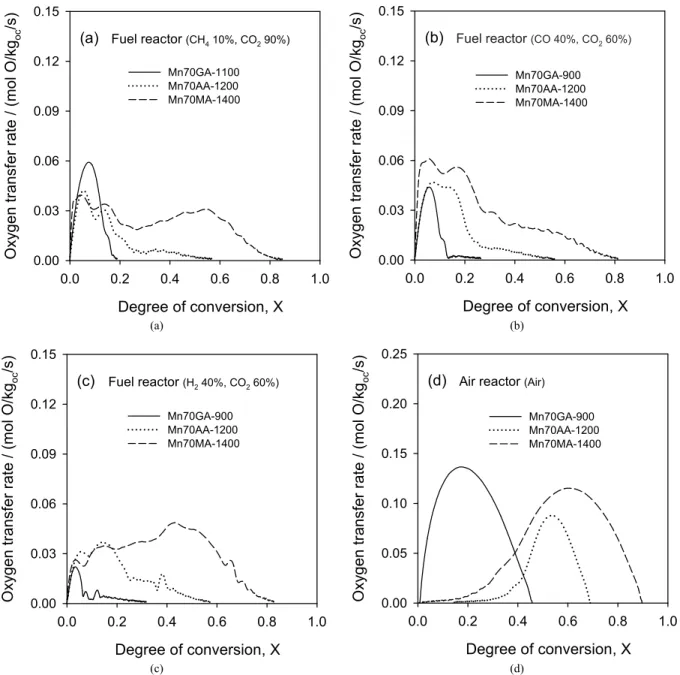
The TGA reactivity tests were performed for the OCs with sufficient mecahnical strength, Mn70GA-900, Mn70AA-1200, and Mn70MA-1400. The mass-based conversion as a function of reaction time and oxygen transfer rate as a function of degree of conversion (X) are presented in Fig. 3 and Fig. 4, respectively.
The oxygen transfer capacities of Mn70GA-900, Mn70AA-1200, and Mn70MA-1400 for 30 minutes were 2.3, 3.4, and 4.4 wt%, respectively, by H
2. The theoretical maximum oxygen transfer capacity of an OC containing 70 wt% Mn
3O
4is 4.9 wt% at 950
C in the Mn
3O
4MnO system. Therefore, Mn70GA-900 and Mn70AA-1200 transferred only 46.9% and 69.4%, respectively, among their transferrable oxygen.
The oxygen transfer capacities of Mn70GA-900 for 30 minutes were 1.9, 2.1 and 2.3 wt% for CH
4, CO, and H
2, respectively. For all fuel gases, they were the lowest capacities among the three OCs in spite of its higher porosity and BET surface area. Mn70GA-900 reacted with CH
4most rapidly even though the driving force of gas diffusion by fuel concentration is lower in 10% CH
4than that in 40% CO or 40% H
2. From the graphs of Mn70GA-900 in Fig. 4(a)-(c), it was observed that the highest oxygen transfer rate appeared at the degree of conversion
(X) below 0.1. The oxidation reaction completed within 30 seconds. This means that oxygen exposed on the surface of the OC reacted fast with fuel, and then the oxygen hardly transported from inside of the grain to the surface.
The oxygen transfer capacities of Mn70AA-1200 for 30 minutes were 3.3, 3.2 and 3.4 wt% for CH
4, CO, and H
2, respectively. Mn70AA-1200 showed higher oxygen transport capacity than Mn70GA-900. Oxygen was transferred to fuel steadily at the degree of conversion below 0.6 and the highest oxygen transfer rate appeared at the degree of conversion around 0.1, as shown in Fig. 4(a)-(c). Oxygen transfer rate sharply decreased at the degree of conversion around 0.2. After 30 or 40 % of the transferable oxygen reacted fast, oxygen transport proceeded slowly in both reduction and oxidation.
The oxygen transfer capacities of Mn70MA-1400 for 30 minutes were 4.4 wt% for all fuel gases. Mn70MA-1400 showed the highest oxygen transfer capacity among the three OCs. Most of the transferable oxygen reacted with fuel within 2 minutes. In the reaction with CH
4and H
2, high oxygen trasfer rate was still maintained even at the degree of conversion around 0.5. This indicates that the oxygen inside of the grain moves easily to the surface even after more than half of the transferable oxygen was exhausted. These characteristics should be considered when a CLC process is designed using Mn70MA-1400.
The oxidation of the reduced OCs proceeded more rapidly compared to the reductuion. Most of the transferable oxygen was absorbed into the OCs within one minute. Although oxygen transfer capacity of Mn70GA-900 is lower than those of Mn70AA-1200, and Mn70MA-1400, Mn70GA-900 showed the highest oxygen trnasfer rate in oxidation. The higher oxygen transfer rate appeared in the latter half of the oxidation reaction for Mn70GA-900, while it was observed in the first half for Mn70AA-1200, and Mn70MA-1400, as shown in Fig. 4(d). The highest oxygen transfer rates in oxidation were almost two times higher than those in reduction, as given in Table 2 and 3. Although the exact reason for this is unclear right now, it is estimated that the dissimilar reaction patterns between OCs resulted from the differences in the chemical state of the active metal and physical structure of the OCs. It should be clarified through further study.
The reaction chateristics obtained in this work on the spray-dried Mn-based OCs can be usefully utilized in the design of CLC processes.
IV. CONCLUSIONS
To develop a low-cost OC, Mn-based spray-dried OCs were prepared with different raw support materials, -Al
2O
3and - Al
2O
3, and MgAl
2O
4. The OC prepared from the structurally less-
(a) (b) (c) (d) (e) Fig. 2. SEM images of the spray-dried Mn3O4 Oxygen carriers. (a) Mn70GA, (b) Mn70GA-900, (c) Mn70GA-1100, (d) Mn70AA-1200, (e) Mn70MA-1400.
Table 2. Oxygen transfer capacity and the highest oxygen transfer rate in reduction at 950 °C
Oxygen carrier Oxygen transfer capacity (wt%)
The highest oxygen transfer rate (mol O/kgoc/s) CH4 10%,
CO2 90% CO 40%,
CO2 60% H2 40%, CO2 60% CH4
10%, CO2
90%
CO 40%, CO2
60%
H2
40%, CO2
60%
30 s 300 s 30 s 300 s 30 s 300 s
Mn70GA-900 0.9 1.4 0.7 1.3 0.4 1.5 0.059 0.043 0.022 Mn70AA-1200 1.1 2.6 1.2 2.7 1.2 2.9 0.042 0.047 0.037 Mn70MA-1400 1.3 4.1 1.9 4.1 1.4 4.2 0.039 0.061 0.049 Table 3. Oxygen transfer capacity and the highest oxygen transfer rate in
oxidation at 950 °C
Oxygen carrier
Oxygen transfer capacity
(wt%) The highest oxygen transfer rate
(mol O/kgoc/s )
Air Air
30 s 300 s
Mn70GA-900 2.2 2.2 0.137
Mn70AA-1200 1.5 2.6 0.087
Mn70MA-1400 2.5 4.3 0.115
stable raw support material, -Al
2O
3, exhibited sufficient mechanical strength at lower calcination temperatures compared to the OCs prepared from structurally stable raw support materials, -Al
2O
3, and MgAl
2O
4. The OC prepared from - Al
2O
3showed the worst oxygen transfer performance although it has higher porosity and surface area. Among the three OCs, the OC prepared from MgAl
2O
4had the best oxygen transfer reactivity for all fuel gases, CH
4, CO, and H
2. It had high oxygen transfer capacity of 4.4 wt%, utilizing around 90% of theoretically tranferable oxygen, and higher reaction rate. For all OCs, oxidation proceeded more rapidly than reduction. The experimental results of this work suggest that MgAl
2O
4can be a recommendable support material for Mn-based OCs prepared by spray drying method. However, the OC prepared from MgAl
2O
4required a high calcination temperature of 1400 °C to obtain strong mechnical strength. Therefore, further studies are needed to find out new support compositions which can reduce the calcination temperature with maintaining or improving the
oxygen transfer performance.
ACKNOWLEDGEMENT
This work was supported by the Energy Efficiency &
Resources Programs of the Korea Institute of Energy Technology Evaluation and Planning (KETEP), granted financial resources from the Ministry of Trade, Industry & Energy (MOTIE) and Korea Electric Power Corporation (KEPCO), Republic of Korea (20152010201840).
REFERENCES
[1] Ishida, M. and Jin, H., “A Novel Chemical-Looping Combustor without NOx Formation,” Ind. Eng. Chem. Res., 35, pp. 2469–
2472, 1996.
[2] Lyngfelt, A., Leckner B., and Mattisson, T., “A Fluidized-bed
Time / s
0 60 120 180 240 300
Mass-based conversion,
0.94 0.95 0.96 0.97 0.98 0.99 1.00
Mn70GA-900 Mn70AA-1200 Mn70MA-1400
Fuel reactor (CH4 10%, CO2 90%)
(a)
Time / s
0 60 120 180 240 300
Mass-based conversion,
0.94 0.95 0.96 0.97 0.98 0.99 1.00
Mn70GA-900 Mn70AA-1200 Mn70MA-1400
Fuel reactor (CO 40%, CO2 60%)
(b)
(a) (b)
(b)
Time / s
0 60 120 180 240 300
Mass-based conversion,
0.94 0.95 0.96 0.97 0.98 0.99 1.00
Mn70GA-900 Mn70AA-1200 Mn70MA-1400
Fuel reactor (H2 40%, CO2 60%)
(c)
Time / s
0 60 120 180 240 300
Mass-based conversion,
0.94 0.95 0.96 0.97 0.98 0.99 1.00
Mn70GA-900 Mn70AA-1200 Mn70MA-1400
Air reactor (Air)
(d)
(c) (d)
Fig. 3. Mass-based conversion of the spray-dried Mn3O4 oxygen carriers as a function of reaction time at 950 °C using (a) CH4 10% and CO2 90%, (b) CO 40% and CO2
60%, (c) H2 40% and CO2 60% in the fuel reactor, (d) air in the air reactor.
combustion process with inherent CO2 separation; application of chemical-looping combustion,” Chem. Eng. Sci., 56, pp. 3101–
3113, 2001.
[3] Kronberger, B., Johansson, E., Löoffler, G., Mattisson, T., Lyngfelt, A., and Hofbauer, H., “A Two-Compartment Fluidized Bed Reactor for CO2 Capture by Chemical-Looping Combustion,”
Chem. Eng. Technol., 27, pp. 1318–1326, 2004.
[4] Ryu, H.-J. and Jin, G.-T., “Criteria for Selection of Metal Component in Oxygen Carrier Particles for Chemical-Looping Combustor,” Korean Chem. Eng. Res., 42, pp. 588–597, 2004.
[5] Jin, H., Okamoto, T., and Ishida, M., “Development of a Novel Chemical-Looping Combustion: Synthesis of a Solid Looping Material of NiO/NiAl2O4,” Ind. Eng. Chem. Res., 38(1), pp. 126–
132, 1999.
[6] Gayan, P., de Diego, L. F., Garcia-Labiano, F., Adanez, J., Abad, A., and Dueso, C., “Effect of support on reactivity and selectivity of Ni-Based oxygen carriers for chemical-looping combustion,”
Fuel, 87(12), pp. 2641–2650, 2008.
[7] Jerndal, E., Mattisson, T., and Lyngfelt, A., “Thermal Analysis of Chemical-Looping Combustion,” Chem. Eng. Res. Des., 84(A9),
pp. 795–806, 2006.
[8] Abad, A., Mattisson, T., Lyngfelt, A., and Ryden, M., “Chemical looping combustion in a 300 W continuously operating reactor system using a manganese-based oxygen carrier,” Fuel, 85(9), pp.
1174–1185, 2006.
[9] Fang, H., Haibin, L., and Zengli, Z., “Advancements in Developments of Chemical-Looping Combustion: A Review,”
International Journal of Chemical Engineering, Volume 2009, Article ID 710515, 2009.
[10] Adanez, J., Abad, A., Garcia-Labiano, F., Gayan, P., and de Diego, L. F., “Progress in Chemical-Looping Combustion and Reforming technologies,” Prog. Energ. Combust., 38, pp. 215–282, 2012.
[11] Ryu, H.-J., Lim, N. Y., Bae, D. H., and Jin, G.-T., “Carbon Deposition Characteristics and Regenerative Ability of Oxygen Carrier Particles for Chemical-Looping Combustion,” Korean J.
Chem. Eng., 20(1), pp. 157–162, 2003.
[12] Chuang, S. Y., Dennis, J. S., Hayhurst, A. N., Scott, S. A.,
“Development and performance of Cu-based oxygen carriers for chemical-looping combustion,” Combust. Flame, 154, pp. 109–121, 2008.
Fuel reactor (CH4 10%, CO2 90%)
Degree of conversion, X
0.0 0.2 0.4 0.6 0.8 1.0
Oxygen transfer rate / (mol O/kgoc/s) 0.00 0.03 0.06 0.09 0.12 0.15
Mn70GA-1100 Mn70AA-1200 Mn70MA-1400
(a)
Fuel reactor (CO 40%, CO2 60%)Degree of conversion, X
0.0 0.2 0.4 0.6 0.8 1.0
Oxygen transfer rate / (mol O/kgoc/s) 0.00 0.03 0.06 0.09 0.12 0.15
Mn70GA-900 Mn70AA-1200 Mn70MA-1400
(b)
(a) (b)
Fuel reactor (H2 40%, CO2 60%)
Degree of conversion, X
0.0 0.2 0.4 0.6 0.8 1.0
Oxygen transfer rate / (mol O/kgoc/s) 0.00 0.03 0.06 0.09 0.12 0.15
Mn70GA-900 Mn70AA-1200 Mn70MA-1400
(c)
Air reactor (Air)Degree of conversion, X
0.0 0.2 0.4 0.6 0.8 1.0
Oxygen transfer rate / (mol O/kgoc/s) 0.00 0.05 0.10 0.15 0.20 0.25
Mn70GA-900 Mn70AA-1200 Mn70MA-1400
(d)
(c) (d)
Fig. 4. Oxygen transfer rate of the Mn-based spray-dried oxygen carriers as a function of degree of conversion at 950 °C using (a) CH4 10% and CO2 90%, (b) CO 40%
and CO2 60%, (c) H2 40% and CO2 60% in the fuel reactor, (d) air in the air reactor.
[13] Villa, R., Cristiani, C., Groppi, G., Lietti, L., Forzatti, P., Cornaro, U., and Rossini, S., “Ni based mixed oxide materials for CH4
oxidation under redox cycle conditions,” J. Mol. Catal. A: Chem., 204-205, pp. 637–646, 2003.
[14] Mattisson, T., Jardnas, A., and Lyngfelt, A., “Reactivity of Some Metal Oxides Supported on Alumina with Alternating Methane and Oxygen: Application for Chemical-Looping Combustion,” Energy Fuels, 17(3), pp. 643–651, 2003.
[15] Baek, J.-I., Ryu, C. K., Lee, J. H., Eom, T. H., Lee, J. B., Ryu, H.- J., Ryu, J., and Yi, J. “The effects of using structurally less-stable raw materials for the support of a spray-dried oxygen carrier with high NiO content,” Fuel, 102, pp. 106–114, 2012.
[16] Baek, J.-I., Yang, S.-R., Eom, T. H., Lee, J. B., and Ryu, C. K.,
“Effect of MgO addition on the physical properties and reactivity of the spray-dried oxygen carriers prepared with a high content of NiO and Al2O3,” Fuel, 144, pp. 317–326, 2015