Vol. 20, No. 9 (2010)
451
†Corresponding author
E-Mail : [email protected] (C. M. Whang)
Gas Permeation of SiC Membrane Coated on Multilayer γ-Al2O3
with a Graded Structure for H2 Separation
Mi Young Yoon, Eun Yi Kim, Younghee Kim* and Chin Myung Whang†
Department of Materials Science and Engineering, Inha University, 253 Yonghyun-dong, Nam-gu, Incheon 402-751, Korea
*Eco-Materials Lab., Green Ceramics Division, Korea Institute of Ceramic Engineering and Technology, 233-5 Gasan-dong, Guemcheon-gu, Seoul 153-801, Korea
(Received August 5, 2010 : Received in revised form August 16, 2010 : Accepted August 17, 2010)
Abstract A promising candidate material for a H2 permeable membrane is SiC due to its many unique properties. A hydrogen-selective SiC membrane was successfully fabricated on the outer surface of an intermediate multilayer γ-Al2O3 with a graded structure. The γ-Al2O3 multilayer was formed on top of a macroporous α-Al2O3 support by consecutively dipping into a set of successive solutions containing boehmite sols of different particle sizes and then calcining. The boehmite sols were prepared from an aluminum isopropoxide precursor and heated to 80oC with high speed stirring for 24 hrs to hydrolyze the precursor. Then the solutions were refluxed at 92oC for 20 hrs to form a boehmite precipitate. The particle size of the boehmite sols was controlled according to various experimental parameters, such as acid types and acid concentrations. The topmost SiC layer was formed on top of the intermediate γ-Al2O3 by pyrolysis of a SiC precursor, polycarbosilane, in an Ar atmosphere. The resulting amorphous SiC-on-Al2O3 composite membrane pyrolyzed at 900oC possessed a high H2 permeability of 3.61× 10⁻⁷ mol·m−2·s−1·Pa−1 and the H2/CO2 selectivity was much higher than the theoretical value of 4.69 in all permeation temperature ranges. Gas permeabilities through a SiC membrane are affected by Knudsen diffusion and a surface diffusion mechanism, which are based on the molecular weight of gas species and movement of adsorbed gas molecules on the surface of the pores.
Key words boehmite sol, polycarbosilane, SiC membrane, H2/CO2 separation.
1. Introduction
The increased demand for pure hydrogen (H2) as a clean, renewable and environment friendly future energy source has led to a wide interest in separation methods for H2.1) An important step in producing pure H2 is separating it from CO containing gas mixtures (H2, CO, CO2 and steam) produced by high temperature reforming of hydrocarbons in industrial chemical processes. Development of inorganic membranes which have excellent properties under severe operational conditions holds the key to the successful economical production of molecular hydrogen.
There are various membranes such as silica, zeolite, Pd, carbon molecular sieves and so on.1-2) A Pd-dense membrane can separate high-purity H2 by ionic conduction mechanism; however, it has a low permeability.3-4) Porous membranes using zeolite and silica have high gas perme- ability and selectivity;5-8) however, the structure of the membranes becomes rapidly unstable at high temperature and under steam condition. Non-oxide ceramics such as silicon carbide (SiC) - and silicon nitride (Si3N4) - based
materials are promising for high temperature gas separation due to its high thermal and chemical stability. Therefore, we have studied SiC membrane, which is a covalent ma- terial with high mechanical strength, resistance in acidic and alkaline environments, chemical inertness and thermal stability. Thus, SiC is a promising candidate material for H2 permeable membrane applications at high temperature.
Several works on SiC-based membrane have been carried out. Takeda et al.9) synthesized SiC membrane coated on γ- Al2O3 tube by CVI (chemical vapor infiltration) technique using SiH2Cl2 and C2H2 gases. The H2 permeability of the membrane was 10−8mol·m−2·s−1·Pa−1 at 350oC, the H2/N2 selectivity was 3.36, which was lower than the theoretical Knudsen value of 3.74. Pages et al.10) fabricated SiC mem- brane coated on α-Al2O3 tube using PECVD technique inducing SiH2(C2H5)2 gas and they obtained the H2 perme- ability of 10−7-10−6mol·m−2·s−1·Pa−1, the H2/N2 selectivity of 3-4. CVI/CVD techniques can be applied at very high temperature and are difficult to control the quality of final products.11) To overcome these problems, preceramic method has been employed due to low cost, heat-treatment at relatively low temperature and easiness of synthesis.12-13) Interrante et al.14) measured the He permeability using SiC membrane obtained via the pyrolysis of a partially allyl-
substituted hydridopolycarbosilane. The He permeability was 10−8-10−7mol·m−2·s−1·Pa−1 at 200oC, the He/N2 selectivity was 20. Suda et al.15) synthesized SiC membrane on α- Al2O3 tube support by dip-coating technique through the pyrolysis of polycarbosilane with added polystyrene to form pores of the membrane. The H2 permeability was 1-3
× 10−8mol·m−2·s−1·Pa−1 at 100oC, the H2/N2 selectivity was 90-150. Morooka et al.16) fabricated SiC membrane by the pyrolysis of polycarbosilane using γ-Al2O3 as intermedi- ate layer on porous α-Al2O3 tube. The H2 permeability of the γ-Al2O3 was 2.25× 10⁻⁶mol·m−2·s−1·Pa−1 at 25oC, the that of the SiC membrane was 1.32× 10⁻⁶mol·m−2·s−1·Pa−1. Nagano et al.17) synthesized SiC membrane by the pyrolysis of polycarbosilane using γ-Al2O3 intermediate layer with twice dip-coating. The H2 permeability was 9× 10⁻⁶mol·m−2· s−1·Pa−1 at 600oC, the H2/N2 selectivity was lower than the theoretical Knudsen value.
The membranes for gas separation need to satisfy the following requirements to have effective gas separation properties of high permeability and selectivity; (a) thin thickness, (b) a defect-free and continuous structure, (c) small and uniform pore sizes, (d) support without per- meation resistance and (e) chemical stability.18) Therefore, the membranes for gas separation consist of three parts;
they are macroporous support having high mechanical strength, mesoporous intermediate layer being easy to control pore sizes and having thermal stability, and finally microporous separation layer having high chemical stability.
In general, intermediate layers with small and uniform pore size can be obtained by dipping into the solutions containing sol particles. If the particle size of sol is too small compared with the pore size of support, sol particles will easily infiltrate into the pores of support and do not form bridges between pores. On the other hand, if the particle size of sol is too large, sol particles will necessarily have interstitial spaces and not cover the surface uniformly.
Therefore, the effective intermediate layer with a graded structure can be obtained by using a large particle and then sequentially coating particles of smaller size on top.18)
In this study, we successfully synthesized amorphous SiC membrane on intermediate multilayer γ-Al2O3 with graded layers of total thickness ~2µm by the pyrolysis of polycarbosilane. The γ-Al2O3 layer was formed on top of a macroporous α-Al2O3 support by successively dipping into a series of solutions containing boehmite sols of different particle sizes and then calcining.
2. Experimental Procedure
A porous α-Al2O3 disk (diameter 30φ, thickness 2 mm) with 100 nm macropores was used as the supporter.
Boehmite (γ-AlOOH) sols were prepared using sol-gel method.18-19) Aluminum isopropoxide (98+%, Al(oC3H7)3,
Aldrich) was added to distilled water, which was kept at 80oC and stirred for 24hrs to hydrolyze isopropoxide and form boehmite precipitate. The molar ratio of water/alkoxide was 90 : 1. To control the particle size of boehmite sols, the precipitate was peptized using a quantity of acetic acid (99.7%, CH3COOH, Aldrich) or nitric acid (70%, HNO3, Aldrich) with a molar ratio of acid/alkoxide in the range of 0.10-0.70. The boehmite sol was refluxed at 92oC for 20hrs to get clear or slightly translucent sol. pH meter and dynamic light scattering (DLS, Model: ELS-8000, Otsuka Electronics Co. LTD) were used to measure pH and particle size distribution of the boehmite sols, respectively.
Intermediate γ-Al2O3 multilayer was prepared on a macroporous α-Al2O3 support by dipping-calcining method.
Dipping solutions were prepared with a polyethylene glycol (PEG, MW: 10,000, Fulka) as the binder. After the α-Al2O3 disk was dipped into the dipping solution, the support was dried overnight in air and calcined at 650oC for 2hrs. The γ-Al2O3 multilayer with a graded structure was prepared using the particle size-controlled boehmite - 500 nm, 250 nm and 50 nm - sols. The dipping-drying-calcining process was repeated three times.
Polycarbosilane (NIPUSI Type A, Nippon Carbon Co.) was used for the synthesis of amorphous SiC mem- branes.12,20) Polycarbosilane precursor was dissolved in toluene (99.8%, C6H5CH3, Aldrich) to make the poly- carbosilane 20wt% solution. The γ-Al2O3 intermediate layer coated on the macroporous α-Al2O3 support was dipped into the polycarbosilane solution. After overnight drying, the membrane was cured at 200oC for 1hr in the air for high yield of SiC ceramics.21) The membrane was heated from 200oC to 900oC with rate of 5oC/min and then pyrolyzed at 900oC for 2hrs under Ar atmosphere.
Thermal decomposition of the polycarbosilane up to 1000oC in nitrogen with a heating rate of 5oC/min was measured by thermogravimetry-differential thermal analysis (TG-DTA, Model: Diamond TG/DTA 6300 Lab System, Perkin Elmer). Heat treatment of boehmite powder causes the formation of a number of phase transition, and transi- tion phase was investigated through X-ray diffraction (XRD, Model: DMAX-2500, Rigaku) using CuKα radi- ation. Changes in the chemical structure during pyrolysis process of the polycarbosilane were determined by a Fourier transform infrared spectroscope (FT-IR, Model: VERTEX 80V, Bruker). KBr disk was prepared by compressing a finely ground mixture with a weight ratio of KBr/sample powder in 40 : 1. Cross-sectional structure of the amorphous SiC membrane on the γ-Al2O3-coated α-Al2O3 porous support was observed by a scanning electron microscope (SEM, Model: S-4300, Hitachi). The gas permeation prop- erties of the resultant membranes were investigated using H2, CO, N2 and CO2 single-component gases at permeation temperature of 25-700oC.
3. Results and Discussion
3.1 Crystalline phase analysis of boehmite
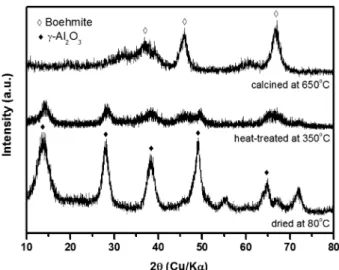
Fig. 1 shows the typical XRD patterns of the powders peptized with acetic acid with acid/alkoxide molar ratio of 0.10 at various heat-treatment temperatures. The XRD peaks of the powder dried at 80oC for 24hrs appeared at 2θ = 14o (020), 28o (120), 38o (031), 49o (200), 65o (080).
These peaks agree with the crystalline peaks of the boehmite phase. The intensity of boehmite peaks of the powder heat-treated at 350oC for 2hrs was extremely weak due to the transformation of boehmite to γ-Al2O3 phase.
The crystalline peaks of the powder calcined at 650oC for 2hrs appeared at 2θ = 37o (311), 46o (400), 67o (440). From these results, it is apparent that the boehmite to γ-Al2O3 transformation is complete.22)
3.2 Effects of synthesis parameters on particle size of boehmite sols
The formation of stable colloidal boehmite sols strongly depends on various experimental variables such as alkoxide- water ratio, hydrolysis temperature and time, acid concen- tration, acid type and aluminum source. Table 1 and Fig. 2 show pH and particle size distribution of boehmite sols peptized with acetic acid or nitric acid with various molar ratios of acid/aluminum alkoxide (R = 0.10-0.70) at 92oC for 20hrs. Fig. 2 is the particle size distribution of boehm- ite sols peptized with different acid types and concentra- tions. While the aluminum alkoxide was hydrolyzed and polymerized, aluminum oxy hydroxide precipitate was formed simultaneously. When the acetic acid or nitric acid was added to the precipitates, boehmite sol became a transparent and stable suspension by peptization. H+ of acid charges the surface of the precipitates of sol causing them to repel each other, allowing the larger precipitates to
break up and form smaller particles through hydrolysis and condensation reactions.18) First, the effect of acid type was investigated. It was found that strong nitric acid gives much smaller particle size (50 nm) compared to weak acetic acid (500 nm). Also, acetic acid with different molar ratios of H+/alkoxide (R = 0.1 and 0.7) displayed considerable differences in the particle sizes, i.e., 500 nm and 250 nm respectively. Thus, lower acetic acid concentration produces larger size particles. Since the pore size of the bare Al2O3 support is 100 nm, a large particle size is required as the first layer of Al2O3 support.
3.3 Changes of physical/chemical structure of poly- carbosilane with various heat treatments
Fig. 3 shows the TG-DTA graphs of the as-received polycarbosilane under N2 atmosphere. The weight loss up to 240oC associated with an endothermic in the DTA trace occurred due to volatilization of the low molecular weight oligomers such as Si-H, C-H, Si-CH3 bonds and water.
The weight increase from 250oC to 550oC was caused by the oxidation of as-received polycarbosilane containing O2 and dehydrogenation or dehydrocarbonation condensation reaction. Above 550oC, organic side groups in the poly- carbosilane decomposed, resulting in weight loss. After Si-CH2-Si in the polycarbosilane started to convert into SiC at 800oC, amorphous SiC was formed around 900oC Fig. 1. The XRD patterns of the powders peptized with acetic acid
and then heat-treated at different temperatures.
Table 1. The pH of boehmite sols peptized with different acid types and concentrations.
Sample Peptization agent (acid)
Molar ratio of acid/alkoxide pH
1 CH3COOH 0.10 4.1
2 CH3COOH 0.70 3.6
3 HNO3 0.20 3.3
Fig. 2. The particle size distribution of boehmite sols peptized with different acid types and concentrations. In BS-X (Y) notation, BS stands for boehmite sol, X is molar ratio of acid/alkoxide and Y is peptization agent.
with no significant weight loss.20-21)
Fig. 4 shows the FT-IR spectra of the polycarbosilane heat-treated at various temperature conditions. The IR spectrum of an as-received polycarbosilane presented typ- ical absorption peaks due to Si-CH3 bending at 830 cm−1, CH2 bending of Si-CH2-Si at 1020 cm−1, Si-CH3 stretching at 1250 cm−1, Si-H stretching at 2100 cm−1 and C-H stretching of Si-CH3 at 2950 cm−1. The spectrum of the polycarbosilane cured at 200oC for 1hr in the air showed absorption peaks due to Si-O stretching at 1020 cm−1, C = O stretching at 1710 cm−1. During the cross-linking process in the air, mainly the Si-H and C-H groups having low bond energies in the polycarbosilane were attacked by oxygen, creating Si-O-Si and Si-O-C bonds as indi- cated by the decrease in the intensity of the Si-H, C-H and Si-CH3 bands. The spectrum of the polycarbosilane, which was cured at 200oC for 1hr in the air and then pyrolyzed at 500oC for 2hrs under Ar atmosphere, shows that Si-C bond due to decomposition of residul organic side groups did not yet occur. Finally, the spectrum of the polycarbosilane, which was cured at 200oC for 1hr in the air and pyrolyzed at 900oC for 2hrs under Ar atmosphere, shows that Si-C bond formation is complete as evidenced by the amorphous SiC absorption peak17,21) around 790 cm−1.
3.4 Microstructures of γ-Al2O3 multilayer and SiC composite membranes
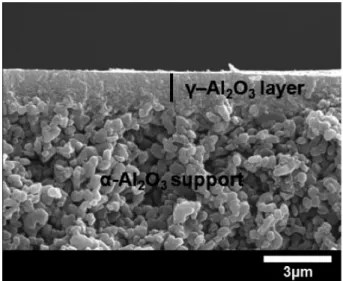
Fig. 5 shows the cross-section of γ-Al2O3 intermediate multilayer prepared by gradually changing particle size- controlled boehmite sols such as 500 nm, 250 nm and 50 nm, sequentially coated on the macroporous α-Al2O3 support. The top γ-Al2O3 layer had a finer structure than the other two layers below because of the use of a solution with smaller sol particles. Thickness of the membrane for gas separation greatly affects gas permeation properties. If
it is very thick, delamination of obtained separation layer occurs or gas permeability decreases. On the other hand, if it is very thin, gas selectivity decreases. Therefore, various dip-coating conditions of boehmite sols were tried and the following conditions were found to be optimal;
withdrawal speed = 0.5 mm/s, PEG concentration = 1wt%, contact time = 10s. The total thickness of the γ-Al2O3 membrane on the macroporous α-Al2O3 support was around 1.6µm. Fig. 6 shows the cross-section of the SiC membrane cured at 200oC and pyrolyzed at 900oC on the graded structural γ-Al2O3 through high magnification. A boundary between the graded structural γ-Al2O3 and the SiC membrane was clear and the thickness of the SiC membrane was about 300 nm.
Fig. 3. The TG-DTA traces of as-received polycarbosilane in nitrogen
atmosphere with a heating rate of 5oC/min. Fig. 4. The FT-IR spectra of as-received polycarbosilane heat-treated at various temperature conditions.
Fig. 5. The SEM image (magnification = 6,000×) of cross-section of γ-Al2O3 intermediate layer coated on the macroporous α-Al2O3 support.
3.5 Gas permeation properties of γ-Al2O3 multilayer and SiC composite membranes
Fig. 7 shows the H2, N2, CO and CO2 single-component gas permeabilities of the graded intermediate γ-Al2O3 coated on porous α-Al2O3 support in the permeation tem- perature range 25-700oC. The H2 gas permeability was about 1-7× 10⁻⁷mol·m−2·s−1·Pa−1, and the permeabilities of N2, CO and CO2 gases were about 2-7× 10⁻⁸mol·m−2· s−1·Pa−1. The H2 permeability value was one order of magnitude higher than those of other gases, whose perme- abilities had similar values. And permeabilities of these four gases using the graded intermediate γ-Al2O3 mem- brane decreased with increasing permeation temperature.
Generally, there are four transport mechanisms for gas separation of porous membrane; Knudsen diffusion, surface diffusion, molecular sieving and capillary condensation
with liquid flow. Among these mechanisms, the perme- ability of any gas via Knudsen diffusion mechanism is inversely proportional to the square root of its molecular weight and absolute temperature. So it seems that transport mechanism for the γ-Al2O3 membrane coated on porous α- Al2O3 support is Knudsen diffusion. To confirm circumstan- tially, gas permeation behavior of the γ-Al2O3 intermediate layer coated on porous α-Al2O3 support is shown in Fig.
8. The experimental values were plotted versus the inverse square root of molecular weight of various gases at per- meation temperature of 500oC. The permeability order of the gases via the γ-Al2O3 membrane coated on the α-Al2O3 support was H2> CO > N2> CO2 showing an inverse de- pendence on the molecular weight of the gases. Since differences in 1/M0.5 values of N2, CO and CO2 gases were very small, it was considered that their permeability values shown in Fig. 7 were very similar. Therefore, these facts indicate that the permeation behavior of the γ-Al2O3 mem- brane is well explained by Knudsen diffusion mech- Fig. 8. Gas permeance behavior of the γ-Al2O3 intermediate layer coated on a macroporous α-Al2O3 support.
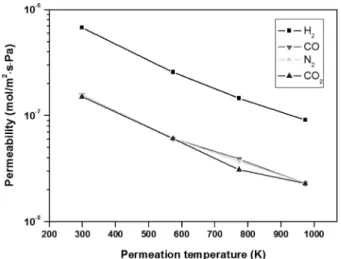
Fig. 9. Gas permeabilities of the SiC membrane with various per- meation temperatures.
Fig. 6. The SEM image (magnification = 3,000×) of cross-section of the SiC membrane coated γ-Al2O3 intermediate layer on the macro- porous α-Al2O3 support with high resolution (magnification
= 50,000×).
Fig. 7. Gas permeabilities of the γ-Al2O3 intermediate layer coated on a macroporous α-Al2O3 support with various permeation tem- peratures.
anism.17) The H2/CO and H2/N2 selectivities were larger than 3.74, which is calculated from molecular weights of gases. Also the H2/CO2 selectivity was similar to the theoretical Knudsen value of 4.69.
Fig. 9 shows the H2, N2, CO and CO2 single-component gas permeabilities of the SiC membrane cured at 200oC and pyrolyzed at 900oC on the graded structural γ-Al2O3 multilayer in the permeation temperature range 25-700oC.
All gas permeabilities using SiC membrane were lower than values through γ-Al2O3 membrane. The H2 gas permeability was from 3.6× 10⁻⁷mol·m−2·s−1·Pa−1 to 3.9× 10⁻⁸mol·m−2·s−1·Pa−1, the N2 and CO permeabilities were 10−7-10−9mol·m−2·s−1·Pa−1 in all permeation temperature ranges. Also permeabilities of these four gases decreased with increasing permeation temperature. The CO2 perme- ability was remarkably low, and the H2/CO2 selectivity was much higher than the theoretical value. Besides Knudsen diffusion mechanism, gas permeabilities through SiC mem- brane are affected by surface diffusion mechanism, which is based on movement of adsorbed gas molecules on the surface of the pores.24) So we suppose that chemical affinity between CO2 gas and the pore wall of the SiC membrane was weaker than those of other species. This result is identical with that for a SiC-based membrane formed by CVD of triisopropylsilane.25)
4. Conclusion
A H2 permeable SiC membrane was successfully syn- thesized coated on the γ-Al2O3 intermediate layer on a macroporous α-Al2O3 support through pyrolysis of poly- carbosilane at 900oC under Ar atmosphere. The graded structural γ-Al2O3 intermediate layer with a smooth and defect-free structure could be obtained from particle size- controlled boehmite sols by peptization. The H2 and CO2 permeabilities of SiC membrane at high permeation tem- perature were ~10−8mol·m−2·s−1·Pa−1 and close to 0, respect- ively. Therefore, the SiC membrane is expected to effectively separate H2 from gas mixtures.
Acknowledgement
The support of this work by Inha University is greatly appreciated.
References
1. T. M. Nenoff, R. J. Spontak and C. M. Aberg, MRS Bulletin, 31, 735 (2006).
2. N. W. Ockwig and T. M. Nenoff, Chem. Rev., 107, 4078 (2007).
3. T. S. Devarajan and P. N. Pintauro, Ind. Eng. Chem.
Res., 30, 585 (1991).
4. X. L. Pan, N. Stroh, H. Brunner, G. X. Xiong and S. S.
Sheng, Separ. Purif. Tech., 32, 265 (2003).
5. K. Kusakabe, S. Yoneshige, A. Murata and S. Morooka, J. Membr. Sci., 116, 39 (1996).
6. E. E. McLeary, J. C. Jansen and F. Kapteijn, Micropor.
Mesopor. Mat., 90, 198 (2006).
7. Y. Yoshino, T. Suzuki, B. N. Nair, H. Taguchi and N.
Itoh, J. Membr. Sci., 267, 8 (2005).
8. S. Gopalakrishnan, M. Nomura, T. Sugawara and S. -I.
Nakao, Desalination, 193, 230 (2006).
9. Y. Takeda, N. Shibata and Y. Kubo, J. Ceram. Soc. Jpn.
Int. Ed., 109, 305 (2001).
10. X. Pagès, V. Rouessac, D. Cot, G. Nanias and J. Durand, Separ. Purif. Tech., 25, 399 (2001).
11. R. J. Ciora, B. Fayyaz, P. K. T. Liu, V. Suwanmethanond, R. Mallada, M. Sahimi and T. Tsotsis, Chem. Eng. Sci., 59, 4957 (2004).
12. K. Okamura, Composites, 18, 107 (1987).
13. G. Pouskouleli, Ceram. Int., 15, 213 (1989).
14. L. V. Interrante, C. W. Whitmarsh and W. Sherwood, Mater. Res. Soc. Symp. Proc., 365, 139 (1995).
15. H. Suda, H. Yamauchi, Y. Uchimara, I. Fujiwara and K.
Haraya, Desalination, 193, 252 (2006).
16. K. Kusakabe, Z. Y. Li, H. Maeda and S. Morooka, J.
Membr. Sci., 103, 175 (1995).
17. T. Nagano, K. Sato, T. Saitoh and Y. Iwamoto, J. Ceram.
Soc. Jpn. Int. Ed., 114, 533 (2006).
18. Y. Gu and S.T. Oyama, J. Membr. Sci., 306, 216 (2007).
19. C. K. Lambert, and R. D. Gonzalez, Mater. Lett., 38, 145 (1999).
20. H. Suwardie, D. M. Kalyon and S. Kovenklioglu, J.
Appl. Polymer. Sci., 42, 1087 (1991).
21. H. Q. Ly, R. Taylor, R. J. Day and F. Heatley, J. Mater.
Sci., 36, 4037 (2001).
22. G. K. Priya, P. Padmaja, K. G. K. Warrier, A. D.
Damodaran and G. Aruldhas, J. Mater. Sci. Lett., 16, 1584 (1997).
23. A. J. Burggraaf and L. Cot, Fundamentals of Inorganic Membrane Science and Technology, p.150, Elsevier Science B. V., Amsterdam, Netherlands, (1996).
24. H. Takaba, K. Mizukami, M. Kubo, A. Stirling and A.
Miyamoto, J. Membr. Sci., 121, 251 (1996).
25. B.-K. Sea, K. Ando, K. Kusakabe and S. Morooka, J.
Membr. Sci., 146, 73 (1998).