Notes
Surface Modification of Carbon Black Using Polymer Resin Synthesized by a Phenyl Radical Reaction
Seungho Lee, Chul Hun Eum ' , and Woon Jung Kim*
Department of Chemistry, Hannam University, Daejeon 34430, Korea. ^E-mail: [email protected] 'Korea Institute of Geoscience and Mineral Resources, Daejeon 34132, Korea
(Received April 21, 2016; Accepted May 13, 2016)
Key words: Phenyl radical polymer, Carbon black, S 니 rface modification, Dispersion stability, Thermal stability
Carbon black (CB) has a variety of industrial uses due to its high strength and electrical conductivity. 1,2 It has been used in industry for almost 100 years, and over this period, new manufacturing methods and products have been devel
oped, leading to a constantly changing market for CB. 3 Currently, CB is widely used in semiconductors, tires, rub
ber, ink, paint, and toner resin. 4
The particle size and surface area of CB are important properties that affect the product performance. In general, CB for use in composites is composed of particles approx
imately 1,000-5,000 nm is size with a surface area of 20
100 m 2 /g; however, some CB grades, such as acetylene black, have surface areas of approximately 600 m 2 / gwhile maintaining particle sizes in this range. 5,6
In particular, CB (‘plasma black') particles produced using plasma have a relatively small particle size, and the CB particles typically range from 10 to 50 nm; correspondingly, plasma black has a relatively high surface area. Nowadays, plasma black has emerged as a core material in nanotech
nology and is of significant interest in various fields. In this study, we report the development of CB dispersions with improved thermal stability for use in a variety of applications, such as toner resins, nano inks, and the manufacture of composites. 7
In many fields, it is important that the CB is uniformly dispersed in the bulk material, i.e., bulk rubber or polymer. A uniform dispersion affects the final product properties, and thus, control over the dispersion is vital to produce a product with outstanding and distinctive properties. 8 However, because CB particles are small, they often aggregate together due to strong interparticle cohesion. Because the surface area and interparticle interaction increase with decreasing par
ticle size, it becomes difficult to uniformly disperse very small CB particles within a polymer matrix. 9 Consequently, it is necessary to develop a method to control the dispersion precisely. 10
In last few years, many studies have been conducted to develop a dispersion method for CB aggregates. 11 In gen
eral, these methods improve the degree of particle dispersion by reducing particle interactions through the addition of a dispersing agent or by surface modification of the particles, allowing dispersion of the CB particles in the matrix. 12 For example, a surfactant or a mixture of surfactants is com
monly used to achieve a stable dispersion. To modify the particle surfaces, the attractive interactions between par
ticles are reduced by grafting an amphiphilic polymer resin, which can be dispersed in aqueous solution, onto the par
ticle surface (Fig. 1). 13 In general, adding surfactant is easy, allowing applications in various industrial fields due to the low viscosity of the resultant dispersions. However, there are disadvantages; for example, adjustment to balance the surface charges is difficult and the stability of the dispersion can decrease due to environmental effects, such as temperature and pressure. In contrast, although surface modification by grafting an amphiphilic polymer resin onto the particle surface increases the viscosity, the process reduces envi
ronmental effects because strong chemical bonds are formed between the CB particles and the grafted polymer, and these are not affected by heat and pressure in the same way as surfactants adsorbed to the particle surface.
Various methods have been studied to modify the par
ticle surface, such as thermal, chemical, electrochemical, plasma treatment, and encapsulation methods, e.g., sur
face coating with organic/inorganic materials. 10 Chemical surface modification improves the dispersion stability of particles by grafting polymer resin chains onto the CB particle surface. 11,14 The polymers that can be used for this method include polystyrene derivatives, 12 polyethylene oxide, 13 polyamide amine, 15 polyethyl amine, 16 and poly- acrylate. 17
The objective of this study was to develop a modification
of the surface of CB particles to obtain CB dispersions
Figure 1. Particle dispersion achieved by adding a dispersing agent (surfactant) (a) or by surface modification (b).
with a high thermal stability for applications in industries requiring the thermal processing of CB dispersions. First, the polymer ("PR-polymer’)was synthesized by means of a phenyl radical reaction (PR), and the CB particle surface was modified by grafting the synthesized PR-polymer onto the CB particle surface.
Lipophilic aromatic rings and hydrophilic hydroxyl groups (OH) are both present on the surface-modified CB par
ticles (‘aromatic ring-CB-OH’). The OH groups facilitate the dispersion of the CB particles in aqueous solution, 18 whereas the aromatic rings improve the thermal stability of the particles. 19 In this study, the effect of the composition ofthe lipophilic aromatic rings and hydrophilic OH groups in the PR-polymer on CB dispersion was investigated.
The surface modification method developed in this study prevented aggregation of CB particles and improved the thermal stability. Therefore, this study provides useful infor
mation for various industrial fields, especially industries involving thermal processing of CB. In particular, a novel synthetic method of a new polymer/CB composite material is presented.
EXPERIMENTAL
Synthesis of PR-p 이 ymer
1 L of 0.2 M HCl (DUKSAN PURE CHEMICALS, Korea) was placed into a 2-L beaker in an ice bath, and 27.428 g of 4-aminophenol (SAMCHUN CHEMICALS, Korea) was added while stirring at 300 rpm. After slowly adding 0.02 M NaNO
2(250 mL) using a peristaltic pump, 20 the solution stirred at 300 rpm for 2h. 21 The obtained PR-polymer was formed as a diazonium salt with a pH of about 10 (Scheme 1). More-
Scheme 1. Formation of the diazonium salt.
Scheme 2. Polymerization of the diazonium salt on the CB sur
face.
over, the diazonium salt formed a PR-polymer on the surface of the CB particles by radical polymerization (Scheme 2).
CB powder samples
In this study, three kinds of commercial CB were used.
Because the pH of the synthesized PR-polymer was close to 10, CBs with acidic surface pH values were selected for a steady acid-base reaction on the CB particle surface. The CBs used in this study were MA-100 (MITSUBISHI, Japan), Nipex 160IQ (ORION ENGINEERED CARBONS, King
wood, USA), and Raven 3500 (COLUMBIAN CHEMICALS COMPANY, Marietta, USA) with particle sizes, surface areas, and surface pH values as summarized in Table 1.
The commercial CBs have particle sizes decreasing in the order MA-100, Nipex 160IQ, and Raven 3500; the decrease in particle size is concomitant with a gradual increase in surface area.
CB dispersion using PR-polymer
The PR-polymer (15 g) and CB (15 g) were mixed in distilled water (70 g) and stirred at 300 rpm for 1 h. 22 After
Table 1. CB samples used in this study and their physical char
acteristics
CB sample Particle size (nm)
Surface area (m/g)
Surface pH
MA-100 24 110 3.5
Nipex 160IQ 21 150 4.0
Raven 3500 13 375 4.0
stirring, each CB dispersion was prepared using a centrifugal UAM-015 zirconia bead mill (Ultra apex mill, Japan).
Preparation of the dispersion lasted 3 h under the follow
ing bead-mill operating conditions: the drive speed was 6-15 m/s, the grinding chamber volume was 150 mL, the mill pressure was 0.4 MPa, the mill heat was <60 °C, the bead diameter was 0.1 mm, the rotor rotational speed was 3,320 rpm, the media volume was 100 mL, bead filling rate was 70%, and the flow rate was 86 mL/min. 22 The resultant dispersions were labeled by CB type; the MA-100 disper
sion is referred as 'CB-1', the Nipex 160IQ dispersion as 'CB-2', and the Raven 3500 dispersion as 'CB-3'.
Instruments
To confirm the presence of PR-polymer on CB particle surface, a Nicolet iS5 FT-IR spectrometer (Thermo Scientific, Waltham, USA) was used. A Brookfield LVDV-E Viscometer (Brookfield AMETEK, Middleboro, USA) was used to mea
sure the viscosity of the dispersion, and a Jenway 3510 pH meter (Dunmow, England) was used to measure the pH of the dispersions. To measure the size of CB particles, a DynaPro NanoStar Dynamic light scattering device (DLS) (Wyatt Tech
nology, Santa Barbara, USA) was utilized. 23 RESULTS AND DISCUSSION
FT-IR analysis of the PR-polymer
Fig. 2 shows the FT-IR spectrum of the PR-Polymer synthesized in this study. The presence of OH groups is confirmed by a broad peak at 3,343 cm
-1 , CO, and CH by a peak at 2,870 cm
-1 , and aromatic rings by peaks between
1,400 and 1,600 cm
-1 .
Viscosity and pH of CB dispersions
Table 2 shows the viscosities and pH values of disper-
Figure 2. FT-IR spectrum of the PR-polymer synthesized in this study.
Table 2. Viscosity and pH of CB dispersions
CB dispersion Viscosity (cps) pH
CB-1 6.4 8.05
CB-2 8.2 8.37
CB-3 8.5 8.74
sions obtained by reacting three types of CB with the PR- polymer, based on a previously described method, followed by bead milling for 3 h.
As shown in Table 2, the initial viscosity and pH were gradually increased with decreasing CB particle size. This increase is due to a gradual increase in particle aggregation because the supply of PR-polymer for particle grafting was not steady as particle size decreased. When particle aggregation increased, the fluidity of the dispersion decreased, resulting in higher viscosity. Meanwhile, an increase in pH was also observed due to increase in the basic PR-polymer.
Bead-milling results of CB dispersions
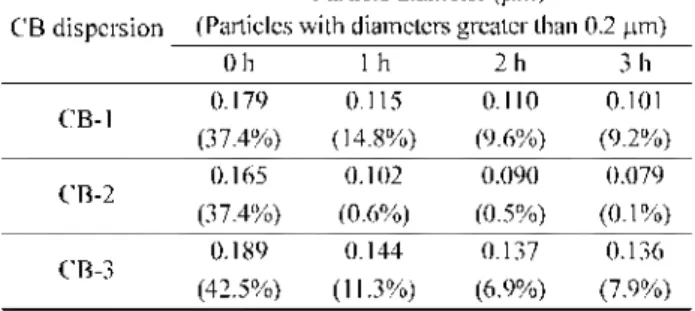
Table 3 shows the sizes of CB particles in the disper
sions and the volume percentage of particles having sizes greater than 0.200 p m listed against bead-milling processing time after surface modification of CB samples using the PR- polymer. In the case of CB-1, the particle size decreased from 0.179 p m before bead milling to 0.101 p m after 3 h treat
ment, while the volume percentage of particles larger than 0.200 p m decreased from 37.4 to 9.2%. However, the volume percentage increased to 17.5% after storing the CB-1 dispersion at 50 °C for 24 h, indicating the low thermal stability of CB-1.
In the case of CB-2, particle size decreased from 0.165 to 0.079 p m after 3 h dispersion, while particles larger than 0.200 p m were almost non-existent (volume percentage is 0.1%). Moreover, the volume percentage was maintained at 0.1% even after storing at 50 °C for 24 h, demonstrat
ing the outstanding thermal stability of CB-2.
In the case of CB-3, the particle size decreased from 0.189 to 0.136 p m after 3 h dispersion, while the volume per
Table 3. Results of bead mill dispersion for CB particles
CB dispersion
Particle diameter ( p m)
(Particles with diameters greater than 0.2 p m)
0 h 1 h 2 h 3 h
CB-1 0.179 0.115 0.110 0.101
(37.4%) (14.8%) (9.6%) (9.2%)
CB-2 0.165 0.102 0.090 0.079
(37.4%) (0.6%) (0.5%) (0.1%)
CB-3 0.189 0.144 0.137 0.136
(42.5%) (11.3%) (6.9%) (7.9%)
centage of particle larger than 0.200
卩m decreased from 42.5 to 7.9%. However, the CB-3 dispersion was found to have a relatively low thermal stability, similar to that of CB-1, because the volume percentage increased to 11.4% after storage at 50 °C for 24 h. These results show that there is a high possibility that the CB particles in CB-1 and 3 re
aggregate, unlike CB-2. This re-aggregation may be due to the loss of grafted PR-polymer from the CB particle sur
faces in CB-1 and 3 on exposure to heat. In contrast, this did not occur in the CB-2 dispersion.
Based on the results shown in Table 3, the percentage of PR-Polymer grafted onto the CB particle surface varied according to the difference in CB particle size and surface area.
Accordingly, different dispersion states were obtained.
Effect of PR-p 이 ymer content
Another method to confirm the differences between dis
persions is to determine the degree of reaction as a function of the amount of PR-polymer relative to that of CB particles.
To investigate the reaction of CB particles and PR-polymer, the dispersion state of CB-2 was compared by varying the amount of PR-polymer. As shown in Table 4, the mass com
position of the CB sample (Nipex 160IQ) was fixed at 15%, and the amount ofPR-polymer was varied to be 5.0, 10.0, 15.0, and 25.0%. A total of four CB dispersions were obtained by adjusting to the total volume with water.
The viscosities and pH values of the four CB dispersions are listed in Table 5. When the pH was reduced from 8.37 to 8.01, the CB-2-1 dispersion formed a gel; the gel was obtained when the amount of PR-polymer was reduced to 5%. This gelation may be due to CB particles aggregation because insufficient PR-polymer was grafted onto the CB particle surface.
In the case of the CB-2-3 dispersion, which was obtained by increasing PR-polymer amount to 25%, the viscosity and
Table 4. CB dispersions obtained at various PR-polymer percentages CB dispersions Nipex 160IQ (%) PR-Polymer (%>)Water (%)
CB-2 15.0 15.0 70.0
CB-2-1 15.0 5.0 80.0
CB-2-2 15.0 10.0 75.0
CB-2-3 15.0 25.0 60.0
Table 5. Viscosity and pH of the CB dispersions CB dispersions Viscosity (cps) pH
CB-2 8.2 8.37
CB-2-1 Gel state 8.01
CB-2-2 6.3 8.68
CB-2-3 25.1 8.78
o?