한수지 49(1), 026-029, 2016
26
Copyright © 2016 The Korean Society of Fisheries and Aquatic Science pISSN:0374-8111, eISSN:2287-8815
Korean J Fish Aquat Sci 49(1),026-029,2016
Original Article
서 론
해삼
(Apostichopus japonicus)
은우리나라를비롯한중국및 일본등에서수요가높은종이며,
비교적고가로판매되고있는 수산물이다.
중국은해삼양식을위한종묘생산및양성기술을 확립하여세계해삼생산량의대부분을차지하고있다.
국내해 삼생산량은2014
년에2,148
톤이었으며대부분어획생산에의 한것이고(Statistics Korea, 2013),
해삼은2004
년부터자원회 복을위한방류품종으로지정되면서종묘생산및어린해삼생 산이활성화되고있다.
특히,
해삼은중국의수요가높아수출 전망이높은양식종이며,
국내에서도해삼양식을시도하는양 어가들이증가하는추세이다.
최근국내해삼양식의대부분은 종묘생산및어린해삼육성위주로이루어지고있다.
국내사료회사에서의해삼전용배합사료개발및생산은미 비한실정이며
,
국내해삼양식장에서는중국산해삼사료사 용을선호하여해삼사료의대부분이중국에서수입되어사용 되고있다.
그러나중국산수입사료는국내에서고가로판매 되고있어외화낭비등의문제점을초래하고있다.
따라서국 내해삼양식활성화를위해서는경제적인해삼용배합사료개 발이필수적이다.
해삼양식용사료개발을위한연구로는어린해삼의단백질및지질과같은필수영양소요구량
(Seo et
al., 2008; Seo and Lee; 2010)
과사료원료이용성(Seo et al., 2011a; 2011b)
에관한연구들이보고되어왔다.
해삼은 퇴적물식자
(deposit-feed)
로써 자연에서는 바다 퇴 적물내유기물및해조류부식물등을섭취한다(Zhang et al.,
1995).
이러한식성을감안하여대부분의 해삼양식장에서는배합사료 내 펄 분말 첨가가 어린 해삼(Apostichopus japonicus)의 성장 및 체조성에 미치는 영향
김경덕*·배기민·한현섭·김강웅·이봉주·김성삼·박기영
1·권오남
1국립수산과학원 사료연구센터, 1 강릉원주대학교 해양자원육성학과
Effects of the Dietary Inclusion of Sea Mud on the Growth and Body Composition of Juvenile Sea Cucumbers Apostichopus japonicus
Kyoung-Duck Kim, Ki-Min Bae, Hyon-Sob Han, Kang-Woong Kim, Bong-Joo Lee, Sung-Sam Kim, Kie-Young Park
1
and O-Nam Kwon1
Aquafeed Research Center, National Institute of Fisheries Science, Pohang 37517, Korea
1
Department of Marine Biology, Gangneung-Wonju National University, Gangneung 25457, Korea
This study investigated the effects of dietary inclusion of sea mud on growth and body composition of juvenile sea cucumber Apostichopus japonicus . In experiment 1, three experimental diets containing sea mud at the level of 0, 30 and 60% were prepared. After feeding trial for 7 weeks, survival was not significantly different among groups. Final mean weight of sea cucumber fed the experimental diet without sea mud supplementation was significantly higher than that of sea cucumber fed the diet containing 30 and 60% sea mud. In experiment 2, three experimental diets containing sea mud at the levels of 0, 15 and 30% were prepared. After feeding trial for 19 weeks, survival was not significantly different among groups. Final mean weight of sea cucumber fed the diet without sea mud supplementa- tion was not significantly different from that of 15%, but was significantly higher than that of sea cucumber fed the diet containing 30% sea mud. It was concluded that dietary inclusion of sea mud may inhibit growth of sea cucumber.
Key words: Apostichopus japonicus , Sea cucumber, Sea mud, Growth, Body composition
This is an Open Access article distributed under the terms of the Creative Commons Attribution Non-Commercial Licens (http://creativecommons.org/licenses/by-nc/3.0/) which permits unrestricted non-commercial use, distribution, and reproduction in any medium, provided the original work is properly cited.
http://dx.doi.org/10.5657/KFAS.2016.0026 Korean J Fish Aquat Sci 49(1) 026-029, February 2016
Received 15 August 2015; Revised 30 December 2015 ; Accepted 5 January 2016
*Corresponding author: Tel: +82. 54. 230. 3630 Fax: +82. 54. 232. 3697
E-mail address: [email protected]
해삼 사료내 펄 첨가 영향
27
사료공급시다량의펄을사료와혼합하여공급하는실정이다
. Liu et al. (2009)
는지충이(Sargassum thunbergii)
분말과펄의 혼합비율을다르게한먹이공급이해삼의성장에미치는영향 에관하여보고하였다.
그러나사료내첨가물의사용효과는첨 가물이혼합된사료의원료조성비에영향을받을수있으며,
배 합사료내펄첨가량이해삼의성장에미치는영향에관한연구 는제한적인실정이다.
그래서본연구에서는펄함량을다르게 첨가한배합사료가어린해삼의성장및체조성에미치는영향 에관하여조사하였다.
재료 및 방법
실험 사료
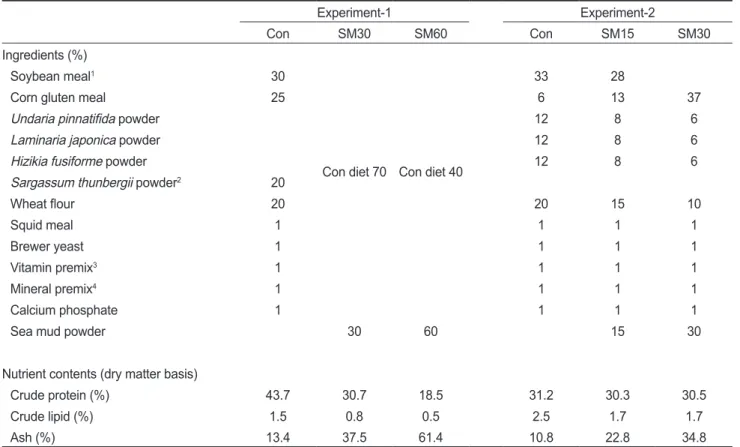
실험
1
에서는펄분말을첨가하지않은대조사료,
대조사료 와펄을7:3
및4:6
의비율로혼합한3
종류의실험사료를설계 하였다(Table 1).
대조사료는주원료로대두박,
콘글루텐밀,
지충이분말및소맥분을사용하였다
.
실험사료제조에사용된펄 분말은충남태안지역에서채취하여수세후자연건조한펄을60℃
에서3
시간건조하여사용하였다.
실험
2
에서는펄을첨가하지않은대조사료와펄15%
및30%
를첨가한
3
종류의실험사료를설계하였다(Table 1).
미역분,
다 시마분,
대두박,
콘글루텐밀및소맥분함량을조절하여모든실험사료의조단백질함량이
30%
전후가되도록조절하였다.
이와같이설계된실험사료는각원료들을잘혼합한후
,
분쇄기(Pulverisette 16, Fritsch)
를사용하여150 µm
이하의입자로분 쇄한후사육실험에사용하였다.
사육 실험
실험
1
의 사육 실험을위하여 어린 해삼(Apostichopus ja- ponicus)
을실험수조에서2
주간순치시킨후,
최초평균체중0.3±0.09 (
표준편차) g
의해삼을9
개의30 L
원형수조에각수 조당100
마리씩3
반복으로수용하여7
주간사육실험을실시하 였다.
각실험수조에는해삼이은신할수있도록검은색플라스Table 1. Ingredients and nutrient contents of the experimental diets
Experiment-1 Experiment-2
Con SM30 SM60 Con SM15 SM30
Ingredients (%)
Con diet 70 Con diet 40
Soybean meal1 30 33 28
Corn gluten meal 25 6 13 37
Undaria pinnatifida powder 12 8 6
Laminaria japonica powder 12 8 6
Hizikia fusiforme powder 12 8 6
Sargassum thunbergii powder2 20
Wheat flour 20 20 15 10
Squid meal 1 1 1 1
Brewer yeast 1 1 1 1
Vitamin premix3 1 1 1 1
Mineral premix4 1 1 1 1
Calcium phosphate 1 1 1 1
Sea mud powder 30 60 15 30
Nutrient contents (dry matter basis)
Crude protein (%) 43.7 30.7 18.5 31.2 30.3 30.5
Crude lipid (%) 1.5 0.8 0.5 2.5 1.7 1.7
Ash (%) 13.4 37.5 61.4 10.8 22.8 34.8
1Dehulled, solvent extracted.2 Imported from China. 3Vitamin premix contained the following amount which were diluted in cellulose (g/
kg premix): L-ascorbic acid, 121.2; DL-α-tocopheryl acetate, 18.8; thiamin hydrochloride, 2.7; riboflavin, 9.1; pyridoxine hydrochloride, 1.8; niacin, 36.4; Ca-D-pantothenate, 12.7; myo-inositol, 181.8; D-biotin, 0.27; folic acid, 0.68; p-aminobenzoic acid, 18.2; menadione, 1.8;
retinyl acetate, 0.73; cholecalciferol, 0.003.4Mineral premix contained the following ingredients (g/kg premix): NaCl, 43.3; MgSO4·7H2O, 136.5; NaH2PO4·2H2O, 86.9; KH2PO4, 239; CaHPO4, 135.3; Ferric citrate, 29.6; ZnSO4·7H2O, 21.9; Ca-lactate, 304; CuCl, 0.2; AlCl3·6H2O, 0.15; KI, 0.15; MnSO4·H2O, 2.0; CoCl2·6H2O, 1.0.
김경덕
ㆍ
배기민ㆍ
한현섭ㆍ
김강웅ㆍ
이봉주ㆍ
김성삼ㆍ
박기영ㆍ
권오남28
틱셀터를
1
개씩넣어주었고(Seo et al., 2009),
사육수를분당1 L
로조절하여흘려주었으며, air
를공급하였다.
사육기간중평 균수온은14±1.2 (
표준편차)℃
였다.
실험사료종류별로펄을 제외한사료량을해삼체중의3-5%
씩동일하게1
일1
회(15:00)
공급하였다.
사료공급전,
각수조에해삼이먹고남은사료와 배설물을제거하여주었다.
실험
2
의사육실험을위하여해삼을실험수조에서2
주간순 치시킨후,
최초평균체중2.9±0.02 (
표준편차) g
의해삼을9
개의300 L
원형수조에각수조당30
마리씩3
반복으로수용하 여19
주간사육실험을실시하였다.
각실험수조에는검은색 플라스틱셀터를3
개씩넣어주었고,
사육수를분당3 L
로조절 하여흘려주었으며, air
를공급하였다.
사육기간중평균수온은19.6±3.1 (
표준편차)℃
였다.
실험사료는해삼체중의1-3%
씩 동일한량을1
일1
회(15:00)
공급하였다.
사료공급전,
각수조 에해삼이먹고남은사료와배설물을제거하여주었다. 해삼 측정 및 성분 분석
사육실험시작시와종료시에는측정전일
24
시간절식시킨 후각수조에수용된해삼의전체무게를측정하였다.
실험2
의 최초성분분석용으로해삼100
마리를샘플하였으며,
실험종 료시에는각실험수조에서생존한해삼중중간크기의해삼 을10
마리씩성분분석용으로채취하여냉동보관하였다.
실험사료와해삼의수분은
135℃
에서2
시간건조한후에측정하였으며
,
조단백질(N×6.25)
은Auto Kjeldahl System (Gerhardt VAP50OT/TT125, Germany)
을사용하여분석하였다.
조지질 은조지질추출기(Velp SER148, Italy)
를사용하여ether
로추 출한후측정하였으며,
조회분은회화로를사용하여600℃
에서4
시간동안태운후측정하였다.
통계 처리
결과의 통계처리는
SPSS
프로그램을 사용하여One-way ANOVA-test
를실시한후Duncan’s multiple range test (Dun- can, 1955)
로평균간의유의성(P<0.05)
을검정하였다.
결 과
실험
1
의대조사료와펄을7:3
및4:6
의비율로혼합하여제조 한사료로어린해삼을7
주간사육한결과를Table 2
에나타내 었다.
생존율은모든실험구에서90-98%
이상이었으며,
실험 구간에유의한차이가없었다.
최종체중은펄첨가량에유의 한영향을받았으며(P<0.05),
펄을첨가하지않은실험구가펄30%
및60%
첨가실험구에비하여유의하게높은최종체중을보였다
(P<0.05).
실험
2
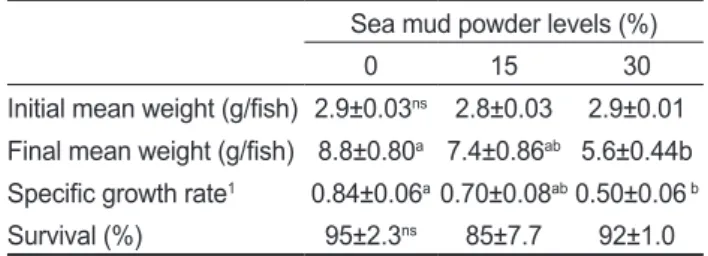
의사료내펄분말을0%, 15%
및30%
첨가한사료로 어린해삼을19
주간사육한결과를Table 3
에나타내었다.
생존율은
85-95%
모든실험구간에유의한차이가없었다.
사료별해삼의최종체중은펄
15%
및30%
첨가실험구가펄을첨가하지않은대조구에비하여감소하였으며
,
펄30%
첨가실험 구의평균체중은펄을첨가하지않은대조구에비하여유의하 게낮았다(P<0.05).
사육실험종료후
,
해삼의일반성분분석결과를Table 4
에나 타내었다.
수분,
조단백질,
회분함량은모든실험구간에유의한 차이가없었으나,
조지질함량은사료내펄함량에유의한영향 을받았다(P<0.05).
Table 4. Proximate composition of whole body in juvenile sea cu- cumber Apostichopus japonicus fed the diets containing different level of sea mud powder for 19 weeks (experiment 2)
Sea mud powder levels (%)
initial 0 15 30
Moisture (%) 90.3 91.4±0.1ns 91.4±0.1 90.9±0.1 Crude protein (%) 4.2 3.8±0.11ns 3.8±0.07 3.8±0.06 Crude lipid (%) 0.22 0.16±0.02a 0.38±0.05b 0.33±0.03b Ash (%) 3.7 3.5±0.01ns 3.5±0.04 3.6±0.08 Values are mean±SE of three replications. ns Not significant (P>0.05).
Table 3. Growth performance of juvenile sea cucumber Aposticho- pus japonicus fed the diets containing different level of sea mud powder for 19 weeks (experiment 2)
Sea mud powder levels (%)
0 15 30
Initial mean weight (g/fish) 2.9±0.03ns 2.8±0.03 2.9±0.01 Final mean weight (g/fish) 8.8±0.80a 7.4±0.86ab 5.6±0.44b Specific growth rate1 0.84±0.06a0.70±0.08ab0.50±0.06 b
Survival (%) 95±2.3ns 85±7.7 92±1.0
Values (mean±SE of three replications) in each row with a differ- ent superscript are significantly different (P<0.05). ns Not signifi- cant (P>0.05). 1[ln (final weight) – ln (initial weight)]×100/days of feeding.
Table 2. Growth performance of juvenile sea cucumber Aposticho- pus japonicus fed the diets containing different level of sea mud powder for 7 weeks (experiment 1)
Sea mud powder levels (%)
0 30 60
Initial mean weight (g/fish) 0.30±0.09ns 0.30±0.09 0.30±0.09 Final mean weight (g/fish) 0.45±0.24a 0.30±0.16b 0.29±0.15b
Survival (%) 98±0.5ns 98±0.3 90±0.3
Values (mean±SE of three replications) in each row with a differ- ent superscript are significantly different (P<0.05). ns Not signifi- cant (P>0.05).
해삼 사료내 펄 첨가 영향
29
고 찰
해삼을양식하는대부분의양어가들은자연에서바다퇴적물 내유기물이나해조류부식물을섭취하는해삼의식성을감안 하여해삼사육용먹이로다량의펄을사료와혼합하여공급하 는실정이다
.
따라서사료내펄첨가가해삼의성장에미치는영 향에대해서는해삼양식에적합한사료공급을위하여우선적 으로고려되어야한다.
사료내펄함량이해삼에미치는영향을 조사한본연구의실험1
에서배합사료에펄을30%
및60%
첨 가함에따라서사료의조단백질및조지질함량은감소하였으 며,
해삼의성장역시펄30%
및60%
실험구가펄무첨가구에 비하여낮았다.
실험2
에서는펄의함량은0, 15
및30%
로다 르지만사료원료조성비를조절하여영양소함량을유사하도 록제조한사료로사육한경우에도 해삼의성장은사료중의 펄함량이증가할수록감소하는경향을보였으나펄을15%
첨 가한실험구는펄을첨가하지않은실험구와유의한차이는없 었다.
이러한결과로볼때,
해삼배합사료에펄분말을혼합하여공급할경우
,
해삼의적정성장을위해서는펄을15%
이하로사용하는것이적합한것으로판단된다
. Liu et al. (2009)
의연구에서지충이분말에펄을
0-80%
첨가한먹이에대한해삼의소화율을측정한결과
,
펄첨가율이증가함에따라서먹이에 대한소화율이감소하는결과를보였는데,
본연구에서펄첨가 에따른해삼의성장감소는이와같은소화율저하에의한것 으로판단된다.
그러나Liu et al. (2009)
의연구에서지충이분말에펄을
20%
첨가한실험구가펄첨가없이지충이분말만을공급한실험구에비해높은성장을보였는데
,
이는펄첨가 에따른사료섭취율증가에의한것으로보고되었다.
본연구 의사육실험에서는실험사료별일일사료섭취율을별도로측 정하지는않았으나,
모든실험사료는해삼이매일섭취하고일 부남을정도로충분히공급하였으며,
펄첨가에따른사료섭취 량의증가는관찰되지않았다.
이와같이사료내펄첨가가해 삼의성장에미치는영향의차이는해삼사육실험에사용된펄 과혼합한기초사료의차이에의한것으로판단된다.
본연구의 경우기초사료는해삼영양요구량을충족할수있도록사료원 료조성비를설계하여제조한배합사료를사용하였으나, Liu et
al. (2009)
의연구에서는펄과혼합한기초사료로지충이분말만을단독으로사용하였다
.
그리고펄을20%
첨가한배합사료 와펄을첨가하지않은배합사료를대조사료로사용하여해삼 의성장도를비교한Robinson et al. (2013)
의연구에서도펄첨 가에따른해삼의성장개선효과는나타나지않아본연구와유 사한결과를보였다.
본연구에서해삼의지질함량은실험구간에유의한차이를 보였지만
,
모든실험구의해삼체내의지질함량은0.16-0.33%
로전반적으로낮은값을보였다
.
이상의결과볼때
,
사료내다량의펄분말첨가는어린해삼 의성장을감소시킬수있으므로,
어린해삼의적정성장을위해서는사료내펄을첨가하지않는것이적합할것으로판단된다
.
사 사
이 논문은
2013
년도 국립수산과학원 수산과학연구사업(R20151016)
의지원으로수행된연구이며연구비지원에감사드립니다
.
References
Duncan DB. 1955. Multiple-range and multiple F tests. Biomet- rics 11, 1-42.
Liu Y, Dong S, Tian X, Wang F and Gao Q. 2009. Effects of dietary sea mud and yellow soil on growth and energy bud- get of the sea cucumber Apostichopus japonicas (Selenka).
Aquaculture 286, 266-270. http://dx.dol.10.1016/j.aquacul- ture.2008.09.029.
Robinson G, Slater MJ, Jones CLW and Stead SM. 2013. Role of sand as substrate and dietary component for juvenile sea cucumber Holothuria scabra. Aquaculture 392-395, 23-25.
http://dx.doi.org/10.1016/j.aquaculture.2013.01.036.
Seo JY and Lee SM. 2010. Optimum dietary protein and lipid levels for growth of juvenile sea cucumber Apostichopus
japonicus. Aquacult Nutr 17, 56-61. http://dx.dol.10.1111/
j.1365-5095.2009.00728.x.
Seo JY, Choi J, Kim GU, Cho SS, Park HG and Lee SM. 2008.
Effects of dietary protein and lipid levels on growth and body composition of juvenile sea cucumber Stichopus ja-
ponicus. J Aquacult 21, 19-25.
Seo JY, Kim DG, Kim GU, Cho SS, Park HG and Lee SM.
2009. Effect of different substrates in the rearing tank on growth and body composition of juvenile sea cucumber
Apostichopus japonicus. J Aquacult 22, 118-121.
Seo JY. Shin IS and Lee SM. 2011a. Effect of various protein sources in formulated diets on the growth and body com- position of juvenile sea cucumber Apostichopus japoni-
cus. Aquac Res 42, 623-627. http://dx.dol.10.1111/j.1365-
2109.2010.02653.x.Seo JY. Shin IS and Lee SM. 2011b. Effect of dietary inclusion plant ingredients as an alternative for Sargassum thunbergii on growth and body composition of juvenile sea cucumber
Apostichopus japonicus. Aquacult Nutr 17, 549-556. http://
dx.doi.10.1111/j.1365-2095.2010.00849.x.
Statistics Korea. 2014. Fishery production survey. Retrieved July 23 2015 from http://kostat.go.kr.
Zhang B, Sun D and Wu Y. 1995. Preliminary analysis on the feeding habit of Apostichopus japonicus in the rocky coast waters off Lingshan Island. Mar Sci 3, 11-13.