Vol. 27, No. 5 (2017)
255
Detection of Oxygen Species Generated from Ag
2Se-Graphene Heterojunction Photocatalysts with Excellent Visible
Light Driven Photocatalytic Performance
Ze-Da Meng
1,2†and Won-Chun Oh
2†1Jiangsu Key Laboratory of Environmental Functional Materials, College of Chemistry and Bioengineering, Suzhou University of Science and Technology, Suzhou 215009, China
2Department of Advanced Materials Science & Engineering, Hanseo University, Seosan-si, Chungnam-do 31499, Republic of Korea
(Received October 13, 2016 : Revised February 6, 2017 : Accepted February 20, 2017)
Abstract
Reactive oxygen species (ROS) can be produced by interactions between sunlight and light-absorbing substances in natural water environments and can completely destroy various organic pollutants in waste water. In this study, we used graphene oxide modified Ag2Se nanoparticles to enhance photochemically generated oxygen (PGO) species activity. Surface area and pore volumes of the Ag2Se-graphene (Ag2Se-G) samples showed catastrophic decrease due to deposition of Ag2Se.The generation of reactive oxygen species was detected through the oxidation reaction of DPCI to DPCO. The photocurrent density and the PGO effect increase in the case of the use of modified graphene. The PGO effect of the graphene modified with Ag2Se composites increased significantly due to a synergetic effect between graphene and the Ag2Se nanoparticles. The photocatalytic activity of sample was evaluated by measuring the degradation of organic pollutants such as methylene blue (MB) and industrial dyes such as Texbrite BA-L (TBA) under visible light.
Key words
Ag2Se-graphene, TEM, visible light, FT-IR, industrial dyes, texbrite BA-L.1. Introduction
Reactive oxygen species(ROS) like hydroxyl radicals (·OH) can be generated in natural water by the inter- actions between sunlight and light-absorbing substances, ROS may participate in the indirect photolysis of trace organic pollutants, therefore resulting in their environ- mental fates and ecological risks in natural water systems.
1)Many studies showed that the heterogeneous photocatalysis through light illumination on a semicon- ductor surface was an attractive Advanced Oxidation Processes(AOPs). During this process, the generation of powerful reactive oxygen species(ROS) like superoxide radical anion(·O
2−), hydroxyl radical(·OH), hydrogen peroxide(H
2O
2) and singlet oxygen(
1O
2) etc. takes place markedly. These oxidizing substances with higher reaction activity than common oxygen molecules can completely
destroy various organic pollutants in wastewaters.
2,3)However, only approximately 3-5 % of the solar spectrum falling on the semiconductor can be used, which means that the efficient utilization of solar energy by the semiconductor is limited. Titanium dioxide(TiO
2) or zinc oxide(ZnO), as a photocatalyst irradiated by ultrasound to produce an excited source of radicals, has been successfully used in the degradation of toxic organic compounds and dye pollutants. It is necessary to enhance the photocatalyst degradation efficiency and to search for new highly active photocatalysts.
4)Carbon-based materials, such as graphite, carbon nano- tubes, graphene sheets and fullerene have been widely studied. Two-dimensional(2-D) graphene has emerged as high potential material and increasingly attracted attention owing to its fascinating physical properties including quantum electronic transport, extremely high mobility,
†Corresponding author
E-Mail: [email protected] (Suzhou Univ. Sci.Technol.) E-Mail: [email protected] (W.-C. Oh, Hanseo Univ.)
©Materials Research Society of Korea, All rights reserved.
This is an Open-Access article distributed under the terms of the Creative Commons Attribution Non-Commercial License (http://creative- commons.org/licenses/by-nc/3.0) which permits unrestricted non-commercial use, distribution, and reproduction in any medium, provided the original work is properly cited.
high elasticity, and electromechanical modulation. As a simple and facile method, hydrothermal method has shown its advantages in the preparation of nanomaterials.
5)During the last few years, narrow band gap semi- conductor quantum dots such as CdS, CdSe, PbS, InAs and InP have been used as photocatalysts.
6,7)There has been much interest in the electronic structure of the transition-metal dichalcogenides. During the last decade a considerable number of experimental and theoretical studies have been reported on the so-called pyrites MX
2, with M = Mn, Fe, Co, Ni and X
2= As
2, S
2or Se.
8)Crystal field splitting, correlation and intrinsic 3d band- width are all about the same magnitude in these com- pounds. Ag
2Se is also an interesting candidate for broad band sensitizers. Ag
2Se has a very small energy gap (Eg = 0.07-0.15 eV, 300 K).
9)It is also the only stable composition that occurs in the phase diagram of the Ag- Se system.
10)Ag
2Se nanoparticles have been synthesized by various methods.
11)1,5-diphenyl carbazide(DPCI) can be oxidized by oxidizing substances into 1,5-diphenyl carbazone(DPCO), which can be extracted by organic solvents and display an obvious absorbance in a certain range of wave- length.
12)The generation of reactive oxygen species were detected through the oxidation reaction from 1,5-diphenyl carbazide(DPCI) to 1,5-diphenyl carbazone(DPCO). If the absorbances of DPCO extract liquors decreases after adding some kind of radical scavengers, it will demon- strate that there is a kind of corresponding ROS in the system.
In this study, graphene modified Ag
2Se nanoparticles has been prepared via sonochemical and hydrothermal method. Interesting phenomena were also found in which the enhancement of photoactivity was attributed the photosensitization of graphene and the enhanced inter- facial charge separation between graphene and Ag
2Se particles.
2. Experimental
2.1 Experimental Materials
Graphene oxide which was prepared by a Hummers- Offeman method used as another carbon nanomaterial in our previous works. For the oxidization of carbon material,3-chloroperoxybenzoic acid(TCPBA) was chosen as the oxidizing agent and was purchased from Acros Organics, New Jersey, U.S.A. Benzene(99.5 %) was used as the organic solvent and was purchased from Samchun Pure Chemical Co., Ltd., Seoul, Korea. Silver nitrate (AgNO
3), Selenium(Se) metal powder and ammonium hydroxide(NH
4OH, 28 %) were purchased from DaeJung Chemicals & Metal Co., Ltd, Korea. Anhydrous purified sodium sulfite(Na
2SO
3, 95 %) was purchased from Duksan
Pharmaceutical Co., Ltd, Korea. Methyl blue(MB, C
16H
18ClN
3S, 99.99+ %) was used as model pollutant which purchased from Samchun Pure Chemical Co., Ltd, Korea, respectively. Texbrite BA-L(TBA) was purchased from Texchem Co. Ltd, Korea. All chemicals used without further purification and all experiments were carried out using distilled water graphene functionalized.
2.2 Synthesis of Ag
2Se-graphene composite
The graphene nanosheets(54 mg) were under ultra- sonication for 1 hour. Firstly, Na
2SO
3(5 g) and Selenium metal powder(0.5 g) were dissolved in 30 mL distilled water and refluxed for 1 h to form Na
2SeSO
3solution.
Then 30 mg graphene nanosheets and 22 mg AgNO
3were dispersed into a solution with the molar ratios of ethanol:H
2O = 7:3, and the suspension was sonicated at room temperature for 1 h using a Controllable Serial- Ultrasonic apparatus(Ultrasonic Processor, VCX 750, Korea). Then, the Na
2SeSO
3solution and 6 mL NH
4OH (28 wt%, pH = 12) were added to above system, and the mixture was stirred rapidly at 100
oC for 8 h. The reaction mixture was allowed to cool to room tempera- ture and the precipitate was filtered, washed with distilled water five times, and dried in a vacuum oven at 80
oC for 12 h before heat treatment at 500
oC for 3 h.
2.3 Characterization
XRD(Shimadzu XD-D1, Uki, Kumamoto, Japan) was used to identify the crystallinity of the composite with monochromatic high-intensity CuK α radiation(l = 1.5406 Å). SEM(JSM-5600, JEOL Ltd., Tokyo, Japan) was used to observe the surface state and structure of the prepared composite. The elemental mapping over the desired region of the prepared composite was determined by an EDX analyzer attached to the SEM. Then, the BET surface area was calculated by nitrogen adsorption. High- resolution transmission electron microscopy(HRTEM, JEM-3010, Japan) was used to observe the surface state and structure of the Ag
2Se-graphene composites. Raman spectra were recorded at room temperature using amicro- Raman spectrometer in the backscattering geometry with a 514.5 nm Ar+ laser as an excitation source. The absorbance spectrum of the photocatalyst was recorded at room temperature in the range 300-800 nm using a UV- Vis spectrophotometer(Genspec III, Hitachi, Japan) equipped with an integration sphere.
2.4 Catalytic degradation of MB and TBA
The photocatalytic activities were evaluated by MB
and TBA degradation in aqueous media under visible
light irradiation. For visible light irradiation, the reaction
beaker was oriented axially and held in a visible light
box(8 W, halogen lamp, KLD-08L/P/N, Korea). The
luminous efficacy of the lamp is 80 lm/W, and the wavelength is 400 nm ~ 790 nm. The lamp was used at a distance of 100 mm from the aqueous solution in a dark box. The amount of the photocatalyst composite was 0.05 g/(50 ml solution). TBA solution(0.001 v/v) and MB solution(1 × 10
−5mol/L) were also prepared, respectively.
The reactor was placed for 30 min in darkness, in order to make the adsorption equilibrium. After the adsorption state, in the process of the degradation of methylene blue, a glass reactor(diameter = 4 cm, height = 6 cm) was used and the reactor was placed on a magnetic churn dasher. The suspension was then irradiated with visible light for a set irradiation time. Visible light irradiation of the reactor was done for 30 min, 60 min, 90 min and 120 min, respectively. Samples were with- drawn regularly from the reactor and dispersed powders were removed by using a centrifuge. The clean trans- parent solution was analyzed by UV-vis spectroscopy. In case of TBA the spectral range was from 250 nm to 350 nm and MB solution was from 250 nm to 800 nm.
The absorbance value at the λ
maxof the dye solutions was obtained. The MB and TBA concentration in the solution was determined as a function of the irradiation time.
2.5 Evaluation of reactive oxygen species
Firstly, six 10.00 mL DPCIstocksolu-tions(1.00 × 10
−2mol/L) were added into three 80 mL volumetric flasks, respectively. And then 50 mg Ag
2Se-Gphotocatalysts were added to above DPCI solutions, respectively. All of the three solutions were diluted to 50 mL with double distilled water. For all three solutions, the final DPCI concentration and Ag
2Se-G photocatalyst amount were 2.00 × 10
−3mol/L and 1.00 g/L, respectively. Among them, the reactors were put into a visible light apparatus away from light directly under visible light irradiation. After 180 min irradiation, from each sample 10.00 mL solution was taken exactly and extracted with benzene. And then, all extracted solutions were diluted to 10.00 mL with benzene solution and their UV-vis spectra were deter- mined.
3. Results and Discussion
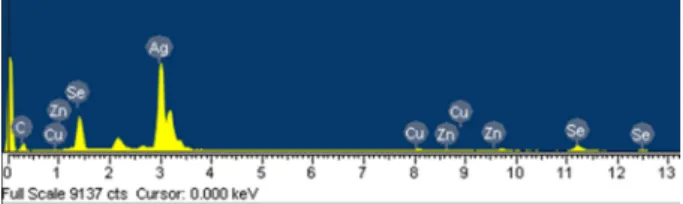
3.1 Elemental analysis of the prepared composite Fig. 1 shows the EDX patterns of the Ag
2Se-G composites. EDX indicated C, Se and Ag as the major elements with small quantities of oxygen in the com- posites. The numerical results of EDX quantitative microanalysis of the samples are listed in Table 1. There were some small impurities, which were attributed to the use of graphene without purification. As shown in Fig. 1 for the products of the fullerene modified hydrothermal
method. The ratio of Se/Ag was detected as 1/1.98 which is in complete agreement with the chemical formula of Ag
2Se showing that no significant residue of the starting materials or the surfactant is remained in the product.
The EDX quantitative microanalysis of carbon was increased with the increase of C
70content.
3.2 Surface characteristics of the samples
The micro-surface structures and morphologies of the different composites were characterized using SEM. Fig.
2 shows the macroscopic changes in the morphology of the composites. Ag
2Se is shown to have a small particle size and good dispersion. It was supposed that the spherical particles in Ag
2Se-G composites are Ag
2Se particles on the surface of graphene. HRTEM was able to reveal clearly the presence of Ag
2Se particles on the surface of graphene. Zhang et al. reported that a good dispersion of small particles could provide more reactive sites for the reactants than aggregated particles.
13)At the same time, the conductivity of graphene can facilitate electron transfer between the adsorbed dye molecules and the catalyst substrate. By comparing Fig. 1(b-c) (after adding graphene), the dispersion of Ag
2Se was a little deteriorated.
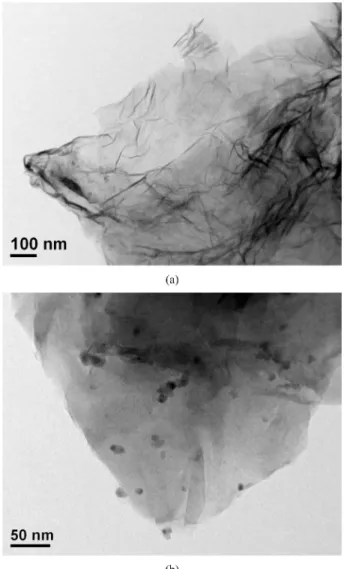
Fig. 3 shows HRTEM images of the Ag
2Se-graphene composites. HRTEM is a technique used for analyzing the morphology, crystallographic structure, and even the composition of a specimen. Fig. 3 gives direct evidence that the graphene are in close contact with Ag
2Se, and particles were observed upon enlargement of the images.
This indicates that the surfaces of the Ag
2Se particles are cleaned under exposure to the reaction conditions. Ag
2Se particles were distributed uniformity with a size of approximately 30 nm, even though this caused partial agglomeration to form block particles. Fig. 3 shows large clusters with an irregular agglomerated dispersion of
Fig. 1. EDX microanalysis and element weight percentage of Ag2Se-G.Table 1. BET surface area of the samples.
Sample name SBET (m2/g)
Ag2Se 20.95
graphene 278.48
Ag2Se -graphene 52.26
fullerene. Ag
2Se nanoparticles were distributed outside the surfaces of the graphene with a size of approximately 9~10 nm, even though this caused partial agglomeration to form block particles. HRTEM also revealed the pre- sence of fullerene particles on the Ag
2Se particles.
14)3.3 Structural features of the catalyst
The FT-IR spectrum of graphene was rather simple and suggested extensive oxidation. The spectra of the crystalline materials showed well distinguished and sharp bands, whereas the amorphous spectra were less resolved.
The hydration results established the importance of defined conditions for FT-IR(Fig. 4). They also suggested that this type of study can be performed on oxidized graphene. Fig. 4(a-b) show the FT-IR spectra of oxidized graphene, and Ag
2Se-graphene composite, respectively.
From Fig. 4(a), the peak at 995 cm
−1was assigned to
the alkane bending vibration, which occurs between 650-
1000 cm
−1, and the peak at 806 cm
−1were assigned to
aromatic symmetric stretching modes, which occur in the
range 690-900 cm
−1. Strong C-O bands at approximately
1102 cm
−1and a strong C=C band at 1538 cm
−1were
Fig. 2. SEM microanalysis of graphene (a), Ag2Se (b) and Ag2Se-graphene (c).observed. The functional groups, C=O and C-OH, were indicated in the spectrum at approximately 1685, and 1091 cm
−1. Meanwhile, -OH was also observed at approximately 1407 cm
−1.
This confirms that artificial ageing is actually occurring in the surface, and that the types of structural changes inferred from the spectra are consistent with the mech- anism proposed in the literature: the formation of O-H bonds resulting from the oxidation of the hydrocarbon triterperpenic molecules by the direct binding of O· and O-O radicals, followed by further oxidation to carbonylic functional groups.
15,16)In Fig. 4(b), the weak peaks at 1186 cm
−1was assigned to the C-O bands, respectively. The CH
3and C=C functional groups were observed at approximately 1400 and 1700 cm
−1, respectively. Compared to the spectrum curves (a) and (b), the peak intensity of the functional group on oxidized graphene was weak and decreased.
This is because some of the functional groups had combined with Ag
2Separticles. The Ag
2Separticles were bound to graphene with different functional groups.
17)XRD was used to determine the crystallographic structure of the inorganic component of the composite.
Fig. 5 shows the XRD patterns of the Ag
2Se and Ag
2Se- graphene samples. The main sharp peaks, at 22.90, 26.75, 30.90, 32.7, 33.50, 34.70, 36.99, 39.96, 40.31, 42.65, 43.45, 43.74, 45.05, 48.43, 48.60 and 49.86 which were assigned to (002), (111), (102), (120), (112), (121), (013), (031), (122), (113), (201), (130), (032), (123), (014), and (212) crystal planes originated from the orthorhombic Ag
2Se phase, which were in accordance with the results reported by Zhan et.al with the lattice parameters were close to a = 4.331 Å, b = 7.061 Å, and c = 7.763 Å(JCPDS card no. 14-0072).
18)No impurity phase is detected. The broadening of these diffraction peaks indicates that the sample is nanosized. From the XRD patterns, it is also possible to compute the %
Fig. 3. HRTEM image obtained from graphene (a) and Ag2Se-graphene (b) composites.
Fig. 4. FT-IR spectra of samples.
Fig. 5. XRD patterns of samples.
crystallinity and crystal size. The amorphous-phase frac- tion of the sample may be determined using the ratio of the amorphous area(area not under the peaks) of the X- ray diffractogram to the total area. Also, the peaks at different crystal planes of the Ag
2Se-graphene nanocom- posite, matched exactly with that of Ag
2Se, indicating essentially no difference with respect to the type of crystalline phase in the two products. It was found that Ag
2Se showed more crystallinity than the prepared Ag
2Se-graphene nanocomposite. This is attributed to the adverse conditions created when adding graphene; which did not allow nucleation and crystal growth.
19)3.4 BET analysis
Nitrogen adsorption isotherms for the original graphene, and Ag
2Se-graphene composites are shown in Fig. 6. The formation of type IV adsorption isotherms confirmed the major presence of mesopores on the surfaces of the samples. Characteristic features of the Type IV isotherm are its hysteresis loop, which is associated with capillary condensation taking place in mesopores, and the limiting uptake over a range of high p/p
o. The initial part of the Type IV isotherm is attributed to monolayer-multilayer adsorption since it follows the same path as the corresponding part of a Type II isotherm obtained with the given adsorptive on the same surface area of the adsorbent in a non-porous form. Type IV isotherms are given by many mesoporous industrial adsorbents.
20,21)This indicates that the Ag
2Se-graphene composites studied was mainly mesoporous in character, with a minor pre- sence of wider pores where capillary condensation occurred. All of the isotherm shapes show similar types for all samples. Surface areas and pore volumes of the graphene were reduced due to deposition of Ag
2Se. The BET surface area values of samples were shown in Table 1. The BET value was decreased from 278.48 m
2/g of
graphene to 52.26 m
2/g of Ag
2Se-graphene. It can be considered that the Ag
2Se nanoparticles were introduced into the pores of the graphene, which decreased the BET surface area. The Ag
2Se-graphene has the larger area which can affect the adsorption reaction. The adsorptive effect of Ag
2Se-graphene was better than that of Ag
2Se because the added graphene can enhance the BET surface area which can increase the adsorption effect.
3.5 Photocatalytic activity of samples
Fig. 7 shows the time series of MB degradation using pure TiO
2, graphene, Ag
2Se and Ag
2Se-graphene com- pounts under visible light with different irradiation intensities. The spectra for the MB solution after visible light irradiation show relative degradation yields at different irradiation times. The dye concentration con- tinuously decreased with an excellent rate, which was due to visible light irradiation. The concentration of MB was 2.0 × 10
−5mol·L
−1, and the absorbance for MB de- creased with increasing visible light irradiation time.
Moreover, the MB solution increasingly lost its color as the MB concentration continued to decrease. Two steps are involved in the photocatalytic decomposition of dyes:
the adsorption of dye molecules and degradation. After adsorption in the dark for 30 min with magnetic stirring, the samples reached adsorption-desorption equilibrium.
In the adsorptive step, All of the composites showed different adsorptive effects, with graphene having the best adsorptive effect. The adsorptive effect of Ag
2Se- graphene was better than that of Ag
2Se because the added graphene can enhance the BET surface area which can increase the adsorption effect.
22)Ag
2Se-graphene has better BET surface area than Ag
2Se, which enhances the adsorptive effect. In the degradation step, the Ag
2Se and Ag
2Se-graphene composites showed a good degradation effect, as shown in the UV-vis absorption spectra. TiO
2 Fig. 7. Degradation of MB under visible light.Fig. 6. Nitrogen adsorption/desorption isotherms of samples.
and graphene have poor degradation effect under visible light, because the larger band gap energy. The Ag
2Se- graphene composites showed good adsorption and de- gradation effects. A comparison of the decoloration effects of the different catalysts showed that the degrad- ation effect can be increased by an increase in the adsorption capacity.
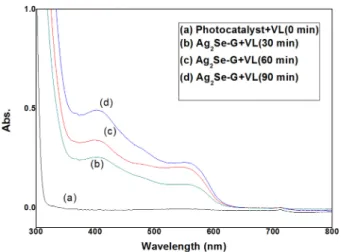
23)Fig. 8 is the UV-vis spectra of OPCO extract liquors in the presence of Ag
2Se and Ag
2Se-graphene composites under visible light irradiation. 1,5-diphenyl carbazide (DPCI) can be oxidized by oxidizing substances into 1,5- diphenyl car-bazone(DPCO). Under visible light irradi- ation, the Ag
2Se-graphene samples turns into the excited state. That is, some electrons are transited from valence band(VB) to conduction band(CB). Simultaneously, the electron-hole pairs form on the surface or in the inner of Ag
2Se-graphene samples. The electrons and holes react with the molecular oxygen(O
2) dissolved in aqueous solution and water molecules(H
2O) absorbed on the surface of Ag
2Se-graphene particles, respectively, pro- ducing the superoxygen radical anions(·O
2−) and hydroxyl radicals(·OH). These ·OH can oxidize 1,5-diphenyl car- bazide(DPCI) into 1,5-diphenyl carbazone(DPCO). The DPCO can be extracted by the benzene solvent and show an absorbance at 560 nm wavelength. Sequentially, the produce and output of ·OH can be easily detected, and the photodegradation activity can be easily detected.
From Fig. 8 we can see that, under visible light irra- diation, the absorption peaks of DPCO around 560 nm show an obvious increase compared with the corres- ponding ones without any irradiation.
24)And that, for different irradiation time under visible light the DPCO solution exhibits different absorbance.
The main reasons why graphene is particularly efficient in mediating photodynamic therapy(PDT) is their ex- tended π-system, which absorbs UV or visible light and
generates ROS through energy and electron-transfer processes from the triplet and singlet states. The more extended is the π system, the higher is the PDT efficiency expected to be. The photodynamic activity of graphene is higher, because the former’s relatively larger cage.
25)Changes in the electronic and geometrical structures of molecules, as well as their interaction with other molecules in the surrounding environment can be induced by the photo-excitation of these molecules.
These electron transfer will take place in both inter and intra-molecular fashion. Because graphene were covalently bound to photoactive chromophores, so there were enhanced photo-induced intramolecular energy transfer or electron-transfer events. Furthermore, relative small vari- ations in the irradiation wavelengths may cause changes in the photophysical behavior of dyes.
26)Based on the above experimental results, we can conclude that this degradation mechanism is suitable to explain the results of photocatalytic degradation using the prepared graphene composite. Fig. 10 shows a schematic diagram of the separation of photogenerated electrons and holes on the Ag
2Se-graphene interface.
4. Conclusion
A novel Ag
2Se-graphene heterojunction photocatalysts were successfully prepared in this study. The FT-IR results illuminated that the Ag
2Se band transfers electrons to fullerene with functional groups attached. The ad- sorption and surface properties as structural and chemical composition of the Ag
2Se-graphene composites were investigated. Surface areas and pore volumes of the samples increased due to deposition of fullerene com- pounds. The XRD results showed that the phase type was hexagonal Ag
2Se phase and fullerene. The quantities of hydroxyl radicals generated can be analysis by DPCI degradation. The results demonstrated that the PGO
Fig. 9. Schematic diagram of the separation of photogenerated electrons and holes on the Ag2Se-graphene interfacec.Fig. 8. UV/Vis spectra of DPCO concentration s after exposure to composites under visbile light at various time intervals.
oxidation of MB and TBA causing its concentration in the aqueous solution to decrease, can be attributed to the synthetic effects of electro-assisted PGO decomposition by Ag
2Se and graphene. The Ag
2Se-graphene composite catalyst prepared by the impregnation method demon- strates higher PGO activity than pure Ag
2Se. Ag
2Se- graphene has the best degradation and adsorption effect due to high photosensitivity and relativity high adsorption effect of graphene.
Acknowledgments
The work was supported by the National Natural Science Foundation of China(Nos. 51502187), the JiangSu Collaborative Innovation Center of Technology and Ma- terial for Water Treatment, and Priority Academic Program Development of Jiangsu Higher Education Institutions (PAPD).
References
1. O. K. Dalrymple, E. Stefanakos, M. A. Trotz and D. Y.
Goswami, Appl. Catal. B: Environ., 98, 27 (2010).
2. P. Xu, T. Xu, J. Lu, S. M. Gao, N. S. Hosmane, B. B.
Huang, Y. Dai, Y. B. Wang, Energy Environ. Sci., 3, 1128 (2010).
3. S. Bagwasi, B. Z. Tian, J. L. Zhang and M. Nasir, Chem.
Eng. J., 217, 108 (2013).
4. O. K. Dalrymple, E. Stefanakos, M. A. Trotz and D. Y.
Goswami, Appl. Catal. B: Environ., 98, 27 (2010).
5. H. Liu, X. N. Dong, X. C. Wang, C. C. Sun, J. Q. Li and Z. F. Zhu, Chem. Eng. J., 230, 279 (2013).
6. Z. D. Meng, M. M. Peng, L. Zhu and W. C. Oh, Appl.
Catal. B: Environ., 113-114, 141 (2012).
7. J. F. W. Mosselmans, R. A. D. Pattrick, G. van der Laan, J. M. Charnock, D. J. Vaughan, C. M. B. Henderson and C. D. Garner, Phys. Chem. Minerals, 22, 311 (1995).
8. N. Nakashima, T. Ishii, M. Shirakusa, T. Nakanishi, H.
Murakami and T. Sagara, Chem. Eur. J, 7, 1766 (2001).
9. J. J. Zhao, B. T. Jiang, S. Y. Zhang, H. L. Niu, B. K. Jin and Y. P. Tian, Sci. China Ser. B, Chem., 52, 2213 (2009).
10. H. M. Pathan and C. D. Lokhande, Bull. Mater. Sci., 27, 85 (2004).
11. V. Buschmann, G. V. Tendeloo, Ph. Monnoyer and J. B.
Nagy, Langmuir, 14, 1528 (1998).
12. J. Wang, Y. W. Guo, B. Liu, X. D. Jin, L. J. Liu, R. Xu, Y. M. Kong and B. X. Wang, Ultrason. Sonochem., 18, 177 (2011).
13. X. W. Zhang, M. H. Zhou and L. C. Lei, Carbon, 43, 1700 (2005).
14. A. Tubtimtae, M. W. Lee, G. J. Wang, J. Power Sources, 196, 6603 (2011).
15. J. Liu, H. Bai, Y. Wang, Z. Liu, X. Zhang and D. D. Sun, Adv. Funct. Mater., 20, 4175 (2010).
16. Y. Zhu, S. Murali, W. Cai, X. Li, J. W. Suk, J. R. Potts and R. S. Ruoff, Adv. Mater., 22, 3906 (2010).
17. Z. D. Meng, T. Ghosh, L. Zhu, J. G. Choi, C. Y. Park and W. C. Oh, J Mater. Chem., 22, 16127 (2012).
18. Y. Cui, G. Chen, J. Ren, M. Shao, Y. Xie and Y. Qian, J. Solid State Chem., 172, 17 (2003).
19. K. Nagasuna, T. Akita, M. Fujishima and H. Tada, Langmuir, 27, 7294 (2011).
20. M. D. Donohue and G. L. Aranovich, Fluid Phase Equilib., 158-160, 557 (1999).
21. H. I. Kim, G. H. Moon, D. M. Satoca, Y. Park and W.
Y. Choi, J. Phys. Chem. C, 116, 1535 (2012).
22. Z. D. Meng, K. Zhang and W. C. Oh, Korean J. Mater.
Res., 20, 228 (2010).
23. R. Azumi, K. Kakiuchi and M. Matsumoto, Bull. Chem.
Soc. Japan, 76, 1561 (2003).
24. H. Gommans, B. Verreet, B. P. Rand, R. Muller, J.
Poortmans, P. Heremans and J. Genoe, Adv. Funct.
Mater., 18, 3686 (2008).
25. D. Ma, M. Zhang, G. Xi, J. Zhang and Y. Qian, Inorg.
Chem., 45, 4845 (2006).
26. H. Q. Cao, Y. J. Xiao, Y. X. Lu, J. F. Yin, B. J. Li, S.
S. Wu and X. M. Wu, Nano. Res., 12, 863 (2010).