소셜 미디어 이용자의 기대가치 구성 요인
김철호
청주대학교 미디어콘텐츠학부 교수
Study on the Components of Social Media Users' Value Expectation
Chulho Kim
Professor, Division of Media Contents, Cheongju University
요 약 본 연구의 목적은 소셜 미디어 이용자의 기대가치 구성 요소를 타당성 있게 유목화 하여, 소셜 미디어 이용자들에 대한 이해를 높이고, 그들과의 소통의 효율성을 제고하기 위한 전략적, 관리적 토대를 구축하는데 있다. 선행 연구로서의 2차 자료 검토, 질적 조사로서의 심층 인터뷰, 양적 조사로서의 사전조사와 본조사가 실시되었다. 연구 결과, 소셜 미디어 이용자의 기대가치는 실용적, 쾌락적, 관계적, 자아 확인적, 윤리 법제적, 시스템 기능적, 참여적, 자기 과시적, 자기 숨김적 관점으로 범주화 되었다. 본 연구의 의의는, 학제적·융합적 측면에서 볼 때, 커뮤니케이션, 심리, 마케팅, 미디어 등 관련 분야 를 통합적으로 조망하고 있다는 점, 실용적 측면에서, 소셜 미디어 이용자의 기대가치를 세분화, 유목화 하여 정리하였다는 점, 전략적 측면에서, 향후 소셜 미디어 이용자의 태도를 예측, 확인, 관리할 수 있는 토대 구축에 기여하고 있다는 점이다.
이에 따라 본 연구는 향후, 구축된 기대가치 구성 요인을 변인으로 한, 소셜 미디어 소비자 태도 연구와, 이를 바탕으로 한 미디어 효과 연구에 도움이 될 것으로 판단된다.
주제어 : 소셜 미디어, 마케팅 커뮤니케이션, 기대가치, 학제적 관점, 융합적 커뮤니케이션
Abstract
The purpose of this research is to increase an understanding of social media users and construct a strategic, administrative foundation to measure the efficiency of communicating with them by validly classifying components of social media users’ value expectation(VE). Reviewing prior research, in-depth interviews as qualitative research, pre-test and main survey as quantitative research are conducted. The result of quantitative research shows that social media users' VE was categorized in terms of utilitarian, hedonic, relational, self-evident, ethical, system functional, participative, self-ostentatious, and self-hiding perspectives. The significance of this study is as follows: 1) It views communication, psychology, marketing, media and etc. related fields from an integrated perspective. 2) It segments and categorizes social media users’ VE from a practical perspective. 3) It contributes to constructing a foundation to predict, confirm, and manage social media users’ attitudes from an administrative perspective. Thus, this research will aid future research on social media users’ attitude using the constructed VE components as variables and future research that uses this as a basis to find media effects.Key Words :
Social Media, Marketing Communication, Value Expectation, Interdisciplinary Perspective, Convergent Communication*This work was supported by the research grant of Cheongju University (2017.03.01.-2019.02.28.)
*Corresponding Author : Chulho Kim ([email protected]) Received October 15, 2018
Accepted December 20, 2018
Revised November 20, 2018 Published December 28, 2018
1. 서론
현대 사회에서 소셜 미디어는 공감가치와 공유가치를 지향하는 소통의 미디어인 동시에, 참여를 통해 자기의 정체성을 발현하고 확인해 가는 관계의 미디어이다. 최 근의 지속적인 하이테크 발전과 이러한 현상의 미디어 산업에의 실용적 적용, 소비자 욕구의 다변화 등은 미디 어의 개념을 바라보는 패러다임을 새롭게 바꿔놓고 있다.
이에 따라 미디어가, “메시지 전달자와 수용자, 정보원 (情報源)과 수취원(受取源), 콘텐츠 창조자와 소비자 등 등 자극원(刺戟源)과 반응원(反應源) 사이에 관계되어, 이것이 현재적인 것이든 잠재적인 것이든(시간성), 이곳 에서든 다른 곳에서든(공간성), 의도된 것이든 우연적인 것이든(목적성), 지속적이든 간헐적이든(상황성) 간에, 둘 이상의 관계를 연결하는 공감 지향체로서 존재” 하는 것으로서, “기본적으로 이들 관계와 함께하는, 공감 지향 체로서의, 모든 존재, 현상, 그리고 행위 그 자체”[1]이며, 나아가 “상황에 따라 접점 자체가 미디어로 기능할 수 있 으며”, “호혜적 커뮤니케이션에 기반을 두고, 기대가치 (Value Expectation)를 공유하는 상호작용성을 실현할 수 있는 도구나 존재라면 모두 미디어로 고려될 수 있 다”[2]는 설명을 고려할 때, 소셜 미디어는, 이러한 변화 된 미디어 인식의 패러다임이 지금의 사회에, 온라인 툴, 플랫폼 등 다양한 형태의 접점으로 투영된 공감 지향적 미디어라 할 수 있다. 아울러, 소셜 미디어의 특성이 “참 여, 공개, 대화, 커뮤니티, 연결의 5가지 네트워크 기반 키 워드들의 복합체”[3]로 설명되는 바, 소셜 미디어는 개방, 참여, 공유가 현실에서 가능하도록 구현해 주는, 공감 지 향체로서의 모든 존재, 현상, 그리고 행위 그 자체를 의미 한다.
하지만 소셜 미디어의 특성을 단지 개방, 참여, 공유를 통한 관계의 강화와 확대, 정보의 생산적 이용과 확산, 호 혜적 상호작용과 사회적 정체성의 표현 등 긍정적 측면 으로만 정리하고 바라보는 시각은 다분히 일방적인 관점 에 국한될 수 있는데, 그 이유는 소셜 미디어가 개인주의 와 공동체 의식이 공존할 수 밖에 없는 사회 현실에서, 최소 관계 유지를 위한 도구, 존재하되 드러내고 싶지 않 은 개인의 익명적 자아 보호를 위한 도구, 그리고 관계의 통제와 관리가 어려운 현실에서 거부하기 어려운 소셜 피로감, 사회적 소진 유발 도구 등으로 인식되고 있음도, 결코 간과할 수 없는 중요한 사회·문화적 의미를 갖고 있
기 때문이다.
기대가치(Value Expectation)는 행동 주체로서의 소 비자가, 대상에 대하여 기대하는, 현재적, 잠재적 가치를 의미하며, 마케팅 분야에서 오랫동안 고려되어 온 교환 행위의 결과로서 인지되는 ‘가치’가 아닌, 교환 행위 이전 의 심리적 ‘기대’ 개념에 의미를 부여하는 학제적·융합적 개념이다. 현대 사회에서 소셜 미디어가 첨단의 기술을 실용화하여 소비자의 의식과 행동 및 다양한 관계에 깊 이 관여되어 있음을 고려할 때, 사람들이 소셜 미디어의 사용으로부터 기대하는 가치의 확인 과정은 소셜 미디어 를 통해 관계를 구축, 유지하고, 콘텐츠를 전달, 공감, 확 대, 공유하고자 하는 기업, 기획자, 제작자 입장에서는, 반드시 파악하여야 할 중요한 개념이다.
이러한 시각들을 통합적으로 고려해 볼 때, 현대 사회 생활과 불가분의 관계에 있는 소셜 미디어와 그 이용으 로부터 소비자들이 기대하는 가치가 무엇인지를 정량적 으로 파악하는 과정은 의미가 크다. 그 이유는 첫째, 마케 팅 커뮤니케이션의 효율적 접점으로서의 소셜 미디어의 영향력이 지속적으로 커지고 있는 바, 그 영향력과 효과 의 측정에 대한 필요성이 꾸준히 환기되고 있고, 둘째, 소 셜 미디어 이용에 대한 기대가치의 정량적 확인은 곧, 소 셜 미디어 이용에 대한 소비자의 기대가치를 유목화 하 여 파악하고 있다는 것을 의미하고, 셋째, 변인들이 유목 화 되었다는 것은, 변인들 간의 관계성과 변인들의 영향 력을 타당성 있게 파악하고 예측할 수 있다는 점을 시사 하기 때문이다. 이에 따라, 본 연구는 비록 탐색적이지만, 소셜 미디어 이용자들의 기대가치 구성 요인을 타당성 있게 유목화 하여, 소셜 미디어 이용자들에 대한 이해를 높이고, 그들과의 소통의 효율성을 제고하기 위한 전략 적, 관리적 토대 구축을 돕는데 그 목적을 둔다.
2. 이론적 배경
2.1 소셜 미디어 2.1.1 개념
소셜 미디어는, 의식과 행위의 주체들이, 자신의 생각, 견해, 의지, 경험 등을 표현하고 공유하며 존재의 의미를 표출하기 위해, 사회적·관계적·문화적 접점으로 활용하 는, 개방화 된 온라인 툴, 플랫폼 기반의 모든 공감 지향 적 미디어이다. 이렇게 볼 때, 소셜 미디어의 정의에서 우
리가 주목해야 할 핵심 개념은, 의식과 행위의 주체, 커뮤 니케이션의 주체로서의 인간, 그들의 생각, 견해, 의지, 경험, 정보 등이 구체적·현실적으로 발현되어 표현된 내 용로서의 콘텐츠, 인간과 콘텐츠의 연결 도구로서, 사회 적·관계적·문화적 공감의 접점(Sympathic Point)으로 설 명되는 미디어, 이러한 관계를 호혜적 상호작용으로 지 지해 주는 실용화 된 테크놀로지, 시간과 장소의 제한 없 이, 언제, 어디에서든 편하게 사용이 가능한 편재성, 그리 고 이들 요소들이 존재할 수 있는 토대를 마련해 주는 경 제적·사회적·문화적 환경 이라고 할 수 있다.
여기서 실용화 된 테크놀로지의 개념은, 아무리 첨단 의 하이테크가 적용된 제품/서비스라도 소비자의 기대가 치를 적확하게 충족시키지 못한다면, 그 제품/서비스는 소비자 입장에서 볼 때 그저 물리적 속성의 단순한 집약 체에 불과할 뿐[4,5] 이라는 사실을 반영한 것이다. Table 1은 소셜 미디어의 정의에서 우리가 주목해야 할 핵심 개 념을 정리한 것이다.
Keyword Context
Human Beings of consciousness and actors. Subject of communication
Contents Specific and realistic manifestation/ expression such as thoughts, perspectives, will, experiences, information and etc.
Media The social, relational, cultural sympathic point functioning as a tool that connects people and content
Practicalized Technology
A practicalized value of technology that supports the relationship among people, media, content through reciprocal interaction Ubiquity Can be used comfortably without being
restricted by time and location
Environment Economic, social, cultural environment that provides a base for structural factors to exist
Table 1. Key concepts that must be focused on indefining social media
2.1.2 소셜 미디어 활성화 이유
이러한 핵심 개념들은 현대 사회에서 소셜 미디어가 지속적으로 활성화 되고 있는 현상과도 밀접하게 관련되 는데, 그렇다면 현대 사회에서 소셜 미디어가 이토록 활 성화 되어가고 있는 이유는 무엇일까? 소셜 미디어가 현 대 사회에서 활성화 되고 있는 이유는 소비자, 하이테크, 미디어, 커뮤니케이션, 마케팅, 사회문화, 법제 등과 같은 다양한 영향 요인을 기반으로 한 학제적·융합적 관점에 서 검토되어야 한다. 어느 하나의 관점으로 전체를 파악 하고자 하는 시도는 소셜 미디어가 활성화 되고 있는 배
경의 정확한 이해에 편향된 결과를 초래할 수도 있기 때 문이다. Table 2는 최근의 사회에서 소셜 미디어가 활성 화 되어가고 있는 이유와 그 배경을 학제적 측면에서 접 근하여 설명하고 있다. 이 표에서 주목해야 할 것은, 소셜 미디어의 활성화에 영향을 미치는 각 분야별 배경들 간 에 상황과 환경에 따라 중복된 영향력이 나타날 수 있다 는 점이다.
Inter- disciplinary Subdivision
Background and Context
Consumer - Strengthened individual identity as beings of consciousness and actors
- Strengthened desire to confirm one’s identity through voluntary expression
- Emphasis on individual opinions, actions, experience following the increase of voluntary solos
- Strengthened status as actors in creating, spreading, evaluating, reinterpreting, recreating information
Technology - The practicalization of technology and the following expansion of ubiquitous use of technology
- The development of structuring and using networks and their generalization in society - Universalization of technological convergence - Emphasizes advanced technology that goes
beyond integration of advanced attributes and appeals to value expectation of consumers Media - Continuous development of interactive media
- Vitalization and practicalization of 1:1 based media focusing on the receiver
- Strengthening of 1-person media’s status and its continuous growth
Communi cation
- Expansion of the importance of reciprocal communication focusing on the information receiver
- As the structural and cognitive factors of reciprocality became important, the importance of structuring and executing reciprocality-based communication was reevaluated and spread Marketing - A marketing environment based on satisfying
value expectation
- Strengthening social media’s function as a sympathic point with consumers
Psychology - Desire to secure and keep maintaining minimum distance and minimal sense of belonging in a network and relationship based society - Desire to exhibit oneself to others - Desire to anonymously express one’s ego
(Desire for anonymity in expressing ego) through anonymous participation and anonymously expressing opinions Social
culture
- Continuous growth in political, economic and social participation culture (individual and collective)
- Expansion of social media functions as a place
Table 2. Reasons and Backgrounds of InterdisciplinaryPerspectives Supporting Vitalization of Social Media
소셜 미디어는 단일 개념의 미디어가 아닌 광범위한 개념인 바, 그 종류로는 SNS(Facebook, LinkedIn 등), Blog(Tumblr, Blogger 등), Wiki(Wikipedia 등), UGC(YouTube, Instagram, Pinterest 등), Microblog(Twitter, Weibo 등), SocialTagging, SocialBookmarking, Podcasting, Videocasting 등이 존 재하고[2], 개방, 참여, 공유가 현실에서 가능하도록 구현 하여 주는 공감 지향적 미디어로서, 지금도 계속 그 종류 가 확장되어 가고 있다.
2.1.3 소셜 미디어의 긍정적 측면
소셜 미디어의 특징과 영향력에 대한 주요 선행 연구 를 다양한 관점에서 살펴보면 다음과 같다. 소셜 미디어 가 갖는 기본적 특성 측면에서 볼 때, 소셜 미디어는 참 여, 공개, 소통, 네트워크 등의 특징을 지니며[6], 정보 교 류의 신속성과 개방성이 뛰어나고[7], 사회 환경적 측면 에서 볼 때, 소셜 미디어는 정치, 경제, 사회, 문화 등에서 지속적인 영향력을 보이며[8], 사회 자본[9,10]으로 기능 한다. 기업 경영 전략 측면에서 볼 때, 소셜 미디어는 마 케팅 커뮤니케이션과 연계된 프로모션의 주요 수단[11]
으로서, 효과적인 마케팅 커뮤니케이션의 도구[12]이며, 고객과의 마케팅 커뮤니케이션에 영향을 미치고 있다 [13] 이러한 시각은 “SNS가 활성화 됨에 따라 커뮤니케 이션에서 소비자의 능동성과 생산성이 영향력을 행 사”[14]하고 있음을 지지한다. 소비자 관계 측면에서 볼 때, 소셜 미디어는 다양한 인적 네트워크 활동과 연계되 며[15], 개인의 사회적 경험을 강화하고[16], 소비자 구매 의도의 효과적 확인과 관계된다[44]. 심리적 측면에서 볼 때, 소셜 미디어는 인간의 쾌락적 정서와 관련[17]되고, 정체성의 강화에 긍정적 영향[18]을 미치고, 자기 이미지 의 노출[19]과 연계된다.
소셜 미디어가 현대 사회에서 다양한 분야와 연관성 을 갖고, 사회 현상과 변화의 패러다임을 읽을 수 있는 주요 키워드의 하나로 자리 잡고 있는 만큼, 이처럼 다양 한 시각에서 소셜 미디어의 특징과 영향력을 살펴볼 수 있지만, 이들 분야들 간의 중첩된 영향력이 상황에 따라
충분히 나타날 수 있음도 주목해야 한다.
Table 3은 소셜 미디어의 특징과 영향력에 대한 주요 선행 연구를 보여준다.
Perspective Research Content (Researcher) Social
Media’s Uniqueness
- Traits such as participation, openness, communication, networks and etc. (Mun &
Jung, 2011)
- Rapidness and openness of information exchange (You, 2010)
Social Environment
Aspect
- Continuously influences politics, economics, society, culture, etc. (Qualman, 2011) - Role as social capital (Helliwell & Putnam,
2004) Corporate
Management Strategy
- Key promotion method connected to marketing communication activity (Mangold & Faulds, 2009)
- An effective marketing communication tool (Tuten & Solomon, 2012)
Consumer Relationship
Aspect
- Connected to various human network activities (Bennett et.al., 2008)
- Strengthens individual social activity (Lee &
Choi, 2015) Psychological
Aspect
- Related to people’s hedonic sentiment (Barker, 2009)
- Strengthens identity (Hwang, 2013) - Exposure of individuals' images (Kim, 2011)
Table 3. Previous Research on the Traits andInfluence of Social Media
2.1.4 소셜 미디어의 부정적 측면
한편, 소셜 미디어의 부정적 측면에 대한 연구도 꾸준 히 제시되고 있는데, 이들 연구는 소셜 미디어가, 소셜 미 디어에 대한 이용자의 중독을 만들어 내며[20,21], 청소년 들의 SNS에의 중독성과 관련되며[22,23], 기업 주도 소 셜 미디어 광고에 대한 낮은 신뢰도[24]를 유발하고, 구 성원에 대한 기업의 통제를 강화시키고[25], 디지털 네트 워크 사회에서의 스트레스를 유발하며[26], 정보 활동과 관련하여 소극적인 참여 행동[27]의 동기가 되며, 개인 정보를 노출[28]하고 있음을 지적한다. 이러한 관점은, 자 연스럽게 “사이버 불링이나 개인 정보 유출, 중독 현상에 대한 예방적 차원의 교육과 윤리 의식 함양을 위한 제도 적 접근”[29] 등의 필요성을 지지한다.
이렇게 볼 때, 소셜 미디어의 긍정적 측면과 부정적 측 면을 바로 알고 이 두 관점을 통합적으로 고려하는 접근 이 필요한데, 이는 현대 사회에서 소셜 미디어가 빚어내 는 경제적, 사회적, 문화적 현상의 올바른 이해와 바른 활 용, 그리고 그 영향력의 적확한 이해를 위해서는 긍정적 인 측면을 강화하고 부정적인 측면을 보완하고자 하는 노력의 병행이 필요하기 때문이다.
for social sharing and sympathy following the expansion of awareness of the importance of shared values and empathic values Legal and
Institutional
- An expansion of legal and institutional support
as the development of the social media industry
created by the fusion of advanced technology
and the media industry is connected to
strengthening national competitiveness
2.2 기대가치(Value Expectation)
기대가치(Value Expectation)는 마케팅 커뮤니케이션, 소비자 행동 등의 분야에서 주목 받는 개념으로서, 기존 의 소비자 가치 개념이, ‘가격’과 ‘품질’ 중심[30,31]으로 이해되는, 교환 행위 이후의 인지적 반응으로서의 ‘결과’
지향적 개념인데 반해, 교환 행위 이전에, 소비자로 하여 금 마케팅 커뮤니케이션 활동에 자발적으로 참여하도록 이끄는 동인(動因)으로서의 ‘기대’ 개념을 ‘가치’에 학제 적·융합적으로 접목한 것이다[1,2,4,32].
‘기대가치(VE)’의 개념을 직시하는 이러한 접근은, 소 비자를 ‘가격’과 ‘품질’을 중심으로 소비 행동을 고려하는 논리적/이성적 문제 해결자로 보아온 시각과, 소비자를
‘감성’과 ‘경험’을 중심으로 소비 행동을 고려하는 경험적 즐거움/재미 추구자로 보는 시각의 균형적 이해와 실용 적 적용의 필요성을 동시에 환기시키고 있다는 점에서 그 의의가 크다. 소비자 행동과 소비자 가치 분야에서의
‘기대’가, 소비의 논리적·이성적 측면과 소비의 경험적·쾌 락적 측면을 모두 포함하는 개념이기 때문이다.
구체적으로 설명하면, 소비자 가치를 바라보는 시각 이, 1)소비자를 논리적/이성적 문제 해결자로 인식하면 서, 소비자 가치 개념을 교환 행위 이후의 ‘결과’로 인식 하는 단계에서, 2) 소비자를 논리적/이성적 문제 해결자 인 동시에, 경험적 즐거움 추구자로 인식[33-35]하는 단 계로 발전하지만, 소비자 가치 개념은 여전히 교환 행위 이후의 ‘결과’로 인식하는 단계에 머물다가, 이러한 인식 의 패러다임이 3) 소비자를 논리적/이성적 문제 해결자 인 동시에 감성적 경험 추구자로 인식하면서, 소비자 가 치 개념을 교환 행위 이전의 ‘기대’로 인식[1,2,4,32]하는, 새로운 단계로 진화하고 있기 때문이다.
Table 4는 소비자의 정체성을 기반으로 한, 소비자 가 치를 바라보는 시각의 변화를 보여준다.
이렇게 볼 때, 소셜 미디어가 현대 생활 속의 경제적, 사회적, 문화적 측면과 관련되며, 동시에 미디어, 커뮤니 케이션, 마케팅, 소비자, 심리학 등 인접 분야와의 학제 적·융합적 접근과 이해가 요구되는 개념인 만큼, 소셜 미 디어 이용자의 기대가치 연구는 사회과학 분야에서 학제 적·융합적 연구를 지향하는 최근의 패러다임을 고려해 볼 때, 탐색적인 접근임에도 불구하고 의미 있는 시도라 할 수 있다.
Perspective to see Consumer Value Result
after Exchanging
Behavior
Expectation before Exchanging
Behavior Logical
/Rational Problem Solver
Step 1) Price &
Quality Centered
Value
Step 2) Price, Quality
&
Experience, Fun Centered
Value
Step 3) Value Expectation as Motives to induce voluntary Participation Emotional/
Experiential Fun Pursuer
Major Research
Zeithaml (1988) Woodruff
(1997)
Babin &
Darden(1995) Babin &
Attaway(2000) Chaudhuri &
Holbrook (2001)
Kim(2004) Kim(2008, 2013, 2018)
Table 4. Changes in perspectives to see consumervalues based on consumer identity
3. 구성 요인의 개발 및 타당성 검토
3.1 연구의 적용 범위, 조사 대상, 진행 과정 앞에서 소셜 미디어의 개념을, 개방, 참여, 공유가 현 실에서 가능하도록 구현하여 주는 공감 지향적 미디어로 설명하면서, 그 종류를 SNS(Facebook, LinkedIn 등), Blog(Tumblr, Blogger 등), Wiki(Wikipedia 등), UGC(YouTube, Instagram, Pinterest 등), Microblog(Twitter, Weibo 등), SocialTagging, SocialBookmarking, Podcasting, Videocasting 등으로 제시하였다. 하지만 하이테크가 실용화 된 소셜 미디어 가 지속적으로 증가하고 있고, 하나의 연구에서 모든 유 형의 소셜 미디어를 연구 대상으로 하기가 현실적으로 어려운 바, 본 연구에서의 소셜 미디어는 그 범위를 SNS 와 UGC로 제한하였다. 아울러, 소셜 미디어의 영역이 지 속적으로 확장되고 있는 현실에서, 본 연구가 탐색적 성 격을 띠고 있음을 고려하여, SNS와 UGC의 범주에 해당 하는 미디어를 폭넓게 연구의 대상으로 설정하였다.
본 연구의 조사 대상은, 소셜 미디어를 일상에서 활발 하게 이용하는 세대인 20대 남녀로 설정하였다.
본 연구의 진행은 1) 2차 자료로서의 선행 연구 검토, 2) 소셜 미디어 이용자 대상 심층 인터뷰, 3) 질적·양적 자료 기반의 사전 조사, 4) 2차/1차 자료 분석, 질적/양적
Value
Expectation Questions Factor
Loading
Superiority VE
sup3 I expect to show that I can do things others cannot when using social media. .953 sup1 I expect to show my experiences regarding a topic before others when using social media. .938 sup2 I expect to show things that others have difficulty doing when using social media. .928
Eigen Value 8.80
Cumulative Percentage 12.2
Cronbach's α .968
Anonymity VE
ano1 I expect to be anonymous when conducting activities in social media. .947 ano2 I expect to conduct activities without revealing who I am when using social media. .935
ano3 I expect anonymity when using social media. .932
Eigen Value 5.40
Cumulative Percentage 19.7
Cronbach's α .959
Ostentation VE
ost3 I expect to proudly show my unique experiences when using social media. .944
ost1 I expect to proudly show my abilities when using social media. .940
ost2 I expect to proudly show things only I can do when using social media. .925
Eigen Value 4.26
Cumulative Percentage 25.6
Cronbach's α .962
Public VE
pub1 I expect to participate in the public good when using social media. .933 pub3 I expect to pursue public good through participation when using social media. .913
pub2 I expect activities that help everyone when using social media. .913
Eigen Value 3.97
Cumulative Percentage 31.2
Cronbach's α .958
Interactivity VE
ina3 I expect to mutually achieve desired results when using social media. .935 ina2 I expect a mutual communication structure when using social media. .931 ina1 I expect reciprocal communication functions when using social media. .931
Eigen Value 3.69
Cumulative Percentage 36.3
Cronbach's α .955
Information VE
inf2 I expect to be able to search for information I want through social media. .912
inf1 I expect gathering information from using social media. .912
inf3 I expect to upload information I want to upload through social media. .904
Eigen Value 3.42
Cumulative Percentage 41.0
Cronbach's α .968
Definitude VE
def2 I expect accurate use of functions based on their roles when using social media. .941
def1 I expect timeliness when using social media. .939
def3 I expect to use unfailing functions when using social media. .938
Eigen Value 3.23
Cumulative Percentage 45.5
Cronbach's α .954
Share VE
sha1 I expect to share corresponding topics with people when using social media. .925 sha3 I expect to feel and share things with others when using social media. .918
sha2 I expect to do something with others when using social media. .915
Eigen Value 3.00
Cumulative Percentage 49.7
Cronbach's α .948
Identity VE
id1 I expect to check my identity by using social media. .904
id2 I expect to check who I am by using social media. .896
id3 I expect to see my essential self by using social media. .889
Eigen Value 2.86
Cumulative Percentage 53.7
Cronbach's α .961
Using Extra Time
VE
tim3 I expect to be able to not be bored during my spare time by using social media. .903
tim1 I expect to make good use of spare time by using social media. .898
tim2 I expect to appropriately use spare time by using social media. .891
Eigen Value 2.60
Cumulative Percentage 57.3
Cronbach's α .951
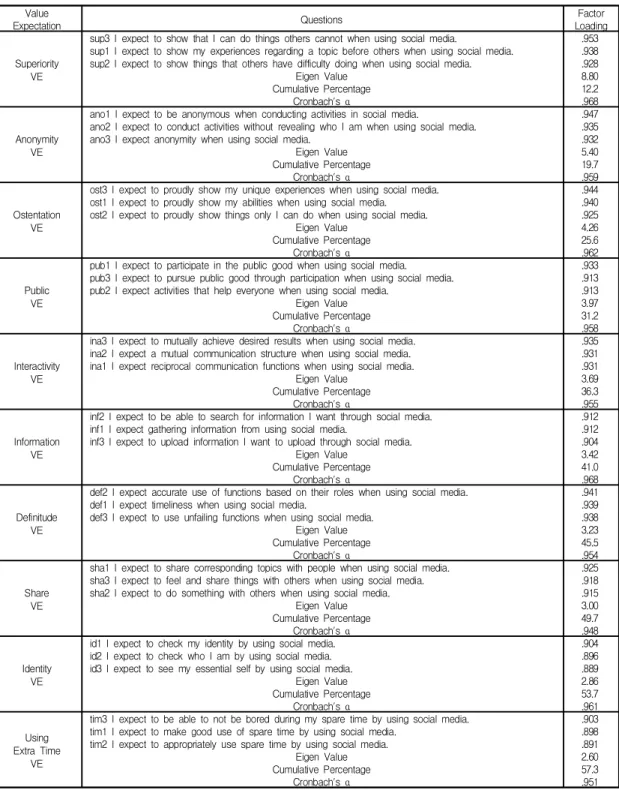
Table 5. Result of the Exploratory Factor Analysis and Reliability Analysis on the Items of Social Media Users' Value Expectation
Self Expression
VE
se2 I expect to show what I think by using social media. .933
se1 I expect to say what I want to say by using social media. .923
se3 I expect to express what I want to by using social media. .907
Eigen Value 2.57
Cumulative Percentage 60.8
Cronbach's α .942
Maintaining Minimum Relationship
VE
mmr3 I expect to maintain relationships that are not too close and not too far by using social media. .932 mmr1 I expect to maintain a minimal relationship with people by using social media. .929 mmr2 I expect to maintain a minimum distance with people by using social media. .909
Eigen Value 2.40
Cumulative Percentage 64.2
Cronbach's α .938
Ubiquity VE
ubi1 I expect to be able to use social media anytime I want to. .897
ubi3 I expect to be able to use social media at the same time as other people. .889
ubi2 I expect to be able to use social media anywhere I want to. .860
Eigen Value 2.17
Cumulative Percentage 67.2
Cronbach's α .959
Escapism VE
esc3 I expect to escape this moment by using social media. .893
esc1 I expect to escape from reality by using social media. .881
esc2 I expect to get out of my current situation by using social media. .879
Eigen Value 2.14
Cumulative Percentage 70.2
Cronbach's α .947
Pride VE
pd2 I expect to express confidence by using social media. .904
pd3 I expect to show a vigorous image of myself through social media. .902 pd1 I expect to manifest a confident image of myself by using social media. .891
Eigen Value 1.84
Cumulative Percentage 72.7
Cronbach's α .932
Social Existence
VE
exi2 I expect to feel that I am not alone by using social media. .915
exi1 I expect to experience my presence in modern society by using social media. .904
exi3 I expect to be a member of society by using social media. .896
Eigen Value 1.68
Cumulative Percentage 75.0
Cronbach's α .923
Familiarity VE
fam3 I expect a favorable environment when using social media. .891
fam1 I expect familiarity with people when using social media. .888
fam2 I expect friendliness with people when using social media. .884
Eigen Value 1.62
Cumulative Percentage 77.3
Cronbach's α .919
Ethical VE
eth1 I expect an ethical attitude from people when using social media. .884
eth2 I expect ethical behavior when using social media. .868
eth3 I expect people to follow their conscience when using social media. .858
Eigen Value 1.52
Cumulative Percentage 79.4
Cronbach's α .925
Distortion VE
dis1 I expect to make myself look like someone other than my original self when using social media. .904 dis3 I expect to be viewed as someone other than my true self when using social media. .903 dis2 I expect to beautify myself to look different from my true self when using social media. .902
Eigen Value 1.45
Cumulative Percentage 81.4
Cronbach's α .913
Network VE
net1 I expect to construct desirable relationships by using social media. .902
net2 I expect networking with people by using social media. .894
net3 I expect to maintain a contact system with other people by using social media. .852
Eigen Value 1.34
Cumulative Percentage 83.3
Cronbach's α .898
Convenience VE
cv3 I expect using social media to not be inconvenient. .907
cv2 I expect to comfortably use social media. .886
cv1 I expect using social media to be convenient. .875
Eigen Value 1.21
Cumulative Percentage 84.9
Cronbach's α .896
자료 분석 및 사전 조사에 기반 한 설문지 확정, 5) 본 조 사, 6) 구성 요소의 신뢰성과 타당성 확인, 7) 조정 및 구 성 요소 선정 등 일곱 단계로 구분하여 실시되었다.
여기서 두 번째 단계인 심층 인터뷰의 경우, 1차 자료 의 수집과 정성적 정보의 수집 두 기법의 병행 차원에서, 20대 남녀 각각 5명을 대상으로 실시되었다. 세 번째 단 계인 사전 조사의 경우, 첫 단계와 두 번째 단계를 통해 수집된 내용의 정량적 확인 차원에서, 20대 남녀 각각 10 명을 대상으로 실시하였다. 구체적으로, “내가 소셜 미디 어를 이용하는 이유는 ~ 때문이다“ 라는 응답에 가능하 면 한 단어로 응답하도록 안내되었고, 이를 통해 핵심 키 워드를 추출하였다. 네 번째 단계에서의 설문지의 경우, 앞의 단계들을 통해 추출된 핵심 키워드의 유목화를 통 해 최종 확정, 구성하였다 (Table 5 참조).
총 335명이 설문에 참여하였고, 이중 불성실한 응답을 제외한 316명의 응답이 분석에 사용되었다.
3.2 구성 요인 설정과 측정 항목
소셜 미디어 이용자의 기대가치 구성 요인을 정리하 기 위해 먼저 선행 연구가 검토되었다. 소셜 미디어의 경 우, 마케팅과 소비자행동 분야에서 주목 받는 기대가치 개념이 미디어 분야에 학제적·융합적 관점에서 적용된 연구가 미비한 바, 소셜 미디어의 이용 동기와 사회적, 문 화적, 환경적 특징을 중심으로 선행 연구가 검토되었다.
이에 따라, 그 이용 동기를 사회적 동기와 정보적 동기 로 제시한 연구[36], 사회적, 기능적, 유희적 차원에서 접 근한 연구[37], 사회적 관계와 상호작용 중심으로 접근한 연구[38], 그리고, 그 특징을 자아 효능감과 연계한 연구 [39], 사회적 실재감 중심으로 접근한 연구[6], 사회 자본 개념으로 설명한 연구[40] 소셜 미디어에 대한 중독 연구
[20,21], 정보성, 신뢰성, 유희성을 통한 소비자의 미디어 이용 형태와 습관 연구[41] 등이 검토되었다.
기대가치의 경우, 소비자 행동 분야의 가치 구성 요인 과 측정 척도 연구[34,35], 소비자 편익 구성 요인 연구 [42], 가상 커뮤니티의 이용 가치 연구[43], 기대가치 구 성 요인과 측정 척도 연구[1,2,4,32] 등이 검토되었다.
3.3 구성 요인의 타당성 검토
소셜 미디어 이용자의 기대가치 구성 요인에 대한 요 인 분석이 실시되었다. 요인의 명확한 분류를 위해 직각 회전(Varimax Rotation)이 사용되었고, Eigen Value값 1 이상의 요인들이 추출되었다. 요인분석 결과, 각 요인을 구성하는 변수들의 요인 적재량은 모두 0.80 이상으로 나 타나 소셜 미디어 이용자의 기대가치 구성 개념에 대한 타당성은 입증되었다. 각 요인의 구성 항목들 간 내적 신 뢰도 검증 결과, 24개 요인 별 Cronbach’s alpha 계수는 모두 0.80 이상으로 나타나 각 요인의 신뢰도가 모두 높 은 것으로 입증되었다. Table 5는 본 연구에서 설정한, 소셜 미디어 이용자 기대가치에 대한 범주화 된 구성 요 인과 측정 항목을 정리한 것이다.
소셜 미디어 이용자의 기대 가치에 대한 확인적 요인 분석 결과, 잠재적인 측정 모델의 적합도는 적절한 것으 로 확인되었다(χ2=2388.37, df=2208, p=0.004, NFI=0.900, RFI=0.885, IFI=0.992, TLI=0.990, CFI=0.992, RMSEA=0.016).
아울러, 소셜 미디어 이용자의 기대 가치 측정 항목에 대 한 표준화 적재치(β), 개념신뢰도(CR)와 분산추출지수 (AVE)를 검토한 결과, 개념 신뢰도와 분산추출지수가 모두 0.8 이상으로 나타나, 개념타당성, 수렴타당성, 내적 일관성 또한 모두 적합한 것으로 확인되었다.
Fun VE
enj2 I expect enjoyment from using social media. .869
enj3 I expect social media must be something that I can enjoy. .857
enj1 I expect entertainment from using social media. .849
Eigen Value 1.09
Cumulative Percentage 86.5
Cronbach's α .883
Voluntary VE
vol3 I expect to participate in activities with nobody interfering when using social media. .850
vol1 I expect my own participation in social media when using it. .835
vol2 I expect voluntary activity when using social media. .833
Eigen Value 1.05
Cumulative Percentage 87.9
Cronbach's α .877
Law-abiding VE
law1 I expect people to mutually stay within the law when using social media. .874
law2 I expect people to follow the law when using social media. .869
law3 I expect people to maintain law and order when using social media. .867
Eigen Value 1.04
Cumulative Percentage 89.4
Cronbach's α .866
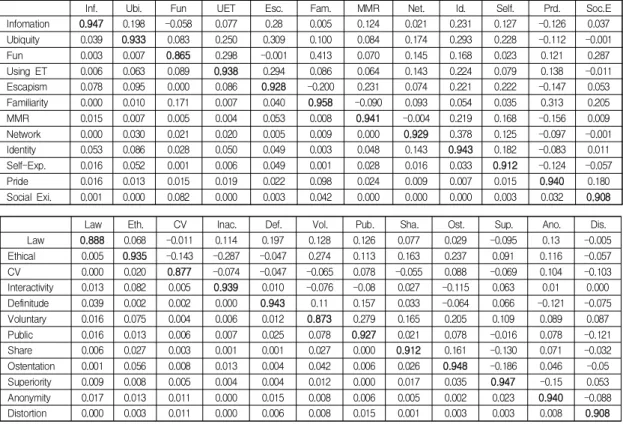
확인적 요인분석 후, 각 요인들 간의 상관계수를 이용 하여 판별 타당성을 검토하였다. 소셜 미디어 이용자의 기대 가치 구성 개념들(정보성, 편재성, 재미성, 잉여시간 활용, 현실도피, 친화성, 최소관계유지, 네트워크, 정체성, 자기표현, 사회적 존재감, 준법성, 윤리성, 편리성, 상호작 용성, 적확성, 차별성, 공익성, 공유성, 과시성, 비교우월 성, 익명성, 왜곡성) 간의 상관계수, 분산추출지수, 및 결 정계수를 비교한 결과, 결정계수가 분산추출지수 보다 작아 구성 개념 간 판별타당성이 유의미하게 존재함이 확인되었다. Table 7은 소셜 미디어 이용자의 기대가치 구성 개념 간의 판별 타당성 분석 결과를 정리한 것이다.
여기서 대각선의 계수는 분산추출지수, 대각선 위의 수 치는 상관계수, 대각선 아래 수치는 상관계수의 제곱을 의미한다.
Latent
Construct MV SRW CR VE
Utilitarian Information inf1 0.949 0.982 0.947
Perspec. VE inf2 0.967
inf3 0.948
Ubiquity ubi1 0.926 0.977 0.933
VE ubi2 0.949
ubi3 0.947
Hedonic Fun enj1 0.909 0.950 0.865
Perspec. VE enj2 0.828
enj3 0.801
Using tim1 0.920 0.978 0.938
Extra Time tim2 0.931
VE tim3 0.94
Escapism esc1 0.932 0.975 0.928
VE esc2 0.925
esc3 0.917
Relational Familiarity fam1 0.877 0.985 0.958
Perspec. VE fam2 0.874
fam3 0.920
Maintaining mm1 0.927 0.980 0.941
Minium Rel. mm2 0.898
VE mm3 0.918
Network net1 0.879 0.975 0.929
VE net2 0.854
net3 0.861
Self Identity id1 0.958 0.980 0.943
Evident VE id2 0.948
Perspec. id3 0.929
Self se1 0.903 0.969 0.912
Expression se2 0.942
VE se3 0.912
Pride pd1 0.902 0.979 0.940
VE pd2 0.903
pd3 0.912
Social exi1 0.902 0.967 0.908
Existence exi2 0.900
VE exi3 0.881
Ethical Law-abiding law1 0.825 0.960 0.888
Perspec. VE law2 0.822
law3 0.834
Ethical eth1 0.898 0.977 0.935
VE eth2 0.902
eth3 0.890
System Convenience cv1 0.856 0.956 0.877
Table 6. Result of the Confirmatory Factor Analysison the Latent Variables
Functional VE cv2 0.852
Perspec. cv3 0.877
Interactivity ina1 0.929 0.979 0.939
VE ina2 0.938
ina3 0.940
Definitude def1 0.937 0.980 0.943
VE def2 0.926
def3 0.943
Partici Voluntary vol1 0.801 0.954 0.873
-pative VE vol2 0.829
Perspec. vol3 0.889
Public pub1 0.953 0.974 0.927
VE pub2 0.935
pub3 0.931
Share sha1 0.953 0.969 0.912
VE sha2 0.923
sha3 0.902
Self Ostentation ost1 0.955 0.982 0.948
Ostenta VE ost2 0.925
-tious ost3 0.956
Perspec. Superiority sup1 0.956 0.982 0.947
VE sup2 0.936
sup3 0.969
Self Anonymity ano1 0.948 0.979 0.940
Hide VE ano2 0.936
Perspec. ano3 0.939
Distortion dis1 0.880 0.967 0.908
VE dis2 0.879
dis3 0.886
χ
2=2388.37, df=2208, p=0.004, NFI=0.900, RFI=0.885, IFI=0.992,
TLI=0.990, CFI=0.992, RMSEA=0.016
4. 결론 및 논의
4.1 연구 결과 요약
본 연구는 현대 사회의 소통의 매개체로 기능함과 동 시에 관계 구축과 유지의 매개체로 기능하고 있는 소셜 미디어를 대상으로, 소셜 미디어 이용자의 기대가치 구 성 요인을 타당성 있게 유목화 하여, 소셜 미디어 이용자 에 대한 이해를 높이고, 그들과의 소통의 효율성을 제고 하기 위한 전략적, 관리적 토대를 구축하는데 그 목적을 두고 실시되었다.
연구 결과, 소셜 미디어 이용자의 기대가치 구성 요인 은 실용적, 쾌락적, 관계적, 자아 확인적, 윤리 법제적, 시 스템 기능적, 참여적, 자기 과시적, 자기 숨김적 관점으로 범주화 되었고, 이 9개 관점은 구체적으로, 실용적(정보 성, 편재성), 쾌락적(재미성, 잉여시간활용, 현실도피), 관 계적(친화성, 최소관계유지, 네트워크), 자아확인적(정체 성, 자기표현, 사회적 존재감), 윤리 법제적(준법성, 윤리 성), 시스템 기능적(편리성, 상호작용성, 적확성), 참여적 (차별성, 공익성, 공유성), 자기 과시적(과시성, 비교우월 성), 자기 숨김적(익명성, 왜곡성)으로 세분화 되어 정리
되었다. Fig. 1은 소셜 미디어 이용자의 기대가치를 잠재 변인으로 설정한 측정 모델을 보여준다.
소셜 미디어 이용자가 소셜 미디어 이용으로부터 기 대하는 실용적 기대 가치는, 이용자가 정보 탐색과 활용 을 추구하며, 언제 어디서든, 시간과 장소의 제약 없이 소 셜 미디어를 이용하기를 기대함을 보여준다.
쾌락적 기대 가치는, 소셜 미디어 이용자가 재미, 즐거 움을 추구하고, 잉여 시간의 적절한 활용 및 현실에 대한 도피 의지 등을 소셜 미디어 이용에서 기대하고 있음을 보여준다.
관계적 기대 가치의 경우, 사회 구성원으로서의 기본 적인 친근한 관계 구축과 유지의 기대, 피로 사회를 살아 가는 현대인의 최소 관계 유지 욕구, 그리고 현실적으로 무시할 수 없는 네트워크 기반의 관계에 대한 기대치를 담고 있다.
자아 확인적 기대 가치는, 소셜 미디어 이용자가 소셜 미디어의 이용을 통해 자기 정체성을 확인하고, 자기의 생각과 의지를 표현하며, 사회적 존재감을 확인하고자 하는 기대를 갖고 있음을 보여준다.
소셜 미디어 이용자가 소셜 미디어 이용으로부터 기
Inf. Ubi. Fun UET Esc. Fam. MMR Net. Id. Self. Prd. Soc.E
Infomation 0.947 0.198 -0.058 0.077 0.28 0.005 0.124 0.021 0.231 0.127 -0.126 0.037
Ubiquity 0.039 0.933 0.083 0.250 0.309 0.100 0.084 0.174 0.293 0.228 -0.112 -0.001
Fun 0.003 0.007 0.865 0.298 -0.001 0.413 0.070 0.145 0.168 0.023 0.121 0.287
Using ET 0.006 0.063 0.089 0.938 0.294 0.086 0.064 0.143 0.224 0.079 0.138 -0.011
Escapism 0.078 0.095 0.000 0.086 0.928 -0.200 0.231 0.074 0.221 0.222 -0.147 0.053
Familiarity 0.000 0.010 0.171 0.007 0.040 0.958 -0.090 0.093 0.054 0.035 0.313 0.205
MMR 0.015 0.007 0.005 0.004 0.053 0.008 0.941 -0.004 0.219 0.168 -0.156 0.009
Network 0.000 0.030 0.021 0.020 0.005 0.009 0.000 0.929 0.378 0.125 -0.097 -0.001
Identity 0.053 0.086 0.028 0.050 0.049 0.003 0.048 0.143 0.943 0.182 -0.083 0.011
Self-Exp. 0.016 0.052 0.001 0.006 0.049 0.001 0.028 0.016 0.033 0.912 -0.124 -0.057
Pride 0.016 0.013 0.015 0.019 0.022 0.098 0.024 0.009 0.007 0.015 0.940 0.180
Social Exi. 0.001 0.000 0.082 0.000 0.003 0.042 0.000 0.000 0.000 0.003 0.032 0.908
Table 7. Result of the Discriminant Validity Analysis on the Latent Variables
Law Eth. CV Inac. Def. Vol. Pub. Sha. Ost. Sup. Ano. Dis.
Law 0.888 0.068 -0.011 0.114 0.197 0.128 0.126 0.077 0.029 -0.095 0.13 -0.005
Ethical 0.005 0.935 -0.143 -0.287 -0.047 0.274 0.113 0.163 0.237 0.091 0.116 -0.057
CV 0.000 0.020 0.877 -0.074 -0.047 -0.065 0.078 -0.055 0.088 -0.069 0.104 -0.103
Interactivity 0.013 0.082 0.005 0.939 0.010 -0.076 -0.08 0.027 -0.115 0.063 0.01 0.000
Definitude 0.039 0.002 0.002 0.000 0.943 0.11 0.157 0.033 -0.064 0.066 -0.121 -0.075
Voluntary 0.016 0.075 0.004 0.006 0.012 0.873 0.279 0.165 0.205 0.109 0.089 0.087
Public 0.016 0.013 0.006 0.007 0.025 0.078 0.927 0.021 0.078 -0.016 0.078 -0.121
Share 0.006 0.027 0.003 0.001 0.001 0.027 0.000 0.912 0.161 -0.130 0.071 -0.032
Ostentation 0.001 0.056 0.008 0.013 0.004 0.042 0.006 0.026 0.948 -0.186 0.046 -0.05
Superiority 0.009 0.008 0.005 0.004 0.004 0.012 0.000 0.017 0.035 0.947 -0.15 0.053
Anonymity 0.017 0.013 0.011 0.000 0.015 0.008 0.006 0.005 0.002 0.023 0.940 -0.088
Distortion 0.000 0.003 0.011 0.000 0.006 0.008 0.015 0.001 0.003 0.003 0.008 0.908
대하는 윤리 법제적 기대 가치는, 이용자들이 법의 테두 리 내에서, 윤리적이고 도덕적인 행동을 하도록 기대하 고 있음을 보여준다. 시스템 기능적 기대 가치는, 소셜 미 디어의 하드웨어 측면과 관련된 기대가치로서, 소셜 미 디어 이용자가 기능적으로 편리하게 소셜 미디어를 이용 하고, 상호작용성을 구현할 수 있으며, 원하는 용도에 맞
는 정확한 기능을 적시에 이용할 수 있기를 기대함을 보 여준다.
참여적 기대 가치는 소셜 미디어 이용자가 자발적으 로 이용에 참여하고, 스스로의 참여 행동이 공공의 이익 에 도움이 되기를 기대하며, 타인과 무엇인가를 함께 공 유하기를 기대하는 가치를 담고 있다.
소셜 미디어 이용자가 소셜 미디어 이용으로부터 기 대하는 자기 과시적 기대 가치는 소셜 미디어를 통해 자 신의 능력을 노출하고 싶어 하고, 자신만이 할 수 있는 무엇인가를 보여주고 싶어 하고, 남보다 먼저 경험한 것 을 자랑스럽게 보여주고 싶어 하는 기대를 담고 있다.
자기 숨김적 기대 가치는 소셜 미디어 이용자가 소셜 미디어를 이용하면서 자신을 굳이 그대로 드러내고 싶지 않은 의지, 신분의 노출을 꺼리는 의지, 즉, 익명성을 유 지하거나, 혹은 본래의 자기 모습 대신 다른 사람처럼 보 여지기를 원하는 기대치를 갖고 있음을 보여준다.
소셜 미디어 이용자가 보여주는 이러한 다양한 기대 가치는 소셜 미디어의 본질에 대한 이해, 그리고 이용자 의 태도에 대한 이해 등이, 어느 한 분야나 시각에 의해 판단되거나 결정되는 것이 아니라, 소셜 미디어를 둘러 싼 경제, 사회, 문화, 미디어, 교육, 심리, 마케팅, 커뮤니 케이션 등 다양한 분야로부터의 학제적이고도 융합적인 접근이 선행되어야 함을 함축적으로 제시하고 있다.
본 연구의 의의는 다음과 같다. 첫째, 학제적·융합적 관점에서 볼 때, 본 연구는 하이테크 기반의 미디어 분야, 마케팅 분야, 커뮤니케이션 분야, 그리고 소비자 심리 분 야를 통합적·융합적으로 아우르는 결과를 도출, 제시하 고 있다. 둘째, 실용적 관점에서 볼 때, 이러한 결과가 세 분화 된 미디어 이용자의 이해 및 이들과의 바람직한 관 계 구축과 유지를 위한 마케팅 커뮤니케이션 기획, 실행, 평가의 효율성 제고에 기여할 것으로 판단된다. 셋째, 전 략적 관점에서 볼 때, 소셜 미디어 이용자의 기대가치 구 성 요인과 측정 척도가 향후 소셜 미디어 효과의 예측, 확인, 관리를 위한 전략적 토대 구축에 기여할 것으로 판 단된다.
4.2 연구의 한계 및 향후 연구 방향
본 연구는 다음과 같은 제한점을 갖는다. 첫째, 소셜 미디어의 범위를 SNS와 UGC에 제한하여 실시한 점, 둘 째, 연구의 대상을 소셜 미디어에 친숙한 20대를 중심으 로 실시한 점이다. 이에 따라, 소셜 미디어가 하이테크의 Fig. 1. The Measurement Model Using Social
Media Users' Value Expectation as Latent Variables
발달과 사용자의 기대가치 분화에 힘입에 지속적으로 그 종류가 확대되어 가고 있고, 폭넓은 연령층에서 그 사용 이 점점 더 증가하고 있다는 점을 고려할 때, 후속 연구 는 이러한 한계를 반드시 고려해야 할 것으로 판단된다.
REFERENCES
[1] C. Kim. (2013). An Exploratory Study on Measuring Value Expectation As a Motivator to Use Digital Signage. Journal of Korea Design Knowledge, 28, 79-90.
[2] C. Kim. (2017). Understanding Advertising Planning
with Interdisciplinary, Integrated Symbiology Studies.
Seoul. Hankyungsa.
[3] National Information Society Agency. (2010). Successful
Social Media Adoption and Utilization Strategies in the Public Sector, 1-31.
[4] C. Kim. (2004). Basic Perspectives on Consumers’
Web-related Communication and Behavior: The Concept of Value Expectation and Interactive Communication. Doctoral Dissertation. USM. USA.
[5] C. Kim. (2007). The Influence of Interactivity and Situational Involvement on Web-based Information as Contents into Recall of Web-based Information and Satisfaction on the Information, The Korean Journal of
Advertising, 18(3), 199-227.
[6] Y. J. Mun & C. H. Jung. (2011). Effect of Social Media Use Motivation on Satisfaction and Revisit Intention : Focused on Rural Tourism Visitors. Journla of the
Korea Contents Association, 11(9), 202-211.
[7] H. J. You. (2010). A Study on the Web PR Strategy Using Social Media: The Case of Chungcheong Tourism.
The e-Business Studies, 11(5), 97-116.
[8] E. Qualman. (2011). Socialnomics. Hoboken, NJ: John Wiley and Sons.
[9] J. F. Helliwell & R. D. Putnam. (2004). The Social Context of Well-Being. The Royal Society, 359, 1435-1446.
[10] C. H. Lee & N. W. Jung. (2014). The Impact of Social Media Use and Motive on Social Capital: Comparison of Open/Closed Social Media.
Korean Journal of Communication & Information, 65, 5-26.
[11] W. G. Mangold & D. J. Faulds. (2009). Social Media: The New Hybrid Element of the Promotion Mix. Business
Horizons, 52, 357-365.
[12] T. Tuten & M. R. Solomon. (2012). Social Media
Marketing. Pearson.
[13] Y. H. Chang. (2012). A Study on the Marketing Performance Using Social Media: Comparison between Portal Advertisement, Blog, and SNS Channel Characteristics and Performance. Journal of Digital
Convergence, 10(8), 119-133.
[14] Y. Kim & S. Han. (2018). How Do Advertisements Spread on Social Metworks? Journal of Digital
Convergence, 16(8), 161-167.
[15] S. Bennett, K. Mator & L. Kervin. (2008). The “digital natives” debate: a critical review of the evidence. British
journal of educational technology, 39(5), 775-786.
[16] J. K. Lee & Y. Choi. (2015). Why People Use Social Media?: A Comparison of Open and Closed SNSs.
Korean Journal of Journalism & Communication Studies, 59(1), 115-148.
[17] V. Barker. (2009). Older Adolescents’ Motivations for Social Network Site Use: The Influence of Gender, Group identity, and Collective Self-esteem. Cyber
Psychology & Behavior, 12(2), 209-213.
[18] Y. S. Hwang. (2013). Political Divide of Twitter Space:
The Verification of Selective Disclosure. Korean Journal
of Journalism & Communication Studies, 57(2), 58-79.
[19] Y. J. Kim. (2011). Facebook Uses and Gratifications.
Media, Gender & Culture, (20), 71-105.
[20] C. Chang. (2012). Examining Users’ Intention to Continue Using Social Network Games: A Flow Experience Perspective. Telematics and Informatics,
30(4), 311-321.
[21] S. H. Lee. (2014). The Relation of Addiction and Sustainable Use of Social Media Service.
Journal of Digital Convergence, 12(1), 273-280.
[22] H. B. Lee, D. W. Kim, J. Y. Choi & M. H. Shin. (2014).
A Study on Teenagers’ SNS Use Features and Addiction: Focus on Middle School Student of Gyenggi-do & Gangwon-do. GRI Review, 16(1), 365-391.
[23] S. Lee. (2013). A Study on the Policy Implication on the Addiction of Social Media Service User: Focusing on the Proposal of Korean SNS Addiction Index (KSAI).
Journal of Digital Convergence, 11(1), 255-265.
[24] S. Diffley, J. Kearns, W. Bennett & P. Kawalet. (2011).
Consumer Behavior in Social Networking Sites:
Implications for Marketers.
Irish Journal of Management, 30(2), 47-65.
[25] National Human Rights Commission of The Republic of Korea. (2013). A Survey on Labor Human Rights Violations by information technology devices.
[26] S. T. Oh & S. C. Park. (2014). Pros and Cons on SNS Usage for Utilizing Individuals' Task. Journal of Korea
Culture Industry, 14(3), 37-48.
[27] G. Burnett. (2000). Information exchange in Virtual communities.
Information Research, 5(4).
http://informationr.net/ir/5-4/paper82.html
[28] E. S. Jeon & S. J. Jang. (2017). Sateomin’s Social Media Use Motive and Self-Disclose Relating to Social Capital and Life Satisfaction.
Journal of communication research, 54(1), 219-257.
[29] S. Park & S. Cho. (2015). Formation of Social Relationship Through SNS and Adolescents' Life Satisfaction. Journal of Digital Convergence, 13(2), 371-379.
[30] B. A. Zeithaml. (1988). Consumer Perceptions of Price, Quality, and Value: A Means-End Model and Synthesis of Evidence. Journal of Marketing, 52, 2-22
[31] R. B. Woodruff. (1997). Customer Value: The Next Source for Competitive Advantage. Journal of the
Academy of Marketing Science, 25(2), 139-153.
[32] C. Kim. (2008). The Influence of Ethical Intention and Value Expectation about Advertising on the Preference of Advertising Appeal Types. The Korean Journal of
Advertising, 19(6), 211-236.
[33] B. J. Babin & W. R. Darden. (1995). Consumer Self-regulation in a Retail Environment. Journal of
Retailing, 71, 47-70.
[34] B. J. Babin & J. Attaway. (2000). Atmospheric Affect as A Tool for Creating Value and Gaining Share of Customer. Journal of Business Research, 49(2), 91-99.
[35] A. Chaudhuri & M. B. Holbrook. (2001). The Chain of Effects from Brand Trust and Brand Affect to Brand Performance: The Role of Brand Loyalty. Journal of
Marketing, 65, 81-93.
[36] P. R. Johnson & S. U. Yang. (2009). Uses and Gratifications of Twitter: An examination of User Motives and Satisfaction of Twitter Use. AEJMC.
Boston, MA.
[37] B. H. Lee, S. L. Han, S. K. Yi & S. H. Lee. (2013).
Exploratory Study of Underlying Dimensions of Use Motive in Social Media and Marketing Implications.
Journal of Koeran Marketing Association, 28(2),
87-108.[38] T. Hennig-Thurau, K. P. Gwinner, G. Walsh & D. D.
Gremler. (2004). Electronic Word-of-mouth via Consumer-opinion Platforms: What motivates Consumers to Articulate Themselves on the Internet?.
Journal of Interactive Marketing, 18(1), 38-52.
[39] E. J. Choi. (2012). Is the Power of Emerging SNS Going Out?: The Study of Continuing Usage Model for Social Network Sites. The Korean Journal of Consumer and
Advertising Psychology, 13(2), 229-253.
[40] S. Valenzuela, N. Park & K. F. Kee. (2009). Is There Social Capital in a Social Network Site?: Facebook Use and College Students’ Life Satisfaction, Trust, and Participation.
Journal of Computer-Mediated Communication, 14(4), 875-901.
[41] C. Jeong. (2018). Effects of Facebook Advertisement Message’s Convergence Type and SNS Trait on Brand Attitude, Purchasing Intention. Journal of the Korea
Convergence Society, 9(3), 187-201.
[42] P. Chandon, B. Wansink & G. Laurent. (2000). A Benefit Congruency Framework of Sales Promotion Effectiveness. Journal of Marketing, 64(4), 65-81.
[43] U. M. Dholakia, R. P. Bagozzi & L. K. Pearo. (2004). A Social Influence Model of Consumer Participation in network and Small-Group-Based Virtual Communities.
International Journal of Research in Marketing, 21,
241-263.[44] H. Seo & H. Park. (2018). Design and Implementation of Potential Advertisement Keyword Extraction System Using SNS. Journal of the Korean Convergence
Society, 9(7), 17-24.
김 철 호(Kim, Chul Ho) [정회원]
․2004년 12월 : University of Southern Mississippi, Mass Communication 전공 (언론학 박 사)
․2007년 3월 ~ 현재 : 청주대학교 미디어콘텐츠학부 부교수
․관심 분야 : 융합적 광고, 소셜 미디어, 공유기대가치, e-Learning
․E-Mail : [email protected]