INTRODUCTION
The cyanobacterium, Microcystis aeruginosa, is one of the most common bloom-forming phyto- plankton species in eutrophic lakes and reser- voirs worldwide (Oh et al., 2000), and has been associated with harmful effects on animals and humans (Skulberg et al., 1984; Song et al., 1998), including allergies, irritation reactions, gastroen- teritis, liver diseases and tumors (An and Carmic- hael, 1994; Bell and Codd, 1994; Dawson, 1998).
Cyanobacterial blooms also cause water prob- lems, such as foul odors, decreased aesthetic value, deterioration of water quality, and deoxy- genation (Sigee et al., 1999). However, although
the physiology and ecology of M. aeruginosa have been extensively studied in terms of bloom mech- anisms and toxicity to aquatic organisms, the growth inhibition or bioremediation of M. aerugi- nosa blooms is less well understood (Reynolds, 1984; Paerl, 1988; Zohary and Robarts, 1989;
Manage et al., 2001).
Allelochemicals are secondary metabolites involving in allelopathy produced by higher plants, which have been shown to inhibit or stimulate the growth of microorganisms in aquatic ecosys- tems (Pillinger et al., 1994; Everall and Lees, 1997; Nakai et al., 2000, 2001; Ebana et al., 2001).
These Fchemicals originate from various plant tissues (leaves, flowers, fruits, stems, and roots), and they include mainly phenolic acids, flavo-
─
─ 475 ──
* Corresponding Author: Tel: +82-42-860-4321, Fax: +82-42-860-4594, E-mail: [email protected]
Algicidal Effects of Korean Oak Trees against the Cyanobacterium Microcystis aeruginosa
Park, Myung--Hwan1, Baik--Ho Kim2, Myung--Soo Han1,2, Chi--Yong Ahn3, Byung--Dae Yoon3and Hee--Mock Oh3,*
(1Department of Environmental Science, Hanyang University, Seoul 133-791, Korea
2Department of Life Science, Hanyang University, Seoul 133-791, Korea
3Environmental Biotechnology Laboratory, Korea Research Institute of Bioscience and Biotechnology, Daejeon 305-333, Korea)
In an effort to identify a new environment-- friendly algicide, we examined the ability of extracts from the leaves and stems of nine Korean oak tree species to inhibit growth of the bloom--forming cyanobacterium, Microcystis aeruginosa. At a concentration of 100 mg L--1, five of the oak tree extracts (QAT-L, QAT--S, QAS--L, QGI--S, and QSA--L) decreased the cell density of M. aeruginosa by over 90% for 7 days. At a concentration of 20 mg L--1, the same five extracts inhibited the growth of M. aeruginosa by approximately 50%. The minimum concentration of oak tree extracts required for effective inhibition of M. aeruginosa (20 mg L--1) is comparable to that of the known algicide, tannic acid (17 mg L--1), which is thought to be one of the main active ingredients in the oak tree extract. These findings suggest that oak extracts may be useful as an environment--friendly algicide to control the bloom- forming cyanobacterium, M. aeruginosa, in eutrophic waters.
Key words : Algal inhibition, Allelochemical, Microcystis aeruginosa, Oak extracts, Tannic acid, Cyanobacteria
noids, terpenoids, steroids, alkaloids and organic cyanide (Whittaker and Feeny, 1971). Of these, phenolic compounds such as caffeic acid, gallic acid, syringic acid and tannic acid, have been widely applied as biocides for phytoplankton con- trol (Pillinger et al., 1994; Everall and Lees, 1997;
Nakai et al., 2000, 2001), and tannic acid is reco- gnized as both a bactericide and an algicide (Hu- ssein-Ayoub and Yankov, 1985; Lee and Shin, 1991). Compared to other higher plants, the oak tree contains relatively high levels of tannic acid.
As the oak tree accounts for approximately 27%
of the total national forest in Korea (Song et al., 2002), it is interesting to speculate that this high- er plant could yield environment-friendly bio- logical controls for use in Korea. However, no pre- vious report has examined the feasibility of using oak tree extracts for controlling harmful algal blooms.
Here, we examined the abilities of extracts from nine species of Korean oak tree (Castanop- sis cuspidata var. sieboldii, Quercus acuta, Q. acu- tissima, Q. aliena, Q. dentata, Q. gilva, Q. glauca, Q. salicina, and Q. serrata) to inhibit the growth of the cyanobacterium, M. aeruginosa, and com- pared their effective concentrations to that of tannic acid.
MATERIALS AND METHODS
1. Algal strain and culture conditions
The cyanobacterium, Microcystis, aeruginosa, strain UTEX 2388 was obtained from the Cul- ture Collection of Algae at the University of Tex- as (Austin, TX, USA) and grown in Allen medium (Allen, 1968) [1,500 mg NaNO3, 39 mg K2HPO4, 75 mg MgSO4∙7H2O, 21 mg Na2CO3, 27 mg CaCl2, 58 mg Na2SiO3∙9H2O, 1 mg EDTA, 6 mg citric acid, 6 mg ferric citrate, 2.86 mg H3BO3, 1.81 mg MnCl2∙4H2O, 0.22 mg ZnSO4∙7H2O, 0.39 mg Na2MoO4∙2H2O, 0.08 mg CuSO4∙5H2O and 0.05 mg Co(NO3)2∙6H2O in 1,000 mL of dis- tilled water, adjusted to pH 7.8] at 28�C in a sha- king incubator with a 14-h light/10-h dark cycle (100µE m-2 s-1 illumination provided by cool- white fluorescent lamps). Microcystis cells were batch-cultured, and every two weeks, 10 mL samples of each culture were inoculated into 90 mL of fresh medium for use as a seed culture.
2. Preparation of oak tree extracts
Extracts from nine representative Korean oak trees were examined for their abilities to inhibit algal growth. Table 1 summarizes the species and plant tissues from which each extract was obtained. Extracts were prepared as described by Suzuki et al. (1998), with some modification.
Briefly, strips of plant material (100 g) were mixed with methanol (1,500 mL) and then sonicated for 10 min at 50�C. The solution was filtered through a GF/C filter (No. 1822 047 Whatman, England) and evaporated. The resulting extract was con- centrated to 1% (dry weight basis) and stored in a freezer (-10�C) until use.
3. Inhibition of algal growth by oak extracts and tannic acid
The seventeen different methanol extracts from the leaves and/or stems of nine different Korean oak tree species were adjusted to 100 mg L-1(w/v) and mixed with 100 mL of algal culture in 250 mL triangle flasks. Water from the Dae- chung Reservoir was used as the culture medium after filtration through a GF/C filter (No. 1822 047, Whatman, England). Changes in the cell density of M. aeruginosa were measured with a Coulter counter (Coulter Z1, Coulter Corp., USA).
Five extracts were found to inhibit algal growth by more than 90% when applied at 100 mg L-1. We then examined the specific activity of these five extracts at 10, 20 and 50 mg L-1, using the above conditions. For comparison, we also exam- ined the inhibitory ability of different concentra- tions (1, 5 and 10µM, corresponding to 1.7, 8.5 and 17 mg L-1, respectively) of experimental- grade tannic acid (Sigma, USA), a major phenolic compound in the extracts.
4. Data analysis
Algal inhibition activity was calculated using the modified equation of Suzuki et al. (1998) and Chung et al. (2001):
Algal Inhibition Activity (%)
= [ (Control-Treatment)/Control]×100
RESULTS AND DISCUSSION
Figure 1 shows the effects of the various oak tree extracts on growth of the cyanobacterium,
M. aeruginosa. Out of 17 different methanol ext- racts, five extracts (QAT-L, QAT-S, QAS-L, QGI-S and QSA-L; see Table 1 for abbrevia- tions) were found to decrease the cell density of M. aeruginosa by over 90% on day 7. Seven other extracts (CC-L, CC-S, QAI-LS, QAS-S, QGL- L, QSA-S and QSE-S) decreased the growth of M. aeruginosa by approximately 50% compared to untreated control over the same period. Table 2 shows the effects of various concentrations of the five most potent extracts on the growth of M.
aeruginosa. At 50 mg L-1, QAT-L, QAS-L and QSA-L strongly inhibited algal growth by more than 90%, while QAT-S and QGI-S moderately inhibited growth by 63% and 78%. At 20 mg L-1, all five extracts inhibited the growth of M. aeru- ginosa by approximately 50%. At 10 mg L-1, only QSA-L (43%) and QAT-L (25%) inhibited the growth of M. aeruginosa, while the other three extracts either had little effect or stimulated al- gal growth. These results indicate that the mini- mum level of Quercus extract needed for effective
inhibition of algal growth is 20 mg L-1.
It is likely that at least some of this algicidal activity is due to the presence of tannins in the oak tree extracts. Tannins, which are known algicides (Hussein-Ayoub and Yankov, 1985) commonly found as byproducts of oxidative degra- dation in the oak tree (Ridge et al., 1999), are thought to inhibit algal growth by altering respira- tion, calcium and potassium uptake, photosynthe- sis, and membrane permeability (Duke, 1986).
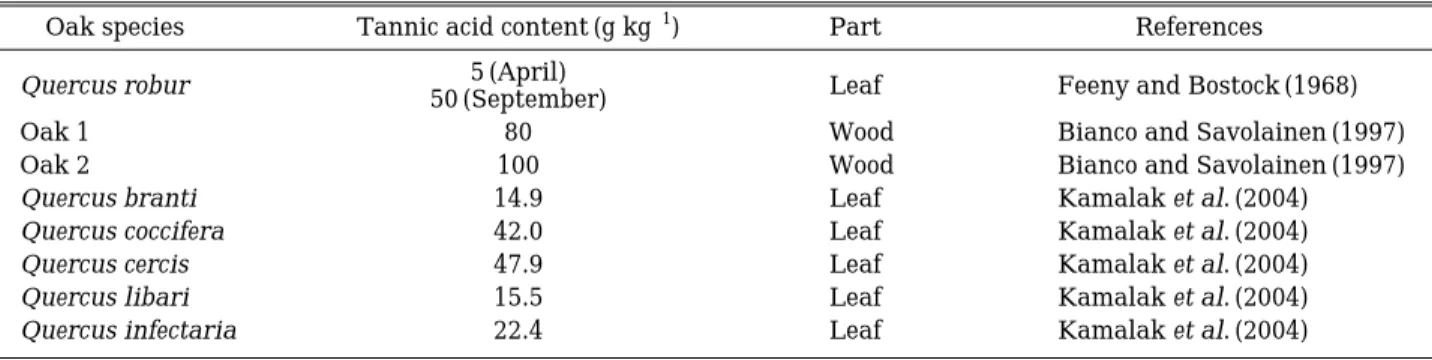
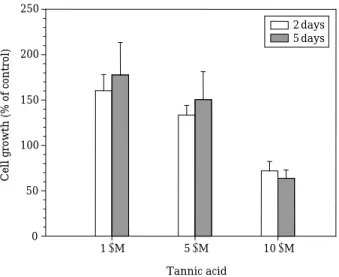
Previous studies have shown that the tannin contents in various oak trees vary from 5 to 100 g kg-1(Table 3), with the genus Quercus showing relatively high levels (Ridge et al., 1999). In addi- tion to species-specific differences, tannic acid levels in oak trees also vary seasonally, showing higher levels in the fall (September) versus spring (April) (Feeny and Bostock, 1968). We next com- pared the effective algicidal concentrations requ- ired of the oak tree extracts with that of tannic acid. Figure 2 shows the anti-algal effects of var- ious concentrations of experimental-grade tannic acid on the growth of M. aeruginosa after 2 and 5 days. Our results revealed that the minimum concentration of tannic required to inhibit growth of M. aeruginosa was 10µM (17 mg L-1), whereas concentrations of 1 and 5µM (1.7 and 8.5 mg L-1) enhanced algal growth by as much as 150%.
Previous studies have shown that the growth of another cyanobacterium, Anabaena sp., was ef-
Cell number (×106 cells mL-1)
0.0 0.5 1.0 1.5 2.0 2.5
Oak extracts
Control MeOH QD-L QGI-L QSE-L QGL-S QD-S QAS-S QAl-LS CC-L CC-S QGL-L QSE-S QSA-S QGI-S QAT-S QAT-L QSA-L QAS-L
Fig. 1. Effects of plant extracts (100 mg L-1) on the growth of M. aeruginosa (cell number) in Daechung Reser- voir. Results indicate the means±SE (n = 3).
Table 1. Methanol extracts from Quercus and Castanopsis in Korean oak.
Symbol Scientific name Parts
CC-L Castanopsis cuspidata var.
sieboldii Leaf
CC-S Castanopsis cuspidata var.
sieboldii Stem
QAT-L Quercus acuta Leaf
QAT-S Quercus acuta Stem
QAS-L Quercus acutissima Leaf
QAS-S Quercus acutissima Stem
QAl-LS Quercus aliena Leaf, stem
QD-L Quercus dentata Leaf
QD-S Quercus dentata Stem
QGI-L Quercus gilva Leaf
QGI-S Quercus gilva Stem
QGL-L Quercus glauca Leaf
QGL-S Quercus glauca Stem
QSA-L Quercus salicina Leaf
QSA-S Quercus salicina Stem
QSE-L Quercus serrata Leaf
QSE-S Quercus serrata Stem
fectively inhibited by 6µM of tannic acid (Rice, 1984), and similar concentrations of tannin inhib- ited growth of the green algae, Chlorella vulagris (Pillinger et al., 1994). In contrast, 100µM of tannic acid was required to effectively inhibit the cyanobacterium, Oscillatoria cf. chalybea, and the green algae, Selenastrum capricornutum (Schrader et al., 1998). These results indicate that the algicidal activities of tannic acid are tar- get algae-specific, and that the effective concen- tration of tannic acid against the growth of M.
aeruginosa (17 mg L-1) was relatively low, and was similar to that of the oak tree extract (20 mg L-1).
Numerous chemical agents and synthetic com- pounds (e.g. copper, chlorine, aluminum, calcium and potassium permanganate) are currently used to control algal blooms in lakes, reservoirs and ponds. However, these chemicals often induce secondary problems, such as the toxic effects of copper on carp (Karan et al., 1998) and the release of phytotoxins that increase potential health ri- sks in drinking water supplies (Lam et al., 1995).
In an effort to develop a more environment-fri- endly algicidal strategy, a number of studies have
examined the abilities of various allelochemicals and plant extracts to inhibit the growth of phyto- plankton species. For example, growth of Micro- cystis, Spirogyra, Selenastrum, Chlorella and Ankistrodesmus have been shown to be inhibited by barley straw (Gibson et al., 1990; Welch et al., 1990; Pillinger et al., 1994; Brownlee et al., 2003), and Chlorella may also be inhibited by oak, pine, willow, elm, birch, sycamore and rowan (Ridge and Pillinger, 1996; Ridge et al., 1999). However, this is the first study to examine the ability of oak tree extracts to control the harmful cyano- bacterium, M. aeruginosa.
The oak tree is an important endemic species in Korea (You et al., 2001), where its distribution has gradually increased over time as a result of artificial planting and the aggressive natural succession of one species, Q. mongolica (You et al., 1995). The oak accounts for -27% of the total tree biomass production in Korea (Song et al., 2002), and of the 600,000 m3of annual lumbering in Korea (ca. 1999), -30% was oak (Korea Forest Service, 2000). The majority of smaller cuttings (⁄10 cm in diameter) are culled, meaning that -35% of oak is discharged as waste annually.
Table 2. Effects of various concentrations of oak extracts on the growth of M. aeruginosa.
10 mg L-1 20 mg L-1 50 mg L-1
Oak extract Cell number
%b Cell number
%b Cell number
%b (106cells mL-1)a (106cells mL-1)a (106cells mL-1)a
Control 1.30±0.09 1.30±0.09 1.30±0.09
QSA-L 0.74±0.02 43 0.65±0.10 50 0.03±0.00 98
QAS-L ¤1.30 - 0.29±0.00 78 0.12±0.00 91
QAT-L 0.98±0.03 25 0.34±0.02 74 0.12±0.00 91
QGI-S ¤1.30 - 0.48±0.08 63 0.28±0.00 78
QAT-S ¤1.30 - 0.54±0.19 58 0.48±0.01 63
QSA-L, Quercus salicina leaf extract; QAS-L, Quercus acutissima leaf extract; QAT-L, Quercus acuta leaf extract; QGI-S, Quercus gilva stem extract; QAT-S, Quercus acuta stem extract. aValues represent the means±SE (n = 3). bAlgal Inhibition Activity (%) = [(Control- Treatment)/Control]×100
Table 3. Comparison of tannic acid contents from different oak species.
Oak species Tannic acid content (g kg-1) Part References
Quercus robur 5 (April) Leaf Feeny and Bostock (1968)
50 (September)
Oak 1 80 Wood Bianco and Savolainen (1997)
Oak 2 100 Wood Bianco and Savolainen (1997)
Quercus branti 14.9 Leaf Kamalak et al. (2004)
Quercus coccifera 42.0 Leaf Kamalak et al. (2004)
Quercus cercis 47.9 Leaf Kamalak et al. (2004)
Quercus libari 15.5 Leaf Kamalak et al. (2004)
Quercus infectaria 22.4 Leaf Kamalak et al. (2004)
Our finding that Korean oak tree extracts effec- tively inhibited the growth of M. aeruginosa sug- gests that this large mass of oak waste might be salvaged as an algicide.
Thus, we herein showed that oak tree extracts effectively inhibit growth of the cyanobacterium, M. aeruginosa, at relatively low concentrations (possibly because of synergistic action by multi- ple phenolic compounds). The application of oak extracts to control blooms of cyanobacteria such as M. aeruginosa has three major advantages: 1) oak extracts are easily dissociated by natural microorganisms (mainly bacteria), thus theore- tically rendering them relatively nontoxic to the environment, 2) tannins do not affect the growth of other aquatic microorganisms (Street, 1979;
Gary et al., 1983), and 3) the use of oak may mini- mize economic costs because it involves recycling of forestal waste. These findings suggest that additional studies are warranted to examine the effects of tannin or oak tree extracts in aquatic ecosystems, with the goal of developing a new strategy for ameliorating harmful algal blooms.
ACKNOWLEDGEMENTS
This study was supported by grants from the Korean Ministry of Environment (to H.-M. Oh)
and MOST/KOSEF to the Environmental Biote- chnology National Core Research Center (R15- 2003-012-02001-0).
LITERATURE CITED
Allen, M.M. 1968. Simple conditions for the growth of unicellular blue-green algae on plates. J. Phycol.
4: 1-4.
An, J. and W.W. Carmichael. 1994. Use of a colorimet- ric protein phosphatase inhibition linked immuno- sorbent assay for the study of microcystins and nodularins. Toxicon 32: 1495-1507.
Bell, S.G. and G.A. Codd. 1994. Cyanobacterial toxins and human health, Rev. Med. Microbiol. 5: 256- 264.
Bianco, M.A. and H. Savolainen. 1997. Phenolic acids as indicators of wood tannins. Sci. Total Environ.
203: 79-82.
Brownlee, E.F., S.G. Sellner and K.G. Sellner. 2003.
Effects of barley straw (Hordeum vulgare) on fre- shwater and brackish phytoplankton and cyano- bacteria. J. Appl. Phycol. 15: 525-531.
Chung, I.M., J.K. Ahn and S.J. Yun. 2001. Assessment of allelopathic potential of barnyard grass (Echinoc- hloa crus-galli) on rice (Oryza sativa L.) cultivars.
Crop Protection 20: 921-928.
Dawson, R.M. 1998. The toxicology of microcystins.
Toxicon 36: 953-962.
Duke, S.O. 1986. Naturally occuring chemical com- pounds as herbicides. Rev. Weed Sci. 2: 17-44.
Ebana, K., W. Yan, R.H. Dilday, H. Namai and K.
Okuno. 2001. Variation in the allelopathic effect of rice with water soluble extracts. Agron. J. 93:
12-16.
Everall, N.C. and D.R. Lees. 1997. The identification and significance of chemicals released from decom- posing barley straw during reservoir algal control.
Wat. Res. 31: 614-620.
Feeny, P.P. and H. Bostock. 1968. Seasonal changes in the tannin content of oak leaves. Phytochem. 7:
871-880.
Gary, F.L., R.L. Crawford and T.K. Kirk. 1983. Degra- dation of phenolic compounds and ring cleavage of catechol by Phanerochate chrysosporium. Appl.
Environ. Microbiol. 46: 191-197.
Gibson, M.T., I.M. Welch, P.R.F. Barrett and I. Ridge.
1990. Barley straw as an inhibitor of algal growth II: laboratory studies. J. Appl. Phycol. 2: 241-248.
Hussein-Ayoub, S.M. and L.K. Yankov. 1985. Algicidal properties of tannins. Fitoterapia 56: 227-229.
Kamalak, A., O. Canbolat, O. Ozay and S. Aktas.
2004. Nutritive value of oak (Quercus spp.) leaves.
Small Rumin. Res. 53: 161-165.
Karan, V., S. Vitorovi´c, V. Tutundzˇi´c and V. Poleksi´c.
1998. Functional enzymes activity and gill histol- ogy of carp after copper sulfate exposure and re- 0
50 150
100 200 250
1 µM 5 µM 10 µM
Cell growth (% of control)
Tannic acid
2 days 5 days
Fig. 2. Effects of various concentrations of tannic acid on the growth of M. aeruginosa. Initial concentra- tions of tannic acid were 1, 5, and 10µM (1.7, 8.5, and 17 mg L-1, respectively). Natural water was obtained from the Daechung Reservoir. Results indicate the means±SE (n = 3).
covery. Ecotoxicol. Environ. Safe. 40: 49-55.
Korea Forest Service. 2000. 2000 Forestry census.
482 p. (in Korean).
Lam, A.K.Y., E.E. Prepas, D. Spink and S.E. Hrudey.
1995. Chemical control of hepatotoxic phytoplank- ton blooms: Implications for human health. Wat.
Res. 29: 1845-1854.
Lee, B.W. and D.H. Shin. 1991. Screening of natural antimicrobial plant extract on food spoilage microor- ganisms. Kor. J. Food Sci. Technol. 23: 200-204.
Manage, P.M., Z. Kawabata and S. Nakano. 2001.
Dynamics of cyanophage-like particles and algici- dal bacteria causing Microcystis aeruginosa mor- tality. Limnol. 2: 73-78.
Nakai, S., Y. Inoue, M. Hosomi and A. Murakami.
2000. Myriophyllum spicatum-released allelopa- thic polyphenols inhibiting growth of blue-green algae Microcystis aeruginosa. Wat. Res. 34: 3026- 3032.
Nakai, S., Y. Inoue and M. Hosomi. 2001. Algal grow- th inhibition effects and inducement modes by plant-producing phenols. Wat. Res. 35: 1855- 1859.
Oh, H.-M., S.-J. Lee, M.-H. Jang and B.-D. Yoon.
2000. Microcystin production by Microcystis aerug- inosa in a phosphorus-limited chemostat. Appl.
Environ. Microbiol. 66: 176-179.
Paerl, H.W. 1988. Nuisance phytoplankton blooms in coastal, esturiane and inland waters. Limnol.
Oceanogr. 33: 823-828.
Pillinger, J.M., J.A. Cooper and I. Ridge. 1994. Role of phenolic compounds in the antialgal activity of barley straw. J. Chem. Ecol. 20: 1557-1569.
Reynolds, C.S. 1984. The Ecology of Freshwater Phy- toplankton. Cambridge University Press, London.
Rice, E.L. 1984. Allelopathy. 2nd edn. Academic Press Inc., Orlando, Florida.
Ridge, I. and J.M. Pillinger. 1996. Toward under- standing the nature of algal inhibitors from bar- ley straw. Hydrobiologia 340: 301-305.
Ridge, I., J. Walters and M. Street. 1999. Algal growth control by terrestrial leaf litter: a realistic tool?
Hydrobiologia 395/396: 173-180.
Schrader, K.K., M.Q. de Regt, P.R. Tidwell, C.S.
Tucker and S.O. Duke. 1998. Selective growth in- hibition of the musty-odor producing cyanobac- terium Oscillatoria cf. chalybea by natural com-
pounds. Bull. Environ. Contam. Toxicol. 60: 651- 658.
Sigee, D.C., R. Glenn, M.J. Andrews, E.G. Bellinger, R.D. Butler, H.A.S. Epton and R.D. Hendry. 1999.
Biological control of cyanobacteria: principles and possibilities. Hydrobiologia 395/396: 161-172.
Skulberg, O.M., G.A. Codd and W.W. Carmichael.
1984. Toxic blue-green algal blooms in Europe: A growing problem Ambio 13: 244-247.
Song, J.H., Y.J. Kim and J.S. Yi. 2002. Optimum growth range and variation in foliar trichome among natural populations of Quercus variabilis in Korea. J. Kor. For. Soc. 91: 687-693 (in Korean).
Song, L., T. Sano, R. Li, M.M. Watanabe, Y. Liu and K. Kaya. 1998. Microcystin production of Microcy- stis viridis (Cyanobacteria) under different cul- ture conditions. Jpn. J. Phycol. 46: 19-23.
Street, M. 1979. The importance of invertebrates and straw. Game Conservancy Ann. Rew. 11: 34-38.
Suzuki, Y., T. Takabayashi, T. Kawaguchi and K.
Matsunaga. 1998. Isolation of an allelopathic sub- stance from the crustose coralline algae, Lithop- hyllum spp., and its effect on the brown alga, Laminaria religiosa Miyabe (Phaeophyta). J. Exp.
Mar. Biol. Ecol. 225: 69-77.
Welch, I.M., P.R.F. Barrett, M.T. Gibson and I. Ridge.
1990. Barley straw as an inhibitor of algal growth I: studies in the Chesterfield Canal. J. Appl. Phy- col. 2: 231-239.
Whittaker, R.H. and P.P. Feeny. 1971. Allelochemicals : Chemical reactions between species. Science 171:
757-770.
You, Y.-H., K.-J. Gi, D.-Y. Han, Y.-S. Kwak and J.-H. Kim. 1995. Succession and heterogeneity of plant community in Mt. Yongam, Kwangnung Ex- permental Forest. Kor. J. Ecol. 18: 89-97.
You, Y.-H., Y.J. Chun, H.-S. Lee, C.-S. Lee and J.- H. Kim. 2001. Distribution of damaged oaks and annual oak biomass removal by oak nut weevil (Mechoris ursulus) in Korea. Kor. J. Ecol. 24:
377-380.
Zohary, T. and R.D. Robarts. 1989. Diurnal mixed layer and the long-term dominance of Microcystis aeruginosa. J. Plankton Res. 11: 25-48.
(Manuscript received 14 November 2005, Revision accepted 10 December 2005)
⁄ ¤
남조류 Microcystis aeruginosa에 대한 국내 참나무들의 살조 효과
박명환1∙김백호2∙한명수1,2∙안치용3∙윤병대3∙오희목3,* (1한양대학교 환경과학과, 2한양대학교 생명과학과,
3한국생명공학연구원 환경생명공학연구실)
본 연구는 새로운 환경친화적 살조제를 탐색하기 위한 연구의 일환으로, 담수에서 조류 대발생 원 인종 Microcystis aeruginosa를 대상으로 하여 국내에 자생하는9가지 참나무 잎과 줄기로부터 추 출한 물질의 조류생장 억제능력을 조사하였다. 추출물 농도100 mg L-1첨가시, 5가지 참나무 추출 물(QAT-L, QAT-S, QAS-L, QGI-S 및 QSA-L)은 M. aeruginosa의 7일 후 세포수를 90% 이상 감소시켰다. 20 mg L-1의 경우에는 상기의 5가지 참나무 추출물에서M. aeruginosa의 세포수가 약 50% 정도 감소하였다. M. aeruginosa를 효과적으로 제어하기 위한 참나무 추출물의 최소 농도는 20 mg L-1로 조사되었다. 참나무의 주요 성분으로 알려져 있는 tannic acid는 17 mg L-1의 농도에 서M. aeruginosa에 대한 억제효과를 나타냈다. 본 연구를 통해서 참나무 추출물은 부영양 수계에 서 조류 대발생 원인종 M. aeruginosa를 제어하는 환경친화적 살조제로서 이용할 수 있을 것으로 판단된다.