• 검색 결과가 없습니다.

Government-Controlled Companies and Audit Committee Effectiveness: An Empirical Study on Saudi Stock Exchange

N/A
N/A
Protected

Academic year: 2021

Share "Government-Controlled Companies and Audit Committee Effectiveness: An Empirical Study on Saudi Stock Exchange"

Copied!
6
0
0

로드 중.... (전체 텍스트 보기)

전체 글

(1)

Print ISSN: 2288-4637 / Online ISSN 2288-4645 doi:10.13106/jafeb.2021.vol8.no4.0363

Government-Controlled Companies and Audit Committee Effectiveness: An Empirical Study on Saudi Stock Exchange*

Raj Bahadur SHARMA

1

, Omer Ali BAGAIS

2

, Khaled Salmen ALJAAIDI

3

Received: November 30, 2020 Revised: February 20, 2021 Accepted: March 02. 2021

Abstract

This study attempts to examine whether ownership of government-controlled corporations and audit committee effectiveness are related.

The population of this study is 431 listed manufactured firms in the Saudi Stock Exchange (Tadawul) for the period 2012–2019 that published their financial and annual reports for the period 2012–2019. This population criterion is based on considerations that manufacturing companies listed on Tadawul have publicly accessible data and they have greater obligations to implement corporate governance code. Using the complementary hypothesis, this study predicts that there is a positive relationship between the ownership of government-controlled companies and audit committee effectiveness. The Pooled OLS regression shows that government-controlled companies’ ownership is positively associated with audit committee effectiveness. Our study also indicates that ownership of government-controlled companies as a governance monitoring mechanism becomes more effective as it is combined with audit committee effectiveness which is another governance monitoring mechanism. The results of this study provide insightful evidence to policymakers at the company and country levels on the relationship of government-corporate ownership and audit committee effectiveness.

Keywords: Audit Committee Effectiveness, Government-Controlled Companies, Ownership, Saudi Arabia JEL Classification Code: M40, M42, G32

business. Concentrated Ownership simply refers to the case where the majority of shares are held by few owners. Ownership concentration is a significant internal governance mechanism in which owners can control and influence the management of the firm to protect their interests. In particular, the major group of blockholders in numerous emergent economies constitutes government-controlled companies (Haniffa et al., 2006).

A blockholder refers to an individual or organization which owns a substantial amount of a company's shares or debt. Due to the large number of shares held, blockholders can influence the direction of a company through exercising its voting rights and threats to sell their shares, negatively impacting the price.

At present, numerous domestic stock markets are extensively and gradually integrating government-owned companies as major players. Study findings provide evidence in support of the notion that firms benefit from corporate ownership in the form of limited liability for their shareholders, a perpetual existence, and ease of transferring ownership interests (Haniffa et al., 2006). Accordingly, domestic investors represent the largest source of financial, technical, and organizational resources in contrast to the contributions of foreign investors (Fama & Jensen, 1983). Moreover, business ties, networks, and the local government represent the most influential

*Acknowledgements:

This publication was supported by the Deanship of Scientific Research at Prince Sattam bin Abdulaziz University, Alkharj, Saudi Arabia.

1

First Author. Assistant Professor, Accounting Department, College of Business Administration, Prince Sattam bin Abdulaziz University, Saudi Arabia. Email: [email protected]

2

Lecturer, Accounting Department, College of Business Administration, Prince Sattam bin Abdulaziz University, Saudi Arabia. Email: [email protected]

3
Corresponding Author. Assistant Professor, Accounting Department, College of Business Administration, Prince Sattam bin Abdulaziz University, Saudi Arabia [Postal Address: Zayed bin Haretha Street, Al-Salam District, Al-Kharj, Al-Rayadh, 16244, Saudi Arabia]

Email: [email protected]

© Copyright: The Author(s)

This is an Open Access article distributed under the terms of the Creative Commons Attribution Non-Commercial License (https://creativecommons.org/licenses/by-nc/4.0/) which permits unrestricted non-commercial use, distribution, and reproduction in any medium, provided the original work is properly cited.

1. Background of the study

An ownership structure concerns the internal organization

of a business entity and the rights and duties of the

individual holding the equitable or legal interest in that

(2)

factors with regard to the monitoring roles assigned to local investors. Government-owned companies consistently uphold best-quality corporate governance and improved corporate governance enhances the quality of service delivery to the public, better growth prospects while increasing foreign investment (Carcello et al., 2002).

For government owners safeguarding their political interests, represents a momentous objective, which makes it a priority to hire ethically aligned auditors to generate financial statements (Hassan et al., 2018). Politically affiliated companies often capitalize on their links to access cheap loans influencing their overall capability to raise substantial capital (Mautz & Neumann, 1977). Politically affiliated companies rarely incur a penalty for higher borrowing costs regardless of their poor productivity (Laksmana, 2008). Furthermore, in emergent economies, the government’s monitoring role lacks proper attention resulting from increased emphasis on policies to advance social welfare objectives (Ferreira et al., 2011).

This study uses the complementary hypothesis to explain the relationship between the government-controlled companies and audit committee effectiveness, expecting that government-controlled companies are interrelated with audit committee effectiveness. According to research findings, corporate mechanisms must be viewed as a collective entity rather than in singularity to protect shareholder interests since these mechanisms complement and substitute each other during execution (Dey, 2008). There exists a gap in ongoing research regarding the underlying factors that influence the operations of the audit committee effectiveness which represents an imperative component of fundamental corporate governance practices (Greco, 2011; Braswell et al., 2012;

Astuti et al., 2020; Arel et al., 2006; Aljaaidi et al., 2021; Abbott et al., 2004). These studies were subject to several limitations.

First, they had been conducted in developing and developed markets. Second, they reported inconclusive and conflicting results. Third, the impact of ownership of government- controlled companies on audit committee effectiveness was not examined in these studies. Finally, the setting of Saudi Arabia was ignored by these studies.

In the context of Saudi Arabia, Aljaaidi et al. (2021) reported a significant positive association between board activity and audit committee effectiveness score. Besides, they reported a positive relationship between company experience and audit committee diligence. They documented a positive relationship between board meetings and audit committee meeting frequency. Therefore, there is still a need to have more empirical investigations of the issues surrounding the audit committee’s effectiveness.

To the best of the researchers’ knowledge, there exists paucity in empirical studies to investigate how government- controlled corporations relate to audit committee effectiveness. Consequently, the present study seeks to lengthen the scope of extant research findings to recognize the incidence of the audit committee’s effectiveness.

The remainder of the paper is organized as follows.

The next section describes the research methods. The third section presents the results and discussions. The final section concludes the study.

2. Research Methods 2.1. Research Design

This research’s model is a relationship study that examines the association of the ownership of government- controlled companies (GOVOWN) with audit committee effectiveness (ACEF). There is one hypothesized variable, namely; ownership of government-controlled companies, and four control variables, namely; family ownership (FOWN), local corporate ownership (LCOWN), board effectiveness (BDMEET), and firm size (FSIZE).

2.2. Variable Measurement

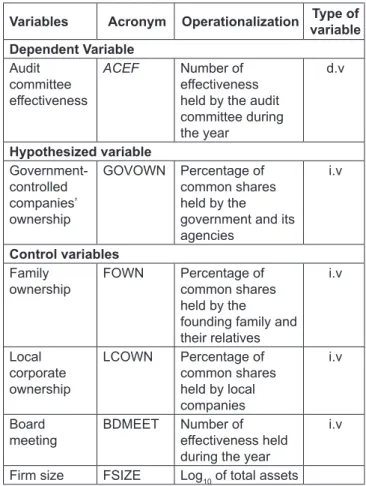
The measurements of the dependent, hypothesized and controlled variables are shown in the following Table 1:

Table 1: Summary of the Operationalization of the Research Variables

Variables Acronym Operationalization Type of variable Dependent Variable

Audit committee effectiveness

ACEF Number of

effectiveness held by the audit committee during the year

d.v

Hypothesized variable Government-

controlled companies’

ownership

GOVOWN Percentage of common shares held by the government and its agencies

i.v

Control variables Family

ownership FOWN Percentage of common shares held by the

founding family and their relatives

i.v

Local corporate ownership

LCOWN Percentage of common shares held by local companies

i.v

Board

meeting BDMEET Number of

effectiveness held during the year

i.v

Firm size FSIZE Log

10

of total assets

Note: d.v – dependent variable, i.v – independent variable.

(3)

2.3. Statistical Model

The research statistical model can be described in the following equation:

ACEF = β

0

+ β

1

GOVOWN + β

2

FOWN + β

3

LCOWN + β

4

BDMEET + β

5

FSIZE + e (1) Where:

ACEF = Number of effectiveness held by the audit committee during the year GOVOWN = Percentage of common shares held by

the government and its agencies FOWN = Percentage of common shares held by

the founding family and their relatives LCOWN = Percentage of common shares held by

local companies

BDMEET = Number of effectiveness held during the year

FSIZE = Log

10

of total assets

e = error term.

Due to the continuous nature of the dependent variable, Pooled Ordinary Least Square (OLS) was utilized as the method of analysis to test the model. The pooled regression model is one type of model that has constant coefficients, referring to both intercepts and slopes. For this model, researchers can pool all of the data and run an ordinary least squares regression model.

2.4. Sampling

The population of this study is manufacturing companies listed on the Saudi Stock Exchange (Tadawul) that published their financial and annual reports for the period 2012–2019. This population criterion is based on considerations that manufacturing companies listed on Tadawul have publicly accessible data and they have greater obligations to implement corporate governance code.

Table 2: Sample Selection

Total Observations

Total observations 465

Observations discarded (outliers,

missing and incomplete data) (34)

Final sample 431

2.5. Method of Collecting Data

This study uses secondary data sourced from audited financial and annual reports of manufacturing companies listed on the Saudi Stock Exchange (Tadawul) for the period 2012–2019. A cross-sectional review of audit reports of the sampled companies listed on Tadawul was undertaken. The samples selected are depicted in Table 2.

To minimize the effect of the variables and to increase the predictive ability of the model, several control variables were included. These are family ownership, local companies’

ownership, board meetings, and firm size

3. Results

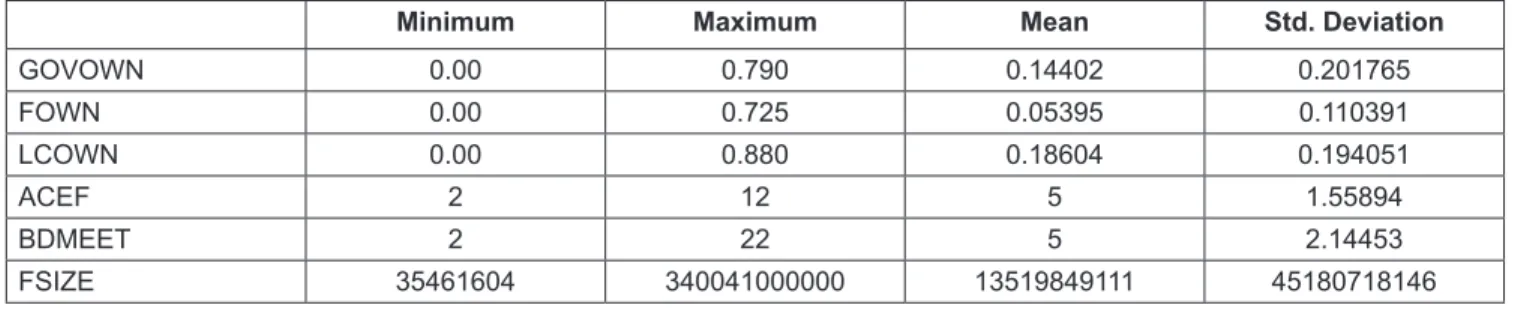
3.1. Descriptive Statistics and Correlation Analysis The descriptive statistics are presented in Table 3, showing the mean, standard deviation, minimum, and maximum of each variable in the sample data set.

The results of the descriptive analysis in Table 3 show that the mean of GOVOWN is 0.14402 and ranges from 0.00 to 0.790 with a standard deviation of 0.201765. The mean of FOWN is 0.05395 and ranges from 0.00 to 0.725 with a standard deviation of 0.110391. The mean of LCOWN is 0.18604 and ranges from 0.00 to 0.880 with a standard deviation of 0.194051. The mean of ACEF is 5 and ranges from 2 to 12 with a standard deviation of 1.55894. The mean of BDMEET is 5 and ranges from 2 to 22 with a standard deviation of 2.14453. The mean of FSIZE is 13519849111 and ranges from 35461604 to 340041000000 with a standard deviation of 45180718146.

Table 3: Descriptive Statistics

Minimum Maximum Mean Std. Deviation

GOVOWN 0.00 0.790 0.14402 0.201765

FOWN 0.00 0.725 0.05395 0.110391

LCOWN 0.00 0.880 0.18604 0.194051

ACEF 2 12 5 1.55894

BDMEET 2 22 5 2.14453

FSIZE 35461604 340041000000 13519849111 45180718146

(4)

of domestic corporate ownership as a monitoring mechanism depends on the effectiveness of the audit committee.

4. Conclusion

The overarching aim of this study was to assess whether the ownership of government-controlled companies impacts the audit committee effectiveness of Saudi companies. The result of the study reveals that the ownership of government- controlled companies is positively associated with audit committee effectiveness. Our study also indicates that the ownership of government-controlled companies as a governance monitoring mechanism becomes more effective when it is combined with audit committee effectiveness which is another governance monitoring mechanism.

The present study makes several important contributions.

First, the researcher employs a predictive modeling approach to evaluate the rights of government-controlled companies on Saudi public-listed firms’ audit committee effectiveness using a huge sample size of corporate data spanning 8 years.

Ultimately, the present study contributes additional knowledge to the narrow pool of documented evidence of audit committee effectiveness in public-listed companies (Al-Daoud et al., 2016; Beasley, 1996; Collier & Gregory, 1999; Klein, 2002;

Lin et al., 2014; Owens- Jackson et al., 2009; Pucheta-Martínez

& De Fuentes, 2007; Sharma et al., 2020; Qasim, 2020;

Vafaes, 1999). Second, the present study findings support the corresponding hypothesis through theoretical deductions.

Evidence of audit committee effectiveness represents a major point of emphasis for government-controlled companies, which seek to emphatically uphold good corporate governance practices. Last, the findings of this study bestow practical implications for the stock markets, banks, regulators, management, and auditors by presenting an understanding of the complementary influence of governmental ownership on the controlling role of the audit committee, which in turn, represents a noble corporate governance practice.

Table 4: Correlation Matrix of Independent Variables GOVOWN FOWN LCOWN BDMEET FSIZE

GOVOWN 1

FOWN –0.242** 1

LCOWN 0.110 –0.001 1

BDMEET 0.108 –0.158** 0.108 1

FSIZE 0.595** –0.117 0.297** 0.019 1

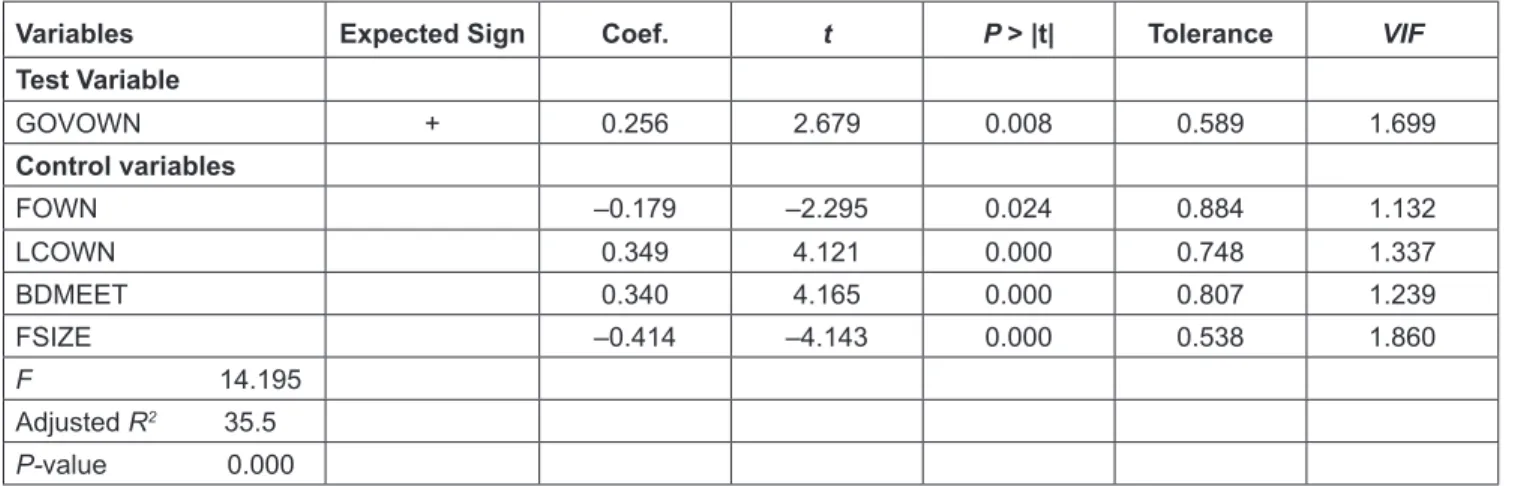
Table 5: Audit Committee Effectiveness Regression Model

Variables Expected Sign Coef. t P > |t| Tolerance VIF

Test Variable

GOVOWN + 0.256 2.679 0.008 0.589 1.699

Control variables

FOWN –0.179 –2.295 0.024 0.884 1.132

LCOWN 0.349 4.121 0.000 0.748 1.337

BDMEET 0.340 4.165 0.000 0.807 1.239

FSIZE –0.414 –4.143 0.000 0.538 1.860

F 14.195 Adjusted R

2

35.5 P-value 0.000

Bold = significance at 1%, 5% and 10% (one-tailed significance).

Table 4 confirms that there is no multicollinearity problem in this study since the correlation matrixes among the variables do not exceed 0.90. All the variables have a correlation of equal to or less than 0.595.

3.2. Hypothesis Testing

Pooled OLS regression was used to test the association of the experimental variable, namely; government-controlled companies’ ownership, and the control variables, namely;

family ownership, local companies’ ownership, board meeting, and firm size with audit committee effectiveness. Table 5 depicts the estimated regression coefficients for the regression model.

Table 5 shows the estimated regression coefficients for the regression model. As shown in Table 5, the model explains 35.5% of the variation in the audit committee effectiveness.

The model is significant (F = 14.195 and Sign F = 0.000). As for testing the hypothesis which states that there is a positive association between government-controlled companies’

ownership and audit committee effectiveness, the direction

of this relationship is positive and significant in the predicted

direction at 1% (β = 256, t = 2.679, P = 0.008, one-tailed

significance). This result is consistent with the prediction of the

complementary hypothesis. This indicates that the ownership

of government-controlled companies as a governance

monitoring mechanism becomes more effective when it is

combined with audit committee effectiveness which is another

governance monitoring mechanism. Besides, the effectiveness

(5)

Accounting Research, 19(3), 365–384. https://doi.org/10.1506/

CHWK-GMQ0-MLKE-K03V

Collier, P., & Gregory, A. (1999). Audit committee activity and agency costs. Journal of Accounting and Public Policy, 18(4–5), 311–332. https://doi.org/10.1016/S0278-4254(99) 00015-0

Dey, A. (2008). Corporate governance and agency conflicts.

Journal of Accounting Research, 46(5), 1143–1181. https://doi.

org/10.1111/j.1475-679X.2008.00301

Fama, E. F., & Jensen, M. C. (1983). Separation of ownership and control. The Journal of Law and Economics, 26(2), 301–325.

https://www.jstor.org/stable/725104

Ferreira, D., Ferreira, M. A., & Raposo, C. C. (2011). Board structure and price informativeness. Journal of Financial Economics, 99(3), 523–545. https://doi.org/10.1016/j.jfineco.2010.10.007 Greco, G. (2011). Determinants of board and audit committee

meeting frequency. Managerial Auditing Journal, 26(3), 208–229. https://doi.org/10.1108/02686901111113172

Haniffa, R., Yatim, P., Kent, P., & Clarkson, P. (2006). Governance structures, ethnicity, and audit fees of Malaysian listed firms.

Managerial Auditing Journal, 21(7), 757–781. https://doi.

org/10.1108/02686900610680530

Hassan, W. K., Aljaaidi, K. S., Bin Abidin, S., & Nasser, A. M.

(2018). Internal corporate governance mechanisms and audit quality: Evidence from GCC region. International Journal of Advanced and Applied Sciences, 5(8), 72–90. https://doi.

org/10.21833/ijaas.2018.08.010

Klein, A. (2002). Audit committee, board of director characteristics, and earnings management. Journal of Accounting and Economics, 33(3), 375–400. https://doi.org/10.1016/S0165- 4101(02)00059-9

Laksmana, I. (2008). Corporate board governance and voluntary disclosure of executive compensation practices. Contemporary Accounting Research, 25(4), 1147–1182. https://doi.org/10.

1506/car.25.4.8

Lin, Y. F., Yeh, Y. M. C., & Yang, F. M. (2014). Supervisory quality of board and firm performance: A perspective of board meeting attendance. Total Quality Management & Business Excellence, 25(3–4), 264–279. https://doi.org/10.1080/14783 363.2012.756751

Mautz, R., & Neumann, F. (1977). Corporate audit committees:

Policies and practices. Cleveland, OH: Ernst & Ernst.

Owens-Jackson, L. A., Robinson, D., & Shelton, S. W. (2009).

The association between audit committee characteristics, the contracting process and fraudulent financial reporting.

American Journal of Business, 24(1), 57–66. https://doi.

org/10.1108/19355181200900005

Pucheta-Martínez, M. C., & De Fuentes, C. (2007). The impact of audit committee characteristics on the enhancement of the quality of financial reporting: An empirical study in the Our study is subject to several limitations. Our study used

only audit committee effectiveness’ numbers from annual reports ignoring the other audit committee activities such as the time, duration, and attendance of the effectiveness. Future research may use other data collection instruments such as questionnaires to collect data about the audit committee’s effectiveness. Besides, this study used audit committee effectiveness as a corporate governance mechanism ignoring the other audit committee characteristics such as size, financial expertise, and experience. Future studies may consider these characteristics examining them in individual or composite measurements. Furthermore, the sample size of this study consists of manufacturing companies listed on the Saudi Stock Exchange for the period 2012-2019. Future research may examine a longer period of time and different sectors and in various Gulf Cooperation Council or other Arab countries.

References

Abbott, L. J., Parker, S., & Peters, G. F. (2004). Audit committee characteristics and restatements. Auditing: A Journal of Practice & Theory, 23(1), 69–87. https://doi.org/10.1007/

s11782-007-0023

Al-Daoud, K. I., Saidin, S. Z., & Abidin, S. (2016). Board meeting and firm performance: Evidence from the Amman stock exchange. Corporate Board: Role, Duties and Composition, 12(2), 6–11. https://doi.org/10.22495/cbv12i2art1

Aljaaidi, K. S., Bagais, O. A., & Adow, A. H. E. (2021). The impact of board activity on the audit committee’s effectiveness score:

Empirical evidence from Saudi Arabia. The Journal of Asian Finance, Economics, and Business, 8(1), 179–185. https://doi.

org/doi:10.13106/jafeb.2021.vol8.no1.179

Arel, B., Brody, R., & Pany, K. (2006). Findings on the effects of audit firm rotation on the audit process under varying strengths of corporate governance. Advances in Accounting, 22, 1–27.

https://doi.org/10.1016/S0882-6110(06)22001-7

Astuti, R. N., Fachrurrozie, F., Amal, M. I., & Zahra, S. F.

(2020). Does audit committee quality mediate determinants of intellectual capital disclosure? The Journal of Asian Finance, Economics, and Business, 7(7), 199–208. https://doi.

org/10.13106/jafeb.2020.vol7.no7.199

Beasley, M. S. (1996). An empirical analysis of the relation between the board of director composition and financial statement fraud. Accounting Review, 443–465. https://www.jstor.org/

stable/248566

Braswell, M., Daniels, R. B., Landis, M., & Chang, C. C. A.

(2012). Characteristics of diligent audit committees. Journal of Business & Economics Research (JBER), 10(4), 191–206.

https://doi.org/10.19030/jber.v10i4.6895

Carcello, J. V., Hermanson, D. R., Neal, T. L., & Riley Jr, R. A.

(2002). Board characteristics and audit fees. Contemporary

(6)

Spanish context. Corporate Governance: An International Review, 15(6), 1394–1412. https://doi.org/10.1111/j.1467- 8683.2007.00653

Qasim, A. (2020). Examining the quality of audit committee work: An empirical examination of the determinants of audit committee diligence in the UAE. Calitatea, 21 (176), 109–111.

Sharma, V., Naiker, V., & Lee, B. (2009). Determinants of audit committee meeting frequency: Evidence from a voluntary governance system. Accounting Horizons, 23(3), 245–263.

https://digitalcommons.kennesaw.edu/facpubs/3102/

Vafeas, N. (1999). Board meeting frequency and firm performance.

Journal of financial economics, 53(1), 113–142. https://doi.

org/10.1016/S0304-405X(99)00018-5

수치

Table 1: Summary of the Operationalization of the Research  Variables
Table 3: Descriptive Statistics
Table 5: Audit Committee Effectiveness Regression Model

참조

관련 문서

As a result of the study, it was confirmed that only human resource competency had a positive(+) effect on the intercompany cooperation method of IT SMEs,

It was to demonstrate what relations the assessed corporation tax amount decided after the audit of corporations by the tax authorities as a substitute

This study also shows that real exchange rate misalignment could have a positive impact on export performance in China.. With its implications on

6) Hampel, Sir Ronald, 1998, Committee on Corporate Governance, Final Report, The Committee on Corporate Goernace and Gee Publishing Ltd:London, UK.. 왜냐하면 앞서

In this study, it is shows that the stream of CO 2 is more effective in the reduction of unreacted TEGDMA and the increase of surface microhardness than that of N 2

Therefore, as a recovery method during exercise, it is more effective for recovery of exercise fatigue and prevention of body acidification due to high

As one of the few Companies that entered India early, I think we have shaped the Indian per- ception on Korean Companies and products to a fair extent .Having made an entry into

First, as an improvement plan for child-care budgets, The Korean government and local government should prepare a system to aid child-care fees and