Investigation and Risk Assessment of Heavy Metals Contamination around an Abandoned Metal Mine in Korea
Jong-Wha Lee · Soon-Sun Kwak · Sung-Chul Hong · Sang-Il Park · Bong-Ki Jang
†Department of Environmental Health Science, Soonchunhyang University, Asan, Korea (Received September 8, 2010/Revised October 20, 2010/Accepted November 29, 2010)
ABSTRACT
Recently, heavy metals contamination of the agricultural soil and crops surrounding mining areas has been identified as one of the most serious environmental problems in South Korea. The Ministry of the Environment in Korea conducted a Preliminary National Environmental Health Survey (PNEHS) in abandoned metal mines in 2007. The priority for a subsequent detailed examination was ranked from the results of PNEHS. The studied mine which was ranked as being of the highest priority is located in the midwestern part of Korea and was operated from 1911 to 1985. In this study, the contamination levels of the heavy metals in the abandoned metal mine were investigated. From the results, the average daily dose (ADD), target hazard quotient (THQ) and target cancer risk of the heavy metals were evaluated. The concentration of arsenic (As) in all of the tailings from the mine was higher than its countermeasure standard of Korea. In particular, the highest concentration of As, 330 mg/kg, was up to 15 times higher than its countermeasure standard. The average concentration of As in agricultural soils was higher than the warning standard of Korea, and higher than its countermeasure standard at six sites. The average concentrations of the analyzed heavy metals in agricultural soil were below the warning standard, but concentrations of cadmium (Cd) and lead (Pb) at 4 sites were higher than its warning standard. The average concentration of As in surface water exceeded the warning standard of Korea. The value of the THQ of As for the tailings was higher than the health protection standard 1. The value of THQ of As for the farmlands was lower than the standard, while the hazard index (HI) of As was higher than the standard. The value of target cancer risk (TCR) of As, 6.44 × 10
−4, were higher than the health protection standard of a lifetime risk for TCR at 1 × 10
−6. This suggests that the residents around the metal mines are exposed to As pollution with a carcinogenic risk.
Keywords: abandoned metal mine, heavy metals, risk assessment, hazard index
I. Introduction
Soil contamination by metals represents one of the major environmental impacts from Abandoned Mine Sites (AMSs).
1)Not only is soil commonly contaminated within the boundaries of AMSs, but also metal compounds may be delivered to soil in the vicinity of an AMS by wind (as dust particles) or by water related pathways (surface runoff, seasonal ground water seepage, shallow ground water table occurrence, or surface water overflow in the flood plains). The characteristics of these
pathways are influenced by climatic, hydrologic and hydrogeologic conditions, which determine locations of potentially contaminated areas, where environmental risk of metal contamination in soil is high. Within the conceptual model of the Environmental Pollution Event, soil is considered as a prime recipient of pollution from AMSs, and soil in turn acts as a pathway for metal transformation to vegetation or other elements of the ecosystem.
Coal and metal mining activities were actively developed in South Korea from the early twentieth century, but most of the mines were closed in the 1970s due to economic conditions and the exhaustion of ore reserves. Currently, there are about 1,000 abandoned metal mines in South Korea; most of
†
Corresponding author : Department of Environmental Health Science, Soonchunhyang University
Tel: 82-41-530-1268, Fax: 82-41-530-1272
E-mail: [email protected]
these mines have been left without any management.
The tailings from these mines contain several types of toxic contaminants, including heavy metals, and the potential is high for deterioration of the ecosystems around these mines. Recently, heavy metal contamination of agricultural soils and crops surrounding the mining areas has been identified as one of the most serious environmental problems in many countries
1-3)including South Korea.
4-6)Ministry of environment in Korea conducted
‘Preliminary National Environmental Health Survey (PNEHS) in abandoned metal mines’ in 2007. For the PNEHS, the health status and heavy metal concentrations in biological samples of the residents around 500 abandoned metal mines in Korea had been examined. The priority for a detailed examination was ranked from the results of PNEHS in 2007. A detailed examination, levels of environmental contamination, health status and heavy metal concentrations of the residents, was performed in 2008 for 10 abandoned metal mines ranked at a group of the highest priority.
The study area, including an abandoned gold/
silver mine, is located in the midwestern part of Korea. During the period of 1999-2003, to tackle potential environmental problems from the mining wastes, the provincial authority undertook remediation
strategies including installation of drainage ditches, surface soil cover, and containment/barrier wall and subsequent reclamation mainly focus on the mining dump. However, the mining wastes had been dispersed down slope by surface runoff mainly during heavy rainfall, wind action and draining effluent, which caused contamination of paddy fields, stream sediments and stream waters.
The nearest residential area is located within 0.5 km downstream of the mine portal. The area of flatland within the valley bottom is irrigated from nearby stream waters and/or ground waters.
For domestic consumption or commercial sale, the irrigated flatland (paddy fields) is farmed intensively for rice and vegetables.
In this study, contamination levels of heavy metals (As, Cd, Cu, Cr, Hg, Pb and Zn) in the abandoned metal mine were investigated. From the results, average daily dose (ADD), target hazard quotient (THQ) and target cancer risk of heavy metals was evaluated.
II. Materials and Methods 1. Sample collection
Tailings, agricultural soils, rice grains, sediments, stream and ground water samples were collected from March to June 2008 around the abandoned
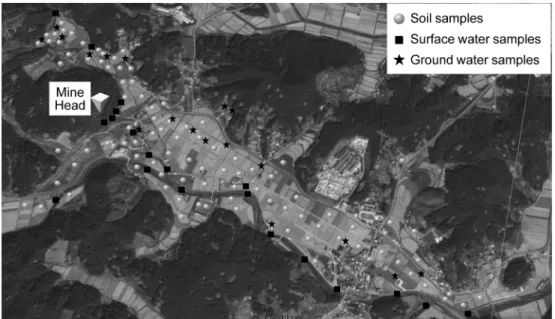
Fig. 1. The sampling sites of soil, surface and ground water.
metal mine in midwestern part of Korea (Gubong mine, Fig. 1). The mine was operated from 1911 to 1985. The mineralogy is classified as a Au/Ag bearing quartz vein type. Total output of gold and silver was estimated 13.2 and 6.7 tons, respectively.
The closure of the mining activity left about 19,000 tons of waste rocks and tailings.
Overall more than 99 soil samples were collected within 2.5 km from mine. About 3 kg of one composite tailings sample was composed of 5 sub- samples. Agricultural soil samples around the mine area were taken within a depth of 15 cm from the surface, and each was a composite of 5-7 sub-samples. In order to compare the surface sample with sub-surface sample, six sub-surface soil samples were taken within a depth of >40 cm from the surface. All soil samples were collected using a hand auger and then stored in polyethylene bags.
Surface water samples (include 2 leachates) were collected from 21 locations within 2.5 km downstream areas. Eighteen sediment samples were taken at the same sites. The stream water samples were filtered through a 0.45 µ m filter, collected in polypropylene bottles and those destined for cation analysis were preserved with ultrapure HNO
3to pH < 2. For the ground waters, at least three well volumes of water were purged before sampling, using a low-rate submersible pump attached to a polyethylene (PE) hose.
Samples for multi-element analysis were syringe- filtered at 0.45 µ m and preserved using ultra-pure 1 m l HNO
3in 1,000 m l HDPE bottles.
2. Sample pretreatment
Air dried tailings, agricultural soils and sediments were pretreated according to the Soil Quality Conservation Act of Korea. Samples were disaggregated, sieved on a 10-mesh size (<2 mm) for As, Cd, total Cr, Cu and Pb, and pulverized into a 100-mesh size (<150 µ m) for Hg and Zn. In order to determine the concentrations of Cd, total Cr, Cu and Pb, 50 m l 0.1 N HCl was added to 10.0 g of samples. These samples were shaken at 30
oC for 1 h, and then filtered through filter paper (Whatman 5B). For the analysis of As, 20 m l 1 N HCl was added to 4.0 g of samples.
These samples were shaken at 30
oC for 30 min. In
order to determine the concentrations of Hg and Zn, 3.3 m l of HNO
3and 10 m l of HCl (aqua regia) were added to 4.0 g of the samples. These samples were heated at 70
oC for 1 h, and then 30 m l of deionized water was added to the solution.
Surface water and groundwater were pre-treated according to the Water Quality Conservation Act of Korea. Briefly, 5 m l HNO
3was added to 500 m l water samples, and then digested on hot plate.
Final analytical solutions were made by addition 20 m l of 3% HNO
3, and then filtered through 0.45 µ m glass filter.
Rice grain samples were taken from the farmlands, and vigorously washed with deionized water to remove soil particles or dust adhered to the crop surface. Samples were then air-dried on covered trays in a filtered-air-drying cabinet at 40
oC for 48 h.
The dry samples were milled, digested with concentrated nitric acid, and added with a diluted acid (5% HNO
3).
3. Analytical methods
Soil and water samples were analyzed for Cd, total Cr, Cu, Pb and Zn concentration by atomic absorption spectrophotometery (AAS 6800, Shimadzu). As was analyzed by hydride generation- atomic absorption spectrophotometry (HG-AAS) equipped with hydride vapor generator (HVG-1, Shimadzu, Japan), autosampler (ASC-6100, Shimadzu), atomizer (Atomic muffle furnace, Shimadzu). Hg was assessed by cold vapor AAS (CV-AAS) in which SnCl
2was used as reductant.
Rice grain samples were analyzed for Cd and Pb by inductively coupled plasma-mass spectro- photometry (ICP-MS). The limits of detection for soil sample were: 4 µ g/kg for As, 0.04 mg/kg for Cd, 0.2 mg/kg for Cr, 0.03 mg/kg for Cu, 0.02 mg/
kg for Hg, 0.5 mg/kg for Pb and 0.1 mg/kg for Zn.
The limits of detection for water sample were:
0.8 µ g/ l for As, 0.9 µ g/ l for Cd, 4 µ g/ l for Cr, 0.8 µ g/ l for Hg and 10 µ g/ l for Pb.
4. Quality control
Appropriate quality assurance procedures and
precautions were carried out to ensure reliability
of the results. Double distilled deionized water
was used throughout the study. Glassware was
properly cleaned, and the reagents were of
analytical grade. Reagents blank determinations were used to correct the instrument readings. For validation of the analytical procedure, a recovery study was carried out by spiking and homogenizing several already analyzed samples with varied amounts of standard solutions of the metals. The recovery rates for soil and water samples were 100 ± 5%. Standard reference materials (SRM) obtained from the Korea Analytical Technical Research Institute (Busan, Korea), including soil and water were used for validation of the analytical procedure. The number of sample (40 samples) in one batch, the numbers of point (at least 4 points) and correlation coefficient (more than 0.999) of calibration curve, coefficient of variation (CV, 10%) of duplicate sample and RSD (10%) of the analytical results were included in the internal quality control. Blank and drift standards were run after twenty determinations to maintain instrument calibration. The coefficient of variation of replicate analyses was determined for the measurements to calculate analytical precision.
5. Risk assessment
For the risk assessment, evaluation of the average daily dose (ADD), target hazard quotient (THQ) and cancer risk were carried out using Risk Assessment Guidance for Superfund
7)and USEPA Region III Risk-Based Concentration Table.
8)The exposure parameters were adjusted with physiological and statistical values suitable for Korean people
such as mean body weight, life time, and exposure frequencies of various activities.
9,10)Three elements, As, Cd and Zn were considered in the assessment based on the database. Cu Cr, Hg and Pb were excluded in the assessment because of no information of reference dose for chronic oral exposure from the integrated risk information system (IRIS).
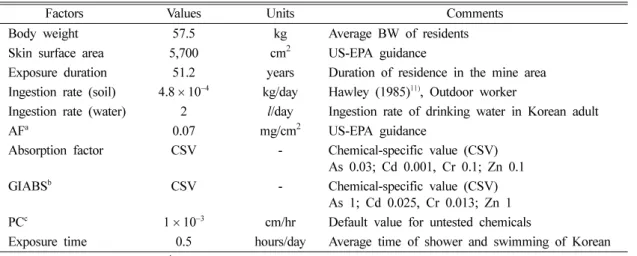
Exposure factors used for evaluation of ADDs are listed in Table 1, other factors absent in list are obtained from USEPA.
8)For the risk assessment from the mine area, THQ, hazard index (HI) and target cancer risk (TCR) were estimated. THQ was used to indicate the non-carcinogenic risks.
TCR was used to indicate carcinogenic risks. The method to estimate THQ and TCR were provided in USEPA Region III Risk-Based Concentration Table.
8)Reference doses (RfD) for As, Cd and Zn were 3 × 10
−4, 5 × 10
−4(1 × 10
−3for food) and 3 × 10
−1, respectively. Slope factor (SF) for As was 1.5. The equations for estimating THQ, HI and TCR were as follows: THQ = ADD/RfD, HI =
Σ THQs, TCR = ADD × SF.
III. Results and Discussion 1. Contamination level of heavy metals in the tailings, soils and sediments
The 0.1-N HCl-extractable concentrations of As (1-N HCl), Cd, Cr, Cu and Pb, and total concentrations of Hg and Zn in the tailings are listed in Table 2. The 0.1-N HCl can extract water
Table 1. Using parameters for evaluation of ADD of As, Cd and Zn with various exposure pathways
Factors Values Units Comments
Body weight 57.5 kg Average BW of residents
Skin surface area 5,700 cm
2US-EPA guidance
Exposure duration 51.2 years Duration of residence in the mine area Ingestion rate (soil) 4.8 × 10
−4kg/day Hawley (1985)
11), Outdoor worker
Ingestion rate (water) 2 l /day Ingestion rate of drinking water in Korean adult
AF
a0.07 mg/cm
2US-EPA guidance
Absorption factor CSV - Chemical-specific value (CSV)
As 0.03; Cd 0.001, Cr 0.1; Zn 0.1
GIABS
bCSV - Chemical-specific value (CSV)
As 1; Cd 0.025, Cr 0.013; Zn 1
PC
c1 × 10
−3cm/hr Default value for untested chemicals
Exposure time 0.5 hours/day Average time of shower and swimming of Korean
a
Soil to skin adherence factor,
bgastrointestinal absorption factor,
cchemical-specific dermal permeability.
soluble, exchangeable and a part of oxides fractions in the soil.
12)Therefore, this method may be related to long-term leacheability of heavy metals.
The mine tailings most severely contaminated by As. Concentrations of As in all tailings were higher than its countermeasure standard of Korea.
In particular, the highest concentration of As 330 mg/
kg, was up to 15 times higher than its countermeasure standard. Average concentrations of the analyzed heavy metals were below its warning standard of Korea, but concentrations of Cd and Pb at 3 sites were higher than its warning standard. Although the mine tailings had been cleaned-up and reclaimed for agricultural uses as a remediation strategies at 1999, the contamination levels of the tailings were relatively high. Therefore, the tailings was until undesirable for an agricultural use.
Average concentrations of As, Cd, Hg, Pb and Zn in the tailings were significantly higher than those in natural soils,
13)and As also higher than the tolerable levels, which are considered as phytotoxically excessive.
14)In particular, the average concentration of As was up to 5 times higher than its tolerable level. Because the concentrations of As, Cd, Cr, Cu and Pb except Hg and Zn are 0.1-N HCl-extractable concentrations (1-N for As), total
concentrations of As, Cd, Cr, Cu and Pb may be higher than those in Table 2.
The 0.1-N HCl-extractable concentrations of As (1-N HCl), Cd, Cr, Cu and Pb, and total concentrations of Hg and Zn in agricultural soils are also listed in Table 2. Average concentrations of As in agricultural soils were higher than its warning standard of Korea, and were higher than its countermeasure standard at six sites. Average concentrations of the analyzed heavy metals in agricultural soils were below its warning standard of Korea, but concentrations of Cd and Pb at 4 sites were higher than its warning standard.
Concentrations of heavy metals in this study were lower than those of previous researches for several AMSs left without any management.
6,16)Average concentrations of As and Zn were higher than those in natural soils. Average concentrations of all analyzed elements were lower than its tolerable levels, but a paddy field soil which is adjacent to the tailing piles presented the highest values of As 98.0 mg/kg (data were not shown).
Table 2 also shows the levels of heavy metals in stream sediment. Stream sediment was severely contaminated by As and Cd. Average concentrations of As and Cd were higher than its countermeasure
Table 2. Average and entire range (in parenthesis) of heavy metal concentrations in tailings and agricultural soils
Sample N As
(mg/kg) Cd
(mg/kg) Cr
(mg/kg) Cu
(mg/kg) Hg
(mg/kg) Pb
(mg/kg) Zn (mg/kg)
Tailings 7 99.0
(7.6-330.7) 1.1
(ND-2.8) 1.0
(ND-2.7) 5.9
(0.8-12.6) 1.7
(0.2-4.6) 60.7
(7.4-129.8) 148.8 (72.1-201.1)
Garden 18 15.6
(ND-179.0) 0.2
(ND-0.8) 0.8
(ND-2.6) 4.8
(0.9-11.8) 0.6
(0.1-2.4) 8.6
(0.9-16.2) 121.4 (84.4-181.5)
Paddy 84 7.2
(0.2-213.4) 0.2
(ND-2.1) 0.4
(ND-3.3) 5.2
(2.0-13.4) 0.3
(ND-3.3) 11.9
(3.3-45.7) 93.9 (54.3-173.0)
Paddy - surface 6 3.3
(0.3-14.9) 0.6
(0.1-2.1) 0.4
(ND-1.3) 5.8
(4.0-10.1) 0.2
(ND-0.6) 14.6
(10.7-20.2) 92.4 (88.5-112.5)
- subsurface 6 5.5
(0.3-9.5) 0.4
(ND-0.9) 0.7
(ND-1.5) 7.4
(2.5-10.9) 0.5
(0.2-0.8) 26.0
(11.1-45.7) 98.5 (77.6-121.1)
Stream sediment 16 114.5
(2.5-396.5) 3.5
(0.1-11.2) ND - 0.4
(0.2-1.0) 55.9
(2.2-163.0) -
World average in soil
a6.0 0.35 20-200
c30 0.03
c35 90
Tolerable level
b20 3.0 - 100 - 100 300
Korean
Standard Warning 6 1.5 - 50 4 100 300
Countermeasure 15 4 - 125 10 300 700
a
Bowen (1979)
13),
bKabata-Pendias and Pendias (1984)
14),
cXie and Lu (2000)
15).
and warning standard of Korea, respectively.
Heavy metal contamination of sediments can critically degrade aquatic systems.
17,18)Their release from the sediment can make them enter the aquatic ecosystems and bring about severe problems.
19)Although the mine had been closed 24 years ago, stream sediments were until severely contaminated with As and Cd. Therefore, further research on the contamination sources and ecological risk of heavy metals in sediments should be performed.
2. Contamination level of heavy metals in agri- cultural soils as influenced by uses, depth and distance
The average concentrations of As and Zn in gardens were significantly higher than those in paddy. Because paddy fields are irrigated every year in Korea, metals in paddy might have opportunities for extraction into the irrigated water. Average concentrations of As, Cr, Cu Hg, Pb and Zn except Cd in subsurface soils of paddy
were higher than those in surface soils (Table 2).
The levels of metals in agricultural soils according to distance from the minehead are shown in Table 3.
The levels of heavy metals were inversely proportional to the distance from the center of the mine.
3. Contamination level of heavy metals in surface water, ground water and vegetables
Table 4 shows the levels of metals in stream waters, ground water and vegetables nearby the metal mine. Average concentration of As exceeded the surface water standard of Korea. Concentrations of Cr, Hg and Pb were below detection limits throughout the monitoring period. The levels of analyzed elements in ground water at all sites were below the ground water standard of Korea.
Average concentrations of Cd and Pb in vegetables were 0.025 (ND-0.450) and 0.037 (ND-0.162) mg/kg, respectively. There was not a positive correlation between the levels of Cd and
Table 3. Average and SD of heavy metal concentrations in agricultural soils by distance from the minehead unit : mg/kg Distance from
mine head No. As Cd Cr Cu Hg Pb Zn
<0.5 km 44 24.3 ± 62.3 0.41 ± 0.61 0.80 ± 0.75 5.6 ± 2.7 0.59 ± 0.90 21.7 ± 28.2 108.6 ± 34.9 0.5 - 1 km 22 1.6 ± 1.70 0.21 ± 0.12 0.22 ± 0.35 4.2 ± 2.2 0.21 ± 0.25 10.1 ± 4.20 91.0 ± 12.5 1 - 2.5 km 32 1.1 ± 0.70 0.15 ± 0.08 0.10 ± 0.20 4.3 ± 2.3 0.16 ± 0.19 6.9 ± 3.00 93.7 ± 18.9
p-value
(ANOVA) 0.03 0.02 <0.01 0.02 <0.01 <0.01 0.01
Table 4. Average and entire range (in parenthesis) of heavy metal concentrations in surfacewater, groundwater and rice grain Sample No. As ( µ g/ l ) Cd ( µ g/ l ) Cr ( µ g/ l ) Hg ( µ g/ l ) Pb ( µ g/ l )
Surfacewater 21 0.06
(0.003-0.27) 0.004
(0.003-0.01) ND ND ND
Groundwater 19 0.009
(0.001-0.04) 0.004
(0.003-0.01) ND ND ND
Korea drinking
water standard 0.05 0.005 0.05 0.001 0.05
Korea surface
water standard 0.05 0.01 0.05 ND 0.1
Rice grain 43 - 0.025 mg/kg
(ND-0.450) - - 0.037 mg/kg
(ND-0.162)
Normal value
a0.06 0.44
a
Lee et al. (2001)
16).
Pb in vegetables and those in agricultural soils (data were not shown).
4. Risk assessment from the mine area An exposure assessment is the qualitative or quantitative estimation of the magnitude, frequency, duration and route of exposure for each potential and actual receptor population in the risk assessment.
The source media, transport mechanism, exposure media and receptors were chosen to describe the specific environmental conditions of the mine areas.
20)Present use of the study sites is agricultural activity and residential without mining activity, and future use is expected to remain as the same activity. The area surrounding the mine sites commonly consists of residential housing with various distances from each mine site and paddy or farmland uses. Agricultural areas are distributed in the down-gradient directly or indirectly from the mine area, and farmers can be exposed to the contaminants through the ingestion and dermal contact of soils, the crops and waters.
Average daily doses (ADD) of As, Cd and Zn with various exposure pathways are shown in Table 5. As is a carcinogenic toxic chemical and
Cd and Zn are considered as non-carcinogenic toxic chemicals.
9)Cu Cr, Hg and Pb were excluded in the assessment because of no information of reference dose for chronic oral exposure from the integrated risk information system (IRIS). Because the tailing had been cleaned-up and reclaimed for future agricultural uses, ADD through the tailing was included in the list. The order of ADD for As through various exposure pathways was tailing >
groundwater > farmland. The order of ADD for Cd through various exposure pathways was groundwater > rice grain > farmland.
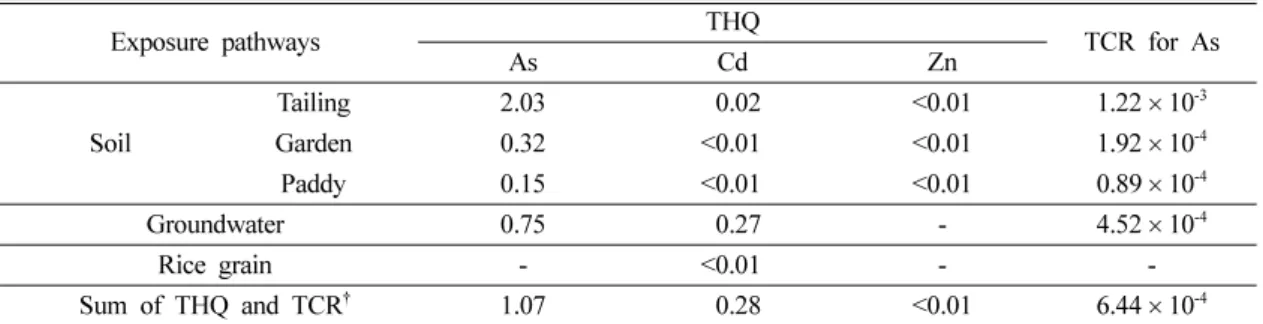
Table 6 shows THQ, hazard index (HI) and target cancer risk (TCR) of As, Cd and Zn. The value of THQ of As for intake through the tailing was higher than the health protection standard 1.
9,21)The value of THQ of As for intake through the farmland was lower than the standard, while the hazard index (HI) of As was higher than the standard. The risk was mainly contributed by As (HI = 1.07), which may cause chronic non- carcinogenic effects, such as jaundice, cirrhosis, blueness of the extremities, Raynaud’s syndrome, blackfoot disease (a type of gangrene), anemia, and hyperkeratosis of the skin.
22)The HI value of
Table 5. Results of ADDs for As, Cd and Zn with various exposure pathways
Exposure pathway Average daily dose
†(mg/kg-day)
As Cd Zn
Soil Tailing 8.12 × 10
−48.81 × 10
−61.29 × 10
−3Garden 1.28 × 10
−41.76 × 10
−61.05 × 10
−3Paddy 0.59 × 10
−41.84 × 10
−60.85 × 10
−3Groundwater 3.01 × 10
−41.34 × 10
−4-
Rice grain - 6.64 × 10
−6-
†
ADD in soil and groundwater is sum of the ingestion and dermal pathways.
Table 6. Results of THQ and carcinogenic risk assessment of As, Cd and Zn for contaminated soil and groundwater
Exposure pathways As THQ Cd Zn TCR for As
Soil Tailing 2.03 0.02 <0.01 1.22 × 10
-3Garden 0.32 <0.01 <0.01 1.92 × 10
-4Paddy 0.15 <0.01 <0.01 0.89 × 10
-4Groundwater 0.75 0.27 - 4.52 × 10
-4Rice grain - <0.01 - -
Sum of THQ and TCR
†1.07 0.28 <0.01 6.44 × 10
-4†