SNCR Application to Diesel Engine DeNOx under Combustion-driven Flow Reactor Conditions
Chang-Mo Nam*, Bernard M. Gibbs1)
Division of Health and Science, Yeungnam College of Science and Technology, Daegu 705-037, Korea
1)School of Process, Environmental and Materials Engineering, University of Leeds, Leeds City, LS2 9JT, UK (Manuscript received 20 April, 2012; revised 21 May, 2012; accepted 21 June, 2012)
Abstract
Diesel DeNOx experiments using the SNCR process were performed by directly injecting NH3 into a simulated engine cylinder (966 cm3) for which a diesel fuelled combustion-driven flow reactor was designed by simulating diesel engine geometry, temperature profiles, aerodynamics and combustion products. A wide range of air/fuel mixtures (A/F=20∼45) were combusted for oxidizing diesel flue gas conditions where an initial NOx levels were 250~900 ppm and molar ratios (β=NH3/NOx) ranged from 0.5∼2.0 for NOx reduction tests. Effective NOx reduction occurred over a temperature range of 1100∼1350 K at cylinder injections where about 34% NOx reduction was achieved with β=1.5 and cylinder cooling at optimum flow conditions. The effects of simulated engine cylinder and exhaust parts, initial NOx levels, molar ratios and engine speeds on NOx reduction potential are discussed following temperature gradients and diesel engine environments. A staged injection by NH3 and diesel fuel additive is tested for further NOx reduction, and more discussed for practical implication.
Key Words : SNCR, Diesel engine, NOx reduction, DeNOx
1)
1. Introduction
NOx emissions from automotive vehicles such as gasoline and diesel engines have reached over 50%
of global NOx emissions from fossil fuels, compared with about 23% of power plants, and thus been a growing concern for several decades because of harmful effects on human health and environmental ecosystem (Srivastava et al., 2005; De Nevers, 2000).
Recently, the use of lean-burn and diesel engines has been accelerated due to various advantages such as fuel economy, high engine efficiency (~52%) and
*Corresponding author : Chang Mo Nam, Division of Health and Science, Yeungnam College of Science and Technology, Daegu 705-037, Korea.
Phone: +82-53-650-9284 E-mail: [email protected]
lower emissions of CO/CO2 species. However, higher NOx emissions from such engines have become new challenges to be overcome in engineering societies, since typical noble metal three-way catalysts show little activity towards diesel NOx reduction under oxidizing exhaust gas conditions (Amiridis et al., 1996; Nakatsuji et al., 2008). Numerous studies for diesel NOx reduction have focused on the selective catalytic reduction (SCR) process by NH3/urea and hydrocarbons agents (i.e. searching for new catalysts), together with recent plasma-catalytic processes, but some practical problems like poor catalytic activities and lower NOx reduction (10~40%) have still emerged in actual exhaust gases (Masuda et al., 1996; Francke, 2000; Yang et al., 2011).
Meanwhile, the gas-phase selective non-catalytic reduction (SNCR) process has been well practiced as a proven NOx control technology mostly in stationary power plants, incinerators and industrial boilers (Arand, 1980; Capener, 2008; Weijuan et al., 2009), and alternatively considered for the present diesel NOx reduction. Lyon (1975) originally found that NO can be selectively reduced by NH3 species in excess oxygen without catalytic materials, also called the Thermal DeNOx process. One major drawback is a narrow temperature window (1100∼1400K), where many reaction parameters such as temperature, molar ratio, residence time, oxygen level and initial NOx are simultaneously involved to affect the NOx reduction potential, proved by extensive experimental observations and kinetic calculations (Kasuya et al., 1995; Miller and Bowman, 1989; Nam and Gibbs, 2002; Weijuan et al., 2009; Niu et al., 2010). Among them, the most important factor for NOx reduction in any reaction environments must be reaction temperature since outside temperature window negligible NOx reductions are observed. However, diesel engine environments are so severe for NOx reductions and all different from those in stationary sources (including reactor geometries). They may include high gas quenching rates (steep temperature drops/gradients) from the cylinder to the exhaust pipe, relatively high CO/unreacted hydrocarbons (UHC) and a wide range of oxygen levels and short residence times, which are all detrimental to sufficient NOx reduction. Even, finding the proper injection timing (crank angle; CA) of the reducing agents into the actual cylinder is absolutely required for proper reaction temperatures, which could be rather a difficult task, compared with large-scale power plants. Up to now, very few investigations have been undertaken regarding the SNCR application to diesel engines in order to reduce NOx emissions. Miyamoto et al. (1995) however, investigated the Thermal DeNOx process by directly injecting reducing agents into the actual 4-stroke
diesel engine cylinder (796 cm3), but unfortunately too much chemicals were injected for NOx reduction.
After that, Nam and Gibbs (2002) tried to investigate systematically the application of SNCR for DeNOx of diesel engines through direct injections of NH3/urea into a simulated cylinder and also performed chemical kinetic calculations under practical nonisothermal conditions for comparisons of experimental phenomena. Recently, another SNCR experiment was performed for diesel engine DeNOx by Xu et al. (2011) in China where the reducing agent (CH3NH2) was particularly injected into the exhaust temperatures of a test engine (6.49 L). They seemed to have achieved significant NOx reduction efficiency (~70%) with a molar ratio (NH2/NO) of 1.2, but again an important experimental result was not discussed such as the NO-NO2 conversion.
In such aspects, this paper presents the SNCR experimental results with NH3 reductant and diesel fuel additive concerning the effects of temperature window and cylinder NOx reduction capacity, initial NOx, molar ratios and engine speed levels. NOx reduction potential is also discussed through understanding NO/NH3/O2 reactions and different diesel engine environments. Moreover, a staged injection of chemicals into both cylinder and exhaust pipe is suggested for a practical DeNOx strategy under severe diesel engine conditions.
2. Materials and methods
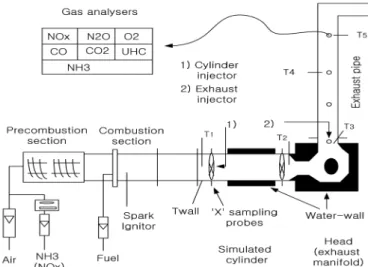
For diesel engine DeNOx experiments, a diesel-fuelled, combustion-driven stainless steel flow reactor was designed by simulating as close as possible gas compositions, temperature profiles, gas cooling rates (quenching rates), residence times and aerodynamics of a diesel engine cylinder and exhaust pipe. The system design was based on a Perkins 4.236 single cylinder diesel engine (966 cm3 capacity), and a schematic diagram is illustrated in
Concentration Flow #
CO (ppm) UHC (ppm) O2(%) CO2(%)
Cylinder inlet Exhaust end Cylinder inlet Exhaust end Exhaust end Exhaust end
1 1802 20 440 5 6.6 11.2
2 1701 35 440 4 8.3 10.2
3 1687 86 400 3 9.2 9.6
4 622 180 200 6 10.1 8.2
5 1334 380 300 9 11.5 7.4
6 1907 710 690 290 12.8 6.2
Table 1. Combustion products profiles emitted from the flow reactor positions according to air/fuel ratios (flow #) utilized in the SNCR experiments
Fig. 1. Layout of a diesel-fuelled, combustion-driven flow reactor for diesel DeNOx experiments.
Fig. 1. The flow reactor consisted of a combustor, fired on diesel fuel and utilizing preheated combustion air, a water-cooled section, a stainless steel tube of 76 mm ID and 213 mm long, simulating the cylinder which is bolted onto an engine cylinder head/exhaust manifold (cut from a real engine) and finally an exhaust pipe of 2 m long tube (40 mm ID). Three different airflow rates were used such as 600, 800 and 1000 L/min, which corresponded to engine speeds of 1200 rpm, 2000 rpm and 3000 rpm, respectively, based on the above single cylinder (Perkins 4.236).
And fuel flow rates normally varied in the range of 0.0832∼0.0368 L/min (69∼30 g/min) that are equivalent to air/fuel ratios (AFR) of 20∼45 (φ=0.72∼
0.32), close to actual diesel operating conditions.
Very efficient and reproducible combustion of
air/fuel mixtures was achieved in the combustion section under fuel-lean oxidizing conditions.
For the exhaust gas concentration measurements, the on-line gas analyzing systems were connected into the combustion flow reactor, and operated simultaneously. NOx concentrations were continuously measured by a chemiluminescent NOx analyser with a stainless steel converter (630℃) (Rotork Model 440). Non-dispersive infrared continuous analysers (NDIR, ADC 370) were used for the CO and CO2 measurements, and a paramagnetic analyser (Servomax 570) for O2 levels. For UHC detection, a flame ionization detector (Signal Model 3000) was employed. The typical emission levels of CO, UHC, O2 and CO2 are presented in Table 1, where CO/UHC levels at the cylinder inlet were maintained
high around <1800/440 ppm, but relatively remain low at the end of exhaust pipe up to less than 380/9 ppm respectively for most combustion flows (except flow #6). As O2 level increases from 6.6 to 12.8% at the end of exhaust pipe, CO2 concentration inversely decreases from 11.2 to 6.2% according to air/fuel ratios. The initial NOx levels were maintained from 250 to 900 ppm for all experiments. Then, a certain amount of NH3 reductant was directly injected into the simulated cylinder for diesel NOx reduction whilst diesel fuel as an additive could be sometimes simultaneously injected into the inlet of exhaust pipe for lower temperature DeNOx capacity. Gas temperatures from the simulated cylinder to the exhaust pipe were finely controlled and adjusted in the range of 1000∼
1400 K according to the air/fuel ratios. They were measured by shielded thermocouples (type R for higher temperatures of cylinder injections >1050 K, type K for others) and were corrected for radiation losses (20~40 K). Typical temperature profiles are shown in Fig. 2 along the flow reactor, where at the cylinder/head section, large gas quenching rates (dT/dt= -5800~-8000 K/sec) were developed for all six flows because of water and natural coolings.
Fig. 2. Typical temperature profiles of all six flows along the reactor positions for cylinder injection SNCR experiments.
3. Results and Discussion
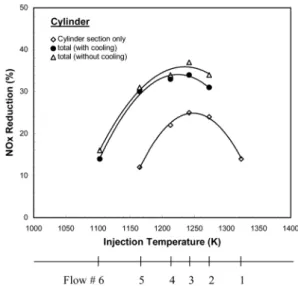
3.1. Temperature window and cylinder DeNOx capacity The SNCR experiments for diesel NOx reduction were conducted under diesel fuel combustion conditions, particularly by injecting NH3 into the simulated cylinder with/without the water-cooling jacket. Fig. 3 shows DeNOx characteristics with varying injection temperature (flow #1~6) in which oxygen levels varied from 6.6 to 12.8% according to the air/fuel ratios. The initial NOx level was set to 530 ppm, and molar ratio (β=NH3/NOx) was fixed to 1.5. Broad temperature windows were observed between 1100~1350 K where, as the water-cooling jacket was removed from the simulated cylinder, about 37% maximum NOx reduction was achieved at the optimum temperature flow #3 (Tin=∼1240 K, O2=
∼9.2%). NOx reduction tends to decrease up to the lowest temperature flow #6 (O2=12.8%) with decreasing injection temperatures, while increase beyond the optimum temperature (up to flow #1) causes NH3
oxidation to become more dominant, leading to less NOx reduction and eventually forming a parabolic curve.
Fig. 3. Effects of the simulated engine variables and temperatures on NOx reduction through cylinder injection; 530 ppm NOx, NH3/NOx(β)=1.5.
With the water-cooling jacket surrounded, the degree of NOx reduction was slightly diminished over the whole range of flows, but ∼34% NOx reduction was obtained at Tin=∼1240 K, which is more meaningful and practical, compared with those of real engine conditions. Concerning the capacity of the cylinder- only NOx reduction, temperature window is narrowly formed between 1150~1350 K, and about 25%
maximum NOx reduction was allowed at the same optimum flow #3. This means that around 10% NOx reduction occurred in the lower temperature exhaust pipe, which is however a little disappointing result considering additional residence time (~40msec) in the exhaust pipe.
These experimental data are qualitatively in good agreement with those in the literature (Kjaergaard et al., 1996; Tayyeb Javed et al., 2009; Quang Dao et al., 2010) in the aspects of temperature windows, usually centered at around 1260 K (±100). In actual engines, the temperatures within actual engine cylinders at 70~90o CA ATDC (after top dead centre) approximately range from 1100~1600 K at an equivalence ratio of 0.6 depending on the power outputs, while the earlier injection timing (40~50o CA) faces a higher temperature range of 1700~2000 K (Heywood, 1988). Thus, the former could be close to the latter half of the expansion stroke, and would cover the optimum temperature window for diesel NOx reductions, provided that injection timing (CA) is systematically controlled. However, NOx reduction potentials were significantly diminished under these combustion-driven, simulated diesel engine conditions.
In the laboratory isothermal conditions, about 80~95% NOx reduction potentials were easily reported with β=1~1.5, and more practically industrial furnaces like power plants usually permit 60~80% NOx reductions. The first main reason for the present low NOx reduction (<40%) should be severe gas quenching rates developed along the simulated cylinder and head section (i.e. -7000 K/sec
at flow #3, Fig. 2), compared with other industrial systems (-200~-300 K/sec). Meanwhile, the effect of the water-cooling system turned out not to hinder too much NOx reduction potential as in Fig. 3, which provides practical implication to real engines.
Secondly, too higher concentrations of CO/UHC (<2,000/<690 ppm) inside the cylinder would be another limitation to NOx reduction potential (Table 1). Caton et al. (1995) reported that the addition of CO (1260 ppm) shifted the temperature window downwards 150 K (presently only around 20 K), and NOx reduction was diminished by about 30% at the higher temperatures. On the other hand, optimum O2
levels have been well known to be between 3~5% in the SNCR process (Kasuya et al., 1995), but a further increase over 10% slightly tends to diminish the degree of NOx reduction. Thus, the present higher oxygen levels (6.6~12.8%) would also have affected the characteristics of diesel NOx reduction towards decreasing to some extent.
3.2. Effect of initial NOx and molar ratios
The primary parameters affecting NOx reduction in SNCR processes should include injection temperature, molar ratio and residence time. Previous studies (Kasuya et al., 1995; Quang Dao et al., 2010) showed that NOx reduction potential is also dependent on initial NOx levels, which were normally conducted under the conditions of laboratory, near isothermal experiments with optimum oxygen levels. NOx emission levels from diesel engines vary drastically in the range of 50~1000 ppm with different engine speed and load changes (De Nevers, 2000). It may be also interesting to establish whether such behaviour will occur in practical systems, especially accompanying large temperature gradients, various CO/UHC and oxygen levels. Fig. 4 shows diesel NOx reduction data plotted versus molar ratios (β=0.5~2) with changing initial NOx levels at the optimum flow #3 of the cylinder injection. When the
Fig. 4. Effects of initial NOx levels on NOx reduction with varying molar ratios at optimum flow #3 (Tin=~1240 K, O2=9.2%).
initial NOx level was increased from 530 to 750 ppm, the degree of NOx reduction increased by about 5%
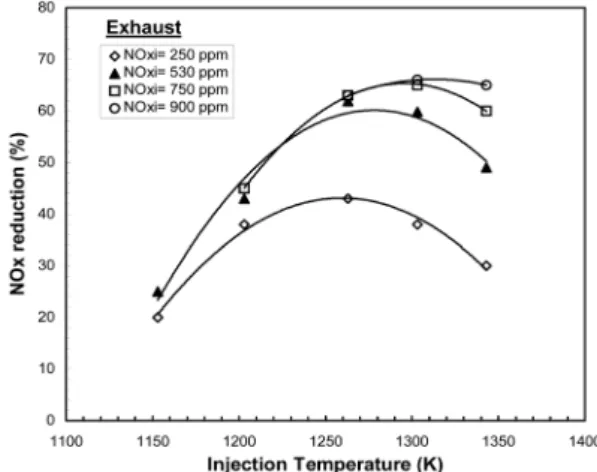
(i.e. 34 to 39% at β=1.5) for all molar ratios. However, further increase to 900 ppm was less effective. To confirm these trends, comparison experiments were also carried out through injecting NH3 into the exhaust inlet where air/fuel ratios were a little adjusted toward increasing fuel rate to make proper injection temperatures. This time, temperature gradients developed through exhaust pipe section were maintained low between -1400~-3200 K/sec for another six flows, compared with those of normal cylinder injection, where O2 levels were also lowered to a range of 3.7~10.1% accordingly. DeNOx characteristics are shown in Fig. 5, for a broad range of initial NOx levels from 250 to 900 ppm with varying temperature. Surprisingly, about 60% NOx reduction was achieved at the same 530 ppm initial NOx and molar ratio (β=1.5) with the optimum temperature (Tin=∼1260 K), which is compared to the above lower NOx reduction (~34%) in usual cylinder injections. The only different things between two systems are temperature gradients and exhaust gas compositions. Further increases to 750 and 900 ppm produced about 5~10% increases in NOx reduction at
Fig. 5. Effects of initial NOx levels on NOx reduction as a function of temperature through exhaust injection for comparison; β=1.5.
the higher temperature (1340 K), which was virtually unchanged for the lower temperature flows.
Meanwhile, as initial NOx level decreases to 250 ppm, NOx reduction again tends to sharply decrease over the whole temperature range, and reached a maximum reduction of ~43% at the optimum temperature.
From the above results, three conclusions can be drawn;
i) The NOx reduction increases with increasing initial NOx level.
ii) The temperature window tends to shift upwards (higher temperatures) with increasing initial NOx level.
iii) The changes of temperature gradients and gas compositions must have affected NOx reduction potentials.
In general, it has been reported that increasing molar ratio over β=2.0 had little effect on an increase in NOx reduction in laboratory, isothermal experiments (Lyon, 1987; Ostberg and Dam-Johansen, 1994).
However, in practical systems accompanying particularly large temperature drops and short residence time, the NOx reduction potential could be more dependent upon higher molar ratios and initial NOx levels, and moreover tends to be accelerated especially under
Air flow rate (L/min)
Single cylinder (Perkins 4.236)
Residence time within cylinder (msec)
Engine Speed (rpm) Load (Nm) 288 K 1223 K
1000 3000 8-45 57.9 12.9
800 2000 8-56 72.5 16.2
600 1200 8-62 96.6 21.6
Table 2. Comparisons of the correlation between air flow rates and residence times within the simulated cylinder with those engine speeds of single cylinder (Perkins 4.236)
such conditions that CO/UHC oxidations actively exist. Miyamoto et al. (1995) reported similar results for diesel DeNOx by directly injecting a reducing agent (urea) into the actual engine cylinder, which gave over 60% NOx reduction, but only at large molar ratio of 16.6, when the injection timing was set at 90o CA ATDC with a low engine speed of 500 rpm. These experimental phenomena can also be kinetically understood by the simple rate equation
( ) where increasing NO and
NH3 concentrations would increase the rate of NO reduction in excess O2 levels according to their reaction orders.
3.3. Air flow rate (Engine speed)
Fig. 6 shows the comparison of the NOx reduction for three different air flow rates, 1000, 800 and 600 L/min for a constant molar ratio of 1.5 with initial NOx 530 ppm. These air flow rates correspond to actual engine speeds of 3000, 2000 and 1200 rpm, based on the single cylinder capacity of 965 cm3 (Perkins 4.236). And their effective residence times are maintained very short, ranging from 12.9 to 21.6 msec within the simulated cylinder at 1223 K (Table 2), and additional residence time of ~40 msec could be provided by the air flow rate of 1000 L/min within the low temperature exhaust pipe section. Since optimum temperatures were similar for all three flow rates, the NOx reduction was plotted as a function of air/fuel ratio. At flow rates of 1000 and 800 L/min, NOx reduction occurs roughly in the same range of
Fig. 6. Effect of air flow rates (engine speed) on NOx reduction; 530 ppm NOx, β=1.5.
air/fuel ratios of 40 to 25 more or less, while for an air flow rate of 600 L/min, the NOx reduction curve was shifted to lower air/fuel ratios of about 34 to 22.
As expected, the lower air flow rate (600 L/min) should have achieved more NOx reduction than for 1000 and 800 L/min because of longer residence time. However, NOx reduction for all three air flows remained similar at about 34% since there was not much difference in residence times. Previous results showed that the required time for enough NOx reduction reached around 200 msec in isothermal and CO/UHC-free conditions (Glarborg et al., 1994).
Even, power plant boilers usually provide sufficient residence time (~1sec) and locations (near superheater) for optimum temperature where the flue gas passes, so enough NOx reduction can be obtained. Nevertheless, one encouraging thing is that
despite severe diesel engine environments providing very short residence times (nearly one-tenth of 200 msec), NOx reduction potential (~34%) was still achieved to a certain degree. These are believed that sufficient CO/UHC species accelerate the rate of NOx reduction in case of large temperature drops, but too higher concentrations decrease the chance of NH3
to react with NO, resulting in overall lower NOx reduction. In fact, Miyamoto et al. (1995) again reported in their real engine tests with direct injection of urea into the cylinder that increasing engine speeds from 500 rpm to 750 and 1000 rpm not only triggered the optimum injection timing advanced (i.e. from 90o to 70o, 50o CA ATDC), but also the degree of NOx reduction decreased slightly at the optimum timing.
They also explained that this might be due to the decrease in residence time with increasing engine speeds. The degree of NOx reduction in this study did not change with the variance of air flow rates as much as Miyamoto’s results.
3.4. Staged injection by diesel fuel
Big challenge to the SNCR process is the narrow temperature window in which NO selectively reacts with NH3 in the presence of oxygen. Previous studies reported that the injection of various hydrocarbon additives such as alkanes (CH4, C2H6), alkenes (C2H4, C3H6), alcohols (CH3OH, C2H5OH) and aldehydes, together with the reducing agents, shifted temperature windows by about 50~200 K towards lower temperatures, depending on species and concentrations (Duo et al., 1990; Tayyeb Javed et al., 2009; Niu et al., 2010). The above results show that most of the NOx reduction would occur in the cylinder and head section, while the exhaust section having longer residence time was of little use to achieve extra NOx reduction because of too low temperatures. Further NOx reduction at lower temperatures could be developed by the injection of additives where diesel fuel as an additive will be much more useful than any
other hydrocarbons due to the practical reason.
Thus, NH3 was injected into the cylinder as a primary reductant, while diesel fuel was injected simultaneously into the inlet of exhaust pipe, called
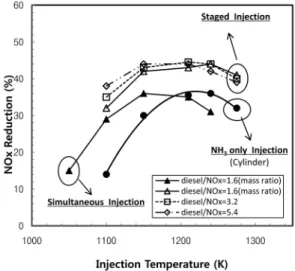
“staged injection.” Fig. 7 shows the comparisons of the staged and other types of injections on diesel NOx reduction with varying mass ratios (r=diesel/
NOx) from 1.6, 3.2 to 5.4 at a constant β=1.5.
Surprisingly, the NOx reduction through staged injection was substantially increased over the whole temperature range by an additional 8~25% above the NOx reduction with NH3-only cylinder (without additive). At higher temperatures (1200~1300 K), less amount of diesel fuel (r=1.6) turned out to be rather more effective for NOx reduction, while as temperature goes down towards 1100 K, more NOx reduction was achieved this time with higher amount of diesel fuel (r=3.2 and 5.4). More encouraging fact is that staged injection did not shift temperature windows downwards at all, but even enhanced the NOx reduction at the whole temperatures, which is huge beneficial for severe diesel conditions. However,
Fig. 7. Comparisons of diesel fuel DeNOx characteristics as an additive for both cylinder simultaneously and staged injections together with NH3-only; 530 ppm NOx, β=1.5.
simultaneous injection of NH3 with diesel fuel (r=1.6) into the cylinder presented the shift of temperature window downwards by about 50 K, and NOx reduction potential was slightly diminished as expected. The SNCR reaction paths have been thoroughly discussed in previous studies where OH/O/H radicals play an important role to initiate NH3 decomposition (Miller and Bowman, 1989; Nam and Gibbs, 2002). Thus, staging diesel fuel into the exhaust section is believed to have promoted the above radical production at the low temperatures, which caused further NOx reduction in the exhaust pipe. Overall, the SNCR process with staged injection using the small amount of diesel fuel (r=1.6) would be more practical and applicable for diesel engine DeNOx performance, compared with those of simultaneous and reductant-only injections.
4. Conclusions
The SNCR application to diesel DeNOx experiments was performed under diesel-fuelled, combustion-driven flow reactor conditions, which closely simulated the actual cylinder and head, exhaust pipe and combustion products. Broad temperature windows were observed between 1100~1350 K where about 34% maximum NOx reduction was achieved at the optimum temperature flow #3 and β=1.5 through the water-cooled cylinder injection. The major reaction parts for NOx reduction were the high temperature cylinder and head section, while exhaust temperatures were too low for further reduction. NOx reduction potential tends to increase with increasing initial NOx levels and molar ratios, but does not strongly depend upon the change of air flow rates (engine speeds) investigated. Moreover, severe diesel DeNOx environments such as large gas quenching rates, high CO/UHC and O2 levels seem to be responsible for relatively lower NOx reduction, together with too short effective residence time.
However, a staged injection by NH3 and diesel fuel turned out to be effective for further NOx reduction without shifting temperature windows downwards, which is practical and proposed as a promising strategy.
References
Amiridis, M. D., Zhang, T., Farrauto, R. J., 1996, Review on selective catalytic reduction of NO by hydrocarbons, Appl. Catal., B, 10, 203-2011.
Arand, J. K., Palos, R., Muzio, L. J., Sotter, J. G., 1980, Urea reduction of NOx in combustion effluents, U.S., Patent No., 4,208,386.
Capener, L., 2008, Advanced overfire air/SNCR and sorbent injection system, Power Eng., 112, 192-198.
Caton, J. A., Narney, J. K., Cariappa, C., Laster, W. R., 1995, The selective non-catalytic reduction of NO using NH3 at up to 15% O2, Cana. J. Chem. Eng., 73, 345-350.
De Nevers, N., 2000, Air pollution control engineering, textbook, 2nd ed., McGraw-Hill, Singapore, 13-35.
Duo, W., Dam-Johansen, K., Ostergaard, K., 1990, Widening the temperature range of the Thermal DeNOx process; an experimental investigation, Proceedings of the Combustion Institute, 23, 297-303.
Francke, K. P., Miessner, H., Rudolph, R., 2000, Plasmacatalytic processes for environmental problems, Catal. Today, 59, 411-416.
Glarborg, P., Dam-Johansen, K., Miller, J. A., Kee, R.
J., Coltrin, M. E., 1994, Modeling the Thermal DeNOx process in flow reactors, Int. J. Chem.
Kinet., 26, 421-4213.
Heywood, J. B., 1988, Internal combustion engine fundamentals. McGraw-Hill Book Co., 157-600.
Kasuya, F., Glarborg, P., Johnson, J. E., Dam-Johansen, K., 1995, The Thermal DeNOx process: Influence of partial pressures and temperature, Chem. Eng.
Sci., 50, 9, 1455-1466.
Kjaergaard, K., Glarborg, P., Dam-Johansen, K., Miller, J. A., 1996, Pressure effects on the Thermal DeNOx process, Proceedings of the Combustion
Institute, 26, 2067-2075.
Lyon, R. K., 1975, Method for the reduction of the concentration of NO in combustion effluents using ammonia, U.S., Patent No. 3,900,554.
Lyon, R. K., 1987, Thermal DeNOx controlling nitrogen oxides emissions by a noncatalytic process, Env.
Sci. Tech., 21, 3, 231-236.
Masuda, K., Tsujimura, K., Shinoda, K., Kato, T., 1996, Silver-promoted catalyst for removal of NO from emission of diesel engines, Appl. Catal., B, 8, 33-40.
Miller, J. A., Bowman, C. T., 1989, Mechanism and modeling of nitrogen chemistry in combustion, Prog. Energy Combust. Sci., 15, 287-338.
Miyamoto, N., Ogawa, H., Wang, J., Shudo, T., Yamazaki, K., 1995, Diesel NOx reduction with ammonium deoxidizing agents directly injected into the cylinder, Int. J. Vehi. Desi., 16, 1, 71-79.
Nakatsuji, T., Yamaguchi, T., Sato, N., Ohno, H., 2008, A selective NOx reduction on Rh-based catalysts in lean conditions using CO as a main reductant, Appl. Catal., B, 85, 61-70.
Nam, C. M., Gibbs, B. M., 2002, Application of the Thermal DeNOx process to diesel engine DeNOx:
an experimental and kinetic modeling study, FUEL, 81, 1359-1367.
Niu, S., Han, K., Lu, C., 2010, Experimental study on the effect of urea and additive injection for controlling NOx emissions, Env. Eng. Sci., 27, 47-53.
Ostberg, M., Dam-Johansen, K., 1994, Empirical modeling of the SNCR of NO: comparison with large-scale experiments and detailed kinetic modeling, Chem.
Eng. Sci., 49, 12, 1897-1904.
Quang Dao, D., Gasnot, L., Marschallek, K., Bakali, A., Pauwels, J. F., 2010, Experimental study of NO removal by gas reburning and selective noncatalytic reduction using ammonia in a lab-scale reactor, Ener. Fuels, 24, 1696-1703
Srivastava, R. K., Hall, R. E., Khan, S., Culligan, K., Lani, B. W., 2005, NOx emission control options for coal-fired electric utility boilers, J. Air Waste Manage. Assoc., 55, 1367-1388.
Tayyeb Javed, M., Nimmo, W., Mahmood, A., Irfan, N., 2009, Effect of oxygenated liquid additives on the urea based SNCR process, J. Env. Manage., 90, 3429-3435.
Weijuan, Y., Zhijun, Z., Junhu, Z., Hongkun, L., Jianzhong, L., Kefa, C., 2009, Application of hybrid coal reburning/SNCR processes for NOx reduction in a coal-fired boiler, Env. Eng. Sci., 26, 311-318.
Xu, B., Tian, H., Yang, J., Sun, D., Cai, S., 2011, A system of selective non catalytic reduction of NOx for diesel engine, Advan. Mater. Res., Vols.
201-203, 643-646.
Yang, S., Wang, C., Li, J., Ma, L., Chang, H., 2011, Low temperature selective catalytic reduction of NO with NH3 over Mn-Fe spinel: performance, mechanism and kinetic study, Appl. Catal., B, 110, 71-80.