• 검색 결과가 없습니다.

A Case Report and Literature Review : Treatment of Nasopharyngeal Cancer(NPC) Patient with AOSD(Adult Onset Still's Disease)

N/A
N/A
Protected

Academic year: 2021

Share "A Case Report and Literature Review : Treatment of Nasopharyngeal Cancer(NPC) Patient with AOSD(Adult Onset Still's Disease)"

Copied!
5
0
0

로드 중.... (전체 텍스트 보기)

전체 글

(1)

Introduction

Nasopharyngeal cancer(NPC) is different from other head and neck cancers; it has a well defined geographic distribu- tion, a strong relationship with Epstein-Barr virus in endem- ic regions, and a remarkable chemo-radiosensitivity. Most of NPC occur only in endemic area(South Eastern China, South- ern and Northern Africa, and Inuit area such as Alaska, Green- land, North Canada), so there has not been many various cas-

es of NPC.

1-4)

In locally advanced head and neck cancer, chemoradiation therapy(CCRT) is a standard treatment method. However in NPC, the sensitivity to chemotherapeutic agents is relatively higher than other head and neck cancer, therefore, the CCRT with consolidation chemotherapy developed since the 1990s became a main therapeutic strategy to reduce local recurrence and distant metastasis as well as to improve overall survival.

5)

Typically, NPC is asymptomatic in early stage and thus it is mostly diagnosed in locally advanced stage. Moreover, lo- cal recurrence or distant metastasis occurs frequently, the majority of these cases are necessitated by aggressive treat- ment including radiation therapy.

6,7)

Various connective tis- sue diseases(CTD) have been reported to be associated with a malignant tumors and an increased incidence of radiation

대한 두경부 종양 학회지

제 30 권 제 1 호 2014

A Case Report and Literature Review :

Treatment of Nasopharyngeal Cancer(NPC) Patient with AOSD(Adult Onset Still’s Disease)

Jun Young Kim, MD

1

, Jin Dong Kim, MD

1

, Kyung Bin Lee, MD

1

, Won Jae Lee, MD

1

, Gun Wung Na, MD

1

, Wonil Park, MD

1

, Gi Cheol Park, MD

2

, Tae Gyu Kim, MD

3

, Jun Ho Ji, MD

1

Department of Internal Medicine,

1

and Otolaryngology,

2

and Radiation Oncology,

3

Samsung Changwon Hospital, Sungkyunkwan University School of Medicine, Changwon, Korea

성인형 스틸씨 병에서 병발된 비인두암의 치료 및 문헌 고찰

삼성창원병원 내과,

1

이비인후과,

2

방사선종양학과

3

김준영1·김진동1·이경빈1·이원재1·나건웅1·박원일1·박기철2·김태규3·지준호1

= 국 문 초 록 =

비인두암에서 시행되는 방사선 치료 이후에 구강건조증과 피부 변화는 흔하게 볼 수 있는 합병증 중 하나이다. 비 인두암의 좋은 예후를 고려할 때, 그러한 치료와 관련된 독성들은 상대적으로 오랫동안 문제를 야기하며 삶의 질 저 하를 불러온다. 특히 류마티스 관절염, 루푸스와 같은 결합조직 질환을 가진 환자들에게서 방사선 치료를 시행하였을 때, 빈번하게 심각한 독성이 관찰된다. 본 증례는 성인형 스틸씨 병에서 병발된 비인두암의 치료로 항암방사선 동시 치료를 실시한 결과, 비교적 경미한 구강 건조, 점막염, 불면증 등의 합병증이 관찰되었으나, 완전 관해가 획득되었다.

이에 저자들은 과거에 보고된 적 없는 성인형 스틸씨 병에 병발한 비인두암의 치료 경험을 다른 결합조직질환들에서 방사선 치료의 문헌들과 함께 보고하는 바이다.

중심 단어

:비인두암ㆍ성인형 스틸씨병ㆍ항암화학방사선 동시치료.

Received : December 31, 2013 / Revised : February 19, 2014 Accepted : February 20, 2014

교신저자 : 지준호, 630-723 경남 창원시 마산회원구 합성동 50 삼성창원병원 혈액종양내과

전화 : (055) 290-6024 ・ 전송 : (055) 290-1014 E-mail : [email protected],

online©MLComm

(2)

sequelae.

8)

Chen et al. reported a significantly greater incidence of toxicity was found between the CTD groups(17%) and control groups(3%)(p=0.0095) in breast cancer.

9)

Even NPC, several cases were reported more toxicities in NPC patients with other CTD. Representatively, Teo et al. reported exces- sive adverse reactions in patients with NPC complicated by CTD.

10)

Known toxicities for the radiation in NPC are xerostomia, skin toxicity, mucositis and that severely impairs quality of life.

1)

So radiation to patient with CTD have been considered as a relative contraindication.

11)

The NPC was found of the patient cared for adult onset still’s disease(AOSD). In terms of NPC, CCRT followed by consolidation chemotherapy will be given to the patient as usual. But our patient had severe unexpected complication and so stopped planned treatment schedule.

To the authors’ knowledge, this is the first case report of the radiation therapy to NPC with Still’s disease. The article below shows complete remission by the CCRT on the NPC with AOSD.

Case Report

In April, 2013, a 43-year-old women undergoing treatment with prednisolone for AOSD from 2008, presented with a 4- month history of progressive pain on left neck. She was diag- nosed AOSD based on arthralgia with spiking fever and rash on both upper arm, thigh and face, with negative ANA and Rheumatic factor test at other tertiary hospital. She had been difficult at swallowing and 7 kg weight loss during 6 months, Upon physical examination, painless non-movable neck mass on left side was palpated. Her initial laboratory analyses show- ed hemoglobin of 12.8 g/dL, leucocytes 7.5 K/uL(75.9% neu- trophils, 14% lymphocytes) and 286 K/uL platelets, LDH of 175 IU/L, HBV Ag, HIV Ag negative but HCV Ab Positive, She has been working as a high school teacher.

The work-up included neck computed tomography(CT), magnetic resonance imaging(MRI) and 18-FDG-positron emission tomography(PET) scan that showed a well enhanced mass in the left rosenmullar fossa across midline with en- larged regional lymph nodes. The main mass extended lon- gus coils, pterygoid muscle and clivus. Lymph node invasion was demonstrated at both cervical level II, III and left supra- clavicular area(cT2N3bM0, stage IVb). Distant metastasis was not observed(Fig. 1).

Sono-guided fine needle aspiration was performed. Path-

ological result was poorly differentiated carcinoma, R/O un- differentiated carcinoma.

She started on cisplatin 100 mg/m

2

every 21 days and con- current radiation therapy with total of 67.2 Gy by T.C Chan’s method since 29 April 2013.

4)

She was treated with IMRT using

60

Co γ-ray to an area ex- tending from the nasopharynx to the lower cervicalarea th- rough opposing lateral parapharyngeal area at a rate of 2.24 Gy/day(67.2 Gy/30 Fx).

An analgesic agent was given to the patient to palliate the pain. Percutaneous feeding tube was not insert due to refusal.

One week after the start of radiation therapy, she compl- ained of insomnia, emesis and dry mouth. At physical exam, there were pronounced acute mucosal reaction and mucosal ulceration of grade III according to the Common Terminolo- gy Criteria for Adverse Events(CTCAE).

12)

However there was not observed any skin reaction(pigmentation, fibrosis) and bleeding. We added anti-anxiety agent(lorazepam), serotonin antagonist(ondansetron) and pilocarpine 5 mg, three times a day and salivary gland sparing radiation therapy was contin- uously given. The treatment was completed without omitting of radiation during the schedule and infusion of cisplatin was also administered as a triweekly schedule. At this time, most serious symptoms were insomnia, anorexia and dry mouth.

A

B

C

Fig. 1. Evaluation of 18-FDG-PET scan(A and B), MRI(C) accord-

ing to 3 cycle of chemoradiation treatment : completely disap- peared mass and enlarged malignant lymph nodes.

(3)

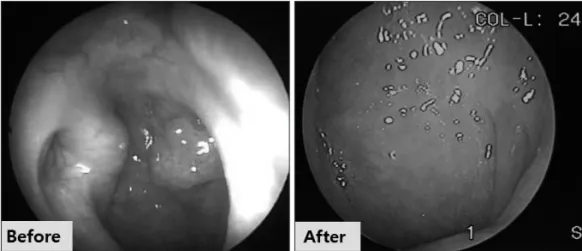
Dry mouth and oral pain were continually annoying her daily life after treatment. A few weeks later, improving mu- cositis, oral pain has subsided but dry mouth was sustained and kept her from eating. So we performed salivary scan, it reveals decreased excretion on parotid and submandibular glands(Fig. 2). Unlike xerostomia, response of CCRT was sat- isfactory. An 18-FDG-PET scan, neck CT scan and neck MRI after end of CCRT was demonstrated completely disappeared mass and enlarged malignant lymph nodes(Fig. 1). Two mon- ths later, her symptom was beginning to improve, at present, dry mouth has somewhat recovered up to grade I by the CT- CAE and she lives an ordinary life(Fig. 3).

Discussions

In our case, radiation toxicities such as skin reaction and xerostomia within this patient was lower than what was ex- pected. However, due to the emotional change and drug de- pendency caused by benzodiazepine that was used for anoth- er symptom, a further consolidation chemotherapy was not executed. With the existence of CTD, possibility of arising xe- rostomia was concerned before the radiation treatment, so the amount of 15-20 Gy was limited in order not to destroy the

salivary gland. It is because that management of xerostomia is rarely effective, prevention is the best treatment.

13)

Never- theless, she suffered from several complications. Even if the salivary gland functionality was confirmed by salivary scan, the decreasing salivary flow and damage from the oral muco- sal integrity were possible causes of the oral dryness. For this patient, additory hyperbaric oxygen therapy is doable.

14)

If lat- er on it were found out to be NPC combined with CTD, cyto- protective agent such as amifostine would be considered to be used. In order to relieve these oral discomforts, salivary stimulating drugs, such as pilocarpine and bromhexine, have been used for some years and their efficacy has been verified in some experimental studies. In some cases, careful use of narcotics such as benzodiazepine is rather to be recommend- ed.

15-17)

And other treatment for reduce xerostomia also used for submendibular gland transfer.

18)

Despite of these toxici- ties, the patients treated in sympathy with protective and sup- portive treatment, the radiation therapy in this setting is en- ough to be recommended.

The prognosis of patients with NPC depends on the stage of the disease at diagnosis, unfortunately at diagnosis, 70%

of patients have locally advanced, non-metastatic stage III or IV disease. CCRT is standard treatment for locally invasive

Fig. 2. Salivary scan after CCRT : distal curve(excretory phase) was fall at normal salivary function, in this case excretory phase does

not exist.

Fig. 3. Laryngoscopic image before and after CCRT.

(4)

NPC.

1,7,19,20)

Radiation therapy in patient with head and neck cancer including NPC have shown several toxicity. One of the most important toxicity is also xerostomia. Radiotherapy of head and neck may result in a decrease in salivary pH and its rate of secretion.

21)

Therefore, any discomfort of chewing, swallowing, speech and sleep may occur in the presence of xerostomia.

22)

AOSD is a rare systemic inflammatory disorder of unknown etiology, characterized by spiking fevers with an evanescent rash, arthritis, and multiple organ involvement. It owes its name to George Still who published in 1897 his monograph.

incidence over the age of 16 among men is 0.22/10,000 and among women 0.34/100.23 Although the diagnosis of AOSD necessitate to exclude malignancy, actually many AOSD was reported coincided with other malignancies such as leukemia, lymphoma, thyroid cancer and lung cancer.

24-30)

In that case, radiotherapy may need to treat of disease but there are few re- ports for treatment of head and neck cancer with AOSD.

We report a case about the treatment of NPC patient with AOSD. Although she suffered prolonged mucositis and dry mouth, she had a complete remission of NPC and immuno- suppressive effect by CCRT resulted in remission of her ar- thritis. In conclusion, CCRT is highly effective and shows ma- nageable toxicity so CCRT as a definitive treatment option is a consideration in NPC patients with AOSD.

References

1) Afqir S, Ismaili N, Errihani H. Concurrent chemoradiotherapy in the management of advanced nasopharyngeal carcinoma:

Current status. Journal of Cancer Research and Therapeutics.

2009;5:3-7.

2) Chan AT, Teo PM, Johnson PJ. Nasopharyngeal Carcinoma. 2002;

13:1007-1015.

3) Siegel R, Naishadham D, Jemal A. Cancer statistics, 2013. CA:

A Cancer Journal for Clinicians. 2013;63:11-30.

4) Jemal A, Bray F, Center MM, Ferlay J, Ward E, Forman D. Glo- bal cancer statistics. CA: A Cancer Journal for Clinicians. 2011;

61:69-90.

5) Kim TH, Ko YH, Lee MA, Kim BS, Chung SR, Yoo IeR, et al.

Treatment outcome of cisplatin-based concurrent chemoradio- therapy in the patients with locally advanced nasopharyngeal cancer. Cancer research and treatment: Official Journal of Korean Cancer Association. 2008;40:62-70.

6) Chu ST, Wu PH, Hou YY, Chang KP, Chi CC, Lee CC. Prima- ry tumor volume of nasopharyngeal carcinoma: Significance for recurrence and survival. Journal of the Chinese Medical As- sociation: JCMA. 2008,71:461-466.

7) Zhang L, Zhao C, Ghimire B, Hong MH, Liu Q, Zhang Y, et al.

The role of concurrent chemoradiotherapy in the treatment of locoregionally advanced nasopharyngeal carcinoma among endemic population: A meta-analysis of the phase III random- ized trials. BMC Cancer. 2010;10:558.

8) Mayr NA, Riggs CE Jr, Saag KG, Wen BC, Pennington EC, Hus- sey DH. Mixed connective tissue disease and radiation toxici- ty. A case report. Cancer. 1997;79:612-618.

9) Chen A, Obedian E, Haffty B. Breast-conserving therapy in the setting of collagen vascular disease. Cancer J. 2001;7(6):480- 491.

10) Teo P, Tai TH, Choy D. Nasophayngeal carcinoma with derma- tomyositis. International Journal of Radiation oncology, Biolo- gy, Physics. 1989;16:471-474.

11) Varga J, Haustein UF, Creech RH, Dwyer JP, Jimenez SA. Ex- aggerated radiation-induced fibrosis in patients with systemic sclerosis. JAMA: The Journal of the American Medical Associ- ation. 1991;265:3292-3295.

12) Chen AP, Setser A, Anadkat MJ, Cotliar J, Olsen EA, Garden BC, et al. Common Terminology Criteria for Adverse Events(CT- CAE). J Am Acad Dermatol. 2012;67:1025-1039.

13) Chen WC, Lai CH, Lee TF, Hung CH, Liu KC, Tsai MF, et al.

Scintigraphic assessment of salivary function after intensity- modulated radiotherapy for head and neck cancer: Correlations with parotid dose and quality of life. Oral Oncology. 2013;49:42- 48.

14) Hadley T, Song C, Wells L, Lehnhardt J, Rogers MW, Anderson J, et al. Does hyperbaric oxygen therapy have the potential to im- prove salivary gland function in irradiated head and neck can- cer patients? Medical Gas Research. 2013;3:15.

15) LeVeque FG, Montgomery M, Potter D, Zimmer MB, Rieke JW, Steiger BW, et al. A multicenter, randomized, double-blind, pla- cebo-controlled, dose-titration study of oral pilocarpine for treat- ment of radiation-induced xerostomia in head and neck cancer patients. Journal of clinical oncology: Official Journal of the American Society of Clinical Oncology. 1993;11:1124-1131.

16) Horiot JC, Lipinski F, Schraub S, Maulard-Durdux C, Bensa- doun RJ, Ardiet JM, et al. Post-radiation severe xerostomia re- lieved by pilocarpine: A prospective French cooperative study.

Radiotherapy and oncology: Journal of the European Society for Therapeutic Radiology and Oncology. 2000;55:233-239.

17) Johnson JT, Ferretti GA, Nethery WJ, Valdez IH, Fox PC, Ng D, et al. Oral pilocarpine for post-irradiation xerostomia in pa- tients with head and neck cancer. The New England Journal of Medicine. 1993;329:390-395.

18) Jha N, Harris J, Seikaly H, Jacobs JR, McEwan AJ, Robbins KT, et al. A phase II study of submandibular gland transfer prior to radiation for prevention of radiation-induced xerostomia in head- and-neck cancer(RTOG 0244). International Journal of Radia- tion Oncology, Biology, Physics. 2012;84:437-442.

19) Chan AT, Leung SF, Ngan RK, Teo PM, Lau WH, Kwan WH,

et al. Overall survival after concurrent cisplatin-radiotherapy

compared with radiotherapy alone in locoregionally advanced

nasopharyngeal carcinoma. Journal of the National Cancer In-

(5)

stitute. 2005;97:536-539.

20) Chan AT, Teo PM, Ngan RK, Leung TW, Lau WH, Zee B, et al. Concurrent chemotherapy-radiotherapy compared with ra- diotherapy alone in locoregionally advanced nasopharyngeal carcinoma: Progression-free survival analysis of a phase III ran- domized trial.Journal of clinical oncology: Official Journal of the American Society of Clinical Oncology. 2002;20:2038-2044.

21) Abbasi F, Farhadi S, Esmaili M. Efficacy of Pilocarpine and Bromhexine in Improving Radiotherapy-induced Xerostomia.

Journal of Dental Research, Dental Clinics, Dental Prospects.

2013;7:86-90.

22) Kakoei S, Haghdoost AA, Rad M, Mohammadalizadeh S, Pour- damghan N, Nakhaei M, et al. Xerostomia after radiotherapy and its effect on quality of life in head and neck cancer patients.

Archives of Iranian Medicine. 2012;15:214-218.

23) Kadar J, Petrovicz E. Adult-onset Still’s disease. Best Practice

& Research Clinical Rheumatology. 2004;18:663-676.

24) Neishi J, Tsukada Y, Maehara T, Ueki K, Maezawa A, Nojima Y. Adult Still’s disease as a paraneoplastic manifestation of breast cancer. Scandinavian Journal of Rheumatology. 2000;29:

328-330.

25) Komano Y, Kubota T, Wakabayashi S, Ochi S, Nonomura Y, Ha- giyama H, et al. A case of paraneoplastic syndrome mimicking adult-onset Still’s disease. Modern rheumatology/the Japan Rheu- matism Association. 2004;14:410-413.

26) Wong P, Tam LS. Lymphoma in a patient with adult onset Still’s disease refractory to immunosuppressants. Hong Kong Bull Rh- eum Dis. 2009;9:58-60.

27) Sono H, Matsuo K, Miyazato H, Sakaguchi M, Matsuda M, Ha- mada K, et al. A case of adult-onset Still’s disease complicated by non-Hodgkin’s lymphoma. Lupus. 2000;9:468-470.

28) Nakagawa Y, Furusyo N, Taniai H, Henzan H, Tsuchihashi T, Hayashi J. Chronic myelogenous leukemia that occurred two years after the diagnosis of adult Still’s disease. Internal Medi- cine. 2005;44:994-997.

29) Wu N, Li Q, Gu CX, Ahmed T, Yao XP. Paraneoplastic synd- rome mimicking adult-onset Still’s disease caused by advanced lung cancer: A case report. BMC Cancer. 2011;11:487.

30) Bosch-Barrera J, Montero A, López-Picazo JM, García-Foncil-

las J, Ferrer M, Yuste JR, et al. Adult onset Still’s disease after

first cycle of pemetrexed and gemcitabine for non-small cell lung

cancer. Lung Cancer. 2009;64:124-126.

수치

Fig. 1. Evaluation of 18-FDG-PET scan(A and B), MRI(C) accord- accord-ing to 3 cycle of chemoradiation treatment : completely  disap-peared mass and enlarged malignant lymph nodes.
Fig. 3. Laryngoscopic image before and after CCRT.

참조

관련 문서

Patients with breast cancer; ovarian cancer; renal cell carcinoma; pancreatic neuroendocrine cancer; colorectal cancer; head and neck cancer; non-small cell lung

Specifically, the prevalence and incidence rates of cancer among chronic diseases are continuously increasing, while early diagnosis and treatment of cancer

Results: 44 of 1048 patients with gastric cancer(4.1%) had synchronous and metachronous cancers. The average time interval between gastric cancer and secondary primary cancer

As usual in most of her novels, she deals with basic misfortunes and sins shown through personal relations of several

The hospital anxiety and depression scale (HADS) and the 9-item patient health questionnaire (PHQ-9) as screening instruments for depression in patients with cancer.. Age

verify that USF2 interacts with BRCA1 in HeLa cells, and investigate changing interaction between.. BRCA1 and USF2 after treatment of ionizing radiation (IR), we

 Bent posture, and as a fast check of the measurement major pectoral muscle case, the patient lying immediately behind the head comes along,

For my study, this being diagnosed with prostate cancer receiving treatment in patients with complementary and alternative therapies for their experience