죽엽황금복합추출물 BS21의 고지방식이 유도 비만 동물모델에서의 지방생성 및 고요산혈증 개선 효과
성윤영1#, 이영실1#, 김승형2, 김동선1*
1: 한국한의학연구원 한약연구부, 2: 대전대학교 동서생명과학연구원
BS21, a combination of
Phyllostachys pubescens
andScutellaria baicalensis extracts
, reduces adiposity and hyperuricemia in high-fat diet-induced obese miceYoon-Young Sung1#, Young-Sil Lee1#, Seung-Hyung Kim2, Dong-Seon Kim1*
1 : Herbal Medicine Research Division, Korea Institute of Oriental Medicine, 1672 Yuseong-daero, Yuseong-gu, Daejeon 34054, Republic of Korea
2 : Institute of Traditional Medicine and Bioscience, Daejeon University, 62 Daehak-ro, Dong-gu, Daejeon 34520, Republic of Korea
ABSTRACT
Objectives :
Phyllostachys pubescensand
Scutellaria baicalensisare considered to be effective in promoting blood circulation in traditional medicine. In this study, we examined whether a mixture of
P. pubescensleaves and
S.baicalensis
root (BS21) had any anti-obesity, anti-hyperlipidemia, or anti-hyperuricemia effects and the possible mechanisms of action.
Methods : We examined the effects of BS21 in high-fat diet (HFD)-induced obese mice. Mice were fed HFD with BS21 (75, 150, or 300 ㎎/㎏) or
Garcinia cambogiaextracts (245 ㎎/㎏) as a positive control for 8 weeks. At the end of 8 weeks, body weight, liver and adipose weight, adipocyte size, plasma lipid profiles, adipokine and uric acid levels, and adipose tissue expression levels in obesity and uric acid production-related genes were examined.
Results : BS21 decreased body weight gain, white adipose tissue, liver weight, adipocyte size, and liver triglyceride accumulation. It also reduced levels of plasma glucose, triglycerides, non-esterified fatty acids, total cholesterol, low-density lipoprotein cholesterol, alanine transaminase, leptin, and uric acid. In contrast, BS21 increased adiponectin levels. Furthermore, BS21 decreased the expression levels of adipogenesis-related genes, such as peroxisome proliferator-activated receptor γ, sterol regulatory element binding protein-1c, and fatty acid synthase, as well as xanthine oxidoreductase, which is involved in uric acid production.
Conclusions : These results suggest that BS21 may exert anti-obesity, anti-hyperlipidemia, and anti-hyperuricemia effects in HFD-induced obese mice by regulating the expression of xanthine oxidoreductase and adipogenesis-related genes.
1)Key words : adipogenesis, hyperuricemia, mixture, obesity, xanthine oxidoreductase
*Corresponding author : Dong-Seon Kim, Korea Institute of Oriental Medicine, 1672 Yuseong-daero, Yuseong-gu, Daejeon 34054, Republic of Korea.
·Tel : +82-42-868-9639 ·Fax : +82-42-868-9578 ·E-mail : [email protected]
#First author : Yoon-Young Sung, Korea Institute of Oriental Medicine, 1672 Yuseong-daero, Yuseong-gu, Daejeon 34054, Republic of Korea.
·Tel : +82-42-868-9543 ·Fax : +82-42-868-9578 ·E-mail : [email protected]
#Co-first author : Young-Sil Lee, Korea Institute of Oriental Medicine, 1672 Yuseong-daero, Yuseong-gu, Daejeon 34054, Republic of Korea.
·Tel : +82-42-868-9543 ·Fax : +82-42-868-9578 ·E-mail : [email protected] ·Received : 05 August 2020 ·Revised : 25 August 2020 ·Accepted : 25 September 2020
Ⅰ. Introduction
Obesity, characterized by excessive fat mass due to an imbalance between energy intake and expenditure, is a significant public health problem worldwide and plays a major role in the development of metabolic diseases (e.g., type 2 diabetes, hypertension, and hyperlipidemia) and cardiovascular disease
1). Currently, pharmacological agents are used to treat obesity in clinical practice;
however, these drugs reportedly induce unwanted side effects
2). Natural products, including herbal medicines, have recently emerged as an alternative strategy that can overcome these limitations
3).
In Korean and Chinese traditional medicine,
Phyllostachys pubescensMazel (Bamboo, family:
Poaceae) leaves (B) have been used to treat palsy and hypertension because of their various biological activities that include antioxidant activity and anticoagulant effects
4,5).
Scutellaria baicalensisGeorgi (Baikal skullcap, family: Lamiaceae) roots (S) are used as an herbal medicine for their diuretic, anti-diarrheal, and anti- inflammatory effects
6), and they have also been reported to reduce body weight gain
7,8). Isoorientin, a major flavonoid found in
P. pubescensleaves, inhibited adipogenesis in 3T3-L1 adipocytes
9). Baicalin, a main compound contained in
S. baicalensis,is found to exhibit an anti-obesity effect through enhanced fatty acid oxidation
10). Collectively, these reports suggest a possible application of
P. pubescensand
S. baicalensisfor the treatment of obesity. Moreover, it has been reported that mixing various herbal extracts may synergistically increase their efficacy
11). Interestingly, we previously observed that various mixtures of
P. pubescensleaves and
S. baicalensisroots (BS) have anti-obesity and anti- hyperlipidemia effects in high-fat diet (HFD)-induced obese mice and that a 2:1 weight ratio of BS (BS21) was the most effective mixture
12). However, the underlying mechanism of BS21 effects on obesity in HFD-induced obese mice has not yet been explored.
This study was designed to examine the effects of BS21 on obesity with a focus on elucidating the underlying mechanism of the anti-obesity effect of BS21 in the C57BL/6J inbred mouse strain. This mouse strain is a good model that mimics human metabolic derangements observed in obesity. That is, when fed ad libitum with HFD, these mice develop obesity, hyperglycemia, and hyperinsulinemia, but when fed ad libitum with a normal-fat diet, they remain lean and without metabolic abnormalities
13).
Additionally, we investigated the effects of BS21 on lowering plasma uric acid levels in an obese state based on a recent report that obesity and various metabolic
disorders are associated with hyperuricemia
14). Hyperuricemia is characterized by elevated blood uric acid levels and is considered to be one of several metabolic diseases
15). Increasing attention has been given to understanding the relationships between uric acid levels, obesity, and various metabolic disorders.
Ⅱ. Materials and Methods
1. Preparation of BS21 extracts
P. pubescens
leaves were collected in Damyang, Korea, and
S. baicalensisroots were purchased from Omniherb Co. (Yeoungcheon, Korea). The Classification and Identification Committee of Korea Institute of Oriental Medicine (KIOM) authenticated the leaves and roots based on their microscopic and macroscopic characteristics.
The voucher specimens (B-20120727; S-20120914) were deposited at the herbarium of KIOM. The dried
P.pubescens
leaves (1 kg) and
S. baicalensisroots (1 kg) were extracted twice with 70% ethanol for 3 h, and then the extract was filtered and evaporated under reduced pressure using a rotary evaporator. The yields of
P. pubescensand
S. baicalensisextracts were 8.91%
and 19.3% (
w/w), respectively. The mixture of
P.pubescens
leaves and
S. baicalensisroots (BS21) was prepared by mixing a 2:1 weight ratio
of P. pubescens(B) and
S. baicalensisroots (S) extracts, respectively.
2. High-performance liquid chromatography analysis of BS21
High-performance liquid chromatography was used to analyze the BS21 mixture. The results indicated two major compounds; namely, isoorientin (7.25 ± 0.5 ㎎/g) originated from
P. pubescensleaf extract and baicalin (64.7 ± 3.2 ㎎/g) originated from
S. baicalensisroot extract
12).
3. Animal study
Four-week old, male C57BL/6J mice were purchased from Daehan Biolink Co. (Eumsung, Korea). The mice were housed under temperature- (23 ± 3℃) and humidity-controlled conditions with a 12-h light/dark cycle. After acclimatization with standard rodent chow diet for 1 week, five mice were assigned to each of the following six groups that were based on body weight:
Group 1: mice fed with a standard chow normal-fat diet (NFD) containing 14% fat, 21% protein, and 65%
carbohydrates (Orient Bio Inc., Seongnam, Korea);
Group 2: mice fed with HFD containing 60% fat, 20%
protein, and 20% carbohydrates (Rodent diet D12492, Research Diets, New Brunswick, NJ, USA); Groups 3, 4, and 5: HFD plus BS21 at doses of 75, 150, and 300
㎎/㎏, respectively; and Group 6: HFD plus
Garcinia cambogia(GC) fruit extract (NOVAREX Co., Ltd., Cheongju-si, Korea) at a dose of 245 ㎎/㎏ (GC 245).
The GC dose was determined using human/animal constants based on the human dosage
16). This fruit extract was chosen as a positive control because it is a popular weight-loss dietary supplement
17). BS21 and GC were mixed with vehicle (0.5% carboxyl methyl cellulose) and administered by oral gavage once daily for 8 weeks in addition to continued HFD feeding. The NFD and HFD groups received only the vehicle. During the experimental period, the mice had free access to water and food, and their body weights and food intake were measured twice per week. Food intake for 24 h was calculated by subtracting the remaining food weight on the following day from the initial food weight on the previous feeding day. Food efficiency ratio (FER) was calculated as (total weight gain/total food intake) × 100. The experimental design was approved by the Institutional Animal Care and Use Committee of Daejeon University (Approval No. DJUARB2016_042), and all experiments were performed in accordance with committee guidelines.
4. Collection of plasma, liver, kidney, and white adipose tissue (WAT)
Mice were anesthetized with Zoletil after fasting at the end of the 8-week study period, and blood samples were collected via cardiac puncture. Blood samples were centrifuged at 3,000
gfor 15 min at 4℃, and the separated plasma samples were stored at -80℃ until the time of analysis. Immediately following blood collection, the liver and WATs (epididymal, perirenal, mesenteric, and subcutaneous) were excised, rinsed, weighed, frozen in liquid nitrogen, and stored at -80℃ until time of analysis. Liver and WAT samples were fixed in 10%
formalin solution for histological analyses.
5. Biochemical analyses of plasma
Plasma glucose, triglyceride (TG), non-esterified fatty acid (NEFA), total cholesterol (T-CHO), low-density lipoprotein cholesterol (LDL-CHO), high-density lipoprotein cholesterol (HDL-CHO), alanine aminotransferase (ALT), aspartate aminotransferase (AST), lactate dehydrogenase (LDH), and creatinine levels were analyzed with an automatic biochemical analyzer
(Hitachi-7020, Hitachi Medical, Japan). Plasma and hepatic uric acid levels were measured with a colorimetric assay kit (BioVision, Milpitas, CA, USA).
Plasma leptin and adiponectin levels were measured by immunoassay using an enzyme-linked immunosorbent assay kit (Mouse leptin and Adiponectin/Acrp30; R&D Systems, Minneapolis, MN, USA) according to the manufacturer’s protocol.
6. Histological analyses of liver and WAT
Liver and WATs were fixed in 10% formalin solution, subjected to dehydration with ethanol, and then embedded in paraffin for histological analyses. All tissues were sectioned at a thickness of 6 ㎛ and then subjected to hematoxylin and eosin staining. Adipocyte size was measured in an area of 20 adipocytes in a stained section per mouse. Data represent the mean of five animals
12). Sections were viewed with a light microscope (Olympus, Tokyo, Japan) and photographed at 200× magnification.
7. Liver TG level measurement
A 0.1 g liver sample was homogenized with 95%
ethanol and centrifuged. The supernatant was mixed with sodium chlorate and Triton X-100, and TG levels were determined using a commercial kit (Triglyceride E test, Wako Pure Chemical Industries, Japan) according to the manufacturer’s protocol.
8. Total RNA isolation and gene expression analyses
The total WAT RNA was isolated using the TRI reagent
(Sigma-Aldrich Co., St. Louis, MO, USA) and translated
to cDNA using the FirstStrand cDNA synthesis kit
(Amersham Pharmacia, Piscataway, NJ, USA) according
to the manufacturer’s protocol. The expression levels
of adipogenesis-related genes were evaluated using
gene-specific primers and probe and Power SYBR
Green PCR Master Mix and TaqMan Gene E-expression
Master Mix (Applied Biosystems, Foster City, CA, USA),
respectively, according to the manufacturer’s instructions
in a real-time PCR ABI Prism 7700 system (Applied
Biosystems). Quantitative real-time polymerase chain
reactions (qPCR) reactions were performed according
to the following protocol: cDNA samples were heated
to 94℃ for 2 min, followed by 40 cycles of 94℃ for 20 s,
60℃ for 20 s, and 72°C for 30 s. The primer sequences
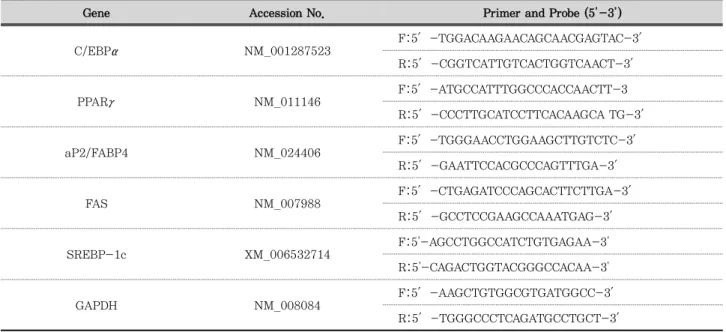
are shown in Table 1. The probe for xanthine
oxidoreductase (XOR), fluorescein amidite (FAM) dye,
was synthesized by Applied Biosystems. The expression levels of the genes of interest in each treated group were determined after normalizing levels to glyceraldehyde 3-phosphate dehydrogenase (GAPDH) expression as an
internal control by using comparative Ct, which is defined as the cycle number at which fluorescence became significantly higher than the background.
Gene Accession No. Primer and Probe (5’-3’)
C/EBPα NM_001287523
F:5′-TGGACAAGAACAGCAACGAGTAC-3′
R:5′-CGGTCATTGTCACTGGTCAACT-3′
PPARγ NM_011146
F:5′-ATGCCATTTGGCCCACCAACTT-3 R:5′-CCCTTGCATCCTTCACAAGCA TG-3′
aP2/FABP4 NM_024406
F:5′-TGGGAACCTGGAAGCTTGTCTC-3′
R:5′-GAATTCCACGCCCAGTTTGA-3′
FAS NM_007988
F:5′-CTGAGATCCCAGCACTTCTTGA-3′
R:5′-GCCTCCGAAGCCAAATGAG-3′
SREBP-1c XM_006532714
F:5'-AGCCTGGCCATCTGTGAGAA-3' R:5'-CAGACTGGTACGGGCCACAA-3'
GAPDH NM_008084
F:5′-AAGCTGTGGCGTGATGGCC-3′
R:5′-TGGGCCCTCAGATGCCTGCT-3′
Table 1. Primer Sequences Used in Real-time PCR Analysis.
9. Statistical analysis
Data are presented as the mean ± standard error of the mean (SEM). Statistical significance was determined using one-way analysis of variance (ANOVA) followed by Dunnett’s multiple comparison test. A difference of
p< 0.05 was considered to be statistically significant.
Ⅲ. Results
1. Effects of BS21 on body weight, body weight gain, food intake rate, and food efficiency ratio
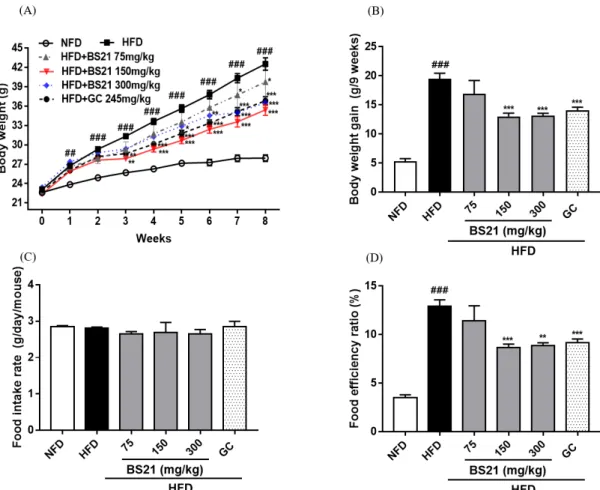
The body weight, weight gain, food intake, and food efficiency ratio are shown in Figure 1. The mean body weight increased with HFD feeding, and the weight gain of the HFD group was higher than in the NFD group.
The body weight gain of the HFD+BS21 groups (150 and 300 ㎎/㎏) and GC positive control group were significantly decreased compared with the HFD group (Fig. 1A and B). Food intake rate was not significantly different among the treated groups (Fig. 1C). The food efficiency ratio of the HFD group was higher than that of the NFD and HFD+BS21 groups (150 and 300 ㎎/㎏), and the GC group showed a statistically significant reduction in food efficiency ratio compared with the HFD group (Fig. 1D).
As shown in Fig. 2A, epididymal, perirenal, mesenteric, subcutaneous, and total WAT weights in the HFD group were increased compared with the NFD group. Epididymal and subcutaneous WAT weights were significantly reduced in the HFD+BS21 groups (150 and 300 ㎎/㎏). Perirenal and mesenteric WAT weight did not differ significantly among the HFD, HFD+BS21, and HFD+GC groups. Total WAT weight was significantly reduced in all HFD+BS21 groups and the HFD+GC group. Adipocyte size in the HFD group was significantly larger than in the NFD group, whereas it was considerably smaller in all HFD+BS21 groups and the HFD+GC group (Fig. 2B).
2. Effects of BS21 on plasma adipokine levels
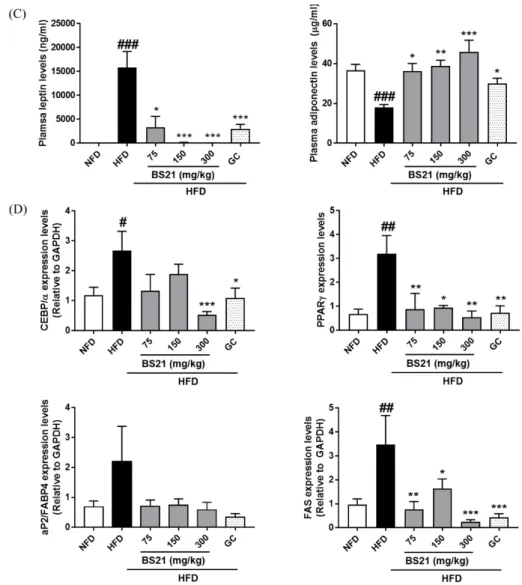
The mean plasma leptin level of the HFD group (15822.40 ± 3366.08 ng/㎖) was higher than that of the NFD group (2.02 ± 0.28 ng/㎖), but it was significantly lower in the HFD+BS21 groups (75 ㎎/㎏:
3326.81 ± 2296.40 ng/㎖; 150 ㎎/㎏: 128.286 ± 65.32 ng/㎖; 300 ㎎/㎏: 45.921 ± 28.74 ng/㎖) and the HFD+GC group (3024.61 ± 933.12 ng/㎖) (Fig. 2C).
Overall, plasma adiponectin levels in the HFD group
were decreased compared with the NFD group. In
addition, the adiponectin levels were significantly
increased in the HFD+BS21 groups and HFD+GC group
compared with the HFD group (Fig. 2C).
Fig. 1. Effects of BS21 on body weight, body weight gain, food intake, and food efficiency ratio in HFD-induced obese mice. (A) Body weight, (B) Body weight gain, (C) Food intake rate, and (D) Food efficiency ratio. BS21: mixture of P. pubescens leaves and S. baicalensis roots extracts at a ratio of 2:1; GC: Garcinia cambogia extracts; HFD: high-fat diet; NFD: normal-fat diet. Values are expressed as the mean ± SEM (n = 5). ##p < 0.01 and ###p < 0.001 vs. the NFD group; **p < 0.01 and ***p < 0.001 vs. the HFD group.
Fig. 2. Effects of BS21 on WATs weight, adipocyte size, adipokine levels, and adipogenesis-related gene expression in WAT in HFD- induced obese mice. (A) WATs weight, (B) Histology and adipocyte sizes of WAT, (C) Leptin and adiponectin levels, and (D) Adipogenesis- related genes (C/EBPα, PPARγ, aP2, and FAS) expression in WATs. The mRNA expression levels are expressed as the fold increase relative to the HFD group after normalization to GAPDH mRNA levels. EpiW: epididymal WAT; MesW: mesenteric WAT; PeriW: perirenal WAT; SubW: subcutaneous WAT; TotalW: EpiW+PeriW+MesW+SubW. BS21: mixture of P. pubescens leaves and S. baicalensis roots extracts at a ratio of 2:1; GC: Garcinia cambogia extracts; HFD: high-fat diet; NFD: normal-fat diet. Values are expressed as the mean
± SEM (n = 5). #p < 0.05, ##p < 0.01, and ###p < 0.001 vs. the NFD group; *p < 0.05, **p < 0.01, and ***p < 0.001 vs. the HFD group.
3. Effects of BS21 on biochemical plasma parameters
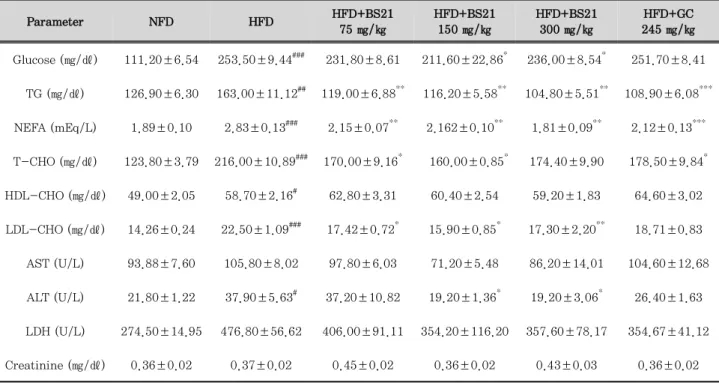
The effects of BS21 on biochemical plasma parameters are shown in Table 2. Plasma glucose, TG, NEFA, T-CHO, HDL-CHO, and LDL-CHO levels in the HFD group were higher than those of the NFD group.
Plasma glucose levels were significantly decreased in the HFD+BS21 groups (150 and 300 ㎎/㎏) compared with the HFD group. Plasma TG and NEFA levels were significantly reduced in all HFD+BS21 groups and the
HFD+GC group compared with HFD alone. T-CHO levels were decreased in the HFD+BS21 groups (75 and 150 ㎎/㎏) and the HFD+GC group compared with the HFD group. There were no differences in HDL-CHO levels among the groups except in the NFD group.
LDL-CHO levels were decreased in all HFD+BS21
groups compared with the HFD group. Plasma ALT
levels were increased in the HFD group, and the levels
were significantly lower in the HFD+BS21 groups (150
and 300 ㎎/㎏). There were no differences in plasma
AST, creatinine, and LDH levels among the six groups.
Parameter NFD HFD HFD+BS21 75 ㎎/㎏
HFD+BS21 150 ㎎/㎏
HFD+BS21 300 ㎎/㎏
HFD+GC 245 ㎎/㎏
Glucose (㎎/㎗) 111.20±6.54 253.50±9.44### 231.80±8.61 211.60±22.86* 236.00±8.54* 251.70±8.41
TG (㎎/㎗) 126.90±6.30 163.00±11.12## 119.00±6.88** 116.20±5.58** 104.80±5.51** 108.90±6.08***
NEFA (mEq/L) 1.89±0.10 2.83±0.13### 2.15±0.07** 2.162±0.10** 1.81±0.09** 2.12±0.13***
T-CHO (㎎/㎗) 123.80±3.79 216.00±10.89### 170.00±9.16* 160.00±0.85* 174.40±9.90 178.50±9.84*
HDL-CHO (㎎/㎗) 49.00±2.05 58.70±2.16# 62.80±3.31 60.40±2.54 59.20±1.83 64.60±3.02
LDL-CHO (㎎/㎗) 14.26±0.24 22.50±1.09### 17.42±0.72* 15.90±0.85* 17.30±2.20** 18.71±0.83
AST (U/L) 93.88±7.60 105.80±8.02 97.80±6.03 71.20±5.48 86.20±14.01 104.60±12.68
ALT (U/L) 21.80±1.22 37.90±5.63# 37.20±10.82 19.20±1.36* 19.20±3.06* 26.40±1.63
LDH (U/L) 274.50±14.95 476.80±56.62 406.00±91.11 354.20±116.20 357.60±78.17 354.67±41.12
Creatinine (㎎/㎗) 0.36±0.02 0.37±0.02 0.45±0.02 0.36±0.02 0.43±0.03 0.36±0.02
NFD: normal-fat diet; HFD: high-fat diet; BS21: mixture of P. pubescens leaves and S. baicalensis roots extract at a ratio of 2:1; GC:
Garcinia cambogia extracts. TG: triglyceride; NEFA: non-esterified fatty acid; T-CHO: total cholesterol; HDL-CHO: high-density lipoprotein-CHO; LDL-CHO: low-density lipoprotein-CHO; AST: aspartate aminotransferase; ALT: alanine transaminase; LDH: lactate dehydrogenase. Values are expressed as the mean ± SEM (n = 5). #p < 0.05, ##p < 0.01, and ###p < 0.001 vs. the NFD group; *p < 0.05,
**p < 0.01, and ***p < 0.001 vs. the HFD group.
Table 2. Effects Of BS21 on Plasma Biochemical Parameters in HFD-Induced Obese Mice.
4. Effects of BS21 on adipogenesis-related gene expression in WAT
To clarify the mechanism underlying the anti-obesity effect of BS21, we focused on the expression of adipogenesis-related genes. CCAAT/enhancer binding protein α (C/EBPα), peroxisome proliferator-activated receptor γ (PPARγ), adipocyte protein 2/fatty acid binding protein 4 (aP2/FABP4), and fatty acid synthase (FAS) mRNA levels were higher in the HFD group than the NFD group (Figure 2D). C/EBPα mRNA expression was significantly decreased in the HFD+300 ㎎/㎏ BS21 and HFD+GC groups. PPARγ and FAS mRNA expression levels in the HFD+BS21 groups and HFD+GC group were decreased compared with HFD mice. The aP2/FABP4 mRNA levels tended to decrease in the HFD+BS21 groups and the HFD+GC group, but these changes were not significant.
5. Effects of BS21 on liver weight and hepatic lipid accumulation
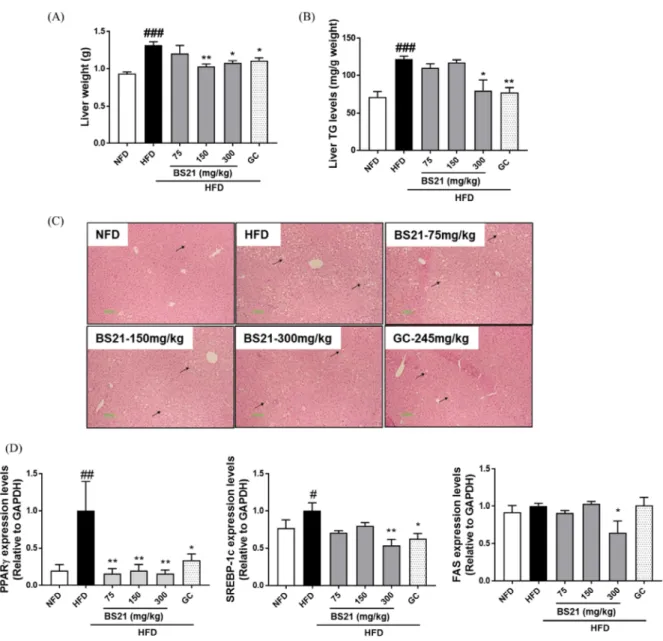
Liver weight in the HFD group was increased compared with the NFD group but was significantly decreased in the HFD+BS21 groups (150 and 300 ㎎/㎏) and HFD+GC group versus HFD mice (Fig. 3A). Lipid accumulation and TG levels in the livers of the HFD group were increased compared with the NFD group.
Notably, the HFD+300 ㎎/㎏ BS21 group and HFD+GC
group showed significantly lower liver lipid accumulation
and TG levels compared with the HFD group (Fig. 3B
and C).
Fig. 3. Effects of BS21 on liver weight, hepatic lipid accumulation, adipogenesis-related gene expression in liver in HFD-induced obese mice. (A) Liver weight, (B) Liver TG levels, (C) Liver histology, (D) Adipogenesis-related genes (PPARγ, SREBP-1c, and FAS) expression.
The mRNA expression levels are expressed as the fold increase relative to the HFD group after normalization to GAPDH mRNA levels.
NFD: normal-fat diet; HFD: high-fat diet; BS21: mixture of P. pubescens leaves and S. baicalensis roots extracts at a ratio of 2:1; GC:
Garcinia cambogia extracts. Values are expressed as mean ± SEM (n = 5). #p < 0.05, ##p < 0.01, and ###p < 0.001 vs. the NFD group;
*p < 0.05 and **p < 0.01 vs. the HFD group.
6. Effects of BS21 on adipogenesis-related gene expression in the liver
PPARγ and sterol regulatory element binding protein (SREBP)-1c mRNA expression levels were increased in the HFD group compared with the NFD group (Fig.
3D). PPARγ mRNA expression levels were significantly decreased in the HFD+three BS21 groups and HFD+GC group. SREBP-1c mRNA levels in the HFD+300 ㎎/㎏
BS21 group and HFD+GC group were decreased compared with the HFD group. FAS mRNA expression levels in the HFD+300 ㎎/㎏ BS21 group were decreased compared with the HFD group.
7. Effects of BS21 on plasma and hepatic uric acid levels and XOR gene expression
Based on reports that visceral fat mass is positively associated with serum uric acid levels and uric acid clearance is reduced in obese subjects compared with non-obese subjects
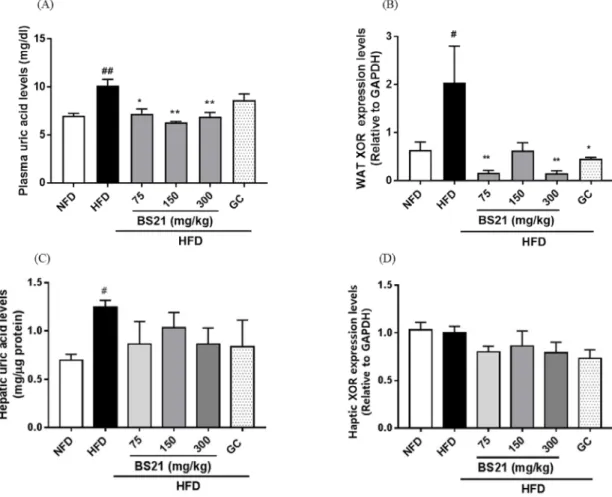
18-20), we investigated whether BS21 could reduce plasma uric acid levels in HFD-induced obese mice. Plasma uric acid levels were increased in the HFD group compared with the NFD group. All three HFD+BS21 groups showed decreased plasma uric acid levels compared with the HFD group (Fig. 4A).
XOR mRNA levels were increased in the HFD groups
versus the NFD group, whereas it was decreased in the HFD+BS21 groups (75 and 300 ㎎/㎏) and HFD+GC group compared with the HFD group (Fig. 4B). BS21
showed a tendency to decrease hepatic XOR mRNA expression and uric acid levels, but the differences were not significant (Fig. 4C and D).
Fig. 4. Effects of BS21 on plasma and hepatic uric acid levels and XOR gene expression. (A) Plasma uric acid levels, (B) WAT XOR gene expression, (C) Hepatic uric acid levels, and (D) Hepatic XOR gene expression. The mRNA expression levels are expressed as the fold increase relative to the HFD group after normalization to GAPDH mRNA levels. BS21: mixture of P. pubescens leaves and S. baicalensis roots extracts at a ratio of 2:1; GC: Garcinia cambogia extracts; HFD: high-fat diet; NFD: normal-fat diet. Values are expressed as the mean ± SEM (n = 5). #p < 0.05 and ##p < 0.01 vs. the NFD group; *p < 0.05 and **p < 0.01 vs. the HFD group.