• 검색 결과가 없습니다.

A Study of Compound Changes in Coffee Beans by Different Roasting Condition

N/A
N/A
Protected

Academic year: 2021

Share "A Study of Compound Changes in Coffee Beans by Different Roasting Condition"

Copied!
6
0
0

로드 중.... (전체 텍스트 보기)

전체 글

(1)

Culinary Science & Hospitality Research. 2016;22(6):114-119.

https://cshr.jams.or.kr/ ISSN  2466‐0752  (Print)

ISSN  2466‐1023  (Online)

A Study of Compound Changes in Coffee Beans by Different Roasting Condition

Jae Chul Lee

Division of Hotel Culinary Arts Foodservice, Hyejeon College, Korea

ABSTRACT: This study aimed to investigate changes in the diverse compound in coffee beans under different roasting conditions. Four different kinds of chemical characteristics (phenolic contents, flavonoid contents, chlorogenic acid, and caffeine) were analyzed. According to the temperature of coffee roasting, this study categorized green bean, extract A (191℃), B (202℃), C (220℃), and D (233℃). As a result, total phenol compound showed low level of total phenol compound at lower temperatures. Extract A showed significantly higher level of total flavonoid (111.33±10.14), green bean showed 83.67±2.43, Extract B 46.11±

2.38, C and D showed 31.44±0.12, 19.22±0.46 respectively. Green bean showed higher level of chlorogenic acid (64.47±0.51), Extract A (39.66±0.47), extract B (12.45±0.99), C, D (3.59±0.31, 0.63±0.12) respectively. This study also noted that there are significant different in terms of caffeine content. Extract A has higher level of caffeine content (38.45±1.70) significantly, green bean (27.14±2.27), extract B (18.95±0.64), extract C (17.89±0.96). As a conclusion, we revealed that roasting conditions play an important role in the composi- tion of coffee compounds.

Keywords: coffee green beans, coffee roasting, phenolic contents, flavonoid contents, chlorogenic acid, and caffeine

¶ Corresponding Author: Jae Chul Lee, Division of Hotel Culinary Arts Foodservice, Hyejeon College, Korea, 25, Daehak-gil, Hongsung-eup, Hongsung-gun. Chungcheongnam-do, 32244, Korea. Tel. +82-10-5423-8123 E-mail: [email protected]

INTRODUCTION

The quality of our modern life has been increasing due to rapid economic growth and expanded leisure time. Also, lifestyle changes have also had an effect on the trend increasing total amount of coffee im- port[1]. Coffee is introduced in the country, esti- mated at around 1890[2]. The etymological origin of the legendary Kappa (kaffaa) of Ethiopia for the word (coffee) coffee[3]. Coffee is one of the most popular beverages in the world, containing its unique flavor[4]. As one of the world's most traded products- second in value only to oil-the coffee industry em- ploys millions of people around the world through its growing, processing and trading[5]. But while the coffee trade is vital to the politics, survival and

economies of many developing nations, the industry's pricing and futures are decided in conference rooms and on stock exchange floors in some of the world's wealthiest cities[4,5]. Not everywhere is suitable for coffee to grow, the place where coffee can be plant- ed is tropical and subtropical zone. The natural condi- tion the coffee need is calm wind, warm cool, shade and moist. So, the zone nearby the equator between 25°S and 25°N is the best place for coffee growth, called coffee belt or coffee zone. Coffee is originated in Africa, the coffee arabica is native to the tropical high altitude area between 900 meter and 1,800 me- ter of Ethiopia, the average annual temperature is 19

℃[5]. The coffee robusta is native to the tropical rain

forest area at an altitude below 900 meter, the aver-

age annual temperature of there is 21∼26℃. These

(2)

country of origins are shade or half shade rain forest and river valley area decide the coffee growth need calm wind, shade, warm cool and moist condition[4].

The Swedish botanist Carolus Linnaeus (1707∼

1778) was the first to described the coffee genus in his publication “Species Plantarum”, which he pub- lished in 1753. Carolus Linnaeus classified the coffee tree as belonging to the botanical family Rubiaceae (more commonly called the Madder family) which has some 500 genera and over 6,000 species[5]. Coffee is a mixture of chemical compounds which are either occurring or formed during the roasting process.

Green coffee beans contain several phenolic com- pounds[6]. The chlorogenic acids are esters formed between quinic acid and cinnamic acids such as caf- feic, ferulic and pcoumaric acid[7,8]. During roasting, coffee beans are heated at 200∼240℃ depending on the degree of roasting (light, medium, and dark roasted coffee)[9]. The beans change their color with the temperature increase and their density de- creases due to the volume increase of the beans.

The chemical composition of the beans is modified and hundreds of chemicals which give coffee’s aroma and taste are formed. Roasting is responsible for a decrease in the content of protein, aminoacids, chlo- rogenic acid and for the increase in volatile com- pounds and melanoidins formation[6].

Among the many processes that coffee undergoes, from the seed to the cup, roasting is undoubtedly crucial[4]. A green coffee bean contains all necessary ingredients for the development of its flavor. During roasting, coffee beans are heated at 200∼240℃ de- pending on the degree of roasting (light, medium, and dark roasted coffee). The beans change their col- or with the temperature increase and their density decreases due to the volume increase of the beans.

The chemical composition of the beans is modified and hundreds of chemicals which give coffee’s ar- oma and taste are formed. Roasting is responsible for a decrease in the content of protein, amino acids, chlorogenic acid and for the increase in volatile com- pounds and melanoidins formation[10]. Chlorogenic acids are degraded proportional with theroasting degree; the loss is higher in dark roasted coffee.

Degradation of chlorogenic acids leads to quinic acid and to others phenols found in coffee’s ar- oma[11,12]. However scientific approach concerning

the contents in coffee beans cannot be found, only few papers about composition in coffee being avail- able[13]. Therefore, this study aimed to investigate changes in the diverse compound in coffee beans under different roasting conditions.

MATERIALS

Guatemala Antigua SHB (Strictly Hard Bean) s were roasted in a at 191℃, 202℃, 220℃ and 233℃. to give light, medium and dark coffee samples. The water content of sample were average 11.1% using by moi- sture meter and 500 g beans were used for each samples. To determine related compounds in the or- dinary coffee liquid that is normally consumed, the following methods were employed.

Roasting machine was a gas type, semi direct type, semi hot air type (model THCR-01, Taehwan Auto- matic Company Co., Ltd.). At input roasting temper- ature of 200℃, coffee beans were roasted. Exhaust temperature was 191℃ (Extract A), 202℃ (Extract B), 220℃ (Extract C), and 233℃ (Extract D), The beans weigh 450 g (Extract A), 430 g (Extract B), 415 g (Ex- tract C), and 390 g (Extract D). First crack was same to 190℃. Agtron/scaa 85∼95 (Extract A), 65∼75 (Ex- tract B), 55∼45 (Extract C), 35∼25 (Extract D). were recorded (Table 1).

The research during July 22

nd

to August 11

st

sent the samples twice to Korea Basic Science Institute for analysis. Among the data of effective component content in the sample, total phenolic content, total flavonoid content, Chlorogenic acid, Caffein were analysed using UV/Visable Spectrophotometer (Ultro- spec 5300 pro, GE healthcare), HPLC (Agilent Techno- logies 1290 Infinity), ands [TCC-G1316C, DAD-G- 4212A, Bin Pump-G4220A, Sampler-G4226A]. To see total phenolic contents, gallic acid (0, 40, 80, 120, 160, 200 μg/mL) were used as a standard. For total flavonoid contents, catechin (0, 1, 5, 10, 20, 50, 100 μg/mL) were used as a standard. Using HPLC, Chlorogenic acid and caffein were analysed with Zorbax SB-C18 (2.1×150 mm, 1.8 μ, Agilent) at 30℃

Column Temperature.

Using SPSS 20.0 program. ANOVA was used to see

the mean differences among for characteristics such

as total phenolic content, total flavonoid content,

Chlorogenic acid, and Caffein. As a post-hoc test,

(3)

Table 1. Characteristics of materials

Exhaust temperature (℃) Beans weight (g) First crack (℃) Agtron/scaa (NO)

Green bean 500

Extract A 191 450 190 85∼95

Extract B 202 430 190 65∼75

Extract C 220 415 190 55∼45

Extract D 233 390 190 35∼25

this study employed Duncan's multiple range test (p

<0.05).

RESULTS & DISCUSSION

According to roasting duration time, extract A showed significantly higher level of total phenolic contents (132.40±7.48) followed by green bean (86.27

±0.32), Extract B (60.47±2.51), Extract C (48.67±1.31), Extract D (33.87±0.11), respectively (Table 2). Bar graph (Figure 1) of the total phenolic contents shows that beans roasting at low level of temperature have high- er level of total phenolic contents significantly (p<

0.001). Previous study reported that phenolic hydroxyl (OH) can combine with protein and activate biological activity such as antioxidation, anticancer, and anti- bacterial function[14]. Farah A, Donangelo CM (2006) also reported that total phenolic contents were mo- derately increased and decreased again[15].

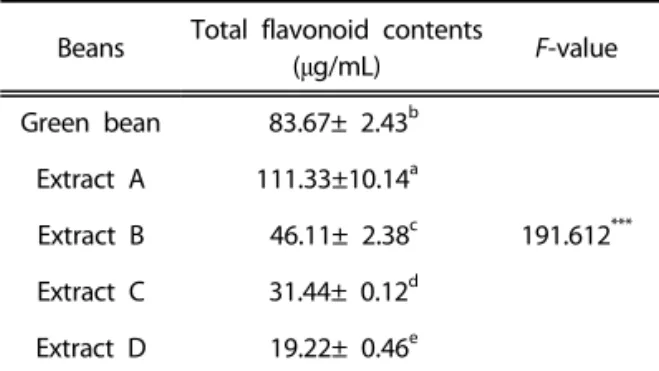
Table 3 showed that Total flavonoid content of

Table 2. Total phenolic content of roasted coffee by different roasting condition Mean±S.D.

Beans Total phenolic contents

(μg/mL) F-value

Green bean 86.27±0.32

b

350.107

***

Extract A 132.40±7.48

a

Extract B 60.47±2.51

c

Extract C 48.67±1.31

d

Extract D 33.87±0.11

e

1)

***

p<0.001.

2)

a∼e

Means in a column are significantly different at the p<0.05 level by Duncan’s multiple range.

3) Extract A:, Extract B:, Extract C:, Extract D:.

Figure 1. Total phenolic content of roasted coffee by different roasting condition.

roasted coffee by different roasting condition. Extract A (111.33±10.14) showed highest level of total fla- vonoid contents (μg/mL), followed by green bean (83.67±2.43), Extract B (46.11±2.38), Extract C (31.44

±0.12), Extract D (19.22±0.46), respectively (Table 3).

Bar graph (Figure 2) displayed a similar shape with the result of total flavonoid content. This result show-

Table 3. Total phenolic content of roasted coffee by different roasting condition Mean±S.D.

Beans Total flavonoid contents

(μg/mL) F-value

Green bean 83.67± 2.43

b

191.612

***

Extract A 111.33±10.14

a

Extract B 46.11± 2.38

c

Extract C 31.44± 0.12

d

Extract D 19.22± 0.46

e

1)

***

p<0.001.

2)

a∼e

Means in a column are significantly different at the p<0.05 level by Duncan’s multiple range.

3) Extract A:, Extract B:, Extract C:, Extract D:.

(4)

Figure 2. Total flavonoid content of roasted coffee by different roasting condition.

ed accordance of previous research[16].

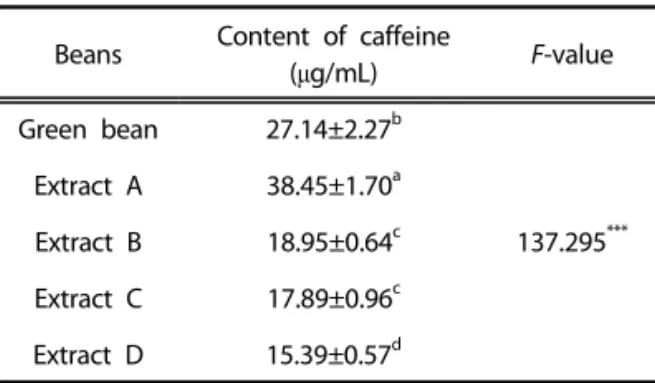
According to caffeine content of roasted coffee, Extract A showed significantly higher level of con- tent of caffeine (38.45±1.70) followed by green bean (27.14±2.27), Extract B (18.95±0.64), Extract C (17.89

±0.96), Extract D (15.39±0.57), respectively (Table 4).

Bar graph (Figure 3) of the caffeine contents shows that beans roasting at low level of temperature have higher level of caffeine contents significantly (p<

0.001). The literature suggests that the following ef- fects on behavior of adult humans may occur when individuals consume moderate amounts of caffeine.

Caffeine increases alertness and reduces fatigue[17].

Caffeine improves performance on vigilance tasks and simple tasks that require sustained response. Effects on more complex tasks are difficult to assess and pro- bably involve interactions between the caffeine and other variables which increase alertness (e.g. person- ality and time of day).

Table 4. Caffeine content of roasted coffee by differ-

ent roasting condition Mean±S.D.

Beans Content of caffeine

(μg/mL) F-value

Green bean 27.14±2.27

b

137.295

***

Extract A 38.45±1.70

a

Extract B 18.95±0.64

c

Extract C 17.89±0.96

c

Extract D 15.39±0.57

d

1)

***

p<0.001.

2)

a∼e

Means in a column are significantly different at the p<0.05 level by Duncan’s multiple range 3) Extract A:, Extract B:, Extract C:, Extract D:.

Figure 3. Caffeine content of roasted coffee by differ- ent roasting condition.

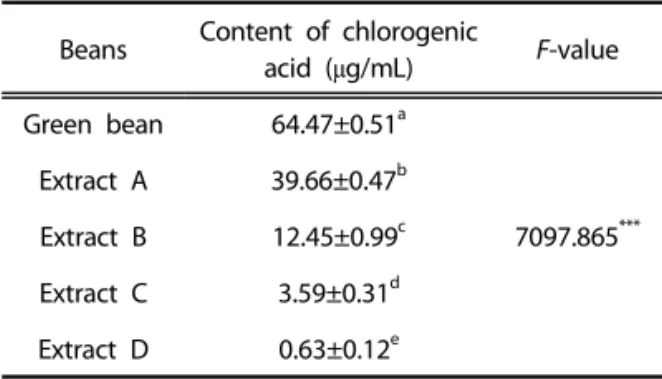
Chlorogenic acid content of different roasting le- vel of coffee beansis presented in Table 5 and Figure 4. Chlorogenic acid content of brews significantly decreased with the increase of roasting degree, at all roasting temperatures. Chlorogenic acids (CGA) are cinnamic acid derivatives with biological effects mostly related to their antioxidant and antiinfla- mmatory activities. Chlorogenic acid is a phytoche- mical found in coffee and coffee beans. It has been touted as being able to reduce blood sugar levels and potentially exert an anti-diabetic effect. It has also been implicated in weight loss and exerting an anti-obesity effect, but that is insofar correlation and not necessarily due to chlorogenic acid. It can be beneficial to supplement, although doses found in food sources are enough for a long-term preventative (anti-diabetic) measure[7,9].

SUMMARY AND CONCLUSIONS

According to roasting duration time, extract A showed significantly higher level of total phenolic contents (132.40±7.48) followed by green bean (86.27

±0.32), Extract B (60.47±2.51), Extract C (48.67±1.31), Extract D (33.87±0.11), respectively. Bar graph of the total phenolic contents shows that beans roasting at low level of temperature have higher level of total phenolic contents significantly (p<0.001). Total flavo- noid content of roasted coffee by different roasting condition. Extract A (111.33±10.14) showed highest level of total flavonoid contents (μg/mL), followed by green bean (83.67±2.43), Extract B (46.11±2.38), Extract C (31.44±0.12), Extract D (19.22±0.46), respec- tively.

The results displayed a similar with the result of

total flavonoid content. According to caffeine con-

(5)

tent of roasted coffee, Extract A showed significantly higher level of content of caffeine (38.45±1.70) fol- lowed by green bean (27.14±2.27), Extract B (18.95±

0.64), Extract C (17.89±0.96), Extract D (15.39±0.57), respectively (Table 4). Bar graph (Figure 3) of the ca- ffeine contents shows that beans roasting at low le- vel of temperature have higher level of caffeine con- tents significantly (p<0.001). The literature suggests that the following effects on behavior of adult hu- mans may occur when individuals consume moder- ate amounts of caffeine. Caffeine increases alertness and reduces fatigue. Caffeine improves performance on vigilance tasks and simple tasks that require sus- tained response. Effects on more complex tasks are difficult to assess and probably involve interactions between the caffeine and other variables which in- crease alertness (e.g. personality and time of day).

Chlorogenic acid content of different roasting le- vel of coffee beansis presented in Table 5 and Figure 4. Chlorogenic acid content of brews significantly decreased with the increase of roasting degree, at all roasting temperatures. Chlorogenic acids (CGA) are cinnamic acid derivatives with biological effects mostly related to their antioxidant and antiinfla- mmatory activities. Chlorogenic acid is a phytoche- mical found in coffee and coffee beans. It has been touted as being able to reduce blood sugar levels and potentially exert an anti-diabetic effect. It has also been implicated in weight loss and exerting an anti-obesity effect, but that is insofar correlation and not necessarily due to chlorogenic acid. It can be be-

Table 5. Total phenolic content of roasted coffee by different roasting condition Mean±S.D.

Beans Content of chlorogenic

acid (μg/mL) F-value Green bean 64.47±0.51

a

7097.865

***

Extract A 39.66±0.47

b

Extract B 12.45±0.99

c

Extract C 3.59±0.31

d

Extract D 0.63±0.12

e

1)

***

p<0.001.

2)

a∼e

Means in a column are significantly different at the p<0.05 level by Duncan’s multiple range.

3) Extract A:, Extract B:, Extract C:, Extract D:.

Figure 4. Chlorogenic acid content of roasted coffee by different roasting condition.

neficial to supplement, although doses found in food sources are enough for a long-term preventative (anti- diabetic) measure.

In conclusion, phenol compound content showed significantly high level in Extract A (132.40±7.48), to- tal flavonoid content also showed highest level in Extract A (111.33±10.14). For caffeine content, extract A showed highest level (38.45±1.70) and green bean has significant higher level of chlorogenic acid (64.47

±0.51).

ACKNOWLEDGEMENT

This research was supported by research support grant of Hyejeon College.

REFERENCES

[1] Lee SH (2015). The impact of coffee barista jab stress on job satisfaction and organizational lo- yalty. Korea J Culinary Res 21(6):91-102.

[2] Jin YH (1999). A study on the present condition of the coffee and vision of 21C in Korea. Korea J Culinary Res 5(2):5-24.

[3] Min KH(2009). A study on the education for em- ployees in coffee restaurants from employers`

viewpoint. Korea J Culinary Res 15(3):271-283.

[4] Seo JW (2013). Coffee Bible. Daewangsa Publi- shing Co. Kyunggi.

[5] Lee JC (2013). Introduction of New Food & Beve- rage. Baesan Publishing Co. Kyunggi.

[6] Kim KJ, Park SK (2006). Changes in major chem- ical constuents of green coffee beans during the roasting. Korean J Food Culture 38(2):153-158.

[7] Clarke RJ, Macrae R (1887). Coffee Vol. 1: Chemi-

(6)

stry. Elsevier Applied Science Publishers Ltd., p.

223-262.

[8] Halliwell B, Aeschbach R, Loliger J, Aruoma OI (1995). The characterization of antioxidants. Food Chem Toxicol 33:601-617.

[9] Feldman JR, Ryder WS, Kung JT (1969). Impor- tance of non-volatile compounds to the flavor of coffee. J Agric Food Chem 17:733-739.

[10] Macdonald IA, Macrae R (1985). The determina- tion of amino acids in coffee products. Proc ASIC, Berlin, Germany. p. 333-340.

[11] Newton JM (1979). Spectrophotometric deterim- nation of caffeine in coffee products. J Assoc Anal Chem 62:705-708.

[12] Moon JW, Cho JS (1999). Changes in flavor char- acteristics and shelf-life of roasted coffee in dif- ferent packaging conditions during storage.

Korean J Food Sci and Tech 31(2):441-447.

[13] Imai J, Ide N, Nagae S, Moriguchi T, Matsuura H, Itakura Y (1994). Antioxidant and radical sca-

venging effects of aged garlic extract and its constituents. Plant Med 60:417-420.

[14] Rice-Evans CA, Miller NJ, Paganga G (1997). An- tioxidant properties of phenolic compounds.

Trends Plant Sci 2:152-159.

[15] Farah A, Donangelo CM (2006). Phenolic com- pound in coffee. Braz J Plant Physiol 18:23-26.

[16] Rice-Evans CA, Miller NJ, Paganga G (1996), St- ructure antioxident activity relationship of fla- vonoids and phenolic acids. Free Radical Biol Med 20:933-956.

[17] Chen JH, Ho CT (1997). Antioxidant activities of caffeic acid and its related hydroxycinnamic acid compounds. J Agric Food Chem 45:2374-2378.

Received: 12 September, 2016

Revised: 21 September, 2016

Accepted: 26 September, 2016

수치

Figure 1. Total phenolic content of roasted coffee by  different roasting condition.
Figure 3. Caffeine content of roasted coffee by differ- differ-ent roasting condition.
Figure 4. Chlorogenic acid content of roasted coffee  by different roasting condition.

참조

관련 문서

Optimizing Arabica coffee production systems in Rwanda: a multiple-scale analysis.. In-depth Study on Analysis of Value Chain for Intensified Crops and

광고 없음: Google은 G Suite 서비스에 있는 데이터를 광고 목적으로 수집, 검사, 사용하지 않으며 G Suite에도 광고를 게 재하지 않습니다.. 30 minutes per week of

If there are no results in each case, then your query result is identical to the answer query result, and therefore your query is correct (or at least, it is good enough that

그린마운틴커피(Green Mountain Coffee), 맥스웰하우스(Maxwell house), 글로리아진스(Gloria Jeans) 등의 브랜드가 유명한 것으로 알고

북동류형 호우 시스템에서 순전(Veering)은 지상에서 대류권계면까지 나타난다.. 따라서 온대저기압의 발달과 경로를

구름이 만들어지고 강수과정이 나타나는 지구 대류권에서 기화열은 융해열보다 중요하게 다루어진다... 지표부근 대기에서는 등온선과

Johnson, 1979: The coupling of upper and lower tropospheric jet streaks and implications for the development of severe convective storms...

52 Sheet resistance and carrier mobility of the spin-coated Al substrates by using PTFE or PTFE/CNT powder with a different CNT contents · ·